## Part 2: A Hidden Legal Protection Exposes My Son’s Elaborate Property Fraud
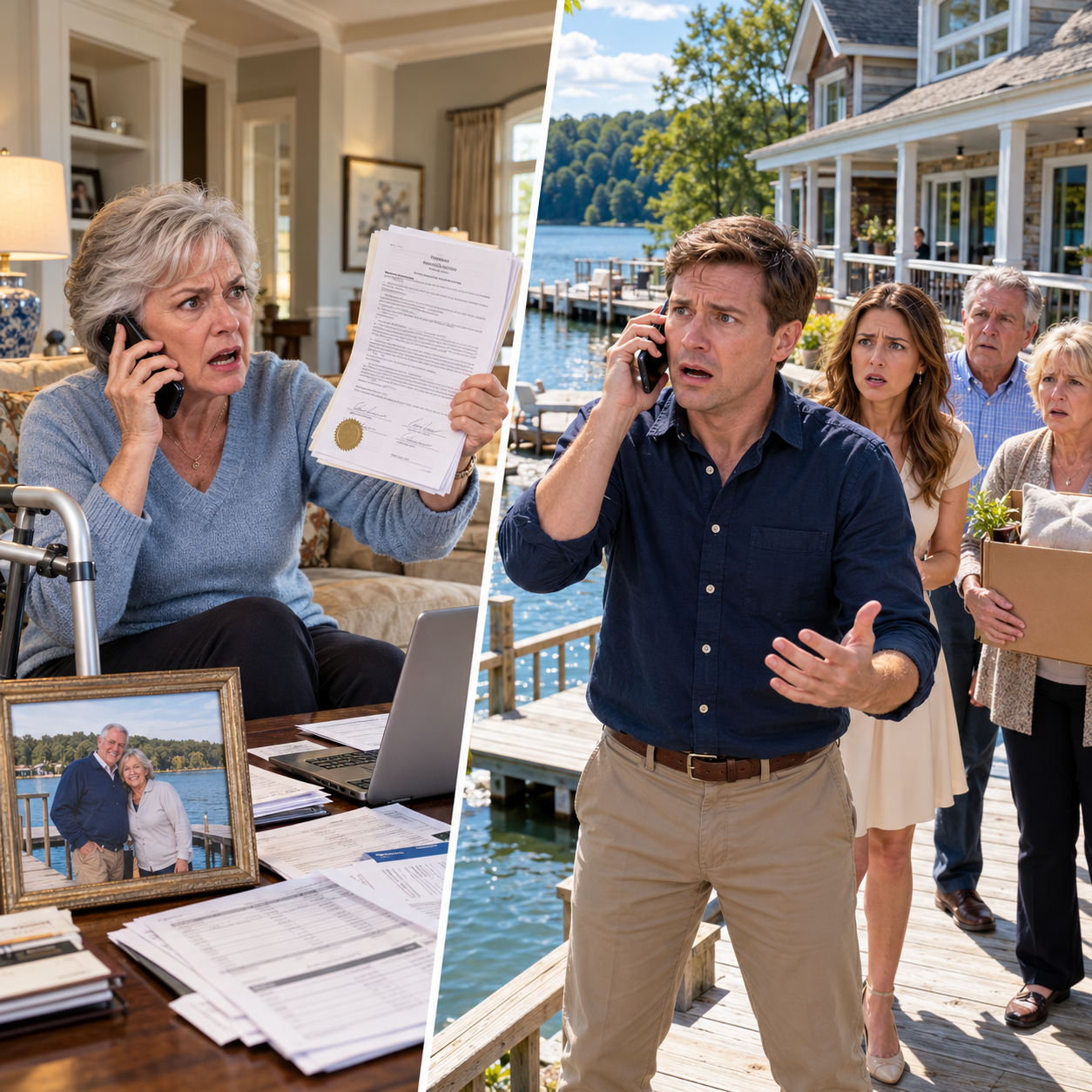
Caroline answered after the second ring, and I told her what Travis had done while spreading the documents across my coffee table. Two years earlier, before traveling to Scotland with my friend Rosalind, I had granted Travis a general power of attorney to handle personal financial emergencies while I was overseas. I had never formally revoked it, believing my son would use it only if I genuinely needed help. “He used that document to sign the deed,” I told her, “but he doesn’t know what we did last February.”
Caroline went quiet, then asked me to read the recording date aloud. Eight months earlier, after Travis began making unusually persistent inquiries about the lake house’s value, Caroline had advised me to place it into a limited liability company. We created Hartwell Legacy Properties LLC, transferred the house into its ownership, and registered me as its sole managing member. My old personal power of attorney gave Travis no authority to transfer a property owned by that company.
“His deed doesn’t establish ownership,” Caroline said. “He attempted to transfer something you no longer held in your personal name.” I heard her keyboard clicking as she retrieved the corporate records, then she added, “And the credit-line charges raise an entirely different problem.” I pressed my fingertips together, the way Gerald always had when concentrating, and asked whether we could recover my property without dragging two unsuspecting elderly people through months of litigation.
“We’ll move quickly,” she said. “But we’ll do this properly, Beverly. We document the fraud, notify the county, and coordinate any removal through lawful procedures.” I looked toward my laptop, remembering the smart-home system Gerald had installed shortly before his death. He had loved technology, especially the ability to monitor the house during long absences, and I still possessed the administrative credentials he had carefully stored in our fireproof safe.
I opened the property dashboard and watched the live status indicators appear. Two unfamiliar phones were connected to the internet, the heating system was running, and the dock lights were glowing above the water. I could picture Patricia settling into my porch chair with her evening tea while her husband watched television in the living room where Gerald and I had celebrated our last Christmas together. For six weeks, strangers had been living inside my memories, apparently believing everything belonged to them.
I canceled the guest network, replaced the administrative credentials, and revoked Travis’s access to the security and lock systems. I disabled the automated climate schedule and briefly closed the remote water valve before the thought of two unsuspecting people inside the house made me stop. I restored their essential utilities, leaving the heating at a safe setting, but every privilege Travis had enjoyed as an authorized family guest was finished. Nobody would be trapped inside, and nobody would be endangered, but my son would no longer control a single system in that house.
Within an hour, his messages began arriving. “Mom, what’s the new Wi-Fi password?” became “Why can’t anybody change the thermostat?” and eventually, “I can’t get into the property controls. What have you done?” I placed the phone facedown, warmed Diane’s casserole, and ate at my kitchen table. For the first time since the surgery, I felt capable of doing something besides waiting for my son to remember me.
Caroline met me the next morning with an organized file containing the corporate ownership documents, disputed deed, credit statements, and photographs Kelsey had publicly posted online. One picture showed Patricia smiling on my screened porch beneath a caption announcing that her hardworking son-in-law had made her retirement dream possible. Another showed her father, Gerald Sterling, fishing from the newly repaired dock. The words beneath the photographs stopped me cold: “This view belongs to them now. Blessed family forever home.”
“Does Kelsey know you never agreed to this?” Caroline asked. I shook my head, studying the photographs again. Kelsey was smiling beside her parents, Travis had his arm around her shoulders, and everyone looked delighted. Not one person had thought to call the woman who actually owned the property.
Caroline prepared formal notices, contacted the appropriate county offices in Georgia, and arranged for the Hart County Sheriff’s Office to be present while the disputed ownership documents were reviewed. She also contacted the Sterlings, explaining the ownership dispute and giving them an opportunity to leave voluntarily rather than face a formal possession action. By then, Travis had called me fifty-three times, and his messages had changed from irritation to panic. He had discovered that the door codes he once used freely no longer worked for him, and he was demanding an explanation.
Two days later, Caroline accompanied me on a carefully arranged trip from Charlotte to Atlanta, followed by a drive northeast toward Lake Hartwell. I watched the familiar pine forests slide past the car windows, gripping my walker whenever we rounded a curve. At the end of my driveway stood two sheriff’s vehicles, while Patricia and Gerald Sterling sat in portable chairs on the lawn, looking bewildered. Travis was on the porch in a jacket and wrinkled pajama pants, repeatedly pressing buttons on a keypad that would no longer recognize him.
He turned when he heard my walker scrape across the gravel. His eyes widened at the sight of Caroline carrying a leather portfolio, and he glanced toward the deputies as though suddenly noticing how many witnesses had gathered. “Mom, what is this?” he demanded, coming down the steps. I stopped a few feet away, looked directly into his face, and answered, “This is what happens when you confuse your mother’s love with permission.”
## Part 3: One Recorded Deed Destroys My Son’s Carefully Constructed Lie
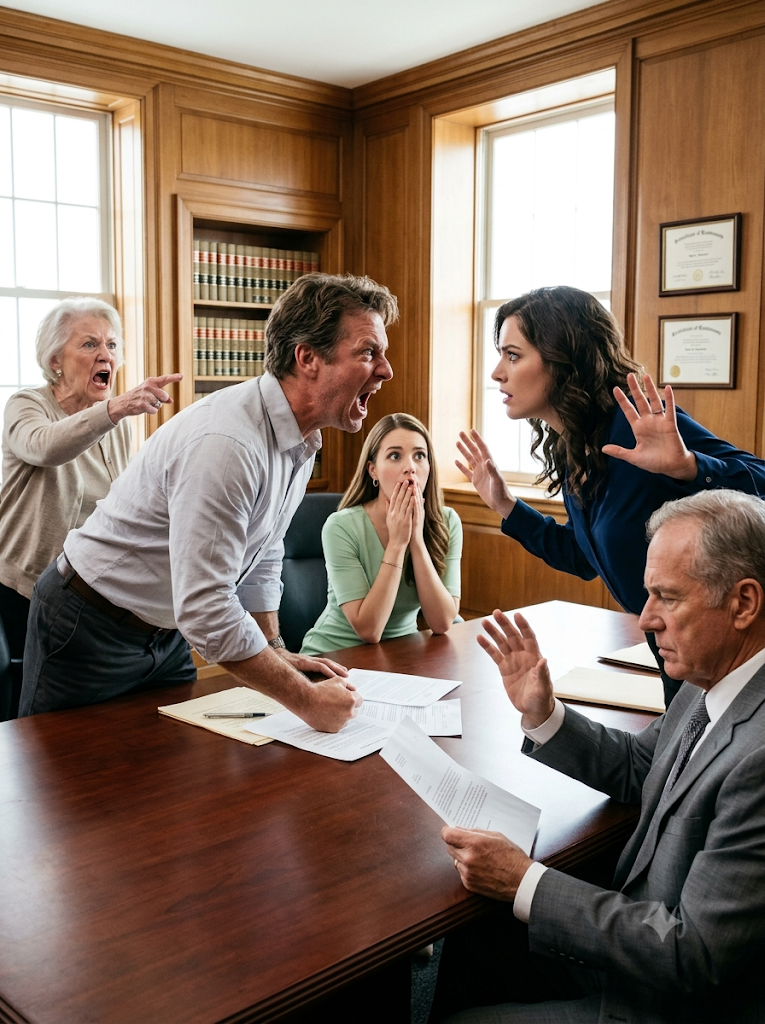
Travis looked from me to Caroline, then toward the sheriff’s deputies waiting beside their vehicles. “I have a deed,” he said, pulling a folded paper from his jacket pocket. “It’s recorded with the county. You signed a power of attorney, Mom, and that gave me the authority to handle the property.” He thrust the document toward the lead deputy with the desperate confidence of a man who believed official paper could turn a lie into truth.
Caroline opened her portfolio and placed another set of documents beside his. “Eight months before your deed was recorded, the property was legally transferred to Hartwell Legacy Properties LLC,” she explained. “Your mother’s personal power of attorney does not authorize you to convey an asset owned by a separate company.” She pointed to the recorded transfer, then to my name as the company’s sole managing member. “You had no authority to execute this transaction, Mr. Hayes, and we have formally challenged the recording.”
Travis stared at the pages. “That’s impossible,” he whispered. “It’s public record,” Caroline replied. “You could have discovered it before you signed anything.” His face lost its color, and he looked at me with an expression I had once seen across an examination desk when a businessman realized the documents in front of me contained the truth he had spent months concealing.
Kelsey removed her sunglasses and stepped off the porch. “Travis, you told me your mother had agreed to give you the property,” she said, her voice becoming sharper with every word. “You said she wanted my parents to have somewhere permanent to live.” He opened his mouth but said nothing, and that silence seemed to answer questions she had never thought to ask.
Then Gerald Sterling rose from his lawn chair. He was sixty-eight, heavyset, and wearing a faded volunteer’s cap, but he crossed the grass with a determination that made everyone turn toward him. “You told us you bought this house,” he said to Travis. “You sat at our kitchen table in Nashville and told Patricia and me that you’d purchased it for our retirement. We sold our home because you promised we’d never have to move again.”
Patricia covered her mouth, her eyes filling with tears. “We thought Beverly knew,” she whispered. “We thought she wanted us here.” I looked at the woman sitting in my chair, wearing a sweater she had probably unpacked with the expectation of growing old beside that lake. Until that moment, I had assumed she and her husband were willing participants in my son’s betrayal.
Travis rubbed both hands over his face. “I was going to fix everything,” he said. “I planned to refinance our house and pay Mom for the lake property. I just needed a little time.” I met his eyes. “With what equity, Travis? You’re already behind on the mortgage, and you used my emergency credit line to pay for renovations here.” He stared at the driveway, unable to deny either statement.
“Mom, please,” he whispered. “You can’t throw Patricia and Gerald out. They don’t have anywhere else.” I looked toward his in-laws, then back at him. “They didn’t create this deception,” I said. “You did. And you had opportunities to tell the truth before they sold their home, before the contractors arrived, and before I went into surgery.”
Caroline explained the ownership documentation and the formal process available if the Sterlings refused to leave. Gerald Sterling listened without interrupting, then slowly turned toward Patricia and said, “We’re going, Patty. I won’t spend another night in a house somebody lied to us about.” The deputies agreed to remain while the couple collected essential belongings, and Caroline arranged for the rest to be retrieved through a local property manager later that week. Patricia stood and began walking toward the porch, wiping her eyes with a folded tissue.
Before Travis could follow her, I reached into my bag and removed another document. Caroline had prepared a repayment agreement totaling $47,000, covering the $38,000 charged to the credit line and $9,000 in disputed property expenses that Travis agreed to reimburse as part of our settlement. It established a payment schedule and made clear that he would surrender every claimed interest in the house. “Read it,” I said, placing the pages against the hood of his truck.
He scanned the amount, then looked up at me. “You’re treating me like a criminal.” I felt the full weight of that sentence, remembering the boy who had once fallen off his bicycle and run crying into my arms. “You used my trust to take my home,” I answered. “You forged a transfer you had no authority to make, spent money that wasn’t yours, and let two older people build their future around your lies.”
Caroline explained that signing the agreement would not erase the disputed deed or prevent authorities from reviewing what had happened. It would, however, establish his personal responsibility for the financial damage and avoid another fight over whether he owed me the money. Travis looked at the pen for a long moment, then signed the pages one by one. His hand shook on the final signature, and for the first time that morning, I saw something in his face that resembled shame.
Patricia and Gerald Sterling emerged carrying two small suitcases and several cardboard boxes. Patricia paused beside me, holding a framed family photograph against her chest. “I’m sorry, Beverly,” she said. “If I’d known what he was doing, I never would have crossed your doorway.” I touched her arm and told her I believed her.
Kelsey helped her parents load their belongings, then walked past Travis without looking at him. His truck remained in the driveway long after the others had departed, and I watched through the kitchen window as he sat behind the steering wheel, staring at nothing. Eventually, he started the engine and drove away. I did not wave, and he did not look back.
When Caroline and I finally entered the house alone, the scent of unfamiliar cooking and fabric softener hung in the air. The stainless-steel appliances gleamed, the new addition stood unfinished behind the kitchen, and pale planks stretched across the repaired dock. I placed my palm on the granite countertop Gerald had chosen years earlier and closed my eyes. My son had almost taken everything my husband left me, but the most painful discovery was that I no longer knew whether the boy I had raised had ever understood what it meant to love someone without taking from them.
## Part 4: I Sold Our Family Sanctuary and Finally Reclaimed My Peace
I stayed at Lake Hartwell for five days while Caroline coordinated the removal of the remaining furniture and arranged for a contractor to assess the unfinished addition. Every room contained small reminders that strangers had occupied my home, from unfamiliar curtains to kitchen drawers filled with utensils I had never purchased. Yet the lake remained exactly as Gerald had loved it, quiet beneath the morning sunlight. I sat on the porch with a blanket across my knees and wondered whether recovering something meant I was obligated to keep it.
On the second afternoon, Diane arrived from Charlotte carrying groceries, fresh flowers, and enough homemade soup to feed a small church congregation. She examined the remodeled kitchen, opened the refrigerator, and shook her head. “These appliances are beautiful,” she said, “but Gerald’s old refrigerator had more personality.” I laughed so suddenly that my hip hurt, and for several seconds, neither of us could stop laughing.
Physical therapy became my new routine. By early December, I could walk without the walker, and my surgeon described my recovery as excellent. Caroline confirmed that Travis had made his first scheduled repayment, although I refused to interpret one payment as proof that he had changed. Responsibility, I had learned, was not a speech delivered in a moment of desperation; it was what someone did when nobody was watching.
Kelsey filed for legal separation in November. I learned about it through a family friend, who also told me that Patricia and Gerald had found a small rental while reconsidering their retirement plans. I felt sorry for them, but I did not offer the lake house again. Compassion did not require me to reopen the door that my son had exploited.
Travis didn’t contact me for three months. When his name finally appeared on my phone, I stared at the screen before answering. “Mom,” he said quietly, “I know I hurt you. I’m sorry.” I gripped the edge of the kitchen counter, waiting for the familiar excuses, but none came. “I hear you, Travis,” I answered, and after a long silence, we said goodbye.
The hardest decision came that spring, when I contacted a real estate agent and listed the lake house for sale. Caroline asked whether I was certain, knowing how much Gerald had loved it. I told her that for years, I had kept the property because I believed preserving his dream was the same as preserving our marriage. But Gerald had never wanted me to spend my remaining years guarding a building against people who mistook my kindness for weakness.
The buyers arrived during the second weekend of showings, a couple in their early forties with two young children. The children hurried toward the dock, laughing as their father called for them to stay close, and I watched from the kitchen window as he rested his hands on the railing. He looked across the water with the same quiet wonder Gerald had worn the first day we saw that view. I knew then that the house could become a place of happiness again, even if it no longer belonged to me.
I accepted their offer and used the proceeds to purchase a two-bedroom condominium in Asheville, North Carolina. From my balcony, I can see the Blue Ridge Mountains stretching across the horizon, and the building has an elevator, controlled access, secure parking, and neighbors who respect a closed door. There are no unexpected renovations, no forgotten powers of attorney, and no emergency credit lines waiting to be exploited.
One morning, while drinking coffee beneath a pale blue sky, I remembered something Gerald used to say: “The difference between generosity and enabling is whether the person you help grows stronger or simply learns to take more.” For years, I had assumed loving my son meant making his life easier, even when doing so made mine harder. Now I understood that love could survive boundaries, but trust had to be earned.
I still love Travis. Perhaps someday we will find a way to build a different relationship, one based on honesty instead of obligation. But I no longer confuse forgiveness with surrendering control of my life.
My son thought the greatest thing he could take from me was a beautiful house beside a lake. The truth was that the house had never been my greatest possession. It was the freedom to decide what happened to my own life, and at sixty-eight, standing on a balcony overlooking the mountains, I had finally taken that freedom back.
The lake house belonged to another family now. The mountains belonged to no one. And for the first time in eleven years, I was no longer trying to hold on to something I’d lost.
I was ready to live.
THE END.
All characters and events in this story are fictional, created for storytelling and entertainment purposes. Thank you sincerely for reading. Your feedback and support are invaluable and motivate me to continue sharing more stories with you.