They Put Me at Table 19—Then the Wedding Video Started
“Try not to ruin this like you ruin everything else,” my father whispered at my sister’s wedding, yanking my tie until it hurt. Minutes later, I found my seat at the children’s table, between spilled juice and crayons, while our relatives dined beneath chandeliers. My mother saw me and turned away. I stayed silent, because I’d spent weeks editing the video about to play above the head table—and it contained a secret my sister had never meant her new husband to hear.
Part 1
My father delivered his warning at Willow Creek Vineyard, where the reception hall smelled of roses and steak. He pinched the knot of my tie, tightened it hard enough to pull against my throat, and gave me his practiced smile. Behind him, Uncle Warren chuckled into his bourbon, while my mother, Diane, studied a flower arrangement with sudden interest. I was thirty-one, but in their company I could still feel sixteen.
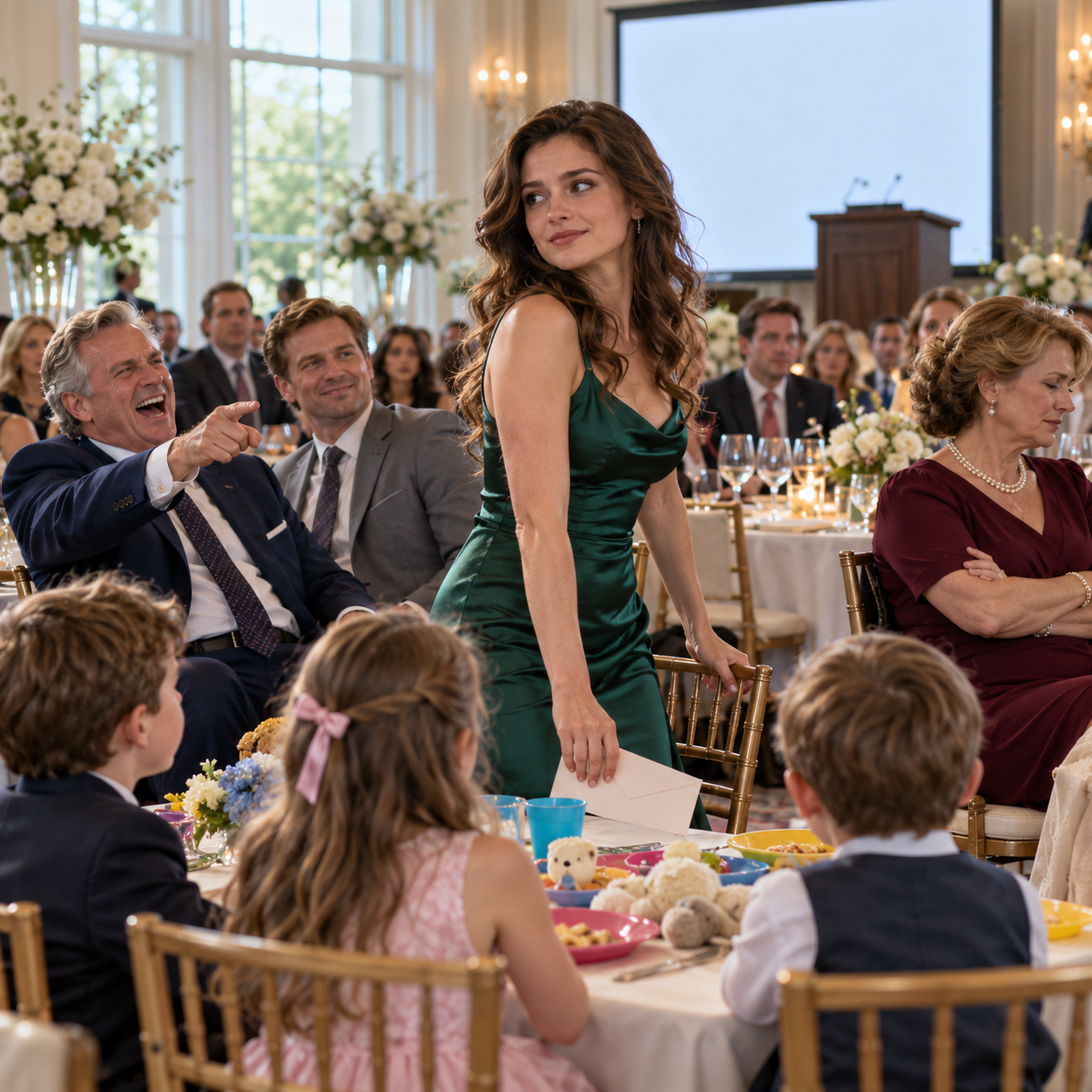
My place card said TABLE 19 in gold script, and a server directed me to a corner beside the glass doors. Six children occupied the table, surrounded by paper placemats, broken crayons, spilled lemonade, and dinner rolls shaped into tiny forts. A boy in a blue vest asked whether I could draw a dragon, then pushed a green crayon toward me as if my presence needed no explanation. Across the room, my adult cousins sat together, raising their glasses beneath a canopy of vines.
Mallory stood at the head table in a fitted ivory gown, smiling up at her new husband, Grant Whitcomb. Mom had a seat near the couple, Dad sat beside Grant’s parents, and Uncle Warren had a chair overlooking the dance floor. I watched Mom notice me by the children’s table, her mouth opening slightly before she turned to speak to a waiter. That small movement hurt more than Dad’s warning, because it was the one I’d been waiting my whole life for her to stop making.
Growing up, Mallory got applause simply for entering a room; I got instructions to stay out of the way. When she backed Dad’s car into the mailbox, he said accidents happened, but when I left the garage open, he lectured me through dinner. My scholarship letter sat unopened on the kitchen counter for two days until I mentioned it myself. Mom looked at the full-tuition offer and said, “Well, standards must be changing.”
Three months earlier, Mallory had called to ask for a reception montage, all childhood birthdays and school plays and embarrassing hairstyles. “Something sweet, Nolan,” she said, sounding almost affectionate. “You’re actually good at this stuff, and I want the whole family in it.” For a foolish moment, I thought she had finally seen the work I’d built without their help, so I agreed to do it as my wedding gift.
She sent me a box of old hard drives and labeled thumb sticks, along with access to a shared folder full of relatives’ phone videos. The first evening, I sorted clips beneath the low hum of my editing computer, making folders by year and occasion. Mallory looked radiant in nearly every frame, a bright ribbon in her hair, a trophy in her hand, someone cheering just outside the shot. I appeared mostly at the edges, holding the camera bag or waiting for someone to notice my school project.
One birthday recording caught Dad telling the person filming, “Keep the camera on Mallory. Nobody wants a shot of Nolan eating cake.” At first I laughed in disbelief, because the words sounded exactly like him; then I remembered being eleven and setting down my fork. Another clip showed me crossing a college graduation stage while Dad muttered that I might finally get a real job. I remembered the silence, but hearing it through the microphone made my stomach tighten.
I was preparing a harmless montage anyway, telling myself nobody needed a family grievance at a wedding. Then an unlabeled phone backup surfaced among the files, containing footage from Mallory’s bachelorette weekend at a lakeside hotel. Most clips showed friends dancing or ordering room service, but the last one began on a windy balcony after midnight. Mallory sat near the railing with a bright pink drink, speaking to someone behind the camera.
I reached for the trim tool, ready to skip another party clip, when I heard my name. Whatever Mallory said next made me stop the playback and move my hand away from the mouse. I listened again with headphones, then checked that I hadn’t misunderstood her. By sunrise, the wedding montage was no longer the only video on my editing timeline.
Part 2
I watched the balcony recording twelve times before I could bear to watch it once without headphones. The video itself wasn’t remarkable: patio chairs, a strip of black water, Mallory laughing under the hotel lights while the wind slapped the microphone. What unsettled me was how casually she spoke when she believed the people listening already agreed with her. She didn’t sound angry, or wounded, or even reckless; she sounded comfortable.
My first instinct was to close the folder and finish the slideshow she had requested. A private conversation wasn’t a courtroom confession, and even after everything, I couldn’t pretend playing it publicly would be harmless. But I kept thinking about Grant, whom I’d met only twice and who had treated me with more respect in ten minutes than my father had in ten years. At the engagement dinner, Grant had asked how my studio worked and actually listened to the answer.
The next morning I called Tessa, a bridesmaid who had uploaded the hotel recordings, and asked whether the balcony video was hers. “Oh, God,” she said, and I heard a coffee grinder roar behind her. She explained that she’d transferred her entire phone backup when Mallory demanded more candid moments for the montage. “She doesn’t know I sent that one,” Tessa added, her voice dropping. “Nolan, please don’t put it in there.”
“Did you know what she said?” I asked. Tessa was silent long enough for the grinder to stop, and then she admitted she’d been standing behind the camera. She said everyone had laughed nervously because Mallory was the bride and nobody wanted an argument during her weekend. Tessa had told herself that Mallory was exaggerating for attention, although she had avoided being alone with Grant since returning home.
I went back through the older footage, looking for one ordinary memory that might make the uglier recordings feel less representative. I found Dad holding the camera at my high school art showcase, recording Mallory’s new shoes instead of my display, and Mom saying she was too busy to attend my scholarship dinner. Then I uncovered a Thanksgiving clip I’d never seen, taken from the far end of the dining room. Mallory told the guests I would probably live in her basement someday, and Mom laughed so hard she spilled her coffee.
I opened a blank timeline and placed the ugly clips beside the cheerful ones, not touching their sound or cutting away the seconds that showed what was happening. Two versions emerged: the slideshow Mallory expected and one that would force people to recognize the person she had asked to erase. I didn’t feel triumphant as I exported the second; my hands shook when I labeled it FINAL_RECEPTION. The file looked painfully ordinary sitting on my desktop.
On Friday, the day before the wedding, Grant found me in the vineyard’s parking lot while I unloaded my camera bag. He had loosened his tie after the rehearsal and held two bottles of water, one of which he offered me. “Mallory says you always save the day with technical stuff,” he said, smiling. “I’m glad we’re going to be family.” I almost asked him how well he knew her, but the happiness in his face stopped me.
Instead, I asked what he loved about Mallory. Grant considered the question, then said she had been incredibly supportive when his mother was recovering from surgery and had made him feel less alone. He spoke without mentioning his family’s property holdings or the vineyard his parents had helped pay for. When he walked away, I stood beside my open trunk, ashamed of how badly I wanted his happiness to survive what I’d heard.
That evening I replayed the final thirty seconds of the balcony file, searching for a reason to believe I’d misunderstood. A woman’s voice behind the camera murmured, “Your brother might hear about this,” and Mallory laughed that I would never risk disappointing our parents. Just before the recording ended, a second familiar voice said, “Put that phone down before somebody sees.” I recognized the voice instantly: my mother had been standing on that balcony, listening to every word.
Part 3
Saturday morning began with a text from Mom asking to approve the slideshow before guests arrived. I met her outside the bridal suite, where hairspray drifted through the half-open door and someone was steaming a veil. She barely looked at my face before holding out her hand for my laptop. “Mallory needs everything perfect,” she said. “No weird childhood pictures, and definitely nothing embarrassing.”
I asked why she’d been on the hotel balcony that night. Her hand stopped in midair, and for one startling second I watched the color leave her cheeks. “That’s none of your business,” she answered, glancing toward the suite, then added that Mallory had been joking and I shouldn’t twist private words into a family crisis. When I asked whether Grant would find them funny, she pressed her lips together and told me I was being spiteful.
“You heard what she said about him,” I whispered. Mom leaned closer until I smelled the sharp peppermint on her breath, then said, “People say things they don’t mean, Nolan. We don’t destroy a marriage over stupid talk.” I wanted to believe she was protecting Grant from a careless joke, but she’d never once asked what Mallory had said about me. That was the answer hiding inside her answer.
Inside the reception hall, my old college roommate Micah was testing the audio system, tapping a microphone while workers polished silverware around him. He ran his own event production business now and had agreed to manage the montage as a favor. I gave him two files on a drive and explained which one I intended to use, without pretending the choice was innocent. Micah watched a minute of the second cut before pushing back his chair.
“This is going to hurt people,” he said quietly, pulling off his headphones. “Including you.” He wasn’t trying to talk me out of telling the truth; he wanted to make sure I understood that a projector wouldn’t let me take it back. I told him I did, although I was still discovering what that meant. We agreed he would play only the file I selected, without improvisation or additional edits.
Before the ceremony, a photographer gathered the family for portraits beside the vineyard’s stone fountain. I moved toward Mom and Dad, but Mallory caught my sleeve and told me the next shot was “immediate family with the bride and groom.” I looked from her to our parents, waiting for one of them to point out that I was her brother. Dad merely waved me toward a row of empty chairs and said I could help carry the flower arrangements afterward.
For a moment I wanted to leave, drive the two hours back to Portland, and delete every file connected to these people. Then Grant stepped away from his groomsmen and asked why I wasn’t in the family photograph. When I said I had been assigned another job, he frowned and insisted the photographer take a picture of us together. Mallory watched from the fountain steps, her smile rigid as the shutter clicked.
At cocktails, Tessa twisted the stem of her empty glass and apologized again for sharing the recording. “If you do this, they’ll blame you instead of listening,” she warned. I said they already blamed me for things I hadn’t done, and she replied that the consequences would still be real.
Back at Table 19, children dismantled their bread baskets while guests filed in for dinner. My youngest cousin asked if I was there to supervise them, and I laughed because there was no gentler answer. Mom glanced toward me, shook her head faintly, and returned to a conversation about the centerpieces. Mallory leaned against Grant beneath the lights.
Dad stopped beside my chair long enough to murmur, “Don’t make a spectacle of yourself tonight.” I wondered whether he heard the absurdity in that warning. When Mallory rose to thank her “perfect family” and “perfect husband,” I caught Micah’s eye at the sound booth and gave one small nod. The lights dimmed, applause faded, and the first image of my sister’s childhood filled the screen.
Part 4
The montage began with piano music beneath birthday photographs and snowy Christmas mornings. Onscreen, she twirled in a glittering princess dress while a seven-year-old version of me shuffled past wearing a cardboard robot helmet. Guests chuckled, silverware clinked, and Dad settled into his chair with his napkin tucked neatly across his lap. The whole room seemed ready for a lovely evening.
Then the music softened, and footage from a family vacation replaced the photographs. A young Mallory ran toward a lake, shrieking with delight, while I stood at the edge holding a bucket of fishing gear. Dad’s voice came through the speakers: “Don’t waste the shot on Nolan. Follow your sister.” A few people laughed automatically, then stopped when I lowered the bucket and walked out of the frame.
The next video showed my college graduation, recorded from our family’s row. My name rang out, and I crossed the stage looking toward the camera for a smile that never came. Dad muttered, “Maybe now he’ll get a real job and stop costing us money,” while Mom asked where they were taking Mallory for lunch. The room grew quiet enough for me to hear ice settle in the pitcher beside my elbow.
More dated moments followed: Mom laughing at Mallory’s joke about my future basement apartment, Dad turning his camera away from my school exhibit, the family applauding Mallory for a Christmas gift while my unopened present sat under the tree. I hadn’t added captions; the footage showed everyone as they had always been. Uncle Warren stared into his drink instead of chuckling.
Mom pressed her napkin over her lips, and Dad twisted around until he found me among the children. His look ordered me to stop, and I almost obeyed. At the head table, Mallory leaned toward Grant and spoke quickly, but he kept watching the screen. The little boy beside me asked why everybody had stopped smiling, and I whispered that he hadn’t done anything wrong.
A brief black frame appeared, and the piano cut out. Wind rushed from the speakers, followed by laughter and the scrape of a chair against concrete. Mallory sat on a hotel balcony, unmistakable in a pink satin sash, her bright drink balanced on one knee. Tessa covered her mouth across the room, and Mom’s eyes closed as though she had been expecting this exact moment.
“Grant’s nice,” the recorded Mallory said, dragging out the word, “but he’s so boring I could scream.” Somebody behind the camera asked why she was marrying him, and Mallory smiled directly into the lens. “Because his family owns half the real estate in town, obviously. I can play devoted wife for that kind of life.” She laughed again, casual and certain that her audience understood.
Grant set down his champagne flute without drinking from it. The recording continued as Mallory scoffed that she could never end up “a broke nobody like Nolan,” then added, “I told Grant my brother resents me, so if he ever says anything, Grant won’t believe him.” When Mom’s voice told her to put the phone away, several guests turned toward my parents at once. My sister’s face went gray, and the silence around Grant seemed almost physical.
“It was a joke,” Mallory said, grabbing his sleeve when he stood. Grant eased her hand away and asked, softly enough that the microphone at their table barely caught it, “Which part?” He waited for an answer that didn’t come, then walked toward the oak doors without looking back. Mallory called after him, her voice cracking, but the only response was the scrape of his shoes across the stone floor.
Dad charged toward Table 19, shouting for Micah to stop the video, but Micah had already paused it. “I told you not to ruin this,” Dad roared, close enough that I could smell the wine on his breath. I set my name card beside a juice cup and said, “You were right about one thing, Dad. I don’t belong at the table you chose for me.” I walked outside as Mallory sobbed behind me, only to find Grant waiting beneath the parking-lot lights, asking for the original recording.
Part 5
Grant stood beside parked cars, his jacket folded over one arm, nothing like the smiling groom in the photographs. He didn’t ask why I’d humiliated my sister or demand that I apologize; he asked whether the balcony recording had been altered. I told him the clip was real, that I had shortened the surrounding footage but left her words intact. “Then I need to hear everything,” he said, his voice steady until the last word.
We sat on a low stone wall outside the vineyard office while I opened the original file on my laptop. Before Mallory spoke about Grant, there was aimless conversation, and afterward the camera caught only waves. Grant listened without interrupting, even when my mother laughed in the background and told Mallory to lower her voice. When it finished, he asked me to send him an untouched copy through a private link, and I agreed.
“I should have told you before tonight,” I said, staring at the gravel beneath my shoes. Grant rubbed his eyes and told me he’d wished I’d chosen another way, because his parents and friends had watched his marriage collapse in public. He didn’t excuse Mallory, but he didn’t pretend my choice was painless either. I thanked him for speaking plainly; in my family, truth arrived wrapped in insults.
Dad called seventeen times as I drove home, accusing me of destroying Mallory’s future. Mom sent one sentence: “You could have handled this privately.” She was right about that, and it made me angrier than another denial would have, because she’d watched Mallory lie to Grant and never considered speaking privately herself. I stopped at a gas station under buzzing fluorescent lights and blocked their numbers before I reached Portland.
By Monday, guests’ phone videos were circulating, showing Mallory’s face when the recording began. I refused requests for the full slideshow and asked Micah not to share his copy, because I’d already exposed more than enough people to one horrible evening. Tessa called to say Mallory was claiming I’d manufactured the audio and that her wedding videographer had been pressured to support that story. Tessa offered Grant her original phone backup, and I told her the choice was hers.
A week later, Dad appeared at my studio without warning, walking past the framed documentary posters in the hallway as if he’d come to repair a printer. He said the Whitcombs were discussing separation with their lawyer and that Mallory had moved into our parents’ house. “You can still fix this,” he insisted, setting a folder of photographs on my desk. “Make a new video. Tell people you twisted her words because you were jealous.”
I closed the folder without looking at the photographs. “You want me to lie so everyone can go back to treating me like the problem,” I said, and for once he didn’t bother denying it. Instead, he threatened to tell every business contact he had that I couldn’t be trusted with private footage. I reminded him that my clients knew my work, and then I walked him to the door and told him he couldn’t come back.
Mom wrote a long email two weeks after that, saying she’d always loved us equally and that the table had been a caterer’s mistake. She never explained why she’d turned away when she saw me standing there, or why she’d listened to Mallory mock Grant without warning him. Mallory sent a message of her own: “I hope you’re happy now.” I archived both without replying. Months later, Grant said they were divorcing and thanked me for the original file. The quiet afterward felt strange, like an old refrigerator finally stopping its rattle.
That same month, a documentary I’d edited screened at a small Portland theater packed with people who had actually chosen to be there. After the credits, my producer offered me a chair and asked what I wanted to work on next, a question my family had never asked. I thought of Table 19, of the green crayon and the name card abandoned beside a juice cup. Then I sat down, looked toward the bright screen, and answered her without wondering who might tell me I didn’t belong.
Legal Notice: This story is a work of fiction. Names, characters, businesses, events, and incidents are the product of the author’s imagination or are used fictitiously. Any resemblance to actual persons—living or dead—or to actual events is purely coincidental. Thank you! 💓