The Birthday Dinner Where My Family Made Me Pay to Be Excluded
“That table is for family, Tessa, not adopted girls.” My mother smiled as she pulled the empty chair away from me, and thirty people watched my face burn. Two hours later, they sent me a $3,270 bill for the dinner I hadn’t been allowed to attend. I paid because I wanted one clean ending to twenty years of humiliation. But before I could leave, a stranger stopped me with a folder bearing my childhood name—and a signature I had never written.
Part 1
My mother had chosen the nicest private dining room in Atlanta for her sixtieth birthday, then asked me to organize every detail. Six weeks before the party, Vivian Whitmore called while I was eating a sandwich over my keyboard at work. She wanted thirty-one guests, an almond cake decorated with orchids, and a reservation deposit charged to my card because her own was supposedly being replaced. “You’re the only one I can trust with arrangements,” she said, in the warm voice she saved for asking favors.
I arrived seven minutes early carrying a wrapped silver picture frame and wearing the navy dress she had once called “respectable enough.” The room smelled of rosemary and melted butter, and tiny gold lights shone above the long table. I spotted an empty chair beside my younger sister, Brynn, and reached for it. Vivian closed her fingers around my elbow and delivered her announcement as cheerfully as if she were offering me dessert.
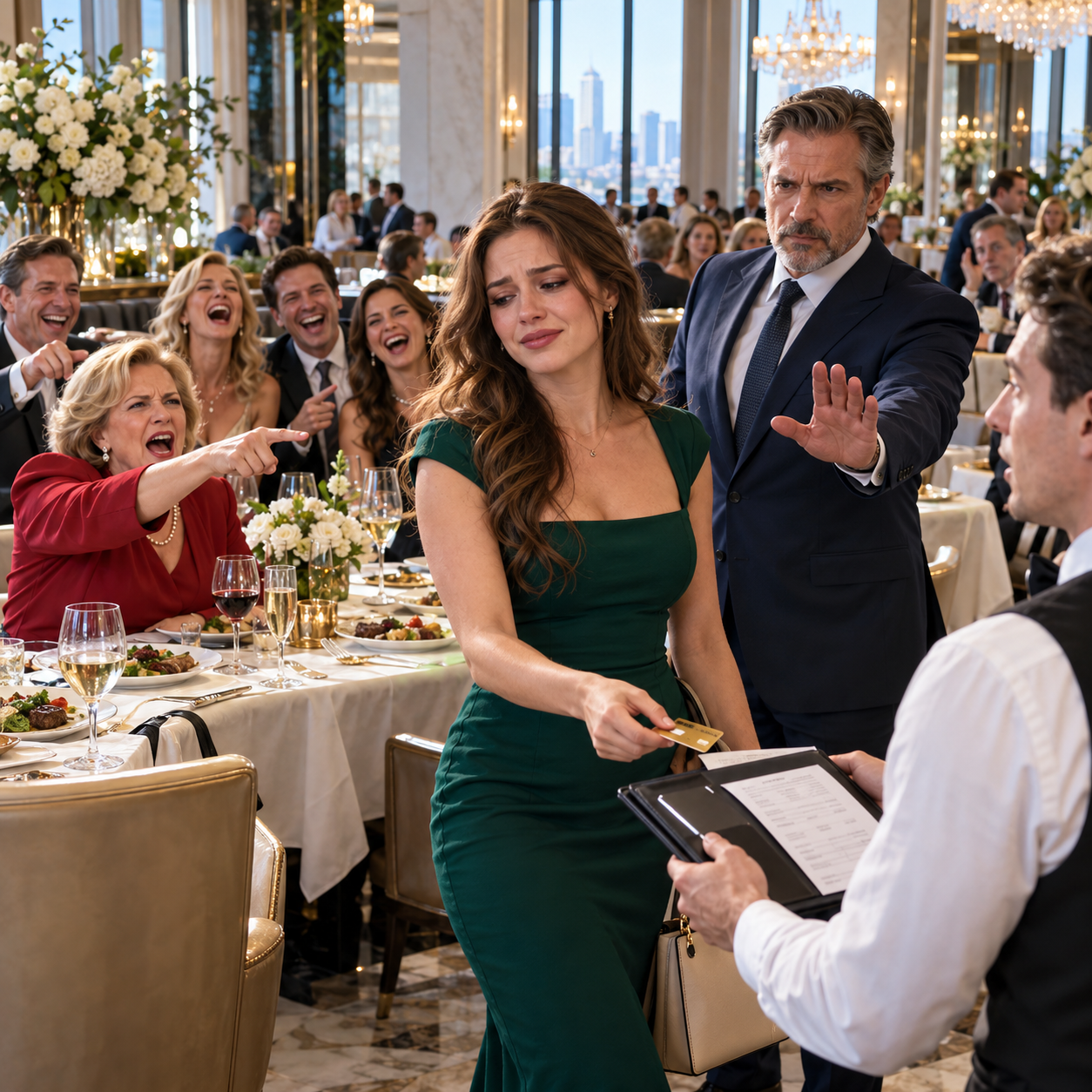
“Find another table, Tessa. This one is for family, not adopted girls.” My brother, Derek, threw back his head and laughed; three cousins followed him, and somebody raised a glass. Brynn stared at her phone, while my father, Nolan, suddenly became fascinated by the wine list. Vivian leaned closer and murmured, “Don’t embarrass me by arguing,” though she was still smiling for the room.
I had been adopted at nine, old enough to remember my first surname, Rowan, and young enough to believe the Whitmores when they promised I would always belong. At charity lunches, Vivian introduced me as proof that love could change a child’s life. At Christmas, she asked me to take the family photograph because it was easier to fit everyone else in the frame. I’d spent twenty years mistaking the difference between those two versions of me for something I could fix.
A server led me to a small table behind a potted olive tree near the bar. From there I heard Derek praise our mother’s generosity, Brynn call her the family’s heart, and Nolan describe her as someone who “never left anybody out.” I ordered salmon and tried not to watch the candles being lit on the cake I’d arranged. The frame sat unopened across from me, its ribbon reflecting the bar lights.
At 8:47, instead of my own check, a bartender named Luis handed me a black leather folder. The restaurant’s bill showed thirty-one entrées, four bottles of wine, private-room charges, and a custom cake, totaling $3,270.14. “They said you were taking care of it,” he told me quietly, glancing toward the party. Through the glass divider I saw Vivian watching me with the small, satisfied smile she wore whenever I obeyed.
“Can you separate my dinner?” I asked. Luis nodded, but explained that the private-room account remained secured against my reservation card. I could dispute the arrangement, call a manager, and spend the rest of the evening negotiating within earshot of people who had already decided I was the problem. I looked at the total once more, then asked him to run the charge and add a generous tip for the staff.
As I signed Tessa Rowan Whitmore, my hand steadied for the first time all night. I wasn’t buying a place at their table anymore; I was paying for the last favor they would ever get from me. Luis returned the card, and I reached for the frame before remembering that Vivian hadn’t even noticed it. I left it on the chair and stood up.
“Just a moment, please,” a woman said behind me. She was in her late fifties, dressed in a charcoal suit, with a leather folder pressed against her chest. “My name is Adrienne Bell, and I came tonight because your mother said you were too busy to speak to me.” She opened the folder to a document headed The Open Door Fund, then touched the signature line: “Why has your name been authorizing payments from this charity for three years?”
Part 2
I stared at the paper, convinced she’d mistaken me for someone else. The name beneath the signature was Tessa Rowan Whitmore, but the handwriting looked like mine only from a distance. My R had a looping tail; this one ended in a sharp slash. Adrienne gave me her card and said her organization had funded The Open Door Fund.
“Your mother said you handle the accounting,” she explained. “Then she said you were traveling. Today she said you preferred not to speak to strangers.” Her organization had requested a routine review of scholarship expenditures, and every response had come from an address containing my name. When I said I had never heard of the charity, the muscles beside her mouth tightened. “Please talk to your own attorney before you talk to your family.”
Outside, wet pavement smelled of magnolia leaves. My phone buzzed with a message from Vivian: “Thank you, darling. See you Sunday to help clean up.” I read the message, then blocked her number for the night. Whatever that folder meant, I couldn’t bear to hear her voice before I understood it.
On Monday, attorney Rachel Sloane met me in a narrow office above a pharmacy. She listened without interrupting while I explained the birthday dinner, the charitable fund, and the old surname that my mother used only when it helped her appear generous. Adrienne joined us with the foundation’s publicly filed documents and copies of correspondence she was authorized to share. Rachel arranged the papers into two piles: what we knew, and what still needed proof.
The Open Door Fund claimed to support young adults aging out of foster care. Its publicity showed Vivian speaking beneath banners about belonging, and its listed treasurer was me. Over three years, Adrienne’s organization had granted it $410,000 for tuition assistance and housing support. The submitted reports showed dozens of awards; the supporting invoices included large payments to a consulting company called Whitmore Strategy Group.
Derek owned Whitmore Strategy Group. I knew because he’d spent the previous Thanksgiving complaining that his clients were slow to pay, then asked me to cover his family’s ski-trip deposit. “Related-party payments aren’t automatically illegal,” Rachel said, tapping the invoice with her pencil. “What matters is what work happened, who approved it, and whether the grant permitted it.” I hated how much relief I felt at hearing a question instead of an accusation.
Adrienne showed us an application bearing my photograph and a paragraph about how the Whitmores had saved me. I recognized the picture: Vivian had taken it at a backyard barbecue when I was twenty-four. That afternoon she’d asked me to sign a release so she could include the photo in a community newsletter. The release was one page; the signature attached to the charity’s finance authorization looked like a scanned copy of it.
“Could somebody have copied it?” I asked. Rachel set both pages side by side and pointed out a tiny break in the ink at exactly the same spot. “We need the original records to establish what happened,” she said, “but you should preserve these copies.” I realized Vivian might have been using my name not just to decorate speeches, but to place responsibility for real money on my shoulders. My stomach dropped harder than it had when the restaurant bill arrived.
That evening, Brynn called from a number I didn’t recognize. “Mom says you’re angry about a seating misunderstanding,” she began, her voice brittle. I asked whether she knew about The Open Door Fund, and the silence lasted long enough for a traffic signal outside my apartment to cycle from red to green. Finally she whispered, “Don’t sign anything Dad sends you this week.”
An email arrived from Nolan eleven minutes later, attached to a document titled Annual Expenditure Certification. He wrote that it was a routine form and needed my signature before Friday. Beneath a page of harmless-looking figures sat a declaration that I had personally supervised every payment made by the charity. For the first time, I wondered whether my family expected me to take the blame for money I’d never touched.
Part 3
Friday was four days away, and suddenly every ordinary sound in my apartment seemed louder. My refrigerator rattled through the night while I sorted years of email, searching for anything I’d once signed for Vivian. Rachel told me not to confront anyone until she’d sent a request that the charity preserve its records, including electronic access logs and original invoices. “We aren’t trying to win an argument at Thanksgiving,” she said. “We’re trying to establish what actually happened.”
I found the community-newsletter release buried in a folder labeled Family Favors. Beside it were receipts for hotel rooms, fundraising flowers, and a dozen transfers I’d made whenever Nolan said an account was temporarily tied up. Nothing proved the larger fraud, but the pattern was humiliating in its simplicity. I’d been an unpaid assistant to people who claimed they were rescuing me, even though I was now thirty-two and paying my own mortgage.
Adrienne arranged a conversation, with permission, between Rachel and a former scholarship applicant named Lena Ortiz. Lena was twenty-three, worked nights at a grocery warehouse, and had been told by The Open Door Fund that she’d received help with community-college tuition. She showed us an acceptance email and a later message saying payment was delayed because of “unexpected administrative costs.” After two semesters of waiting, she’d dropped her classes and moved into her cousin’s spare room.
“I thought I did something wrong,” Lena said, twisting a cheap silver ring around her finger. Her voice barely rose above the coffee shop’s milk steamer, and I remembered being nine, apologizing for taking up space at the Whitmores’ kitchen table. Rachel carefully explained that we still couldn’t say where Lena’s promised money had gone. But as Lena folded the email back into her bag, I knew silence would protect the wrong people.
On Wednesday, Vivian appeared outside my office carrying two lattes, the way she did when she wanted the audience of my coworkers. She greeted the receptionist by name and asked me to step into the courtyard, where rainwater gathered in the seams between the paving stones. “Your father needs that form,” she said without bothering to offer me a cup. “Surely you aren’t going to punish an entire charitable organization over one silly birthday joke.”
“Was I ever actually supposed to sit at that table?” I asked. Vivian’s expression flattened, as though I’d asked a question too childish to entertain. “We gave you everything,” she replied, “and you keep counting chairs.” I asked what The Open Door Fund had purchased from Derek’s company, and she studied me for a long moment. “You don’t understand how nonprofits operate,” she said, which was the first answer she’d given that frightened me more than her insults.
Brynn came to my apartment that evening with a battered external drive inside a grocery bag. She admitted she’d designed the charity brochures and had been paid for photography, but insisted she’d never approved spending or managed the accounts. “Mom told everyone you preferred working behind the scenes,” she said, staring at my kitchen floor. I wanted to believe her, but I remembered how she’d looked at her phone while everyone laughed, so I let her speak without comforting her.
The drive contained original photographs and dated design files, including the barbecue picture Vivian had used for my supposed financial authorization. Brynn showed me a draft brochure that described me as “our inspiring founder,” then a revised version that called me “volunteer treasurer.” She also had an email from Nolan requesting a clean scan of my signature from the old release. “I should have asked why,” she whispered, and for once I didn’t rush to tell her it was all right.
Rachel examined the copies and asked Brynn to retain the original device for verification. Then she opened another attachment from Adrienne: a financial report sent to the donor’s compliance office only hours earlier. It claimed I’d personally selected Derek as a service provider and approved the disputed invoices, with Nolan and Vivian listed merely as advisers. At the bottom, under a heading marked Responsible Officer, was a statement declaring that if any funds had been misapplied, I alone had controlled their use.
Part 4
I barely slept after reading that statement, but anger gave me a kind of focus I’d never felt before. Rachel advised me to provide a written denial and supporting materials to the charity’s independent trustees and Adrienne’s organization. We sent the original release, the suspicious authorization, Brynn’s email, and Nolan’s certification request, keeping copies of everything. By Thursday evening the trustees had called an emergency meeting for Friday morning, before a donor luncheon Vivian had spent months promoting.
The meeting took place in a hotel conference room that smelled of burnt coffee and freshly cleaned carpet. Three independent trustees sat along one side of the table, with an outside accountant beside them; Vivian, Nolan, and Derek occupied the other. The projector fan ticked beside a tray of untouched pastries, and Vivian wore the same gleaming pearl earrings she had shown off at her birthday dinner. I entered with Rachel and Adrienne, and watched my mother’s gaze travel from my attorney’s briefcase to the folders in our hands. “This is a family matter,” she declared, as though the trustees had arrived at her house without an invitation.
The board chair, Mr. Foster, explained that restricted grant money and potentially unauthorized signatures were not private family matters. Nolan interrupted to say that my involvement had always been informal and that any misunderstanding came from my habit of avoiding paperwork. Derek nodded so vigorously that his chair squeaked against the carpet. I wanted to shout, but Rachel touched the edge of my folder, reminding me that this was the first room in my life where I didn’t have to fight just to finish a sentence.
I explained the newsletter release and the forged-looking approval forms, then described the birthday dinner without raising my voice. “You can inspect my personal bank records through the proper process,” I said. “I have never received, directed, or authorized a grant payment from this organization.” The accountant produced a preliminary list of transfers showing that the charity’s bank account had paid Derek’s company, a decorator, and a property-management business associated with Nolan. He emphasized that payments required verification; nevertheless, Nolan’s own account credentials appeared in the bank’s approval records.
“That’s impossible,” Nolan said, reaching for the page. Mr. Foster drew it back and told him to stay seated. Brynn, who had arrived separately, confirmed she’d been asked to scan my old signature, and handed over her original email archive for examination. Derek turned on her, demanding whether she understood what she was doing to the family. She began crying, but she didn’t retract a word.
Vivian finally looked straight at me. “After everything we did for you, you’re going to let strangers destroy us?” Her voice had the familiar tremble that usually made me feel like a cruel daughter. This time I pictured Lena’s acceptance email, the promised tuition that never arrived, and the empty chair beside Brynn. “You made my adoption into a fundraising story,” I said. “Then you used my name to hide transactions you wouldn’t explain.”
The trustees voted to suspend Vivian and Nolan’s authority over foundation accounts pending independent review, while the grantor placed remaining payments on hold. Derek’s company contracts were referred for an outside examination, and Mr. Foster said professional advice would determine any required reports to regulators. There were no handcuffs or dramatic confessions, only the slow, heavy sound of people realizing documents would matter more than the Whitmore reputation. Vivian left without touching my shoulder, and for the first time I was glad.
In the hallway, Nolan caught up and told me I could still make things “less ugly” by signing a carefully worded clarification. Rachel stepped between us and asked him to send any proposal to her office; Nolan’s jaw tightened as the elevator doors opened. I thought the worst was behind us until Adrienne approached with a new expenditure entry the accountant had just located. The date was the morning after Vivian’s birthday, and the amount was so familiar that I could have recognized it upside down: $3,270.14.
Part 5
The payment had gone from The Open Door Fund to Vivian’s personal account under the description Donor Stewardship Dinner. Attached was the restaurant’s original itemized bill, including the thirty-one entrées and the orchid cake; nowhere did it mention that I had already paid that exact charge myself. The charity had reimbursed my mother for a dinner she’d made me finance, using funds intended for young adults who needed housing and tuition. I sat in Rachel’s car afterward, staring at the rain on the windshield, and felt something colder than anger settle into place.
Rachel told me the entry was evidence of a questionable reimbursement, not a verdict about every transaction or every person involved. I understood that, and I gave her my card statement and the signed restaurant receipt so the investigators could match the payments. Luis later supplied the restaurant’s records through the proper request, confirming that my card had settled the account. One ridiculous birthday bill had become a clear trail between the family’s treatment of me and the money it claimed to manage for strangers.
The donor luncheon went ahead without Vivian presiding over it. Mr. Foster told attendees only that an independent financial review was underway and that the foundation would temporarily halt new disbursements while protecting existing applicants’ records. Some guests looked horrified; others seemed relieved that somebody had finally asked questions. I didn’t go, because I’d spent enough of my life standing on the edges of rooms my mother controlled.
Over the following months, an independent review identified more than $200,000 in expenses requiring recovery or further investigation. The foundation pursued repayment, ended Derek’s consulting agreement, replaced its financial officers, and referred its findings to the appropriate authorities. The process wasn’t tidy: lawyers disputed invoices, records went missing before being recovered from backups, and I spent several afternoons explaining that I had never served as treasurer. My name was eventually removed from the organization’s filings, with corrections made to the records that had falsely named me.
Lena received the tuition assistance she’d originally been promised after the new board verified her application and funded the award through recovered money and fresh donations. She sent me a picture of a textbook beside a paper coffee cup on her first day back at school. I didn’t post it or turn it into an inspiring story about myself; I’d seen too closely what happened when another person’s hardships became someone’s advertisement. I put the photograph on my refrigerator, where it reminded me that a small, concrete outcome mattered more than any gala speech.
Brynn wrote a long apology, admitting she’d known my exclusion was deliberate and had stayed quiet to keep her place in the family. I thanked her for preserving the evidence but told her I wasn’t ready for a relationship. Derek sent two furious emails through a relative; Nolan asked for a private conversation without attorneys, which I declined. Then Vivian mailed me a check for $3,270.14 and a card that read, “Families make mistakes. It’s time to come home.”
I returned the check with a short letter from Rachel’s office stating that any repayment could be handled through the ongoing accounting review. I didn’t answer the message about coming home, because the apartment I’d bought with my own savings was already home. Later, I legally changed my surname back to Rowan, not to erase my childhood, but to stop carrying a name that had always come with conditions. On the day the change was finalized, I took myself to a quiet neighborhood restaurant and ordered the most expensive thing I actually wanted.
The server placed a candle beside the window as evening fell, and outside I watched people hurrying through the last of the rain. Nobody checked whether I belonged at my table, nobody asked me to pay for someone else’s celebration, and nobody called gratitude the price of love. I left a tip, folded my receipt, and walked into the cool air without looking back. Vivian had taught me that family was a seat someone could take away; I had finally learned that a life of my own didn’t require her permission.
Legal Notice: This story is a work of fiction. Names, characters, businesses, events, and incidents are the product of the author’s imagination or are used fictitiously. Any resemblance to actual persons—living or dead—or to actual events is purely coincidental. Thank you! 💓