My Daughter Drew the $380 Red Shoes I Couldn’t Afford—Six Months Later, Her Father Dropped a Tray When He Saw Her Name on a Gallery Wall
“Not today, sweetheart,” I whispered as my six-year-old daughter stared at the red shoes behind the expensive store window. Her father had abandoned us, and I barely had enough money for rent. Instead of crying, she pulled out a pencil and drew the shoes on an old receipt. I never noticed the wealthy stranger watching us. Six months later, my daughter stood before a magnificent display bearing her name, and the man who had abandoned her dropped a silver tray in shock.
Part 1
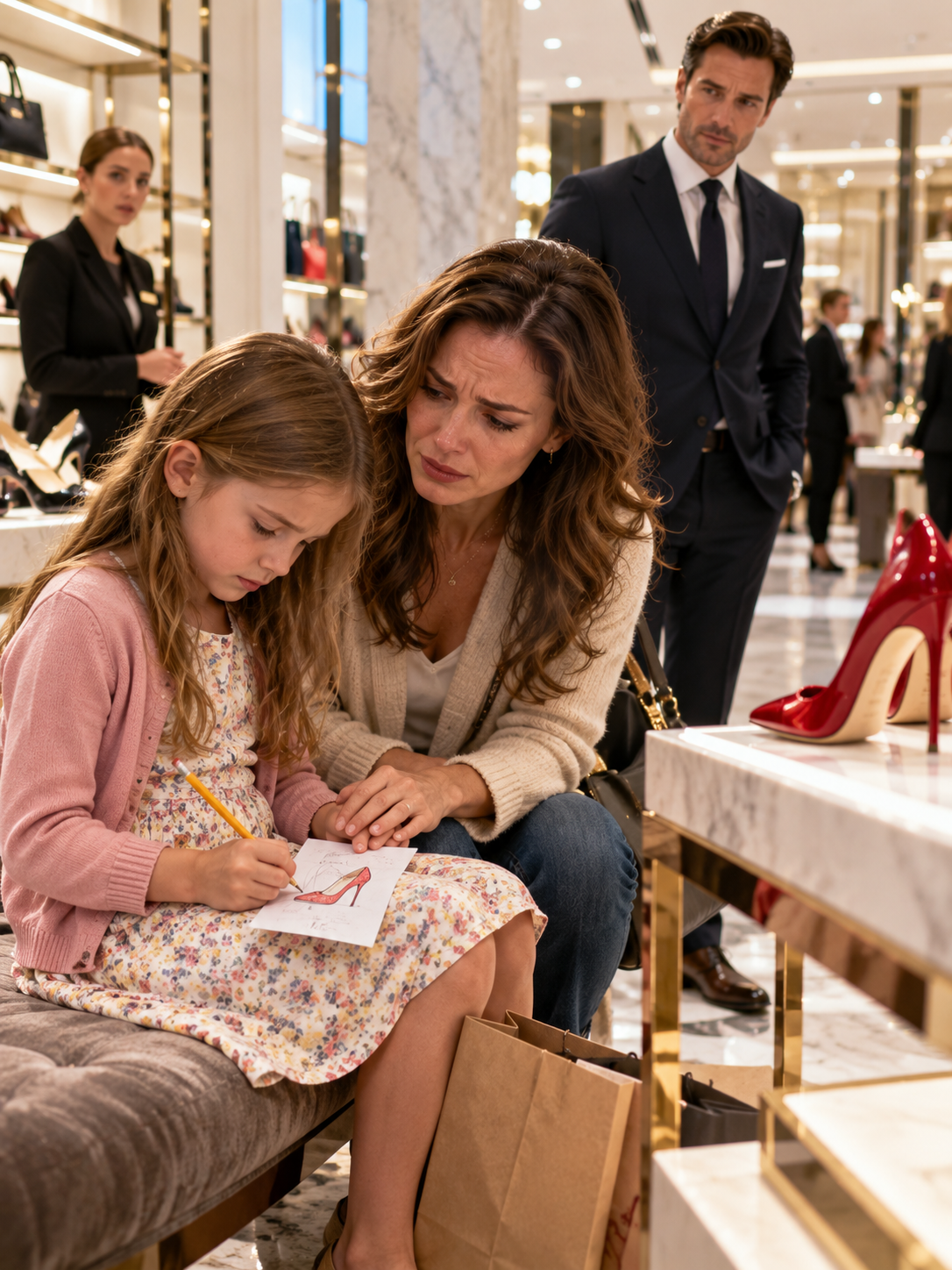
My daughter, Mia, pressed both palms against the department store window on Fifth Avenue, leaving two little fingerprints on the spotless glass. Behind it stood a pair of shiny red patent-leather shoes with delicate satin bows and tiny gold buckles, arranged beneath a miniature Christmas tree. The price tag read $380, which was almost exactly what I had left for groceries, subway fares, and emergencies until my next paycheck. “Mommy, do you think princesses wear shoes like those?” she asked, turning toward me with eyes full of impossible hope.
I crouched beside her and pulled her wool scarf tighter against the December wind. “Maybe they do, sweetheart, but we can’t buy them today,” I said, hating the disappointment I expected to see. Mia nodded without arguing, opened her battered purple backpack, and pulled out a pencil worn almost to the eraser. She flipped over a grocery receipt and began drawing the shoes, carefully copying their bows and curved toes.
I was thirty years old, raising a six-year-old alone in a cramped Queens apartment above a laundromat. Every morning at five, I started work at Juniper & Rye, a bakery in Greenwich Village, where I shaped sourdough and decorated birthday cakes for customers who sometimes spent more on dessert than I earned in a week. Mia’s father, Logan Pierce, had walked away when she was two, saying he needed time to discover who he really was. Apparently, discovering himself required changing his number, ignoring child-support obligations, and forgetting his daughter existed.
Since then, I had learned to measure life in bus transfers, discount coupons, and electricity bills. Our downstairs neighbor, Mrs. Evelyn Park, sometimes watched Mia when my shifts ran late, accepting homemade bread because she refused payment. Mia never complained about secondhand clothes or the small bedroom we shared, although I occasionally caught her studying the beautifully dressed children who passed our bakery. Drawing was her way of keeping things she couldn’t have, and that hurt me more than any tantrum could have.
“Excuse me,” a man’s voice said behind us, and I turned so quickly that my shopping bag brushed his coat. He was tall, perhaps forty, wearing a charcoal overcoat and polished shoes that probably cost more than my monthly rent. We’d nearly collided with him earlier at the revolving entrance, where he’d patiently held the door while Mia performed an exaggerated little curtsy. Now he was smiling at the drawing in her hands.
“That’s quite an impressive sketch,” he said, lowering himself slightly to examine it. Mia proudly explained that she’d added stronger buckles because the original shoes looked too delicate for running. The man laughed and introduced himself as Adrian Whitlock, then asked whether she designed other things. “Mostly dresses and coats,” Mia answered, “but sometimes houses for people who don’t have one.”
Something shifted in Adrian’s expression, although he quickly recovered his smile. He told us he’d come shopping for his mother’s Christmas gift, but nothing in the store felt especially meaningful. Then he looked at me rather than addressing Mia over my head. “Would you allow me to buy those shoes for your daughter?”
My first instinct was to refuse because strangers with money made me nervous, especially when they seemed interested in our circumstances. “That’s an incredibly generous offer, but we don’t know you,” I answered, taking Mia’s hand. Adrian nodded, slipped his wallet back into his coat, and said he understood completely. His willingness to accept my refusal made me reconsider more than any argument could have.
“I could make something in return,” I suggested after a moment. “My grandmother had a honey-walnut cake recipe, and I’d be happy to bake one for your mother.” Adrian studied me with surprising seriousness before accepting the arrangement. Inside the store, he waited while Mia tried on the shoes, and I insisted she walk around to check their fit.
When she finally stood before the mirror, Mia spun once and whispered, “Mommy, they look exactly like my drawing.” I thanked Adrian while she admired her reflection, promising to have the cake ready the next morning. Before leaving, he handed me a simple business card bearing his name and a telephone number. I didn’t recognize the company printed beneath it until we were back on the subway, where a stranger glanced at the card and asked, “Do you know who that man is?”
Part 2
The woman on the subway pointed toward the company name. “Adrian Whitlock owns half the buildings my husband manages,” she said with an incredulous laugh. I searched his name after Mia went to bed and discovered that Whitlock Development Group was worth billions. There were photographs of Adrian beside mayors, architects, and celebrities, along with an old article about his wife dying four years earlier.
Suddenly, the gift felt different. A wealthy stranger had spent hundreds of dollars on my daughter without expecting anything more than a cake, and I couldn’t decide whether that made him unusually kind or dangerously unpredictable. I considered returning the shoes, but Mia had placed them carefully beside her pillow before falling asleep. I couldn’t bear to take away the first beautiful thing she’d ever owned simply because I was frightened of generosity.
The following morning, I arrived at the bakery before sunrise and prepared my grandmother’s honey-walnut cake. At eleven, Adrian appeared in an ordinary dark sweater, waited behind six customers, and ordered coffee when it was finally his turn. My manager nearly dropped a tray of croissants when she recognized him, but Adrian seemed more interested in the cake’s cinnamon fragrance. “My mother hasn’t tasted anything homemade like this in years,” he said, accepting the box with both hands.
He returned two days later carrying a handwritten thank-you card from his mother, Margaret, who’d apparently eaten two slices before dinner. “She says you owe her the recipe,” he told me, smiling. Then he asked whether Mia and I would like to go ice skating at Bryant Park, adding that I could bring anyone I wanted. I agreed because he offered a public meeting place, understood my hesitation, and didn’t make me feel foolish for having it.
Mia had never worn ice skates, and she clung to the rink railing as though crossing a suspension bridge. Adrian stayed beside her, offering his arm whenever she lost her balance, but letting her try again independently. After her fifth tumble, she announced that successful designers needed strong knees, which made him laugh so hard he nearly fell himself. I stood nearby with hot chocolate, realizing I hadn’t laughed that freely in years.
After skating, Adrian gave Mia a leather sketchbook and colored pencils, explaining that artists deserved materials they could use every day. “When I’m big, I’ll make clothes for girls who can’t afford the fancy stores,” she told him. He answered, “Then you already have a reason to become a great designer.” It was the first time I’d heard an adult discuss her dream without calling it adorable or unrealistic.
Over the next several weeks, Adrian found reasons to visit the bakery after my morning rush. Sometimes he bought pastries for his office; other mornings he carried heavy flour sacks into the storeroom without being asked. We talked about music, childhood, and the exhaustion of starting over after losing someone. He spoke quietly about his late wife, Caroline, and how he’d buried himself in business because working felt easier than grieving.
Mrs. Park noticed the change before I did. “You’re smiling when you come home,” she observed one evening while hemming Mia’s winter coat. I told her about Adrian, expecting a lecture on wealthy men and complicated relationships. Instead, she asked whether I could disagree with him comfortably, and whether he respected my answer when I said no.
I considered those questions the following Saturday when Adrian suggested a weekend trip to his family’s country house. I declined because Mia had schoolwork and I wasn’t ready to spend nights away with him. He simply said, “Another time, perhaps,” and asked if we’d rather visit the public library’s fashion exhibition. His reaction reassured me more than an expensive dinner could have.
Then, one Monday afternoon, a coworker showed me a photograph circulating on a celebrity gossip account. It showed Adrian holding Mia’s hand at the skating rink, with me smiling beside them. The caption described us as “Manhattan’s Mystery Family” and invited readers to identify the woman and child accompanying the billionaire. I stared at my daughter’s unguarded face on the screen, wondering whether I’d accidentally opened our carefully protected world to strangers.
Part 3
I called Adrian that evening and asked whether he’d arranged the photograph. “Absolutely not,” he answered, sounding genuinely upset. He explained that photographers sometimes followed him at public events and promised to request the image’s removal through the website’s proper channels. Then he asked what I wanted rather than announcing what he intended to do, and I realized how rarely anyone had given me that courtesy.
The photograph eventually disappeared from the account, although Adrian warned me that copies might remain elsewhere. For two weeks, I avoided our usual outings and concentrated on Mia’s school routine and my bakery shifts. I expected Adrian to lose interest once our lives became inconvenient. Instead, he called occasionally, never demanding an explanation, and respected the distance I needed.
One afternoon, Mia asked why we hadn’t visited the library with Adrian lately. I told her some people were curious about him because he owned a big company, and that I wanted to protect our privacy. She considered this carefully before asking whether rich people ever got lonely. Her question surprised me enough that I called Adrian that evening and invited him for homemade pizza, giving us a chance to reconnect somewhere private.
He arrived with tomatoes and fresh basil rather than expensive gifts, then spent twenty minutes helping Mia wash flour from our kitchen table. Our apartment was so small that his knees nearly touched the cabinets when he sat down, but he never complained. After Mia went to bed, he admitted that he’d spent years surrounded by people who needed his signature or approval. “I forgot what it’s like to be invited somewhere just because somebody wants me there,” he said.
By spring, our friendship had become something neither of us wanted to dismiss as casual. I still worked my regular shifts, paid my bills, and insisted that Mia’s future wasn’t a project for Adrian to manage. He encouraged me to negotiate better compensation when the bakery began selling my grandmother’s cakes, but he didn’t interfere in the discussion. When my manager approved a raise and a percentage of specialty cake sales, Adrian celebrated with grocery-store cupcakes and a paper crown Mia had made for me.
In April, he invited me to dinner at a restaurant overlooking Central Park. I panicked over my clothes until Mrs. Park brought out an emerald-green dress she’d kept from her younger years. She altered it while Mia stitched a tiny red ribbon inside the waistband, saying every important dress needed a secret surprise. When Adrian saw me outside our building, he stopped speaking halfway through his greeting.
“Is something wrong?” I asked, looking down at the dress. “No,” he said softly, smiling. “I’m trying to remember how to breathe.” Over dinner, we discussed his mother, Caroline’s memory, and how frightening it felt to care about someone after learning to survive alone. He didn’t ask me to abandon my life for his, and I didn’t promise him a future I wasn’t ready to give.
A month later, I met Margaret Whitlock over lunch at her apartment overlooking the river. She was elegant and direct, asking about Mia’s interests before discussing my work at the bakery. I expected questions about my finances or intentions toward her son, but she surprised me by bringing out the wooden recipe box she’d kept since her own mother’s death. “Adrian hasn’t brought anyone into our family life in years,” she said, “and I hope you’ll never feel you have to become somebody else to belong.”
In early June, Adrian invited Mia and me to a charity exhibition supporting young artists from families with limited resources. The gallery had requested permission to display several sketches Mia had willingly shared, and I reviewed the consent forms before agreeing. I liked the organization’s educational programs, although I warned Adrian that I wouldn’t let Mia become an advertisement for his generosity. He promised that the exhibition was about the children and their work, not the donors.
As the event approached, Adrian grew strangely secretive about the final display. Mia noticed that several receipt drawings she’d given him months earlier weren’t inside the portfolio he usually carried, and he only smiled when she asked about them. Two days before the gala, a gallery coordinator confirmed that Mia’s drawings had been prepared for a prominent installation, but wouldn’t describe it. I had no idea that the surprise waiting behind those doors would also bring the one man I never wanted to see again.
Part 4
The gallery occupied a renovated warehouse in SoHo, where enormous windows looked down on streets crowded with summer evening traffic. Inside, white spotlights illuminated paintings, sculptures, and installations created by children from across New York. Mia wore the ivory dress Mrs. Park had altered and the red shoes she’d polished carefully that morning. Adrian greeted us at the entrance and took Mia’s hand when she became nervous around the unfamiliar crowd.
“There’s something I want you both to see,” he said, guiding us past a sculpture made from recycled bicycle parts. We entered a circular exhibition space where visitors stood before a large brass-framed display beneath a glowing ceiling. At first, I saw scraps of brown paper, grocery receipts, bakery bags, and pieces of cardboard arranged like an extraordinary patchwork quilt. Then I recognized a tiny red bow drawn in pencil.
I stepped closer, hardly breathing. Dozens of Mia’s sketches had been professionally preserved and arranged to show how her imagination had developed over six months. There were winter coats with enormous pockets, dresses covered in flowers, boots shaped like stars, and the red shoes she’d drawn outside that Fifth Avenue window. Beneath the display, a polished plaque identified the collection as “The World Beyond the Window,” created by Mia Ortiz, age six.
Mia covered her mouth with both hands. “Those are mine,” she whispered, looking from the frame to Adrian. He explained that he’d saved the drawings she’d given him and worked with the curator to preserve them, while other pieces came from the portfolio I’d approved. “Your ideas deserve to be seen,” he told her, “whether they’re drawn on expensive paper or the back of a grocery receipt.”
I couldn’t speak for several moments. For years, I’d worried that Mia would remember everything I couldn’t afford, but here was proof she’d turned those disappointments into something beautiful. Adrian quietly offered me a handkerchief without drawing attention to my tears. When Mia asked whether other children might like her designs, he showed her the exhibition booklet describing a scholarship program supporting young artists.
Then a silver tray crashed onto the marble floor behind us. Several glasses shattered, and conversations stopped as a catering employee stood frozen beside the scattered pieces. He wore a white shirt beneath a black vest, and his hair was thinning around his temples. When he lifted his face toward me, I felt the years between us collapse.
“Hannah?” he whispered, staring as though he’d seen someone return from the dead. My hand tightened around Mia’s shoulder before I even recognized my own reaction. The man was Logan Pierce, my former partner and Mia’s father, whom I hadn’t seen in four years. The last time we’d spoken, he’d stood in our kitchen with a packed duffel bag and told me fatherhood had ruined his freedom.
Logan glanced at Mia’s red shoes, then slowly raised his eyes toward the enormous display bearing her name. His mouth opened, but nothing came out until he noticed Adrian standing beside us. “Is that really her?” he asked, taking a hesitant step forward. Mia edged closer to my skirt, clearly frightened by the stranger’s sudden attention.
Adrian looked at me rather than responding for me. “Would you like some privacy?” he asked quietly, positioning himself nearby without blocking my view. I nodded, grateful that he understood this wasn’t his confrontation to control. A gallery coordinator began clearing the broken glasses while I guided Mia away from the scattered fragments.
Logan followed us toward a quieter corridor, ignoring the supervisor calling his name. “I’ve been trying to find you,” he said, his voice trembling. I remembered every unanswered message, every birthday he’d missed, and every time Mia had asked why some children had fathers waiting outside school. Before I could respond, he looked directly at her and whispered, “Mia, sweetheart, I’m your daddy.”
Mia stared at him, her small fingers curling around mine. “Mommy,” she asked, looking up at me with frightened confusion, “is that the man who left us?” The question landed harder than all the years of silence, and Logan’s face went pale. I knew my next words would shape how she remembered this moment long after the red shoes no longer fit.
Part 5
“Yes, sweetheart,” I answered, kneeling until my eyes were level with hers. “That’s Logan, your biological father, and he left when you were very little.” Mia looked from me to the stranger, studying his face as though trying to find something familiar. I added, “You haven’t done anything wrong, and you don’t have to speak to him unless you want to.”
Logan’s eyes filled with tears. “Hannah, please, I made a terrible mistake,” he said, glancing nervously toward Adrian. “I was young, and I panicked, but I’ve thought about you both constantly.” I remembered working through a fever because missing one shift meant falling behind on rent, and I wondered where those supposed thoughts had been then.
“You knew where we lived,” I replied. “You knew where I worked, and you had every opportunity to contact us.” He began explaining financial problems, unstable jobs, and years of embarrassment, but none of those things explained abandoning a child. His catering uniform wasn’t the problem; it was the four years he’d chosen not to be her father.
Adrian quietly offered to take Mia back to see the other artwork while we spoke. She hesitated, then asked whether I would be coming too. “In just a minute,” I promised, and she walked away holding Adrian’s hand. Logan watched them disappear and suddenly seemed more interested in the man beside my daughter than in the daughter herself.
“Is he really that Whitlock billionaire?” Logan asked, lowering his voice. “Does he live with you?” I felt the last trace of sympathy leave me. After four years, his first real questions about our lives concerned Adrian’s money, not Mia’s happiness, schooling, or health. “Our lives are none of your business,” I answered.
He reached toward my arm, but stopped when I stepped back. “I want another chance,” he pleaded. “I’m still her father.” I told him that biology didn’t erase responsibility and that any future contact would have to respect Mia’s well-being and follow proper arrangements. “You don’t get to walk into her happiest evening and demand a place in her life,” I said.
Logan lowered his head as the gallery coordinator approached to address the broken glass and his abandoned work assignment. I didn’t ask for him to be humiliated or dismissed, because his employment had nothing to do with our history. I simply walked away. When he called my name again, I didn’t turn around.
I found Mia standing before her framed drawings, explaining a purple winter coat to Adrian. When she saw me, she hurried over and wrapped both arms around my waist. “Was it my fault he left?” she whispered. I held her tightly and answered, “Never. Grown-ups are responsible for their own choices, and you have always deserved love.”
Later that night, after Mia fell asleep, Adrian and I sat beside the apartment window overlooking the streetlights. He didn’t ask me to forgive Logan or promise to replace him. Instead, he said, “Whatever you decide about your future, I hope you’ll always know how much you’ve already accomplished.” I rested my head against his shoulder because, for once, I didn’t need to prove I could manage everything alone.
In the following weeks, Logan sent a letter asking to reconnect, which I referred to my attorney. I made it clear that I wouldn’t excuse his years of abandonment or let him approach Mia unpredictably. Whether he eventually became a responsible parent was something he would have to demonstrate through actions, not emotional speeches. I did not forgive him, and I stopped waiting for him to become the man I’d once believed he could be.
Meanwhile, Mia joined a children’s design workshop connected to the gallery, and Mrs. Park began teaching her basic sewing techniques. My specialty cakes earned enough regular orders for me to negotiate fewer exhausting morning shifts at the bakery. Adrian remained part of our lives, but our future developed gradually, through ordinary dinners, school events, and conversations rather than extravagant promises. We didn’t rush toward marriage or pretend every difficulty had disappeared.
A year later, Mia’s red shoes had become too small, their glossy toes scratched from countless adventures. She placed them on a shelf beside the original receipt drawing, insisting that she wanted to remember where her first collection began. One evening, she looked at them and said, “Mommy, someday I’ll make beautiful shoes that every little girl can afford.” I smiled and told her, “Then I’ll be your very first customer.”
I used to believe our life would become complete only when someone wealthy or powerful came along to change it. But Adrian hadn’t given Mia her imagination, and he hadn’t given me the courage to raise her alone; those things already belonged to us. He had simply recognized their value and chosen to walk beside us. The man who abandoned us could keep his apologies, because my daughter and I had already built a life worth loving.
✨ THE NEXT PART IS BELOW 👇 Don’t forget to switch from “Most Relevant” to “All Comments” to continue reading more 👇