
Chapter 2
The temporary custody order allowed Lily to visit her mother and grandparents every weekend while the court considered their petition.
Every Friday evening, I met Melissa outside a grocery store halfway between our homes. Lily would climb into her mother’s car with her weekend bag, wave through the window, and disappear down the road.
Sunday evenings were worse.
She always returned quieter than she’d left.
One night, while we were washing dishes, she asked whether I was angry with Grandma.
“I’m upset about some things, sweetheart, but that’s between the grown-ups.”
“Grandma says you’re going to lose.”
I dried my hands.
“What do you think?”
Lily looked toward the living room, where the grandfather clock my grandfather built was ticking beside the fireplace.
“I think Grandma doesn’t know you very well.”
I hugged her.
For the first time in weeks, I felt something besides fear.
Helen spent the following days reviewing documents and preparing for the hearing. We obtained shop safety records, statements from longtime customers, and receipts establishing where I’d been on dates when witnesses claimed to have seen me behaving badly.
One neighbor insisted he’d heard me screaming at Lily on a Saturday afternoon.
I had spent that entire day at an antique clock exhibition in Portland.
Another witness claimed to have seen Lily sitting alone outside my shop in freezing weather.
School records showed she had been attending an indoor birthday party with classmates at the time.
Helen studied the contradictions with quiet satisfaction.
“Why aren’t we confronting them immediately?” I asked.
“Because I want them to explain themselves under oath before we challenge their statements.”
She paused.
“And there’s something else. Their attorney, Charles Mercer, has been involved in several contentious custody disputes. He’s experienced enough to know exactly how witnesses should prepare.”
I recognized the name.
Eight months earlier, a man named Charles Mercer had brought an expensive vintage wristwatch into my shop.
He had been unusually particular about its repair.
“Don’t polish the back,” he’d instructed. “And don’t disturb any markings inside the case.”
I’d found a tiny engraving beneath the watch’s rear cover. It appeared to be a personal message, followed by a date.
I hadn’t thought much about it at the time.
Now I wondered why that same man was representing my in-laws.
The custody hearing began on a cold Monday morning in November.
Judge Evelyn Harper presided. She was in her early sixties, with closely cropped white hair and an expression that suggested she had very little patience for courtroom performances.
Diane arrived wearing a lavender cardigan and a silver cross. Robert sat beside her, looking solemn.
Melissa wore a navy dress I’d bought her for our anniversary.
She never looked in my direction.
Charles Mercer stood and described me as an emotionally volatile father whose personal problems endangered his daughter.
He spoke smoothly, confidently, and at considerable length.
The five witnesses followed.
Our neighbor said I screamed at people. The church elder suggested my irregular attendance reflected moral instability. The counselor, who had met Lily only twice at Diane’s request, described her as anxious and withdrawn.
The supposed business associate accused me of frightening suppliers with angry outbursts.
Finally, Eric Dawson claimed I’d shoved him against a workbench when I fired him.
I wanted to stand and shout that he was lying.
Helen touched my arm.
“Stay seated, Thomas.”
During cross-examination, she asked each witness almost the same questions.
Had anyone offered them money or favors? Had anyone promised assistance in exchange for their testimony? Had anyone told them what they should say?
Every witness answered no.
Eric hesitated before answering.
His eyes flickered toward Diane.
But eventually, he gave the same answer.
“No, ma’am.”
Helen thanked him and returned to her seat.
I leaned toward her.
“That’s all?”
“For now.”
After court adjourned that afternoon, I followed her into the hallway.
“You didn’t even mention the evidence that proves they were lying.”
“I know.”
“Then what are we doing?”
She stopped beside a window overlooking the courthouse parking lot.
“Thomas, your opponents have made very specific statements under oath. If evidence contradicts those statements, the consequences go far beyond an ordinary custody disagreement.”
I looked at her.
“You’re still thinking about Diane’s phone.”
“I’m thinking about whether the truth has already been preserved somewhere they don’t expect.”
The following morning, Judge Harper met privately with Lily. A court-appointed child advocate accompanied her, and the conversation took place away from the adults.
When Lily returned, she looked tired.
“How did it go?” I asked.
“She asked where I wanted to live.”
“What did you say?”
“At home with you.”
I smiled.
“That was an honest answer.”
Lily looked down at her shoes.
“She asked why.”
“What did you tell her?”
“Because that’s where Grandpa Henry’s clock is. And because I have my stool in the shop.”
I hugged her.
After the private conversation, Lily was allowed to sit with her advocate in the courtroom for the concluding proceedings.
Melissa took the witness stand.
She testified that our marriage had become frightening and that she feared my unpredictable behavior might eventually harm our daughter.
When Helen questioned her, Melissa denied that anyone had offered favors or discussed false testimony.
She also denied knowing whether any witnesses had received financial assistance.
Then the attorneys finished.
Judge Harper reviewed her notes, removed her glasses, and looked around the courtroom.
“Before I consider the remaining evidence and issue the appropriate orders, is there anything further that needs to be brought to the court’s attention?”
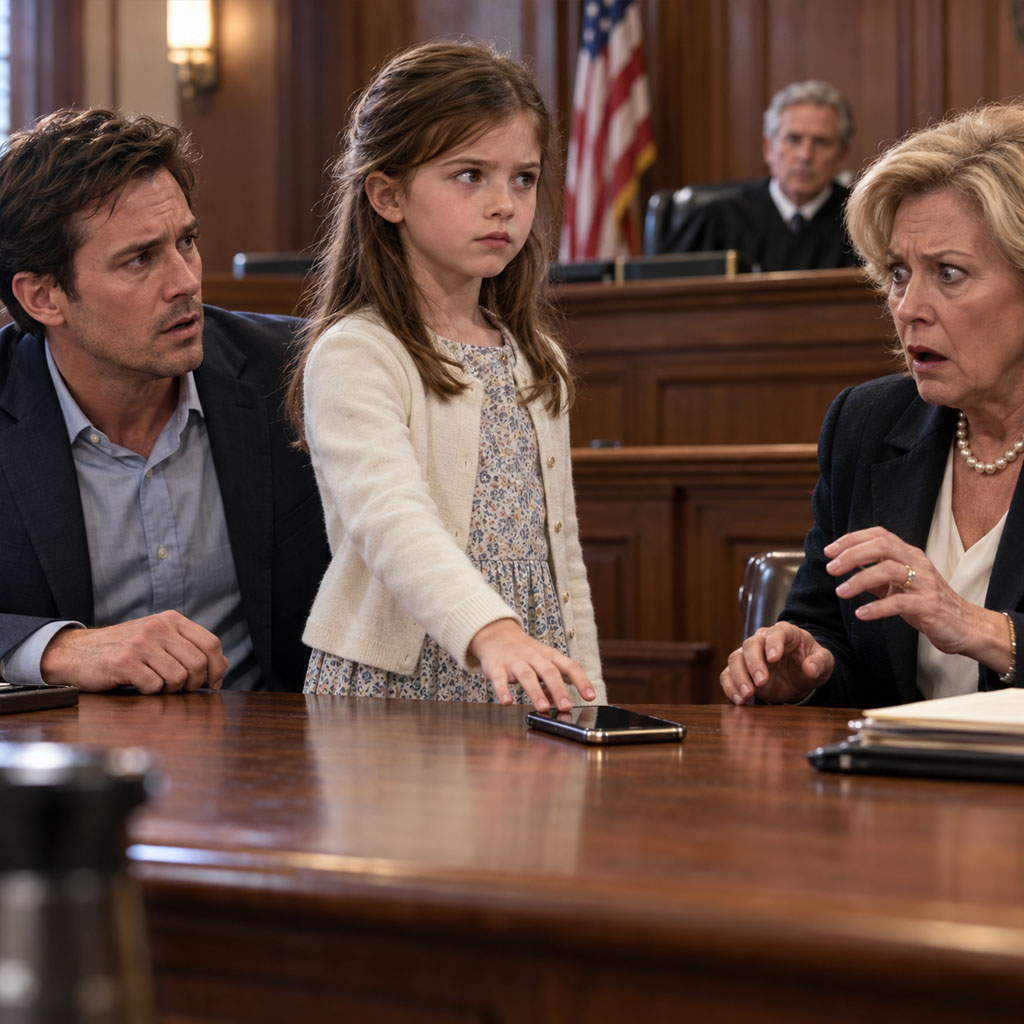
A small hand rose in the front row.
Lily stood beside her advocate.
“Excuse me, Your Honor. Can I play something from Grandma’s phone?”
Diane’s purse was sitting near the bench where Lily had been seated during the recess. Somehow, the pink-cased phone that Diane had allowed her granddaughter to use was now in Lily’s hands.
My mother-in-law jumped to her feet.
“That’s my private property!”
Judge Harper immediately instructed everyone to remain seated.
Charles Mercer objected, pointing out that a child’s possession of another person’s phone did not make its contents automatically admissible.
The judge agreed that proper procedures were necessary.
But she also noticed something unmistakable.
Diane was trembling.
Judge Harper asked the advocate to take possession of the device and ensure it was preserved. She then asked Lily, gently, whether she understood what she had found.
“I heard Grandma talking to Mr. Mercer,” Lily answered. “She said the other people knew what to say.”
Diane burst into tears.
“She’s confused! She’s only nine!”
The judge looked toward my mother-in-law.
“Mrs. Whitmore, your granddaughter has raised a serious concern. We will handle it carefully, and no one is going to place responsibility for this proceeding on her.”
After a brief recess, the parties addressed how the recordings could be reviewed. The judge ordered the device secured and allowed a limited examination of relevant material under court supervision, subject to further authentication.
That afternoon, one recording was played in the courtroom.
Charles Mercer’s voice came through the speaker.
“Diane, everyone understands the arrangement. Dawson’s debt has been handled. Reverend Cooper gets his church renovation contribution. They know the questions Helen Price will ask.”
Then Diane answered.
“And they’re all going to deny it?”
“Of course. A simple no. That’s all they need to say.”
The recording ended.
The courtroom was silent.
Judge Harper stared at the speaker.
Then she looked toward Charles Mercer.
“Counselor, I believe we have a very serious problem.”
Chapter 3
Charles Mercer tried to speak, but nothing coherent came out.
Diane pressed both hands against her mouth. Robert stared at the table, and Melissa’s face had gone completely white.
Judge Harper ordered a recess and directed that the relevant recordings be preserved for further examination.
The next recording was even worse.
Melissa’s voice filled the courtroom.
“Mom, stop worrying. Once Dad and you have custody, I can move to Arizona and start over.”
Diane replied, “And Thomas?”
“He’ll be too busy fighting the court to stop anything. Charles says filing through you and Dad makes the whole thing look like a loving family stepping in.”
“What about Lily?”
“She’s nine, Mom. She’ll get used to it.”
Then Diane said the words I’d heard my daughter repeat weeks earlier.
“Once we have her, everything will finally be quiet.”
I felt physically sick.
For years, I’d believed Melissa was unhappy because I wasn’t ambitious enough. I’d believed we might eventually separate respectfully and find a way to raise Lily together.
Now I understood that she had been willing to let her parents take our daughter while she moved across the country.
Judge Harper instructed the court reporter to preserve the exact words.
The judge’s face had become stern and deeply troubled.
“Mrs. Bennett,” she said to Melissa, “are you telling this court that you supported a third-party custody petition because you intended to relocate?”
Melissa began crying.
“I didn’t want to hurt anybody.”
“That was not my question.”
“I just wanted a different life.”
“And you believed depriving your daughter of her father was the way to obtain it?”
Melissa lowered her head.
Robert suddenly stood.
“I didn’t know about any of this.”
Diane turned toward him.
“Robert, sit down.”
He ignored her.
“You told me we were helping Lily. You told me Thomas was dangerous.”
“Robert!”
“You said those people came forward because they were worried.”
Judge Harper instructed them to stop speaking over one another.
Robert sank back into his chair, looking twenty years older than when he’d entered.
Another recording revealed that money had been directed toward the church elder’s building fund. A separate conversation referred to Eric’s gambling debt and the expectation that he would cooperate.
Helen requested that the entire matter be reviewed by appropriate investigators.
The judge agreed.
Then something unexpected happened.
The court’s technical specialist identified a separate audio file labeled “Tom Final.”
It was ninety seconds long.
When played, I heard my own voice.
“You think I won’t do it? I’ll take Lily somewhere you’ll never find her.”
A woman’s frightened gasp followed.
Then came a loud crash.
My stomach dropped.
“I never said that.”
Charles Mercer suddenly recovered enough confidence to speak.
“Your Honor, that recording demonstrates precisely why the family became concerned.”
But something about the sound bothered me.
I listened again.
Behind my supposed threat was the faint chime of a clock.
Not just any clock.
The old Vienna regulator hanging in my living room.
It had a distinctive flat tone because its original bell had been replaced decades earlier. It chimed once every half hour.
In that ninety-second recording, the chime sounded twice.
I leaned toward Helen.
“That recording has been altered.”
“How can you tell?”
“The clock. Listen.”
She requested that the audio be replayed.
The judge listened carefully.
There it was.
A soft, slightly flat metallic note.
Then, barely a minute later, the same note again.
I explained the clock’s mechanism and why it couldn’t produce those two scheduled chimes so close together.
The specialist confirmed that the recording contained suspicious discontinuities and recommended a formal forensic examination before any conclusions were drawn.
More importantly, another file contained the longer original conversation.
In it, I was speaking calmly to Diane about Melissa’s departure and asking whether my wife needed help.
Individual words and phrases had apparently been taken from that conversation and rearranged to manufacture a threat.
As the specialist explained the discrepancies, Charles Mercer stared straight ahead.
Judge Harper looked at him for a long moment.
“Mr. Mercer, there is now substantial reason to believe that this court has been presented with coordinated false testimony and manipulated evidence.”
He said nothing.
“The matter will be referred for criminal and professional investigation. This court will also consider whether sanctions are appropriate.”
For the first time since the proceedings began, I felt the pressure in my chest begin to loosen.
But I wasn’t thinking about revenge.
I was thinking about Lily.
She had been sitting quietly with her advocate, watching adults she loved turn against one another.
I wanted her out of that room.
Judge Harper seemed to understand.
She directed the advocate to take Lily into a private waiting area and asked me to accompany her.
As we walked through the doorway, Lily reached for my hand.
“Daddy, did I make everybody mad?”
I crouched beside her.
“No, sweetheart.”
“Grandma looked really upset.”
“That’s because the grown-ups have some serious things to answer for.”
She looked frightened.
“Am I going to get in trouble for touching her phone?”
I hugged her.
“The adults will sort out what happened with the phone. You are not responsible for what anyone said in those conversations.”
She buried her face against my shoulder.
“I just wanted them to stop saying you were bad.”
I held her for a long time.
When the hearing resumed, the court dismissed the grandparents’ custody petition after considering the full record and the serious credibility problems. The judge entered protective temporary orders maintaining Lily’s residence with me while remaining custody matters were addressed.
She also ordered that further contact with Melissa and her grandparents be supervised pending review.
The recordings and testimony were referred to investigators.
As we left the courthouse that evening, Eric Dawson approached me in the hallway.
His eyes were swollen from crying.
“Mr. Bennett, I need to tell you something.”
I stopped.
“They paid off what I owed. Mr. Mercer said all I had to do was tell the court you scared me.”
“Did I ever shove you?”
He shook his head.
“No, sir.”
“Then tell the investigators the truth.”
He nodded.
“I’m sorry.”
I looked at the young man I’d once tried to help.
“I’m sorry too, Eric. But being desperate doesn’t make lying about a child acceptable.”
He lowered his head.
I took Lily’s hand and walked outside.
Cold rain was falling across the courthouse steps.
She looked up at me.
“Can we go home now?”
I squeezed her hand.
“Yes, sweetheart. We’re going home.”
Chapter 4
The consequences unfolded over the following months.
Charles Mercer faced criminal charges related to witness tampering and falsified evidence. He eventually entered a guilty plea and lost his license to practice law.
Diane admitted helping coordinate the false testimony and received a sentence that included probation and strict restrictions on contacting witnesses.
Several other witnesses faced penalties for their participation.
The counselor’s professional conduct was investigated, while Eric cooperated with authorities and entered a court-approved diversion program.
Robert told investigators everything he knew. He maintained that Diane had deceived him about the payments and had repeatedly insisted Lily was unsafe with me.
I didn’t know how much he’d understood before the hearing.
For Lily’s sake, I was willing to leave that question to the investigators.
Melissa eventually acknowledged her involvement and accepted responsibility through a plea agreement.
Her plan to move to Arizona fell apart.
Our divorce was finalized the following spring, and I was awarded primary legal and physical custody of Lily.
I never celebrated the outcome.
There was too much sadness wrapped around it.
A child had nearly lost the home she loved because adults had confused their own desires with her best interests.
After the hearing, Lily had trouble sleeping.
Sometimes she woke from dreams in which somebody took her away from my shop. Other nights, she worried that her mother no longer loved her.
I arranged for her to meet with a child therapist named Dr. Rebecca Ellis.
Dr. Ellis helped Lily understand that adults could make harmful choices without those choices being the child’s responsibility.
The healing came gradually.
Some mornings, Lily was her cheerful old self. Other days, she became quiet when we passed the grocery store where I’d once handed her over for weekend visits.
One Saturday, she asked whether she’d ever see Melissa again.
“Yes, sweetheart. There are safe ways for you to spend time together.”
“Even after what Mommy did?”
“She’s still your mother. That doesn’t make what happened okay, but it doesn’t mean you have to stop loving her.”
Lily considered that.
“Can I be mad at her and still love her?”
“Absolutely.”
She nodded.
“Good. Because that’s how I feel.”
When supervised visits eventually began, they took place in a family services center.
At first, Melissa spent most of each hour crying and apologizing.
Lily found those visits exhausting.
After speaking with Dr. Ellis, Melissa learned to focus on being present rather than asking her daughter to make her feel better.
They began playing board games, talking about school, and reading together.
Trust returned slowly.
There were setbacks, awkward conversations, and moments when Lily chose not to visit.
But Melissa kept her appointments, respected the rules, and stopped asking for more than Lily was ready to give.
I noticed the change.
I couldn’t forget the courtroom or the recording in which she treated our daughter like an obstacle to a different life.
Yet I hoped she might eventually become the mother Lily deserved.
As for Diane, our contact remained limited.
Robert and Diane separated after forty-three years of marriage. He moved into a small apartment and began attending counseling.
Several months later, he wrote me a letter.
He didn’t ask for forgiveness.
Instead, he described his shame at allowing his wife’s certainty to substitute for his own judgment.
“I should have asked questions,” he wrote. “I should have spoken to Lily instead of deciding what was best for her. And I should never have accepted accusations about you simply because they came from my own family.”
I read the letter twice.
Then I put it away.
Forgiveness wasn’t something I could manufacture because another person finally understood the damage.
But I appreciated that Robert had stopped making excuses.
That summer, an unexpected telephone call came from the courthouse.
Judge Harper’s clerk asked whether I’d be willing to inspect the large wall clock in Courtroom Three.
Apparently, it had been running seven minutes slow for years.
I laughed when I heard that.
I’d noticed the problem on the morning of our hearing, but I hadn’t exactly been in a position to offer repair services.
On a quiet Saturday afternoon, Lily and I arrived at the courthouse carrying my toolbox.
The building felt different without lawyers, witnesses, and worried families filling the halls.
Sunlight streamed through the tall windows. The courtroom benches were empty, and the silence was broken only by the air-conditioning.
I set up a stepladder beneath the clock.
Lily sat in the front row, on the same bench where she’d raised her hand months earlier.
“Are you going to fix it, Daddy?”
“That’s why they called us.”
I removed the clock and opened its case.
The problem was simple.
Its minute hand had been incorrectly positioned years earlier, causing the displayed time to remain consistently wrong.
I adjusted it, checked the movement, and hung it back on the wall.
Lily watched the second hand travel around the dial.
“How long was it broken?”
“According to the clerk, almost ten years.”
“And nobody fixed it?”
“I guess everybody got used to seeing the wrong time.”
She thought about that.
“That’s kind of sad.”
“Why?”
“Because if something’s wrong for a long time, people start thinking it’s normal.”
I stopped packing my tools.
Sometimes children say things that take adults a lifetime to understand.
“You’re right, sweetheart.”
We sat together for a while, watching the clock.
Then Lily asked a question I’d been expecting.
“Daddy, did I save you?”
I turned toward her.
“You helped the truth come out.”
“But if I hadn’t found Grandma’s phone, maybe they would’ve believed everybody else.”
“Maybe. We had other evidence too, and Helen was working hard to protect us.”
Lily looked down at her shoes.
“I was scared when Grandma started yelling.”
“I know.”
“I thought she was going to hate me forever.”
I put an arm around her shoulders.
“Listen carefully, sweetheart. You didn’t make those recordings. You didn’t tell those lies. Whatever your grandmother feels about what happened, those are her feelings to work through.”
She leaned against me.
“I just wanted to live with you.”
I kissed her forehead.
“And I’m grateful every day that we get to be together.”
Outside, the afternoon sun was beginning to disappear behind the hills.
We packed the tools and drove back toward Cedar Falls.
That evening, we stopped for hamburgers and milkshakes at the diner my grandfather used to take me to when I was a boy.
Lily ordered chocolate.
I ordered vanilla.
She stole half my fries, just as she always did.
On the way home, she fell asleep with her head against the truck window.
I watched the road stretch ahead beneath the orange light of sunset and thought about the strange path our lives had taken.
My in-laws had tried to take my daughter by convincing a courtroom that I was dangerous. They had gathered witnesses, rehearsed stories, and treated the truth like something that could be rearranged to suit their plans.
They’d believed that wealth, confidence, and a respected attorney would be enough.
But their carefully constructed story had fallen apart because of something they never considered.
A nine-year-old girl had listened.
She’d heard adults speaking when they thought she wasn’t paying attention. She’d recognized that their private words were different from what they said in public.
And when the moment came, she’d found the courage to speak.
For months afterward, strangers who heard about the case would occasionally ask whether I felt victorious.
I never knew quite how to answer.
I had kept my daughter, my home, and the little shop my grandfather left me. In that sense, yes, I had won.
But Lily had also learned that people she trusted were capable of terrible dishonesty.
There was no celebration that could erase that.
What mattered was what happened afterward.
She grew more confident. She returned to school without fearing someone would suddenly take her away. She continued spending afternoons on her stool beside my workbench, asking questions that made me rethink things I’d believed for years.
One evening, nearly a year after the hearing, she helped me repair an old mantel clock.
The owner had brought it in after her husband died. It had stopped on the morning of his funeral, and she couldn’t bear to throw it away.
Lily watched as I carefully replaced a damaged spring.
“Will it work again?”
“I think so.”
“Will it sound exactly like before?”
“Maybe not. Some older clocks develop a slightly different sound after repairs.”
She frowned.
“Does that mean it’s ruined?”
I looked at the clock, then at my daughter.
“No, sweetheart. It just means something happened to it. That doesn’t mean it can’t keep good time.”
She smiled.
We wound the clock together.
A moment later, its pendulum began swinging.
Tick.
Tock.
Tick.
Tock.
Lily leaned close and listened.
“It’s different,” she whispered.
“Yes.”
“But I like it.”
I watched her face brighten as the movement settled into a steady rhythm.
And suddenly I understood what my grandfather had spent so many years trying to teach me.
Repairing something doesn’t erase the damage it suffered. It means taking what remains, treating it with care, and giving it the chance to work again.
Our family would never be what it once was.
Melissa and I would never share the marriage we’d imagined. Diane would have to live with the consequences of her choices. Robert would spend years rebuilding relationships he’d allowed to be damaged.
And Lily would carry memories no child should have needed.
But those memories would not decide her future.
She still had a home where she felt safe, a father who listened, and people willing to help her grow into the person she was meant to become.
That was enough to begin again.
As I switched off the lights in the shop, Lily slipped her hand into mine.
“Daddy?”
“Yes, honey?”
“Do you think Grandpa Henry would be proud of us?”
I looked around the shop he’d built, at the clocks he’d taught me to repair and the wooden stool where three generations of our family had sat.
My throat tightened.
“I think he’d be very proud.”
Lily smiled.
“Good. Because I think he’d like that we fixed the courthouse clock.”
I laughed.
“He definitely would.”
We walked outside together, and I locked the door behind us.
For the first time in a long while, I wasn’t wondering what tomorrow might take away.
I was thinking about what tomorrow might bring.
The truth had finally been heard. The people who lied had faced the consequences of their choices, and my daughter was free to be a child again.
And whenever someone asks what I remember most about that terrible day in court, I don’t tell them about my mother-in-law’s face or the attorney’s stunned silence.
I remember a little girl standing beside a courtroom bench, frightened but determined, asking whether someone would finally listen.
She taught me that courage doesn’t always arrive with a raised voice.
Sometimes it comes from the smallest person in the room, speaking softly enough that everyone else must become quiet to hear.
THE END. ⚠️ All characters and events are fictional. Do not imitate or apply them in real life. 😌😌😌

