
Chapter 2
Leonard Voss practiced family law out of a modest office between a nail salon and a sandwich shop. He was in his sixties, wore reading glasses low on his nose, and had the calm manner of a man who had watched hundreds of marriages collapse without ever becoming impressed by the drama.
He asked me about the house, the shop, retirement accounts, vehicles, savings, debts, and twenty-eight years of finances.
When I finished, he leaned back.
“Document everything.”
I almost laughed.
“I’m a mechanic. I document everything.”
That turned out to matter.
I had tax returns, mortgage records, business statements, loan payments, receipts, credit card records, and old bank files stacked in boxes. When Leonard and his staff organized them, the picture became clearer than I wanted it to be.
Over the years, I had paid more than $60,000 in credit card debt Colleen accumulated. Shopping, restaurants, trips, things for the house, things Paige wanted. Whenever I objected, Colleen promised she would cut back.
She never really did.
Sheridan Auto, meanwhile, had grown from three bays to six. I had paid off the business loan and reinvested most of my profits into equipment and payroll. The shop was now worth close to $400,000.
Colleen had never worked there.
When Victor helped me move my personal belongings from the house, I expected anger. What surprised me was grief.
My father’s worn leather recliner came with me. So did my tools, old photographs, winter clothes, and boxes of keepsakes.
The workbench in the garage stayed behind.
I ran my fingers across its scarred wooden surface before leaving. Paige had stood beside me there when she was sixteen while I showed her how to change her oil.
She had complained that her hands smelled afterward.
I had laughed.
That memory felt like it belonged to somebody else.
The divorce papers were served the following week.
Three days later, Colleen appeared at Victor’s house.
She looked tired and furious.
“You filed without even talking to me.”
“Talking requires listening.”
“You’re throwing away twenty-eight years because Paige said something stupid.”
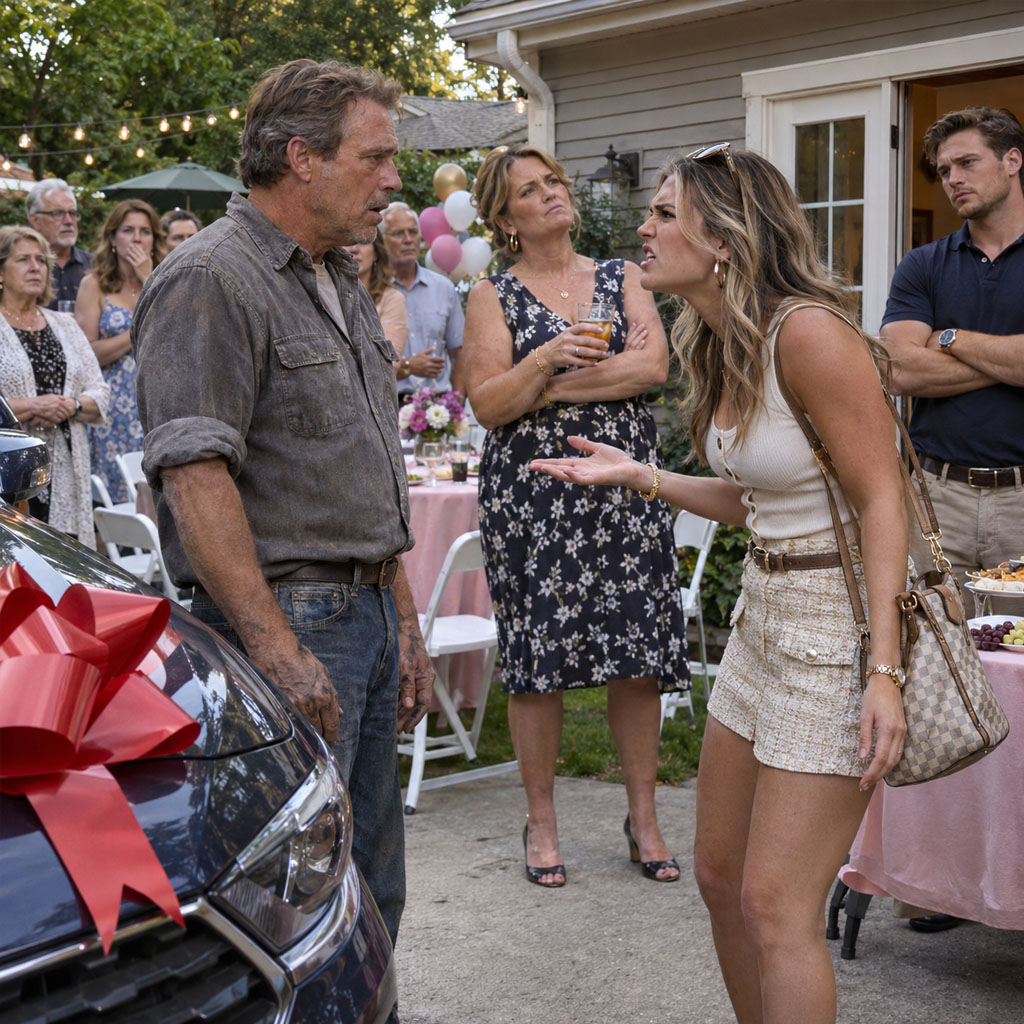
“You called a thirty-two-thousand-dollar car pathetic.”
“She was embarrassed.”
“So was I.”
Colleen crossed her arms.
“You’ve always been too sensitive about money.”
That almost made me smile.
“I worked sixty-hour weeks so you wouldn’t have to be sensitive about money.”
Her expression hardened.
“I want the house.”
There it was.
Not I miss you.
Not Can we fix this?
The house.
“Talk to Leonard.”
“You’re really doing this?”
“Yes.”
She studied me, perhaps searching for the version of me who always gave in after enough pressure.
Apparently, she didn’t find him.
“You’ll regret it.”
“Maybe.”
She turned and walked back toward her car.
The engine knocked badly as she drove away. The mechanic in me knew exactly what it needed.
The husband in me no longer cared.
Mediation came in October.
Colleen asked for the house, half my retirement, and alimony. Her attorney described her as a homemaker who had supported my career while raising our daughter.
Leonard placed twenty-eight years of records on the conference table.
Mortgage payments from my income.
Business loans repaid by me.
Credit card balances I had covered.
Bank statements.
Tax filings.
Detailed records of Colleen’s spending.
Her attorney grew noticeably quieter.
During a break, Leonard asked what mattered most to me.
“The shop.”
“And the house?”
I thought about the garage. Christmas mornings. Paige racing down the stairs in pajamas. Summer evenings on the deck.
Then I remembered her birthday.
“Let Colleen have it.”
The final agreement gave Colleen the house and 15 percent of my retirement. No alimony. Sheridan Auto remained mine.
When I signed, I expected triumph.
Instead, I felt relief.
Victor was waiting outside.
“So?”
“House is hers. Shop is mine.”
He slapped my shoulder.
“Dinner’s on me.”
That winter I rented a two-bedroom apartment across town.
It was quiet. Almost painfully quiet at first.
Then the quiet became peaceful.
Chapter 3
My life slowly filled itself again.
Sheridan Auto got busier. I hired two young mechanics out of trade school and discovered I enjoyed teaching them. Victor talked me into joining his bowling league. We finished near the bottom every week and celebrated as though losing consistently required special talent.
I even learned to cook.
Then I adopted Bruno.
He was an eight-year-old shelter mutt with gray around his muzzle and the suspicious expression of a retired security guard. Puppies came and went while Bruno had been overlooked for six months.
I understood overlooked.
He came home with me that afternoon.
Paige married Chester in March.
I wasn’t invited.
A cousin told me it was held in Colleen’s backyard—the same backyard where my daughter had told me she wished she had a better father.
I didn’t send a gift.
I didn’t send an angry message either.
I simply let the day pass.
For the first time in my adult life, I stopped trying to purchase peace.
Months later, while sorting old paperwork for the shop, I began adding up everything I had paid for Paige after she reached adulthood.
Tuition.
Apartment rent.
Insurance.
Emergency repairs.
A maxed-out credit card.
Dental work.
Medical bills after a skiing accident.
I created a spreadsheet mostly because I wanted to understand how far the pattern went.
The total stunned me.
Just over $140,000.
That did not include food, clothing, childhood expenses, or all the ordinary costs parents willingly accept. This was money spent after Paige became an adult—money I had repeatedly handed over because she needed rescuing.
I printed the records and organized them in a black binder.
On the cover, I wrote:
WHAT I GAVE.
Victor found it one Tuesday during lunch.
He flipped through several pages.
“That’s a lot of money.”
“That’s a lot of years.”
“What are you going to do with it?”
“I don’t know.”
He closed the binder.
“This won’t make them grateful.”
“I know.”
“Then what’s it for?”
I looked at the cover.
“Maybe it’s for me.”
Six months later, I learned Paige and Chester had bought a house.
The numbers didn’t make sense. Chester sold insurance. Paige worked part-time at a boutique. Neither earned enough to explain the down payment.
Then my cousin told me.
Colleen had borrowed $40,000 against the house she received in the divorce.
The house I had worked decades to pay off.
The equity had become Paige’s down payment.
When Victor came to the shop that Tuesday, he took one look at me.
“You’ve got that face.”
“What face?”
“The one you get before you either fix something or make it worse.”
I told him what happened.
He was quiet.
“Whatever you do, make sure you can live with it afterward.”
That night I opened the black binder.
For years, Colleen had apparently told relatives that I had abandoned my family over a birthday argument. Paige had told Chester’s parents she had always been financially independent.
Neither version matched the paperwork.
I copied twenty-seven pages.
I sent one packet to Colleen’s sister.
The other went to Chester’s parents.
No insults.
No accusations.
No demand for sympathy.
Just dates, amounts, statements, and receipts.
The truth did the rest.
Chester’s parents had helped their son financially because they believed he and Paige were building a life on their own. When they learned how much support Paige had received—and where the new down payment had originated—they started asking questions.
Colleen’s sister did the same.
Within days, the stories Colleen and Paige had been telling began to unravel.
I heard most of it through my cousin. There were arguments. Hurt feelings. Chester and Paige fought over money. Chester’s parents felt misled. Colleen’s sister confronted her about years of spending and the claim that I had simply walked away.
Colleen left one voicemail.
“I hope you’re happy with what you’ve done.”
I deleted it.
I wasn’t happy because they were miserable.
I was happy because, for once, I didn’t have to defend myself.
The records could speak without me.
Chapter 4
More than a year after the birthday party, Paige came to my apartment.
I was sitting on the balcony with Bruno when her old Honda pulled into the parking lot. The engine sounded terrible.
Some things, apparently, never changed.
Paige climbed the stairs slowly.
When I opened the door, I barely recognized the expression on her face. She looked older—not in years, but in the way disappointment can age a person.
“Can I come in?”
“The balcony’s fine.”
We sat across from each other. Bruno sniffed her shoe, decided the situation did not interest him, and returned to his bed.
Paige stared through the railing.
“Chester’s parents barely speak to us.”
I waited.
“They think I lied.”
“Did you?”
Her jaw tightened.
“They didn’t need to know every detail of my finances.”
“The past paid for your present.”
She looked at me.
“That down payment came from equity in the house your mother received. I paid that mortgage for years. You don’t get to pretend money appears from nowhere.”
“You didn’t have to send them everything.”
“No. I didn’t.”
“Then why?”
I leaned back in Victor’s rocking chair.
“Because your mother was telling people I abandoned both of you over nothing. And you were telling people you built your life without help. I got tired of being the villain in a story I financed.”
Her eyes filled.
“That was cruel.”
I considered that.
“Maybe it was. But facts can feel cruel when you’ve spent years avoiding them.”
She wiped her face.
“I’m sorry.”
I had imagined hearing those words many times.
They didn’t satisfy me as much as I expected.
“Sorry you said it, or sorry there were consequences?”
Paige stared at her hands.
For once, she didn’t have an immediate answer.
Finally, she whispered, “Both.”
That honesty mattered more than a dramatic apology would have.
“I was spoiled,” she said. “I thought because you could afford things, you owed them to me. Mom always said you were cheap when you said no. I believed her because it was easier.”
“And the birthday?”
She closed her eyes.
“I wanted to impress people who don’t even matter anymore.”
I looked toward the parking lot, where her Honda sat beneath a streetlamp.
“You called me pathetic in front of them.”
“I know.”
“You said the best gift would be a decent father.”
Her voice broke.
“I know.”
I remembered scraped knees, school plays, braces, Christmas bicycles, graduation pictures. Love does not disappear merely because someone wounds you. But love also does not require pretending the wound never happened.
“I want my dad back,” she said.
“You never lost your dad.”
She looked at me.
“You pushed me away, Paige. There’s a difference.”
“What do I do?”
There it was again—the question she had always asked before I solved something for her.
What do I do?
Which check do you write?
Who do you call?
How do you fix it?
I shook my head.
“I’m not giving you instructions this time.”
“But I’m trying.”
“Then keep trying.”
Her frustration showed immediately.
“What does that even mean?”
“It means get your finances under control. Maintain your own car. Pay your own bills. Treat your husband honestly. Stop expecting your mother to borrow against her future every time you want something today. Become somebody who understands what things cost—not just in dollars.”
She stared at me.
“And then you’ll forgive me?”
“I didn’t say that.”
Her face fell.
“I’m not bargaining with you. Do those things because they’re right, not because you think they’ll earn a reward from me.”
We sat quietly.
A year earlier, Paige would have argued until I gave her the answer she wanted.
This time, she nodded.
“I’ll try.”
“Trying is a start.”
She left without a hug.
I watched her Honda pull away, the engine stumbling as it reached the street.
Bruno rested his head on my shoe.
For the first time since the birthday party, I allowed myself to hope—but only a little.
Chapter 5
Hope turned out to require patience.
For nearly three months, Paige did not ask me for anything.
Then one Saturday morning, she walked into Sheridan Auto.
One of my mechanics came to the office.
“Boss, there’s a woman asking if we can look at her Honda.”
I stepped into the waiting area.
Paige stood by the counter.
“What’s wrong with it?” I asked.
“Everything, probably.”
Normally, I would have taken the keys and fixed it for free.
Instead, I said, “Eddie can diagnose it. Shop rate is posted by the door.”
She glanced at the sign.
Then at me.
“Okay.”
That single word surprised me.
The repairs were more than the Honda was worth. Paige listened while Eddie explained the estimate. She didn’t demand a discount.
“I can’t afford that,” she said.
Eddie looked at me.
I said nothing.
Paige took a breath.
“Then I guess I need to start saving for another car.”
She paid the diagnostic fee herself.
Before leaving, she stopped by my office.
“I picked up more hours at the boutique. And I started bookkeeping classes at the community college.”
I nodded.
“That’s good.”
“Chester and I made a budget.”
“That’s better.”
She almost smiled.
Then she left.
Over the next six months, the changes continued quietly.
Paige sold clothes and handbags she no longer needed. She and Chester cut expenses. When Colleen offered them more money, Paige turned it down.
I knew because Colleen called me.
It was the first conversation we had had since the divorce.
“She says you made her ashamed to accept help,” Colleen said.
“No. I asked her to understand the difference between help and dependence.”
“You turned her against me.”
“She’s twenty-seven. Maybe let her make her own choices.”
Colleen was silent.
Then, unexpectedly, she said, “I made mistakes too.”
I didn’t answer.
“I spent too much,” she continued. “I encouraged Paige because I liked being the parent who said yes. You were always the one who worried about the future.”
“That made me easy to blame.”
“Yes.”
Her voice softened.
“I’m sorry for what I said at the party.”
It was not enough to rebuild a marriage.
But it was enough to end the conversation without anger.
“I appreciate you saying that.”
A year later, Paige returned to the shop.
This time, she was driving a six-year-old Toyota she had purchased with money she and Chester saved.
“No bow?” I asked.
She laughed nervously.
“No bow.”
She handed me a small paper bag.
Inside was a coffee mug.
WORLD’S MOST STUBBORN MECHANIC.
“I know it’s not much.”
I looked at her.
“It’s yours to give.”
She nodded, understanding exactly what I meant.
We sat in my office drinking coffee.
She told me she had finished her bookkeeping certificate and was working full-time for a small accounting firm. Chester had started counseling with her after their marriage nearly fell apart. They were still learning how to talk about money without turning every disagreement into a battle.
“What about your house?” I asked.
“We’re paying Mom back for the down payment.”
That surprised me.
“All of it?”
“Every dollar. It’ll take years.”
“Good.”
She smiled faintly.
“I knew you’d say that.”
Then she reached into her purse.
“I found something when Mom cleaned out the garage.”
She handed me a photograph.
Paige was seven years old, sitting beside me on the half-built platform of her treehouse. I was holding a hammer. She was wearing an oversized plastic construction helmet and grinning proudly.
On the back, in my handwriting, were four words:
Built it with Dad.
My throat tightened.
“I remember that day,” she said. “You let me hammer one nail and I bent it sideways.”
“You bent three.”
She laughed.
Then her face grew serious.
“I used to think being a good father meant giving me what I wanted.”
I said nothing.
“I was wrong.”
That was the apology I had been waiting for.
Not because she cried.
Not because her life became difficult.
Because she finally understood.
I stood and walked around the desk.
For a moment, neither of us moved.
Then Paige stepped forward.
I hugged my daughter.
It wasn’t the kind of embrace that erased the past.
Nothing could.
It was simply the beginning of something healthier.
Something neither of us could buy.
Victor later asked whether I regretted the divorce, the binder, or walking away that night.
I thought about Colleen living her own life, Paige learning to stand on her own feet, Sheridan Auto thriving, Bruno sleeping beneath my desk, and the rocking chair on my balcony.
“No,” I said.
“Not even the seven grand you lost on the Mazda?”
“That still bothers me.”
Victor laughed so hard he nearly dropped his coffee.
I had spent most of my life believing love meant giving until there was nothing left to give. I know better now.
A decent father does not measure love by the price of a gift.
And a decent family does not measure a man by how much they can take from him.
Sometimes the most important thing you can give the people you love is a boundary—and the chance to become better when they finally reach it.
THE END
⚠️ All characters and events are fictional. Do not imitate or apply them in real life. 😌😌😌