Chapter 2
I didn’t answer.
The phone rang six times before going silent. Then it started again.
I turned it face down on the pavement.
Floyd watched me carefully.
“Joel, I think you need to call somebody.”
I pulled out my own phone and called Ron Ortiz, a deputy sheriff I’d known since high school. We’d played baseball together. He had been my catcher, and over the years, we’d developed the kind of friendship where neither man needed to explain everything before asking for help.
Ron arrived nineteen minutes later.
He was off duty, wearing jeans and a faded work shirt. But when he saw Hope sitting on my couch, wrapped in the quilt from my bed, his expression changed immediately.
He didn’t waste time asking unnecessary questions.
The documents were spread across my kitchen table.
There was a real passport issued in my daughter’s new name. There was an airline reservation showing two seats on a one-way flight from Wichita to Houston, then onward to San Jose, Costa Rica.
The departure was scheduled for Saturday morning at 6:05.
The adult passenger was Carson R. Sheffield.
The child passenger was Hope A. Sheffield.
There was no third passenger.
I looked at the date on the reservation. The tickets had been purchased eleven days earlier.
Underneath them was a document bearing the seal of the U.S. Department of State.
It was a parental consent form authorizing the issuance of a passport for a child under sixteen.
According to the document, I had given permission for Hope to receive the passport and travel internationally.
At the bottom was my signature.
Or something very close to it.
The little tail on the J was almost perfect. The way I crossed the T in Tidwell was exactly the same.
But I hadn’t signed it.
“That’s a good forgery,” Ron said quietly.
I stared at him.
“Then arrest him.”
Ron rubbed his forehead.
“I can’t just arrest somebody because you say he forged your signature. We need evidence showing who actually signed it. The notary stamp is from another county. I’ll have to contact the appropriate authorities.”
“The flight is Saturday.”
“I know.”
“That’s two days away.”
“I know, Joel.”
He looked toward Hope, who was sitting quietly on the couch.
“There’s another problem. Angela has custody this week. If Carson and Angela come here demanding that you return her, I need a legal basis to keep her away from them.”
I felt my jaw tighten.
“You’re telling me I have to hand her back?”
“I’m telling you we need to protect her without giving Carson’s attorney an easy way to turn this into a custody violation.”
Before I could answer, headlights appeared outside.
A white pickup truck pulled up behind the school bus.
Angela stepped out of the passenger seat.
Carson remained behind the wheel.
Angela wore a gray cardigan I’d bought her for our fifth anniversary. Her hair was pulled back, the way she used to wear it when she was nervous.
Ron moved toward the door.
“Don’t open it yet,” he told me.
“That’s Hope’s mother.”
“Exactly. Let me talk to them first.”
I watched from the window.
Carson stepped out of the truck and approached Ron with a friendly smile. They shook hands. Carson said something that made Ron’s shoulders stiffen.
Then Carson looked up at my apartment window.
He raised two fingers to his forehead in a small, casual salute.
I had never wanted to break a window before.
When Ron returned upstairs, he looked exhausted.
“They’re saying Floyd took Hope without permission. They want her returned tonight.”
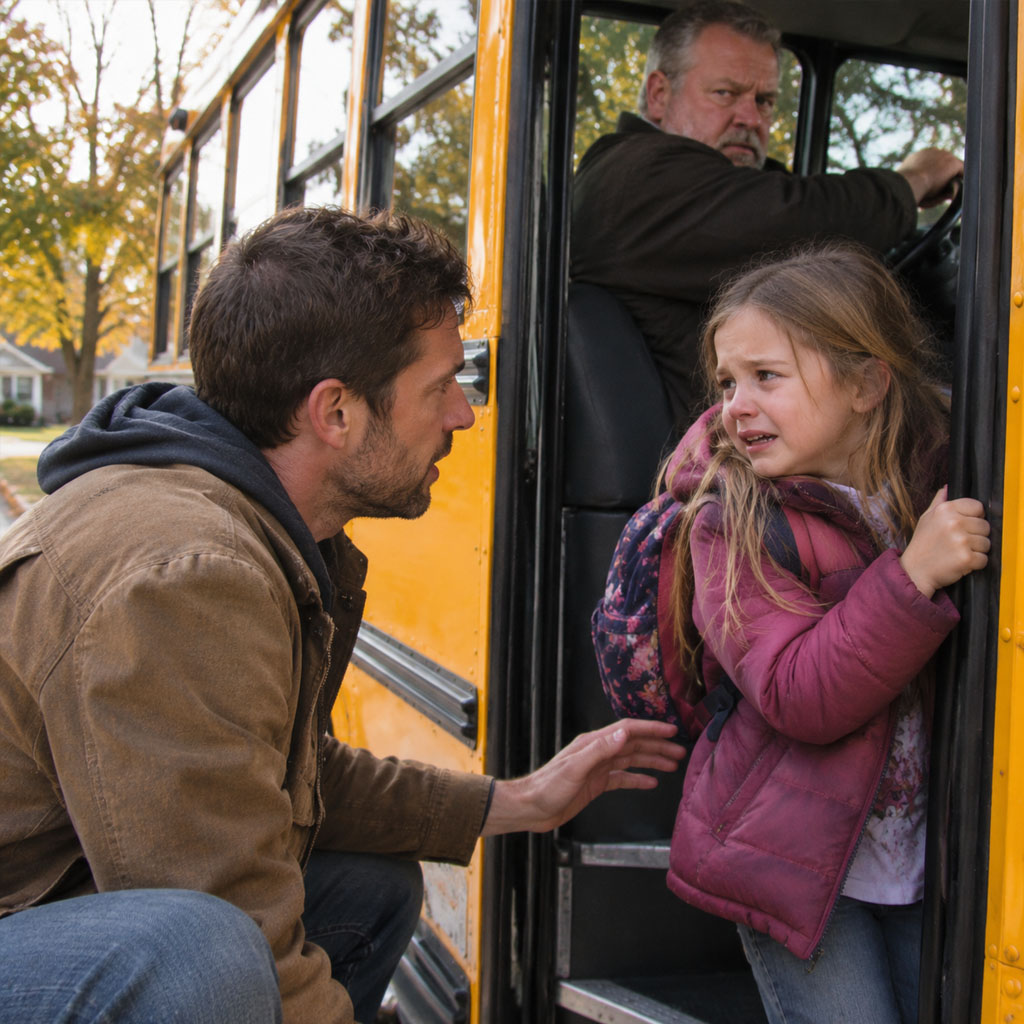
“She refused to get off the bus.”
“They say that’s irrelevant.”
“She’s six years old, Ron.”
“I know.”
Ron looked at the documents again.
“Carson is threatening to file a kidnapping report against Floyd if Hope isn’t returned within ten minutes.”
Floyd, who had been sitting at my kitchen table with an untouched cup of coffee, closed his eyes.
“I’ve never been in trouble in my life,” he whispered.
Ron pulled out a chair.
“There’s a provision in Kansas law that allows an officer to place a child temporarily with a relative if there’s reason to believe the child faces immediate danger while in a parent’s custody. We need a relative both sides can identify.”
Floyd looked up.
“Gail Barlow.”
Angela’s mother.
Gail was a retired school librarian who lived in a white house on Cedar Street. She was a small, sharp-eyed woman who believed in returning books on time and telling the truth even when it was uncomfortable.
During my divorce, she had hugged me outside the courthouse and said she loved both me and her daughter, though she was disappointed in us both.
Ron called her.
The conversation lasted four minutes.
When he hung up, he picked up his keys.
“She’s waiting. She says the porch light is on.”
We made the arrangements quietly.
Ron informed Carson that Hope would be placed temporarily with her grandmother pending a court hearing the following morning.
Carson didn’t shout.
He didn’t argue.
He simply nodded, glanced at Angela, and returned to his truck.
Angela stayed behind.
When I carried Hope outside, wrapped in my quilt, she approached me.
“Joel,” she said, her voice breaking.
“What did you sign?”
She frowned.
“What?”
“What did you sign for Carson?”
“I don’t know what you mean.”
Then she added, too quickly, “I didn’t sign anything.”
Hope lifted her head from my shoulder.
“Mama?”
Angela looked at her.
“You didn’t read it,” Hope whispered.
Angela’s mouth opened, but no words came out.
I carried my daughter to Ron’s truck.
As Floyd held the door open, Carson called from his pickup.
“Joel, buddy! There’s a folder of mine in that back. Some private business papers. You hold on to those for me until Monday, all right? I’d hate for you to lose them.”
I turned toward him.
Monday.
He had said Monday, not Saturday.
The flight was scheduled for Saturday morning.
And somehow, that small difference bothered me more than anything else he’d said.
Chapter 3
Judge Marion Ewing entered courtroom B at 8:30 Friday morning.
She was 61, wore bifocals, and had a reputation for disliking surprises. Unfortunately, the situation in front of her was nothing but surprises.
I sat beside a young attorney named Priya Patel. She had spent most of the night preparing our emergency motion and looked as if she’d survived on coffee and determination.
Across the aisle sat Angela and her attorney, Wayne Driskill, a silver-haired man who seemed to have been born wearing an expensive suit.
Carson sat behind them.
He looked relaxed.
Wayne made his argument first.
He described the situation as a custody disagreement exaggerated into something criminal. A divorced father had retained a child who was legally supposed to be with her mother. A school bus driver had abandoned his assigned route and transported a first grader fourteen miles without notifying dispatch or the custodial parent.
He acknowledged Floyd’s excellent employment record but argued that none of it changed the facts.
Then he held up the passport consent form.
“Your Honor, this document bears Mr. Tidwell’s signature. He now claims it is forged, but he has provided no independent evidence of that claim.”
Priya argued that the notary information needed investigation and that the international flight was scheduled for the following morning.
The judge asked whether we had a handwriting expert.
We didn’t.
She asked whether the notary had been contacted.
The office hadn’t yet opened.
Judge Ewing removed her glasses and looked at Angela.
“Ms. Barlow, did you sign any authorization relating to your daughter’s passport?”
Angela stood.
Her hands gripped the back of the chair.
“I signed a form for a school field trip last month. Carson said it was part of a district contract. I sign forms all day at work. I don’t remember what was on it.”
“Did you sign a passport application?”
“I don’t remember signing one.”
It was a carefully worded answer.
I watched Carson sitting behind her. He had uncrossed his legs and was looking straight ahead.
The judge made several notes.
Finally, she announced her decision.
She wasn’t changing custody based on the evidence presented that morning. However, she found enough troubling information to justify keeping Hope with her grandmother until Monday’s hearing.
She also ordered the disputed documents delivered to the court clerk in a sealed envelope.
Carson was not to approach Hope.
I handed over the original passport, airline reservation, and consent form. Before coming to court, I’d made photocopies of everything. Ron had another set.
I walked out feeling as if I’d surrendered the only proof I had.
Then my phone rang.
It was Floyd’s wife, Marlene.
“Joel, they’ve suspended him.”
“What?”
“The district called him in at seven this morning. Unpaid suspension pending an investigation. They even mentioned termination.”
I closed my eyes.
“Where is he?”
“He’s sitting in the garage with his hands on the steering wheel of the lawn tractor. He won’t come inside. He keeps saying he did the right thing and he’d do it again.”
“I’ll be there.”
The school bus yard was behind a chain-link fence along Route 9. Thirty-one yellow buses sat in neat rows.
I found Floyd’s colleagues in the driver’s lounge.
They stopped talking when I entered.
A large man named Tuck Evans leaned back in his chair. Donna Pruitt, a driver with a gray braid who had worked the East Loop for years, gave me a cautious look.
“Mr. Tidwell,” she said. “We heard about what happened.”
“I’m not here to argue about Floyd breaking the rules.”
“Rules are there for a reason,” Tuck said.
“I know. But my daughter is safe because he broke one.”
Nobody responded.
Donna stood and walked to the whiteboard near the sink.
“There’s something you should see.”
She pointed to two route schedules.
The first was dated September 14.
The second was dated September 15.
On the first schedule, Birchwood Lane was the third stop on the afternoon route.
On the second, it had been moved to the very end.
“Who changed it?” I asked.
“Transportation scheduling,” Tuck answered. “Only one person handles those changes.”
I looked at him.
“Angela.”
Donna nodded.
“At first, we thought she wanted Hope to have a quieter ride. Maybe she was having trouble sleeping. But then that tall fellow in the white truck started showing up.”
“Carson?”
“He came out here three times in September. Asked Floyd which stop was last, how long the bus sat there, and what a driver was supposed to do if a child refused to get off.”
Tuck shook his head.
“Floyd told him the same thing every time. He’d stay with a child until a parent took responsibility.”
I felt something cold settle in my stomach.
“Did Floyd think anything of those questions?”
“He thought the man was curious,” Donna said. “Floyd never imagined somebody would use his answers against him.”
I asked to speak with Marge Hill, the transportation director.
Marge was 63, short, square-shouldered, and usually surrounded by spreadsheets. She listened while I explained the passport, the flight, and the route changes.
I placed the copies on her desk.
She studied them carefully.
Then I showed her the district’s routing log, including the date and initials of the person who had moved Hope’s stop.
She removed her glasses.
“I don’t think Angela understood what she was doing,” I said.
Marge looked at me.
“You think she was manipulated?”
“I think Carson asked her to do something that sounded harmless. And she trusted him.”
Marge remained silent for a moment.
“I can’t reverse Floyd’s suspension. The board has to handle that.”
“I understand.”
“But I can tell you something else.”
She opened a file on her desk.
“Bus 14 failed its pre-trip inspection this morning. Brake line issue. It’s been tagged and taken out of service. No driver is permitted to operate it.”
I nodded.
“All right.”
She turned back to her computer.
“The gate is chained, and the key has hung on the same nail since 1998. I have a dentist appointment in Wichita at 3:30.”
I stared at her.
She put her glasses back on.
“I’ll be forty miles away. I trust the people I’ve hired. And I would strongly prefer not to read anything about this in tomorrow’s newspaper.”
I left without asking what she meant.
Sometimes, in a small town, people don’t need to finish every sentence.
Chapter 4
Gail Barlow’s house smelled like cinnamon toast and old books.
A hand-painted sign beside the front door read, “Please return books.”
She met me at the screen door.
“Hope is at the kitchen table. She’s asked for you twice.”
I could hear my daughter’s crayons moving across paper.
Gail stepped aside.
“There’s someone else here you need to talk to.”
Angela was sitting at the far end of the oak kitchen table.
Her hair was down, her eyes swollen, and her hands rested in her lap. A cup of tea sat in front of her, untouched.
She didn’t stand when I entered.
“I want to explain something,” she said. “Please let me finish before you say anything.”
I pulled out a chair.
“Go ahead.”
She took a breath.
“Carson came to my office in August with a stack of forms. He said they were for the district’s field trip contract. There were insurance documents, travel authorizations, all kinds of things. He had put little yellow tabs where I needed to sign.”
She looked down at her hands.
“He said the airline needed a district employee’s signature on each page. I signed where he told me.”
“Did you read them?”
“No.”
Her voice broke.
“I didn’t think I needed to. I trusted him.”
I remembered Hope’s words outside my apartment.
You didn’t read it.
Angela continued.
“Then he asked about changing Hope’s bus stop. He said she seemed tired in the afternoon and that moving her to the last stop would give her a quieter ride. He said Floyd was a kind man and would look after her.”
She wiped her eyes.
“I thought it was thoughtful. I thought he was paying attention to our daughter.”
Gail placed a plate of toast on the table.
“Joel,” she said, “tell her what’s in the folder.”
I laid out the photocopies.
The passport.
The flight reservation.
The forged consent form.
Angela looked at each page slowly.
Then she stopped at the passenger list.
“One adult,” she whispered. “One child.”
She moved her finger down the page.
“Where am I?”
Nobody answered.
She looked up.
“I thought we were all going. Carson told me we would take a family trip after the holidays. He said it would be a fresh start. He said he was arranging Hope’s passport early so there wouldn’t be any delays.”
Her voice became thinner.
“He told me it was a surprise.”
Gail sat across from her.
“Why would a man want a six-year-old child and not her mother?”
It was such a simple question that it seemed to drain all the air from the room.
Angela covered her mouth.
Then Gail stood and walked to an old wooden cabinet.
She returned carrying a thick legal folder.
“This belonged to my husband, Lloyd.”
Lloyd had died several years earlier. He had been a farmer, a veteran, and a man who planned for every possibility.
When Hope was born, he had placed money into a trust for her future education and medical needs.
Gail opened the folder to a marked page.
“There’s a clause here that Lloyd insisted on. I told him it was foolish, but he wouldn’t change it.”
She read it aloud.
“If the child’s custodial parent relocates her abroad for the purpose of education, the bank releases a lump sum of $210,000 to the custodian.”
Angela stared at the page.
“I told Carson about the trust,” she whispered.
She explained that she had mentioned it casually during a dinner months earlier. She had been proud that her father had left something for Hope.
Carson had listened.
He had asked a few questions.
She had thought he was being interested in their family.
Now the pieces began falling into place.
The passport carried Hope’s new last name.
The travel consent bore my forged signature.
The paperwork Angela had signed apparently granted Carson authority to handle the relocation.
And if Hope crossed the border under those arrangements, Carson could claim legal authority over her and access the trust money.
He had booked a one-way flight for himself and my daughter.
He had not booked a seat for Angela.
“You’re not on the plane,” I said.
Angela shook her head.
“No.”
She began crying again, but this time she didn’t try to hide it.
“He told me we would all go together.”
Gail put a hand on her daughter’s shoulder.
“Angie, listen to me. You made a terrible mistake by trusting him without reading those papers. But you still have a chance to protect your daughter.”
Angela wiped her face.
Then she looked at me.
“There’s something else.”
She took her phone from her purse.
“Carson wants that little gray phone in Hope’s backpack. I heard him talking about it last night. He said if the phone was still with her, everything he’d texted her would still be there.”
I looked at the backpack on the chair.
“What kind of messages?”
“I don’t know. But he said he’d told her what to say, what to hide, and who not to tell.”
My stomach tightened.
Angela looked toward the kitchen table where Hope was coloring.
“He’s been talking to our daughter about keeping secrets from us.”
She stood up.
Her hands were trembling, but her voice had changed.
“I want to help you catch him.”
“Angie, you don’t have to do anything dangerous.”
“I know. But he thinks I still believe him. He thinks I’m frightened and confused. I can make him come somewhere.”
Gail looked at her daughter for a long moment.
Then she nodded.
“All right. But this time, we read everything before we sign anything.”
For the first time in two days, I almost smiled.
Angela called Carson.
She told him Floyd had contacted her that morning. She said the old driver was frightened about losing his pension and wanted to make things right.
She also told Carson she had found the phone.
Carson sounded interested.
Very interested.
Angela suggested meeting him at the old Mill Road crossing, eleven miles outside town.
She said she would bring the phone.
He agreed.
We spent the next hour planning what would happen.
Ron would bring another deputy. The school buses would remain hidden until needed. Angela would wear a small recording device clipped inside her coat.
The real phone, the one Hope had carried, was already secured with the court evidence.
The phone Angela would offer Carson was a different one.
We would give him exactly what he wanted to see.
And this time, we would let him talk.
Chapter 5
The Mill Road crossing was a narrow stretch of concrete over Cutler Creek, surrounded by cornfields and low brush.
In dry weather, cars crossed it without much thought. But after the previous week’s rain, brown water flowed several inches over the concrete.
Bus 14 sat in the gravel turnaround with its engine off.
Floyd stood beside me in the weeds.
I had told him repeatedly that he didn’t need to be there.
He refused to listen.
“That’s my bus,” he said. “I’m staying.”
Behind a small rise, eleven other school buses waited with their engines turned off.
Tuck had brought the first one.
Donna had brought the second.
By four o’clock, the others had joined them.
Nobody had asked too many questions.
They simply wanted to help.
At 4:52, Carson’s white pickup appeared on the access road.
He drove slowly toward the bus and stopped about forty feet away.
Angela stood beside the open door, wearing a gray coat.
Her hands were steady.
Carson stepped out.
“Angie.”
He smiled warmly.
“Is that for me?”
“Floyd left it,” she said. “He called me this morning. He’s worried about losing his job. He wanted you to have it before Joel found out.”
Carson laughed.
“Good man.”
He walked toward the bus.
He climbed the steps, looked toward the second bench, and picked up the pink backpack.
A moment later, he came back down with the gray phone in his hand.
He turned it over, smiled, and slipped it into his jacket.
“Okay. That’s the hard part done. You did good, sweetheart.”
Angela didn’t move.
“Carson, where am I on the plane?”
He paused.
“What plane?”
“Saturday. Six-oh-five. Wichita to Houston, then Costa Rica.”
He looked at her.
“I saw the passenger list. There’s one adult and one child.”
She took a breath.
“Is the adult me?”
For a moment, Carson said nothing.
Then his expression changed.
It wasn’t dramatic. His smile simply disappeared, and the warmth behind his eyes went with it.
“Angie, you’ve had a stressful couple of days.”
“I signed a trust document without reading it. I signed a passport form without reading it. I may have signed a power of attorney in September.”
She looked directly at him.
“Where am I on the plane?”
Carson sighed.
“You’re not on it.”
The words came out casually, almost impatiently.
“Why?”
“Because a mother on the plane asks questions. A mother in Costa Rica wants to know where her daughter is every five minutes. A mother at home can be explained away.”
Angela’s face went pale.
He continued.
“The money from your father’s trust pays for the house. The paperwork makes me the custodian. The passport makes the travel easy.”
“And Hope?”
“She’s a sweet kid. I like her.”
Angela shook her head.
“You told me we were going together.”
“That was never practical.”
“You told me you loved her.”
“I do, in my own way.”
He shrugged.
“Nothing personal. The child is the key, Angie. Two hundred and ten thousand dollars is a lot of money for a man who knows how to move things around.”
Angela’s eyes filled with tears.
“And Joel’s signature?”
Carson gave a quiet laugh.
“That took some practice. About a week. The J was the hardest part.”
“And Floyd?”
“The driver was an old man who was supposed to follow a rule. Rule men don’t ask questions.”
He shook his head.
“I figured he’d take her back if her mother was standing there. That’s what the procedure says.”
Angela looked at him.
“But Hope refused.”
“Yes. Funny little thing, isn’t it? Twenty-two years of following rules, and then one little girl decides to make trouble.”
He pulled the gray phone out of his pocket.
Then he looked at it for a moment and tossed it over the metal railing.
It disappeared into the creek.
“There,” he said. “Now it’s just my word against yours.”
“No,” a voice answered from the far bank.
Ron Ortiz stepped out of the brush.
His badge was visible, and his hands remained away from his equipment.
“It’s your word against hers.”
He nodded toward Angela’s collar.
The small recorder was blinking green.
Carson froze.
“And the real phone,” I said as I stood up from the weeds, “is in an evidence locker at the courthouse.”
His eyes moved toward me.
“Hope is at her grandmother’s house, where she belongs.”
For several seconds, Carson didn’t speak.
Then he looked toward the rise behind bus 14.
One by one, engines started.
Eleven yellow school buses rolled into view.
They came down the access road in a long line, filling the narrow crossing and the gravel turnaround.
Tuck led the procession.
Donna followed.
Amber lights flashed.
The buses stopped one after another, and their red stop arms swung outward.
Carson looked from the buses to Ron.
Then he ran.
He didn’t run toward the road. There was nowhere to go.
Instead, he rushed toward the creek crossing.
His expensive shoes slipped on the wet concrete.
He fell hard onto his side, and the current carried him toward the far end of the crossing, where the creek dropped into a steep spillway.
I didn’t think.
I ran into the water.
It reached my thighs, and the current pushed against my legs. I managed to catch the back of Carson’s suit jacket just before he went farther downstream.
For several seconds, we struggled against the moving water.
Then I found my footing and dragged him toward the gravel.
When I finally pulled him onto the bank, he lay coughing at the feet of one of the deputies.
He looked up at me.
“You didn’t have to do that,” he gasped.
“I know.”
Ron placed him in handcuffs.
Carson’s expensive watch was filled with creek water. His perfectly arranged hair had fallen across his forehead.
The confident man who had arrived in his spotless white truck looked very different now.
Angela stood beside the bus with one hand over her mouth.
The recorder was still blinking.
Floyd slowly came out of the weeds.
He walked to the front of bus 14, placed both hands on its yellow hood, and lowered his head.
He didn’t say anything.
He didn’t have to.
The following Monday, Judge Ewing’s hearing lasted eleven minutes.
Carson’s attorney announced that he was no longer representing him.
The judge didn’t look surprised.
Then the recording was played.
It lasted twenty-one minutes.
The courtroom listened to every word.
When it ended, Judge Ewing removed her glasses and placed them on the bench.
Nobody spoke.
The federal government charged Carson with passport fraud, forgery, and the false use of a notary seal. Kansas authorities charged him with attempted interference with custody.
The bank in Topeka froze the $210,000 trust provision.
A month later, Gail petitioned the court to remove the relocation clause entirely. Another judge agreed.
Angela wasn’t charged with a crime. The prosecutor reviewed the recording and the documents carefully.
She had signed forms without reading them. She had trusted a man she barely knew with decisions involving her daughter.
It was reckless and deeply damaging.
But she had also helped expose the scheme and put herself in danger to protect Hope.
She lost her job at the district office on Tuesday.
Marge Hill personally handed her the termination letter.
Angela didn’t argue.
The judge awarded me primary custody on a temporary basis, with a review scheduled for spring. Angela was allowed supervised visits with Hope two afternoons a week at Gail’s house.
Signing the agreement was the hardest thing I’d done since our divorce.
Angela stood beside me in the courthouse hallway afterward.
“I know it’s right,” she said. “But it’s still the worst day of my life.”
I looked at her.
“It’s not the worst day.”
She frowned.
“It’s the day you walked out of.”
She lowered her eyes.
Neither of us had anything more to say.
Chapter 6
The school board meeting took place on the second Thursday of November in the cafeteria of Ellis Grove Elementary.
The agenda included a personnel review of Floyd Crawford.
The district had expected perhaps forty people.
More than two hundred showed up.
Parents stood along the walls. Farmers in work boots filled the back rows. Several former students came with their children.
Floyd sat in the first row wearing the same dark suit he’d worn to his wedding. Marlene held his large hand in both of hers.
He looked uncomfortable.
He had spent twenty-two years driving children around the county. He wasn’t used to being the center of attention.
Tuck Evans spoke first.
He stood at the microphone, holding his cap in one hand.
“I’ve followed the rules for nineteen years,” he said. “I believe in rules. They’re what keep our children safe. But I was wrong about one thing.”
He looked toward Floyd.
“A rule is a promise we make to the kids. Floyd broke a rule to keep the promise. I don’t know what the board calls that. I call it doing the job.”
Donna Pruitt spoke next.
Then a mother whose son had gotten sick on Floyd’s bus years earlier. She remembered how he had cleaned the mess, comforted the boy, and made sure he got home safely.
Finally, the board invited me to speak.
I stood at the microphone.
I wasn’t good at public speaking. I was a meter reader, not a politician. My hands felt awkward, and I had to clear my throat twice.
“Floyd cleaned up after me when I was in second grade,” I said. “And twenty-nine years later, he drove my daughter fourteen miles when I wasn’t there to protect her.”
I looked at the old driver.
“He didn’t know what was waiting for her. He didn’t know what would happen to his job. He just knew a little girl was frightened, and he listened.”
I paused.
“I’d like him to keep his bus.”
The vote was unanimous.
Floyd was reinstated.
But the board went further.
They added a new paragraph to the district’s transportation handbook. It became known as Policy 7.14.
The policy stated that if a child reported through words or actions that they felt unsafe at a designated stop, the driver must not release the child until dispatch had been contacted and the situation had been addressed.
Nobody on the board called it the Crawford Rule.
Everyone in Ellis Grove did.
Floyd finished the school year behind the wheel of bus 14.
He drove the same gravel loop past the Pruitt Road grain bins. He checked the emergency exits three times before every run. He kept his coffee can of butterscotch candies beside the steering wheel.
And he never forgot the Thursday afternoon when a little girl refused to leave his bus.
In June, he retired.
On his final afternoon, he parked in the Oak Terrace lot with the doors open and the engine running.
A seven-year-old girl in a purple coat came down the steps.
Hope.
She was carrying two plastic bags of butterscotch candies.
“These are for you, Mr. Floyd.”
Floyd smiled.
“Well, that’s mighty kind of you, Miss Hope.”
She held up one finger.
“I sat all the way down first.”
He laughed, but his eyes filled with tears.
Then he lowered himself onto one knee, slowly, the way a man does when his body has spent decades climbing bus steps.
He took off his cap.
“Miss Hope, can I ask you something?”
She nodded.
“The next time somebody asks you what you did right, what are you going to tell them?”
Hope thought about it.
She looked at the bus, then at Floyd.
“I’m going to tell them I told a grown-up, and he listened.”
Floyd nodded.
“That’s right, sweetheart. That’s exactly right.”
I stood near the dumpsters with her winter coat over my arm and a granola bar in my pocket.
The bus pulled away.
Its air brakes released with that familiar long sigh, and the yellow vehicle disappeared down Mill Street.
Hope tugged at my sleeve.
“Daddy?”
I bent down.
“What’s up, pumpkin?”
She looked around to make sure nobody was listening.
Then she whispered, “I have to tell you something.”
I knelt until my face was level with hers.
She placed one small hand on my shoulder.
“Sometimes grown-ups tell you that you’re supposed to keep a secret because they love you. But if the secret makes you scared, it’s not a good secret.”
I swallowed.
“That’s right, sweetheart.”
“And if somebody tells you not to tell your mommy or daddy, you can still tell them, can’t you?”
“Always.”
She thought for a moment.
“Even if they’re mad?”
“Even then.”
She wrapped her arms around my neck.
I held her for a long time.
For weeks, I had thought about that Thursday afternoon. I had thought about the forged papers, the passport, the flight, the money, and the man who had nearly taken my daughter away.
But the thing I remembered most clearly was not any of those things.
It was a little girl’s hand gripping a school bus seat so tightly that her fingernails broke.
It was an old man’s decision to stop following the ordinary routine.
And it was the quiet voice of a frightened child finding one adult willing to listen.
We spend a lot of time teaching children to listen to grown-ups.
We teach them to follow directions, respect authority, behave in public, and never interrupt.
Those lessons matter.
But perhaps we should spend just as much time teaching them that their feelings matter, that they are allowed to speak up, and that no adult has the right to demand a frightening secret from them.
And perhaps the rest of us need a reminder, too.
When a child speaks quietly, don’t rush to finish the sentence.
Don’t dismiss the fear because the words seem too small.
Don’t assume everything is fine simply because the adults involved look respectable.
Bend down.
Look the child in the eyes.
Listen.
Because sometimes the most important thing a person can do is stop, ask one more question, and give a frightened child enough time to tell the truth.
And sometimes, that one small act of listening can change everything.
THE END.\
⚠️ All characters and events are fictional. Do not imitate or apply them in real life. 😌😌😌