
Chapter 2
The next morning, Griffin came downstairs wearing a new leather jacket and enough cologne to announce his arrival before he entered the kitchen.
“Don’t bother making breakfast for me anymore,” he said, noticing the oatmeal on the stove. “Amanda and I are going out.”
“I made it for myself,” I replied.
He frowned, irritated that I wasn’t behaving like a heartbroken wife. Then he pulled out a chair and began explaining how difficult my life would become without him.
“Do you even know what property taxes cost? Or what decent health coverage runs these days? Michael can’t spend the rest of his life looking after you.”
“Yes, Griffin,” I said quietly. “I know.”
He shook his head. “You’ve always been stubborn.”
After he left, Michael called to remind me that his father had supported our family financially. I listened while he praised Amanda’s sophistication, her knowledge of wine, and her talent for arranging luxury vacations.
“Michael,” I interrupted, “who paid your college tuition?”
“Dad, I assume. Why?”
“And the down payment on your house?”
“Mom, what difference does it make? It was family money.”
I closed my eyes. For years, I had convinced myself that raising a child meant giving without expecting recognition. But there was something deeply painful about hearing my own son dismiss the life I’d built around him.
“It makes a difference,” I said. “More than you realize.”
He sighed. “Please don’t turn this into a fight.”
I ended the call without another word.
Two weeks later, Amanda appeared at my front door.
She was forty-six, beautifully dressed, with carefully styled blond hair and a polished smile. Leo stood beside her holding an enormous new Lego set.
“Donatella, I hope we’re not interrupting,” she said sweetly.
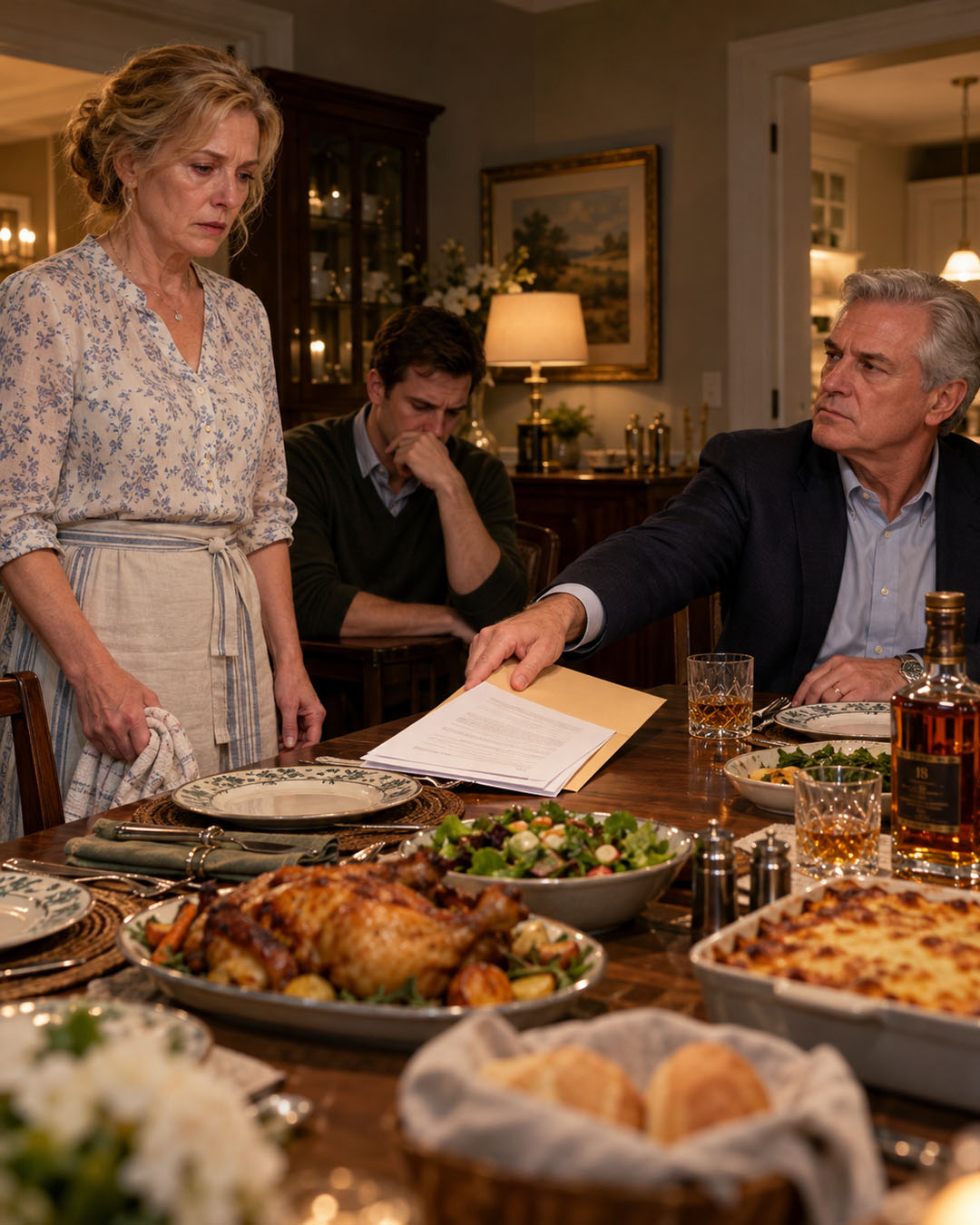
Griffin hurried out of the living room to greet her. Michael and Lauren were already visiting, apparently to discuss the upcoming sale of my house.
Amanda placed a basket of expensive fruit on the coffee table and opened a glossy brochure.
“Thirteen European countries,” she announced. “A river cruise, private tours, wonderful hotels. Griffin deserves something extraordinary after working so hard.”
“How lovely,” I said.
She studied me, apparently disappointed that I hadn’t raised my voice.
“I know this must be difficult,” she continued. “But Griffin and I have something special. We’re not trying to hurt anyone.”
Griffin wrapped an arm around her shoulders.
“See, Donatella? She’s trying to be considerate. You could learn something from her.”
I looked at the brochure, then at the man I’d married when we were both young enough to believe promises lasted forever.
“And all of this depends on selling the house?”
“Naturally,” Griffin replied. “We need the money for the next stage of our lives.”
Amanda gave his arm a gentle squeeze. “It’s a fresh beginning.”
Lauren leaned forward. “Mom, once you get your share, we can help you find somewhere suitable.”
“Somewhere suitable,” I repeated.
“A safe community,” she explained. “With people your own age.”
Leo raced his police car across the carpet.
“Grandpa says the house is going away!” he shouted. “Then we can go on the cruise!”
I looked around the room. Everyone had a plan for my future, and not one of them had asked what I wanted.
“Fine,” I said.
Griffin’s face brightened. “So you’ll cooperate?”
“I’ll meet you at the attorney’s office when the waiting period is over. We can settle everything there.”
Amanda smiled triumphantly. She seemed to believe that the woman standing before her was too old, too frightened, and too dependent to resist.
That evening, after everyone had gone, I called Jessica again.
“Bring the ownership documents,” I told her. “And the company records.”
“All of them?”
“All of them.”
Thirty days after Griffin’s announcement, we gathered in a Manhattan law office.
Griffin arrived wearing a new suit, Amanda holding his arm. Michael and Lauren came along, presumably to make sure I didn’t change my mind.
The attorneys reviewed the agreement and completed the required formalities. When the final documents were placed before me, I signed without hesitation.
Griffin immediately checked his watch.
“Excellent. Now we can arrange the house sale. Our European trip leaves next week.”
I set down my pen.
“Before you make any more plans,” I said, “there’s something you should know.”
Griffin rolled his eyes. “Not another argument.”
“Not an argument,” I replied. “A secret I’ve kept for nearly thirty years.”
At that moment, the conference room door opened.
Jessica walked in carrying three thick folders.
Chapter 3
Jessica had been my closest friend since our twenties. Griffin knew her as a sharp, ambitious woman who worked in business law, though he’d never shown much interest in what she actually did.
She placed the folders in front of me and greeted everyone politely.
“Let’s begin with the house,” I said.
Griffin leaned back in his chair. “We already settled that. Half the proceeds belong to me.”
“Actually,” Jessica replied, “the property is titled solely in Donatella’s name.”
Griffin laughed. “We’ve lived there for more than thirty years.”
“That doesn’t automatically determine ownership,” she said. “The house was purchased entirely with proceeds from property Donatella inherited from her parents. The estate documents, transaction records, and your signed acknowledgment establish the ownership arrangement.”
I opened the first folder.
“My father left me his house before we married,” I explained. “When the neighborhood was redeveloped, I sold it and used the money to purchase our current home.”
Griffin reached for the papers.
“That’s impossible. We bought that house together.”
“We lived there together,” I corrected him. “You never contributed to the purchase.”
Jessica turned to another page.
“Fifteen years ago, during a home-equity loan transaction, you also signed an acknowledgment of Donatella’s separate ownership.”
Griffin stared at his signature.
“I don’t remember signing this.”
“You were late for a Yankees game,” I said. “The loan officer suggested you read everything carefully. You said paperwork was a waste of time.”
His mouth opened, then closed.
“The documents have been reviewed in preparation for this settlement,” Jessica continued. “The house remains Donatella’s separate property under the applicable agreements.”
Amanda slowly released Griffin’s arm.
“But you promised we’d sell it,” she whispered.
Griffin ignored her.
“Fine,” he snapped. “Keep the house. But you still owe me a share of everything else. I worked while you stayed home. I supported you for decades.”
“That’s an interesting point,” I said. “Jessica, would you show him the second folder?”
She placed a yellowed agreement on the table.
Griffin recognized it immediately.
Twenty-eight years earlier, shortly after becoming a supervisor, he’d insisted that we sign a postnuptial agreement. He had wanted his salary, bonuses, investments, and future assets protected from me.
I remembered sitting across from him at our kitchen table while he explained his reasoning.
“It’s just good business, Donatella. We should each keep whatever we earn. That way nobody can take advantage of anybody.”
I had asked what he thought I might take.
He’d shrugged. “You never know how people change.”
Now Jessica carefully explained the terms and the independent legal review that had taken place. The agreement designated each spouse’s separately held earnings, investment accounts, and business interests as individual property, subject to the applicable law.
Griffin frowned.
“So what? You never had any money.”
I looked directly at him.
“The month after we signed that agreement, I started a company.”
He blinked. “What company?”
“Hearthstone Senior Services.”
Amanda made a small, startled sound.
I continued before Griffin could interrupt.
“When the factory laid me off, I saved my severance. After you insisted I stay home, I began helping older neighbors who needed meals, transportation, and assistance with everyday tasks. I discovered that many families desperately needed reliable, compassionate care.”
My first office had two desks, a telephone, and a secondhand filing cabinet. I cooked meals before sunrise, drove clients to appointments, and completed paperwork after Michael went to bed.
Some months, I barely broke even. Other months, I wondered whether I’d made a terrible mistake.
But I kept going.
Within five years, Hearthstone had opened a caregiver training program. Within ten, we managed senior-care contracts throughout several New York counties. Eventually, we developed residential communities that combined professional care with independent living.
Griffin shook his head.
“You volunteered with old people. That’s what you told me.”
“I told you I was working with seniors,” I replied. “You decided it was a hobby.”
He looked toward Jessica.
She opened a corporate report.
“Hearthstone is now one of the larger privately held elder-care organizations in New York State,” she explained. “I serve as chief executive officer. Donatella Ricci, professionally known as Donatella Blake, founded the company and retains sixty-one percent voting control through her holdings and trust.”
Michael leaned forward.
“Mom, you’re the Donatella Blake?”
I nodded.
Amanda’s complexion had gone pale. Working in luxury retirement travel, she knew Hearthstone’s reputation.
Griffin stared at me.
“You’re rich?”
I thought of the hundreds of mornings I’d risen before five. The missed vacations, the long nights balancing payroll, the difficult decisions, the employees who depended on me.
“I’m financially independent,” I answered. “There’s a difference.”
He grabbed the postnuptial agreement.
“I didn’t know about any of this!”
“Because you never asked.”
For years, Griffin had joked to friends that I earned a little grocery money helping elderly people. He’d never attended a company event, never asked about a contract, never wondered why I frequently traveled to Albany or why Jessica called so often.
He had been so certain that my life was insignificant that he’d never considered looking more closely.
Michael rubbed his forehead.
“But Dad still paid the bills. He paid for college and everything afterward.”
I nodded to Jessica.
Her assistant opened a laptop and displayed a financial summary on the conference room monitor.
There were the college payments, including fifty-six thousand dollars transferred through Hearthstone’s education-benefit program and thirty-eight thousand I’d personally contributed toward Michael’s year abroad in London.
There were payments for his graduate degree, his first apartment, his wedding, and his relocation expenses.
Then came the four-hundred-thousand-dollar down payment on Michael and Lauren’s home.
Lauren sat upright.
“Wait a minute.”
The records continued: medical bills surrounding Leo’s birth, his education fund, preschool tuition, music lessons, and summer activities.
Each payment came from accounts I controlled.
Michael stared at the screen.
“I thought Dad handled all that.”
“Your father paid many of our ordinary household expenses,” I said. “And I appreciate that he worked. But he was never the only one supporting this family.”
Griffin’s face darkened.
“You’ve been keeping records so you could humiliate me.”
“No,” I said. “I kept records because running a business taught me the importance of being responsible.”
I looked at Michael.
“Your father worked hard. So did I. The difference is that his work always counted in this family, while mine was treated as though it didn’t exist.”
Michael’s eyes filled with tears.
“Mom, I didn’t know.”
“I know you didn’t,” I answered. “But you never asked, either.”
Lauren reached for a tissue.
“We’re grateful for everything you’ve done. You know that.”
I remembered her calmly discussing retirement homes while my husband planned to sell the roof over my head.
“Then perhaps you shouldn’t have treated me like an inconvenience.”
Jessica closed the financial summary and opened the third folder.
“There’s one more matter concerning Michael and Lauren’s home.”
Lauren’s expression changed.
I removed the original loan agreement we’d signed when they purchased their house.
“Do you remember insisting that the down payment be documented as a loan?” I asked her.
She swallowed. “That was years ago.”
“You said you didn’t feel comfortable accepting such a large gift. I respected that, so Jessica prepared the paperwork.”
Michael reached for the document.
“Mom, we thought it was just a formality.”
“Then you should have read what you signed.”
The agreement contained a provision allowing repayment to be requested upon thirty days’ written notice, along with terms governing refinancing or sale.
Lauren began crying.
“We can’t possibly repay four hundred thousand dollars in a month. We have a mortgage. We have Leo.”
“And I understand that,” I said. “But when Griffin demanded that I sell my house, you didn’t seem concerned about where I would go.”
Michael lowered his head.
I placed a written repayment notice on the table.
“I’m willing to discuss a reasonable arrangement through Jessica. But I will no longer pretend that your obligations disappear simply because I’m your mother.”
For the first time that afternoon, nobody had anything to say.
Then Griffin pushed back his chair.
“This is revenge,” he declared. “You’ve spent thirty years planning to destroy me.”
I stood slowly.
“Griffin, you asked me for a divorce. You brought another woman into our home. You encouraged our son to believe I was helpless, and you planned to finance your new life by selling property that was never yours.”
My voice remained steady.
“All I’ve done is remind you that I have a life of my own.”
Amanda reached for her handbag.
“I think this has become unnecessarily unpleasant.”
Jessica turned toward her.
“Before you leave, Ms. Bennett, there is one financial matter Mr. Ricci may wish to review.”
Amanda stopped moving.
Chapter 4
Jessica placed a final packet in front of Griffin.
It contained his membership agreement with Silver Horizons Club, a luxury retirement travel organization that had recently approached Hearthstone about a possible business partnership.
Our company had declined after its compliance team identified questionable sales practices and unusually restrictive refund provisions.
Amanda worked as a referral consultant for the organization.
“Mr. Ricci,” Jessica said, “our review indicates you’ve paid one hundred thousand dollars toward a premium travel membership. Is that correct?”
Griffin nodded cautiously.
“Amanda arranged it. We’re getting special treatment.”
Jessica opened the contract.
“The agreement allows substantial cancellation fees. It also permits itinerary changes under broad circumstances. I strongly recommend that you have independent counsel review your options.”
Amanda folded her arms.
“There’s nothing improper about that. Luxury travel is expensive.”
“Certainly,” Jessica replied. “But prospective clients should understand exactly what they’re purchasing.”
She showed Griffin publicly available promotional materials describing Amanda’s work with several retirees, including a former teacher and a restaurant owner. Both had purchased expensive packages through her referral program.
Griffin looked confused.
“You told me I was the only man you were planning a future with.”
Amanda’s face tightened.
“Those are clients, Griffin.”
“Then why did you tell me they were lonely men whose families didn’t appreciate them?”
She hesitated.
Jessica spoke carefully.
“We aren’t making assumptions about Ms. Bennett’s personal relationships. But the promotional correspondence supplied to our company contains language remarkably similar to what Mr. Ricci described about his retirement plans.”
Griffin picked up a printed sales message.
He read aloud, his voice weakening.
“You’ve sacrificed enough for everyone else. Now it’s your turn to live.”
Those were almost exactly the words he’d used at our retirement dinner.
He looked at Amanda.
“Did you say that to all of them?”
“Griffin, don’t be ridiculous.”
“And the house?” he pressed. “You kept saying we could upgrade our trip once I sold it.”
Amanda’s composure finally broke.
“Well, you told me you owned a valuable house! You told me you were financially secure. How was I supposed to know you couldn’t sell it?”
The room fell silent.
Griffin stared at her for a long moment.
“I thought you loved me.”
Amanda gave a bitter laugh.
“I thought you were being truthful about your circumstances.”
She grabbed her purse and hurried toward the door.
“Amanda, wait.”
But she was already gone.
Griffin remained standing, staring at the empty doorway. He looked suddenly much older than sixty-two.
I felt no triumph. Watching someone lose his illusions was not nearly as satisfying as people imagine.
It was simply sad.
After several minutes, Griffin turned toward me.
“Donatella,” he whispered, “we’ve been married for thirty-four years.”
“Yes,” I said. “We have.”
“We could fix this. Maybe we should forget the divorce. We could get married again.”
Michael looked up hopefully.
For a moment, I saw the man Griffin had been when we were young. I remembered summer evenings on the porch, Michael falling asleep between us, and the brief periods when I’d believed our marriage might become something warmer.
Then I remembered that he hadn’t asked me to stay until the house and my company were beyond his reach.
“Griffin,” I said, “Amanda didn’t destroy our marriage.”
He flinched.
“We lost each other years ago. Every time you dismissed my work, every time you made decisions without me, every time you treated my kindness as something you were entitled to, another piece disappeared.”
His eyes reddened.
“I can change.”
“Perhaps you can,” I answered. “But you have to do it for yourself, not because you’ve lost something you expected to keep.”
Michael stepped beside me.
“Mom, I’m sorry. I should have defended you that night.”
I looked at my son, remembering the little boy who used to run into my arms after school.
“I love you, Michael. That hasn’t changed. But love doesn’t mean I must accept disrespect.”
He nodded, tears sliding down his cheeks.
Lauren apologized, too. I believed they regretted what had happened, though I couldn’t know whether they regretted their behavior or the financial consequences.
Perhaps it was both.
Jessica gathered our documents, and we left the conference room together.
Outside, Manhattan was bright beneath a clear afternoon sky. People hurried along the sidewalks, yellow cabs moved through traffic, and somewhere a street musician was playing a song I hadn’t heard in years.
Jessica glanced at me.
“How do you feel?”
I considered the question.
“Strange,” I admitted. “But lighter.”
She squeezed my hand.
“Then maybe this is the beginning you’ve been waiting for.”
Over the following months, my life changed in ways I hadn’t expected.
Griffin’s European vacation never happened. Silver Horizons refunded only a small portion of his payment under the contract, and he spent months trying to recover the rest.
He rented a modest apartment in Queens and began learning the ordinary tasks he’d once assumed were beneath him.
Michael told me his father had difficulty adjusting. He complained about cooking, cleaning, medical appointments, and how quiet the apartment became after sunset.
I didn’t wish him suffering. But I no longer believed it was my responsibility to protect him from every consequence.
Michael and Lauren had their own difficult decisions to make.
After several serious conversations with Jessica, we negotiated a repayment schedule that protected my interests without forcing an immediate sale of their home. They adjusted their spending and began making regular payments.
I didn’t erase the debt, but I didn’t want Leo punished for the mistakes of adults, either.
For several weeks, Michael and I barely spoke. Then one Sunday afternoon, he arrived alone and asked whether we could sit together in the garden.
“I’ve been thinking about how I grew up,” he said. “Dad would come home, and we’d all act like he’d done something extraordinary just by walking through the door. You’d already cooked dinner, cleaned the house, helped me with homework, and probably worked all day, too.”
I waited.
“And somehow I learned that his work mattered more than yours.”
His voice broke.
“I’m ashamed of that, Mom.”
I reached across the table and took his hand.
“Then teach Leo something different.”
He nodded.
That was the beginning of our reconciliation. It wasn’t immediate, and it wasn’t perfect, but it was honest.
I never sold the family house.
Instead, I hired contractors to remove the heavy dark furniture Griffin had always preferred. We opened up the rooms, painted the walls warm white, and added broad windows overlooking the garden.
For the first time in decades, every decision belonged to me.
Six months after the divorce, I moved into Hearthstone’s coastal retirement community on Long Island. I kept the renovated house as a family retreat, but I wanted to experience the kind of life I’d spent years helping other people enjoy.
My new apartment overlooked the water. The community had a library, beautiful walking paths, a photography studio, and an indoor heated pool.
I enrolled in swimming lessons.
At sixty-one, I was embarrassed to admit that I’d never learned. As a girl, I’d spent summers helping my mother rather than going to the beach. As a wife and mother, I’d always had something more urgent to do.
My instructor, a cheerful woman named Susan, guided me into the shallow end.
“Relax your shoulders, Donatella,” she said. “The water can support you. You don’t have to fight it.”
I tried to float but immediately grabbed the side.
Susan smiled patiently.
“You’re safe. Just let yourself trust the water.”
On my third attempt, I finally leaned back and loosened my grip.
For several wonderful seconds, I floated.
Above me, sunlight moved across the high glass ceiling. The sounds of the pool faded until all I could hear was my breathing.
And I realized how long I’d spent holding everything together.
I’d supported my husband, raised our son, cared for aging relatives, built a business, and solved problems nobody else even noticed.
I’d been useful to everyone.
But somewhere along the way, I’d forgotten that I was allowed to simply live.
That Christmas, Michael brought Leo to visit.
Leo was eight by then, a little taller and much quieter than the boy who’d asked for a new grandmother.
We walked along the beach together, collecting smooth stones and watching gulls circle above the waves.
After a while, he slipped his hand into mine.
“Grandma, I’m sorry I said I wanted Amanda instead of you.”
I stopped walking.
“Sweetheart, you don’t have to worry about grown-up problems.”
“But I hurt your feelings.”
I knelt so we were eye to eye.
“Sometimes people say things without understanding how much they hurt. What matters is learning to be kinder.”
He hugged me tightly.
“You’re still my favorite grandma.”
I laughed, though my eyes filled with tears.
“And you’re still my favorite grandson.”
That evening, after Michael and Leo left, I carried my camera onto the balcony.
The sun was setting over the Atlantic, painting the water gold and rose. The breeze was cool, but I stayed outside, watching the last light gather along the horizon.
Griffin had once told me that life ended, in a way, when a person retired.
I used to believe him.
Now I understood that getting older didn’t mean becoming less important. It meant recognizing what truly mattered and having the courage to stop living according to someone else’s expectations.
I was no longer Griffin Ricci’s wife.
I was still Michael’s mother and Leo’s grandmother, but those roles no longer defined the boundaries of my world.
I was Donatella Blake, a woman who had built something meaningful, loved deeply, endured disappointment, and finally learned to choose herself.
I raised my camera and took a photograph of the sunset.
For the first time in thirty-four years, I wasn’t waiting for anyone to come home.
I was already home.
THE END. ⚠️ All characters and events are fictional. Do not imitate or apply them in real life. 😌😌😌

