Chapter 2
Rebecca arrived shortly after nine the next morning carrying a leather folder I recognized immediately. Dad had come ten minutes earlier with coffee for himself, tea for me, and absolutely nothing for Mark, which told me how angry he was. My father was so relentlessly polite he once thanked a tow-truck driver who backed into his mailbox.
Rebecca pulled a chair to my bedside. “How are you feeling?”
“Like every cheerful person in Ohio owns a blood-pressure cuff.”
She smiled. “Then we’ll keep this simple.”
She opened the folder.
Most of the documents were the ones we had drafted eleven months before. Estate planning. Business protections. Limited financial authorization. Beneficiary changes. Nothing magical, nothing designed to erase Mark from legal existence.
“You’re not making a completely new decision because you’re frightened in a hospital,” Rebecca told me. “You already made most of these decisions. You simply didn’t execute them.”
That stung because it was true.
She explained everything carefully. The house remained separately titled. My inherited investments had been structured separately. My majority ownership in Bennett & Whitaker was protected by the company’s operating agreement. But we also had shared accounts, joint debts, marital contributions to renovations, and seventeen years of financial overlap.
“This is not one of those stories where a lawyer pushes a button and your husband gets nothing,” Rebecca said.
Dad sighed. “I was hoping there was a button.”
“There are no buttons.”
“Expensive profession.”
Rebecca ignored him. “And Claire, I mean this seriously. Don’t let urgency make you careless. Nothing gets signed unless you understand it.”
That afternoon my fever rose again.
For several hours I forgot about betrayal because survival takes up a surprising amount of mental space. Around two in the morning, I stared into the darkness and wondered whether all the legal papers were absurd because I might actually die.
I thought about our daughter, Megan, who was twenty-four and teaching third grade in Indianapolis. I thought about turning fifty. I thought about standing in my own kitchen on an ordinary Tuesday complaining about grocery prices.
Revenge suddenly seemed small.
Dad found me crying the next morning.
“I don’t know if I can do this,” I said.
“The treatment?”
“Any of it. Mark. Lawyers. Fighting.”
He pulled the chair closer. “Have you changed your mind about trusting him?”
“No.”
“Then you’re tired. That’s different.”
“I may not have the energy for some grand battle.”
“Then don’t have one today.”
He leaned forward.
“Being tired doesn’t mean you owe somebody access to your life.”
That was all.
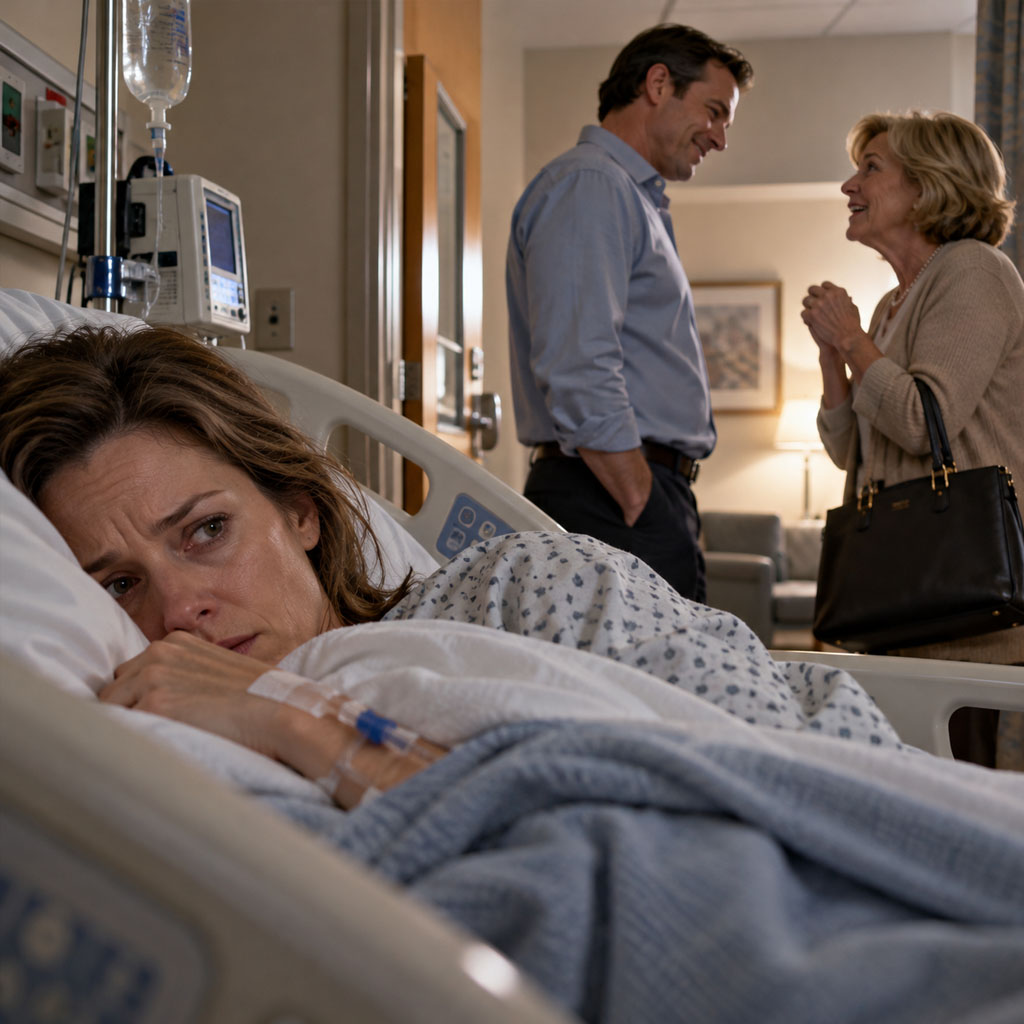
Around eleven, Mark walked in with grocery-store flowers and his concerned-husband expression.
“How’s my girl?”
“Still here.”
“Good.”
For fifteen minutes he talked about traffic, work, and baseball. Then he reached into his briefcase.
“By the way, there are a couple forms I need you to sign.”
Every part of me went still.
“What kind of forms?”
“Nothing complicated. Authorization stuff. So I can handle things while you’re sick.”
He placed a folder on the tray table.
“What things?”
“Bills. Accounts. Whatever comes up.”
“All the accounts?”
“Basically.”
He smiled as though I were being difficult. “I’m not stealing your identity, Claire.”
“Leave them.”
His eyebrows lifted. “What?”
“I’ll read them.”
“You don’t need to read every line.”
That sentence damaged something beyond repair.
“Then you won’t mind if I do.”
He stared at me for a moment before standing.
“You’re exhausted. Don’t turn this into something it isn’t.”
After he left to take a work call, I photographed every page and sent the pictures to Rebecca.
She called nineteen minutes later.
“Do not sign those.”
“No hello?”
“Claire.”
“I was hoping you’d tell me it was a gym membership.”
“One document gives Mark extremely broad financial authority. Powers of attorney between spouses are common, but given what you’ve told me, I would never advise signing this.”
“So he can legally ask?”
“He can ask. You can legally say no.”
“Not as dramatic as I hoped.”
“Accurate answers rarely are.”
The following afternoon, Megan arrived carrying an overnight bag, an enormous insulated cup, and enough anger to power downtown Columbus.
“Was anybody going to tell me how sick you were?”
“Your father called you.”
“He said you were improving.”
“I am.”
She gave me the look she had perfected at six years old.
“Mom.”
I surrendered. “Fine. He understated it.”
She hugged me carefully, and the carefulness almost broke me.
After a few minutes she asked, “What is going on with Dad?”
“Your father and I are dealing with some marriage issues.”
“I’m twenty-four.”
“Yes, and I’m trying not to make you forty before lunch.”
She almost smiled.
I didn’t tell her about Jennifer.
Not yet.
The next morning, Dad brought his laptop. Rebecca had asked him to organize company records and our legitimate financial documents. My father loves spreadsheets with a devotion most people reserve for grandchildren and baseball.
He was clicking through files when he suddenly stopped.
“Claire.”
Something in his voice made me look up.
“Has anybody besides you, me, and Rebecca requested valuation information about Bennett & Whitaker?”
“No.”
He turned the screen.
A request from the previous month asked for ownership percentages, operating agreements, and estimated company value.
The email address belonged to Jennifer Cole.
By noon we understood more.
Jennifer and Mark had been discussing a future together. Not abstractly. Not “maybe someday.”
There had been conversations about buying a condo in Dublin. Contact with a mortgage broker. A message referring to “expected liquidity following a family estate event.”
I read those words three times.
“That’s a polished way of saying my funeral.”
Dad adjusted his glasses. “Euphemisms help bad ideas wear neckties.”
Then Rebecca helped us review joint-account statements.
Once the charges were placed side by side, patterns emerged. Cincinnati hotels. Expensive restaurants. Jewelry. Flights. A resort weekend Mark had called a client conference.
Approximately thirty-eight thousand dollars over fourteen months appeared tied directly or indirectly to Jennifer.
The amount made me angry.
The planning made me sick.
Mark hadn’t simply fallen into an affair. He had been building another life with pieces stolen from mine.
Later that afternoon, Megan went downstairs for coffee.
At least Mark thought she did.
He stepped into the hallway to answer his phone. His voice carried through the partly open door.
“Jennifer, stop calling me here.”
Silence.
Then, quieter, “No, three days doesn’t mean exactly three days.”
Megan stood near the nurses’ station.
She had heard every word.
When she returned, she closed my door and leaned against it.
“Mom.”
I couldn’t pretend anymore.
“Who is Jennifer?”
I swallowed.
“I believe your father is having an affair with her.”
Megan stared at me as if she had forgotten how to sit down.
“How long have you known?”
“I suspected for months.”
“Months?”
“I didn’t want to drag you into our marriage.”
Her face hardened. “Congratulations. I’m in it now.”
She left for the cafeteria furious with both of us, and I realized that protecting a family by hiding the truth could become another way of preserving the lie.
A few hours later, Dr. Shaw entered with my new bloodwork.
For once, her face gave me hope before she spoke.
“You’re responding to treatment.”
I released a breath I felt I had been holding for days.
“So I’m not dying?”
“I’d rather say you’re no longer in the immediate danger you were in.”
Mark stood near the foot of my bed.
He looked almost startled.
“She’s definitely improving?”
Dr. Shaw glanced at him.
“Yes. Significantly.”
Then she added, dryly, “This is usually where family members say thank God.”
I turned toward the window before Mark could see me smile.
Two days later, I went home.
And that was when my mother-in-law started measuring my windows.
Chapter 3
Mark became the world’s most devoted husband the moment I returned.
Coffee appeared beside me every morning. He cooked soup. He asked whether I needed another pillow. Yet every act of kindness eventually circled back to the same subject.
“We should simplify some things.”
“What things?”
“Accounts. Bills. The house paperwork.”
“You seem very interested in reducing my administrative burden.”
He laughed a little too loudly.
Dolores visited with chicken soup and concern. She told me I looked thin, which struck me as a fascinating observation for someone who had recently assumed I was dying.
Half an hour later, I heard movement upstairs.
I climbed slowly, against doctor’s orders, and found her in my bedroom with the top dresser drawer open.
My jewelry box was inside.
“What are you doing?”
She snapped the drawer shut. “Looking for an extra blanket.”
“In my jewelry drawer?”
“I didn’t know which drawer it was.”
“Do you usually wear diamonds for warmth?”
She pushed past me, offended.
The following day I caught her holding her phone along the living-room window frame.
“What are you doing?”
“Nothing.”
“That looks suspiciously like measuring.”
“I was checking something for curtains.”
There was no embarrassment in her face.
Only irritation.
As though I had delayed her move-in date.
Two days later, my phone buzzed with a message from an unfamiliar number.
Claire, this is Jennifer Cole. I need to speak with you.
I stared at it until another arrived.
I know you hate me. You should. But Mark lied to me too. There’s something you need to see.
I nearly deleted both messages.
Instead, I agreed to meet her the next afternoon at a café in Dublin. Daylight, public place, Dad knew exactly where I was.
Jennifer arrived wearing black slacks and a cream sweater. She looked ordinary, which was somehow disappointing. Betrayal should come wearing a cape or carrying a warning sign.
She sat across from me.
“I knew he was married,” she said immediately. “I’m not going to insult you by denying that.”
“Good start.”
“He told me your marriage had been over for almost a year. He said you both knew it and were only waiting for the financial details to be settled.”
“And you believed him.”
“I wanted to.”
I hated that answer because I understood it.
“He said your illness delayed the divorce,” she continued. “Then he told me you were accusing him of things because of medication.”
“I heard him in the hospital.”
“I know now.”
I watched her carefully.
“I’m not asking you to forgive me,” she said. “What I did was wrong. But I didn’t know he was waiting for you to die.”
“That distinction is less comforting than you think.”
“I didn’t expect it to comfort you.”
For the first time, I believed her.
Then she unlocked her phone.
“There’s more.”
She slid it across the table.
A message from Mark filled the screen.
Once everything settles, the house is ours. Mom can use the downstairs suite.
I read it twice.
“He gave you my house.”
Jennifer winced. “Apparently he’s very generous with property he doesn’t own.”
A laugh escaped me before I could stop it.
Maybe betrayal becomes absurd when it grows too large to fit inside grief.
Jennifer showed me more messages. Wedding plans. House plans. Financial plans. Mark had constructed an entire future for three women without securing the consent of a single one of us.
“I’ll give copies to your lawyer,” Jennifer said.
“Please do.”
She nodded.
“This doesn’t make us friends,” I told her.
“I know.”
“And I’m not forgiving you.”
“I didn’t come for forgiveness.”
That answer earned more respect than I wanted to give her.
I had been planning to confront Mark privately, but sitting across from Jennifer changed my mind. Mark survived through compartmentalization. One story for me. Another for Jennifer. Another for Dolores. Another for Megan.
His lies depended on us remaining separated.
“I want him to tell the truth in front of everyone he lied to,” I said.
Jennifer frowned. “What are you thinking?”
“Sunday dinner.”
By Saturday, Mark had convinced himself the dinner was a peace offering.
“So who’s coming?” he asked.
“Dad. Megan. My brother David. Your sister Patty and her husband. Your mother. A couple others.”
“What’s the occasion?”
I looked at him.
“I almost died, Mark. I thought we could celebrate the fact that I didn’t.”
His eyes dropped to his coffee.
“Maybe it’ll be good for us.”
Maybe.
Sunday evening, the house smelled of catered lasagna, chicken piccata, and garlic bread. I had survived a medical crisis. Nobody was getting homemade pasta from me.
Megan arrived early.
“Is Jennifer coming?”
“Yes.”
“Does Dad know?”
“No.”
She closed her eyes. “Mom, this is an ambush.”
“It is.”
“Why?”
“Because every time someone asks him privately, he changes the story. Tonight he only gets one.”
“What am I supposed to do?”
“Nothing. Don’t defend me. Don’t attack him. Don’t choose sides.”
“He’s going to ask me to.”
“I know.”
By six, everyone had arrived except Jennifer, who waited nearby for my text.
Dinner began almost normally.
Football. Neighborhood gossip. Patty complaining about her homeowners association. Dad telling a contractor story. Dolores eating two servings of lasagna in the dining room she had recently assumed would belong to her.
Then Mark stood and raised his wineglass.
“I’d like to say something.”
His hand settled on my shoulder.
“The past few weeks reminded me how quickly life can change. Sometimes you don’t understand what matters until you nearly lose it.”
Dad stared at his plate with the concentration of a man performing advanced anger management.
Mark continued.
“So here’s to Claire. To recovery and second chances.”
Glasses rose.
I waited until everybody had taken a sip.
“That,” I said, “is exactly what tonight is about.”
I lifted the hospital folder from beside my chair and placed it on the table.
Mark’s smile vanished.
“What’s that?”
“You know.”
Patty looked from him to me.
“Mark, why did you bring these papers to my hospital room?”
His jaw tightened. “Seriously?”
“Answer me.”
“So I could handle things while you were sick.”
“What things?”
“Accounts. Bills. Everything.”
Dolores set down her fork. “Claire, this hardly seems appropriate.”
I turned toward her.
“Actually, Dolores, I’ve been meaning to ask which bedroom you chose.”
Silence descended over the table.
Patty frowned. “What?”
Dolores looked at Mark.
“The downstairs room?” I asked. “Still planning to put your husband’s old furniture there?”
Mark shoved back his chair.
“Claire, stop.”
I looked directly at Dolores.
“Three days,” I said softly. “Good. I’m taking the house.”
Her face changed.
“You were unconscious!”
Patty’s fork struck her plate.
Dad slowly raised his eyebrows.
I nodded. “Thank you, Dolores.”
She realized too late what she had admitted.
Mark stood. “You were medicated. You don’t know what you heard.”
“I heard enough.”
Then I looked at him.
“And I heard the name Jennifer.”
Megan stared at the table.
Mark went rigid.
“Who?” he asked.
“You know who.”
“She’s a colleague.”
“That’s all?”
“Yes.”
I picked up my phone beneath the table and sent one message.
Come in.
A few seconds later, the front door opened.
Heels crossed the hardwood floor.
When Jennifer appeared in the dining-room doorway, Mark’s face lost every trace of color.
Chapter 4
“What are you doing here?” Mark demanded.
Jennifer stayed by the doorway.
“Apparently attending a family meeting.”
“You need to leave.”
“No.”
He turned toward me. “You called her?”
“She called me first.”
That frightened him more than anything else had.
Jennifer lifted her phone.
“Mark, these are your messages.”
“Don’t.”
She read calmly.
“When this is over, we won’t have to hide anymore.”
“That’s out of context.”
She continued.
“Once everything settles, the house is ours. Mom can use the downstairs suite.”
Dolores snapped her head toward him.
“You said I could have the downstairs.”
Jennifer looked at her. “Apparently we were issued different brochures.”
Patty made a sound somewhere between a cough and a laugh.
Mark pointed at Jennifer. “You knew exactly what our situation was.”
Jennifer’s face hardened.
“I knew you were married. I knew I was wrong to be involved with you. What I didn’t know was that your definition of ‘separated’ included Claire believing she still had a husband.”
Then she read one final message.
“Once Claire’s gone, I’ll clean everything up fast. Then we can finally get married.”
Nobody spoke.
Mark looked at me.
“You set me up.”
Dad put down his fork.
“Son, nobody needed to set you up.”
Mark turned on him.
Dad’s voice remained calm. “We simply stopped cleaning up after you.”
“This is between me and my wife.”
“Then perhaps,” Dad said, “you shouldn’t have involved your mother, your girlfriend, and a mortgage broker.”
Mark’s face reddened.
“So what’s the plan?” he demanded. “You think you’re throwing me out with nothing?”
“No.”
That answer surprised him.
“The house is titled to me,” I said. “It always has been. My inherited assets are separate. My business is governed by an operating agreement.”
Dolores jumped in. “Mark has lived here seventeen years.”
“So has the dining table.”
David suddenly became fascinated with his water glass. Patty covered her mouth.
I continued.
“That doesn’t mean this is simple. There were marital contributions toward renovations. We have shared debts and joint assets. Rebecca already warned me the legal process won’t be clean.”
Mark stared at me.
“You’ve already hired a lawyer?”
“I already had one.”
His expression told me everything.
Eleven months earlier, he had believed my hesitation meant ignorance.
It had only meant hope.
“I may have to write a check before this is over,” I said. “I may have to negotiate things I don’t want to negotiate. That’s reality. But nobody is taking over my company, and your mother is not moving into my bedroom.”
Mark turned toward Megan.
“You knew about this?”
“I knew enough.”
“Your mother planned all this behind my back.”
Megan raised her eyes.
He stepped closer.
“Megan, you know me.”
Her eyes filled.
“Yes.”
“Then tell them. Tell them I’m not some monster.”
I had promised not to interfere.
Every instinct in me screamed to protect her anyway.
But Megan was an adult, and part of respecting her meant allowing her to answer for herself.
“Dad,” she whispered, “I love you.”
Mark’s shoulders loosened.
Then she finished.
“But I don’t recognize you right now.”
His face collapsed for one brief second.
Strangely, seeing him hurt still hurt me.
Seventeen years doesn’t disappear because someone earns consequences.
Dolores broke the silence.
“Well, where am I supposed to live?”
I looked at her.
“Jennifer’s condo?”
“Absolutely not,” Jennifer said.
Patty laughed into her napkin.
Even Dad smiled.
Mark looked around the room. At his mother. Jennifer. Megan. Me.
Everything he had planned required each woman to remain in the role he assigned her.
None of us had.
He pointed at Dad.
“You did this.”
Dad shook his head.
“No. Claire did.”
Then he nodded toward me.
“I just answered the phone.”
Mark grabbed his keys and jacket.
There was no dramatic packing scene. No shattered glass. No screaming. He simply walked outside and closed the door behind him.
I sat listening to the silence.
I had imagined feeling victorious.
Instead, I felt exhausted and unbearably sad.
A marriage can end in an evening.
Seventeen years cannot.
The divorce lasted seven months.
Not seven thrilling months of courtroom speeches and dramatic reversals. Seven ordinary, expensive months of spreadsheets, emails, lawyers, bank statements, and discussions about my kitchen as though it were disputed international territory.
Mark rented an apartment.
I asked Megan once, “Is he okay?”
She studied me.
“Do you really want to know?”
“Yes.”
“He’s angry.”
“That wasn’t what I asked.”
A pause.
“He’s okay.”
“Good.”
And I meant it.
Wanting consequences is not the same as wanting someone homeless, sick, or destroyed. I wanted Mark out of my marriage, not off the planet.
The house created the biggest financial argument.
“The deed is clean,” Rebecca explained. “The marital contributions are not.”
“So he cheats on me, spends thousands on another woman, and I may still have to compensate him for improvements to my own house?”
“Divorce law was not written by poets.”
“I’ve noticed.”
The money connected to Jennifer became part of negotiations, but real life did not deliver a perfect reimbursement down to the final dinner bill. Some charges mattered. Some were disputed. Some became leverage.
In the end, I kept the house.
I kept my business interests.
Mark received his lawful share of marital property.
And I wrote a settlement check that made me stare at my bedroom ceiling for several nights.
Dad found me on the back porch the next morning.
“How much do you hate him today?” he asked.
“On a scale from one to ten?”
“Sure.”
“Twelve.”
“That’s inconvenient.”
“I had to write him a check for my own house.”
“Not exactly.”
“It feels exactly like that.”
Dad sipped his coffee.
“You bought peace and an ending date.”
I glared at him.
“Rebecca tell you to say that?”
“No. Her hourly rate is too high.”
I laughed despite myself.
Megan was harder than the money.
She continued seeing her father. Dinner every few weeks. Phone calls. She helped him choose a couch for his apartment.
I told her from the beginning that her relationship with him belonged to her.
Then I discovered that saying mature things and feeling mature about them are completely different skills.
One evening she casually mentioned having dinner with Mark, and something sharp moved through me.
She caught my expression.
“Mom, don’t.”
“I didn’t say anything.”
“You made the face.”
“What face?”
“The face where you say you’re fine while mentally dropping somebody into a wood chipper.”
“I do not have that face.”
“You absolutely have that face.”
I laughed.
She didn’t.
“I still love him.”
“I know.”
“That doesn’t mean I think what he did was okay.”
“I know that too.”
She looked down.
“I was angry at you.”
That still hurt.
“I know.”
“I wish you’d told me sooner.”
I took my time before answering.
“I wish I’d told myself sooner.”
She finally looked at me.
We didn’t have a grand reconciliation. She reached over and stole one of my fries.
With Megan, that was close enough.
Jennifer ended things with Mark soon after the dinner. Months later, she sent me one short message wishing me well.
I replied, I am. Take care.
We never became friends.
She had knowingly been involved with my husband. Mark’s lies to her did not erase her choices. But I also decided I wasn’t spending more years hating a woman I barely knew.
Mark had already taken enough time.
Dolores blamed me for months.
Eventually she called.
“You humiliated my son in front of his family.”
I was sitting at the kitchen island, looking toward the window she had once measured.
“Dolores, I was lying in a hospital bed, and you called dibs on my house.”
She hung up.
Six months later she called again.
“I shouldn’t have said those things.”
I waited.
“I was upset.”
There was the little escape hatch.
“No,” I said quietly. “You shouldn’t have meant them.”
She never gave me a better apology.
I stopped needing one.
Mark returned once after the divorce to pick up boxes from the garage. On his way through the hallway, he paused beside the pantry.
Pencil marks climbed the trim from Megan’s childhood.
Age seven.
Age nine.
Age twelve.
Mark had drawn several of them himself.
He touched one line with his thumb, and for a second I remembered the younger man who had slept upright in a plastic hospital chair beside our sick little girl. The man who brought me terrible coffee and said, “You sleep. I’ve got her.”
I thought he might finally apologize.
He turned around.
“Did you pack my phone charger?”
I stared at him.
Then I laughed.
“Kitchen drawer.”
He found it.
And he left.
That was Mark.
Not a criminal mastermind. Not some storybook monster. Just a man who had been given a good life, grown accustomed to it, and eventually confused being loved with being entitled to everything love had provided.
A year after my illness, I returned to Riverside for a follow-up appointment.
Dr. Shaw reviewed my results and smiled.
“Everything looks good.”
Those words felt better than revenge ever had.
On the way home, I stopped at a garden center and bought a young red maple. Dad came over that weekend to help me plant it in the backyard, although at seventy-three his definition of “help” had evolved mostly into supervision.
When we finished, he stepped back.
“It’s leaning.”
“So was I.”
“Want me to straighten it?”
I looked at the thin trunk and the leaves moving in the breeze.
“No. Give it time.”
For years, I believed strength meant keeping everyone comfortable.
Don’t upset Megan.
Don’t embarrass Mark.
Don’t argue with Dolores.
Don’t make money awkward.
Don’t ruin Christmas.
Don’t ask a question unless you are prepared to hear the answer.
I became so good at preserving peace that I failed to notice how much of myself I was spending to buy it.
Mark mistook that for weakness.
Dolores did too.
For a while, so did I.
But when I remember those days now, the best moment was not Jennifer walking into my dining room. It wasn’t Dolores learning she would never inherit my house. It wasn’t even Mark realizing the future he had carefully planned depended on people who no longer intended to participate.
The most important moment happened in a hospital bed with an IV in my arm and fear sitting heavily on my chest.
I called my father.
He asked whether I was finally done protecting a man who had stopped protecting me.
And I said yes.
That was the day I stopped waiting for Mark to become the man I remembered and began deciding who I still had time to become.
The maple tree stands straight now.
Nobody forced it.
It simply grew toward the light.
THE END.
⚠️ All characters and events are fictional. Do not imitate or apply them in real life. 😌😌😌