Chapter 2
Jeff turned off the burner and sat across from me.
“In October, Todd called and asked for the list.”
I felt my shoulders stiffen.
“What did he say he needed it for?”
“He said the mayor wanted to recognize the people who helped elderly residents during winter. He mentioned thank-you letters and maybe a little ceremony.”
“And you believed him?”
“He’s my brother.”
Jeff rubbed both hands over his face.
“He said it was supposed to be a surprise for you. I thought I was helping.”
I stared at him.
“That list belonged to me, Jeff. Those people trusted me.”
“I know.”
“Did you know he was applying for a grant?”
“No. I swear I didn’t.”
I wanted to shout. Instead, I looked through the kitchen window at the snow collecting along our back fence.
My husband had given away something he’d never understood was private.
The notebook held more than names and addresses. Beside each house I’d written practical things I needed to remember.
Mrs. Halvorsen’s mailbox leaned toward the road. Eddie needed enough space to back out safely. The Sunquists had a buried stone border that could damage a plow blade.
There were notes about mobility problems, emergency contacts, and who might need someone to check on them during a storm.
Those weren’t entries in a publicity campaign.
They were neighbors.
Kellen appeared in the doorway holding his sandwich.
“Uncle Todd got six grand for Mom’s work?”
Jeff lowered his eyes.
“Looks that way.”
Kellen frowned.
“What’s he buying jackets for? Mom doesn’t even have employees in winter.”
“Apparently,” I said, “he’s planning to invent some.”
Kellen considered that.
“Can I be vice president of the imaginary crew?”
Despite everything, Jeff let out a short laugh.
Then he stopped laughing and took my hand.
“I’m sorry, Paula.”
I believed him.
But believing someone is sorry doesn’t immediately repair what they’ve done.
The situation had actually begun several weeks earlier, at Thanksgiving.
Every year, Todd hosted the family at his big house overlooking the lake. Nineteen relatives had crowded around his dining table that afternoon.
Todd carved the turkey, told his usual stories, and waited until dessert to tap a spoon against his glass.
“Got a little announcement,” he said.
Everyone turned toward him.
“The mayor’s office has selected our family snow crew for this year’s Good Neighbor Award.”
People applauded.
Jeff’s cousins congratulated him. Linda kissed his cheek.
I set down my fork.
“What snow crew?”
Todd grinned.
“Ours, Paula. The Veland crew. Ridge Street. All those older folks.”
“You mean the driveways I plow?”
“It’s a family effort.”
I watched him smile at the table.
“I’ve coordinated the recognition,” he continued. “Someone sent the committee a wonderful nomination about the green Veland truck.”
“Did you read the nomination?”
“Of course.”
“All of it?”
He waved a dismissive hand.
“Enough. It’s a beautiful tribute to the community.”
Then he winked at me.
“Don’t worry, Paula. I’ll mention you.”
Several relatives laughed.
I didn’t.
Jeff squeezed my knee beneath the table.
It was a familiar signal.
Please don’t make a scene.
I kept quiet, although every instinct told me something was wrong.
After dinner, Todd asked Kellen to take a photograph of us outside beside my truck.
He positioned himself directly in front of the plow blade.
“Make sure you get the business name,” he instructed.
Kellen took several pictures.
Todd kept asking for another.
I had assumed he wanted a photograph for the family Christmas card.
Now that same picture was on the newsletter’s front page, promoting a grant application submitted in Todd’s name.
Sitting at my kitchen table that Monday, I realized Todd had planned much more than a holiday announcement.
He had built an entire program around work I was already doing.
And he hadn’t once asked permission.
I picked up the telephone and called Agatha.
She answered immediately.
“Paula, dear. I suppose you’ve seen the newsletter.”
“Yes. Eddie showed me.”
“He called here at seven this morning. He was extremely upset. I haven’t heard language like that since my husband worked at the docks.”
I almost smiled.
“Agatha, do you remember the letter you took to City Hall in October?”
“Perfectly.”
The memory came back clearly.
She’d called one afternoon asking for a ride downtown. When I arrived, she was waiting with a large white envelope resting on her lap.
It was addressed to the Good Neighbor Award Committee.
I’d asked what it contained.
“A complaint,” she’d said solemnly. “About a terrible noisy truck that wakes me before dawn.”
Then she’d smiled through the windshield.
At City Hall, she insisted on delivering the envelope herself, directly to the committee’s collection box.
Now I understood what she’d been doing.
“Agatha, did you nominate me?”
“Yes.”
“Does Todd know?”
A pause followed.
“Has he read my letter?”
“He says he skimmed it.”
“Then I suppose he doesn’t know very much at all.”
I leaned against the kitchen counter.
“There’s going to be a ceremony Saturday.”
“I’m aware. I have an invitation.”
“Agatha, I need to talk to Todd before then.”
“You certainly may.”
Her voice softened.
“But there’s something I would like to ask you.”
“What?”
“Let me read my letter at the ceremony.”
I closed my eyes.
Agatha had spent six winters watching that green pickup come down her street. She was the one who had written the nomination.
I didn’t have the heart to refuse her.
“Are you sure?”
“I’m 81 years old, Paula. I’ve spent most of my life reading other people’s words. I would very much enjoy reading my own for a change.”
“All right.”
“Will you drive me?”
“Of course.”
“Good. And wear your warm coat. Those outdoor ceremonies are dreadful.”
After we hung up, I sat quietly for a long time.
I wasn’t planning a public confrontation. I wanted the truth known, and Agatha wanted to tell it.
I could hardly imagine what would happen when Todd heard her letter.
But before Saturday arrived, Jeff decided to confront his brother.
He went to City Hall during his Wednesday lunch break.
When he returned home, he looked exhausted.
“I told Todd about the newsletter,” he said.
“What did he say?”
“He says he’s helping you. He says the city needs someone who understands paperwork, and you wouldn’t apply for a grant yourself.”
I folded my arms.
“He’s right that I didn’t apply. That doesn’t make the work his.”
“I told him that.”
Jeff sat on the edge of our bed.
“Then he said something about when we were kids.”
I waited.
“You remember that birdhouse story?”
I did.
When Jeff was nine, he built a birdhouse for a school competition. He spent weeks measuring wood, sanding the edges, and painting the roof bright red.
Todd, three years older, carried it to the judging table.
Somehow, the entry ended up under Todd’s name.
Their mother used to tell the story with an amused smile.
Jeff never found it funny.
“Todd brought it up today,” Jeff said. “He said I’m the builder and he’s the talker. That’s how things work in our family.”
His voice tightened.
“He actually laughed about it.”
I sat beside him.
“I’ve spent my whole life letting him take credit because arguing seemed harder,” Jeff whispered. “And now I helped him do it to you.”
I squeezed his hand.
“Then let’s stop letting it happen.”
Jeff looked at me.
“Saturday night, I’m standing beside you.”
Todd called Thursday evening.
“Big night coming up!” he announced brightly. “The newspaper will be there. Maybe television, too.”
I held the phone away from my ear.
“What do you need, Todd?”
“Park your truck behind the stage at five. Right under the Christmas lights. It’ll look terrific in photographs.”
I looked toward the driveway.
“Have you actually read Agatha’s nomination?”
“Paula, we’ve discussed this. I skimmed it.”
“What about the $6,000?”
“It’s for the program.”
“My program?”
“Our program. We’re building something bigger. You’ll appreciate it once you see the jackets.”
“There is no crew, Todd.”
“There will be. That’s the whole point.”
He lowered his voice.
“Look, I know you’re not comfortable speaking in public. Let me handle that part. It’s what I’m good at.”
Then he hung up.
I stood holding the telephone.
Todd understood cameras, speeches, and ceremonies.
He knew how to make a room applaud.
What he didn’t understand was why an old woman left coffee on her porch in the darkness.
Saturday afternoon, I washed my father’s truck in freezing weather.
I scrubbed the green doors, wiped the mirrors, and cleaned the yellow plow blade.
When Kellen asked why I bothered, I told him the truth.
“Because your grandfather took care of this truck. And I want it looking respectable.”
At five o’clock, I parked behind the stage on Washington Street, exactly where Todd requested.
Then Jeff and I drove to Agatha’s house.
She was waiting in her gray wool coat, holding her cane and a carefully folded envelope.
As she settled into the passenger seat, she patted the letter.
“Everything ready?” I asked.
“Everything I need.”
She looked at me over her glasses.
“Now, Paula, please remember one thing.”
“What’s that?”
“Whatever happens tonight, don’t apologize for telling the truth.”
Chapter 3
The temperature had fallen to nine degrees by the time we reached downtown Marquette.
Washington Street was packed with families in heavy coats. Children bounced excitedly beside their parents, and a brass band played Christmas music near the harbor.
More than 400 people had gathered for the annual tree lighting.
Mayor Hollis Kangas stood on the wooden stage wearing a red scarf and a dark winter coat.
At 66, he still looked like the hockey coach he’d been for much of his adult life. He was a broad-shouldered man with a patient voice, and half the town still called him Coach.
Todd stood near him, greeting people and shaking hands.
When he spotted my truck behind the stage, he gave me an enthusiastic thumbs-up.
I didn’t return it.
Jeff noticed and slipped his arm around my shoulders.
“You okay?”
“No.”
“Me neither.”
Kellen was wandering around with two friends, hoping to find free hot chocolate.
Agatha stayed close to me, her gloved hand resting securely around my arm.
The high school choir sang. The mayor invited the crowd to count down, and the enormous spruce near the harbor burst into hundreds of white lights.
Children cheered.
Then Mayor Kangas returned to the microphone.
“Before we finish tonight, we have a special recognition.”
He lifted a walnut plaque from a small table.
“This year’s Good Neighbor Award honors a remarkable effort to help 23 older residents remain safe and independent during our long winters.”
I felt Agatha’s fingers tighten around my sleeve.
“Every snowfall, these driveways are cleared before the sun comes up, without charge.”
People began applauding.
“Our community relations coordinator, Todd Veland, has organized what his office calls the Neighborhood Snow Crew. Todd, come on up.”
Todd climbed the steps wearing the broadest smile I’d seen on his face.
The mayor handed him the plaque.
Todd raised it above his head.
More applause followed.
He stepped to the microphone.
“Thank you, Coach. This really means a lot.”
He glanced toward my truck.
“My crew and I just do what neighbors do. We look after each other. That’s what makes Marquette special.”
Jeff’s jaw tightened beside me.
I could hear the words, but they seemed strangely distant.
Six winters.
Hundreds of mornings.
Frozen fingers, diesel bills, missed breakfasts, and a truck that sometimes needed coaxing just to start.
And Todd was standing under Christmas lights accepting thanks for all of it.
I thought about walking away.
Then Agatha tugged my sleeve.
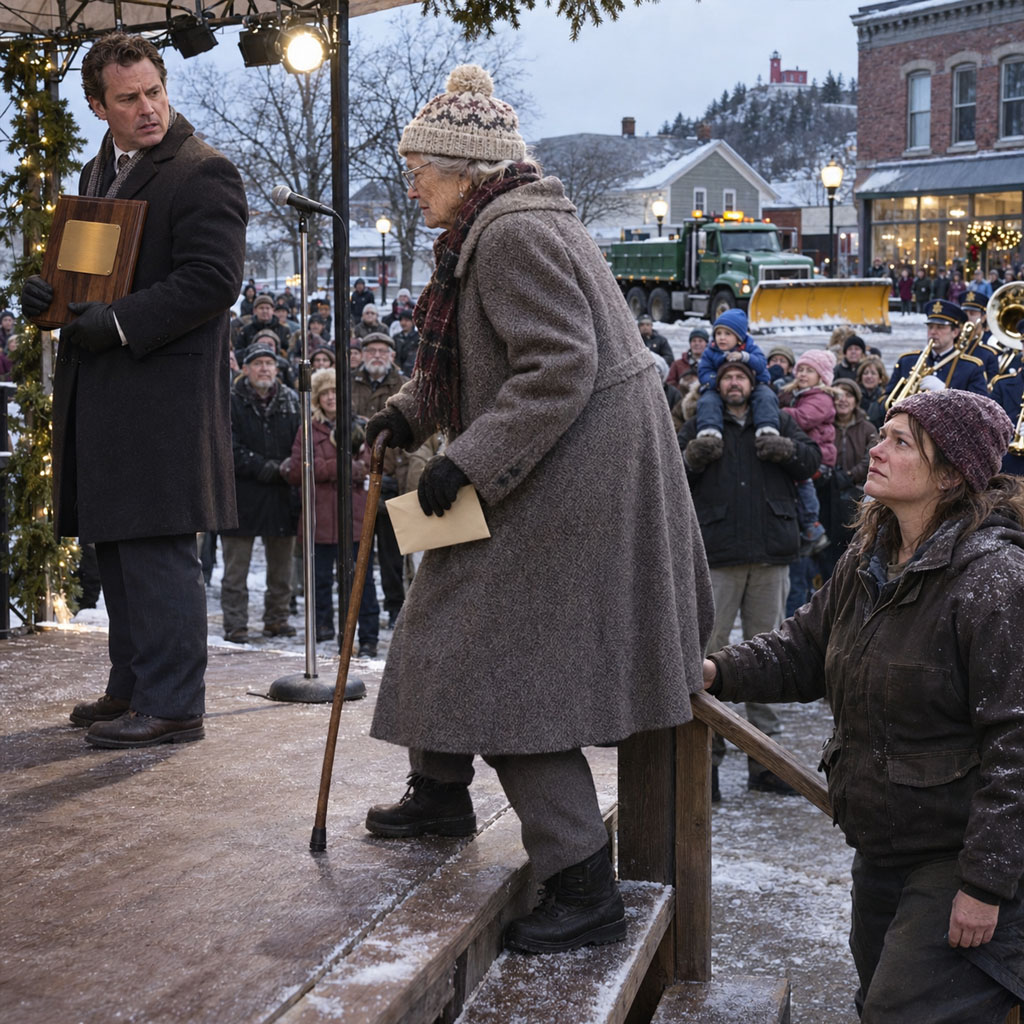
“Help me up the steps, Paula.”
I looked down at her.
“Are you ready?”
She straightened her hat.
“At my age, dear, ready is whatever you decide it is.”
We moved through the crowd slowly.
People stepped aside when they saw her cane.
I helped her climb the four wooden steps, steadied her at the top, and stepped back down.
Todd turned toward her, still smiling.
“Well, hello there, ma’am.”
Agatha looked directly at him.
“Good evening. I’m Agatha Moss.”
Todd blinked.
“Of course. Wonderful to have you here.”
She turned to the mayor.
“Mayor Kangas, I wrote the nomination letter for this award. May I read it?”
The mayor looked surprised.
Then he smiled.
“Mrs. Moss, we’d be honored.”
Todd stepped aside, although he kept holding the plaque.
The mayor adjusted the microphone to Agatha’s height.
She unfolded her letter and put on her reading glasses.
The crowd gradually became quiet.
“Dear members of the Good Neighbor Award Committee,” she began.
Her voice was thin but steady.
“I would like to nominate a woman whose kindness has become part of my mornings, although she has never once asked me to notice it.”
I felt something tighten behind my ribs.
Agatha continued.
“For six winters, I have watched a green pickup truck turn onto Ridge Street before four o’clock in the morning. It carries a yellow snowplow, and behind the wheel is a woman who works while most of us are asleep.”
Todd shifted his weight.
“She clears my driveway first. Then she continues down the street, clearing 22 more.”
Agatha glanced toward me.
“She has never asked me for payment. She has never knocked on my door to remind me of what she does. She simply arrives whenever the snow does.”
People began looking around.
A few recognized my truck.
“Before her, her father cleared these same driveways. My husband, Robert, worked with him at the ore docks. They were friends for almost fifty years.”
Agatha’s voice trembled.
“After my husband died, I continued leaving coffee for Arnold. And when Arnold passed away six years ago, I thought the familiar sound of his truck would disappear from my life.”
She paused and drew a breath.
“But the next time snow fell, that green truck came back.”
My eyes filled.
“His daughter was driving.”
Someone near the front quietly blew their nose.
Agatha pressed the paper flat against the podium.
“I watched her from my kitchen window, and I cried. Not simply because my driveway was clear, but because a good man had raised a daughter who understood what he valued.”
Jeff squeezed my hand.
I couldn’t look at him.
“Occasionally,” Agatha continued, “a teenage boy comes along to shovel the steps. I believe he’s her son, and I strongly suspect he would prefer to be sleeping.”
Laughter rippled through the crowd.
Somewhere behind us, Kellen shouted, “She’s right!”
Even Agatha smiled.
Then she read the final paragraph.
“The woman’s name is Paula Veland. She owns Veland Lawn and Snow. I would like the town to recognize her kindness, her sacrifice, and the quiet example she has set for all of us.”
She folded the letter.
For a moment, nobody spoke.
Todd stared at the microphone.
Agatha wasn’t finished.
She looked at the plaque in his hands.
“I’ve heard Mr. Veland describe his crew this evening.”
Then she turned toward the audience.
“I can only tell you what I have seen from my window, every snowfall for six years.”
Her voice strengthened.
“That crew is one woman in a green truck.”
The silence that followed was almost unbearable.
I felt hundreds of eyes turning toward me.
Agatha extended her hand.
“Paula, would you please come up here?”
I couldn’t move.
Jeff gave me a gentle nudge.
“Go on.”
I climbed the steps.
At the top, Agatha took my hand.
Todd stood beside us, still holding the walnut plaque.
His cheeks were bright red.
From the front row came Eddie Pala’s unmistakable voice.
“Give her the award, Todd!”
Several people laughed nervously.
Eddie wasn’t finished.
“She’s been tearing up the corner of my lawn for six years. I ought to know who’s driving that truck!”
The laughter grew louder.
Then someone began clapping.
Others joined in until the entire street seemed to fill with applause.
Todd looked toward the mayor.
Mayor Kangas said nothing. He simply held out his hand toward the plaque.
Todd slowly passed it to him.
The mayor placed it in my hands.
It was heavier than I’d expected.
“Paula,” he said into the microphone, “I knew your father. He was a fine man, and I should have recognized his truck.”
He looked at the audience.
“Thank you for taking care of your neighbors.”
I tried to answer, but my voice wouldn’t cooperate.
So I nodded.
Agatha slipped her arm through mine.
The choir began singing again, and the crowd gradually moved toward the refreshments.
I thought the worst was over.
Behind the stage, however, Mayor Kangas approached Todd.
I was helping Agatha down the steps when I heard him speak.
“Todd, a word.”
Todd straightened his coat.
“Sure, Coach.”
“Last week, I signed a report connected to a $6,000 state grant. The application listed 23 households served by a volunteer snow crew your office coordinated.”
Todd’s expression changed.
“That’s right.”
The mayor looked at my truck.
“Are those the same 23 driveways Paula clears?”
Todd hesitated.
“I organized the paperwork.”
“That’s not what I asked.”
“Yes,” Todd admitted.
“Did Paula authorize the application?”
Todd stared at the pavement.
“Not exactly.”
The mayor’s voice became very quiet.
“Bring the entire grant file to my office Monday morning.”
Todd opened his mouth.
“I want every application, every statement, and every budget document,” the mayor continued. “We’ll review what was submitted and contact the state.”
He walked away without another word.
Todd turned toward me.
“You could have warned me.”
I stared at him.
“About what?”
“That she was going to embarrass me like that.”
“I asked you twice whether you’d read her letter.”
“You knew I hadn’t.”
“Yes, Todd. I did.”
His face hardened.
“You let me stand up there looking like a fool.”
I looked past him at my father’s truck.
“No, Todd. You walked up there on your own.”
For once, he had nothing to say.
He left without saying goodbye.
Jeff joined us a moment later with Kellen.
He pulled me into his arms so tightly that the plaque pressed against my coat.
“I’m proud of you,” he whispered.
Kellen studied the plaque.
“Does this mean I get promoted from assistant shovel guy?”
“You can have the whole company,” I said, “if you agree to the four o’clock mornings.”
He immediately shook his head.
Agatha laughed.
I drove her home and carried her envelope to the porch.
The green thermos was sitting on the railing, waiting to be washed.
Agatha touched it gently.
“Your father would have been proud tonight.”
I looked down.
“I wish he could have seen it.”
“I think he would have cared more about what happens tomorrow.”
She glanced toward the gathering clouds.
“There’s another storm coming, you know.”
She was right.
And whatever happened with Todd, the snow wasn’t going to stop.
Chapter 4
On Monday morning, Todd walked into the mayor’s office carrying the grant file.
I wasn’t there.
Jeff learned the details later that evening, when Todd called him.
Mayor Kangas reviewed the application and discovered that Todd had listed the Neighborhood Snow Crew as a city-coordinated volunteer project.
The work had been performed by my private business, without compensation, and without my knowledge that it was being described as a city program.
The state grant hadn’t been awarded for Todd’s personal use. It was restricted to approved community-service expenses.
But the application had credited the wrong person with organizing the actual work, and the proposed budget did little to address the costs of keeping the driveways clear.
The mayor contacted the state grant administrator and requested a formal review.
He also removed the snow program from Todd’s responsibilities.
Todd wasn’t fired.
I was relieved about that, despite everything.
He and Linda had a mortgage and obligations of their own. I wanted the truth corrected, not his family destroyed.
But Mayor Kangas made it clear that Todd couldn’t submit another person’s work as his own again.
The following two weeks were uncomfortable.
Todd stopped calling.
He didn’t attend our family Christmas gathering. Linda brought their gifts over herself.
She stood in our doorway holding a wrapped box and looking exhausted.
“He’s ashamed, Paula.”
I nodded.
“He should be.”
“I know.”
She shifted the box in her arms.
“I told him that. More than once.”
We stood together for a moment.
Then Linda said, “He did love his mother. You know that, right?”
My expression softened.
“I’ve never doubted it.”
“He just always wants everybody to know when he’s done something good.”
I thought of Todd accepting that plaque.
“Maybe that’s the problem.”
Linda hugged me.
“I hope you two can find your way through this.”
“So do I.”
In early January, the state agreed to consider revising the grant’s approved purpose and identifying the actual volunteer coordinator.
The city council would review the proposed changes later that month.
Meanwhile, my transmission continued making an ugly grinding sound whenever I shifted into reverse.
My mechanic shook his head when he heard it.
“Paula, I’m serious. This truck needs work before it leaves you stranded.”
“I know.”
“You’ve been telling me that since October.”
“I know that, too.”
He leaned against the fender.
“Sometimes knowing isn’t enough.”
I promised to bring the truck back after the next storm.
Then Lake Superior delivered one of the worst storms we’d seen in years.
Snow began falling Friday afternoon and continued through Saturday.
By Sunday morning, Ridge Street was buried beneath 26 inches.
The roads were difficult, visibility was poor, and every radio station seemed to have the same advice: stay home unless travel was necessary.
At 3:45 a.m., I started my father’s truck.
Kellen climbed into the passenger seat wearing snow pants, thick gloves, and an expression of deep personal suffering.
“You didn’t have to come,” I reminded him.
“Yeah, I did.”
He leaned his head against the window.
“Just don’t expect conversation until sunrise.”
We reached Agatha’s house while the neighborhood was still dark.
Her green thermos sat on the porch rail.
The note read:
“Twenty-six inches. Strong coffee today. Please be careful.”
I tucked the card into my pocket.
We cleared her driveway and shoveled the front steps.
Then we moved down Ridge Street.
The Sunquists were next.
Eddie stood behind his living room window in a plaid robe, raising one fist in what I assumed was either encouragement or criticism.
We finished his driveway, then another, and another.
At the tenth house, the truck made a noise I’d never heard before.
A grinding rattle came from beneath the floor.
The steering wheel shuddered.
Then there was a heavy clunk.
I pressed the accelerator.
Nothing.
I shifted carefully into reverse.
The truck didn’t move.
I tried once more, then shut off the engine.
Kellen looked at me.
“Mom?”
I sat staring through the windshield.
The plow blade was half buried in snow. The truck was stopped beside the road, and 13 driveways remained untouched.
The transmission had finally given up.
For a long moment, I could only hear the wind brushing snow against the windows.
Kellen spoke softly.
“What do we do?”
I looked at the shovel across his knees.
“We do what we can.”
We climbed out.
The snow reached almost to Kellen’s thighs in places. We began clearing the nearest driveway by hand, pushing and lifting snow into piles along the edges.
After twenty minutes, we’d barely made a dent.
My shoulders burned.
Kellen’s breathing grew heavy.
I looked up the street at the dark houses.
I thought of all the people who depended on us, and for the first time in six winters, I knew I couldn’t finish the route.
“Mom,” Kellen said, “maybe we should call somebody.”
“Who?”
He glanced toward the bottom of the hill.
Before he answered, headlights swept across the snow.
An orange pickup truck with flashing amber lights turned onto Ridge Street.
A city snowplow.
It approached slowly and stopped behind my disabled truck.
The driver’s door opened.
Todd climbed out.
He wore a city parka, borrowed snow pants that ended above his boots, and an expression I’d never seen on him before.
Uncertainty.
Jeff emerged from the passenger side.
I stared at them.
“What are you doing here?”
Jeff came toward me.
“Kellen texted me that the truck quit.”
Kellen gave me an apologetic shrug.
“I figured we needed help.”
Todd held up a set of keys.
“I called the public works foreman. The city has a spare truck. He authorized us to use it for the emergency volunteer route, with you supervising.”
I looked at the orange plow.
“You’re driving?”
Todd glanced down at his boots.
“I was hoping you’d teach me.”
For a moment, I couldn’t find a single word.
He swallowed.
“I don’t know how to operate the blade, Paula. I’ve never done it.”
Snow collected on his shoulders.
“I’ve spent years telling people I coordinate things. But I can’t even clear one driveway.”
He looked directly at me.
“Please. Show me.”
There were a dozen things I could have said.
I could have reminded him about the newsletter, the plaque, the grant, the way he’d spoken to me at Thanksgiving.
Instead, I looked at the remaining houses.
“Get in.”
Todd hurried around to the driver’s side.
I climbed into the passenger seat and showed him the controls.
How to angle the blade.
How to raise it near the garage door.
How to push snow without blocking a mailbox or damaging a lawn.
He listened carefully.
Then he attempted his first driveway.
It went badly.
He left a ridge of snow across the sidewalk and came dangerously close to a stone planter.
“Todd, stop.”
He braked.
“What?”
“You’re trying to move all the snow at once. Take smaller passes.”
“Right.”
He backed up and tried again.
The second attempt was better.
The third was not.
At one point, he turned the blade in the wrong direction and nearly pushed a snowbank into Mrs. Halvorsen’s ditch.
I grabbed the dashboard.
“Stop! Stop!”
He slammed on the brakes.
We sat in silence.
Then Todd said, “You’re going to tell everybody about this, aren’t you?”
I looked at him.
“Only if you start talking about the jackets again.”
He laughed.
Not his polished public laugh.
A real one.
We kept going.
Jeff and Kellen followed behind us, clearing steps and walkways.
At each house, I directed Todd while he practiced controlling the plow.
Sometimes he needed three attempts to do what I would have done in one.
But he didn’t complain.
He didn’t ask to switch places.
When I pointed out a mistake, he corrected it.
By 8:15, we’d finished all 23 driveways.
The sun had risen over Lake Superior, turning the snow pale gold.
Todd parked outside Agatha’s house and shut off the engine.
He stared down the cleared street.
“Thirteen,” he murmured.
“What?”
“I actually plowed thirteen driveways.”
“With supervision.”
“Considerable supervision.”
I smiled.
He kept looking through the windshield.
Then Agatha appeared on her porch.
She wore a robe beneath her winter coat and carried a second green thermos.
Todd rolled down his window when she approached.
“I wasn’t sure how you take your coffee,” she told him. “So I put cream in it.”
Todd accepted the thermos with both hands.
“Thank you, Mrs. Moss.”
Agatha studied his face.
“I hear you’ve been busy.”
“Trying.”
“That’s a good place to begin.”
Todd lowered his eyes.
“I’m sorry about the ceremony. And the grant. All of it.”
“I know, dear.”
“I didn’t even read your letter.”
Agatha smiled gently.
“Yes. I gathered that.”
Then she patted the truck door.
“Keep helping your sister-in-law. She’s been carrying quite a load.”
She returned to her house, leaving Todd staring at the thermos.
For a while, neither of us spoke.
Finally, he turned toward me.
“Can I tell you something?”
I nodded.
“When Mom was living with us, I drove her to physical therapy three mornings a week. Six o’clock appointments.”
He ran his thumb around the thermos lid.
“One morning we came down Ridge Street and saw you clearing Agatha’s driveway.”
I watched him carefully.
“Mom said, ‘Look at that woman out there in the dark. Isn’t that something?'”
Todd’s voice grew quieter.
“I told her it was you.”
He looked out the window again.
“She said, ‘Of course it’s Paula. That girl has her father’s heart.'”
I felt my throat tighten.
Todd continued.
“Mom was proud of you. She talked about you like you were doing something extraordinary.”
“She was proud of you, too, Todd.”
“Maybe. But I always wanted her to say it the way she said it about you.”
He shook his head.
“I took care of her because she was my mother. I loved her. But sometimes I caught myself wishing somebody would notice how much we were doing.”
I didn’t interrupt.
“When that nomination came in, I saw a chance to be associated with something people already admired. I told myself I’d coordinate the grant and make it bigger.”
He swallowed.
“Then I started acting like I was the reason it existed.”
Outside, Jeff and Kellen were loading shovels into the back of the city truck.
Todd looked at his hands.
“I wanted the applause without doing the work.”
I let his words settle.
“Your mother knew you loved her,” I said. “And Linda did a wonderful thing taking care of her. Nobody can take that away.”
He nodded.
“But you can’t take someone else’s work and make it yours, either.”
“I know.”
I glanced at the cleared street.
“Today you helped. That’s different.”
Todd looked at me.
“Is it enough?”
“Not to erase everything.”
He nodded again.
“But it’s a start.”
We sat together in the quiet truck.
Then Todd said, “Your father must have been a very patient man.”
I thought of Dad’s enormous hands and his habit of letting silence answer difficult questions.
“Sometimes.”
Todd gave a tired smile.
“Well, his daughter isn’t nearly as patient.”
“No,” I said. “She isn’t.”
And for the first time in weeks, being together didn’t feel uncomfortable.
Chapter 5
The city council met near the end of January.
I attended with Jeff, Kellen, Agatha, and Eddie Pala, who wore a clean plaid shirt and announced that he had prepared a statement.
His statement turned out to include four minutes about the condition of his lawn.
Mayor Kangas let him finish.
Then the mayor explained the revised grant proposal.
After reviewing the documentation, the state had approved a change to the program’s designated coordinator and allowable expenses.
The $6,000 would support the actual Ridge Street volunteer route, with me responsible for coordinating the work.
The approved budget would help cover the equipment repair, fuel, and insurance costs, including the rider needed for the volunteer driveways.
For the first time, the money would serve the people whose names had appeared on the application.
The council voted unanimously to approve the revised program.
I exhaled so deeply that Jeff squeezed my shoulder.
But Mayor Kangas wasn’t finished.
“There’s one more issue,” he said.
He looked directly at me.
“Twenty-three driveways is too much responsibility for one person and one aging pickup.”
I started to object.
He held up a hand.
“Paula, your father and I knew each other for years. I respected him. But even Arnie couldn’t do everything.”
A few council members smiled.
“We have an older pickup available through public works. I’d like to propose assigning it to the volunteer route during storms, with authorized volunteer drivers who complete the required training.”
He looked around the room.
“We’ll establish a roster and a safety procedure, and the city can help coordinate emergency coverage.”
I stared at him.
Two trucks.
Actual volunteers.
People sharing the responsibility that had been sitting on my shoulders for six winters.
The proposal passed unanimously.
Eddie applauded so loudly that several people laughed.
Agatha reached for my hand.
“There,” she whispered. “That sounds a bit more sensible.”
The volunteer sign-up sheet went up at City Hall the following morning.
Todd’s name was first.
Jeff’s was second.
Kellen signed third, in enormous, uneven handwriting.
Beside his name, he wrote:
“Available after 5:00 a.m. on weekends. Preferably later.”
By February, we had eight volunteers.
Some were retired ore-dock workers who’d known Dad. One was a hospital nurse who worked unusual hours and rarely slept through a snowstorm anyway.
Others were younger neighbors who simply wanted to help.
We organized the route into manageable sections and made sure everyone understood how to use the equipment safely.
Todd attended every training session.
He was still a terrible plow driver at first.
But he worked at it.
He asked questions, accepted criticism, and learned where Eddie’s lawn ended and the driveway began.
That particular lesson took several attempts.
The city replaced the brass plate on the Good Neighbor Award.
My name was engraved on it, along with a dedication to my father.
I mounted the plaque securely inside the cab of my truck, where I could see it without obstructing the windshield.
Jeff asked why I didn’t hang it in the living room.
I told him the truck seemed like the right place.
After all, that was where Dad had taught me nearly everything important about the work.
And it was where I’d spent all those mornings wondering whether anyone knew what I was doing.
By March, the worst of the winter seemed over.
Then one final storm moved across Lake Superior.
It brought heavy, soft snow that settled quietly over Ridge Street.
I reached Agatha’s house before dawn, as usual.
The green thermos was waiting on her porch rail.
So was a familiar index card.
“Today’s forecast: snow, followed by more snow. Coffee remains the best remedy.”
I laughed and tucked the note into my pocket.
After clearing her driveway, I turned off the engine.
For six winters, I’d never knocked on Agatha’s door after plowing.
That morning, I decided to change that.
I reached into the glove compartment and took out the old red coffee can.
It was scratched, dented, and full of folded index cards.
I carried it to her porch.
Agatha opened the door wearing her robe and slippers.
“Paula? Is something wrong?”
“Nothing’s wrong.”
I held out the can.
“I brought you something.”
She looked puzzled as she lifted the lid.
Then she saw the cards.
Her hand flew to her mouth.
“Oh, my.”
She sat slowly on the little bench by the doorway.
“You kept them?”
“Every one.”
She lifted a card from the top.
A crossword clue from two winters earlier.
Then another.
A joke about a snowman.
Another held a note reminding me to watch for ice near her garage.
Agatha smiled, but tears were gathering in her eyes.
“I thought you read them and threw them away.”
“Never.”
She continued sorting through the cards.
Near the bottom, she found one that looked different.
The paper had yellowed. The handwriting was larger, the letters printed in careful block capitals.
She stopped breathing for a moment.
Then she held it closer to the porch light.
“Paula.”
I leaned toward her.
“What’s wrong?”
“This is Robert’s handwriting.”
I stared.
She turned the card toward me.
“ARNIE, COFFEE’S HOT. THANK YOU, OLD FRIEND. — R.”
I felt a sudden ache in my chest.
“I didn’t know that was in there.”
“It must have been in your father’s truck.”
I nodded slowly.
“When I started keeping your notes, there were some old papers in the glove compartment. I put everything together.”
Agatha held the little card against her chest.
For a long while, neither of us spoke.
Beyond the porch, snow drifted gently through the streetlights.
“Thirty years,” Agatha said at last.
I looked at her.
“For thirty years, one of us has left coffee on this railing. First Robert for your father. Then me for your father. Then me for you.”
Her voice trembled.
“I used to wonder whether anyone understood what those mornings meant to us.”
I sat beside her.
“I did.”
She looked at me.
“And your father did, too.”
Agatha touched the faded writing.
“Robert wasn’t much for speeches.”
“Neither was Dad.”
“They suited each other.”
She laughed softly.
Then she placed the old card on top of the pile and closed the can.
“Take this back to your truck.”
“Are you sure?”
“Absolutely.”
She pressed it into my hands.
“That’s where these memories belong.”
I carried the can back to the green pickup and set it carefully inside the glove compartment.
Before starting the engine, I sat for a moment looking at Dad’s old steering wheel.
So much had changed since he’d driven that truck.
And yet the most important things hadn’t changed at all.
The neighbors still needed help.
The coffee still waited on the porch.
And kindness still mattered most when no one was watching.
By the following December, nearly a year after the award ceremony, our little operation had grown to eleven regular volunteers.
The green pickup was running again with a rebuilt transmission.
The city truck was equipped with a plow and a hand-painted sign Kellen made in his school workshop.
“RIDGE STREET VOLUNTEERS.”
Todd drove the orange truck every Tuesday and Friday when snow was expected and his schedule allowed.
He was getting better.
Not wonderful, but better.
Eddie claimed Todd damaged his lawn at least once a month.
Todd insisted Eddie was exaggerating.
I suspected they both enjoyed the argument.
Todd never posted photographs of himself plowing on the city’s Facebook page.
One morning, I asked him why.
He shrugged.
“Nobody needs a picture of me doing what I said I’d do.”
I smiled.
“That’s a change.”
“Yeah,” he said. “I guess it is.”
He finished checking the plow blade, then looked up at me.
“You know something your dad used to say?”
“What?”
“You don’t plow for thank-yous.”
For a moment, I couldn’t speak.
“Where’d you hear that?”
“Jeff told me.”
Todd pulled on his gloves.
“He said your father taught you that. Seems like a good rule.”
I studied my brother-in-law.
He was still Todd.
He still talked too much at Thanksgiving. He still liked being the center of attention. He still occasionally explained things I understood better than he did.
People don’t become entirely different overnight.
But he had learned to show up when the work was difficult, even when nobody was there to applaud.
That mattered.
One evening, while we were finishing a family dinner, Todd approached me in the kitchen.
“Paula, there’s something I’ve been meaning to say.”
I set down the dish towel.
“I’m listening.”
He looked uncomfortable.
“I used to think that because Linda and I took care of Mom, people owed us something.”
I waited.
“But you never owed me your work. Or your silence.”
He swallowed.
“I’m sorry I made you feel that way.”
I looked at him for a long moment.
“I was grateful for what you and Linda did,” I said. “I always will be.”
“I know.”
“But gratitude isn’t the same as giving somebody permission to walk all over you.”
Todd nodded.
“No. It isn’t.”
I handed him a dish towel.
“Now you can start by drying those plates.”
He laughed and got to work.
Jeff watched us from the doorway with a smile.
For years, he’d felt caught between loyalty to his brother and loyalty to his wife.
Now he was learning that loving someone didn’t mean protecting them from every uncomfortable truth.
And I was learning something, too.
I had spent so long honoring my father’s quiet generosity that I’d forgotten I was allowed to speak when someone treated me unfairly.
Dad never expected praise.
But he never taught me to accept dishonesty, either.
There was a difference between serving others without asking for recognition and allowing someone else to take what belonged to you.
It had taken an 81-year-old librarian, a microphone, and a very public embarrassment to teach our family that lesson.
The following winter, on a bitter morning just before Christmas, I pulled up outside Agatha’s house at 3:45.
Two thermoses waited on the porch rail.
One for me.
One for whoever was driving the orange truck.
That morning, it was Todd.
He climbed out of his pickup and walked over as I finished clearing the driveway.
He picked up his thermos and read the note attached to it.
“Five-letter word for a man who finally learned to run a snowplow.”
He turned the card over.
“Answer: TODD. Sometimes.”
He burst out laughing.
I laughed with him.
From her kitchen window, Agatha raised one hand.
We waved back.
Then Todd climbed into his truck, and I climbed into mine.
We still had 22 driveways to clear.
As I reached for the ignition, the dashboard lights caught the brass plate of the Good Neighbor Award.
It bore my name.
Beneath it, in smaller letters, were the words:
“In loving memory of Arnold Veland, whose kindness continues.”
I touched the edge of the plaque.
Then I started the engine.
My father had spent years showing me that generosity didn’t need an audience.
Agatha had shown me that quiet kindness was still seen.
And Todd had finally learned that genuine respect comes from what you’re willing to do, not what you’re willing to claim.
That morning, two trucks rolled down Ridge Street while the town slept peacefully beneath a fresh blanket of snow.
My brother-in-law had once stood before hundreds of people and said his crew was simply doing what neighbors do.
Back then, those words hadn’t belonged to him.
Now, as his orange truck turned into the next driveway and its plow blade lowered into the snow, they finally did.
THE END.\
⚠️ All characters and events are fictional. Do not imitate or apply them in real life. 😌😌😌