
Chapter 2
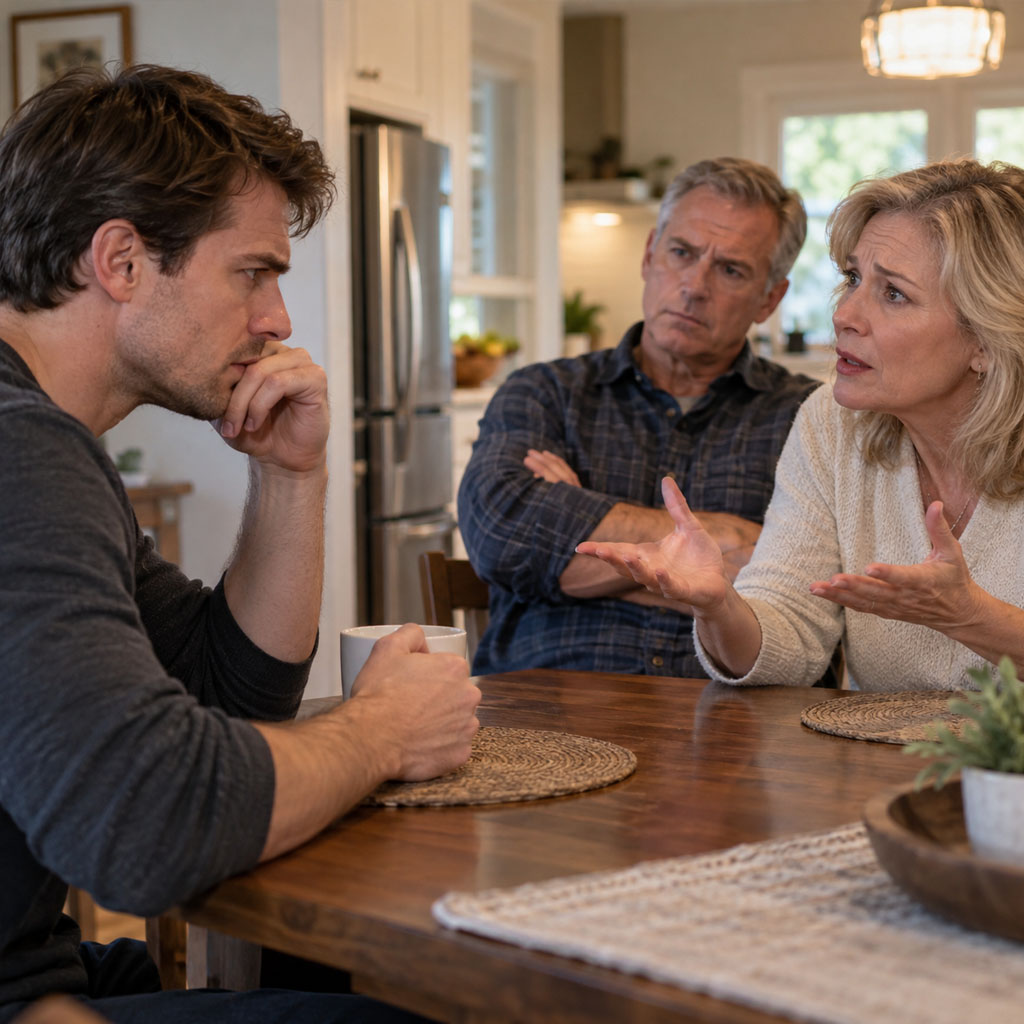
The next morning, I waited until everyone was at the breakfast table.
Mom had made eggs. Dad was reading something on his phone, and Brian looked as if he had just rolled out of bed.
I poured coffee and remained standing.
“You have forty-eight hours.”
Dad lowered his phone. “For what?”
“To move out.”
Mom’s fork stopped halfway to her mouth.
Brian actually laughed. “Good one.”
“I’m serious.”
Mom pushed back from the table. “Matt, that is not what we discussed.”
“No. You discussed removing me from my own house so Brian could have it.”
“We were trying to help your brother.”
“And I’m choosing to help myself.”
Dad’s voice hardened. “You’d put your own parents out?”
“I gave you three years.”
“We’re family.”
“I know.”
“You don’t do this to family.”
That sentence almost got me. For years, those four words had controlled me better than any threat could have.
Then I looked around the kitchen.
The house had not changed.
I had.
“You also don’t ask your son to surrender the house he pays for because his brother wants an easier life.”
I went upstairs before the argument could become uglier.
The next two days were miserable. Mom alternated between wounded silence and emotional reminders of childhood. Dad barely spoke to me. Brian made jokes loud enough for me to hear about “successful people forgetting where they came from.”
I remembered exactly where I came from.
I also remembered whose name was on the deed.
When the deadline arrived, almost nothing had been packed.
Dad sat in the living room with his arms crossed.
“You’re really doing this.”
“Yes.”
“Where are we supposed to go?”
“You have savings. Aunt Carol already offered you her guest room last year. Brian has friends. You have options.”
Mom’s eyes filled with tears. “After everything we did for you.”
That hurt more than I wanted it to.
“I’m grateful for what you did when I was growing up. That doesn’t mean I owe you my house forever.”
By late afternoon, they finally left.
Mom stopped at the doorway as though she expected me to break down and call everyone back. Dad carried two suitcases without looking at me. Brian was last.
He leaned close enough that only I could hear.
“You’re going to regret this.”
“No,” I said. “I regret waiting three years.”
Then I closed the door.
For the first time since they moved in, the house was completely silent.
I stood in the entryway expecting triumph.
Instead, I felt grief.
The quiet exposed everything I had lost long before they left: privacy, trust, ordinary affection, the ability to sit with my family without wondering what would be demanded next.
A week later, Aunt Carol called.
“Matt, your parents are here.”
“I figured.”
She hesitated. “There’s something else.”
“What?”
“Your mother has been telling people you threw them out because you’re selling the house and moving away.”
I closed my eyes.
“I’m not selling.”
“I know. I told her that story didn’t sound right.”
“What else is she saying?”
Carol sighed. “That success changed you. That you don’t care about family anymore.”
Within days, I felt the difference around town. An older neighbor who used to stop and talk barely waved. A man at the hardware store asked whether my parents were “doing all right after everything.” Even my barber said, “Heard you and your folks had a falling-out.”
I didn’t defend myself to everyone.
Part of me still hoped the whole mess would cool down.
Then, two weeks after they moved out, an email arrived from my mortgage servicer.
The subject line read: Requested Ownership Documentation.
I assumed it was spam.
Then I saw my address.
My loan number.
And a document attempting to transfer an interest in the property to Brian.
I read it three times.
At the bottom was a signature using my name.
It wasn’t mine.
My stomach turned cold.
I called the mortgage company immediately.
The representative assured me nothing had been transferred. The request had failed verification because the information did not match their ownership records.
“Who submitted it?” I asked.
She could not give me every detail over the phone, but the accompanying paperwork contained my father’s contact information.
I sat perfectly still after the call ended.
The disrespect was one thing.
This was different.
I called Dad. Voicemail.
Then Mom.
She answered in a soft voice.
“Hi, honey.”
“Did you and Dad try to put my house in Brian’s name?”
Silence.
“Mom.”
“You’re misunderstanding.”
“I have the paperwork.”
“We were only trying to explore options.”
“You signed my name.”
“Your father thought—”
“My name.”
Her tone sharpened. “You don’t have to talk to me like I’m a criminal.”
“Then explain why someone tried to transfer my property without asking me.”
She breathed into the phone.
Finally she said, “Brian needs a home base, Matt. You’re doing well. You can buy another place someday.”
I felt something inside me become very still.
“You actually believe that.”
“You always land on your feet.”
There were those words again.
As if strength were permission to take from me.
As if because I could recover, hurting me did not count.
I ended the call.
That afternoon, I contacted an attorney.
Her name was Lydia Grant. She listened without interrupting while I explained the three years, the eviction, and the attempted transfer.
When I finished, she said, “The most important thing now is protecting your property and preserving documentation. Don’t threaten anyone. Don’t retaliate. Save every email and message, and let the records speak for themselves.”
For the first time in weeks, someone had given me advice that did not require me to surrender something for the sake of peace.
So I followed it.
We placed additional safeguards around the property records and formally documented the unauthorized attempt. I changed locks, account passwords, security codes, and emergency contacts. Every step was legal, quiet, and final.
But emotionally, I was falling apart.
I stopped going to the gym. I ordered groceries instead of shopping. I avoided places where I might run into people who had heard my mother’s version of events.
Then my oldest friend, Dan, appeared at my door one Saturday with sandwiches and a six-pack.
“You planning to become a hermit?” he asked.
“Thinking about it.”
He came inside anyway.
We watched half a basketball game before he finally spoke.
“You know you didn’t deserve what happened.”
I stared at the television.
“They’re my parents.”
“I know.”
“I put them out.”
“After they asked you to leave your own house.”
I said nothing.
Dan leaned forward.
“Helping somebody doesn’t mean giving them permission to erase you.”
That sentence stayed with me after he left.
That night, I walked into the room Mom had turned into a craft room and opened a closet I had barely touched in years.
Inside was a cardboard box.
It contained old notebooks, business cards, rough plans, and a folder labeled Greer Technology Consulting.
A business I had once dreamed of starting.
A life I had postponed because there was always someone who needed something first.
I carried the box to my desk.
For the first time since my family left, I stopped thinking about what they had taken.
I started thinking about what I could build.
Chapter 3
The next six months were not dramatic.
They were exhausting.
I kept my contract work while building my consulting business at night. I registered the company, created a website, contacted former clients, and accepted projects small enough that I would once have considered them beneath me.
A dental office needed cybersecurity help.
A trucking company needed its aging network replaced.
A local accounting firm needed remote access rebuilt.
One job became two. Two became six.
Then one of my clients offered me a monthly retainer.
I reclaimed my house at the same time.
I moved into the primary bedroom for the first time since buying the place. I repainted the former craft room and turned it into an office. I replaced the couch Brian had stained and cleared Dad’s abandoned shelving from the garage.
Nothing was extravagant.
That was what made it powerful.
Every room slowly began to feel like mine again.
The silence changed too.
At first it had felt lonely.
Then it became peaceful.
Mom sent messages occasionally.
Hope you’re doing well.
Your father’s birthday is next week.
Maybe we could have dinner. No drama.
I didn’t answer.
Then Brian left me a voicemail.
“Hey, man. I know things got weird. Anyway, apartment prices are insane. If you’ve got room, I could stay temporarily and kick in some money once I find something steady. Just like old times.”
I played it once.
Then saved it with the rest of the documentation.
Just like old times was exactly what I no longer wanted.
Lydia encouraged me to keep my distance.
“Boundaries aren’t punishment,” she said. “They’re information. They tell people what access they do and do not have.”
That idea changed the way I thought about everything.
I stopped trying to convince relatives that I was right. When someone asked sincerely, I explained the facts without exaggeration.
Yes, my parents had lived with me rent-free for three years.
Yes, they had asked me to move out.
Yes, an unauthorized property-transfer request had later been submitted.
I did not call my parents names.
I did not insult Brian.
I simply told the truth.
The story traveled on its own.
Aunt Carol eventually apologized.
“I thought maybe everybody was emotional and the truth was somewhere in the middle,” she said. “Then I saw the paperwork.”
“I’m not asking you to choose sides.”
“I know. I just wish your mother had told me what really happened.”
“So do I.”
Meanwhile, the consulting firm kept growing.
Through a client, I met a commercial real estate agent named Jordan Blake. She was in her early thirties, sharp, funny, and completely unimpressed by people who inflated their own importance.
She helped me find a two-story brick building near downtown. The ground floor had enough room for offices and a conference room. The upstairs had a small apartment that could be renovated later.
Six months earlier, buying commercial property would have sounded ridiculous.
Now the numbers worked.
I bought it.
Not to prove anything.
Not to punish anyone.
Because the business needed space.
That distinction mattered.
I moved the company into the ground floor and hired a project coordinator and a part-time technical specialist. The business was still small, but it was real.
A local business publication eventually contacted me for a story about entrepreneurs renovating older downtown properties. During the interview, the reporter asked why I had decided to build my own company.
I could have given a polished answer about market opportunity.
Instead, I told a careful version of the truth.
“I spent years thinking being dependable meant saying yes every time someone needed me. Eventually I learned that responsibility without boundaries turns into something unhealthy.”
The reporter asked whether something specific had happened.
“A family situation.”
I did not name anyone.
The article appeared under the headline Rebuilding More Than a Business.
Mom texted me that afternoon.
Saw the article. We’re proud of you.
I stared at the message for several minutes.
Then I put the phone away.
Pride without accountability was not reconciliation.
Around that time, Brian began telling people he had become a real estate investor.
Jordan heard about it before I did.
“He’s trying to flip a house,” she told me over coffee.
“Good for him.”
She studied my face. “You mean that?”
“I hope he succeeds.”
And I did.
What I no longer felt obligated to do was rescue him if he failed.
A month later, I heard that renovation work had been stopped because permits and utility inspections had not been handled properly. Brian had poured money into improvements before understanding what the property required.
Years earlier, I would have called him.
I would have researched everything.
I would have offered money or contacts.
Instead, I stayed out of it.
Aunt Carol later told me Brian lost most of what he had invested.
“He’s furious,” she said.
“At who?”
“Everybody.”
That sounded like Brian.
I felt no pleasure hearing it.
But I did feel something else.
Relief.
His consequences were finally his.
Mine had always become mine.
His had always become someone else’s.
That pattern had ended.
A few months after the article, my company sponsored a financial literacy workshop run by a nonprofit client. The topic was protecting yourself from financial manipulation inside families.
I agreed to speak for fifteen minutes.
I talked about generosity, boundaries, documentation, and the danger of assuming love makes paperwork unnecessary.
I told the audience I had once allowed relatives to live with me without rent because I loved them.
I told them that love was real.
So was what happened later.
“You can care about someone,” I said, “and still refuse to give them control over your property, money, or future. Those things are not opposites.”
Afterward, several people approached me.
A widow told me her adult son had pressured her to cosign loans.
A retired teacher said her sister had borrowed money for years without repaying it.
A young man told me he thought setting boundaries made him a bad son.
Listening to them, I understood something that surprised me.
My story was no longer just about what my parents had done.
It was about what I had learned because of it.
That evening, Mom sent another message.
I heard about your workshop. Was telling that story really necessary?
I began typing an angry reply.
Then deleted it.
I wrote instead:
I did not use anyone’s name. I spoke about my own experience. I’m not going to pretend it didn’t happen.
She never answered.
Chapter 4
Almost a year after my parents left my house, Dad contacted me directly.
He asked if I would meet him at a diner near the old high school.
I nearly declined.
Then I agreed, partly because I wanted to know whether anything had changed.
He was already sitting in a booth when I arrived. He looked older than I remembered, not dramatically, just enough that guilt tried to rise inside me before he had said a word.
I sat across from him.
“How are you?” he asked.
“Fine.”
“The business looks good.”
“It is.”
He nodded.
For a while, neither of us mentioned the real reason we were there.
Then Dad looked down at his coffee.
“I should not have submitted that property paperwork.”
It was the closest thing to an apology I had heard from him.
“No,” I said. “You shouldn’t have.”
“Your mother thought Brian needed help.”
“Mom didn’t sign it.”
He looked up.
“I know.”
“Why did you?”
He rubbed his thumb against the coffee cup.
“Because I told myself you would be okay.”
The answer hurt precisely because it was familiar.
“You were always the one who figured things out,” he continued. “Brian wasn’t.”
“So you decided the capable son should lose something because the other one might fail.”
Dad winced.
“When you say it like that—”
“How else should I say it?”
He had no answer.
I did not raise my voice.
“I spent most of my life believing being responsible meant I should carry more. What I didn’t understand was that everybody else had started believing the same thing.”
Dad stared at the table.
“I’m sorry.”
I waited.
There was no excuse after it.
No but.
That mattered.
“What about Mom?” I asked.
“She still thinks you could have handled things differently.”
“Of course she does.”
“She misses you.”
“I miss her too.”
He looked surprised.
I continued before he could misunderstand.
“I miss the mother I thought I had. I miss Christmas mornings. I miss her lasagna. I miss calling her when something good happened. Missing somebody doesn’t mean you can trust them.”
Dad’s eyes watered slightly.
I looked out the diner window.
For years, I had imagined that if either parent ever apologized, everything would suddenly feel repaired.
It didn’t.
Some damage can be forgiven long before it can be trusted again.
“I don’t know what happens next,” I told him. “Maybe someday we can have some kind of relationship. But nobody is moving into my house. Nobody is borrowing money. Nobody gets access to my finances. And if Mom wants a relationship with me, she has to stop telling people a version where I abandoned her for no reason.”
Dad nodded slowly.
“That’s fair.”
I almost smiled.
Fair.
It had taken us a year to reach that word.
Brian never apologized.
For a while, he lived with my parents in a small rental outside town. His failed renovation finally forced him to take a steady warehouse job. According to Dad, he hated it at first.
Then something unexpected happened.
He stayed.
Six months.
Then nine.
He eventually moved into a modest apartment with a roommate.
I learned all this secondhand.
I did not rush back into his life.
Sometimes the kindest thing you can do for an adult is stop interrupting the lessons their choices are trying to teach them.
My own life kept expanding.
Jordan and I began dating slowly, almost accidentally. She understood what it meant to love family without surrendering yourself to them, and she never treated my history like a wound she was entitled to inspect.
One evening, we sat on the rooftop above my office as the downtown lights came on below us.
She asked, “Do you miss them?”
I thought about my answer.
“Yes.”
She waited.
“But I think I miss who I believed we were.”
Jordan nodded.
“That makes sense.”
Below us, cars moved through the intersection. Inside the building were employees whose salaries now depended partly on a company that had once existed only in a dusty cardboard box.
A few years earlier, I had believed losing my family’s approval would destroy me.
Instead, losing it forced me to discover who I was without it.
I still owned the ranch.
I could have sold it when I moved into the apartment above the office, but I didn’t. Eventually I rented it to a retired couple from Michigan who wanted to be closer to their grandchildren.
Before they signed the lease, the husband walked through the living room and said, “Beautiful place. You must have good memories here.”
I looked around.
Some were good.
Some were not.
“All kinds,” I said.
Before handing them the keys, I walked through the house alone one final time.
I stood in the kitchen where Mom had told me to move out.
I passed the living room where Brian had once asked why I acted like I owned the place.
Then I stepped into the garage where Dad’s workbench had stood.
Nothing about the house hurt anymore.
It was wood and brick and drywall.
The meaning had always come from the people inside it.
For three years, I thought generosity required me to keep giving until there was nothing left to defend.
I was wrong.
Generosity is a gift.
A gift given under pressure is something else.
Family love should not require one person to become smaller so everyone else can remain comfortable.
I locked the door and walked to my car.
My phone buzzed.
It was a message from Dad.
Your mother wants to know if you’d be willing to meet us for lunch Sunday. Public place. No pressure. She says she owes you an apology.
I read it twice.
Jordan was waiting for me across town.
My office would be busy Monday morning.
My life no longer paused when my family wanted something.
That was the difference.
I typed:
Sunday lunch is okay.
Then, after thinking for a moment, I added:
But we start slowly.
Dad replied almost immediately.
Understood.
I smiled.
Not because everything was healed.
It wasn’t.
Not because I had won.
There had never been anything worth winning.
I smiled because for once, helping my family did not require abandoning myself.
And if they wanted a place in my life again, they would have to enter through the same door everyone else did now.
With respect.
THE END.
⚠️ All characters and events are fictional. Do not imitate or apply them in real life. 😌😌😌


