
Chapter 2
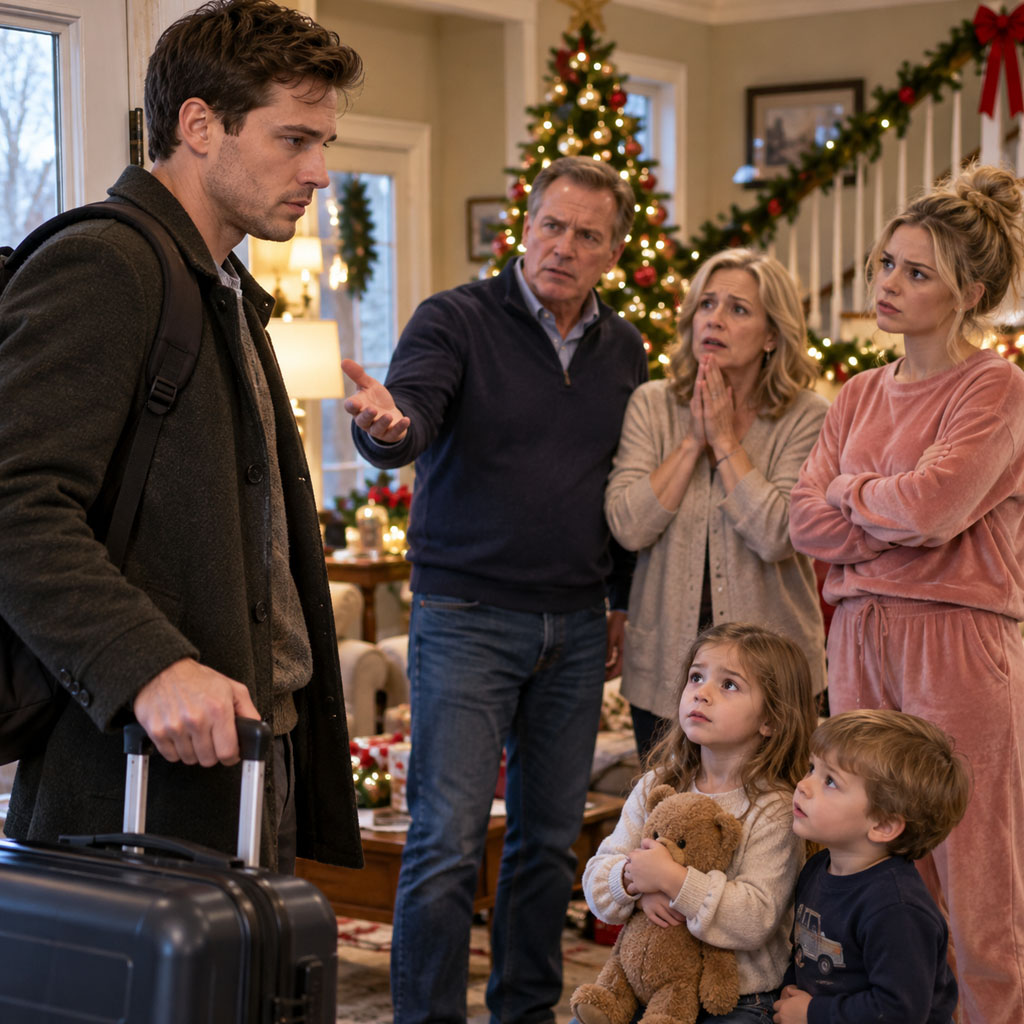
Dad slammed his suitcase against the wall hard enough to make Lily jump.
“After everything we’ve done for you, this is how you repay us?”
I looked at him steadily. “Dad, I’ve been paying your mortgage for years. I’ve covered the utilities, Jenna’s car, insurance, groceries, and practically every unexpected expense that comes through that door. What exactly am I supposed to be repaying?”
“You wouldn’t have that fancy job without the upbringing we gave you!”
“I appreciate being raised,” I answered. “But raising your child isn’t a loan you collect interest on for the rest of your life.”
Mom moved between us, her familiar expression pleading for peace without asking anyone to change.
“Please, Daniel. It’s Christmas. Can’t we talk about money another time?”
“That’s what we’ve been doing for eight years, Mom. Talking another time.”
Jenna crossed her arms. “So you’re just abandoning us because you’re upset about babysitting?”
“No,” I replied. “I’m finally recognizing something I should have understood a long time ago. You’ve mistaken my willingness to help for an obligation to support three capable adults.”
My sister shook her head. “You have no idea how difficult raising two children is.”
“You’re right. I don’t know everything you deal with. But I do know that Lily and Noah deserve a mother who takes responsibility for them instead of assuming someone else always will.”
Her eyes filled with angry tears.
Dad stepped toward me. “That’s enough. You’re going to stay here and watch those children. We’ll discuss your little financial tantrum when we get back.”
I reached for my suitcase.
“No, Dad. I’m not.”
His mouth opened, but before he could shout, I continued.
“There’s another problem with your vacation.”
Jenna frowned. “What problem?”
“The resort reservation has been canceled.”
For several seconds, nobody moved.
Then my sister pulled out her phone.
“What are you talking about?”
“I booked that resort three months ago,” I explained. “Dad mentioned wanting a getaway, and I thought it might be a nice Christmas gift. I paid with my credit card, put the reservation in my name, and told Mom about it.”
Mom stared at the floor.
“I’d forgotten you arranged it,” she whispered.
“I hadn’t. When I realized what was happening, I contacted the resort and canceled the reservation while it was still refundable.”
Jenna tapped frantically at her phone. Then she looked up, stunned.
“It’s gone.”
“Yes.”
“But we were supposed to leave today!”
“You were also supposed to spend Christmas with me.”
Dad jabbed a finger toward my chest. “That was our vacation!”
“It was a vacation I paid for,” I answered. “I was happy to give it to you when I believed we had a relationship built on something other than money. I’m no longer comfortable paying for a trip that depends on deceiving me.”
Mom sank into a chair.
“Daniel, how could you do this without telling us?”
I almost laughed at the question.
“How could you invite me across the country without telling me you intended to leave?”
She had no answer.
I opened my banking application and showed them the records.
“Over the past five years alone, I’ve contributed more than $175,000 to this household. That’s money I earned while working nights, weekends, and holidays. Money I could have used to build my own future.”
Jenna stared at the screen.
“I didn’t know it was that much.”
“Because you’ve never had to know.”
Dad folded his arms.
“And now you expect us to come up with thousands of dollars overnight?”
“No. I expect you to begin making a plan. I’ve already canceled the future automatic payments from my accounts. I’ll give you copies of the bills so you know what’s due, but I won’t keep paying them.”
For the first time, my father’s confidence faltered.
“You’d let your mother lose her home?”
“I’d rather see you both find work and take responsibility before that happens.”
Dad started pacing.
“I have a bad back, Daniel. You know that.”
“I know you’ve had back problems. I also know you’ve refused every opportunity to look into work that fits your limitations.”
He turned away.
Mom spoke so softly I could barely hear her.
“And what about Jenna?”
I looked at my sister.
“Jenna is thirty-one years old. She can apply for jobs. She can look into child-care assistance. She can take responsibility for the children she brought into this world.”
Jenna’s voice cracked. “You make everything sound so easy.”
“I don’t think it’ll be easy. I think it’ll be necessary.”
At that moment, Noah began crying because Lily wouldn’t share her stuffed unicorn. Jenna barely looked at him. Mom automatically rose to intervene, but I gently stopped her.
“Let Jenna handle it.”
My sister stared at me as though I’d asked something unreasonable. Then she reluctantly crossed the room and knelt beside her son.
Watching them, I felt sadness rather than triumph.
I hadn’t come home wanting to hurt anyone. I’d come because some foolish part of me still wanted to believe my family loved me for reasons that had nothing to do with what I could provide.
But the worst discovery of that afternoon was still ahead.
The doorbell rang.
Dad opened it and found a woman wearing a county identification badge.
“Good afternoon,” she said. “I’m Marissa Cole with Child Protective Services. I’m following up on a report concerning the well-being of two children in this household.”
Jenna slowly stood up.
“What report?”
I stepped forward.
“I made it.”
The silence that followed was absolute.
Three weeks earlier, after another troubling video call with my niece and nephew, I’d contacted the appropriate child welfare office. I’d shared specific observations, including times the children appeared unsupervised and occasions when their basic needs seemed to have been overlooked.
I hadn’t done it because I wanted to punish Jenna.
I’d done it because I was afraid that if everyone kept making excuses, something preventable might happen.
Marissa explained that she wanted to speak with the family and assess the children’s circumstances. My parents reluctantly agreed to cooperate.
What she found concerned her.
The kitchen was cluttered with dirty dishes. The children’s bedroom was cold because a damaged window hadn’t been repaired. There was spoiled food in an old cup, and medications were stored within easy reach of little hands.
The refrigerator contained little fresh food despite the substantial grocery money I’d recently sent.
Marissa remained calm and professional. She asked questions about the children’s routines, medical appointments, and supervision. Jenna struggled to explain how responsibilities were divided among the adults.
When Marissa asked who would be caring for the children that week, Jenna pointed at me.
“My brother agreed to stay.”
“No,” I said quietly. “I wasn’t told about that arrangement until I arrived today.”
Marissa made a note.
She explained that the family would need to address the identified concerns promptly and that the agency would arrange follow-up contact. She also provided information about local family services, parenting support, and community resources.
The visit wasn’t a courtroom judgment, and nobody was taken away. But it was the first time someone outside the family had looked at our situation without accepting the excuses we’d been repeating for years.
After Marissa left, I turned toward my parents.
“I need you to understand that I love those children. I couldn’t keep pretending everything was fine.”
Jenna wiped her cheeks.
“You should have talked to me.”
“I did, Jenna. More times than I can count.”
Dad opened the front door.
“Get out.”
Mom looked up sharply. “Richard—”
“I said get out. You come into my house, humiliate my daughter, threaten our finances, and call the authorities on us?”
I waited for Mom to defend me.
She didn’t.
I picked up my suitcase.
“All right.”
As I stepped outside, Lily ran toward me.
“Uncle Daniel, are you leaving?”
I knelt and hugged her.
“I have to go, sweetheart. But listen to me. None of this is your fault, and I love you very much.”
She wrapped her little arms around my neck.
“Will you come back?”
I swallowed hard.
“I hope so, honey. When things are better.”
Then I walked into the rain.
Behind me, Dad shut the door.
For the first time in my life, I didn’t turn around.
Chapter 3
The strangest thing about leaving my parents’ house was that I didn’t feel lost.
I felt exhausted, heartsick, and frightened about what might happen next. But beneath those emotions was something I’d almost forgotten existed.
Freedom.
I spent that evening in a downtown Portland hotel, ignoring dozens of phone calls while I reviewed my finances.
Dad’s messages were furious.
“You’ve ruined Christmas.”
“Your mother is crying because of you.”
“I hope you’re proud of yourself.”
Mom’s messages sounded gentler but carried the same familiar expectation.
“Please call. We need to work something out.”
Jenna sent a picture of the children sitting together on the couch.
“They keep asking why you left.”
That one hurt.
For several minutes, I stared at Lily’s sad little face before setting the phone down.
I loved my niece and nephew. But loving them didn’t mean I had to accept a lifetime of being manipulated through them.
The next morning, I returned to Miami.
There was another surprise my family knew nothing about.
Six months earlier, after years of sending every spare dollar home, I’d finally begun setting aside money for myself. I stopped covering optional expenses and extra requests. I carefully reviewed my budget, sold an investment I’d held for years, and began searching for an affordable place to live.
Three months before Christmas, I’d purchased a modest one-bedroom condominium from an estate sale.
It wasn’t luxurious. The kitchen was small, the flooring needed work, and the balcony overlooked a busy street rather than the ocean.
But it belonged to me.
No relatives had keys. No one expected me to offer it up as emergency housing. No one had been allowed to turn my accomplishment into another family resource.
When I stepped inside that afternoon, sunlight stretched across the freshly painted walls.
I set my suitcase down and stood in the silence.
For years, silence had meant waiting for my phone to ring with another financial emergency.
Now it meant peace.
I bought groceries, unpacked my belongings, and hung a framed photograph from a fishing trip I’d taken with college friends. Then I made myself dinner and sat at my own kitchen table.
It was an ordinary evening.
That was what made it wonderful.
Two days later, Jenna called.
I almost ignored her, but something about her voicemail made me listen.
“Daniel, it’s me. I know you’re angry, and you have every reason to be. I don’t want money. I just want to apologize. Please.”
We arranged a video call that evening.
When her face appeared, she looked tired. Her hair was pulled into a loose ponytail, and there were shadows beneath her eyes.
For once, she wasn’t performing happiness for a social media photograph.
“I was wrong,” she said.
I waited.
“About the trip. About expecting you to watch the kids. About all those times I acted like you owed me something.”
She looked away.
“I think we got so used to you fixing everything that we stopped noticing how much you were sacrificing.”
I didn’t know what to say.
For years, I’d imagined hearing those words. Now that they were finally coming, they felt almost unreal.
“Why now?” I asked.
Jenna took a breath.
“Because the social worker came back. She helped me understand how much needs to change. And because when Noah asked why you left, I realized I couldn’t honestly tell him you’d done anything wrong.”
That answer surprised me more than any accusation could have.
She explained that she’d applied for a receptionist position at a dental office. The pay wasn’t impressive, but the hours were predictable.
Mom had agreed to help with child care while Jenna worked. Dad was making inquiries about light maintenance jobs.
“The house is cleaner,” she added. “We fixed the window. I bought groceries with the money Mom and I had left, and I’ve started making a real schedule for the kids.”
“That’s good, Jenna.”
She nodded.
“I know words aren’t enough.”
“No, they’re not.”
A long silence followed.
Then she asked, “Do you think you’ll ever forgive me?”
I looked at my sister, remembering the little girl who used to follow me around our backyard, begging me to push her on the swing.
“I think I can,” I said. “But forgiveness doesn’t mean everything goes back to the way it was.”
“I understand.”
“Do you?”
She looked directly into the camera.
“I’m beginning to.”
For the next few weeks, our conversations were cautious.
Jenna got the job. She arranged a child-care routine with Mom and began looking for an apartment closer to work.
For the first time in years, her calls included ordinary things.
Lily had learned to ride a bicycle. Noah was practicing writing his name. Jenna was nervous about learning the dental office’s computer system.
She didn’t ask me for money.
That small change meant more than she probably understood.
Mom also started working again, cleaning homes three mornings a week. Dad eventually found part-time maintenance work at an apartment complex where he could choose tasks appropriate for his physical limitations.
Their finances were still difficult.
But difficulty wasn’t the same as helplessness.
One afternoon, Mom mailed me a handwritten letter.
Inside was a check for $750.
Her note read:
“Daniel, this doesn’t begin to repay what you’ve done for us. We understand that now. Your father doesn’t know I’m sending this, but I wanted you to see that we’re trying. I love you, Mom.”
I sat with that letter for a long time.
I didn’t immediately deposit the check.
Part of me wanted to mail it back and tell her to use it for groceries. Another part recognized that accepting her effort might be important.
For once, she was offering something instead of asking.
I placed the check in a drawer and left the letter on my desk.
Christmas itself was quiet. I ordered Chinese food, watched an old movie, and called two friends I’d neglected while working myself to exhaustion.
A month after leaving Portland, I was sleeping better, cooking regularly, and spending weekends doing things I actually enjoyed.
My new job was going well, too.
My supervisor told me I seemed more focused.
He had no idea how much of my life had changed.
Then, one Wednesday evening, I received a voicemail from Dad.
His voice was low and cold.
“You think you can embarrass me and walk away? You think this is over because you’ve got yourself a new place and a new job? You’re going to find out what happens when you turn your back on your family.”
I listened twice.
Then I saved the recording.
Something in his voice told me his anger had moved beyond disappointment.
And for the first time, I wondered whether separating my finances from my family would be enough to protect the future I’d worked so hard to build.
Chapter 4
Three months after that miserable Christmas, my bank called me on a Tuesday morning.
I was preparing for a sales presentation when an unfamiliar number appeared on my phone.
“Mr. Carter?” a woman asked. “This is Allison from your bank’s fraud prevention department. We’re contacting you about a wire transfer request for $12,000.”
I frowned.
“I haven’t requested any transfer.”
“That’s why we’re calling. Our system flagged the transaction and placed it on hold. We’ll need to verify some information and secure the account.”
After hanging up, I called the bank directly using the number on the back of my card.
The alert was genuine.
Someone had attempted to move $12,000 from my savings to an overseas account.
The money hadn’t left, but the discovery made my stomach tighten.
I spent the morning changing passwords and reviewing every transaction. Then I checked my credit reports.
Six unfamiliar credit inquiries appeared.
Someone had applied for loans using my personal information.
At first, I wondered whether my information had been exposed in a data breach. That was frightening enough, but I could handle it. I froze my credit, reported the suspicious activity, and began documenting everything.
Then my supervisor called.
“Daniel, I need you in a meeting with our legal department.”
His tone made my heart sink.
When I entered the conference room, our company’s attorney had several printed emails spread across the table.
Three clients had received messages from an email account using my full name.
The messages accused me of improperly handling confidential company information and passing business records to competitors.
None of it was true.
The sender had contacted clients I’d spent years building relationships with, using enough personal details to make the accusations appear credible.
I stared at the emails.
“Where did these come from?”
“We’re investigating,” the attorney replied. “We also need to confirm there’s no security issue.”
For the next two days, I cooperated with an internal review, provided access to relevant work records through the proper procedures, and helped my company reassure concerned clients.
The allegations proved unsupported.
My supervisor stood by me.
But I couldn’t escape one question.
Who would want to destroy my reputation and financial security at the same time?
That evening, I contacted an attorney named Michael Harris, an old college acquaintance who specialized in civil litigation.
After hearing what had happened, he asked whether anyone close to me might have a reason to retaliate.
I hesitated.
Then I played Dad’s voicemail.
Michael listened without interrupting.
“Daniel,” he said carefully, “you need to preserve everything. Messages, bank notices, credit reports, emails. And you should make a formal report.”
I told him about the Christmas confrontation, the canceled financial support, and Dad’s threats.
Michael didn’t jump to conclusions.
But he agreed that the pattern warranted attention.
Over the following days, I filed reports with the appropriate authorities, worked with my bank’s investigators, and provided relevant information to my company’s legal team.
The investigation gradually uncovered connections between the fraudulent activity and devices associated with my father’s household.
One of the impersonation accounts even contained recovery information tied to an email address Dad had used for years.
When an investigator explained the findings, I sat in stunned silence.
I had expected anger from my father.
I had expected blame, accusations, and years of stubborn refusal to apologize.
I hadn’t expected him to try to destroy the career that had supported his household for nearly a decade.
That night, Mom called.
I answered because, despite everything, part of me still needed to hear her voice.
“Daniel,” she whispered, “some people came to the house asking questions about your father.”
“I know.”
She began crying.
“Please tell me this can be settled privately. Your father was upset. He wasn’t thinking clearly.”
“Mom, someone tried to take $12,000 from my account. Someone also tried to damage my professional reputation. This isn’t a family disagreement.”
“He says he didn’t mean for things to go this far.”
I closed my eyes.
“Has he admitted what he did?”
She didn’t answer.
“Mom?”
“He says you pushed him.”
Something inside me went very still.
For thirty-four years, I’d listened to explanations for Dad’s temper.
He was tired. He was under pressure. He had pride. He didn’t know how to express his feelings.
But this time, his actions had consequences I couldn’t smooth over by writing a check.
“No,” I said. “I didn’t cause this by refusing to keep paying his bills.”
“He’s your father.”
“And I’m his son. Why doesn’t that matter?”
She started crying harder.
I wanted to comfort her.
Instead, I took a slow breath.
“I love you, Mom. But I’m not going to interfere with the investigation. Dad needs to take responsibility for whatever he did.”
I ended the call.
For a long time, I sat at my kitchen table staring at the wall.
I didn’t feel victorious.
I felt as if a door I’d spent years trying to open had finally closed, and behind it was a version of my father I’d never wanted to see.
A few days later, investigators executed a lawful search warrant at my parents’ home and collected electronic devices relevant to the case.
Dad was subsequently charged in connection with the alleged identity theft and fraudulent activity. The separate allegations involving the false emails were also documented for further legal review.
My attorney reminded me that the criminal process could take time and that the court would determine the outcome.
I accepted that.
What mattered was that I would no longer be the person expected to absorb the damage and keep quiet.
Jenna called after hearing what happened.
“I’m sorry,” she said.
I could hear Lily laughing somewhere in the background.
“Did you know anything about it?”
“No. I swear I didn’t.”
I believed her.
She took a breath.
“Dad keeps saying you should make it all disappear. Mom’s scared. But Daniel, I think you need to do whatever is necessary to protect yourself.”
Those words nearly brought me to tears.
For once, someone in my family had acknowledged that my well-being mattered too.
“Thank you, Jenna.”
She was quiet for a moment.
“There’s something else I wanted to tell you. Lily got an award at school for helping a new student. She wanted me to send you a picture.”
I smiled despite everything.
“Please do.”
A moment later, my phone buzzed.
There was my niece, standing proudly in her classroom with a bright paper certificate clutched in both hands.
I saved the photograph.
Then I realized something.
Whatever happened between my father and me, I still had a chance to be part of those children’s lives.
But this time, I would be their uncle.
Not the family’s unpaid caretaker, emergency lender, or permanent solution to problems other adults refused to solve.
Chapter 5
By the time summer arrived, my life looked nothing like the one I’d been living before Christmas.
I had settled into my condominium. I was doing well at work, and my supervisor had promoted me to a regional sales position with a schedule that finally allowed me to enjoy my weekends.
I even started seeing someone.
Her name was Claire, a forty-year-old physical therapist I’d met at a neighborhood charity fundraiser. She was thoughtful, independent, and had a quiet sense of humor that made ordinary conversations feel easy.
When I told her about my family, I expected the familiar expression of disbelief.
Instead, she listened.
“Sounds like you’ve spent a long time taking care of everyone except yourself,” she said.
I looked down at my coffee.
“That’s pretty much it.”
She smiled gently.
“Well, maybe it’s time somebody made sure Daniel Carter gets a little care, too.”
I hadn’t realized how badly I needed to hear something like that.
Our relationship developed slowly. We went to farmers markets, visited museums, and spent Sunday afternoons cooking meals neither of us particularly knew how to make.
For once, I wasn’t constantly distracted by a message demanding money.
But some parts of my past still needed attention.
Dad’s legal case remained unresolved, and I continued working with my attorney and investigators. I maintained a protective boundary, avoided direct contact, and kept careful records of any relevant communication.
I didn’t celebrate his troubles.
There was nothing joyful about seeing someone who’d raised me facing serious consequences.
Yet I refused to confuse compassion with permission.
Mom and I exchanged occasional letters.
She continued working part-time and managing her own expenses. The first time she told me she’d paid the mortgage without my help, I felt unexpectedly proud of her.
Not because paying a bill was extraordinary.
Because she’d finally stopped treating responsibility as something that belonged to someone else.
Jenna’s progress was even more remarkable.
She had moved into a small two-bedroom apartment with Lily and Noah. The children had regular bedtimes, their own little reading corner, and a kitchen table covered with crayons and school projects.
She still struggled some months.
But instead of asking me to rescue her, she learned to budget, accepted extra shifts when available, and connected with community services that helped make child care manageable.
The follow-up reports from the child welfare agency had documented meaningful improvements, and Jenna had continued cooperating with the recommended support services.
One evening, she called while preparing dinner.
“Daniel, can I ask you something?”
My stomach tightened out of old habit.
“Sure.”
“Would you be willing to visit for Lily’s birthday? Not to babysit. Just to be there.”
I looked at the calendar.
“When is it?”
“August seventeenth.”
“I think I can make that work.”
She grew quiet.
“Really?”
“Really.”
I heard her tell Lily, and my niece let out a delighted squeal that made me laugh.
When I hung up, I realized I was actually looking forward to seeing them.
That had never happened during the years when every trip home felt like an obligation.
In August, I flew to Portland.
This time, I bought my ticket because I wanted to go.
Jenna met me at the airport with both children. Lily ran toward me carrying a handmade sign that said WELCOME UNCLE DANIEL in crooked purple letters.
Noah followed close behind, proudly showing me a missing front tooth.
I hugged them both.
Then Jenna hugged me.
It was awkward for about half a second, the way hugs can be when people are still learning how to trust each other.
But she held on.
“I’m glad you came,” she whispered.
“Me too.”
Her apartment was small but bright. There were family photographs on the walls, clean dishes drying beside the sink, and a calendar covered with school reminders.
Lily’s birthday decorations were homemade.
Pink streamers hung above the table, and a cake sat beneath a plastic cover. Jenna apologized that she hadn’t been able to afford anything fancy.
I looked at my niece laughing as she helped Noah arrange paper plates.
“Jenna, this is perfect.”
She smiled.
Later, when the children were occupied with a board game, Jenna and I sat on the balcony.
“Remember when we were kids?” she asked. “Dad used to say you were the responsible one and I was the fun one.”
I chuckled.
“I remember.”
“I think I believed that meant you had to handle everything while I could do whatever I wanted.”
I looked at her.
“You were a kid, Jenna. It wasn’t your job to understand everything back then.”
“But it became my job when I grew up.”
She took a breath.
“I want you to know something. I haven’t forgotten what happened at Christmas. I probably never will. But I think that day saved me from becoming someone my kids couldn’t depend on.”
I watched Lily through the sliding glass door.
She was carefully helping Noah count the spaces on his game board.
“You did the work afterward,” I told Jenna. “That’s what matters.”
She nodded.
“And you were right about the money. I didn’t appreciate what you gave us because I never had to earn it.”
I smiled faintly.
“Money isn’t the only thing I wanted you to appreciate.”
“I know.”
For a while, we sat without speaking.
Then she said something that stayed with me.
“Sometimes loving somebody means refusing to keep helping them hurt themselves.”
I looked at her, surprised.
“Where’d you hear that?”
She laughed.
“My counselor. I’m still working on a few things.”
“Aren’t we all?”
That evening, after Lily blew out her candles, she climbed onto my lap and handed me a folded piece of construction paper.
Inside was a drawing of two people standing beneath a bright yellow sun.
One was small, with long brown hair.
The other was tall, wearing a blue shirt.
Across the top, in careful handwriting, she’d written:
“THANK YOU FOR COMING JUST TO SEE ME.”
My throat tightened.
I looked at Jenna.
She was watching quietly, her own eyes shining.
“Did you help her write this?”
“Only with the spelling.”
I hugged Lily.
“Sweetheart, there’s nowhere else I’d rather be today.”
She smiled and rested her head against my shoulder.
For the first time in years, I felt like I belonged in that room.
Not because I was paying for it.
Not because I was fixing a problem.
Simply because I was loved.
Before leaving Portland, I arranged to meet Mom at a small coffee shop.
She arrived early, wearing the same blue cardigan she’d owned for years. Her hair had more gray in it than I remembered, and she looked tired.
But when she saw me, she smiled.
“Daniel.”
“Hi, Mom.”
She stood and hugged me.
For a moment, I was a little boy again, breathing in the familiar scent of her hand lotion.
We talked about ordinary things at first. Her work, the weather, Jenna’s new apartment, and the children.
Eventually, she placed an envelope on the table.
“What’s this?” I asked.
“Another payment. It’s not much.”
I opened it.
Inside was a check for $400.
I stared at the number.
“Mom, you don’t have to repay everything.”
“I know I probably never can.”
She folded her hands.
“But I want to try. Not because you’re demanding it. Because I finally understand what we asked you to give up.”
I looked into her eyes.
“Why didn’t you ever stand up for me?”
Her face changed.
For a moment, I thought she might make another excuse.
Instead, she spoke quietly.
“Because it was easier to let you be unhappy than to make your father angry.”
The admission hurt.
But it was the truth.
“And I was wrong,” she continued. “I convinced myself I was keeping the family together. What I was really doing was teaching everyone that your needs mattered less than ours.”
I blinked hard.
“I spent years wondering what was wrong with me, Mom. Why I could give everything and still not be enough.”
She reached across the table.
“There was nothing wrong with you. We were the ones who failed to see what we had.”
I let her take my hand.
We sat that way for several minutes.
There were things I still couldn’t forgive completely. Memories that would take years to soften, if they ever did.
But I didn’t need to settle everything that afternoon.
For once, neither of us was asking the other to pretend.
Before we parted, Mom asked whether I planned to speak with Dad.
I shook my head.
“Not now. Maybe someday, if he takes responsibility and things genuinely change. But I can’t promise that.”
She nodded.
“I understand.”
And this time, I believed she did.
Back in Miami, I framed Lily’s drawing and hung it beside the window in my living room.
A few weeks later, Claire noticed it while we were making dinner.
“That’s beautiful,” she said.
“My niece made it.”
She read the words and smiled.
“Sounds like she knows what’s important.”
I looked at that crooked yellow sun and thought about everything that had happened since Christmas.
I’d lost the illusion that being a good son meant never saying no. I’d learned that generosity without boundaries could become a burden, and that keeping peace at any cost wasn’t really peace.
I’d also discovered something I hadn’t expected.
People could change.
Not everyone. Not automatically. Not because I sacrificed enough to force them to.
But when they chose to take responsibility, real change was possible.
My sister was proof. My mother was beginning to be.
As for Dad, the legal process would take its course. I hoped he would eventually understand what he’d done, but my future no longer depended on that hope.
One Sunday morning, I stood on my balcony holding a cup of coffee.
The city was waking beneath a pale blue sky. Somewhere nearby, a dog barked, and the smell of fresh bread drifted from the bakery downstairs.
My phone buzzed.
It was a message from Jenna.
A photograph showed Lily and Noah sitting at the breakfast table, grinning over a stack of pancakes.
Beneath it, she’d written:
“They wanted to wish their favorite uncle a good morning. No favors needed. We just love you.”
I read those words twice.
Then I smiled.
For years, I’d believed I had to earn my place in my family by being useful. I’d confused being needed with being loved, and I’d allowed that mistake to consume far too much of my life.
That Christmas, my family had begged me to come home.
They’d wanted a free babysitter, a convenient solution, one more sacrifice from the son who always said yes.
Instead, I’d finally said no.
And somehow, that single word had opened the door to a life I hadn’t believed was possible.
I typed a reply to Jenna.
“Love you all, too. Give the kids a hug for me.”
Then I put my phone down and went inside, where Claire was laughing at something on the radio and breakfast was waiting.
I didn’t need to prove my worth anymore.
I didn’t need to buy affection or exhaust myself trying to deserve a place at someone else’s table.
I’d built a home of my own, one where love wasn’t measured by what I could pay for or what I was willing to surrender.
And if there was one lesson I hoped Lily and Noah would carry into adulthood, it was this:
Family should be a place where love gives you strength, not a place where you must lose yourself to keep everyone else comfortable.
Sometimes the bravest way to protect a family is to stop pretending its problems don’t exist.
And sometimes the greatest gift you can give yourself is permission to live your own life.
THE END. ⚠️ All characters and events are fictional. Do not imitate or apply them in real life. 😌😌😌

