
Chapter 2
San Francisco was not kind to a twenty-five-year-old man with three thousand dollars and no connections.
I rented a tiny studio apartment where rainwater sometimes leaked through the ceiling. I ate inexpensive noodles, repaired software for small companies, and worked late into the night improving my predictive-maintenance system.
Every rejection reminded me of my father’s voice.
“You’re not a businessman.”
“You’re wasting your time.”
“You should be more like Patrick.”
For months, I wondered whether he was right.
Then I met Maria Collins.
Maria was a thirty-five-year-old investment strategist with a reputation for recognizing opportunities everyone else overlooked.
We met at an industrial technology conference.
After listening to me explain my software over coffee, she studied me thoughtfully.
“Daniel, you’ve got something valuable here.”
“Investors don’t seem to agree.”
“Then stop waiting for someone to discover you,” she said. “Build a company that proves them wrong.”
We founded Ironbridge Capital the following year.
At first, we had almost nothing.
We bought a struggling software business, improved its products, and turned it profitable. Then we acquired a small manufacturing company that had been losing customers because its equipment was outdated.
Using my technology and Maria’s financial expertise, we transformed it.
We repeated the process again and again.
Over the next several years, Ironbridge became one of the country’s most respected firms specializing in industrial technology and business turnarounds.
My personal net worth eventually exceeded two hundred million dollars.
But my family knew none of it.
I had legally changed my last name to Daniels, distancing myself from the Bennett business network. Our acquisitions were conducted through corporate entities, and I rarely appeared in publicity photographs.
Whenever Mom called, she asked whether I had found steady employment.
I told her I was doing fine.
She usually responded by suggesting I call Patrick for career advice.
I stopped explaining.
Success had given me financial security, but it hadn’t erased the memory of my father’s disappointment.
Somewhere inside me remained the sixteen-year-old boy who’d watched his invention break against the garage floor.
And I still wanted Dad to admit he’d been wrong.
That desire became dangerous when I started following Bennett Industrial Systems more closely.
Its financial performance was deteriorating.
Service costs were increasing, customers were leaving, and competitors were introducing technologies remarkably similar to what I’d proposed years earlier.
Patrick had become executive vice president, though his qualifications appeared to consist mainly of being Dad’s favorite son.
Brandon had built an online personality around luxury cars, expensive vacations, and his supposedly self-made lifestyle.
I knew enough about our family to suspect much of that lifestyle depended on the company.
But I didn’t initially intend to buy Bennett Industrial Systems.
Then Maria brought me an acquisition report involving a longtime supplier.
The owner of a small Ohio manufacturing business wanted to retire. His company provided important components to Bennett and several other regional contractors.
We purchased it at a fair price and retained its employees.
Later, we acquired a Texas electronics manufacturer that supplied control boards for commercial equipment.
Gradually, Ironbridge became deeply involved in the industrial supply network my father’s company relied upon.
One evening, Maria found me studying Bennett’s financial statements.
“You’re still watching them,” she observed.
“Something’s wrong with their numbers.”
“Businesses decline all the time.”
“This is different.”
She sat opposite me.
“Daniel, are you trying to save your father’s company or punish him?”
I didn’t answer immediately.
“Maybe both.”
Maria folded her arms.
“Those are very different goals. You need to decide which one matters.”
Her question stayed with me.
Six months before Thanksgiving, I met with an independent Chicago attorney named Lawrence Harris, who had previously advised businesses connected to my father’s company.
Lawrence had heard rumors of serious financial trouble.
A bank loan was approaching default, operating costs were rising, and several large withdrawals required investigation.
He couldn’t disclose confidential client information, but he encouraged me to pursue any acquisition through proper due diligence and independent counsel.
I followed his advice.
Our legal and accounting teams reviewed the information the company formally provided during negotiations.
What they discovered was troubling.
Bennett Industrial Systems was burdened by substantial debt.
Several transactions involving related businesses lacked adequate documentation.
And there were growing questions about the company’s pension obligations.
My father had built a respected business over thirty years, but poor management was threatening hundreds of jobs.
I thought of Walter.
I thought of technicians who’d worked there since before I was born.
And I thought about the families depending on those paychecks.
Ironbridge offered eighty million dollars for the company, subject to a careful review of its liabilities and the completion of specific financial protections.
The offer exceeded what several analysts believed the struggling business was worth.
Maria objected.
“You’re paying a premium for a company with serious problems.”
“I know.”
“We could get a much better deal if we waited.”
“And what happens to the employees while we wait?”
She looked at me.
I continued.
“I don’t want to buy a bankrupt shell. I want to preserve the jobs, modernize the operation, and repair what can still be saved.”
Maria studied me for a long moment.
“Then let’s make sure we do this the right way.”
Negotiations proceeded through lawyers.
My father believed Ironbridge was an independent West Coast investment firm. He knew its reputation but had never bothered to research its leadership carefully.
That failure would soon become the most expensive oversight of his life.
A week before Thanksgiving, I was sitting in my California office reviewing the nearly completed agreement when Mom called.
“Daniel, your father expects everyone home for Thanksgiving.”
“I wasn’t planning to travel.”
“This is important. There will be business guests, and your father has an announcement.”
I looked at the documents on my desk.
“All right.”
“And Daniel?”
“Yes?”
“Please wear a proper suit. We don’t want people thinking you’re still struggling.”
I glanced around my office, forty floors above the city.
“I’ll wear a suit, Mom.”
“Good. And try not to argue with your father.”
I closed my eyes.
“I won’t start anything.”
After the call, Maria gave me a concerned look.
“You don’t have to go.”
“I know.”
“Then why?”
I looked down at the acquisition agreement.
“Because this time, I want to see what happens when he learns who I became.”
Chapter 3
I landed at O’Hare two days before Thanksgiving and rented an ordinary gray sedan.
The Bennett mansion looked much as I remembered it: enormous stone walls, carefully trimmed hedges, and a circular driveway designed to impress visitors before they’d even reached the front door.
Patrick spotted me unloading my luggage.
“Well, look who’s back from California!”
He leaned over the balcony railing with a cigar between his fingers.
“Nice rental car, little brother. Business must be booming.”
“Hello, Patrick.”
Brandon appeared behind him, filming with his phone.
“Everybody, look who showed up! My mysterious brother, Daniel. Still doing computer repairs out west, buddy?”
I gave the camera a polite wave.
“Something like that.”
They laughed.
Dad barely acknowledged my arrival.
When I found him speaking with two business associates, he nodded once and returned to his conversation.
Eight years away.
One nod.
I told myself it didn’t matter anymore.
But the truth was that a child can grow into a successful adult and still feel small in the presence of a parent who never offered approval.
My childhood bedroom had become a storage room.
Mom directed me to a small guest room above the kitchen.
“It should be comfortable enough,” she said. “We weren’t sure you’d actually come.”
I unpacked quietly.
That evening, I called Maria.
“Everything proceeding?”
“The final conditions are being reviewed,” she replied. “Our lawyers expect completion tomorrow. The purchase is structured to protect the employees and address the verified liabilities.”
“And the pension accounts?”
“Still under investigation. We’re preparing to make up any confirmed shortfall.”
I leaned against the window.
“Good.”
Maria hesitated.
“Daniel, remember why you’re doing this.”
I watched snow begin drifting across the lawn.
“I’m trying.”
The following morning, Walter called.
I hadn’t heard his voice in nearly a year.
“Is this the boy who still owes me two turkey sandwiches?”
I laughed.
“Walt! How are you?”
“Old, stubborn, and retired. But I’ve got something serious to tell you.”
His voice changed.
“Some of the fellas have been checking their retirement statements. The numbers aren’t right, Daniel. Money’s missing, or at least that’s what it looks like.”
My stomach tightened.
“Have they contacted the plan administrator?”
“Several have. They’re worried.”
I stared at the snow outside.
“I’ll look into it personally.”
“I figured you would.”
Walter paused.
“Your father never understood what made that company valuable. It wasn’t the building or the trucks.”
“I know.”
“It was the people.”
After we hung up, I stood silently for several minutes.
That conversation settled something inside me.
Whatever happened with my family, the employees would not become casualties of our history.
On Thanksgiving afternoon, Patrick found me walking across the back patio.
He tossed a plastic rake toward my feet.
“Landscapers missed the driveway. Since you’ve got nothing better to do, why don’t you clean it up?”
I looked at him.
He smiled.
“Come on, Daniel. Make yourself useful.”
For a moment, I considered telling him exactly what I owned.
Instead, I picked up the rake.
“Sure, Patrick.”
For forty minutes, I gathered wet leaves beneath the cold November sky.
When I finished, Patrick inspected the driveway.
“Not bad.”
He dropped a crumpled twenty-dollar bill near my shoes.
“Buy yourself a decent haircut before dinner.”
I picked up the money.
Smoothed it carefully.
And slipped it into my pocket beside the old green circuit board.
That evening, I dressed in a dark tailored suit and went downstairs.
The dining room glittered with candles, silver, and crystal.
Dad sat at the head of the table, Mom beside him.
Patrick occupied the place of honor on his left.
Brandon sat near the center with his phone recording everything.
I was seated beside the kitchen doors.
Nothing had changed.
Not the seating arrangements.
Not the jokes about my supposed failure.
Not Aunt Dorothy’s suggestion that I might find respectable work if I stopped wasting time on technology.
I answered politely.
Then I waited.
At 5:12 that afternoon, my phone had received a message from our attorney confirming that the necessary signatures were complete and the closing process was proceeding.
By dinner, the final confirmation arrived.
The acquisition had closed.
Ironbridge Capital now owned Bennett Industrial Systems.
My father didn’t know that the buyer was controlled by his middle son.
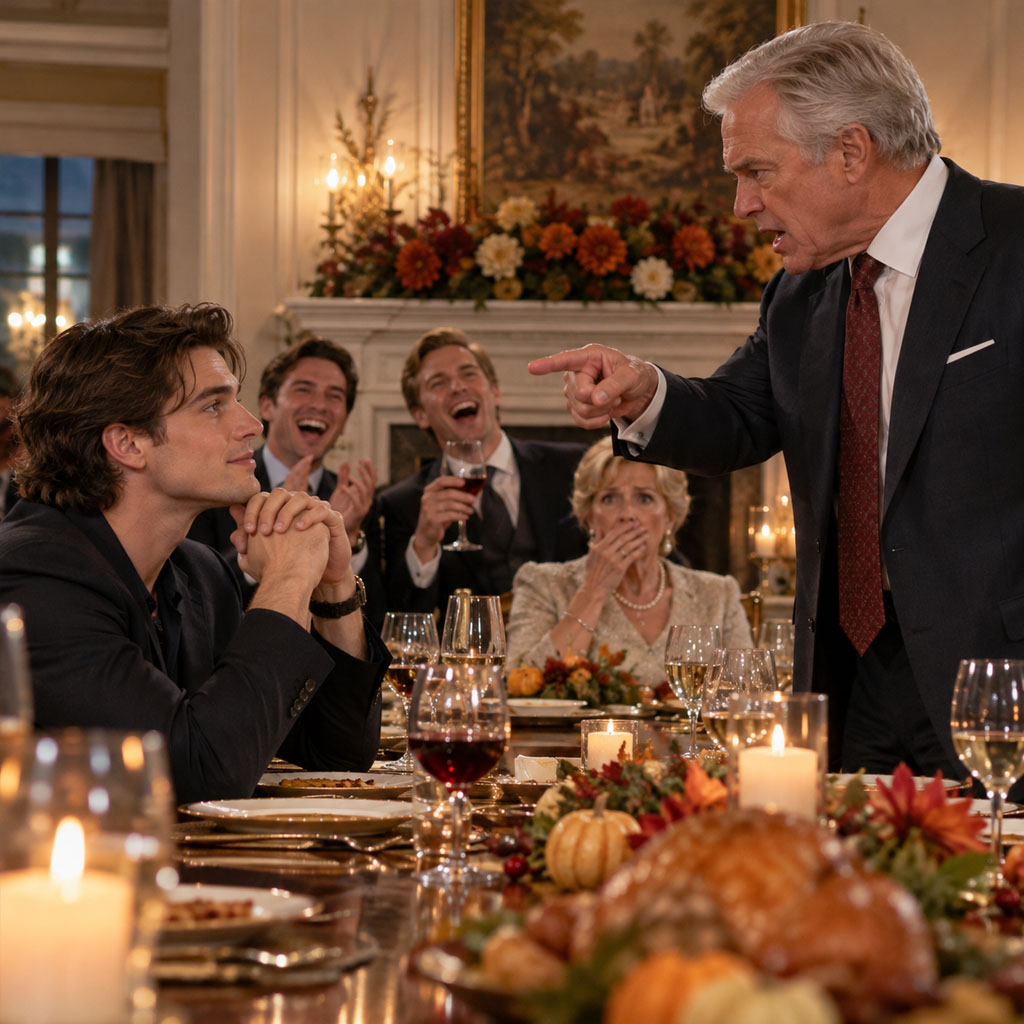
After dessert, Dad tapped his glass and began his announcement.
He praised his own achievements, celebrated the enormous sale, and declared that his children would receive none of the money.
He praised Patrick and Brandon as successful men who needed no financial assistance.
Then he singled me out for one final insult.
“You get zero, Daniel.”
My brothers cheered.
I laughed.
Dad’s expression darkened.
“What’s so funny?”
“Nothing disrespectful,” I replied. “I’m just curious. Did you personally investigate the company buying yours?”
He frowned.
“Of course. Ironbridge Capital is a highly respected firm.”
“Do you know who owns it?”
“Some California investor.”
I reached into my jacket and removed a black business card.
Then I passed it to Patrick.
“Would you read that, please?”
He glanced down.
His smile disappeared.
“Daniel Daniels,” he read slowly. “Founder and Chief Executive Officer. Ironbridge Capital Holdings.”
Nobody spoke.
Dad stared at me.
“That’s impossible.”
I stood.
“No, Dad. It’s true.”
My mother gripped the edge of the table.
I looked directly at my father.
“You sold your company to me.”
The silence was extraordinary.
Brandon’s phone continued recording.
Patrick looked from the card to my face.
Dad shook his head.
“No. You’re lying.”
I took out my phone and opened the closing confirmation.
“The transaction has been completed through Ironbridge’s acquisition subsidiary. Your legal team can verify everything.”
At that moment, the doorbell rang.
Our attorney arrived carrying the final closing documents.
Dad watched him enter the dining room.
“Lawrence, tell my son this is some ridiculous joke.”
The attorney looked uncomfortable.
“I’m afraid it isn’t, Richard.”
He turned toward me.
“Mr. Daniels, the closing has been confirmed. Congratulations.”
Dad lowered himself slowly into his chair.
For the first time in my life, he had nothing to say.
Chapter 4
Patrick recovered first.
“This can’t be legal,” he snapped. “You can’t just come in and take over everything.”
“I didn’t take anything,” I replied. “Dad agreed to sell. He received a negotiated price, and the transaction was reviewed by lawyers.”
Patrick stood.
“I’ve worked for that company my entire adult life!”
I looked at him.
“Then you should understand why its financial records concern me.”
His face changed.
I continued carefully.
“Our accountants identified transactions involving companies connected to your division. There are serious discrepancies that require an independent investigation.”
Several business guests exchanged uncomfortable looks.
Patrick’s mouth tightened.
“What are you accusing me of?”
“I’m not making accusations over Thanksgiving dinner. I’m telling you that the records will be reviewed properly, and anyone responsible for misconduct will be held accountable.”
Brandon reached for his phone.
I glanced toward the camera.
“You might want to end your broadcast. These are private financial matters involving employees and shareholders.”
For once, he listened.
The little red light disappeared.
Dad finally spoke.
“Daniel, why would you do this to your own family?”
I studied him.
“Do what, Dad? Buy a company that was facing serious financial trouble? Preserve its workforce? Pay a fair price?”
His face reddened.
“You’ve spent years planning to humiliate me.”
I couldn’t immediately deny it.
There had been nights when I’d imagined proving him wrong in front of everyone who’d laughed at me.
I had wanted him to feel the embarrassment I’d carried for years.
But standing there, looking at the frightened faces around the table, revenge suddenly felt smaller than I’d expected.
“Part of me wanted you to see what I accomplished,” I admitted. “I won’t pretend otherwise.”
Mom began crying quietly.
“But this isn’t only about us,” I continued. “There are hundreds of employees whose livelihoods depend on that company. Their pensions and futures matter more than our arguments.”
Patrick looked away.
Dad stared at his hands.
I reached into my pocket and removed the little green circuit board.
“Do you remember this?”
He glanced at it.
“No.”
“You knocked it off my workbench when I was sixteen.”
His expression shifted.
I placed it on the table.
“That was the beginning of the technology that helped me build Ironbridge.”
Nobody spoke.
“You told me I’d never understand business because I liked fixing machines. But fixing things turned out to be exactly what I was good at.”
Dad looked at the board for a long time.
Then he whispered, “I remember.”
I was surprised by how much those two words affected me.
I had waited nearly twenty years for him to acknowledge that morning in the garage.
Now he remembered.
And it wasn’t enough to erase anything.
Patrick broke the silence.
“So what happens to me?”
I turned toward him.
“Your employment will be reviewed independently. The financial discrepancies will be investigated, and decisions will be based on evidence.”
His expression hardened.
“You’re going to fire me.”
“I won’t protect you from the consequences of your own decisions.”
Brandon looked pale.
“What about me?”
“Your business arrangements are yours to resolve. Any company resources you’ve been using without proper authorization will have to be accounted for.”
He lowered his eyes.
For years, both brothers had been allowed to confuse privilege with achievement.
Now the difference was becoming impossible to ignore.
I turned toward Mom.
“I’m sorry this happened at Thanksgiving.”
She wiped her cheeks.
“Why didn’t you tell us you were successful?”
I gave her a tired smile.
“Would you have believed me?”
She opened her mouth.
Then closed it.
I picked up my jacket.
“Daniel,” Dad said.
I stopped.
He looked older than he had an hour earlier.
“Was any of it real?”
“What do you mean?”
“The company. Your success. Everything.”
I looked at him steadily.
“Every bit of it.”
He lowered his eyes.
I waited for him to say he was proud of me.
He didn’t.
And I finally understood that I couldn’t keep organizing my life around the hope that someday he would.
I turned toward the door.
Behind me, Dad spoke again.
“What are you going to do with the business?”
I paused.
“Something you once taught me without realizing it.”
He looked confused.
“I’m going to make sure the people who built it aren’t forgotten.”
Outside, the November wind swept across the driveway.
Snow had begun collecting along the stone walls.
I walked to my rental car and called Maria.
“It’s done.”
She was quiet for a moment.
“How do you feel?”
I looked back at the mansion.
For years, I’d imagined this moment bringing tremendous satisfaction.
Instead, I felt exhausted.
“Like I’ve been carrying something heavy for a long time,” I said, “and I’ve finally put it down.”
Maria’s voice softened.
“Then come home.”
“Tomorrow. But first, we have work to do.”
I gave her instructions for the transition team.
“Secure the records. Protect the employees. Bring in independent auditors. And arrange a meeting with Walter Price.”
“Why Walter?”
“Because he’s the only person in that company who believed in me before I had anything.”
Chapter 5
At nine the next morning, Walter walked through the headquarters lobby wearing an old wool coat and polished Sunday shoes.
He stopped when he saw me standing beside the reception desk.
“Well,” he said, his gray mustache twitching, “I heard you made Thanksgiving interesting.”
I laughed.
“A little.”
He studied the building around us.
“Is it true? You own the place?”
“I do.”
Walter shook his head slowly.
“Your grandfather would never have believed it.”
“Neither did Dad.”
For a moment, he looked sad.
Then he asked the question I’d expected.
“What happens to the workers?”
“Every viable job stays. We’re making the pension investigation a priority. If money has been improperly diverted, we’ll pursue recovery and fund the verified shortfall so employees aren’t left carrying the loss.”
Walter stared at me.
“You’re serious?”
“Completely.”
His eyes brightened.
I continued.
“And I’d like you to return as a senior adviser. We need someone who understands the people and the equipment better than any executive.”
He looked toward the workshop doors.
“I’ve been retired for more than a year.”
“I know.”
“My knees aren’t what they used to be.”
“You won’t be climbing ladders.”
He laughed.
“Then maybe we’ve got a deal.”
We shook hands.
Then I removed the scratched green circuit board from my pocket.
“Remember this?”
Walter smiled.
“Of course I do.”
“You saved it for me.”
He shrugged.
“It was too good to throw away.”
I held it between my fingers.
“Without you, I might’ve believed Dad.”
Walter’s expression grew serious.
“Daniel, I didn’t build your future. You did. I just handed you back something that belonged to you.”
I swallowed.
“That was enough.”
Over the following months, Bennett Industrial Systems underwent substantial changes.
We replaced several ineffective executives, introduced modern maintenance technology, and established a clear process for financial oversight.
The independent investigation confirmed that company funds had been improperly diverted through transactions associated with Patrick’s division.
He lost his executive position.
The matter was referred to the appropriate authorities, and a civil recovery process began. Patrick eventually entered a repayment arrangement under legal supervision while the broader financial issues were addressed.
For the first time in his life, my older brother had to build a career without our father’s influence.
He found a modest sales position at a logistics company.
I heard through relatives that he hated it.
But he kept showing up.
Brandon’s situation was different.
Without access to corporate money, he could no longer maintain the expensive image he’d built online.
He sold several possessions, moved into a smaller apartment, and took a regular job.
His follower count dropped dramatically.
Eventually, he stopped posting every detail of his life.
I hoped the quiet would do him some good.
My parents remained in the Lake Forest mansion.
The sale proceeds had resolved major business obligations, but their personal finances were more complicated than Dad had admitted.
They could no longer afford their former lifestyle.
The gardener was dismissed.
Several paintings were sold.
And my father, according to Aunt Dorothy, began spending afternoons raking the driveway himself.
When I heard that, I thought about Patrick’s twenty-dollar bill.
I still had it.
I’d kept it in my desk, folded beside an old photograph of Walter and me outside the workshop.
I didn’t want it as a trophy of humiliation.
Instead, I decided to put it toward something better.
We established the Bennett Technical Apprenticeship Fund, providing tuition assistance and training opportunities for young people interested in skilled trades.
The first donation was Patrick’s twenty dollars.
I framed the bill with a note explaining that even a small beginning could help build a meaningful future.
Next to it, in the headquarters lobby, we installed a glass case containing my original green circuit board.
The plaque beneath it read:
“Great ideas deserve the chance to grow.”
Walter insisted on telling every new apprentice the story.
He said it wasn’t really about a computer.
It was about what happens when someone sees potential where others see nothing.
Six months after Thanksgiving, a package arrived at my California office.
There was no return address.
Inside was a small gold-colored trophy, dull with age and chipped near the base.
I recognized it immediately.
My first-place award from the Illinois State Science Fair.
I’d won it at fourteen for designing a self-regulating greenhouse.
Mom had displayed it on the living room mantel for one week before moving it into the attic because she thought it looked out of place beside Patrick’s athletic trophies.
I hadn’t seen it in almost twenty years.
Beneath the trophy lay a handwritten note.
“Daniel, I found this while cleaning the attic. I should never have hidden something you were so proud of. I wish I’d made you feel more valued when you were young. I’m sorry. Love, Mom.”
I read those words several times.
Then I placed the trophy on my desk.
I didn’t call her immediately.
Some wounds need more than one apology.
But I kept the note.
A week later, another letter arrived.
This one was from Dad.
His handwriting looked uneven.
“Daniel, I don’t know how to say what I should have said years ago. My father made me feel worthless whenever I failed at anything. I spent my life believing that being tough meant never showing approval too easily. I thought I was preparing you for the world. Instead, I became the person who made your world harder. You didn’t deserve that. I know I cannot change what happened.”
I stopped reading.
For a long time, I sat staring at the paper.
I remembered Dad’s father, a severe man who had worked in the steel mills.
I remembered the few stories Dad had told about being humiliated in front of other workers as a child.
For years, he’d carried those experiences like proof that cruelty was necessary for success.
Now, finally, he seemed to understand what he’d passed down.
The letter ended simply.
“I’m proud of the man you became. I’m sorry I couldn’t say it when you needed to hear it.”
I folded the paper.
Those were the words I’d wanted since I was sixteen.
And yet, reading them now, I understood something surprising.
I no longer needed them to believe in myself.
That didn’t make the apology meaningless.
It simply meant that my life had grown beyond the place where my father’s approval was the center of everything.
I thought about calling him.
Instead, I waited another week.
Then I wrote a letter of my own.
“Dad, I received your note. Thank you for acknowledging what happened. I believe people can change, but I also believe trust has to be rebuilt through actions. I’m not ready to pretend our past never existed. Perhaps someday we can sit down and have an honest conversation without discussing money, the business, or who has accomplished more. Until then, I wish you and Mom well.”
I mailed it before I could change my mind.
For the first time, I wasn’t trying to punish him with silence.
I was giving myself permission to heal at my own pace.
That summer, Ironbridge celebrated the reopening of the modernized Bennett facility.
More than three hundred employees attended.
Walter stood beside me as technicians demonstrated the updated equipment to their families.
A young apprentice named Jason approached the glass case containing my old circuit board.
“Mr. Daniels, is it true you built that when you were sixteen?”
I nodded.
“Most of it.”
He studied the scratched surface.
“Looks pretty rough.”
I laughed.
“It was.”
“Did it really work?”
“Well enough to teach me what I needed to know.”
Jason looked thoughtful.
“I’m trying to design something myself. It’s not going very well.”
I remembered a garage floor covered in broken wires.
“Keep working on it,” I told him. “And ask for help when you need it.”
He smiled.
“Thanks, Mr. Daniels.”
As he walked away, Walter nudged my shoulder.
“Look at that.”
“What?”
“You’re doing exactly what somebody should’ve done for you.”
I glanced toward the young apprentice, who was already excitedly explaining his project to another student.
For a moment, I couldn’t speak.
Then I smiled.
“Better late than never.”
That evening, after everyone had gone home, I remained in the lobby.
The building was quiet.
Outside, the summer sun was setting over Chicago.
I stood before the little green circuit board and thought about the long road that had brought me there.
For years, I’d believed victory would mean making my father feel as small as he’d made me.
I’d imagined the shocked faces, the broken pride, and the moment my brothers finally realized I was the successful one.
And yes, those things had happened.
But their humiliation hadn’t healed my childhood.
The real healing had come afterward.
It came when Walter walked through the doors and knew the workers would be protected.
It came when apprentices received scholarships.
It came when my technology finally helped the very company that once rejected it.
And it came when I realized I could acknowledge my family’s mistakes without spending the rest of my life trying to make them suffer.
I had bought the company my father built.
But I hadn’t bought his love.
I hadn’t purchased a better childhood.
And I hadn’t erased the years when I felt invisible.
What I had done was build a future that no longer depended on being chosen by someone who couldn’t see my worth.
My phone vibrated.
It was a message from Maria.
“Ready for dinner? The team is waiting.”
I looked once more at the circuit board.
Then I picked up my jacket and headed toward the doors.
Before leaving, I noticed the framed twenty-dollar bill beside the scholarship announcement.
Patrick had once thrown that money at my feet to remind me how little he thought I was worth.
Now it stood beside a fund helping young people gain skills, find work, and build independent lives.
That seemed a far better use for it.
I turned out the lobby lights.
As I walked into the warm Chicago evening, I thought about Thanksgiving and the words that had started everything.
“You get zero.”
My father had been wrong.
I hadn’t received zero.
I’d received lessons I never wanted, strength I hadn’t known I possessed, and the opportunity to become someone very different from the men who raised me.
But the most valuable thing I’d gained wasn’t worth eighty million dollars.
It was the freedom to stop proving myself to people determined not to see me.
And that was something no one could ever take away.
THE END. ⚠️ All characters and events are fictional. Do not imitate or apply them in real life. 😌😌😌


