Chapter 2
I returned home shortly after six.
Carter was on the couch watching a football discussion program. He looked up when I entered.
“Hey, babe. What’s for dinner?”
“The power went out at the bakery. Joanne sent everyone home.”
I placed the pie on the counter.
He came over, kissed my forehead, and cut himself a generous slice.
“Your grandmother’s recipe?”
“Yes.”
“Best pie in Tennessee.”
He ate two pieces while telling me the Tennessee Titans would probably have another disappointing season.
I nodded in the right places.
I watched him carefully.
He seemed perfectly comfortable. No nervousness, no guilt, no indication that he’d spent the afternoon planning how to take my inheritance and replace me with another woman.
That night, I lay beside him while he fell asleep.
I thought about the years before we married.
In 2012, when I was 23, my parents died in a highway accident on Interstate 65. A truck, a rainstorm, and a dangerous curve south of Nashville had changed my life in a matter of seconds.
My mother had been my grandmother’s only child.
After the funeral, I moved to the farmhouse and stayed with Grandma for nearly a year.
She was 73 then, a widow who had already buried her husband and now her daughter. She rarely spoke about grief. Instead, she got up at five, made coffee, and found something useful to do.
She taught me to bake her buttermilk pie.
She also taught me something she repeated whenever I complained about people.
“Watch what someone does when they think you’re not looking, Vivian. That’s who they are. The rest is manners.”
I met Carter six years later at the Franklin Fall Festival.
He was 32, worked in commercial truck sales, and had an easy smile. He bought a pie from my bakery tent, returned the following Saturday, and eventually admitted he wasn’t coming back for the pie.
He was coming to see me.
I liked his confidence. I liked that he remembered small details. He could talk to almost anyone without making them feel uncomfortable.
My grandmother met him at Christmas.
After he’d left, she stood at the kitchen sink and said, “He looks at the house before he looks at you.”
I laughed.
“Grandma, that’s not fair.”
She didn’t argue.
She simply rinsed her coffee cup and changed the subject.
We married in June 2020 in her backyard. It was a small wedding, with twenty guests and a cake I’d baked myself.
Carter’s mother, Marjorie, cried through the ceremony.
“I’m getting a second daughter today,” she’d said, holding my face in both hands.
Marjorie was a widow, active in the women’s ministry at Grace Fellowship, and best friends with Patrice Hensley.
She called everyone honey and seemed to know every piece of gossip in Williamson County.
In April 2022, I lost a pregnancy at eleven weeks.
Marjorie stayed with us for three days. She cooked, brought groceries, and made sure I rested. She’d even made a copy of our house key so she could let herself in.
At the time, I thought she was being kind.
Carter was gentle, too. He told me we didn’t have to rush into anything and that we had plenty of time.
After that, he rarely mentioned having children again.
I had mistaken his silence for consideration.
On Saturday morning, Carter made eggs.
He only made breakfast when he wanted something.
“So,” he said, setting a plate in front of me, “I’ve been thinking about the bakery.”
I looked up.
“Joanne’s not going to wait forever. If we use the farm as collateral, the bank will want both our names on the paperwork. That’s standard.”
I studied his face.
“Have you spoken to Howard about that?”
“I can go with you Monday.”
“Why?”
“To make things easier.”
I almost laughed.
In six years of marriage, Carter had never offered to accompany me to my grandmother’s attorney.
Now he seemed eager to get involved.
“I’ll call Howard myself,” I said.
He nodded, but I noticed the disappointment.
That afternoon, I picked up the church bulletin from the bakery counter. My assistant manager, Molly, had brought it in after Sunday service.
I glanced through the prayer requests and announcements.
Then I saw a name.
Patrice and Gene Hensley requested prayers for their daughter Brooke, who was expecting a baby in December.
I knew Patrice.
Her husband owned Hensley Grounds, the largest landscaping company in the county. Carter had sold trucks to them for years.
Their daughter, Brooke Hensley, was 31.
I’d met her twice at church gatherings. Blonde, attractive, and always dressed beautifully.
I folded the bulletin and slipped it into my purse.
That afternoon, we had Sunday lunch at Marjorie’s house.
Patrice was there, talking about her daughter.
“The father is somebody from up in Nashville,” she said. “It’s complicated. Brooke won’t tell us much.”
Marjorie immediately changed the subject.
“Vivian, honey, how’s Joanne doing with the bakery sale?”
Carter stood up and walked into the kitchen.
His glass was still full.
Something was happening, and everyone seemed to know more than I did.
Monday night, I opened our joint bank account while Carter was showering.
I’d always checked the balance and paid bills from that account. I’d never bothered sorting the transactions by recipient.
I searched Marjorie’s name.
There it was.
A transfer of $1,400 on the first of every month, beginning in September 2024.
The memo line read: Mom car.
There were 21 transfers.
Smaller payments appeared between them, labeled Mom miscellaneous.
I added everything.
$58,200.
I stared at the number.
Marjorie drove a 2019 Buick. It had never needed anything more than ordinary maintenance.
Why had we been sending her $1,400 every month?
I opened the credit card statements.
For nearly two years, Carter had made regular purchases at a gas station in Spring Hill, about twelve miles from our home.
Most Tuesdays.
Usually around 6:50 in the evening.
His sales territory was north of Franklin, toward Nashville. Spring Hill wasn’t part of his regular route.
I counted the transactions.
Seventy.
My hands went cold.
I didn’t drive to Spring Hill.
I wanted to, but I remembered Grandma’s advice.
Don’t go looking for an argument when you can first find the facts.
The next morning, I called Howard.
Chapter 3
Howard agreed to see me Wednesday afternoon.
I told him everything, from the conversation in the hallway to the monthly transfers and the gas station receipts.
He listened without interrupting.
When I finished, he removed his glasses.
“Don’t sign anything, Vivian.”
“I haven’t.”
“Don’t mix marital money with those properties. Don’t put Carter’s name on a single document.”
I looked at him.
“Why did Grandma insist on transferring everything into my name alone?”
He leaned back.
“Your grandmother came to see me in 2019. She wanted the properties placed in a trust so they would pass directly to you, without unnecessary delays.”
“Why?”
“She said she wanted to make sure nobody could talk you out of what belonged to you.”
I thought about his handwritten warning.
“Did she mention Carter?”
Howard hesitated.
“She was concerned about his interest in the farmhouse.”
I sat very still.
“What did he do?”
“I don’t want to speculate. Your grandmother kept her own records. I would suggest you review them before making any decisions.”
He walked me to the door.
Then he asked one more question.
“Who else has a key to the farmhouse?”
“Carter.”
“Has he ever used it without you?”
I thought about the holidays, the roof repairs, and the times he’d said he was going to check on the property.
“I don’t know.”
Howard nodded.
“Find out.”
That Thursday, I opened a separate bank account at another institution.
I arranged for my future paychecks to go there.
I didn’t make a dramatic announcement. I simply began protecting my financial independence.
I also asked a loan officer what would be required to finance a small business purchase.
“Ninety days of business statements,” she explained. “We’ll need to review the bakery’s income and expenses before considering collateral.”
I wrote that down.
Then I went home and told Carter.
“The bank needs ninety days of the bakery’s financial records before they’ll even consider the loan.”
He looked up.
“Ninety days?”
“That’s what they said.”
He did the math.
“That takes us into September.”
“Probably.”
He nodded, satisfied.
I realized he’d believed me because the explanation sounded reasonable.
The following Saturday, I drove to the farm with a pie for Opel Dunning.
Opel was 79 and had rented the little cottage beside Grandma’s farmhouse for 22 years.
She’d been a second-grade teacher for 31 years and had a habit of carrying a folding chair wherever she went because of her back.
My grandmother had charged her $650 a month, less than half the market rate.
Opel took the pie and looked at me.
“How’s Carter’s coworker doing?”
I frowned.
“Which coworker?”
“The young blonde girl. The one he brought out here last October.”
My heart began beating faster.
“What are you talking about?”
“October 18, I believe. You were working at the bakery. Carter came by on a Saturday and said he was going to fix the porch step. He brought a young woman with him. Brooke, I think her name was.”
I sat down.
“What did Grandma say?”
“She gave them both lemonade. After they left, she went inside and wrote something on her calendar.”
Opel folded her hands.
“I asked if she was going to tell you. She said, ‘No. Vivian will see for herself.'”
I walked across the yard to the farmhouse.
The calendar still hung on the wall.
I turned the pages backward until I reached October.
There it was.
October 18.
Carter plus Brooke. Says coworker. Fixed porch step. Held hands at truck.
Grandma had drawn a small question mark after the word coworker.
I stood there for several minutes.
Then I noticed the porch step.
It still creaked.
Carter hadn’t fixed anything.
He’d brought another woman to show her the property.
That evening, I looked through Brooke’s public social media account.
She’d posted a photograph in October showing her sneakers on an old wooden porch.
The caption was one word.
Someday.
I recognized the porch.
In May, she’d posted a sonogram. More recently, there was a photograph of her in a baby store with Marjorie standing beside her.
My mother-in-law had one hand on Brooke’s shoulder.
I looked at the picture for a long time.
Then I returned to Grandma’s calendar.
She’d known about Brooke months before I did.
She’d seen my husband holding another woman’s hand and chosen to leave the truth where I could find it.
I wished she’d told me outright.
But I remembered her words at the hospital in December, after she’d fallen and broken her hip.
“Your husband brings strangers around a lot.”
I’d told her she was confused.
She’d looked at me and said, “I’m not confused, Vivian. I’m old. There’s a difference.”
Now I understood.
Chapter 4
The next Monday, I received a call from the nurse renting my parents’ old condo in East Nashville.
Her name was Dana, and she was moving to Knoxville for a new hospital position.
She’d be out by the end of July.
I drove up after work to inspect the place.
It had been fourteen years since I’d last walked through that front door.
My parents had lived there after losing their original house during the financial crisis. Grandma had bought the condo in 2008 and rented it to them.
My mother had chosen the green kitchen tile herself.
I stood in that kitchen, looking at the familiar color around the stove.
Carter had never once asked about the condo.
He knew about the farm, the cottage, and the river property because Grandma had mentioned them at Thanksgiving.
He didn’t know about the fourth property.
And I decided to keep it that way.
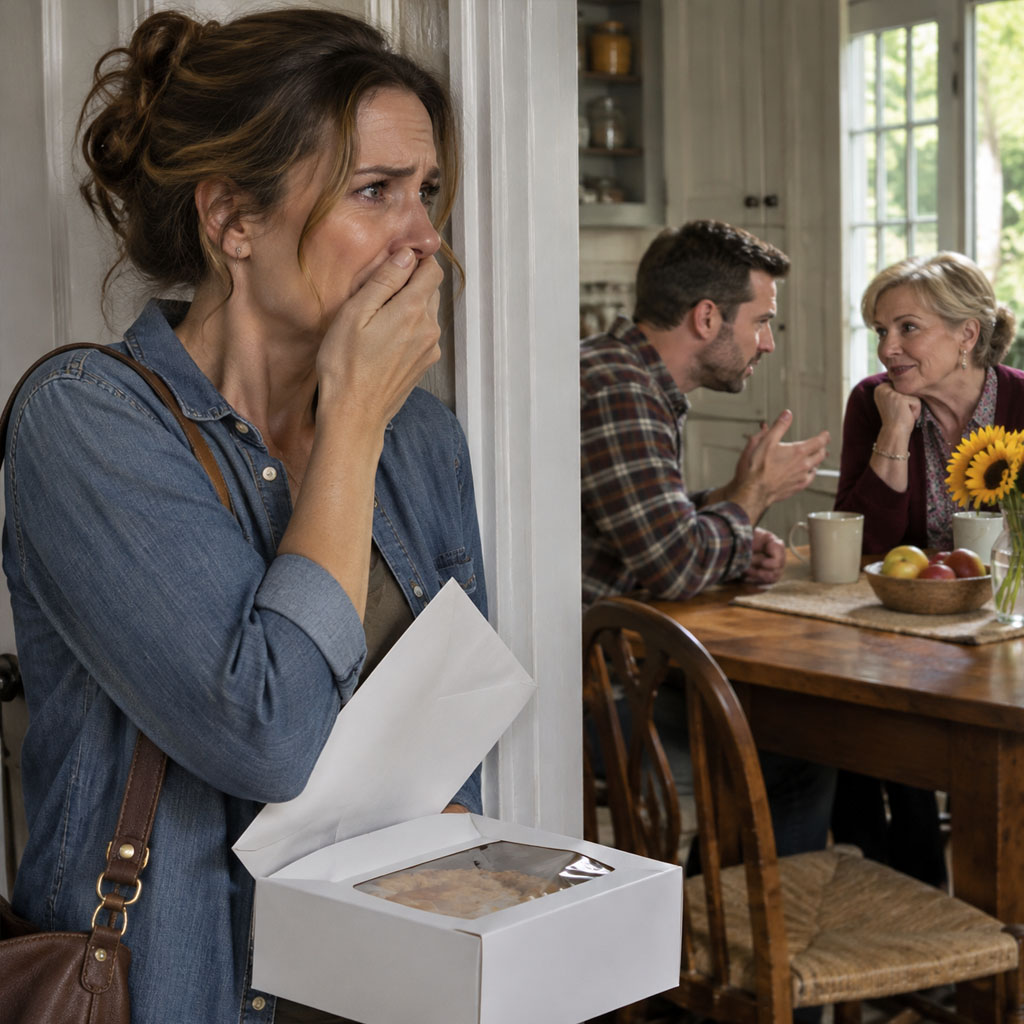
A week later, Marjorie called me at the bakery.
She said she’d made a chicken casserole for Brooke and asked if I could deliver it on my way home.
“She’s pregnant and living alone, honey. Poor girl needs a little help.”
I almost dropped the phone.
But I agreed.
The apartment was in a complex off Main Street in Spring Hill, four minutes from the gas station on Carter’s credit card.
I carried the casserole up the stairs in Marjorie’s favorite covered dish.
Brooke opened the door.
She was about eighteen weeks pregnant.
“Oh, you’re Carter’s wife!” she said brightly. “Marjorie talks about you all the time.”
Behind her, hanging over a kitchen chair, was a navy jacket with the Harpath Valley Truck Center logo.
Carter’s name was stitched over the chest.
A man doesn’t leave his work jacket somewhere he visits once.
He leaves it where he lives.
I smiled.
“Marjorie said you might appreciate dinner. The dish is oven-safe. Keep it.”
Brooke looked almost relieved.
“Thank you. That’s so sweet.”
I walked downstairs without another word.
I sat in my car for three minutes, took a photograph of the apartment building number, and sent it to myself.
Then a message arrived from Marjorie.
Did she like it? She’s such a sweet girl. ❤️
I replied that Brooke loved it.
I stopped at the gas station and filled my tank. I kept the receipt.
Not because I planned to show it to a judge.
Because I wanted something physical to remind myself that I hadn’t imagined any of this.
That Sunday, Carter’s younger sister, Courtney, called.
She was 35, a school nurse in Chattanooga, and had two children with her husband, Neil.
“Vivian, I know this is a little awkward,” she said, “but Mom told me you and Carter are moving to the farm in the fall.”
I said nothing.
“She also said the river property would be available for Neil and me to build something for the kids. I just wanted to thank you.”
I let her finish.
Then I asked, “Did your mother say the land belonged to Carter or to me?”
There was a pause.
“She said it was family property now.”
I thanked her for calling.
After we hung up, I sat at the bakery counter.
My mother-in-law had apparently promised the same three acres to two different families.
She’d offered it to Brooke for her baby and to Courtney for her children.
And she’d done it because she believed I would eventually sign everything over to Carter.
I called Brooke using the bakery’s phone.
“This is Vivian. I’d like to meet for coffee. I’m not calling to argue.”
She agreed surprisingly quickly.
We met the following Saturday at a coffee shop in Spring Hill.
She ordered decaf and barely touched it.
At first, she was guarded.
Then she finally said, “Carter told me you two were basically roommates.”
I looked at her.
“He told me our marriage had been over for years,” she continued. “He said he was just waiting until your grandmother’s situation was settled.”
“That’s interesting. He hasn’t mentioned being separated to me.”
Her face changed.
“He said you knew.”
“I didn’t.”
She stared at her cup.
“Marjorie said you’d stay at the farmhouse for a while. That you’d take care of the tenant and the property. Once the other houses were sold, Carter would make everything official.”
I let that sink in.
“So I was going to sign away my grandmother’s properties, then remain at the farm as some kind of caretaker?”
Brooke didn’t answer.
I asked her one more question.
“Did Marjorie promise you the river property?”
She nodded.
“She said it would be a place for the baby. Somewhere to build when things settled down.”
I told her Courtney had been promised the same land.
Brooke went very still.
For nearly thirty seconds, she didn’t move.
Then she looked toward the window.
“Why are you telling me this?”
“Because somebody should have told me.”
I paid for the coffee and left.
I didn’t hug her or promise we’d become friends.
But I knew something important had changed.
Brooke was no longer certain she was the person being rewarded in this arrangement.
She was beginning to understand that she’d been used, too.
The following Wednesday, Carter placed a document on our kitchen table.
It was a quitclaim deed form printed from the internet.
The farmhouse address was already filled in.
The grantee’s name was Carter Bellamy, written in Marjorie’s handwriting.
“It’s just paperwork,” he said. “The bank might need it.”
I picked it up, folded it once, and placed it in my purse.
“Then it can wait until the weekend.”
His eyes narrowed.
“Mom wants it handled.”
“I know what your mother wants.”
For the first time, he looked at me as though he wasn’t sure he understood the woman sitting across from him.
“You’ve been awfully quiet lately.”
“I’ve been listening.”
That night, I lay beside him and listened to him breathe.
I thought about Grandma’s calendar, the apartment, the money, and the document in my purse.
Then I made a decision.
I was not going to disappear quietly.
Chapter 5
Marjorie came by the next morning with a spiral notebook.
She had planned Carter’s 40th birthday celebration at Grace Fellowship for August 15.
Eighty guests.
A slideshow.
A two-tier cake.
And a surprise announcement.
She expected me to bake the cake.
“At the end of the party, I’ll tell everyone about your move to the farm,” she said. “A new chapter for the family.”
I looked at her.
“Which family?”
She laughed.
“Oh, honey. Everyone loves a new chapter.”
Then she lowered her voice.
“If that paperwork could be signed before the party, it would make the announcement so much nicer.”
I smiled.
“I’ll think about it.”
After she left, I called Joanne.
We were alone in the bakery, with the chairs turned upside down on the tables.
I told her everything.
The hallway.
The pregnancy.
The money.
The calendar.
The planned announcement.
Joanne listened without interrupting.
When I finished, she asked one question.
“What do you want to still be true when this is over?”
I thought for a moment.
“I don’t want to become like them.”
She nodded.
“Then don’t.”
She also reminded me that Patrice Hensley was Marjorie’s closest friend. Patrice had no idea her daughter was involved with Carter.
“Don’t turn that woman into another casualty,” Joanne said. “She deserves to hear the truth, but she deserves to hear it with dignity.”
I knew she was right.
In early August, Courtney drove up from Chattanooga to help with the birthday arrangements.
Instead of taking her to the church, I drove her to the farmhouse.
I showed her the October calendar entry.
Then I showed her the bank transfers.
Finally, I told her what Brooke had said about the river property.
Courtney read everything without speaking.
“Brooke Hensley?” she finally asked.
“Yes.”
“I used to babysit her.”
I nodded.
Courtney walked outside and made a phone call.
I stayed in the kitchen.
When she came back, she sat on the porch step, staring at the ground.
“Mom told me the kids could build there,” she said.
“I’m sorry.”
She shook her head.
“Don’t apologize. You didn’t promise it.”
Then she looked at me.
“Does Carter know you know?”
“Not yet.”
Three days later, Courtney sent me a message.
Brooke had confronted Carter.
She wanted a real date when he would leave me. She wanted to tell her parents the truth before the baby arrived.
Carter had told her to wait until after the birthday party and the paperwork.
Brooke had finally realized that the paperwork meant me signing away my inheritance.
She asked Courtney whether I would ever agree.
Courtney answered no.
That evening, Carter came home with a different expression.
“Vivian, I need you to take this seriously. Mom has put a lot into this party.”
“Into the party?”
He ignored the question.
“I’m going out to the farm this weekend to check the roof before we move.”
“That sounds fine.”
I’d already changed the locks on July 25.
Every exterior door.
I had given Opel a new key and kept the other.
Carter didn’t know.
On Sunday, he drove to the farmhouse.
His key wouldn’t turn.
He called me.
“My key doesn’t work.”
“I changed the locks.”
“Why would you do that?”
“It’s my grandmother’s house.”
“It’s our house, Vivian.”
“No. It isn’t.”
Silence.
Then he said, “Since when do you talk to me like this?”
“Since June.”
He didn’t ask what had happened in June.
That told me plenty.
That evening, Marjorie texted and invited me to lunch.
I declined.
Instead, I asked Opel to attend the birthday party with me.
Marjorie objected when she heard.
“It’s a family celebration. Why would you bring the tenant?”
I replied, “Grandma would have considered Opel family.”
Opel agreed to come, but she made one condition.
“I won’t say anything that isn’t true.”
I promised.
Two days before the party, I drove to the river property.
Three acres of grass, sycamore trees, and a gravel pull-off beside the Duck River.
Grandma had bought it in 1990 and never built on it.
She used to say it was for whoever in the family needed somewhere to start over.
I sat on the tailgate and looked at the water.
I could have left that weekend.
The East Nashville condo was empty. I could have packed my things, driven there, and let Howard handle the divorce.
But I knew what would happen.
Marjorie would tell eighty people that I’d become difficult after Grandma died. She’d explain that she’d tried to help me, that I’d changed, that I was ungrateful.
Carter would stand beside her.
And everyone would believe the people who remained in the room.
I called Joanne.
“I’m going to the party.”
“Good.”
“But I don’t want to read bank statements or argue.”
“Then don’t.”
“What should I say?”
Joanne thought for a moment.
“Ask one question. The right question can do more than a speech.”
I returned to the farmhouse and took out the envelope Howard had given me.
On the back, I wrote three rules.
I will not mention the baby.
I will not read financial documents aloud.
I will not argue with Carter in front of his mother.
Then I placed the envelope back in the drawer.
The baby had done nothing wrong.
Whatever happened that night, I wasn’t going to make an innocent child pay for the decisions of adults.
Chapter 6
The morning of August 15, I baked Carter’s birthday cake at four.
I drove to the farm at seven and took the October calendar page off the wall.
Before removing it, I photographed both sides.
Then I placed the original in my purse.
Opel watched from her folding chair.
“You know what that page says,” she remarked.
“Yes.”
“And you know what it doesn’t say?”
I looked at her.
“It doesn’t say whose baby Brooke is carrying.”
“Exactly.”
“I’m not going to make that accusation. I’m giving the page to Patrice. She can decide what questions she needs to ask.”
Opel nodded.
“Your grandmother wrote facts, not accusations. Keep it that way.”
At two that afternoon, Brooke texted me.
I’m coming with my mother and father. I’m not hiding anymore.
I replied, I understand. Thank you.
At three, Marjorie sent another message.
Wear the blue dress, honey. It photographs beautifully.
I wore the blue dress.
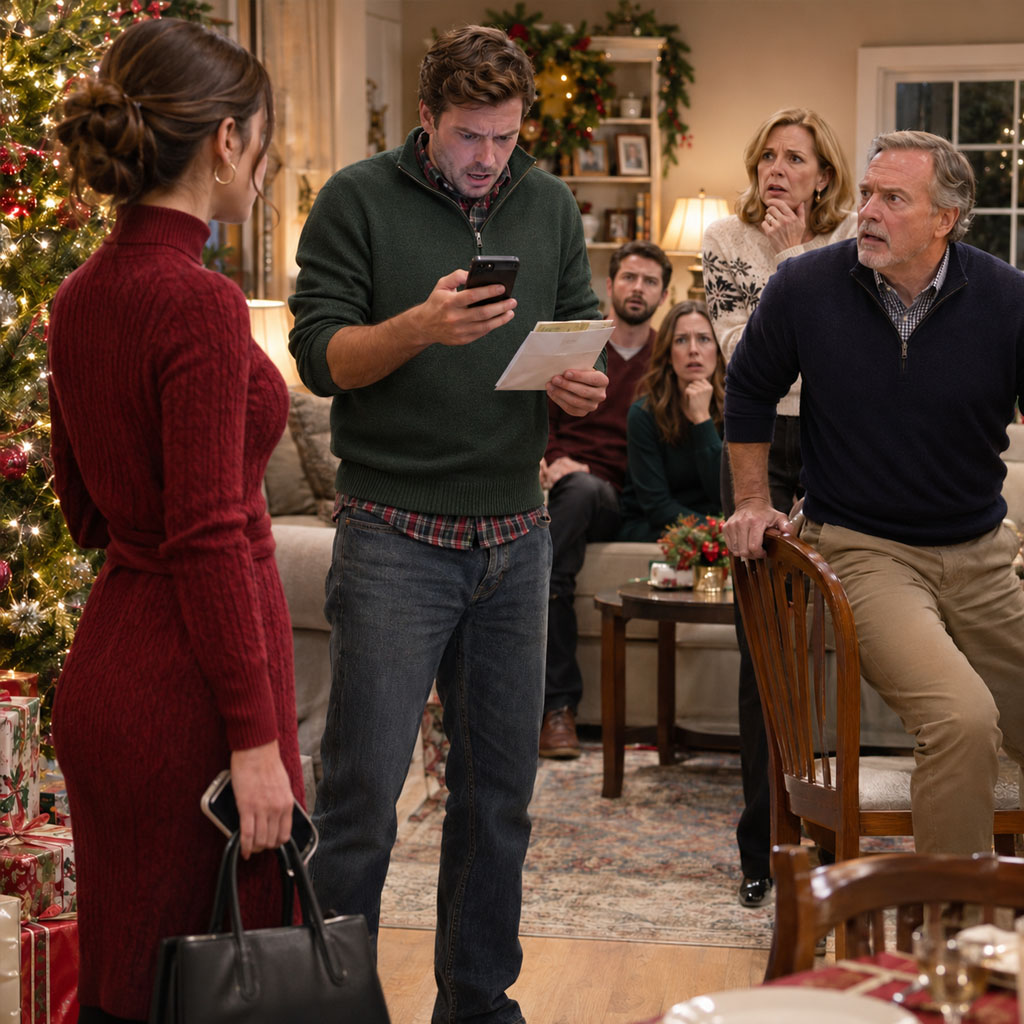
The fellowship hall at Grace Fellowship was filled with round tables, white tablecloths, and photographs of Carter’s childhood projected onto a screen.
Eighty people had gathered.
His coworkers.
Church friends.
Family members.
Patrice and Gene Hensley.
Courtney and Neil.
And Marjorie, moving through the room as though she owned the evening.
I entered with Opel.
Marjorie noticed us immediately.
“Why is the tenant here?” she whispered, smiling at someone behind me.
“You said family.”
She didn’t answer.
Opel placed her folding chair beside Courtney and settled into it comfortably.
At 6:20, the Hensleys arrived.
Patrice wore yellow. Gene looked as though he’d come straight from one of his landscaping jobs.
Brooke walked between them.
She was 24 weeks pregnant, wearing a loose green dress.
Marjorie froze for half a second.
Then she hurried over, kissed Brooke on the cheek, and greeted Patrice warmly.
Carter was standing near the stage.
He saw Brooke.
Then he looked across the room and saw me watching him.
For the first time that evening, he seemed unsure of what to do.
At seven, Marjorie took the microphone.
She was good at public speaking.
She told stories about Carter selling lemonade as a little boy. She showed photographs of him fishing with his father, riding his first bicycle, and standing beside his first truck.
The room laughed in all the right places.
She called him a wonderful son.
A devoted family man.
Then she looked at me.
“My second daughter,” she said affectionately.
I didn’t move.
Finally, she announced her surprise.
“This fall, Carter and Vivian are moving to Eleanor’s beautiful farm. A new chapter for them and for our whole family!”
People applauded.
Marjorie waited.
“And someday, God willing, there will be a little house by the river for Courtney’s children.”
She smiled toward the family table.
“Vivian, honey, stand up so everyone can see you.”
I remained seated.
Carter stood, already wearing the practiced smile he’d rehearsed at home.
Then Courtney spoke.
“Mom, which family?”
The room quieted.
Marjorie laughed lightly.
“Courtney, not now.”
“You told Brooke the same thing in April.”
A few people turned toward the Hensleys.
Marjorie’s smile tightened.
I stood.
I didn’t walk toward the microphone.
I simply looked at my mother-in-law.
“Marjorie, I have one question.”
She looked irritated.
“What is it, honey?”
“Who’s been paying Brooke’s rent?”
The room went completely still.
Marjorie blinked.
“I don’t know what you’re talking about.”
“Fourteen hundred dollars every month,” I said. “Since September 2024. The payments came from our joint account. The memo said your car.”
Gene Hensley slowly turned toward his wife.
Patrice looked at Brooke.
Marjorie opened her mouth, but I was already walking toward the Hensleys’ table.
I took the October calendar page from my purse and placed it in front of Patrice.
“My grandmother wrote this on October 18. She saw Carter bring Brooke to her house. She wrote that they were holding hands beside his truck.”
Patrice picked up the paper.
I watched her read.
Her hands became still when she reached the question mark after the word coworker.
Then I turned toward Carter.
“June 5. Our kitchen. You said, ‘Once I get the houses, she’s out.’ I was standing in the hallway.”
Carter’s face drained of color.
“Vivian, that’s not—”
“I know who you were talking to.”
He raised his hands.
“I was talking to Mom about business.”
I didn’t answer.
Patrice was still holding the calendar page.
Then she looked at her daughter.
Brooke stood up.
“Mom, it’s Carter’s.”
Her voice shook.
“The baby is his. Marjorie has known since April. She told me I had to wait until Vivian was gone.”
Patrice slowly rose from her chair.
“You sat beside me in church,” she said to Marjorie. “You prayed with me for this baby.”
Marjorie reached toward her.
“Patrice, I was protecting you.”
“Protecting me from what? My own grandchild?”
Nobody spoke.
Gene put a hand on his wife’s back.
Courtney stood and gathered her children.
Opel, still seated, spoke from the family table.
“Eleanor knew, too. She told me to let Vivian see for herself.”
She looked around the room.
“Well, we’ve all seen.”
Gene Hensley stood.
He didn’t shout.
He simply looked at Carter.
“Monday. My office.”
Then he sat beside his wife.
Carter crossed the room toward me.
“Vivian, let’s go home and talk.”
“There is no home to go back to.”
“You’re upset.”
“You said it yourself. Once you got the houses, I was out.”
“That isn’t what I meant.”
“You don’t get the houses, Carter. They were never ours. They were mine.”
He looked around the room.
His mother was still holding the microphone.
Brooke was standing beside her parents.
His sister was leaving.
Then he said the worst thing he could have said.
“I only said that because Mom wanted me to.”
I let the silence answer him.
From the stage, Marjorie called his name.
“Carter, sit down. People are watching.”
He looked at his mother.
Then at Brooke.
Then at me.
Finally, he sat.
I took the key to our house in Franklin out of my purse and placed it beside the birthday cake.
“The lease ends September 30. I won’t be there.”
I looked at him one last time.
“Happy birthday, Carter. You’re forty years old. Nobody’s handling your life for you anymore.”
Then I picked up my purse.
Opel folded her chair.
Together, we walked out.
Behind us, the slideshow continued playing photographs of a little boy in a cowboy hat while his mother stood onstage holding a microphone.
Chapter 7
I slept at the farmhouse that night.
For the first time in months, I slept peacefully.
At seven Monday morning, Carter’s truck came up the gravel driveway.
He walked onto the porch and tried the screen door.
I had installed a small hook the previous week.
We spoke through the mesh.
He looked exhausted.
He admitted the affair.
He admitted Brooke’s pregnancy.
He admitted the monthly payments from our joint account.
He said he’d planned to tell me eventually.
He said his mother had become involved and everything had gotten out of control.
Then he asked about my grandmother’s inheritance.
“After six years of marriage, don’t I deserve something?”
I looked at him.
“There’s nothing of hers to divide. There never was.”
“Vivian, be reasonable.”
“Howard will send the paperwork.”
He stood there for a while.
Then he asked a question I believed he genuinely wanted answered.
“Did you ever love me?”
“Yes.”
I paused.
“That’s the part you’ll have to live with.”
He nodded.
At the bottom of the steps, he turned around.
“Did your grandmother ever like me?”
I looked at the porch railing.
“She said you looked at the house before you looked at me.”
He lowered his head.
I continued.
“She was right.”
He got into his truck and drove away.
Howard filed the divorce paperwork the following week.
The $58,200 in unexplained transfers was included in the financial proceedings. We closed the joint account and divided the remaining shared assets according to the settlement.
Carter returned to his mother’s house when the lease on our Franklin home ended.
I didn’t pursue every possible claim against him.
I wanted my life back more than I wanted another year of arguments.
The consequences of the birthday party unfolded without my involvement.
Patrice stepped down from her position in the women’s ministry. She explained why to the church board.
Marjorie took a leave from her responsibilities.
The following Sunday, her name was missing from the bulletin.
Gene Hensley moved his company’s truck business to another dealership. His fourteen commercial vehicles had represented a substantial account for Carter.
A few weeks later, Carter left Harpath Valley Truck Center.
I heard these things from Courtney.
I never asked.
Our relationship changed, too.
She began calling occasionally, and we started having lunch whenever she came to Franklin.
One evening, she told me she’d never accept the river property as a gift.
“Not after what Mom did,” she said.
I laughed gently.
“It was never hers to give.”
“I know.”
She paused.
“But maybe the kids could swim there someday?”
“Of course.”
She cried.
I didn’t.
In September, Brooke sent me a message.
Carter had moved back in with his mother. He hadn’t asked about the baby’s room or made any clear plans.
She didn’t know why she was telling me.
I thought about ignoring the message.
Instead, I wrote:
I’m not your enemy, but I’m not your friend either. Take care of yourself and the baby. Don’t wait for him to do it.
Then I deleted the conversation.
I hoped she would be all right.
On September 18, I bought Pickett’s Oven.
The purchase price was $260,000.
Joanne signed the paperwork across the table from me, then took off her apron and handed it over.
“Your name only,” she said.
“My name only.”
I used the rental income from the little cottage and the Nashville condo to help cover the loan.
The farmhouse wasn’t collateral.
No one else’s name was on the paperwork.
The following morning, I added my grandmother’s buttermilk pie to the menu.
The little card beside it read Eleanor’s Buttermilk Pie.
The first customer to order a slice was a 79-year-old woman who had driven thirty miles from the farm.
She sat near the window and took one bite.
“Needs a little more salt,” she announced.
It didn’t.
But I smiled because I could almost hear Grandma saying the same thing.
I moved into the farmhouse permanently.
In the kitchen, I hung my father’s old wooden key rack beside the calendar.
It had four brass hooks.
I placed the farmhouse key on the first.
The cottage key went on the second.
The condo key went on the third.
The fourth remained empty.
The river property didn’t have a door.
I never hung the Franklin house key there.
On the last Saturday in September, Opel and I drove to the river lot.
She unfolded her chair beneath the sycamores while I sat on the tailgate.
The water was low, and the afternoon sun came through the trees.
We didn’t speak for a long time.
Finally, Opel said, “You know what your grandmother used to call this place?”
“Land for whoever in the family needs a place to start over.”
“That’s right.”
She looked toward the river.
“She always said whoever. Not just the children. Not just the grandchildren. Whoever.”
I walked toward the highest patch of grass.
I’d brought a small wooden stake from the barn and pushed it into the ground.
Opel watched me.
“What are you marking?”
“Maybe a porch.”
“You’re going to build a house?”
“Not yet.”
She nodded approvingly.
“Your grandmother always said you should sit on land for a year before deciding what to do with it.”
So that’s what I planned to do.
I would sit there.
I would watch the seasons change.
And when I was ready, I would decide what came next.
That evening, I took a new calendar from the hardware store and hung it on the nail above my father’s key rack.
I opened it to September.
Then I took Grandma’s blue pen from the scissors drawer.
On the first blank day, I wrote:
September 26. River. Just me.
I thought about the afternoon in June when I’d stood in the hallway with an envelope pressed against my chest.
I’d gone home believing I was bringing my husband good news.
Instead, I’d discovered that he and his mother had already planned a future in which I no longer belonged.
They had counted the houses, the land, the money, and even the months until the baby arrived.
They had counted on my silence.
They had counted on my trust.
And most of all, they had counted on my willingness to sign whatever they placed in front of me.
But my grandmother had left me more than four properties.
She’d left me records, memories, a place to begin again, and the knowledge that I didn’t have to surrender my future simply because someone I loved had made plans without me.
I turned off the kitchen light and stood for a moment beneath the old calendar.
Four hooks.
Three keys.
One stretch of river waiting for whatever came next.
And for the first time in a long while, I wasn’t waiting for somebody else to decide what my life would look like.
I was home.
THE END.\
⚠️ All characters and events are fictional. Do not imitate or apply them in real life. 😌😌😌