Chapter 2
The next morning, Grant arrived at my mother’s house carrying a leather folder and behaving like a man who expected to finish an unpleasant chore before lunch.
I had been there since seven, studying the documents in Mom’s filing cabinet.
He entered without knocking.
“You could have told me you were coming over.”
I looked up.
“It’s my mother’s house.”
“That’s exactly the attitude I’m worried about.”
He set his folder on the desk.
I remained seated.
“What’s that?”
“Authorization for me to deal with contractors and insurance claims. The place needs work, Elena. You know that.”
“Then we can hire contractors.”
“And who’s going to supervise them? You already work full-time.”
“I’ll manage.”
He sighed and opened the folder.
“Just read it.”
The first page seemed ordinary enough. It referred to maintenance, inspections, and correspondence with insurers.
But the second page was different.
It authorized Grant to communicate with potential buyers, negotiate property transactions, and execute certain agreements on behalf of whoever had legal authority over the house.
I looked at him.
“Why does a repair authorization mention prospective buyers?”
“Standard language.”
“Why would you need authority to negotiate a sale?”
“We may eventually decide selling makes sense.”
“We?”
Grant folded his arms.
“Elena, we’re married.”
“That doesn’t make my mother’s property yours.”
His jaw tightened.
“I’ve spent years helping your family. Don’t make me sound like a stranger.”
I thought about the holidays he’d complained about spending here, the repairs he’d postponed, and the evenings he’d refused to visit because Mom supposedly criticized him.
“You can leave the papers,” I said. “Mr. Whitaker will review them.”
“I don’t see why we need to spend hundreds of dollars on an attorney.”
“Then don’t spend them.”
For a few seconds, we stared at each other.
Then he picked up the folder.
“Your mother already discussed letting me manage the house.”
“When?”
“December.”
I remembered a note I’d found that morning on the back of an insurance statement.
Met with Grant January 24. No agreement concerning house.
“December?” I repeated.
“Yes.”
“What day?”
He rubbed his forehead.
“For heaven’s sake, Elena. Who remembers the exact date of every conversation?”
“Mom usually did.”
He left without another word.
I waited until his car disappeared before returning to the cabinet.
The blue folder contained more than I’d realized.
There were notes from discussions with Grant, photocopies of insurance correspondence, and a printout from a local real estate brokerage.
The company was Coastal Heritage Realty, a small firm near downtown Savannah.
I searched the company website.
Brooke Callahan was listed as a client relations coordinator.
Not an attorney. Not a property owner.
A brokerage employee.
I opened the valuation packet again.
The initials B.C. appeared beside notes about staging the downstairs rooms, photographing the gardens, and arranging a preliminary showing after the property changed hands.
They weren’t planning maintenance.
They were imagining a sale.
My phone buzzed.
Luke.
“Hey, sis. Grant called.”
I closed my eyes.
“What did he want?”
“He says you’re upset about some paperwork.”
“That’s one way of putting it.”
“He thinks you’re making decisions too quickly.”
“Did he mention bringing his girlfriend to Mom’s funeral?”
Luke hesitated.
“He said she’s a business associate.”
“Do you believe that?”
“I don’t know what to believe, Elena.”
I wanted to be angry with my brother, but he sounded miserable.
Luke was 54, six years younger than I was. He’d spent most of his adult life avoiding conflict. After a difficult divorce, he had become especially grateful to anyone who offered calm explanations.
Grant excelled at those.
“Come by tonight,” I said. “I’ll show you what I found.”
“All right.”
Before hanging up, he added, “Just don’t let this tear the family apart.”
I stared at the phone.
The family was already coming apart.
By late afternoon, I had enough information to confront Grant, though not enough to understand the entire picture.
He came home shortly before six.
Our townhouse was only a few miles from Mom’s place, but it felt like another country. Everything there was modern, neutral, and carefully chosen.
Grant had insisted on replacing most of our furniture three years earlier.
“New beginning,” he’d called it.
I wondered now whether he’d been imagining one without me.
He found me at the kitchen table.
“Have you eaten?”
“Yes.”
He poured himself some water.
Then I asked, “How long have you been working with Brooke on my mother’s house?”
The glass stopped halfway to his mouth.
“What?”
“She’s employed by Coastal Heritage Realty.”
“So?”
“Her initials are on a valuation packet for Mom’s property.”
He put down the glass.
“You’ve been investigating my friends?”
“I’ve been reading my mother’s files.”
“You’re making something innocent sound sinister.”
“Then explain it.”
He sat across from me.
“Brooke gave me some preliminary information. Your mother was getting older. The house is expensive to maintain. I wanted to understand our options.”
“Our options?”
“Your future, Elena. Ours.”
“Mom was still alive when you prepared the packet.”
He looked toward the kitchen window.
“She wasn’t going to live forever.”
I felt something cold settle inside me.
He seemed to realize how ugly the sentence sounded.
“That’s not what I meant.”
“Then choose different words.”
He leaned forward.
“Your mother was sitting on an asset worth more than a million dollars. She never had a realistic plan for it.”
“She had a will.”
“A will doesn’t pay property taxes.”
“Neither does secretly planning a sale.”
His expression hardened.
“You don’t understand our financial situation.”
That caught my attention.
“What situation?”
He stood.
“Forget it.”
“No. What obligations are you talking about?”
“Business obligations. Things I’ve been handling.”
Grant owned a small commercial consulting firm. He’d always kept its accounts separate from our household finances, claiming that arrangement protected me.
Now I wondered what he’d been protecting.
“How much do you owe?”
He picked up his keys.
“You’re not in the right state of mind for this conversation.”
“How much, Grant?”
He stopped at the doorway.
“Your mother knew about Brooke.”
The words seemed to empty the room.
“What?”
“She saw us together downtown.”
“When?”
“Last fall.”
I stood slowly.
“How long have you been seeing her?”
He looked away.
“That isn’t relevant.”
“It is to me.”
He shook his head.
“Your mother never liked me. She saw something and assumed the worst.”
“Was she wrong?”
He said nothing.
I couldn’t help thinking about Mom’s final weeks.
She’d been unusually affectionate, holding my hand longer than necessary, asking whether I was happy, reminding me that I had always been capable of supporting myself.
I’d interpreted those moments as the tenderness of a mother facing the end of her life.
Perhaps some of them had been warnings.
Grant opened the door.
“Be careful what you accuse people of,” he said. “You could make this very unpleasant.”
Then he left.
Chapter 3
Luke arrived that evening with two containers of chicken and dumplings from our mother’s favorite restaurant.
He placed them on the table without speaking.
For several minutes, we ate the way we had as children after an argument, waiting for somebody else to decide it was safe to talk.
Finally, he said, “Grant showed me a letter.”
I put down my fork.
“What letter?”
“Something Mom wrote about selling the house.”
“Do you have it?”
“Just a picture.”
He opened his phone and showed me a photograph of a page written in Mom’s familiar slanted handwriting.
Grant says the house is worth more than I realized.
That was the only complete sentence visible.
The lower half had been cropped away.
“When was this written?”
“About eight months ago.”
“Where’s the rest?”
“Grant didn’t show me.”
I studied the image.
“Mom didn’t make decisions from half a page, Luke. Neither should we.”
He leaned back.
“You’re acting like everybody’s against you.”
“No. I’m acting like somebody wants control of a house he doesn’t own.”
“Grant says he was trying to help.”
“Then why won’t he show us the complete letter?”
Luke looked down.
“I don’t know.”
I opened the photographs on my phone and showed him the valuation, the authorization form, and Mom’s handwritten instructions.
He studied each page carefully.
When he reached the real estate packet, he frowned.
“Brooke’s initials?”
“Yes.”
“And this was prepared before Mom died?”
“Yes.”
He rubbed his forehead.
“Why didn’t you show me all this earlier?”
“Because I was still trying to understand it.”
He handed back the phone.
“Did Mom tell you she was worried about Grant?”
“Not directly.”
“Then maybe we’re misunderstanding something.”
I could see how desperately he wanted that to be true.
I wanted it too.
But wishing Grant innocent wouldn’t change the dates on those documents.
After Luke left, I returned to Mom’s house.
I wasn’t ready to go home and wonder where Grant was spending the night.
In the study, I spread the estate papers across the desk.
Mom had numbered several folders in the bottom drawer. Property records were marked one. Insurance records, two. Tax statements, three.
The sequence continued through six.
Then came eight.
Number seven was missing.
I searched the drawer, the cabinet, and the shelves behind her desk.
Nothing.
Near midnight, I found a letter from Thomas Whitaker tucked inside an old appointment book.
It had been written two months before Mom’s death.
Mrs. Bennett, following our discussion, I recommend proceeding with the amendment we reviewed. All records relating to any unauthorized attempt to obtain control of the property should remain preserved with the estate file.
My heart began pounding.
Mom hadn’t merely been suspicious.
She’d consulted her attorney.
The next morning, I drove directly to Mr. Whitaker’s office.
He’d handled my parents’ estate planning for nearly 30 years. At 73, he was thoughtful, deliberate, and almost impossible to hurry.
His receptionist offered coffee while I waited.
When he finally invited me into his office, I placed Mom’s note on his desk.
“She told me not to sign anything until you reviewed it.”
He adjusted his glasses.
“That sounds like Margaret.”
“Did she tell you Grant was trying to control her house?”
He considered the question.
“Your mother expressed concerns regarding certain documents.”
“What documents?”
“I’m limited in what I can discuss until the estate meeting, but I can review anything presented to you for signature.”
I showed him the authorization form.
He studied the photograph.
“Did you sign this?”
“No.”
“Good.”
His voice was so firm that I sat straighter.
“Mr. Whitaker, what’s in file seven?”
He looked up.
“Where did you hear about that?”
“Mom numbered her folders. Seven is missing.”
He removed his glasses.
“She was an unusually careful woman.”
“Did she leave something for me?”
“Yes.”
“Can I see it?”
“Certain documents are being held with the estate records. The formal meeting is scheduled for tomorrow afternoon.”
“Grant is pressuring me to sign paperwork now.”
“Then don’t sign.”
“He’s also threatening me.”
That changed his expression.
I showed him Grant’s latest text message.
It included a photograph of Mom’s house, taken from across the street.
Underneath he’d written:
You need to decide whether you want to cooperate or make this ugly.
Mr. Whitaker read it twice.
“Please preserve this message.”
“Is there something I should be afraid of?”
“You should be cautious, Elena. And from this point forward, don’t discuss the property with Grant without legal advice.”
“Do you know what he’s planning?”
“I know your mother took steps to protect her estate.”
“From him?”
He didn’t answer directly.
Instead, he opened his appointment calendar.
“Tomorrow at two. Your brother, your husband, and anyone claiming an interest in the property have been invited.”
“Brooke too?”
“Mr. Mercer requested that she attend.”
I stared at him.
“Why would he do that?”
“Perhaps he believes she can support his position.”
I left his office with more questions than answers.
When I arrived home, an envelope lay on the kitchen counter.
There was no stamp, no return address.
Only my name.
I opened it.
Inside was a copy of the property management authorization Grant had tried to make me sign.
Except this version already carried a signature.
Mine.
I sat down.
The handwriting was disturbingly close. The letters slanted as mine did, and the long stroke beneath my surname looked familiar.
But I knew with absolute certainty that I hadn’t signed it.
The document was dated three weeks before Mom died.
Below the signature appeared the name of a witness.
Brooke Callahan.
My mouth went dry.
I photographed everything.
Then I called Mr. Whitaker and sent the images through his office’s secure email system.
He returned my call within minutes.
“Elena, do not alter the document. Keep the original envelope.”
“That’s not my signature.”
“I understand.”
“What should I do?”
“Preserve it. We’ll discuss the next steps tomorrow.”
After we hung up, my phone rang again.
Grant.
I answered.
“Did you get the paperwork?” he asked.
“Yes.”
“Then we can stop this nonsense.”
“Are you saying I signed it?”
“You agreed to the arrangement.”
“That’s not what I asked.”
He sighed.
“You know how these things work. There are documents, there are conversations—”
“Grant, I never signed that paper.”
A long silence followed.
Then his voice changed.
“You’d better be careful before you start saying things you can’t prove.”
I looked at the signature again.
“I know what I wrote, Grant. And I know what I didn’t.”
He disconnected.
For several minutes, I remained at the table, listening to the refrigerator hum.
Then I remembered the narrow drawer beneath Mom’s writing desk.
She’d always kept little things there: stamps, spare reading glasses, birthday cards she’d bought months in advance.
But the drawer had a false back.
I’d discovered it as a teenager while searching for Christmas presents.
I drove to her house and pulled it open.
Behind the thin wooden panel sat a sealed envelope.
My name was written on the front.
Underneath were six words in my mother’s handwriting.
Open only after you understand why.
I held the envelope against my chest.
For the first time since her death, I spoke aloud to the empty room.
“Mom, what were you trying to tell me?”
Chapter 4
I opened the envelope the following morning at 6:30.
Inside were a handwritten letter, a certified copy of the property deed, and a small flash drive.
I unfolded the letter carefully.
My darling Elena,
If you’re reading this, something has happened that I hoped we could avoid. I should have told you sooner what I learned about Grant. I kept hoping I had misunderstood him, because I knew how much the truth would hurt you.
I stopped.
Mom had always been protective, but she wasn’t sentimental about dishonesty.
If someone cheated at cards, she noticed. If a repairman charged for work he hadn’t done, she called him back and asked for an explanation.
She’d taught me not to confuse politeness with trust.
I continued reading.
Last fall, Grant came to see me about transferring the house into your name and giving him authority to manage it. He said the arrangement would protect you from future expenses.
I told him I wasn’t interested.
He returned with a young woman named Brooke Callahan. She said she worked with a real estate company and could help us understand the property’s value. I never hired her, and I never agreed to sell.
My hands began trembling.
Mom had met Brooke.
And Grant had known.
The next paragraph was harder to read.
I saw them together downtown several weeks before that meeting. It was clear to me that their relationship was not professional. When I confronted Grant, he told me I was mistaken. Later, he asked me not to upset you with suspicions.
I didn’t believe him.
But I wanted you to have the truth in your own time, not as another burden during my illness.
Tears blurred the page.
I pictured Mom sitting at this very table, knowing her daughter was being deceived.
Had she lain awake worrying about me?
Had she rehearsed the words and lost her courage whenever I visited?
The letter continued.
I began keeping copies of everything Grant brought me. I also kept records of what he said, because his explanations changed from one conversation to the next.
If he tells you I agreed to sell the house, ask him when.
If he says you need him to make decisions, remember that you have made difficult decisions successfully your entire life.
You don’t need anyone’s permission to protect what belongs to you.
I covered my mouth.
Mom’s final paragraph was simple.
I love you and Luke equally, but Luke trusts people more easily. That isn’t a fault. It is simply his nature. You mustn’t let Grant use that difference to turn you against each other.
The house is a gift, Elena, not an obligation. Keep it, sell it, or change it as you wish. I only ask that you make the decision yourself.
Love always,
Mom
I read the letter twice.
Then I plugged the flash drive into my laptop.
There were four folders.
Property. Insurance. Correspondence. Seven.
I opened the last one.
Inside were scanned emails between Grant and Brooke, copies of the preliminary real estate packet, and images of documents my mother had refused to sign.
One message from Brooke made me stop.
If Elena signs the management authorization, we can move quickly once the estate is settled.
Grant had replied:
She won’t sign if she knows we’re planning to list the house.
Brooke’s answer appeared seven minutes later.
Then tell her it’s for insurance and repairs.
I stared at the screen.
Another exchange concerned Mom’s will.
What if Margaret changes her mind about the house?
Grant responded:
She doesn’t understand what it’s worth. I’ll handle it.
Brooke:
And if she changes the will?
Grant:
Then we’ll deal with that when the time comes.
These weren’t vague conversations about future possibilities.
They were discussions about obtaining authority while concealing the purpose from me.
I continued reading.
One email mentioned a possible purchase offer from an investor. Another referred to Grant’s need to clear outstanding business obligations.
The amount startled me.
Nearly $280,000.
I knew his consulting firm had struggled occasionally, but he’d never told me the problems were that serious.
Suddenly, his behavior began to make a terrible kind of sense.
The house wasn’t just an attractive investment.
To Grant, it was an escape from financial trouble.
And Brooke had helped him imagine that escape.
Then I found the document that made my stomach turn.
It was a digital copy of the authorization bearing my supposed signature.
Beside it was an earlier unsigned version.
Another file contained a scan of my driver’s license.
Grant had access to that information because we were married. I’d never considered that he might use it to support paperwork I hadn’t approved.
I couldn’t tell exactly who had created the altered document.
But I could see that it existed long before Grant delivered a copy to my kitchen.
There was one final item.
A short video recorded in Mom’s study.
I clicked it.
My mother appeared on the screen, sitting in her favorite chair, wearing a blue cardigan.
She looked thinner than I remembered.
“Elena,” she began, “I’m recording this because I want you to hear the truth from me, in case anyone tells you something different.”
Her voice was steady.
“I have not authorized Grant Mercer or Brooke Callahan to manage, transfer, or sell my house. I have not promised the property to either of them.”
She paused to catch her breath.
“I’ve spoken with Thomas Whitaker. He knows what I want done. Please trust the documents, sweetheart, even when people you love tell you another story.”
I pressed my hands against my face.
Mom looked directly into the camera.
“And don’t let this make you bitter. There are still good people in the world. Your brother is one of them, even when he gets things wrong.”
The video ended.
I sat alone in the quiet house, crying for the mother who had worried about me when she should have been resting.
Then I gathered the letter, the flash drive, and the authorization form.
At nine o’clock, I was back in Mr. Whitaker’s office.
He listened without interrupting while I explained what I’d found.
When I finished, he folded his hands.
“Your mother gave my office copies of many of those records. I hadn’t seen the version containing your purported signature until you sent it yesterday.”
“Can they prove what Grant did?”
“They raise serious questions. Proper examination may establish who prepared the document and whether anyone attempted to use it.”
“Does he already own part of the house?”
“No. Your mother’s recorded deed identifies her as the owner. Grant’s marriage to you does not give him ownership of her property.”
I took a long breath.
“And her will?”
“That will be addressed this afternoon.”
“Please tell me what she changed.”
He opened a folder.
“Your mother revised her estate plan two months before her death. She also left explicit instructions concerning the preservation of documents if anyone attempted to claim authority they didn’t possess.”
I looked at him.
“She expected this?”
“She considered it possible.”
He studied me for a moment.
“Elena, there is something important you should understand. Your mother didn’t want you forced into an argument where everyone simply chose whose story to believe.”
“What did she want?”
“She wanted records that could be examined independently.”
I looked down at the flash drive.
The emails, dates, letters, and documents weren’t merely accusations.
They were evidence.
Mr. Whitaker continued.
“Today’s meeting will clarify her wishes. It won’t determine anyone’s criminal responsibility or settle every legal question, but it should make certain matters considerably harder to misrepresent.”
I thought about Grant’s warnings.
His certainty.
Brooke’s laugh at the funeral.
“What if they deny everything?”
“Then the appropriate professionals will examine the records. You don’t need to argue with them.”
For the first time in days, I felt capable of breathing normally.
Before I left, Mr. Whitaker handed me a tissue.
“Your mother was proud of you,” he said.
I looked away.
“She should have told me.”
“Perhaps. But she was also trying to give you room to discover the truth without taking away your choices.”
I nodded slowly.
At two o’clock, Grant and Brooke would enter my mother’s house expecting a discussion about property.
They had no idea how carefully Margaret Bennett had kept her records.
Chapter 5
Luke arrived at Mom’s house shortly before two.
He looked tired and wore the same brown jacket he’d worn to the funeral.
“Are you okay?” he asked.
“No. But I’m ready.”
He nodded.
“Grant called this morning.”
“What did he say?”
“That Whitaker’s making everything complicated.”
“Of course he did.”
Luke put his hands in his pockets.
“He also said Mom wanted the house sold.”
“Did you ask him to show you the complete letter?”
“Yes.”
“And?”
“He said he’d misplaced it.”
I looked at my brother.
For the first time, I saw doubt replacing his determination to defend Grant.
“Luke, whatever happens today, I need you to remember something.”
“What?”
“You’re my brother. I don’t want this house coming between us.”
His expression softened.
“Neither do I.”
Before we could say more, a car pulled up outside.
Grant got out first.
Brooke followed.
She was wearing a navy dress and carrying a leather portfolio. Her hair was neatly arranged, and she looked more prepared for a business presentation than an estate meeting.
Grant walked up the porch steps without looking at me.
“Let’s get this over with.”
Brooke glanced around the foyer.
I caught her looking toward the staircase, then the dining room, as though checking details she’d only seen in photographs.
“Beautiful house,” she murmured.
I didn’t answer.
Mr. Whitaker arrived minutes later with his assistant, who would take notes and maintain the estate records.
We gathered in Mom’s study.
Grant sat beside Brooke on the sofa. Luke took the chair near the window.
I sat at Mom’s desk.
Mr. Whitaker placed a thick folder in front of him.
“Thank you for coming. Before we begin, I want to clarify that this meeting is to review Mrs. Bennett’s final estate instructions and address questions concerning the property. Any disputed legal matters will be handled through the appropriate formal processes.”
Grant crossed his arms.
“Fine.”
Mr. Whitaker began with the ordinary provisions.
Mom had left donations to the Savannah public library and the animal rescue organization she’d supported for years.
Luke would receive her jewelry collection, including several pieces that had belonged to our grandmother, along with a designated portion of her savings.
I would receive her personal correspondence, photographs, furniture, and remaining household belongings.
Grant appeared uninterested.
He checked his watch twice.
Then Mr. Whitaker reached the house.
“The property located on East Waldburg Street,” he said, “is to pass entirely to Mrs. Bennett’s daughter, Elena Mercer, subject to ordinary estate administration and any legally enforceable obligations.”
Grant straightened.
“Excuse me?”
Mr. Whitaker continued reading.
“The instrument expressly states that Mrs. Bennett did not intend to grant her son-in-law, Grant Mercer, or any person acting on his behalf, authority to manage, sell, transfer, or encumber the property.”
Grant stood.
“That’s not what Margaret told me.”
Mr. Whitaker looked up.
“I’m reading the wishes she formally executed.”
“She asked me to help with the property.”
“Her written records reflect a different position.”
Grant glanced at Luke.
“Tell him your mother talked about selling.”
Luke didn’t move.
“She talked about lots of things.”
“She told you the house was too much for her.”
“She said the stairs were getting difficult.”
“Exactly.”
Luke shook his head.
“That isn’t the same as agreeing to sell it.”
Grant’s face reddened.
Brooke shifted beside him.
Mr. Whitaker waited until the room settled.
“Mrs. Bennett also included an additional instruction.”
He turned a page.
“If any person attempts to obtain title, control, or financial benefit from this property through an unauthorized representation or document, my estate representative is directed to preserve the relevant records and provide them to the parties and authorities legally entitled to examine them.”
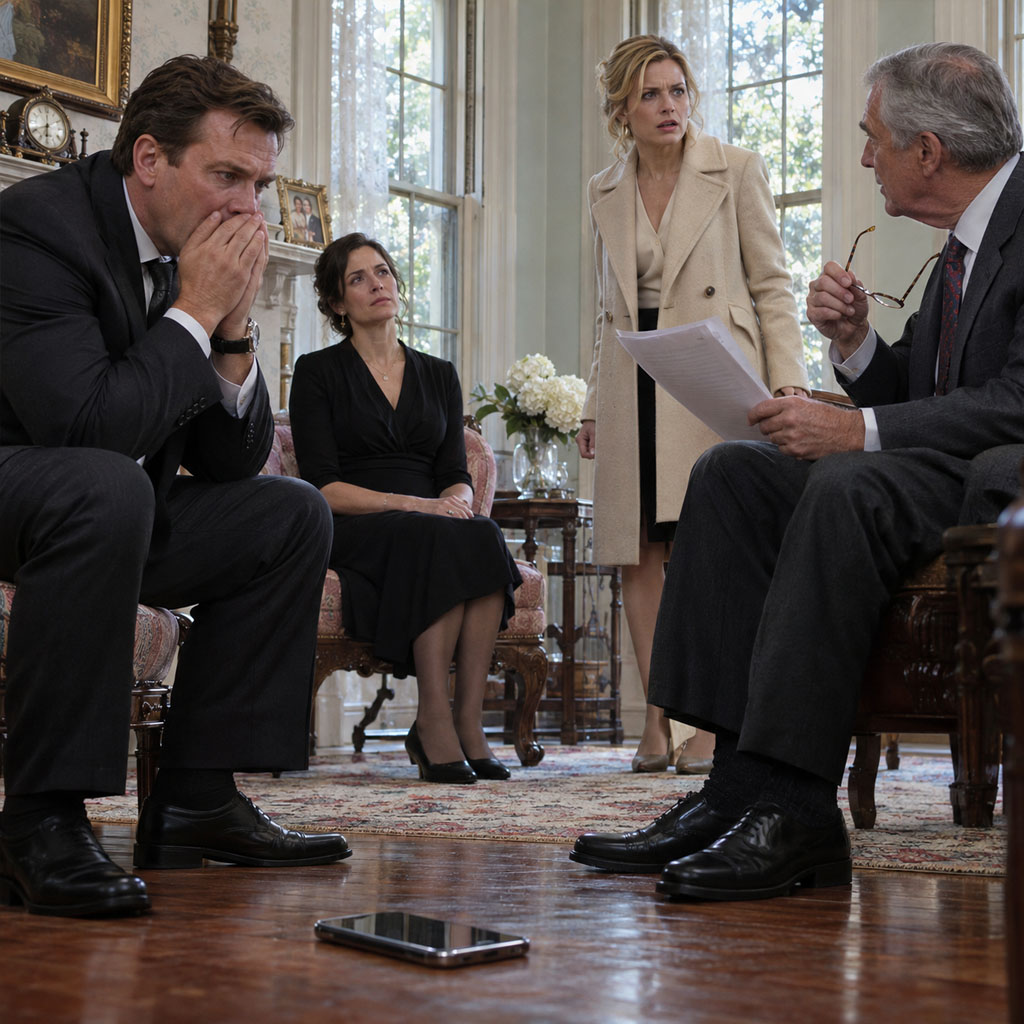
Grant’s phone slipped from his hand.
It struck the hardwood floor with a sharp crack.
Nobody moved.
He stared at Mr. Whitaker.
“What records?”
Mr. Whitaker removed his glasses.
“Mrs. Bennett preserved correspondence and documents concerning proposed transactions involving her home.”
Brooke sat perfectly still.
Grant recovered his phone but didn’t look at it.
“Those conversations were preliminary.”
“Some were,” Mr. Whitaker replied. “Others concern documents that appear to claim authority Mrs. Bennett expressly denied granting.”
“You’re taking things out of context.”
“That is precisely why the full records have been preserved.”
Brooke finally spoke.
“Why am I here if this is a family estate matter?”
Mr. Whitaker turned toward her.
“Miss Callahan, certain documents bear your name and a signature purporting to be yours.”
Her expression changed.
“What documents?”
He placed a photocopy on the desk.
I recognized it immediately.
The property management authorization bearing my supposed signature.
Brooke’s eyes moved to the bottom of the page.
“That isn’t—”
She stopped.
Grant looked at her.
“Don’t say anything.”
Mr. Whitaker remained calm.
“Miss Callahan, the document identifies you as a witness to Elena Mercer’s signature.”
Brooke swallowed.
“I was told the paperwork had been approved.”
“Did you personally see Mrs. Mercer sign it?”
Her eyes flicked toward Grant.
“Brooke,” he warned.
Mr. Whitaker spoke again.
“You’re not required to answer questions here. Given the dispute, you may wish to seek independent legal advice.”
But Luke had already leaned forward.
“Elena, did you sign that?”
“No.”
Grant turned on me.
“You agreed to let me help.”
“I agreed to nothing of the kind.”
“You knew I was handling things!”
“Handling repairs doesn’t mean selling my mother’s house.”
“Nobody sold anything!”
I looked at him.
“Then why did you prepare paperwork suggesting I had already authorized you?”
He opened his mouth.
Then closed it.
Mr. Whitaker laid another document beside the first.
“This is an unsigned version of the same authorization. The records include earlier drafts and correspondence relating to its preparation.”
Brooke stared at the pages.
Grant leaned over.
“Where did you get those?”
“They were preserved by Mrs. Bennett and delivered to the estate file.”
The color drained from his face.
For several seconds, nobody spoke.
Then Brooke said, almost inaudibly, “You told me she wouldn’t find those.”
Grant turned sharply.
“Brooke.”
“You said Margaret didn’t keep copies.”
The room fell silent.
Brooke seemed to realize what she’d revealed.
She pressed her lips together.
I watched her with a strange feeling of distance.
This was the woman who’d laughed at my mother’s funeral.
The woman who’d looked at me as though I were merely an inconvenience standing between her and a beautiful house.
Now she couldn’t meet my eyes.
Mr. Whitaker gathered the pages.
“I suggest we refrain from further statements about disputed matters without legal representation.”
But Grant wasn’t finished.
He pointed toward me.
“You’ve been planning this.”
I shook my head.
“No.”
“You found the documents. You went behind my back.”
“They were my mother’s documents.”
“You could have come to me.”
“I did. I asked you what they meant.”
“You didn’t trust me!”
That sentence hurt more than I expected.
For 24 years, I’d trusted him with my home, my savings, my plans, and my future.
I’d believed his explanations when business took him away for weekends.
I’d defended him when Mom questioned his behavior.
And now he was standing in her study, demanding that I apologize for doubting him.
“I trusted you for a very long time,” I said.
My voice was quiet.
“That was never the problem.”
He stared at me.
Brooke stood and picked up her purse.
“I need to leave.”
Grant caught her arm lightly.
“Sit down. We can explain this.”
She stepped away.
“You said Elena had already agreed. You said Margaret was being difficult, but everything would be settled.”
“Brooke, stop talking.”
“You told me the house was practically yours.”
Grant went still.
I looked at her.
“Did he?”
She didn’t answer.
She didn’t need to.
Mr. Whitaker closed the folder.
“The estate’s position is clear. Mr. Mercer has no authority under Mrs. Bennett’s documents to act regarding this property. Any disputed authorization will be reviewed through appropriate legal channels.”
Grant lowered himself onto the sofa.
He seemed suddenly older.
“Elena,” he said, “you don’t understand the pressure I’ve been under.”
I thought about the messages concerning his debts.
“I understand more than you think.”
“My business is struggling.”
“Then you should have told me.”
“I was trying to save everything.”
“By taking something that wasn’t yours?”
He stared at the floor.
There was nothing left for him to say.
Brooke stood near the doorway, gripping her portfolio.
I looked at her.
At the funeral, she’d laughed when I’d whispered, “Enjoy the house.”
Now she looked around the room as though she’d never seen it before.
“You knew I hadn’t signed that document,” I said.
Her eyes filled.
“Grant told me you’d eventually agree.”
“That isn’t what I asked.”
She looked away.
I didn’t raise my voice.
I didn’t insult her.
I didn’t need to.
“You came here when my mother had just died,” I said. “You looked at her home and saw something you thought you could have.”
Brooke’s shoulders sagged.
“I’m sorry.”
Perhaps she meant it.
Perhaps she was simply frightened.
I couldn’t tell, and I no longer needed to.
Grant looked at me.
“What happens now?”
I thought about the years we’d shared.
About the woman I’d been when I married him.
About Mom sitting alone in this study, making notes because she was afraid somebody would exploit her daughter’s trust.
Then I answered.
“Now you stop calling this house yours.”
Chapter 6
The consequences didn’t arrive all at once.
There were attorneys, letters, questions from the brokerage, and discussions about the disputed authorization.
Mr. Whitaker made sure the relevant records were preserved. The questionable documents and supporting correspondence were referred to legal professionals for review.
I wasn’t required to settle every issue that afternoon.
For once, I could allow a process to unfold without personally carrying every burden.
Grant moved out of our townhouse within the following week.
He took his clothes, his computer, and several boxes from the garage.
I watched from the kitchen while he loaded his car.
When he came inside for the final box, he stopped beside the table.
“Twenty-four years,” he said.
I looked up.
“What about them?”
“Doesn’t any of it matter to you?”
The question was almost unbearable.
Because of course it mattered.
It mattered that he’d held my hand when my father died.
It mattered that we’d driven across the country together on our tenth anniversary.
It mattered that he’d brought me soup when I was sick, knew how I liked my coffee, and could still make me laugh when he wasn’t trying to control the conversation.
Those memories were real.
So were the lies.
“All of it matters,” I said. “That’s why this hurts.”
He looked down.
“I made mistakes.”
“Yes.”
“I was scared.”
“You could have told me.”
He had no answer.
After a moment, he asked, “Is there any chance we can work this out?”
I studied the man I’d loved for nearly half my adult life.
“I don’t think so, Grant.”
He nodded once.
Then he picked up the box and left.
I stood in the doorway until his car disappeared.
I didn’t feel victorious.
I felt 60 years old, exhausted, and uncertain about what came next.
But I also felt something I hadn’t experienced in a long time.
Relief.
Over the next several weeks, I met with a divorce attorney and reviewed our finances.
Grant’s business troubles were worse than he’d admitted. Fortunately, many of the obligations belonged to his company, though our shared accounts still required careful examination.
The process wasn’t painless.
We had disagreements about savings, property, and expenses.
My attorney explained what I could reasonably pursue and what prolonged litigation might cost.
I considered everything.
Then I chose a settlement that protected my future without requiring years of arguments.
Grant retained a portion of our shared savings that I might have challenged.
It wasn’t forgiveness.
It was a decision about how much more of my life I wanted to spend fighting him.
Brooke’s situation unfolded separately.
Her brokerage reviewed her involvement in the property documents, and she stopped working there during the inquiry. I never learned every detail of what happened afterward.
Mr. Whitaker told me that any allegations concerning false signatures and unauthorized representations would have to be evaluated through proper procedures.
I agreed.
The records would remain available.
The truth didn’t need me standing in front of Grant, repeating it until he finally admitted everything.
One evening, several weeks after the estate meeting, Luke came to Mom’s house carrying a toolbox.
I was sitting on the front porch with a glass of iced tea.
He pointed toward the loose railing.
“That thing’s going to fall apart.”
“Mom had been complaining about it for months.”
“Then I guess somebody ought to fix it.”
He set down the toolbox and began removing the damaged screws.
For a while, we worked quietly.
I held the railing while he tightened the brackets.
Finally, he said, “I’m sorry.”
I looked at him.
“For what?”
“For believing Grant.”
I didn’t answer immediately.
Luke continued.
“I kept thinking there had to be a reasonable explanation. He’s been part of the family so long.”
“I thought the same thing for years.”
“That’s different.”
“Not entirely.”
He sat on the porch step.
“Mom warned me once that Grant was too interested in the house.”
I turned toward him.
“When?”
“Last winter. She asked whether he’d talked to me about selling it.”
“What did you tell her?”
“That he’d mentioned it. I thought she was just worried about getting older.”
He rubbed his hands together.
“She told me not to let anybody rush you.”
I swallowed.
“She said that?”
He nodded.
“I should have listened.”
I sat beside him.
“Luke, Mom knew you wanted everyone to get along. That’s one of the things she loved about you.”
He gave a sad smile.
“Sometimes it’s not very useful.”
“Sometimes it is.”
We sat quietly, listening to a car pass on the street.
Then he reached into his jacket pocket.
“I found something at my place.”
He handed me a small envelope.
Inside was an old photograph of the two of us standing on the porch when we were children.
I was about ten, wearing a yellow dress.
Luke was four, holding a toy fire truck.
Mom stood behind us, smiling into the sunlight.
On the back, in Dad’s handwriting, were the words:
Home is where we take care of one another.
I ran my thumb over the faded ink.
“Where did you find this?”
“In a box Mom gave me last Christmas.”
He looked toward the front door.
“I think she’d want us to stay close.”
I nodded.
“She would.”
We didn’t hug or make grand promises.
Luke finished repairing the railing.
I brought him another glass of iced tea.
And by late afternoon, the porch felt like ours again.
Chapter 7
Three months after Mom’s funeral, I finally began changing the house.
Not because I wanted to erase her.
Because I had decided to live there.
The townhouse was too full of memories I couldn’t yet separate from regret. Mom’s Victorian, with its wide porches and stubborn windows, offered something different.
It had always been a place where I could breathe.
I hired a contractor to repair the roof, replace the damaged window frames, and inspect the old electrical system.
I chose the contractors myself.
I read every agreement before signing.
Some people might have called that excessive caution.
I called it paying attention.
Luke helped me repaint the downstairs bedroom. Denise brought homemade peach cobbler and insisted that the kitchen curtains needed replacing.
I kept Mom’s dining room table, her old grandfather clock, and the bookshelf where she’d stored cookbooks beside mystery novels.
The house changed slowly.
One weekend, I found a small box in the back of her bedroom closet.
It contained birthday cards she’d never mailed, a few old recipes, and a note written on a sheet of pale blue stationery.
The note wasn’t addressed to anyone.
It was simply a thought she’d written down.
A house can hold your memories, but it should never hold you prisoner.
I sat on the edge of her bed and read it again.
For weeks, I’d been thinking about what it meant to keep the house.
Had I chosen it because I loved it?
Or because losing it to Grant would have felt like losing Mom all over again?
I walked through the rooms that afternoon, asking myself a question I’d avoided.
If there had never been an argument, would I still want to live here?
I stood in the kitchen and looked through the window toward the garden.
The camellias were beginning to bloom.
I remembered Mom teaching me to make biscuits, my father reading the newspaper at the table, and Luke racing down the hallway in his socks.
Then I imagined the future.
Holiday dinners with Luke and Denise.
Neighbors dropping by for coffee.
Quiet mornings without anyone questioning my decisions.
I smiled.
Yes.
I wanted to stay.
Not because Grant had tried to take the house.
Not because its value exceeded a million dollars.
Because I could picture an ordinary, peaceful life inside it.
That evening, I placed Mom’s brass key bowl back beside the front door.
I’d considered putting it away with her other keepsakes.
Instead, I dropped my new house keys into it.
The familiar sound brought tears to my eyes.
I remembered the day of the funeral.
Brooke’s smile.
Grant’s hand resting against her back.
The way she’d laughed when I whispered, “Enjoy the house.”
At the time, I’d said those words because I sensed that the two of them were making plans behind my back.
I hadn’t known about the disputed signature, the emails, or the extent of Grant’s financial trouble.
I hadn’t known how carefully Mom had documented her concerns.
And I certainly hadn’t known how much strength it would take to walk away from my marriage.
But I understood something now that I hadn’t understood then.
Protecting yourself doesn’t always mean taking revenge.
Sometimes it means refusing to let someone else’s dishonesty decide what kind of person you become.
I hadn’t destroyed Grant’s life.
His decisions had consequences, and I had allowed the appropriate people to address them.
I hadn’t humiliated Brooke for pleasure.
I’d simply stopped pretending that her choices were harmless.
And I hadn’t kept every dollar I might have fought for.
I’d chosen peace where peace was possible, without surrendering what mattered.
A few days later, a letter arrived from my divorce attorney confirming that the final paperwork was moving forward.
I placed it in a drawer beside my mother’s old recipe cards.
Then I went outside.
Luke had repaired the porch railing so well that it no longer moved when I leaned against it.
The evening sun was sinking behind the neighboring houses, painting the street a soft golden color.
I stood there listening to the sounds of Savannah.
A bicycle bell.
A dog barking two doors down.
Someone laughing on the sidewalk.
The ordinary sounds of a life continuing.
For so long, I’d believed that losing a marriage meant losing the future I’d imagined.
Now I understood that the future hadn’t disappeared.
It had changed.
I thought about my mother sitting in her study, quietly making arrangements to protect her children.
She’d never been a woman who needed the final word in an argument.
She preferred to do what was necessary and let the results speak for themselves.
I wished I could tell her that Luke and I were all right.
That the house was safe.
That I was learning how to trust my own judgment again.
The porch light clicked on automatically.
It was the same light Mom had always left burning when she knew one of us was coming home late.
For a moment, I stood beneath it with my hand against the repaired railing.
Then I went inside.
The brass bowl caught the soft hallway light, and my keys lay exactly where hers had always been.
I closed the door and looked around.
The house belonged to me now.
But it no longer felt like something I’d won.
It felt like somewhere I could finally come home.
THE END.
⚠️ All characters and events are fictional. Do not imitate or apply them in real life. 😌😌😌