Chapter 2
My father, Dale Simmons, was 68 years old and had spent more than two decades running a plumbing business in Des Moines.
He was not a man who raised his voice often.
When I was growing up, Dad could settle an argument simply by asking one question and waiting for an honest answer.
My brothers had inherited different parts of his personality.
Stuart, the oldest, was steady and thoughtful, a father of three daughters who could recognize trouble before anyone mentioned it.
Felix, my younger brother, was more direct. He worked as an electrician and had a habit of solving problems while other people were still explaining them.
All three had planned to visit that evening with groceries, diapers, and a portable bassinet.
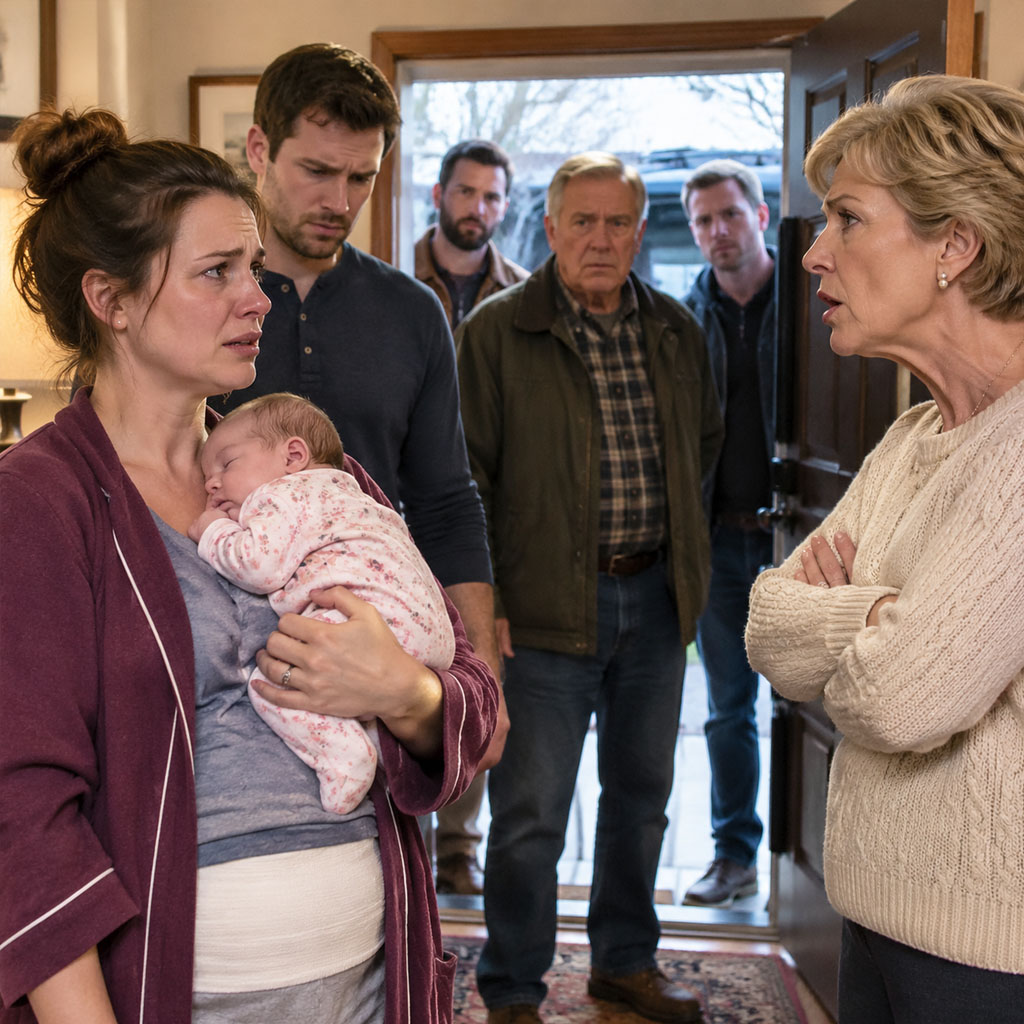
Instead, they found me standing in the hallway holding a newborn, with packed bags beside my feet.
Stuart took one look at me.
“Vivien, why are you standing? Sit down.”
“I’m okay.”
“You’re four days out from surgery. Sit.”
His voice was gentle, but he didn’t make it a request.
I lowered myself onto the couch.
Felix set a grocery bag on the table.
“Where’s the rest of your stuff?”
“In the bedroom.”
He nodded to Stuart, and they went to collect it.
Harriet stepped into the living room.
“Would someone please explain what this ridiculous production is about?”
Dad didn’t look at her immediately.
He crouched beside the couch and studied my face.
“Sweetheart, are you all right?”
I tried to answer.
Instead, tears slipped down my cheeks.
He reached for my hand.
“Okay,” he said quietly. “You don’t have to explain right now.”
Then he stood and turned toward Owen.
“Son, what happened here?”
Owen rubbed the back of his neck.
“Things got a little tense.”
Dad waited.
“Mom asked Vivien to help with dinner, and Vivien got upset.”
My father looked toward me.
“Help with dinner?”
Harriet stepped forward.
“I’ve been here an entire week. I came from Arizona to support them, and I haven’t received a bit of appreciation.”
Dad nodded slowly.
“Traveling to help family is a generous thing.”
Harriet’s expression softened slightly.
“Thank you.”
“But Vivien just came home from the hospital,” he continued. “She needs rest and assistance. That’s what helping her would mean.”
Harriet lifted her chin.
“Women have been having babies for thousands of years.”
“Yes, ma’am. And right now, my daughter needs time to recover from an operation.”
His voice remained perfectly calm.
“I’d like to take her home with us.”
“She already has a home,” Harriet replied sharply.
Dad looked at me.
“Vivien, where would you like to be?”
“With you, Dad.”
“Then that’s settled.”
Harriet turned to Owen.
“Are you really going to let them walk out of here with your wife and child?”
The room became very quiet.
Owen looked at me.
I waited.
He could have said his mother had been wrong. He could have told me he was sorry, that he understood why I was hurt, and that he would make sure it didn’t happen again.
Instead, he sighed.
“Can’t everybody just calm down?”
I closed my eyes for a moment.
There was my answer.
“Dad,” I said, “I’m ready.”
Stuart brought the bags to the truck. Felix secured Clover’s infant seat in the back, carefully checking the installation before calling us outside.
Dad helped me walk to the passenger door.
Owen followed us onto the porch.
“Vivien, you’re really doing this?”
I stopped beside the truck.
“Yes.”
“I wish you’d talk to me instead of running away.”
I looked at the man I’d married.
“I have been talking to you, Owen. You just haven’t been listening.”
He looked away.
I wanted him to reach for me. I wanted him to say something that would make the last hour less painful.
But he remained silent.
Dad helped me into the truck, and Felix handed Clover to me once I was safely seated.
As we pulled away, I looked back.
Owen and Harriet stood together on the porch.
Neither followed.
The drive to Des Moines took nearly two hours. Dad drove carefully, stopping once so I could feed Clover and stretch my legs.
Stuart and Felix followed in another vehicle with our bags and supplies.
Nobody pressured me to explain.
When we reached Dad’s house, the guest bedroom was already prepared.
There were fresh sheets, extra pillows, bottled water, and a small lamp beside the bed.
Felix carried in the bassinet and assembled it while Stuart put groceries away.
Dad brought me a cup of tea.
Then he sat in the chair beside my bed.
For several minutes, I cried without trying to hide it.
Dad waited.
When I finally stopped, he handed me a tissue.
“You only have to ask once, sweetheart.”
I looked at him.
“For help?”
“For help. For respect. For somebody to take you seriously.”
I wiped my face.
“I feel foolish.”
“Why?”
“Because I should have seen this coming.”
Dad leaned back.
“Seeing a problem and knowing how to solve it are two different things.”
I stared at Clover sleeping beside me.
“I wanted everything to be different when we brought her home.”
“I know.”
“Maybe I overreacted.”
Dad shook his head.
“Vivien, you asked for help. That’s not overreacting.”
I let his words settle.
For the first time since leaving the hospital, I felt I could sleep without worrying that someone would come in and tell me I wasn’t doing enough.
The following days were a strange mixture of exhaustion and relief.
Clover woke frequently to eat. My incision was tender, and ordinary movements required patience.
But nobody expected me to cook or clean.
Dad made oatmeal every morning and brought it upstairs with water and whatever else I needed.
Stuart’s wife delivered freezer meals.
Felix assembled shelves for Clover’s supplies and read the bassinet instructions three separate times.
“You know you’ve already built it,” I teased.
He frowned at the booklet.
“That’s not the point. I want to make sure I built it correctly.”
I laughed.
The house wasn’t silent. My brothers visited, their children occasionally came by, and Dad had a habit of listening to the morning news at an unnecessarily high volume.
But I felt cared for.
That difference mattered.
Owen texted every day.
At first, his messages were simple.
“How are you feeling?”
“How’s Clover?”
“Can I come see her?”
I answered honestly and sent photographs.
Then came the explanations.
“Mom was exhausted.”
“She didn’t mean to upset you.”
“She’s having a difficult time without Dad.”
I understood his mother’s grief.
What I couldn’t understand was why my recovery seemed to matter less than her disappointment.
Five days after arriving at Dad’s house, I opened our joint checking account to pay a medical bill.
As I scrolled through the transactions, one caught my attention.
Three weeks before Clover’s birth, Owen had transferred $3,200 to his mother.
There was a short description attached.
“Postpartum household assistance.”
I read it twice.
Then I called him.
He answered almost immediately.
“Hey, Vivien. Everything okay?”
“Why did you send your mother $3,200?”
Silence.
“Three weeks ago,” I continued. “From our joint account.”
Owen cleared his throat.
“It was for helping with the baby.”
“What do you mean?”
“Meals, cleaning, groceries, whatever you needed after the hospital.”
I looked around Dad’s quiet guest room.
“Owen, when I came home, your mother told me to cook dinner.”
“I know.”
“The sink was full of dishes.”
“She was planning to get organized.”
“Did you know she was charging us to help?”
“She said it would cover her time and expenses.”
I sat very still.
“Did you discuss this with me before sending the money?”
He hesitated.
“I thought you’d appreciate not having to worry about it.”
“Did she buy anything for the baby?”
“I don’t know.”
“Did she arrange meals?”
“She said she had everything handled.”
I closed my eyes.
Three thousand two hundred dollars.
Money we had carefully saved for medical expenses, supplies, and the possibility that I might need extra help during recovery.
Owen had handed it to his mother without telling me.
And she had expected me to make dinner four days after surgery.
“Owen,” I said, “I need you to find out exactly what that money paid for.”
He sounded uncomfortable.
“Can’t we discuss it when you come home?”
“That’s part of what we need to discuss before I come home.”
I ended the call.
Then I opened a notebook.
I wrote down the transfer date, the amount, Owen’s explanation, and everything I remembered about the afternoon we returned from the hospital.
Dad had taught me that when emotions made a problem confusing, it helped to put the facts on paper.
I didn’t yet know what those facts meant.
But a week later, a phone call from someone I barely knew made the situation far more troubling.
Chapter 3
The woman introduced herself as Rosemary Vance.
She was a longtime acquaintance of Harriet’s and belonged to a neighborhood meal ministry through St. Andrew’s Church.
“I hope I’m not bothering you, Vivien,” she said. “I wanted to check whether you received the baby blanket I sent.”
I looked at Clover, who was sleeping in the bassinet.
“I’m sorry, Rosemary. I haven’t seen it.”
“Oh.”
Something about the way she said that made me pause.
“Did you leave it with Harriet?”
“Yes. I brought it over while you were still in the hospital.”
I thanked her and promised to look for it.
Then Rosemary hesitated.
“While I have you, may I ask something?”
“Of course.”
“Were you unhappy about the meal deliveries?”
I frowned.
“What meal deliveries?”
There was a long pause.
Rosemary explained that eight families had volunteered to provide dinners for Owen and me during the first two weeks after Clover’s birth.
There were casseroles, soups, chicken dinners, and a pot roast one woman was especially proud of making.
The schedule had been completed weeks before my due date.
Eleven days before Clover was born, Harriet canceled the entire arrangement.
“She said you wanted privacy,” Rosemary explained. “She told us you didn’t want people coming to the house and preferred to manage everything yourselves.”
I stared at the wall.
“I never said that.”
“Oh, dear.”
“I didn’t even know anyone had offered.”
Rosemary sounded genuinely upset.
“Vivien, we would never have canceled if we’d known.”
I swallowed.
“Why didn’t anybody contact me directly?”
“Harriet said she was coordinating everything. She’s been part of our group for years, and we trusted her.”
I looked down at my daughter.
Eight families had offered to feed us.
Harriet had sent them away.
Then, after receiving $3,200 from our household savings, she’d stood over me on the couch and demanded that I cook.
“Rosemary,” I said quietly, “thank you for telling me.”
“I’m so sorry.”
“You didn’t know.”
After we hung up, I sat with the phone in my hand.
I thought back to Harriet’s repeated promises during my pregnancy.
“Don’t worry about anything after the baby comes.”
“I’ll take care of the house.”
“You won’t have to lift a finger.”
I’d believed her.
So had Owen.
But what had she actually planned to do?
I called my husband.
When I told him about the canceled dinners, he sounded confused.
“That doesn’t make sense.”
“Call your mother.”
“Vivien—”
“Please. Ask her why she canceled them.”
He promised he would.
Three hours later, he called back.
His voice was different.
“Mom says she thought the deliveries would be intrusive.”
“Did she tell you that before canceling them?”
“No.”
“Did she ask what I wanted?”
“No.”
I waited.
“She says she was trying to protect your privacy,” he added.
“Owen, I was looking forward to having help. I told both of you that.”
“I know.”
“Then why did she decide for me?”
He had no answer.
I brought up the money again.
“Did you ask her what she spent the $3,200 on?”
He sighed.
“She got upset.”
“That’s not an answer.”
“I know.”
For once, he didn’t tell me to be patient with her.
He simply said, “I’m coming to Des Moines this weekend. We need to talk.”
Two days later, Owen arrived carrying flowers and a folder of bank statements.
Dad welcomed him politely, then took Clover for a walk around the neighborhood so we could have some privacy.
Owen and I sat across from each other at the kitchen table.
The flowers rested in a vase nearby.
“I brought everything you asked for,” he said.
I opened the folder.
The transfer was exactly as I’d seen it.
Three thousand two hundred dollars from our joint account to Harriet Gallagher.
No receipts.
No household purchases attached.
No written agreement.
“Why didn’t you tell me?” I asked.
Owen folded his hands.
“Mom said she’d handle things while you recovered. She talked about the cost of her time, travel, groceries, and supplies. I thought paying her would make everything easier.”
“For whom?”
He looked at me.
I continued.
“We agreed to save that money for help after Clover arrived. You used it without asking, and the help never came.”
“I thought she was going to follow through.”
“Then let’s ask her.”
I placed my phone in the center of the table and called Harriet on speaker.
She answered cheerfully when she heard Owen’s voice.
“Hello, sweetheart. How are you?”
“Mom, Vivien and I need to talk about the meals.”
Her tone changed.
“What about them?”
“Rosemary told Vivien you canceled the church deliveries.”
Harriet sighed.
“I thought we’d already discussed that.”
“Why did you tell everyone Vivien wanted privacy?”
“Because she needed privacy. A new mother shouldn’t have strangers parading through the house.”
“Those people weren’t strangers,” I said. “They were neighbors who wanted to help us.”
“Vivien, I was protecting you from being overwhelmed.”
“Did I ask you to cancel the meals?”
Silence.
“Harriet?”
“No. But I’ve raised children. I know what new mothers need.”
I glanced at Owen.
“Then why did you ask me to cook dinner the day I came home?”
“I was tired, Vivien.”
“So was I.”
“I had been managing that house for a week.”
I thought of the dishes in the sink.
“What meals did you prepare during that week?”
Her voice sharpened.
“I don’t need to submit a report on everything I do.”
I took a breath.
“All right. Then let’s discuss the $3,200.”
Another silence.
“What about it?”
“Owen said that money was for meals, cleaning, groceries, and help after Clover’s birth.”
“It was compensation for my time.”
“Did you buy groceries with it?”
“I had expenses.”
“What expenses?”
Harriet sounded offended.
“Do you know what it costs to fly across the country and give up your personal schedule?”
Owen leaned toward the phone.
“Mom, I paid for your flight. And you stayed in our guest room.”
She didn’t answer.
He continued.
“Did you use the money for household supplies?”
“I bought things I needed.”
“Such as?”
Harriet exhaled loudly.
“I don’t appreciate being interrogated.”
“Mom, please answer.”
A long silence followed.
Then she said, “I had some personal expenses. I don’t see why that should concern either of you.”
Owen went very still.
I remembered a video call we’d had a month before Clover was born.
Harriet had proudly shown me photographs of new furniture she’d ordered for her condominium in Phoenix.
A large sectional sofa.
A matching entertainment center.
She’d told me she’d been saving for months.
I didn’t know whether our money had paid for any of it. But I knew she’d received money intended for our recovery and hadn’t explained where it went.
“Owen,” I said, “ask your mother whether she still has any of that money.”
Harriet answered before he could speak.
“I am not discussing my finances with the two of you.”
Then she hung up.
The kitchen fell silent.
Owen stared at the phone.
For the first time, he didn’t offer an excuse.
He didn’t blame my exhaustion or his mother’s grief.
He simply sat there, looking at the evidence.
Finally, he whispered, “I really thought she was helping us.”
I closed the folder.
“So did I.”
He looked up.
“I’m sorry, Vivien.”
I studied his face.
He looked frightened, disappointed, and ashamed.
I wanted to reach for him.
But three years of swallowing small hurts had taught me to be careful with apologies that weren’t followed by change.
“I’m glad you understand more now,” I said. “But I need to see what you’re going to do about it.”
He nodded slowly.
“Okay.”
It was the first conversation we’d had in weeks that felt like we might actually be hearing each other.
Chapter 4
Harriet did not take the conversation well.
Within days, members of Owen’s family began contacting me.
His aunt Glenda sent a long message about respecting elders and the importance of forgiveness.
“Your mother-in-law has sacrificed so much,” she wrote. “It’s unfortunate that a simple misunderstanding about dinner has become such a family division.”
I read the message twice.
Then I put my phone down.
The problem wasn’t dinner.
The problem was that Harriet had made decisions about my recovery without asking me, accepted money intended for household help, and then told other relatives a version of events that made me appear unreasonable.
I didn’t respond to Glenda immediately.
Instead, I concentrated on Clover.
She was beginning to stay awake a little longer between feedings. She studied my face with serious blue-gray eyes and made small sounds that seemed full of important opinions.
Sometimes I sat beside her bassinet for an hour, simply watching her.
I hadn’t known it was possible to feel so exhausted and so grateful at the same time.
Rosemary called again that week.
“I wanted you to know something,” she said.
Harriet had told several members of the meal group that she’d worked tirelessly after Clover’s birth and had been unfairly criticized.
“People are confused,” Rosemary explained. “A few of us have been talking, and we realize we should have contacted you directly about the meals.”
“You were trying to help,” I said.
“We were. But we let Harriet speak for you.”
I appreciated that distinction.
Rosemary hesitated.
“She’s always liked being in charge. She’s organized our meal schedules for years. Usually it works out beautifully.”
“I’m sure it does.”
“But helping someone and controlling everything around them aren’t the same thing.”
I looked at Clover sleeping beside me.
“No,” I said. “They aren’t.”
Meanwhile, Owen began visiting regularly.
At first, he seemed unsure what to do.
He would sit beside the bassinet, admire Clover’s tiny hands, and ask whether I needed anything.
I started giving him actual responsibilities.
“She needs a diaper change.”
“Can you prepare the next bottle?”
“Her clean sleepers are in the second drawer.”
He learned quickly.
One afternoon, Clover began crying while I was finishing lunch.
Owen picked her up and held her against his shoulder.
He moved slowly around the room, speaking softly.
Within a minute, she settled.
He looked at me, surprised.
“How did I do that?”
“She needed someone to hold her.”
He glanced down at our daughter.
“That’s all?”
“Sometimes that’s all.”
He sat beside me.
For a while, we watched Clover sleep.
Then Owen said, “I think I spend too much time trying to make people stop being upset.”
I waited.
“When Mom gets angry, I try to fix it by giving her whatever she wants. I thought I was keeping peace.”
“Whose peace?”
He considered the question.
“Mine, mostly.”
I appreciated that he didn’t try to make the answer sound better.
A few days later, Owen asked whether I would attend a family gathering Harriet was organizing at St. Andrew’s fellowship hall.
“She wants to have a welcome celebration for Clover.”
I looked at him.
“Why?”
“She says people didn’t get to meet the baby properly.”
“And?”
He hesitated.
“She wants everyone together again.”
I wanted Clover to know her extended family.
I wanted a relationship with Harriet that didn’t require constant caution.
But Rosemary called the following day with troubling news.
Harriet had been telling people she planned to make a speech about motherhood, sacrifice, and the importance of gratitude.
Apparently, she wanted to explain what had happened when I left the house.
I called Owen.
“Your mother is planning to use Clover’s celebration to defend herself.”
He sighed.
“I’ll talk to her.”
He called back an hour later.
“She says she has the right to tell her side.”
I looked at the folder of bank records on Dad’s desk.
“Then I have the right to tell mine.”
Owen was quiet.
“You’re right,” he said.
I hadn’t expected those words to mean so much.
The gathering took place on a Saturday afternoon.
I wore a comfortable blue dress that didn’t press against my healing incision. Clover wore a soft cream-colored outfit with tiny embroidered flowers.
Dad offered to come with me.
I shook my head.
“I want to handle this myself.”
He studied me.
“Call if you need anything.”
“I know.”
I carried a folded copy of the bank transfer and my handwritten notes in my purse.
I didn’t intend to show them unless necessary.
When I entered the fellowship hall, I was surprised by how lovely it looked.
Yellow tablecloths covered the tables. White balloons floated near the windows, and a banner welcomed Clover in cheerful pink letters.
Someone had made three kinds of pie.
People came forward to admire the baby.
For almost an hour, the afternoon felt pleasant.
Then Harriet stood at the front of the room and tapped a spoon against her glass.
“May I have everyone’s attention?”
The conversations faded.
Harriet smiled warmly.
“Thank you all for coming to welcome our beautiful granddaughter.”
She spoke about how much Clover meant to the family.
Then her expression grew solemn.
“The last few weeks have been difficult. As many of you know, I traveled from Arizona to help my son and daughter-in-law during a very challenging time.”
Several people nodded.
“I managed their household while Owen worked and Vivien recovered. I tried to respect Vivien’s wish for privacy by keeping outside help to a minimum.”
My stomach tightened.
Harriet continued.
“Sometimes we give everything we have to the people we love, only to discover that our efforts aren’t understood.”
A few people glanced toward me.
I could feel my cheeks warming.
Harriet lifted her chin.
“But as mothers, we keep giving. That’s what family does.”
I looked at Owen.
He was standing near the side of the room, his expression troubled.
Then I stood.
“Harriet, may I ask you a question?”
Her smile faltered.
“Of course, dear.”
“Which meals did you make for us?”
A murmur moved through the room.
Harriet blinked.
“What?”
“You said you managed our household while I was recovering. I’m asking which meals you prepared.”
She cleared her throat.
“I made sure everything was handled.”
“Did you?”
“Vivien, this isn’t appropriate.”
I kept my voice even.
“When I came home from the hospital, the sink was full of dishes. I’d been home twenty-seven minutes when you told me to get up and cook dinner.”
Several people turned toward Harriet.
She folded her arms.
“I was exhausted after helping all week.”
“I had just undergone a C-section.”
“Women recover differently.”
“Yes,” I said. “And my doctor told me to rest and avoid unnecessary strain.”
Harriet looked toward Owen.
“Are you going to let your wife speak to me this way?”
For a moment, my heart sank.
I’d heard that question before.
At our house.
The afternoon I’d called Dad.
But this time, Owen didn’t look away.
He walked toward the front of the room.
“Mom,” he said quietly, “Vivien is telling the truth.”
Harriet stared at him.
“Owen.”
“You canceled the meal deliveries.”
The room grew still.
“Eight families had volunteered to bring us dinners. You told them Vivien didn’t want their help.”
“I was protecting her privacy.”
“She never asked you to do that.”
Owen stood beside me.
“And I sent you $3,200 from our household savings because you said you’d use it to help us after the baby arrived.”
Harriet’s expression changed.
“That was compensation for my time.”
“You didn’t tell us you intended to use it for personal expenses.”
She looked around the room.
“I don’t believe this.”
Owen’s voice remained calm.
“Mom, you stayed in our guest room. We paid for your flight and groceries. You canceled the meals that other people offered, and when Vivien came home from the hospital, you asked her to cook.”
I felt tears threatening.
But I kept my eyes on him.
He continued.
“I should have stopped it that day. I didn’t, and that was wrong.”
Rosemary stood near the back of the room.
“May I say something?”
Everyone turned.
“I organized the meal schedule,” she said. “Eight families signed up. Harriet told us Vivien wanted privacy, so we canceled the deliveries.”
She looked toward me.
“I spoke with Vivien afterward. She didn’t know about the meals. She never asked us to cancel.”
The room fell completely silent.
Harriet stared at Rosemary.
Then at Owen.
Then at me.
“I have given years of my life to this family,” she said, her voice trembling with anger.
Nobody answered.
She picked up her handbag.
“I won’t stay here and be humiliated.”
She turned toward Owen.
“I expected better from you.”
Owen took a breath.
“Mom, I love you. But telling the truth isn’t disrespect.”
Harriet walked out.
The door closed quietly behind her.
For a long moment, nobody moved.
Then Glenda rose from her chair.
She approached me slowly.
“Vivien, Harriet told me she’d been cooking and cleaning for you all week.”
I nodded.
“That’s what she told a lot of people.”
Glenda pressed her lips together.
“She said you left because Owen asked you to help around the house.”
I looked at her.
“That’s not what happened.”
“I can see that now.”
She glanced toward Clover.
“I’m sorry. I should have asked you before making judgments.”
I took a breath.
“Thank you.”
Rosemary approached next.
Then two other women from the meal group.
They apologized for the misunderstanding and offered to bring dinners once I returned home.
I thanked them.
I hadn’t wanted an argument at my daughter’s welcome celebration.
But at least the room no longer felt filled with things I wasn’t allowed to say.
Owen took my hand.
For the first time in a very long time, I didn’t feel alone while standing beside him.
Chapter 5
That evening, Owen drove Clover and me back to Dad’s house.
After we settled the baby, we sat on the back porch while Dad stayed inside.
The sun was setting behind the trees, and the air carried the faint smell of freshly cut grass.
Owen stared into the yard.
“I should have stood up for you the day we came home.”
I didn’t answer.
“And years before that.”
He rubbed his hands together.
“When Dad died, Mom started calling me about everything. Bills, appointments, decisions, little problems around the house.”
I listened.
“I thought keeping her happy meant I was taking care of her.”
He looked toward the kitchen window.
“If I disagreed, she’d get upset. So I learned to agree. It was easier.”
“For you,” I said.
He nodded.
“For me.”
I watched a robin move along the fence.
“I understand that you love your mother, Owen. I never wanted you to stop loving her.”
“I know.”
“But I need to know that our marriage matters when she’s unhappy with me.”
“It does.”
I looked at him.
“Then I need more than promises.”
He turned fully toward me.
“What do you need?”
The question was simple.
But it was the first time in months he’d asked without already deciding what the answer should be.
“I need time,” I said. “I need you to stop making financial decisions that affect both of us without talking to me.”
He nodded.
“I need you to set boundaries with your mother.”
“Okay.”
“And I need you to discuss the money with her. It was meant for my recovery and Clover’s care. We still need it.”
“I will.”
I looked through the window at Dad, who was carrying Clover around the kitchen.
“I also need to know that when our daughter is older, she won’t grow up watching me accept treatment I’d never want her to accept.”
Owen’s expression changed.
He lowered his head.
“You’re right.”
I wanted to believe everything could be repaired immediately.
But trust isn’t restored simply because someone finally says the right words.
Over the following weeks, Owen began doing the difficult work.
He called Harriet about the money.
She refused to discuss repayment at first.
She insisted the payment had been a gift, then said it was compensation for her time.
Owen reminded her that he’d sent the money for household assistance, not unrestricted personal spending.
He also admitted that he’d been wrong to make the arrangement without consulting me.
After several conversations, Harriet agreed to repay the $3,200 in installments.
The first payment arrived on a Tuesday morning.
I used it for groceries, baby supplies, and occasional help while I recovered.
For once, money set aside to support our family was actually doing that.
Owen also began seeing a therapist.
He didn’t make a grand announcement about it.
One afternoon, he simply told me he’d scheduled an appointment.
“I think I’ve been confusing keeping people comfortable with taking care of them,” he said.
I nodded.
“Those aren’t always the same thing.”
“I know that now.”
I stayed at Dad’s house until I felt comfortable returning home.
When I finally walked through our front door again, the house was different.
The kitchen was clean.
The refrigerator was stocked.
Fresh sheets covered our bed.
Owen had moved Clover’s bassinet beside my side of the mattress and arranged her supplies within easy reach.
He met me in the hallway.
“Welcome home.”
I looked around.
“Did you do all this?”
“Some of it. Stuart helped with the furniture, and Felix checked the bassinet. But I did the cleaning.”
I smiled faintly.
“Thank you.”
He shook his head.
“You shouldn’t have to thank me for cleaning our house.”
I studied him.
“That’s true.”
Rosemary and the church meal group began delivering dinners the next evening.
For two weeks, our porch filled with casseroles, soup, roast chicken, and homemade bread.
Sometimes the person bringing dinner stayed for a short visit.
Sometimes they simply rang the bell and left the food in an insulated bag.
We were grateful either way.
Harriet remained distant.
She called Owen occasionally, usually to complain about the gathering at St. Andrew’s.
At first, he listened patiently.
Then, when she began blaming me again, he interrupted.
“Mom, I’m not going to discuss Vivien as though she caused this.”
Harriet hung up.
The next day, Owen called her back.
He explained that she was welcome to remain part of Clover’s life if she respected our household and spoke honestly about what had happened.
He wasn’t angry.
He wasn’t threatening.
He was simply clear.
That was new.
There were still difficult evenings.
Sometimes Owen slipped into old habits, avoiding an uncomfortable conversation or agreeing too quickly just to make a problem disappear.
Sometimes I became anxious over things that would once have seemed small.
We had to learn how to speak plainly without assuming the other person would turn away.
We spent months rebuilding a marriage that had been quietly weakening long before Clover was born.
It wasn’t romantic in the way movies make reconciliation seem romantic.
There were no dramatic declarations beneath the rain.
There were grocery lists, medical appointments, shared responsibilities, uncomfortable conversations, and small promises that had to be kept repeatedly.
But little by little, the house began to feel like ours again.
And Harriet?
She remained Clover’s grandmother.
We didn’t erase her from the family.
But we stopped allowing her to make decisions that belonged to Owen and me.
Visits were arranged in advance. We agreed on reasonable boundaries, and Owen handled difficult conversations with his mother instead of expecting me to absorb them.
Harriet wasn’t pleased with every change.
Still, over time, she stopped assuming that being unhappy with a decision would automatically make us reverse it.
That was progress enough for the moment.
Chapter 6
Clover was eight months old when Dad arrived at our house carrying a heavy Dutch oven.
He walked through the kitchen door, set it on the stove, and announced, “Beef stew. Enough for three nights.”
I laughed.
“Dad, you don’t have to keep feeding us.”
He shrugged.
“I know.”
He washed his hands and sat at the table while I fed Clover small pieces of banana.
She picked up a piece, examined it carefully, and dropped it onto the floor.
Then she looked down to see what had happened.
“Very impressive experiment,” I told her.
She repeated it.
Dad chuckled.
“She’s determined.”
“She certainly is.”
He looked around the kitchen.
Clean bottles were drying beside the sink. A basket of folded laundry rested on the counter. A drawing from Stuart’s youngest daughter was taped to the refrigerator.
From the hallway came the faint sound of Owen working in Clover’s bedroom.
He’d volunteered to repaint it after deciding the original color was too dark.
Dad glanced toward the sound.
“He’s making an effort.”
“He is.”
“How are you feeling about everything?”
I considered the question.
“Better. Not completely settled, but better.”
Dad nodded.
“That’s usually how repairing something works.”
He smiled.
“People think you fix a problem by finding the broken part and replacing it. Sometimes that works with a faucet.”
“And with people?”
“You have to figure out why it broke in the first place.”
I looked at him.
He continued.
“Then you’ve got to be willing to do things differently, even when it’s uncomfortable.”
It sounded like the sort of advice he’d given me when I was a child.
Dad had never been a man of complicated speeches.
But he’d always understood the value of showing up.
He’d shown up the afternoon I called him.
Thirteen minutes after hearing the fear in my voice, he’d been standing at my door with my brothers.
He hadn’t demanded an explanation before helping.
He hadn’t told me I was overreacting.
He hadn’t worried about whether Harriet would be offended.
He’d simply asked what I needed.
That small act had reminded me of something I’d nearly forgotten during three years of trying to be an agreeable wife and daughter-in-law.
I was allowed to need help.
I was allowed to rest.
And I was allowed to expect respect in my own home.
Owen entered the kitchen with a little paint on his forearm.
“Something smells good.”
“Your father-in-law made stew,” I said.
Dad lifted the lid.
“Needs another hour, but it’s coming along.”
Owen smiled.
“I was going to make dinner tonight.”
Dad gave him a skeptical look.
“Then you’re welcome to make the salad.”
“I can do that.”
He went to wash his hands.
Clover reached toward him.
Owen immediately came back, picked her up, and kissed her forehead.
“Hello, little troublemaker.”
She grabbed his shirt and laughed.
I watched them together.
There had been a time when I worried my daughter would grow up learning that women were supposed to carry everyone else’s burdens without complaint.
Now I watched her father carry her patiently while I finished my lunch.
He had learned her routines, taken responsibility for bedtime, and stopped treating my requests for help as interruptions.
The changes weren’t perfect.
But they were real.
Later that evening, while Dad prepared bowls of stew, Owen stood beside me at the kitchen counter.
“Vivien?”
“Yes?”
“I was thinking about the day you came home from the hospital.”
I turned toward him.
He looked serious.
“I keep remembering how you were sitting on the couch with Clover. You looked so tired.”
I waited.
“And instead of bringing you something to eat, I asked you to make dinner.”
His voice grew quiet.
“I can’t believe I did that.”
I reached for his hand.
“You did.”
“I know.”
He looked down.
“I wish I could give you that first afternoon back.”
My eyes stung.
“Me too.”
For a moment, we stood quietly.
Then I said, “You can’t change that afternoon, Owen. But you can keep making the afternoons after it better.”
He nodded.
“That’s what I want to do.”
From the kitchen table, Dad called, “If you two are finished talking, the stew’s ready.”
I laughed through the tears.
Owen squeezed my hand.
“Coming.”
We sat down together.
Dad served the food. Owen brought water and bread to the table. Clover watched us from her high chair, occasionally making determined little noises to remind everyone that she was present.
It was an ordinary family dinner.
No speeches.
No demands.
No one keeping score of who had sacrificed the most.
Just people eating together, passing dishes, and helping when someone needed another hand.
Halfway through the meal, Clover dropped her spoon.
Owen picked it up, put it aside to be washed, and handed her a clean one.
She immediately dropped that one, too.
Dad laughed so hard he had to set down his fork.
“That girl has the whole family trained.”
“She’s working on it,” I said.
Owen smiled at Clover.
“At least she’s honest about what she wants.”
I looked around the table.
Eight months earlier, I’d been sitting in this same house, holding my newborn, exhausted and frightened by how quickly the happiness of bringing her home had become something painful.
I’d made one telephone call.
Thirteen minutes later, three men stepped out of a dark green pickup and reminded me that love was supposed to make difficult days easier, not harder.
My father hadn’t fixed my marriage that afternoon.
My brothers hadn’t made decisions for me.
They had simply given me the support and breathing room to decide what I needed.
Owen had done the harder part himself afterward.
He’d admitted where he’d failed, accepted the consequences, and started changing the habits that had hurt us.
And I had learned that being strong didn’t mean enduring everything quietly.
Sometimes strength meant asking for help before you were completely worn down.
Sometimes it meant leaving a familiar place until it became safe to return.
And sometimes it meant allowing someone who had disappointed you the opportunity to grow, without pretending that the disappointment never happened.
After dinner, Dad washed the dishes while Owen dried them.
I carried Clover into the living room and settled onto the couch.
The same couch where Harriet had stood over me eight months earlier and declared that I’d rested long enough.
Now the room was quiet.
Clover rested against my chest, making soft sleepy sounds.
From the kitchen, I could hear Dad teasing Owen about the way he stacked plates.
Owen laughed.
No one called for me to get up.
No one asked why I wasn’t helping.
Nobody suggested I’d been sitting too long.
I looked down at my daughter.
She opened her eyes and wrapped her tiny fingers around mine.
“You’re going to learn something, sweetheart,” I whispered.
“You’re going to learn that love isn’t measured by how much you can give until there’s nothing left.”
She blinked sleepily.
“It’s measured by how people care for one another when caring isn’t convenient.”
I kissed her forehead.
Outside, the evening settled over Cedar Falls. A neighbor’s dog wandered along the fence, and the last sunlight touched the windows.
Nothing extraordinary was happening.
And that was exactly what made it beautiful.
I had come home from the hospital expecting a family to care for me.
It took one painful afternoon, one phone call, and months of difficult truth-telling before our home became the place I had hoped it would be.
But sitting there with my daughter, listening to my husband and father laughing over the dishes, I knew one thing for certain.
Clover would grow up understanding that kindness was not a favor to be held over someone’s head.
It was something you gave because you loved them.
And when she needed help, I wanted her to remember what my father had taught me.
You should never have to beg the people who love you to care.
THE END.\
⚠️ All characters and events are fictional. Do not imitate or apply them in real life. 😌😌😌