
Chapter 2
Three weeks after my arrest, Judge Eleanor Harmon granted me bail under strict conditions. I surrendered my passport, accepted electronic monitoring, and agreed to have no contact with Brooke or the twins while the charges remained pending.
Walking out of the courthouse should have felt like freedom. Instead, I felt as though someone had taken the life I’d built and locked it behind a door I couldn’t open.
My younger sister, Melody, met me outside.
She hugged me so tightly I could barely breathe.
“We’re going to get through this, Russ.”
“How are the kids?”
Her expression softened.
“They’re confused. Aiden keeps asking why Daddy hasn’t come home, and Sophia cries whenever someone mentions the accident.”
Those words hurt more than anything I’d endured in jail.
I stayed in the guesthouse behind Flynn’s law office while we prepared my defense.
Flynn had hired Dr. Maya Winters, a respected forensic scientist, to review the vehicle evidence. Her examination raised serious doubts about the prosecution’s theory.
“The damage suggests someone wanted the brakes to fail under particular circumstances,” she explained. “That doesn’t establish who did it, but it raises questions about how this crash occurred.”
I studied her photographs carefully.
“Whoever tampered with that car understood mechanical systems.”
“Yes,” she replied. “And we’re looking for evidence that identifies the person responsible.”
Meanwhile, Flynn’s investigator discovered that Detective Walsh had previously handled several suspicious cases involving wealthy married couples, insurance policies, and accusations of attempted murder.
The similarities were troubling.
But Flynn warned me against drawing conclusions too quickly.
“We need admissible evidence, Russell. A pattern gives us reasons to investigate, not permission to accuse.”
One evening, while reviewing photographs of our house, I remembered something important.
A week before the crash, I’d upgraded our home security system. Brooke knew about the cameras facing the driveway, but she didn’t know I’d added another camera inside the garage.
The recordings were backed up automatically to an account connected to my company.
I told Flynn immediately.
After confirming the proper procedures for preserving the material, his digital evidence specialist retrieved the recordings.
We gathered around a computer in his office.
At 2:17 a.m., the night before the accident, a man entered our garage through the side door.
He wore a dark jacket and baseball cap.
Seconds later, Brooke appeared.
She moved toward him, placed both hands on his shoulders, and kissed him.
My stomach tightened.
Then the man turned toward the camera.
Greg Walsh.
Nobody spoke.
We watched as Walsh opened the hood of my sedan. He worked for nearly twenty minutes while Brooke stood near the doorway, occasionally looking toward the house.
When he finished, she embraced him again.
Flynn paused the recording.
“Russell, this changes everything.”
I stared at the frozen image of my wife.
Fifteen years of marriage. Two beautiful children. A home I’d worked countless hours to provide.
And there she was, helping another man destroy it.
“Give the original recording to the independent investigators,” I said quietly. “I want everything handled properly.”
Flynn arranged for the footage to be preserved and reviewed by investigators outside Walsh’s department.
The investigation soon uncovered another connection.
A mechanic named Tony Valdez owned a repair shop that occasionally serviced unmarked police vehicles. Walsh had visited him shortly before the crash, claiming he needed advice for a police training demonstration.
Tony admitted he’d loaned Walsh specialized equipment after being told it was for legitimate departmental work.
“I didn’t know he was going to use it on somebody’s family car,” Tony told investigators. “If I’d known that, I would’ve called the police myself.”
His account was supported by business records and messages.
But the investigation went deeper.
Dr. Winters identified traces of an unusual industrial compound among the damaged components. The material resembled one used in testing at my own engineering company.
That discovery frightened me.
Someone with access to my workplace might have helped frame me.
Our head of security, Mitchell Landry, had once worked under Detective Walsh.
Records showed unusual activity involving restricted company materials before the crash. When independent investigators interviewed Mitchell, he initially denied knowing anything about it.
Later, confronted with additional evidence, he requested an attorney.
Within days, his lawyer approached prosecutors about cooperation.
Mitchell admitted providing Walsh with restricted information and assisting in the manipulation of business records. He claimed Walsh had promised him substantial money and assured him nobody would be seriously hurt.
“Nobody would be seriously hurt,” I repeated when Flynn told me.
My children had been sitting in that car.
There was no way to guarantee their safety.
But the most devastating revelation was still waiting.
Flynn had obtained financial records showing that Brooke expected to control substantial assets connected to the children’s trusts if I were imprisoned. She’d also arranged a separate policy connected to my life, apparently believing she’d eventually benefit from my removal.
The supposed financial motive for murdering my family had been manufactured to hide her own greed.
Then Flynn showed me a photograph from a police charity gala held two years earlier.
Brooke stood beside Greg Walsh, laughing with a glass of champagne in her hand.
They’d known each other long before the crash.
All those evenings she’d claimed to be organizing fundraisers suddenly made sense.
I looked at Flynn.
“She didn’t fall in love with him after our marriage started falling apart.”
“No,” he said. “From what we’ve uncovered, this relationship had been going on for quite some time.”
I stood beside the window, looking out at the darkened parking lot.
“What happens now?”
Flynn closed the folder.
“Now we make sure a jury sees the evidence. And we make sure Walsh can’t control the investigation anymore.”
Chapter 3
My trial began beneath a storm of television cameras and shouted questions.
For months, strangers had treated me as a man who’d tried to murder his wife and children for money. My company had lost clients, longtime acquaintances had stopped returning calls, and photographs of my arrest appeared whenever reporters discussed the case.
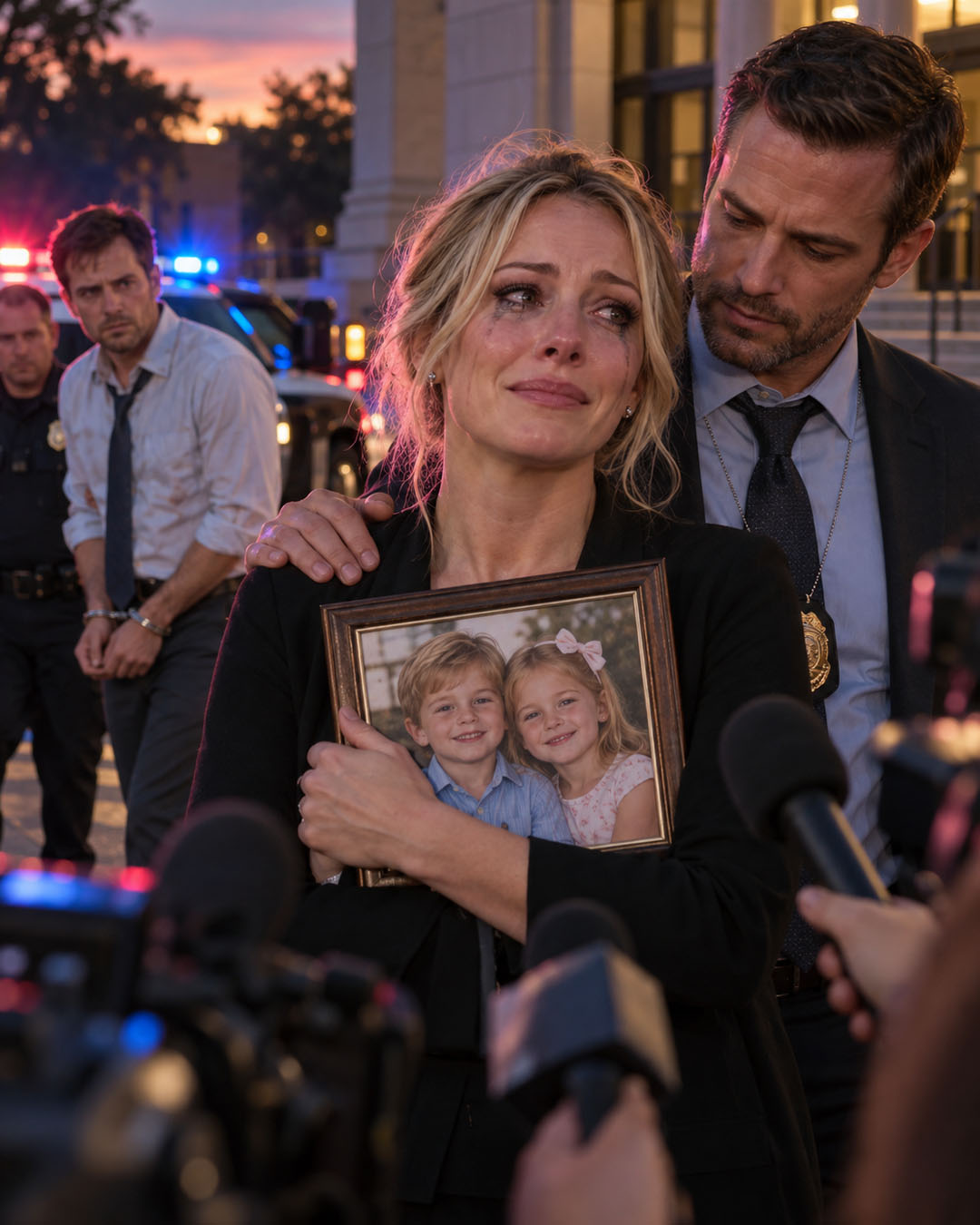
Brooke arrived at the courthouse wearing a plain navy dress. Her hair was pulled back, and she carried a photograph of our twins.
She looked like a grieving mother.
Greg Walsh entered separately, maintaining the appearance of a professional investigator.
But I knew what the garage camera had recorded.
I also knew something Brooke didn’t.
The evidence against her was no longer just my word against hers.
The prosecution opened by describing me as an intelligent engineer who’d used his expertise to arrange a deadly crash. They pointed to the damaged brake system, questionable financial documents, and searches about vehicle failures found on my computer.
Flynn listened carefully.
When his turn came, he stood before the jury.
“This case is about deception,” he said. “The state believes the defendant planned a crime because the evidence appears to point toward him. But the evidence has a history, and that history matters.”
Over the following days, Flynn challenged the assumptions behind the prosecution’s case.
He showed that my fingerprints were consistent with ordinary vehicle maintenance. He demonstrated serious discrepancies in the financial documents. Digital specialists explained why the computer search records could not reliably establish that I’d conducted those searches.
Then Brooke took the witness stand.
Under questioning, she described our marriage as increasingly strained.
“Russell became obsessed with money,” she testified. “I started to feel afraid of him.”
Flynn approached calmly.
“Mrs. Thornfield, did you know Detective Greg Walsh before your automobile accident?”
“No.”
“Not socially?”
“No.”
“Not through your charity work?”
Brooke hesitated.
“I might have met him at an event, but I don’t remember.”
Flynn presented the photograph from the police gala.
“Is this you standing beside Detective Walsh two years before the crash?”
Brooke stared at it.
“Yes, apparently.”
“Do you remember him now?”
“I meet hundreds of people.”
Flynn moved on.
“Are you familiar with a lakefront property in the Catskill Mountains?”
“No.”
“Have you ever used the name Ben Thomas in connection with financial transactions?”
Her face lost some color.
“I don’t know what you’re implying.”
“I’m asking whether you transferred money into an account associated with that name.”
Brooke looked toward the prosecutor.
The judge instructed her to answer.
“I handled some household investments,” she admitted.
“Did those investments include a house your husband knew nothing about?”
She remained silent.
The courtroom stirred.
Then Flynn introduced the preserved garage footage, which had been authenticated and admitted after extensive legal arguments.
The jurors watched Brooke enter the garage at two in the morning.
They watched her kiss Walsh.
And they watched Walsh open the hood of my car.
For the first time, Brooke’s expression completely collapsed.
She looked toward Walsh, but he wouldn’t meet her eyes.
Dr. Winters testified about the vehicle evidence, explaining its connection to the tools and materials uncovered during the independent investigation. Tony Valdez described Walsh’s unusual request at his repair shop.
Mitchell’s cooperation provided further evidence concerning access to restricted materials and manipulated records.
But the final witness was a man nobody in my family had ever met.
His name was Carlos Mendoza, a maintenance supervisor who worked near the road where Brooke crashed.
Carlos testified that he’d seen a woman and man studying the safety barrier that morning, more than an hour before the accident.
“I was checking drainage problems along the road,” he explained. “I remember thinking they were looking at the barrier like they were planning some construction work.”
Flynn showed him photographs.
“Can you identify them?”
Carlos pointed toward Brooke and Walsh.
“Those two.”
The room fell silent.
Carlos then explained that he enjoyed amateur landscape photography. He’d taken several photographs of the roadway that morning, and the two figures were visible in the background.
The images had been preserved on his camera.
They showed Brooke and Walsh near the exact location of the later crash.
Carlos testified that he’d mentioned the sighting to police at the scene, but the information never appeared in the official reports.
The first responding patrol officer, Tyler Jenkins, also testified.
He explained that Walsh had unusually directed him to patrol that road before the crash and had arrived at the scene despite not being dispatched through the normal process.
Jenkins had become suspicious after reviewing the records.
“I became a police officer to protect people,” he said. “I couldn’t ignore what I found.”
As the evidence accumulated, the prosecution’s original theory began to collapse.
During a recess, Flynn approached me.
“The district attorney is reviewing the case with investigators from outside Walsh’s department.”
I stared across the courtroom at Brooke.
“Will they finally believe me?”
Flynn put a hand on my shoulder.
“They’re going to have to follow the evidence, Russell. And the evidence isn’t pointing at you.”
The trial ended several days later.
When the jury returned, I stood beside Flynn, my heart pounding so hard I could hear it.
The foreperson unfolded the verdict.
“On the charge of attempted murder, we find the defendant not guilty.”
For several seconds, I couldn’t move.
Then Melody began crying behind me.
Flynn squeezed my shoulder.
I closed my eyes.
I thought of Aiden and Sophia, wondering whether they still remembered our bedtime stories or the pancakes I used to make on Saturday mornings.
I didn’t feel victorious.
I felt exhausted.
The court released me from the restrictions that had kept me away from my children. Separate investigations into Brooke, Walsh, and Mitchell continued, supported by evidence uncovered during my defense.
Walsh was suspended and later arrested.
Brooke faced charges connected to the staged crash, conspiracy, fraud, and endangering our children.
When reporters surrounded me outside the courthouse, one woman shouted, “Mr. Thornfield, what do you want to say to your wife?”
I stopped.
For months, I’d imagined confronting Brooke and demanding to know how she could risk our children’s lives.
But standing there, I realized I didn’t need another answer from her.
“I have nothing to say to Brooke,” I replied. “My responsibility now is to help my children heal.”
Then I walked away.
Chapter 4
Six months later, I stood on the back porch of a modest house overlooking a quiet California neighborhood.
Aiden and Sophia were playing beneath an old oak tree, laughing as they chased our golden retriever through the grass.
Both children still attended counseling.
They sometimes had nightmares about the crash, and Sophia became frightened whenever a car stopped suddenly. Aiden occasionally asked why his mother had done what she did.
I never lied to them.
But I also refused to burden them with details they were too young to understand.
“Your mother made some very serious choices,” I told them. “Those choices hurt people, and she has to answer for them. But none of it was your fault.”
Eventually, Brooke accepted a plea agreement carrying a lengthy prison sentence. Walsh was convicted in a separate proceeding, while Mitchell received a reduced sentence after cooperating with investigators.
The family court awarded me sole custody of the twins, with strict protections governing any future contact with Brooke.
My company survived the scandal.
With help from my management team, we restored damaged client relationships and strengthened our security systems. Several years later, Thornfield Precision Engineering expanded into new aerospace markets.
The money mattered because it allowed me to provide for my children.
But it wasn’t what made me feel whole again.
That came slowly, through ordinary moments.
Helping Sophia learn to ride a bicycle. Building a model airplane with Aiden. Sitting beside them at school concerts, where they searched the audience until they found my face.
Fifteen years passed.
My hair turned gray at the temples, and the twins grew into thoughtful, independent young adults.
Aiden followed me into engineering, while Sophia pursued psychology, hoping to help families affected by betrayal and trauma.
My sister Melody remained close to us. Flynn eventually became a family friend, and Dr. Winters continued her work developing better forensic methods.
The investigation into Walsh’s conduct also prompted reviews of other convictions connected to him. Several serious errors and instances of corruption were eventually uncovered.
I was grateful for the people who’d refused to accept appearances as truth.
When the twins were twenty-one, Brooke became eligible for release.
She sent them each a letter.
Aiden came to my office one afternoon carrying his unopened envelope.
“Dad, she wants to see me.”
I set aside the engineering plans on my desk.
“How do you feel about that?”
He looked uncertain.
“Part of me wants to know why she did it. Another part doesn’t want to hear another excuse.”
“You don’t have to decide today.”
“Sophia says she won’t see her.”
“That’s her choice.”
He sat across from me.
“Would you be angry if I met Mom?”
I shook my head.
“No, son. You have a right to decide what relationship, if any, you want with her.”
He studied me for a moment.
“After everything she did to you?”
“Your mother hurt me deeply. But you don’t owe me loyalty by denying yourself the chance to find answers.”
Several weeks later, both twins visited Brooke in a supervised setting. Sophia went to support her brother but chose not to pursue a relationship.
That evening, they came to my house.
I made tea while they sat at the kitchen island, looking unusually tired.
“How was it?” I asked.
Aiden wrapped both hands around his mug.
“Strange. She looks so different from the photographs.”
Sophia nodded.
“She tried explaining what happened. She talked about feeling trapped, being unhappy, and letting Walsh influence her.”
I waited.
“Did it help?”
Aiden thought carefully.
“I don’t think there’s an explanation that makes it okay. But seeing her helped me understand that she’s just a person who made terrible choices.”
Sophia looked at me.
“She asked whether you were happy.”
“What did you say?”
“I told her you built a good life. That you raised us, loved us, and never made us feel like we were responsible for what happened.”
My throat tightened.
Aiden smiled.
“I also told her your happiness isn’t something she gets to decide anymore.”
I reached across the counter and held their hands.
For fifteen years, I’d worried that the crash would define their childhoods. I’d feared they’d grow up believing love was dangerous and trust was foolish.
But sitting across from them, I saw two adults who understood compassion without surrendering their judgment.
That evening, after they left, I walked onto my terrace.
The sun was setting over the hills, and the garden smelled of jasmine. I thought about the frightened man I’d been in that detention center, watching his wife accuse him of trying to murder his family.
Back then, I’d believed that proving my innocence would make everything right again.
I understood now that justice and healing were different things.
Justice had cleared my name and held the people responsible accountable.
Healing had required years of patience, difficult conversations, and the decision not to let betrayal become the center of my life.
My phone rang.
It was Melody.
“Just checking on you,” she said. “Aiden told me they saw Brooke today.”
“They did.”
“How are you holding up?”
I looked through the window at the family photographs lining the living room wall.
There was Aiden receiving his college diploma. Sophia standing proudly beside her first published research project. Melody laughing with the twins at Thanksgiving.
And in the center sat a photograph taken on the day the children and I moved into this house.
We were standing beneath the oak tree, holding hands.
“I think I’m finally at peace,” I told her.
Melody was quiet for a moment.
“You deserve that, Russ.”
After we hung up, I remained outside, listening to the evening breeze.
Brooke had tried to destroy my freedom, my reputation, and my relationship with our children. She’d believed that if she controlled the story, she could control what happened to us.
But she’d been wrong.
The truth had survived her lies.
More importantly, our children had survived the harm she caused and grown into people capable of making their own choices.
I couldn’t change what happened that terrible morning. I couldn’t give them back the innocence they’d lost or erase the nights they cried themselves to sleep.
But I could choose what we built afterward.
And that, after everything, was the greatest victory of my life.
Not revenge. Not wealth. Not even the verdict that restored my freedom.
It was the simple knowledge that the two children I’d once feared losing still called me Dad, still trusted me, and still knew they were loved.
Brooke had written a terrible chapter in our family’s history.
But she didn’t get to write the ending.
THE END.
⚠️All characters and events are fictional. Do not imitate or apply them in real life. 😌😌😌

