
Chapter 2
The following Monday, I returned to school with three dollars and an empty stomach.
My best friend, Chelsea Sanders, noticed immediately.
“Did your parents give you another losing week?”
I nodded.
“How much?”
“Three dollars.”
Chelsea looked horrified.
“That’s not even enough for two decent lunches.”
I shrugged, pretending it didn’t matter.
She offered to share her food, but I refused.
I’d become very good at refusing kindness because I was terrified of becoming a burden.
That evening, Elena posted photographs from a birthday celebration with her friends.
There was pizza, cake, iced coffee, and enough food to feed a classroom.
Her caption read, “Another lucky week! Some people are just blessed.”
The next afternoon, I bought two granola bars from a vending machine. I planned to save one for dinner.
On my way to gym class, I passed Elena outside the cafeteria.
She was throwing away a nearly full coffee drink.
“Too sweet,” she complained to her friends.
Then she spotted me.
“Nina! Wait!”
She hurried over carrying a paper bag.
“Here. I couldn’t finish my birthday cake. You can have what’s left.”
Inside was a crushed piece of cake with melting frosting.
I thanked her automatically.
Then I carried it to a bench and left it there.
I was hungry enough to feel sick, but I couldn’t bear the thought of eating my sister’s discarded dessert.
During gym class, everything began spinning.
The whistle sounded far away.
I remember trying to reach the edge of the track.
Then my knees buckled.
When I opened my eyes, I was lying in the school nurse’s office.
Chelsea sat beside me, holding a paper cup of sweetened juice.
The nurse, Mrs. Harrison, checked my pulse.
“Your blood sugar was dangerously low, sweetheart. Have you been eating regularly?”
I looked away.
She sat beside the bed.
“Nina, I’m not here to scold you. I’m worried about you.”
Something in her voice nearly made me cry.
The school called my parents.
Mom answered on speakerphone.
“Is there a medical bill?” she asked immediately.
Mrs. Harrison explained that I needed proper meals and that repeated episodes of faintness could become serious.
Mom laughed dismissively.
“She’s always been dramatic. She receives the same allowance as her sister. Elena manages perfectly well.”
I sat up.
“No, we don’t.”
The room went silent.
I looked at the telephone.
“Elena received a hundred dollars this week. I received three.”
Mom’s voice turned sharp.
“Nina, stop discussing our private family arrangements with strangers.”
Mrs. Harrison frowned.
“Mrs. Carter, your daughter needs reliable access to food. This is not a matter of managing spending money.”
Mom said she would deal with me at home.
Then she hung up.
Mrs. Harrison brought me crackers and another cup of juice.
When I asked how much I owed, her expression softened.
“You don’t owe me anything.”
I cried then.
Not because she’d given me food.
Because she’d given it without making me prove I deserved it.
The school counselor, Ms. Bennett, met with me that afternoon. She helped arrange meals through the school and explained that the adults responsible for my care couldn’t simply dismiss my basic needs as a lesson in thrift.
For the first time, someone outside my family knew what was happening.
But my parents were furious.
That Friday, Dad ordered me into the living room.
“Your teacher called again,” he said. “Apparently you’ve convinced everyone we’re starving you.”
“I told them what happened.”
Mom crossed her arms.
“We’re teaching you how to survive difficult circumstances.”
“Then why doesn’t Elena have to survive them?”
Dad stared at me.
Mom answered.
“Elena is sensitive. She’s had health problems since she was little. You know she doesn’t handle disappointment well.”
I couldn’t believe what I was hearing.
“So you make sure she wins because you don’t want her to feel sad?”
“You’re stronger,” Mom said.
I looked at her.
“You’d rather I go hungry than let Elena lose a pretend lottery ticket?”
Mom reached into her purse and pulled out twenty dollars.
“Here. Take this and stop embarrassing us.”
I didn’t touch it.
“I need a fair, dependable arrangement. Not money because the school called.”
Dad’s face darkened.
“Then earn your own money. Maybe you’ll finally appreciate what things cost.”
His words stayed with me.
By the following week, I’d begun tutoring classmates after school.
I was good at math and English, and I knew how to explain difficult assignments without making people feel foolish.
At first, I earned five dollars helping a freshman prepare for an algebra test.
Then another student asked for essay guidance.
Soon I was making study guides and running small review sessions.
Chelsea helped me organize appointments.
Within a month, I’d earned $350.
The first time I bought a hot lunch with money I’d earned myself, I sat staring at the tray.
A hamburger.
An apple.
A carton of milk.
Nothing extravagant.
But I could eat everything without wondering whether I’d have enough left for tomorrow.
Chelsea smiled across the table.
“You okay?”
I nodded, blinking back tears.
“I forgot what it felt like to eat lunch without worrying.”
She reached across the table and squeezed my hand.
With Ms. Bennett’s guidance, I opened a youth savings account through a local credit union.
I set aside money for school expenses and carefully saved what remained.
For the next several weeks, my parents seemed pleased that I’d stopped asking for additional allowance.
Then Elena told Mom about my tutoring work.
That Friday, Mom held out her hand as soon as I entered the house.
“Give me the money you’ve earned.”
I stared at her.
“What?”
“You live under our roof. If you’re making money, you can contribute.”
Dad announced that I would begin paying a hundred dollars a month in rent.
I was seventeen.
They were still responsible for my basic care.
When I pointed that out, Dad stood so abruptly that his chair scraped across the floor.
“Don’t lecture me about responsibility!”
Mom pointed toward my bedroom.
“If you refuse to cooperate, we’ll take away your desk and your privacy. Let’s see how much tutoring you can do then.”
I walked to my room without answering.
Inside, I sat on the edge of my bed, shaking.
Then I picked up my phone and contacted Ms. Bennett.
This time, I didn’t minimize what was happening.
I told her everything.
The next morning, she helped me begin arranging a safer living situation with my aunt Clara, who’d always been kind to me.
It wasn’t an instant escape. There were conversations, formal arrangements, and difficult weeks ahead.
But for the first time, I could see a road leading out of that house.
Meanwhile, my parents became increasingly worried about Elena’s grades.
She had two D’s and an F in chemistry.
Dad immediately ordered me to complete her assignments.
“You’re good at school,” he said. “Help your sister.”
“I’ll explain her homework if she wants to learn,” I answered. “But I won’t do it for her.”
Mom looked outraged.
“You’ve become selfish since you started earning money.”
I thought about the countless nights I’d studied while hungry.
“No,” I said. “I’ve started understanding the difference between helping someone and being used.”
Dad raised his hand in anger, then stopped.
I backed toward the hallway and went directly to my room.
The next day, I told Ms. Bennett what had happened.
Soon afterward, I moved into Aunt Clara’s spare bedroom.
She didn’t ask me to scratch a ticket.
She didn’t ask me to earn my dinner.
She simply put fresh sheets on the bed and said, “You can rest here, sweetheart.”
That night, I slept almost twelve hours.
Chapter 3
For the next several months, my life changed in ways I could hardly believe.
Aunt Clara was my mother’s older sister, a retired elementary school teacher with silver hair and a habit of humming while she cooked.
She lived alone in a little brick house fifteen minutes from my high school.
Every morning, she made oatmeal or scrambled eggs before I left.
At first, I kept asking what I could do to repay her.
One Saturday, she sat beside me at the kitchen table.
“Nina, helping around the house is fine. But you don’t have to earn your place here.”
I stared into my cup of tea.
“Mom always said I should be grateful for whatever I got.”
Clara sighed.
“Gratitude is a lovely thing. But nobody should have to be grateful for being fed.”
I never forgot that sentence.
With steady meals and a peaceful place to study, my grades improved even further.
Chelsea and I expanded our tutoring sessions, and I continued saving money.
By spring, I’d built a modest emergency fund.
I also applied to several universities and every scholarship program I qualified for.
I didn’t tell my parents.
They had made it clear that my education was my responsibility.
For once, I accepted that without argument.
Elena’s situation was different.
My parents hired private tutors and paid for additional classes, but her grades remained inconsistent.
She disliked studying and had grown accustomed to blaming teachers whenever something went wrong.
Eventually, she received an offer from an expensive private college with relatively flexible admissions standards.
Mom and Dad were delighted.
They planned a large family celebration, complete with decorations and a catered dinner.
Aunt Clara received an invitation.
To my surprise, so did I.
“You don’t have to go,” Clara told me.
“I know.”
I looked at the envelope.
“But I think I’d like to.”
By then, I’d received several college acceptance letters, though I was still waiting to hear about my most important scholarship application.
The afternoon of Elena’s party, Mom’s house was filled with relatives and neighbors.
Pink balloons covered the staircase.
A banner above the fireplace read, “CONGRATULATIONS, ELENA!”
My sister stood in the middle of the living room wearing a new dress.
Mom told everyone how proud she was.
“Elena has always been special,” she announced. “Good things seem to happen wherever she goes.”
Then Aunt Clara asked a question.
“What about Nina? Has she decided where she’s going?”
Mom gave a dismissive laugh.
“Oh, she’s figuring things out. You know Nina. Very independent, but a little too stubborn for her own good.”
Dad nodded.
“We’ve told her community college would be a sensible option. She needs to learn the value of hard work.”
I stood near the doorway, listening.
Clara put a reassuring hand on my shoulder.
Then my phone buzzed.
It was an email from a university in Chicago where I’d applied to study computer science.
My scholarship decision was available.
I opened the message.
I read the first line.
Then the second.
My knees nearly gave way.
I had received a full scholarship covering tuition, housing, meals, and academic expenses, along with an additional stipend for books.
I read the message three times.
Chelsea had helped me prepare the application essays. Aunt Clara had driven me to an interview, and my teachers had written thoughtful recommendations.
But the years of studying belonged to me.
Every hungry afternoon.
Every borrowed textbook.
Every night spent working toward a future I could barely imagine.
I looked at Clara.
She read the screen, gasped, and wrapped her arms around me.
“Oh, Nina,” she whispered. “You did it.”
Our embrace attracted attention.
Uncle Robert approached.
“What’s the good news?”
Clara was crying.
“Nina’s been awarded a full university scholarship.”
The room fell quiet.
“What?” Mom asked.
I showed Uncle Robert the message.
He read it aloud, his voice rising with excitement.
Several relatives began congratulating me.
Dad looked stunned.
Mom hurried forward wearing a smile I recognized immediately.
“Well, of course!” she said. “We always knew Nina was brilliant. That’s why we pushed her to become independent.”
She reached to hug me.
I stepped back.
“Mom, please don’t.”
Her smile tightened.
“Nina, not now.”
I looked around the room.
For years, I’d been afraid of embarrassing my parents.
But silence had allowed them to tell everyone that their treatment of me was fair.
I took a slow breath.
“I earned this scholarship because I worked hard,” I said. “And because some people finally helped me when I needed it.”
Mom frowned.
“What are you implying?”
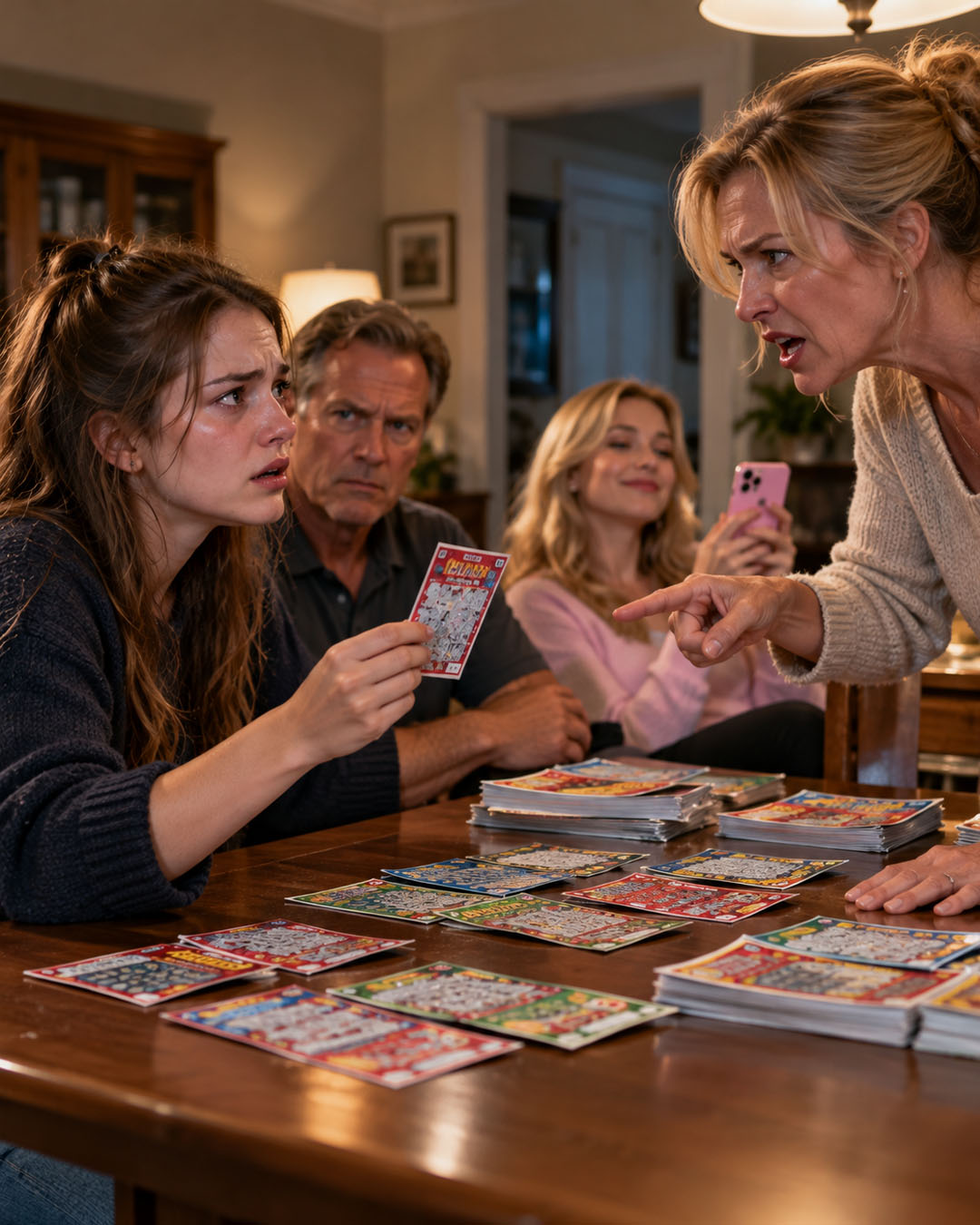
“I’m saying you and Dad gave Elena pretend winning lottery tickets every week while making sure mine lost.”
Several people stared.
Dad’s face reddened.
“That’s enough.”
“No,” Aunt Clara said firmly. “Let her finish.”
I explained how the tickets worked.
How I’d discovered they were custom printed.
How Elena received enough money for restaurants and clothes while I sometimes had only three dollars for food.
I told them about fainting during gym class.
And about the nurse who’d given me crackers when I couldn’t afford lunch.
Mom shook her head.
“We were trying to teach her resilience.”
Uncle Robert looked appalled.
“Margaret, the child was going hungry.”
“She exaggerates!”
Mrs. Harrison and Ms. Bennett had already documented the concerns, and Aunt Clara knew the circumstances of my move.
I didn’t need to argue about every detail.
I simply looked at my parents.
“You told me the game was fair. You knew it wasn’t.”
Elena began crying.
“You’re ruining my celebration!”
I turned toward her.
“I’m not angry that you were given nice things, Elena. I’m angry that everyone expected me to suffer so you wouldn’t have to be disappointed.”
Mom tried to take my hand.
I stepped away again.
“I spent two years believing something was wrong with me because I never won. But there was never anything wrong with my luck.”
The silence felt enormous.
Then I said the words I’d needed to say for so long.
“You weren’t teaching me how to survive. You were teaching me that my needs didn’t matter.”
I left with Aunt Clara.
Outside, the sun was shining.
She opened the passenger door of her car, then paused.
“How do you feel?”
I looked back at the house.
For once, I didn’t feel frightened.
“Free,” I said.
Chapter 4
Five years passed.
I graduated from college with honors and accepted a position as a software engineer at a respected technology company in Chicago.
The starting salary was more money than I’d once believed I would earn in a lifetime.
I rented a bright apartment with tall windows, bought a reliable used car, and continued putting money aside.
Chelsea became my roommate for a while before moving into her own place.
Aunt Clara visited every few months.
We spent weekends exploring museums, walking along Lake Michigan, and cooking the recipes she’d taught me.
I paid off the few expenses my scholarship hadn’t covered and established a comfortable emergency fund.
Most importantly, I no longer worried about my next meal.
That was a luxury I’d never take for granted.
I maintained limited contact with my parents through occasional updates from Clara.
Their circumstances had changed.
Elena completed her private college degree after switching majors several times.
But years of careless spending had caught up with her.
She’d accumulated substantial credit card debt on top of the money my parents had spent on her education.
Dad suffered a mild stroke and had to retire earlier than planned.
Mom took a part-time job to supplement their reduced income.
I felt sad hearing about their difficulties.
But I didn’t contact them.
I’d learned that compassion didn’t require returning to a situation that had hurt me.
One rainy October evening, I was sitting in a downtown coffee shop reviewing a work presentation.
The door opened, and a woman carrying a worn umbrella stepped inside.
I barely looked up.
Then I heard my name.
“Nina?”
I raised my eyes.
Elena stood beside my table.
She looked older than twenty-two. There were shadows beneath her eyes, and her coat was damp from the rain.
For several seconds, neither of us spoke.
Then she pulled out a chair.
“I can’t believe it’s you.”
“Hello, Elena.”
She glanced at my laptop and the work papers spread across the table.
“I heard you got some big job in technology.”
“I’m doing well.”
Her eyes filled with tears.
“Mom and Dad have been looking for you. Dad’s health isn’t good. Mom works all the time, and I’m drowning in debt.”
“I’m sorry to hear that.”
She leaned forward.
“I need help, Nina.”
I waited.
“I owe more than eighty thousand dollars. I have interviews, but nobody wants to pay enough. If you could just give me fifty thousand, I could get everything under control.”
I stared at her.
Fifty thousand dollars.
She said it almost as casually as Mom used to announce her weekly hundred-dollar prizes.
“That’s a lot of money,” I replied.
“You make six figures. Everybody knows.”
“That doesn’t mean I have fifty thousand dollars available to give away.”
Her expression changed.
“Seriously? After everything?”
“Everything?”
“We’re sisters! Mom and Dad raised you. You have a responsibility to help us.”
I felt an old ache in my chest.
For a moment, I was seventeen again, standing in the kitchen with three dollars while my sister counted her winnings.
Then I remembered the life I’d built since leaving.
“I’ll help you find a nonprofit credit counselor,” I said. “They can explain options for dealing with the debt. But I’m not paying it for you.”
Elena stared at me.
“You’re really going to let me struggle?”
I looked out at the rain sliding down the windows.
“Do you remember those lottery tickets?”
She frowned.
“What about them?”
“Do you remember how you always won?”
“That was years ago.”
“Did you know they were fake?”
She looked down.
After a long silence, she nodded.
“Mom told me eventually.”
I felt the answer settle heavily inside me.
“Did you know mine were designed to lose?”
Elena didn’t answer.
“Did you know I was going hungry?”
She began twisting the strap of her handbag.
“I knew you didn’t get as much.”
“And you never said anything.”
She looked up sharply.
“What was I supposed to do? Refuse the money? It wasn’t my fault Mom and Dad liked giving me things.”
“No,” I said. “It wasn’t your fault that they favored you. But you had choices about how you treated me.”
Her eyes filled again.
“You’re making me sound terrible.”
“I’m telling you what I remember.”
I reached into my purse.
For years, I’d carried one of the fake tickets in a small envelope.
I hadn’t kept it as a weapon.
I’d kept it because, during my hardest days, it reminded me that my failures had once been arranged for me.
I placed the ticket on the table.
Elena recognized it immediately.
“Why do you still have that?”
“Because it taught me something important.”
I pushed it toward her.
“Scratch it.”
She hesitated.
“Why?”
“Just look at it.”
She picked up a coin from her purse and scraped away the silver coating.
The first space revealed nothing.
So did the second.
The third showed a losing message.
When she’d finished, the total was zero.
She stared at the card.
“Of course it’s a loser.”
“Yes,” I said. “It came from my stack.”
For a long time, neither of us spoke.
Finally, Elena looked up.
“I never thought about what it felt like for you.”
I studied her face.
For once, she didn’t look angry or indignant.
She looked ashamed.
“Every Sunday,” I said quietly, “I sat beside you and wondered why I couldn’t be lucky like you. I thought I must be doing something wrong.”
My throat tightened.
“But I was never supposed to win.”
Elena wiped her eyes.
“I’m sorry, Nina.”
I didn’t answer immediately.
I’d waited years to hear those words.
Now that they had come, I understood that an apology couldn’t return the childhood I’d lost.
But it could mark the beginning of understanding.
“I hope you mean that,” I said.
“I do.”
She looked at the scratched card.
“Can we ever be sisters again?”
I thought about Aunt Clara.
About Chelsea.
About the teachers who’d helped me when I was frightened and hungry.
They’d shown me what genuine care looked like.
“Maybe someday,” I said. “But we can’t go back to pretending nothing happened.”
Elena nodded slowly.
I wrote down the name of a reputable credit counseling organization and slid the paper across the table.
“This is a place to start. You have to do the work yourself.”
She folded the paper carefully.
“Thank you.”
When she stood to leave, she glanced at the old ticket one last time.
“Can I keep that?”
I considered her request.
Then I nodded.
“Yes.”
She slipped it into her handbag.
As she walked toward the door, I noticed that she was crying again.
But I didn’t chase after her.
I didn’t offer money to stop her sadness.
And I didn’t apologize for refusing.
Several months later, Elena sent me a short letter.
She had found steady work and entered a structured repayment plan.
It would take years to clear her debts, but she was finally making progress.
She also wrote that she’d stopped asking Mom and Dad to solve every problem for her.
At the bottom of the page, she’d added a sentence.
“I understand now that you weren’t unlucky. We were unfair to you.”
I read those words twice.
Then I put the letter in my desk drawer.
I wasn’t ready for a close relationship, but I appreciated her effort to take responsibility.
That Thanksgiving, I traveled to Aunt Clara’s house.
Chelsea joined us, along with two of Clara’s neighbors who had nowhere else to celebrate.
We cooked turkey, mashed potatoes, green beans, and pumpkin pie.
When everyone sat down, Clara asked each person to share something they were grateful for.
Chelsea thanked us for friendship.
One neighbor spoke about his grandchildren.
Clara smiled at me.
“And you, Nina?”
I looked around the table.
Five people who had come together because they wanted to be there.
No competition.
No favoritism.
No pretend games.
“I’m grateful,” I said, “that I finally know what fairness feels like.”
Clara reached for my hand.
After dinner, I helped her wash the dishes.
Through the kitchen window, I could see the first snowflakes drifting across the backyard.
I remembered being seventeen, standing in a convenience store with a worthless scratch-off ticket in my hand.
Back then, I’d thought that discovering the truth was the worst thing that could happen to me.
Now I understood it had been the beginning of my freedom.
My parents had tried to teach me that life was a game of chance, and that I should accept whatever I received without question.
But they had confused obedience with gratitude and suffering with strength.
Real strength hadn’t come from going hungry.
It had come from asking for help, working toward independence, and learning that love should never depend on winning a game someone else had rigged.
I had spent two years believing I was unlucky.
Five years later, I knew better.
I hadn’t needed a winning lottery ticket.
I’d needed someone to believe that I deserved a fair chance.
Eventually, I learned to become that person for myself.
And that was something nobody could ever take away.
THE END.
⚠️ All characters and events are fictional. Do not imitate or apply them in real life. 😌😌😌

