Chapter 2
On Wednesday afternoon, my grandmother’s attorney came to the hospital.
Jacinda Ramsdell was a composed woman in a navy suit who carried a leather portfolio and spoke without wasting words.
She confirmed that Grandma had established an irrevocable trust before her death.
Grandpa was the trustee.
I was the sole beneficiary.
The money had originally come from the sale of Grandma’s share of an Iowa family farm. She had invested it carefully for decades.
The trust required that I complete my college degree.
Although I’d collapsed before receiving my diploma, the university had officially conferred my degree that Monday.
The condition was satisfied.
“Can my parents challenge it?” I asked.
“Anyone can file a lawsuit,” Jacinda replied. “That doesn’t mean they have a valid claim.”
“What if they say I’m too sick to manage the money?”
“Your medical condition doesn’t automatically give them control. And nobody can change the trust simply by pressuring you.”
I looked at Grandpa.
He seemed relieved to hear someone else say it.
Before leaving, Jacinda handed me two business cards.
“One is yours. The other is for anyone who wants to discuss the trust. Tell them to contact me in writing.”
I placed both cards on the tray table.
My parents arrived Thursday afternoon.
I heard Dad arguing with a nurse before I saw him.
He entered my room wearing the tan sport coat he’d worn in Paris. My mother followed, clutching her handbag.
For a moment, Dad looked genuinely shaken.
His eyes moved over my shaved scalp, the dressing near my temple, and my trembling hand.
“Does it hurt?” he asked.
“Some.”
He swallowed.
Then he pulled Grandpa’s chair closer and sat down.
“We need to talk about your grandmother’s money.”
I stared at him.
He had been in the room less than a minute.
Dad began explaining that Sasha’s engagement had been wonderful. Her fiancé, Laurent Aubichon, belonged to a respected family with homes in St. Louis and Paris.
The wedding would take place at a château outside Paris the following spring.
Laurent’s parents were paying for the ceremony.
Our family, Dad explained, had promised to cover the reception.
“How much?” I asked.
“Sixty thousand dollars.”
I looked at Mom.
She avoided my eyes.
“Bridget,” Dad continued, “your grandmother left you more than enough. We’re only asking for a reasonable contribution.”
“No.”
He blinked.
“What?”
“I’m not paying for Sasha’s wedding.”
His face reddened.
“After everything this family has done for you?”
“What exactly have you done?”
“Your grandparents sent thousands for your education, and you threw it away when you quit school. You owe this family something.”
Grandpa appeared in the doorway holding a sandwich.
He stopped.
I looked between the two men.
“What thousands?”
Dad’s expression changed.
Mom reached for his arm.
“Daryl, she’s tired. We should go.”
But I’d heard him clearly.
“Grandpa, did you send money for my tuition?”
Grandpa looked at Dad.
“Of course we did.”
Something cold settled inside me.
“I never received it.”
Nobody spoke.
Mom pulled Dad toward the door.
As they left, he pointed at me.
“Think about your sister for once. That’s all I’m asking.”
After they were gone, Grandpa sat down without touching his sandwich.
I didn’t question him further.
His heart had already endured too much.
Instead, I contacted the university’s bursar and requested my complete student account history.
Then I downloaded my federal student loan records.
If money had been sent for my education, I wanted to know where it had gone.
The following day, I was moved to inpatient rehabilitation.
My right leg wasn’t responding normally, and I needed help walking.
My physical therapist, Thomas, was a broad-shouldered man with a gentle manner. He strapped a safety belt around my waist and helped me travel twenty feet down the corridor.
It exhausted me.
The neurologist also explained that I couldn’t drive until I’d been seizure-free for six months.
That was devastating news.
I had accepted a job with an environmental consulting firm in St. Louis. It required driving to field sites several days a week.
I emailed the company and asked whether my start date could be postponed.
Then Sasha arrived.
She wore a beautiful silk scarf and brought me a tin of French butter cookies and a miniature Eiffel Tower that lit up when pressed.
She hugged me carefully.
“Oh, Bridget. Your hair.”
“It’ll grow.”
She smiled sympathetically.
Then she held out her left hand.
An enormous engagement ring glittered beneath the hospital lights.
“Laurent proposed on a bridge in Paris. His whole family was there. It was magical.”
I managed a smile.
“Congratulations.”
She sat beside me.
“Listen, there’s something awkward I need to ask.”
I already knew what was coming.
“Laurent’s family attorney is preparing our prenuptial agreement. Mom says Grandma loved us equally, so I should probably list half the trust as an expected inheritance.”
I looked at my sister.
“Grandma left the trust to me.”
Sasha’s smile tightened.
“But half would be fair.”
“That’s something you should discuss with the attorney.”
I handed her Jacinda’s card.
She slipped it into her purse.
Before leaving, she casually mentioned that Dad had somehow found the money to send her to Paris for a study-abroad semester in 2017.
I remembered that year very well.
I was working overnight shifts at a warehouse, trying to pay old tuition debt.
The thought stayed with me long after Sasha left.
On Monday, the bursar’s report arrived.
It listed every payment made toward my education.
Federal grants.
Student loans.
My own earnings.
And a column labeled third-party payments.
For every semester I’d attended, the column showed the same amount.
$0.00.
I printed the pages and placed them in a blue folder.
That afternoon, Grandpa brought a small cedar box from the farmhouse.
Inside were fourteen letters.
He explained that Grandma had received them while living in Tucson.
“They were from you,” he said. “She read them over and over.”
I opened one.
It described a geology field trip in October 2017 and a stubborn mule that refused to cross a creek.
I had never taken that field trip.
There had never been a mule.
In October 2017, I was loading pallets at four in the morning.
The letters were signed in blue ink.
Love, Bridget.
But I recognized the handwriting.
My mother had written them.
I closed the box.
My family hadn’t merely kept money from me.
Someone had spent years convincing my grandmother that I was living a completely different life.
Chapter 3
The next afternoon, Dad arrived with a notary and two documents.
One would give him financial power of attorney.
The other would direct my grandmother’s trust payments into an account he controlled during my recovery.
“It’s temporary,” he assured me. “You’ve got medical bills. You can’t even drive. Let your father help.”
The notary asked whether I understood what I was signing.
“Yes,” I said. “And I don’t consent.”
She immediately closed her pen.
Dad’s face darkened.
“She’s recovering from brain surgery. She’s confused.”
A nurse appeared in the doorway.
“Mr. Matson, your daughter has asked you to stop.”
“It’s family business.”
“Then you can discuss it after she’s recovered. Right now, you need to leave.”
Grandpa arrived as Dad raised his voice.
He heard his son accuse Grandma of hiding money and manipulating the family for decades.
Then Dad pointed toward my bed.
“And now she’s doing exactly the same thing!”
Grandpa reached for the doorframe.
His knees buckled.
The nurse caught him before he fell.
Medical staff rushed him into an adjoining room. His pacemaker was functioning, but his blood pressure had dropped dangerously.
I lay helpless in bed, unable to walk to him.
Dad left without checking on his father.
That night, Grandpa returned in a wheelchair.
We held hands for a long time.
“I’m sorry I raised him,” he whispered.
“You raised a little boy, Grandpa. He’s responsible for the man he became.”
Grandpa squeezed my hand.
There was nothing else either of us could say.
Two days later, I asked Jacinda to arrange a meeting with the entire family.
Dad immediately assumed I had surrendered.
“Smart girl,” he said when I told him I’d consider signing whatever Jacinda recommended.
I didn’t correct him.
I simply insisted that everyone be present, including Grandpa and the attorney.
We scheduled the meeting for June 3.
Meanwhile, Sasha’s wedding arrangements continued.
Her fiancé’s family had received Jacinda’s written confirmation that Sasha was not a beneficiary of the trust.
Instead of reconsidering the reception, my parents signed a château contract with a nonrefundable deposit of $38,400.
Mom posted photographs online, announcing that our family had never been closer.
I was learning to climb four stairs with a physical therapist.
A week later, Dad sent Jacinda a formal letter demanding that half the trust be reserved for Sasha.
He repeated his claim that every dollar Grandpa had provided for my education had gone toward tuition.
He accused me of manipulating my dying grandmother.
When Jacinda refused his demand, he hired an attorney and filed a petition asking the court to remove Grandpa as trustee and freeze the distribution.
The petition contained a sworn statement repeating the tuition accusation.
I printed it and added it to the blue folder.
By then, I understood something important.
Dad wasn’t merely telling a family story.
He was putting that story into legal documents.
And documents could be checked.
On May 29, Grandpa was formally served with the lawsuit at his farmhouse.
His own son was suing him.
He brought the papers to my hospital room and sat staring at them.
“I thought I knew my boy,” he said.
I touched his arm.
“We’ll handle it.”
He looked toward his jacket.
The old envelope was still there.
A few days later, I suffered another seizure during physical therapy.
My neurologist adjusted my medication and explained that my driving restriction would restart from that date.
The consulting firm withdrew its job offer because the position required regular travel.
I tried to remain calm until the doctor left.
Then I cried into my pillow.
I had worked so hard for that degree.
Now I had a brain injury, no job, and a family fighting over money that was supposed to help me rebuild my life.
That afternoon, Grandpa sat beside me.
He told me a story about Dad at fourteen.
Grandma had been his earth science teacher.
One day, Dad proudly brought home a test he’d scored 94 on.
Grandma circled the six points he’d missed and spent the evening explaining his mistakes.
“She thought she was helping him improve,” Grandpa said. “But she never told him he’d done well.”
He looked ashamed.
“I should have said something. I was always working. I let her handle everything.”
I thought about the man my father had become.
I could understand how a boy might grow bitter after years of criticism.
But understanding the wound didn’t excuse what he’d done to me.
Grandpa seemed to read my expression.
“It doesn’t make any of this right,” he said.
On Tuesday, the day before our meeting, Dad visited the farmhouse while Grandpa was at the hospital.
A neighbor saw him leaving with a cardboard box containing Grandma’s desk lamp and several files.
When Grandpa returned home, he found her desk drawers open and her papers disturbed.
Dad had searched her belongings.
He was looking for something.
But the thing he wanted was still inside Grandpa’s jacket.
That evening, Sasha visited me alone.
Her engagement was beginning to unravel.
Laurent’s father had discovered the lawsuit against Grandpa and refused to become financially involved in the château contract.
Sasha sat on the edge of my bed, looking exhausted.
“Laurent keeps asking who paid for my semester in Paris,” she said.
“What do you tell him?”
“That Dad paid.”
“Did you ever ask where he got the money?”
She shook her head.
“In our family, you don’t ask where money comes from. You say thank you.”
Then she began crying.
She told me Mom had weighed her every morning during her childhood dance years and recorded the numbers on a kitchen calendar.
“She always said one of us would marry well and prove Grandma wrong. I knew she meant me.”
For a moment, I saw my sister differently.
She had spent her life trying to become the daughter our mother wanted.
I had spent mine trying to become someone our mother would notice.
Neither of us had been allowed to be ourselves.
“There’s still time to tell Laurent the truth,” I said.
She shook her head.
“Just sign tomorrow, Bridget. Please.”
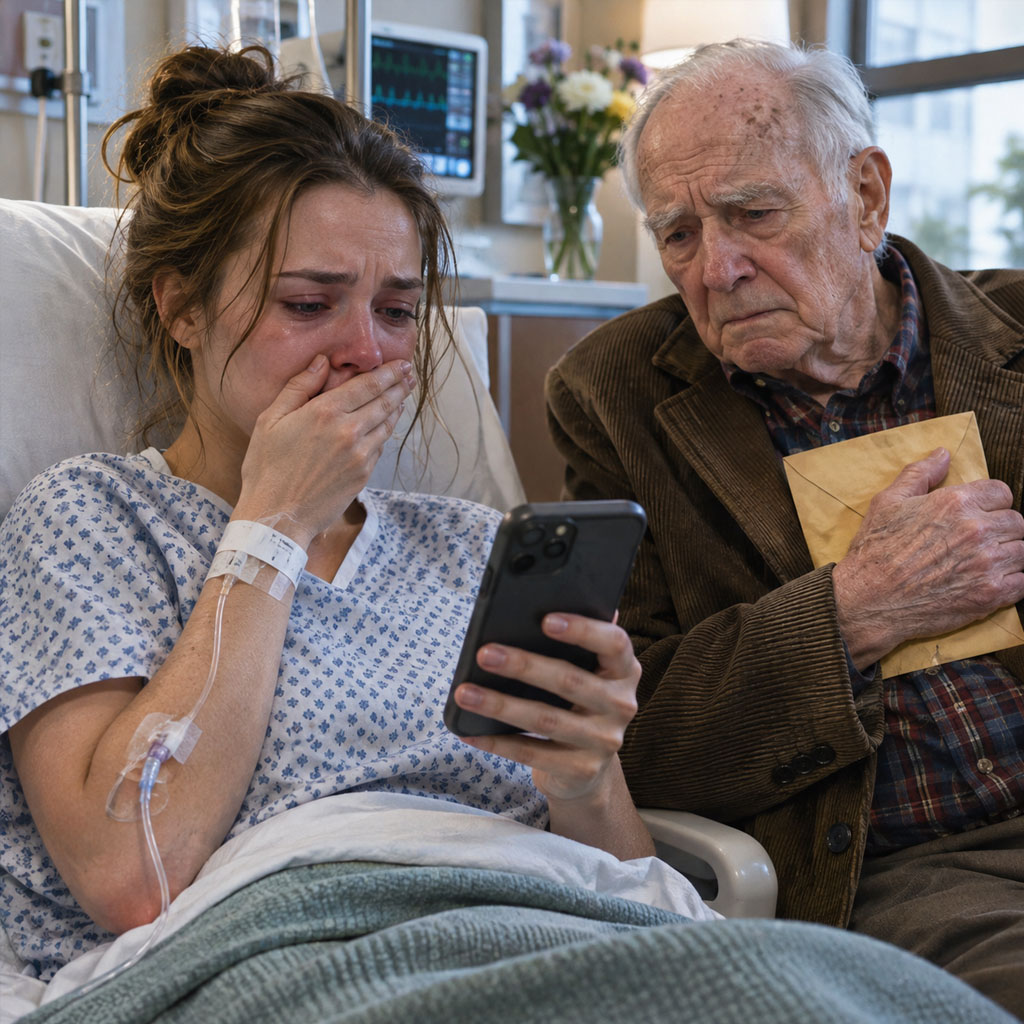
After she left, Grandpa took the old envelope from his jacket.
The writing on the front was clear.
For Bridget. Open only with Daryl present if he asks for my money.
I looked at Grandpa.
“She knew he’d ask?”
He nodded.
“Your grandmother gave me two instructions. One involved this envelope. The other involved whether it should ever be opened.”
“What was the other?”
His fingers closed over the paper.
“I’ll tell you tomorrow.”
Chapter 4
On Wednesday, June 3, my family arrived at the hospital shortly before ten.
Dad wore a sport coat and carried a leather folder.
Mom wore a peach-colored dress. Sasha came with Laurent, who stood quietly near the door.
Jacinda had arrived earlier with a box of documents.
Grandpa sat beside my bed, his corduroy jacket buttoned despite the warm weather.
I wore jeans and a gray sweater instead of a hospital gown. The blue folder rested in my lap.
Dad placed a settlement agreement on the tray table.
“Half the trust goes to Sasha,” he announced. “I withdraw the lawsuit, and we all move forward.”
He set a pen beside the document.
“Bridget, sign it.”
I looked at Jacinda.
“Is that what Grandma’s trust requires?”
“No,” she replied.
Dad frowned.
“Then what are we waiting for?”
He turned toward Grandpa.
“Dad, tell her to sign. Mom’s money belongs to this family.”
Grandpa looked at his son for a long moment.
Then he unbuttoned his jacket.
“There it is,” he whispered.
He withdrew the envelope.
The room fell silent.
He handed it to me.
“Your grandmother said to open it when your father asked for her money in front of you.”
My fingers trembled as I broke the old seal.
Inside were three items.
The first was a handwritten letter from Grandma.
The second was a stack of eight photocopied checks.
The third was a folded sheet of yellow legal paper.
I examined the checks first.
Each was made payable to my father.
Each was for $9,150.
The dates ranged from August 2015 through January 2019.
Every check contained the same words in Grandma’s handwriting.
Bridget’s tuition.
On the back of each check was Dad’s signature.
Jacinda arranged them across the table.
“Eight checks,” she said. “A total of $73,200.”
I could hear the faint hum of the hospital’s ventilation system.
I looked at Dad.
He said nothing.
Then I unfolded the yellow paper.
It was dated August 17, 2015.
It stated that Daryl Matson acknowledged receiving funds from his parents exclusively for Bridget’s tuition and educational expenses.
Any money not used for that purpose would be repaid upon request.
Beneath the statement was Dad’s signature.
Grandma had signed as a witness.
Dad’s voice became sharp.
“She made me sign that like I was a child. It doesn’t prove anything. The money went to Bridget’s education.”
I opened my blue folder.
“This is my official student account history.”
I handed Jacinda a copy.
“Every tuition charge, every payment, every loan. It’s all there.”
I turned to the page showing outside contributions.
“Look at this column, Dad. Payments from parents or third parties.”
The amount was zero.
For the entire period I attended university.
Then I showed him the final page.
September 2, 2016.
Unpaid balance: $4,870.
Registration hold. Financial withdrawal.
“Your third check cleared two weeks before I was forced out of school,” I said.
Dad stared at the documents.
Jacinda opened the court petition.
“Mr. Matson, you also signed a sworn statement claiming every dollar was used for Bridget’s schooling.”
She placed the petition beside the checks.
“I strongly recommend discussing these records with your attorney.”
Dad’s mouth opened, but he didn’t speak.
Then I lifted the cedar box onto my bed.
I removed the fourteen letters and arranged them beside the settlement agreement.
“These are the letters Grandma received from me,” I said. “The ones about my field trips and college professors.”
I picked up the letter about the mule.
“In October 2017, I wasn’t attending school. I was working at a warehouse.”
I looked at Mom.
“Who wrote these?”
She stared at the letters.
For several seconds, I thought she would refuse to answer.
Then she whispered, “I did.”
Sasha turned toward her.
“Mom?”
“I typed them at the pool company office. Your father said the checks would stop if the letters stopped.”
I felt my chest tighten.
Mom’s eyes filled.
“I knew exactly what Eudora wanted to hear. You talked like her, Bridget. Ever since you were seven years old.”
Her voice broke.
“Every time you corrected me, every time you stood with your hands on your hips, I saw her. I couldn’t separate you from her.”
I remembered my childhood.
The way Mom braided Sasha’s hair but handed me a brush.
The way she laughed when I came home excited about rocks.
The way she called me difficult whenever I disagreed with her.
“You punished me because I reminded you of Grandma?”
Mom covered her mouth.
“I know what I did,” she whispered.
Laurent stepped forward.
“Sasha,” he asked quietly, “was your semester in Paris paid for with this money?”
My sister looked at the checks.
Then she looked at Dad.
She didn’t answer.
Laurent lowered his eyes.
The silence answered for her.
Grandpa reached into his other jacket pocket.
He removed an old cardboard matchbook from the Sunrise Diner, where he and Grandma used to eat breakfast.
It was faded and worn.
“Your grandmother gave me this, too,” he said.
Dad stared at it.
Grandpa’s voice shook.
“Before she died, your mother told me that one day you’d need Bridget. Something would happen, and you’d have to decide whether to show up for your daughter.”
He paused.
“She told me to mention the trust when that day came. Then watch what you did.”
Dad slowly sat down.
“If you came home to Bridget,” Grandpa continued, “I was supposed to burn the envelope and never tell either of you it existed.”
His eyes filled with tears.
“But if you called about the money instead, I was supposed to open it.”
He held the matchbook in his trembling hand.
“I carried these matches every day since Saturday. I wanted to burn that envelope, son. More than anything.”
Dad stared at the floor.
“I kept thinking you’d turn around. That you’d get off the plane somewhere and come back.”
Grandpa’s voice broke.
“I prayed you’d give me a reason to burn it.”
Nobody moved.
Then I picked up Grandma’s letter.
The final page was addressed to Dad.
I handed it to him.
He read silently.
Later, Grandpa told me what Grandma had written.
She apologized for treating her son’s childhood like a series of examinations.
She wrote that she had graded him when she should have embraced him, and that she’d mistaken correction for love.
But she also wrote that if he was reading those words, it meant he’d asked for her money instead of going to his daughter.
She wasn’t punishing him.
She was refusing to help him repeat the harm.
Dad read the letter twice.
Then he looked at Jacinda.
“What happens now?”
“The trust will be distributed to Bridget according to Eudora’s instructions,” she said. “Your father also has a signed repayment agreement concerning the education funds.”
Dad lowered his head.
Jacinda continued.
“The records show that the payments never reached Bridget’s university account. The trustee will be requesting repayment. You should also review your sworn court filing with your attorney.”
Grandpa slowly stood.
He held out his hand.
“Your keys, Daryl.”
Dad looked confused.
“My keys?”
“The farmhouse key.”
After a long pause, Dad removed his key ring.
Grandpa carefully detached the old brass key with the green paint on its head.
“And bring your mother’s lamp and files back,” he said.
Dad didn’t argue.
Mom left first.
Dad followed, carrying none of the documents he’d brought.
Sasha stood near the doorway, her face pale.
Laurent looked at me.
“I’m sorry, Bridget. I didn’t know.”
“I know you didn’t.”
He walked out.
Sasha hurried after him.
When the room was finally quiet, Grandpa handed me the first two pages of Grandma’s letter.
The first contained an apology to my mother for a cruel remark Grandma had made years earlier about the cost of marrying into the family.
She admitted that some of her judgments had been unkind.
Then I read the second page.
It was addressed to me.
Grandma wrote that my mother had spent years telling me I was exactly like her.
But I wasn’t.
I was my own person.
She wrote that she was sorry for failing to discover the truth about my education sooner.
Then came the sentence that finally broke me.
“You were never a copy of me, sweetheart. You were always yourself. I was simply the one who took the time to see you.”
I began crying.
Grandpa moved closer and wrapped one arm around my shoulders, careful not to touch the surgical dressing.
“I see you, Bridget,” he whispered. “I should have been looking all along.”
I cried against his corduroy jacket.
For the first time in years, I didn’t feel obligated to stop.
Chapter 5
I left the hospital on June 5.
I didn’t return to my apartment.
Grandpa brought me home to the farmhouse near Rolla because I couldn’t drive, couldn’t work, and still needed help with everyday activities.
He prepared the bedroom overlooking the creek.
On the nightstand, he placed Grandma’s old rock hammer and a small geode she’d collected years before.
The weeks that followed were difficult.
My balance was unreliable. Some mornings, my right hand shook so badly I couldn’t button a blouse.
I attended physical therapy, took my medication, and tried not to become discouraged when progress came slowly.
Grandpa helped without making me feel helpless.
Sometimes he simply sat beside me while I practiced writing my name.
Other times, he brought me tea and talked about Grandma’s garden.
He never told me I was strong.
He asked whether I was tired.
That small difference meant more than he knew.
In July, Dad’s attorney requested dismissal of the lawsuit.
On August 14, the court dismissed the petition and ordered Dad to pay the trust’s attorney fees.
The sworn statement about my education had made his position impossible to defend.
Grandpa’s formal demand for repayment went out through Jacinda’s office.
Dad didn’t contest it.
In September, he and Mom took out a home equity loan against their house in Lee’s Summit and repaid the $73,200.
Grandpa didn’t keep the money.
He directed $41,800 toward my student loans.
One morning, I opened my loan account and saw the balance reduced to zero.
I sat staring at the screen.
Six years of working overnight shifts.
Six years of wondering whether I’d ever finish college.
And thousands of dollars of debt I’d carried because someone had taken the money intended for me.
I closed my laptop and cried quietly.
The remaining $31,400 went toward establishing a university scholarship in Grandma’s name.
The Eudora Matson Award would help geology students who worked nights while completing their degrees.
Grandpa said Grandma would have liked that better than a new headstone.
He also revised his will.
Dad would no longer be responsible for any part of Grandpa’s estate.
My parents’ lives changed.
Dad sold his company’s second truck and began doing more installation work himself.
Mom found a job at the reception desk of a dental office.
She removed the cheerful Paris photographs and angry family posts from social media.
Neither parent called to apologize.
In July, I wrote Mom a letter.
I told her I understood that Grandma had hurt her.
I told her I understood how painful it must have been to spend years feeling judged by another woman.
But I also told her that understanding wasn’t forgiveness.
If she wanted a relationship with me, she would have to know the real Bridget.
The one who worked in a warehouse.
The one who never went on those field trips.
The one who loved rocks, drank black coffee, and sometimes needed help.
She never replied.
I stopped waiting for an answer.
Sasha’s engagement ended on June 9, six days after our family meeting.
Laurent told her he couldn’t build a marriage around secrets and money that didn’t belong to them.
He ended things quietly, without public accusations.
The château kept the deposit.
Most of the debt remained on Sasha’s credit cards.
She tried to negotiate payment arrangements, but by October she still owed more than $35,000.
On October 24, she called me crying.
“Bridget, I know I shouldn’t ask, but I don’t know what else to do.”
I listened.
Then she asked whether I could pay the balances using Grandma’s trust.
I looked out the farmhouse window.
The creek glittered between the trees.
“No, Sasha,” I said gently. “I’m not paying your debt.”
She began crying harder.
“But I will help you find a way to manage it,” I continued. “I have the number of a nonprofit credit counseling organization. I’ll sit with you while you call.”
She was quiet.
“And I’ll buy you lunch next Saturday,” I added. “Just lunch. No money.”
After a long pause, she said, “Okay.”
Then she told me she’d written to Jacinda to ask what Grandma’s trust actually said.
Jacinda had answered her.
For the first time, Sasha had asked for the truth instead of accepting what our parents told her.
It was a small beginning.
I had learned not to mistake small beginnings for complete changes, but I didn’t dismiss them either.
In August, I started working at the Missouri Geological Survey’s core library in Rolla.
It wasn’t the field position I’d originally accepted.
Instead, I cataloged rock cores and geological samples in a cool warehouse filled with shelves of stone.
The work suited my recovery.
I didn’t have to drive.
A coworker named Delia picked me up on her way to work and brought me home in the afternoon.
My doctors were pleased with my progress.
I hadn’t suffered another seizure since June 1.
If that continued, I hoped to be allowed to drive again in December.
One Sunday in late October, Grandpa asked whether I’d like to walk down to the creek.
He was 86, with a pacemaker and an artificial knee, and his doctor had warned him not to lift anything heavy.
I told him I’d carry the buckets.
He laughed.
“Your grandmother would’ve said the same thing.”
The maple trees had turned red and gold.
The creek ran low and clear over the stones.
We walked slowly along the bank, stopping whenever Grandpa needed to rest.
I carried two small buckets and Grandma’s old hammer.
At a gravel bar, Grandpa sat on a flat rock.
“Let’s see what we’ve got,” he said.
I handed him an ordinary gray stone.
He tapped it carefully.
Nothing remarkable appeared inside.
The second was the same.
The third broke unevenly and showed only dull rock.
Grandpa shook his head.
“Nothing’s also information.”
I laughed so hard I had to sit beside him.
Grandma used to say those exact words.
Then I selected another stone, round and unremarkable, and handed it to Grandpa.
He held the hammer with his thumb against the worn blue grip.
He struck the stone carefully.
It opened into two clean halves.
Inside, tiny white crystals caught the afternoon sunlight.
Grandpa lifted both pieces.
For a long moment, he didn’t speak.
“She would’ve liked this one,” he finally said.
I nodded.
“I think so, too.”
We sat together beside the creek, an old man and his granddaughter, watching the water move around stones that had been there long before either of us.
I thought about my father.
I thought about the fourteen-year-old boy whose mother couldn’t praise a 94 without pointing out the six missing points.
I understood him better than I once had.
But he had been given a chance to make a different choice.
He could have come to the hospital.
He could have sat with Grandpa.
He could have held my hand when I woke from surgery.
Instead, he asked about the money.
That was his decision, not mine.
I also thought about Mom, who had spent decades seeing someone else whenever she looked at her own daughter.
I hoped someday she might learn to see me.
But I no longer needed her permission to be myself.
Grandpa handed me the two halves of the geode.
“You keep those,” he said.
I placed them carefully in the bucket.
Then I looked at him.
“Do you ever wish you’d burned the envelope?”
He was quiet for a while.
Finally, he shook his head.
“I wish your father had given me a reason to.”
I leaned against his shoulder.
He rested his hand over mine.
For years, people had praised me for being the strong daughter.
The one who never complained.
The one who could work through exhaustion, handle disappointment, and find a way forward without anyone’s help.
I had mistaken their praise for love.
Now I understood that sometimes calling someone strong is simply an excuse not to show up for them.
Grandpa never asked me to be strong.
He signed the hospital forms.
He sat through the long nights.
He held my hand when it shook.
And when the truth finally came out, he stayed beside me.
Grandma had left me enough money to change my future.
But the greatest gift she left wasn’t in the trust.
It was in the envelope.
She left behind the truth, written carefully enough that no one could erase it.
The checks remembered where the money went.
The university records remembered what I paid.
The forged letters remembered the years someone had stolen from my grandparents and me.
And Grandma’s final letter reminded me that I had always been worthy of being seen.
I looked down at the two halves of the geode.
The crystals were beautiful, but there had been no way to know what was inside until the stone opened.
Grandma had been right about that.
She’d also been right about something much more important.
A person’s real worth isn’t determined by how useful they are to their family, how much money they provide, or how quietly they carry their pain.
Sometimes the greatest act of love is simply staying when everyone else has somewhere more exciting to be.
Grandpa stood slowly, and I offered him my arm.
Together, we walked back toward the farmhouse.
The afternoon sun warmed the fields.
The two buckets swung gently from my free hand.
And for the first time in my life, I wasn’t walking home as the daughter everyone expected to manage on her own.
I was simply Bridget.
And I was finally enough.
THE END.\
⚠️ All characters and events are fictional. Do not imitate or apply them in real life. 😌😌😌