
Chapter 2
The bracelet sparkled beneath the chandelier lights.
It had six oval diamonds set in platinum, surrounded by tiny engraved leaves. My grandmother had worn it in her wedding photographs, and her own mother had brought it from Italy decades earlier.
I’d admired it since childhood.
Grandma used to let me try it on when I visited.
“One day, Lizzie,” she’d say, fastening the clasp around my small wrist, “this will be yours. You’ll have to grow into it first.”
After Grandma died, Mom told me the bracelet had been placed in a safety deposit box.
“It’s too valuable to leave lying around,” she explained.
Now it was on Madison’s wrist.
I approached her.
“That’s a beautiful bracelet.”
Madison smiled brightly.
“Thank you! Andrew gave it to me for our anniversary.”
I felt my throat tighten.
“Did he?”
“Isn’t it gorgeous? He said it’s a family heirloom.”
I looked toward Andrew.
He stood across the room laughing with several friends.
“Yes,” I said quietly. “It certainly is.”
I didn’t confront him.
Not there.
Not while two hundred guests were celebrating my birthday and my father was preparing to make another speech.
Instead, I stepped into the hallway and sent Margaret a message.
“I saw Grandma’s bracelet. Andrew gave it to Madison. Mom said it was in a bank deposit box.”
Her reply arrived minutes later.
“Do not confront anyone tonight. We will address this through the estate records.”
I put my phone away.
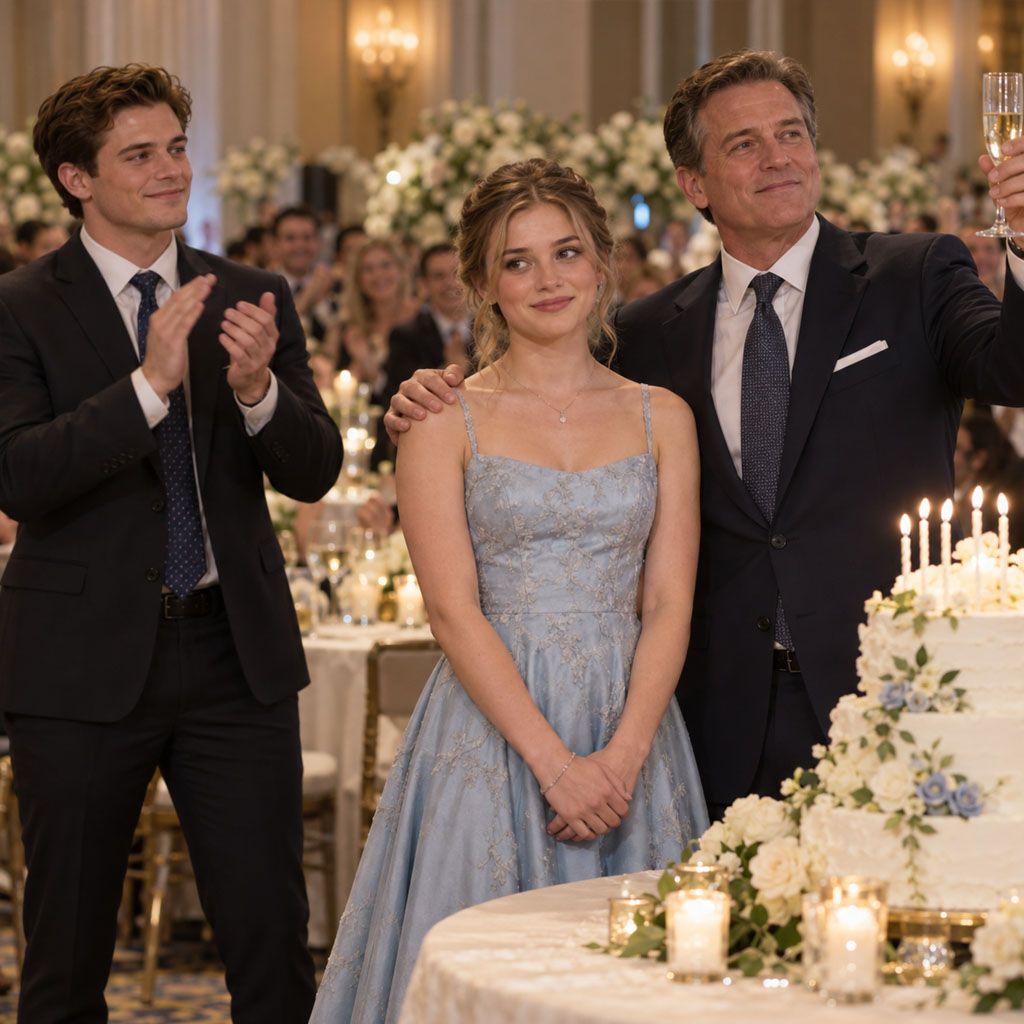
A few minutes later, Dad tapped his champagne glass with a silver spoon.
“Ladies and gentlemen, may I have your attention?”
The music stopped.
Everyone turned toward him.
He smiled the way he always smiled when cameras were nearby.
“Eighteen years ago, Victoria and I were blessed with a beautiful daughter.”
The guests applauded.
He continued with a carefully rehearsed speech about family tradition, responsibility, and the importance of passing wealth from one generation to the next.
Then he raised his glass.
“Elizabeth has officially become a woman, and soon she’ll take her rightful place in helping guide the Whitmore family’s future.”
More applause.
I stood beside him, smiling.
Dad placed an arm around my shoulders.
“Your grandfather would be proud of how we’re going to protect his legacy.”
I looked straight ahead.
Grandpa would have understood exactly what I’d done that afternoon.
Dad had no idea.
For the next several hours, I played my expected role.
I cut the cake.
I posed for photographs.
I accepted hugs from relatives I barely knew.
I thanked people for gifts I hadn’t asked for.
Near midnight, I told Mom I was tired.
She frowned.
“Stay until the important guests leave.”
I nodded but eventually slipped away.
My room was on the hotel’s second floor, in a quieter wing away from the ballroom.
As I walked down the carpeted hallway, I heard a familiar voice.
Dad.
He was standing around a corner, speaking urgently into his phone.
“What do you mean she moved the money?”
I stopped.
His voice became sharper.
“Three million dollars doesn’t just disappear. Call the trustee again.”
There was a pause.
Then he said a word I’d heard Margaret use that afternoon.
“Irrevocable?”
Another silence.
“Are you telling me there’s absolutely no way to access it?”
My heart pounded.
Dad dragged a hand down his face.
“We already committed those funds. The restaurant financing depends on them!”
He turned suddenly.
Our eyes met.
For one terrible second, I saw something I’d never seen in his face before.
Fear.
Then his expression hardened.
“Elizabeth. What are you doing awake?”
“Going to my room.”
“Then go.”
He spoke as though nothing unusual had happened.
I continued walking.
Behind me, his phone conversation resumed in an angry whisper.
I reached my room, locked the door, and sat on the edge of the bed.
For eighteen years, I’d believed Dad knew how to control everything.
Now I’d heard him discover that he couldn’t control me.
I opened my suitcase and began packing.
Not because I planned to run away.
Because I knew the morning would be difficult.
At 7:30, Margaret called.
“Elizabeth, the trust documents have been completed and accepted by the trustee. Everything is in place.”
I exhaled.
“Thank you.”
She hesitated.
“There’s something else. Your father has contacted several people about the funds.”
“I know. I overheard him last night.”
“Are you safe?”
I glanced at the locked door.
“For now.”
“Listen carefully. Your grandfather made arrangements in case your family reacted badly when they discovered they couldn’t access your inheritance.”
“What arrangements?”
“I’ll explain when I see you.”
I looked at my packed suitcase.
“Margaret, what exactly was Grandpa investigating?”
There was a longer pause.
“Something your father may have spent years trying to conceal.”
Before I could ask another question, someone knocked on my door.
It was Mom.
“Elizabeth, your father wants to see you downstairs. Now.”
Chapter 3
The breakfast room was unusually quiet when I entered.
Dad stood beside the long mahogany table with both hands resting on its polished surface.
Mom sat near the window, her arms folded tightly.
Andrew leaned against the fireplace, looking irritated.
Nobody had touched the breakfast tray.
Dad looked at me.
“Sit down.”
I took a chair across from him.
“What is this about?”
He laughed without humor.
“You know exactly what this is about.”
I remained quiet.
Dad took a breath.
“We’ve learned that you transferred your grandfather’s inheritance into another trust.”
“Yes.”
“Without consulting your parents.”
“I’m eighteen. I discussed it with the attorney handling Grandpa’s estate.”
His face darkened.
“Margaret Reynolds has filled your head with nonsense.”
“She explained my options.”
“She manipulated you!”
Mom leaned forward.
“Elizabeth, sweetheart, we were trying to protect you.”
I looked at her.
“From what?”
“From making foolish decisions with money you don’t understand.”
I glanced toward Dad.
“Then why were you planning to use it for Andrew’s restaurant?”
Andrew pushed away from the fireplace.
“Because we’re family.”
I looked at him.
“That doesn’t explain why my inheritance was included in your financing plans without asking me.”
Dad straightened.
“We had obligations.”
“Whose obligations?”
“Our family’s.”
I felt my pulse quicken.
“Grandpa left that money to me.”
Mom shook her head.
“He wanted it to benefit the family.”
“Then why did he put it in my name?”
Nobody answered.
Dad walked to the window.
“Your brother’s investment needs temporary financing. The company has several outstanding commitments. Your mother’s foundation also has expenses coming due.”
I stared at him.
“So all of you were counting on my money.”
He turned.
“Don’t make it sound ugly.”
“Then tell me how it was supposed to work.”
Dad’s jaw tightened.
“We intended to consolidate the funds into a professionally managed family account.”
“And who would control that account?”
“I would.”
The simplicity of his answer almost stunned me.
“And when would I get control back?”
He didn’t answer.
Mom’s voice became sharp.
“You’re acting selfishly. Your grandfather gave you a tremendous gift, and all you can think about is keeping it for yourself.”
I looked down at my hands.
For years, I’d been told to be generous, obedient, and grateful.
Now I understood that generosity, in my family’s vocabulary, meant surrendering what belonged to me.
Andrew stepped closer.
“You really messed things up, Liz.”
“I didn’t agree to finance your restaurant.”
“You’re eighteen. You don’t understand business.”
“Then why did you need my money?”
He opened his mouth, then closed it.
Dad pointed toward the doorway.
“Enough. If you want to make decisions like an adult, you can live like one.”
I looked at him.
“What does that mean?”
“It means you can pack your belongings and leave this house today.”
Mom looked away.
I waited for her to object.
She didn’t.
“You’re serious?” I asked.
Dad’s expression remained cold.
“You’ve chosen to put outsiders ahead of your family. We won’t support that.”
I looked from my father to my mother.
Then to Andrew.
Three people I’d spent my entire life trying to please.
Not one of them seemed concerned about where I would go.
Their anger wasn’t about my safety.
It was about losing access to money.
I stood.
“All right.”
Dad blinked.
“What?”
“I’ll leave.”
Andrew laughed.
“You think you can survive on your own?”
I looked at him.
“I think I’d rather learn than spend my life asking permission.”
Dad’s face reddened.
“Don’t you dare speak to your brother that way.”
Before I could respond, the doorbell rang.
A housekeeper appeared in the doorway.
“Mr. Whitmore, Ms. Reynolds is here.”
Dad’s expression changed.
“Tell her this is a private family matter.”
But Margaret was already entering the foyer.
She wore a navy suit and carried a thick leather folder.
Behind her stood a middle-aged man I didn’t recognize.
Margaret looked directly at me.
“Elizabeth, are you all right?”
I nodded.
“Dad asked me to leave.”
She took a breath.
“Then it’s fortunate we prepared for that possibility.”
Dad stepped forward.
“You have no business coming into my home.”
Margaret remained calm.
“Charles, I would prefer to discuss this civilly.”
“Discuss what?”
“Your attempts to obtain access to Elizabeth’s trust. And several financial matters involving Whitmore Holdings and the Whitmore Family Foundation.”
Mom slowly rose from her chair.
“What financial matters?”
Margaret opened her folder.
“Before Mr. Bennett passed away, he requested an independent review of certain transactions connected to your husband’s company and the foundation.”
Dad went still.
“That’s ridiculous.”
“The review identified discrepancies that required further examination.”
“Discrepancies?” Mom repeated.
The man beside Margaret introduced himself.
“David Mercer. I’m a forensic accountant.”
Dad stared at him.
David opened another folder.
“We’ve reviewed several years of financial records. Our findings raise serious questions about certain transfers and charitable disbursements.”
I felt the room change.
Andrew looked at Dad.
“What transfers?”
Margaret spoke carefully.
“Some foundation payments appear to have been redirected into accounts unrelated to their stated charitable purposes.”
Mom gripped the back of her chair.
“Charles?”
Dad said nothing.
David continued.
“Our review identified approximately sixty-three thousand dollars in questionable disbursements over eighteen months. Several authorization records also contain signatures that require verification.”
Andrew stepped away from the fireplace.
“Dad, what is he talking about?”
Dad finally spoke.
“This is an outrageous accusation.”
Margaret nodded.
“You’re entitled to dispute the findings. The appropriate authorities will determine what happened, and your attorney will have an opportunity to respond.”
She placed a document on the table.
“However, the matter has already been referred for formal review. Your business records are now subject to legal requests for production.”
Mom looked as though she might faint.
“Is this why you’ve been worried about the company?”
Dad turned toward her.
“Victoria, not now.”
But Margaret wasn’t finished.
She opened another section of the folder.
“There’s also the matter of your attempt to extend control over Elizabeth’s inheritance.”
I looked at her.
“What attempt?”
She turned toward me.
“Your father submitted documents last year arguing that you might lack sufficient emotional maturity to control significant financial assets at eighteen.”
The room tilted.
“What?”
Dad stared at Margaret.
“That was a precaution.”
My voice sounded distant.
“You tried to stop me from receiving Grandpa’s money?”
Dad said nothing.
Margaret continued.
“Your grandfather anticipated that possibility. He specifically instructed us to challenge any unsupported attempt to restrict your rights.”
I remembered all the times Dad had called me too sensitive.
Too emotional.
Too inexperienced.
And now I understood why he’d been so interested in creating a record of those supposed weaknesses.
He hadn’t simply wanted to control the inheritance.
He’d been preparing arguments to prevent me from controlling it myself.
I looked at him.
“Did you ever intend to let me make my own decisions?”
For the first time that morning, he couldn’t find an answer.
Chapter 4
The silence lasted so long that I could hear the grandfather clock ticking in the hallway.
Mom sat down slowly.
Andrew stared at Dad as though he were seeing him for the first time.
I remained standing beside the table, trying to understand everything Margaret had revealed.
“Grandpa knew?” I finally asked.
Margaret turned toward me.
“Yes, Elizabeth. He suspected problems long before he became ill.”
She explained that Grandpa had noticed unusual financial activity connected to the family foundation while reviewing charitable grants.
At first, he’d asked ordinary questions.
Why had certain donations been delayed?
Why did some payments appear to have gone to unfamiliar accounts?
Why were the foundation’s reported expenses increasing while its charitable programs remained unchanged?
The answers hadn’t satisfied him.
So he’d hired an independent accounting firm.
The investigation began quietly.
Grandpa was already sick, but he continued meeting with accountants and attorneys whenever his strength allowed.
“He didn’t want to make accusations without evidence,” Margaret explained. “He believed the truth mattered too much to handle carelessly.”
I looked at Dad.
His face had lost its color.
Margaret continued.
“Your grandfather also became concerned that your inheritance might be used to cover obligations unrelated to your future.”
My throat tightened.
“He knew they wanted it?”
“He suspected they might.”
I remembered visiting Grandpa during his illness.
The long afternoons when he’d seemed unusually thoughtful.
The way he’d watched Dad during holiday dinners.
The questions he’d asked me about college, independence, and whether I understood basic financial documents.
I’d thought he was simply worried about leaving me.
Now I realized he’d been preparing me.
“What did he tell you?” I asked Margaret.
She reached into her folder and removed a sealed envelope.
My name was written across the front in Grandpa’s unmistakable handwriting.
Elizabeth.
My eyes filled with tears.
“He asked me to give you this if circumstances showed that you needed to separate your financial future from your family’s decisions.”
I took the envelope.
For a moment, I couldn’t bring myself to open it.
Then I carefully unfolded the letter inside.
“My dear Lizzie,” it began.
I could almost hear his voice.
He wrote that he loved me more than words could express. He wanted me to use the inheritance for education, independence, and a life of my own choosing.
He also warned that money could reveal difficult truths about people.
“Never confuse someone needing what you have with someone caring about who you are,” he wrote.
Tears slipped down my cheeks.
Grandpa continued.
He acknowledged that he couldn’t protect me from every disappointment, but he could give me tools to protect myself.
He urged me to learn, ask questions, maintain careful records, and surround myself with trustworthy people.
Then came the sentence that broke my heart.
“If the day comes when you must choose between keeping your family’s approval and keeping your own judgment, remember that love worthy of your trust should never demand that you surrender yourself.”
I pressed the letter against my chest.
For a moment, I wasn’t in my parents’ beautiful breakfast room.
I was sitting beside Grandpa in his old brick house, listening to classical music while he peeled an orange with his pocketknife.
I could smell cedarwood and coffee.
I could hear him laugh.
And I could almost feel his hand closing gently around mine.
Dad broke the silence.
“Samuel always hated me.”
Margaret looked at him.
“Mr. Bennett’s concerns were based on financial records, Charles, not personal feelings.”
“You’re trying to destroy my family.”
“No,” she replied. “We’re trying to establish what happened and protect those who may have been affected.”
Mom suddenly looked at him.
“Did you take money from the foundation?”
Dad’s jaw tightened.
“Victoria, we need to speak privately.”
“Did you?”
He looked away.
That was answer enough for her to demand an explanation, though it wasn’t a legal determination of guilt.
Andrew sat heavily in a chair.
“My restaurant financing,” he said quietly. “Was any of that connected to this?”
Dad didn’t answer him either.
I looked around the room.
Our expensive furniture, the paintings, the silver breakfast service.
Everything had always been arranged to create the impression of a perfect family.
Now the illusion was falling apart.
But I felt something unexpected.
I wasn’t relieved to see them frightened.
I wasn’t happy that Dad was facing questions he couldn’t easily dismiss.
I was simply sad.
Because beneath all the money and arguments was a truth I could no longer ignore.
My family had treated my eighteenth birthday as a financial opportunity.
Not a milestone in my life.
Not a celebration of my becoming an adult.
An opportunity.
Margaret approached me.
“Elizabeth, I’ve arranged temporary accommodations. Your personal documents and belongings can be collected with appropriate assistance.”
I wiped my cheeks.
“Thank you.”
Dad looked up.
“So you’re really leaving?”
I met his eyes.
“You told me to.”
“I was angry.”
“You were angry because I wouldn’t give you control of my inheritance.”
He looked away.
I continued.
“I don’t want anything bad to happen to this family. But I’m not going to give up Grandpa’s wishes to make your problems disappear.”
Mom began crying quietly.
“Elizabeth, please. We can work this out.”
I looked at her.
“Maybe someday we can talk about our relationship. But not if the conversation is really about my money.”
She covered her face.
I turned toward Andrew.
He looked smaller than I’d ever seen him.
“Liz, I didn’t know about the foundation investigation.”
“I believe you didn’t know everything.”
He nodded weakly.
“But you knew Dad was planning to use my inheritance.”
He didn’t deny it.
I returned upstairs and collected the two suitcases I’d packed the night before.
My room looked strangely unfamiliar.
The framed photographs, stuffed animals, and books had belonged to the girl I was before this morning.
I took Grandpa’s small wooden music box from my dresser.
He’d given it to me when I turned fifteen.
When opened, it played a Chopin waltz.
I wound the key and listened for a few seconds.
Then I closed it and placed it carefully in my bag.
Downstairs, Margaret waited near the door.
Dad stood at the far end of the hallway.
For once, he wasn’t giving orders.
Mom sat silently in the breakfast room.
Andrew remained by the fireplace.
I looked at them one final time.
“I hope we can all become better people after this,” I said.
Nobody answered.
Then I walked out.
A car was waiting in the driveway.
As we pulled away, I looked back at the house where I’d spent my childhood.
It was beautiful.
It had always been beautiful.
But for the first time, I understood that a beautiful house and a loving home weren’t necessarily the same thing.
Chapter 5
One year later, I was sitting at a small desk in a university dorm room in North Carolina, studying for my finance examination.
Rain tapped softly against the window.
Grandpa’s music box sat beside my textbooks.
Sometimes, when coursework became overwhelming, I opened it and let the familiar melody fill the room.
My life looked nothing like the one my parents had planned.
And I was grateful.
I chose a university far enough from Philadelphia to give myself space, but close enough that I could visit Margaret whenever necessary.
My major was finance.
People occasionally found that amusing.
After everything I’d experienced with my inheritance, they assumed I’d want nothing to do with money.
But I wanted to understand it.
Not because I dreamed of becoming wealthy.
I already had more than enough money for a comfortable future.
I wanted to understand how financial decisions affected people’s lives, how institutions could be held accountable, and how someone could protect what they’d worked hard to build.
Grandpa had spent his life creating something valuable.
I wanted to learn how to care for it responsibly.
The trust remained under professional management, with distributions governed by its terms and overseen by an independent trustee.
I received enough to cover tuition, reasonable living expenses, and educational needs.
The principal remained invested according to a long-term plan.
I didn’t have unrestricted access to spend it whenever I wanted.
That was the point.
My inheritance was no longer something my family could easily pressure me to transfer or pledge against someone else’s debt.
Margaret remained my attorney.
Over time, she also became someone I trusted for advice.
We met for lunch whenever I visited Philadelphia.
She always ordered grilled salmon and drank black coffee.
I teased her that she was the most predictable person I’d ever met.
She smiled.
“Predictability is underrated.”
I laughed.
“So I’ve learned.”
The legal matters involving Dad’s company and the foundation continued for months.
Investigators reviewed financial records, interviewed people connected to the transactions, and examined the questionable disbursements.
Eventually, prosecutors filed charges connected to the misuse of foundation funds and falsified financial records.
Dad retained attorneys and contested parts of the allegations.
The proceedings were complicated, and not every accusation was resolved in the way people initially expected.
But the accounting review established serious wrongdoing.
The foundation’s finances were reorganized under independent oversight, and steps were taken to recover and redirect misused funds toward their intended charitable purposes.
Mom cooperated with investigators.
I learned that she’d known about some financial problems but hadn’t understood their full extent.
Our relationship remained strained.
She wrote me several letters.
Some contained apologies.
Others focused on how difficult life had become since I left.
I read them slowly.
I wasn’t ready to rebuild our relationship.
But I no longer needed to hate her to keep my distance.
I hoped she would find a way to understand how her choices had affected me.
Whether she ever did was something I couldn’t control.
Andrew called twice.
I answered the second time.
“Hey, Liz,” he said awkwardly.
“Hi, Andrew.”
There was a pause.
“How’s school?”
“Good.”
“That’s good.”
We talked about ordinary things for several minutes.
Then he said, “I owe you an apology.”
I leaned back in my chair.
“For what?”
“For acting like Grandpa’s money belonged to all of us. And for helping Dad pressure you.”
I said nothing.
“I thought I was entitled to it because we’re family. I didn’t really stop to think about what you wanted.”
I looked at the framed photograph of Grandpa on my desk.
“Thank you for saying that.”
Andrew sighed.
“I’ve made a mess of a lot of things.”
“Then maybe it’s time to start making different choices.”
He laughed softly.
“You sound like Grandpa.”
My eyes filled with tears.
“I hope so.”
We didn’t become close overnight.
But the conversation ended without threats, accusations, or demands.
For now, that was enough.
Several months after I left home, Margaret called with news about Grandma’s diamond bracelet.
During the review of estate property, it had been identified as an heirloom intended for me.
Andrew had apparently taken possession of it through a family arrangement that hadn’t properly honored Grandma’s instructions.
After the ownership questions were resolved, the bracelet was returned.
Margaret had it delivered to my dormitory with the appropriate documentation.
I opened the padded box slowly.
There it was.
Six oval diamonds set in platinum.
The same bracelet Grandma had let me wear when I was little.
I held it for a long time.
For years, I’d thought jewelry like that represented wealth and status.
Now I saw something different.
I remembered Grandma sitting in her garden, showing me how to grow roses.
I remembered her telling me stories about her mother arriving in America with little more than a suitcase.
I remembered how she’d say that beautiful things were meant to be treasured, not used to make other people feel small.
I placed the bracelet back in its box.
I didn’t wear it.
Not yet.
Someday, perhaps, I’d wear it for a meaningful occasion.
Or pass it to someone who understood its history.
For now, it was enough to know it had come home.
That spring, I visited Grandpa’s grave.
The cemetery was quiet, with tall trees lining the winding paths.
I brought fresh flowers and knelt beside the simple headstone.
“Hi, Grandpa.”
A breeze moved through the branches.
“I started studying finance. You’d probably laugh at that.”
I smiled through my tears.
“Actually, no. You’d probably ask me whether I knew how to read a balance sheet yet.”
I sat there for a while.
Then I told him about school.
About my roommate, who loved baking cookies late at night.
About the professor who’d encouraged me to apply for a summer internship.
About Margaret, who still checked on me and reminded me to ask questions before signing anything.
And about the fact that I was learning how to make decisions without constantly worrying whether someone would approve.
Finally, I looked at his name carved into the stone.
“Thank you for protecting me.”
My voice cracked.
“But I wish you were here.”
I stayed until the afternoon light began to fade.
On the way back to campus, I thought about the last time we’d spoken in the hospital.
Money doesn’t make you safe.
Knowing how to protect yourself does.
At seventeen, I’d assumed he was talking about banks, lawyers, and investment accounts.
Now I understood that he’d meant something much larger.
He’d taught me to ask questions.
To recognize when love was being used as pressure.
To keep records.
To trust people who earned that trust.
To remember that being young didn’t mean being powerless.
He hadn’t simply left me money.
He’d left me the knowledge that my life belonged to me.
That summer, I started volunteering with a nonprofit organization that taught basic financial skills to teenagers preparing to leave foster care.
We talked about budgeting, checking accounts, credit, employment, and understanding contracts.
Some of the students had never had an adult explain those things patiently.
I recognized the fear behind their questions.
The uncertainty of standing at the beginning of adulthood without knowing whom to trust.
During one workshop, a seventeen-year-old girl asked me, “What if somebody in your family tells you you’re selfish for wanting to keep your own money?”
I paused.
The room grew quiet.
Then I said, “Helping people you love can be a wonderful thing. But you have the right to understand what you’re agreeing to, and you have the right to say no.”
She thought about that.
“Even if they’re your parents?”
“Even then. Respectful boundaries don’t mean you don’t love your family.”
She nodded slowly.
I could see her considering the idea.
After the workshop, she approached me.
“Thank you,” she said.
“For what?”
“For making me feel like it’s okay to ask questions.”
I smiled.
“It is always okay to ask questions.”
Driving home that afternoon, I realized Grandpa’s lessons were becoming part of something beyond my own life.
I couldn’t change what had happened in my family.
But I could choose what I carried forward.
I could use what I’d learned to help someone else recognize their own worth.
And I could build a future that honored Grandpa without letting his money define me.
On the anniversary of my eighteenth birthday, I spent the evening with a few friends from college.
There was no ballroom.
No champagne fountain.
No five-tier cake.
We ordered pizza, watched an old comedy, and ate cupcakes someone had bought from the grocery store.
My roommate surprised me with a little card signed by everyone.
Inside, she’d written, “Here’s to another year of becoming exactly who you want to be.”
I read the words twice.
Then I smiled.
Not the carefully rehearsed smile I’d worn at my eighteenth birthday party.
A real one.
Later that night, after everyone had gone to bed, I sat beside my window and opened Grandpa’s music box.
The familiar Chopin melody drifted through the quiet room.
I looked at the photograph beside it.
Grandpa stood next to his old pickup truck, smiling beneath a faded baseball cap.
He’d spent decades building a business from almost nothing.
During the final months of his life, while facing an illness he couldn’t overcome, he’d devoted his remaining strength to protecting the people and values he cared about.
He couldn’t control every outcome.
He couldn’t guarantee my family would make good choices.
And he couldn’t prevent me from experiencing heartbreak.
But he’d given me something solid to stand on when the people I trusted most turned against me.
That mattered more than the money.
At eighteen, I’d walked out of my parents’ house carrying two suitcases and a letter.
I thought I was losing everything familiar.
Instead, I was beginning to learn what independence really meant.
Not that I would never need help.
Not that I had to face every challenge alone.
But that I could choose whom to trust, when to seek guidance, and which decisions were mine to make.
I could love my family without surrendering my future.
I could remember the good parts of my childhood without denying the painful ones.
And I could use Grandpa’s inheritance responsibly without allowing it to become the price of anyone else’s approval.
Outside my window, the rain had stopped.
The campus lights reflected on the wet sidewalks.
I closed the music box and placed it gently beside Grandpa’s picture.
Then I opened my textbook and returned to studying.
I still had so much to learn.
But I was no longer afraid of growing up.
My family had thrown an elaborate party because they believed my eighteenth birthday would finally put my inheritance within their reach.
They’d expected a daughter who smiled, obeyed, and signed wherever they pointed.
What they hadn’t expected was that Grandpa had taught me something they never bothered to teach.
My future was not a family asset.
My signature was not a gift I owed anyone.
And my worth had never depended on how much money I could provide.
They thought they were celebrating the day they would gain control of my inheritance.
Instead, it became the day I finally gained control of my life.
THE END. ⚠️ All characters and events are fictional. Do not imitate or apply them in real life. 😌😌😌


