
Part 2
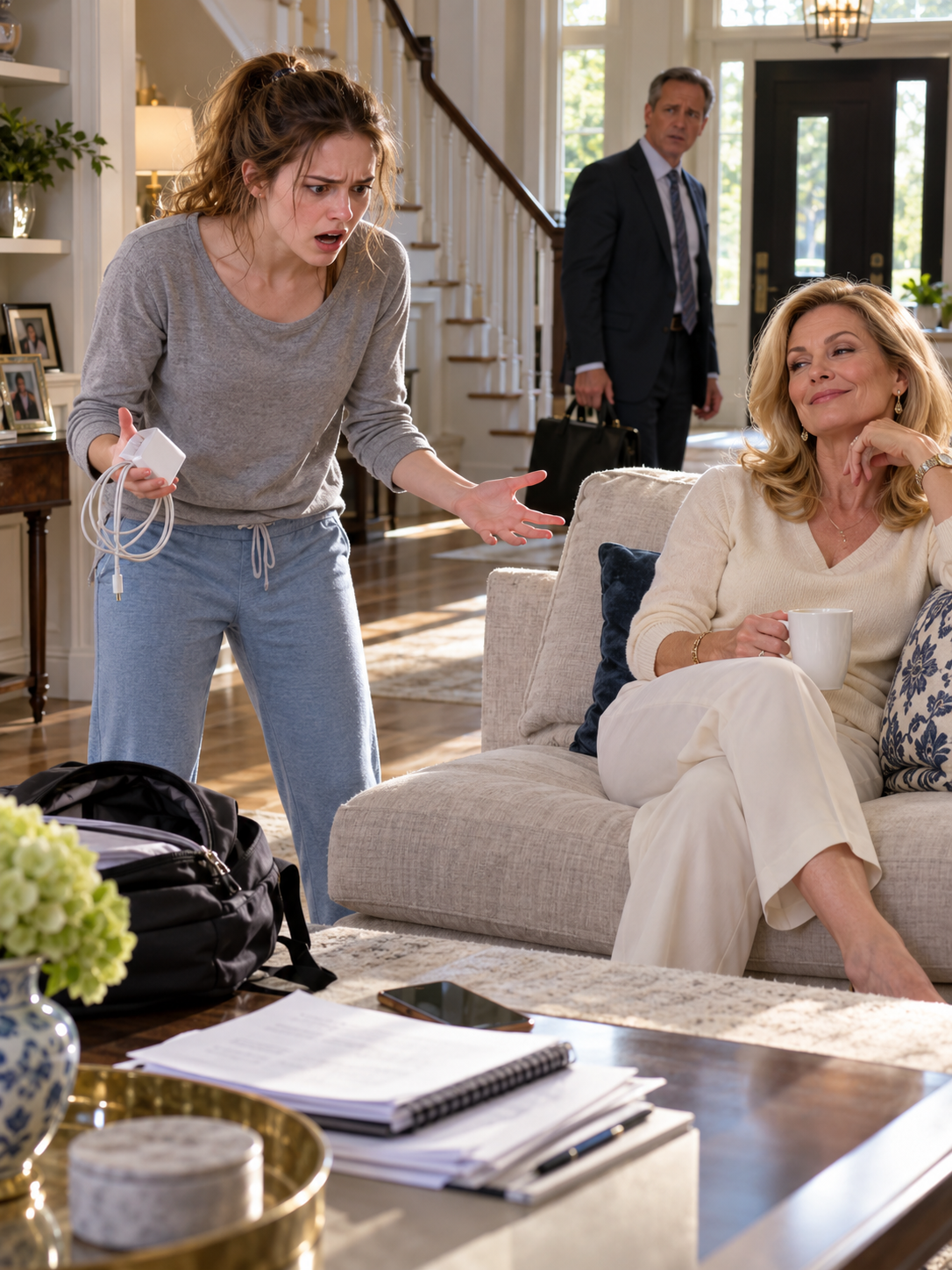
I walked into the living room holding my phone so tightly my fingers hurt.
“You called my university.”
Karen looked up. “Excuse me?”
“They told me.”
For a moment she maintained the performance. Then something changed in her eyes. The concerned stepmother vanished, and I saw something colder underneath.
“You really should be more responsible with your things.”
“Where is my laptop?”
She smiled. “You’re accusing me?”
“Yes.”
“Careful, Olivia. Accusations have consequences.”
“You told them I lied.”
“I told them what I believed.”
“No. You tried to destroy my credibility on the day my thesis was due.”
Karen put down her coffee. “You walk around here acting like you’re better than everyone because you have your university and your little technology job. Your father talks about you as though you invented electricity.”
“So this is about Dad being proud of me?”
Her face hardened.
“Life doesn’t hand everybody a trophy, Olivia.”
“This isn’t a trophy. I worked for it.”
“Well, then proving that shouldn’t be difficult.”
She stood and brushed past me.
“Good luck convincing them.”
I called Tasha first. She arrived forty minutes later with Mike, an old college friend who worked in network security and had the deeply irritating habit of becoming cheerful whenever a situation involved electronics, deception, or both.
“You think she actually took it?” Mike asked.
“I know she did.”
“Knowing and proving are different things,” Tasha said.
Tasha had just begun law school, which meant she had recently developed a healthy respect for evidence and an unhealthy affection for the phrase “document everything.” We decided not to confront Karen again. Instead, we would preserve emails, keep written records of incidents, and place small security cameras in common areas where there was no expectation of privacy.
I hated the idea.
“This is my father’s home,” I said. “We’re turning it into a crime documentary.”
“No,” Tasha replied. “She turned it into one. You’re just keeping receipts.”
Dad came home that evening worried and confused. Karen told him I had become “hysterical” after losing the laptop and had started blaming her without proof. I could see him struggling between what he knew about me and the woman he had trusted enough to marry.
“Liv, did you back up the thesis?”
“Most of it.”
“Then that’s something.”
“Dad, she called my university.”
Karen pressed one hand dramatically to her chest. “I called because I was concerned. She was falling apart.”
“By telling them I was lazy?”
“I may have chosen my words poorly.”
It was a masterful retreat. Just enough apology to sound reasonable, not enough to admit anything.
Dad rubbed his forehead. “Can we please stop fighting?”
That hurt more than I expected.
Because we weren’t fighting.
I was being attacked.
The university delayed any formal decision while reviewing the situation, but my submission remained incomplete. My adviser, Professor Whitman, quietly assured me that my previous drafts and research logs mattered. Still, I could hear the caution in his voice. Universities had procedures, and procedures moved slowly.
Karen did not.
Over the next two weeks, little things happened.
An email from my adviser vanished from the family computer after I had opened it there. A printed page containing an updated meeting schedule disappeared from the kitchen counter. Someone called the startup pretending to be me and asked whether my upcoming internship could be withdrawn.
That last attempt nearly worked.
My manager called immediately.
“Olivia, did you just phone HR?”
“No.”
“Someone did.”
I closed my eyes.
“What did she say?”
“She said you were overwhelmed, dropping out of school, and no longer interested in the position.”
Mike recovered the front-door camera footage from the same time. Karen was visible through the kitchen window, pacing with her phone pressed to her ear.
We had her.
Or so I thought.
Tasha wanted us to go directly to Dad, but something stopped me. Perhaps I needed enough evidence that Karen could not explain it away. Perhaps I was afraid my father would watch everything and still find a reason not to believe me.
That fear embarrassed me.
One evening, I came downstairs for water and heard Karen speaking softly in the kitchen.
“Yes, she’s a nightmare,” she was saying. “Always the victim. Always causing drama. John is completely blind when it comes to that girl.”
I froze in the hallway.
Karen laughed.
“No, he has no idea about the laptop.”
Every muscle in my body went still.
Then I heard a breath behind me.
Dad stood three feet away.
He had heard her too.
His face looked ten years older.
“Liv,” he whispered, “what laptop?”
Part 3
I did not answer in the hallway. I took Dad upstairs, closed my bedroom door, and opened the folder Mike had created on a backup tablet.
“Before you watch this,” I said, “I need you to understand that I didn’t want any of it to be true.”
Dad sat on the edge of the bed.
I played the recordings.
He watched Karen delete an email from my account after I had left the kitchen. He watched her make the phone call about my internship. He heard her tell a friend that if I lost my graduate program, maybe I would “come down off my pedestal.”
Then came the kitchen recording.
“No, he has no idea about the laptop.”
Dad paused the video himself.
For a long time, neither of us spoke.
“I defended her,” he finally said.
“You didn’t know.”
“I told you to stop fighting.”
“You wanted peace.”
“I wanted easy.” His voice broke. “That isn’t the same thing.”
He covered his face with both hands. I had seen my father cry only twice before—at my mother’s funeral when I was fourteen, and years later when his older brother died. Watching him realize that his marriage had been built partly on manipulation felt almost unbearably intimate.
“I’m sorry, Liv.”
I sat beside him.
He looked at me. “I should have believed you sooner.”
What I wanted to say was that it didn’t matter.
But it did.
So I told him the truth.
“I needed you to trust me.”
He nodded slowly. “I know.”
My phone rang before either of us could say more. It was Tasha, speaking so quickly that I had to ask her to repeat herself.
She had been digging through publicly available court records and contacting people Karen herself had once mentioned. What she found did not prove every rumor, but it revealed a pattern. Former coworkers described complaints, false accusations, and retaliatory behavior. One woman who had briefly been Karen’s stepdaughter years earlier said Karen had repeatedly sabotaged her relationship with her father.
Dad listened on speakerphone.
When the call ended, he stared at the wall.
“How much of her life do I actually know?”
That was the question Karen had never expected him to ask.
The university scheduled a formal meeting three days later. I entered the conference room carrying a binder, a flash drive, phone records, email logs, and enough nervous energy to power the building.
Professor Whitman sat near the dean. Two faculty members joined by video. Dad came with me but waited until he was asked to speak.
I told the story in order.
No shouting. No exaggeration. No name-calling.
Just dates.
Messages.
Recordings.
Witnesses.
When I played the audio of Karen saying Dad did not know about the laptop, the room became very quiet.
The dean folded his hands.
“Ms. Parker, I want to apologize for the distress this has caused you. Your prior drafts, version history, faculty correspondence, and the evidence you’ve provided establish that you had been actively completing your thesis before the computer disappeared.”
My eyes burned.
He continued. “You will receive an extension without academic penalty. We will also document that the allegations communicated to the university were unsubstantiated.”
For the first time in weeks, I could breathe all the way to the bottom of my lungs.
Professor Whitman smiled.
“Now finish the thesis.”
I laughed.
“Yes, sir.”
Dad and I barely spoke during the drive home. There was nothing left to debate.
Karen was in the dining room when we arrived.
She looked at our faces and immediately understood that something had changed.
“Where have you two been?”
Dad placed his keys on the table.
“The university.”
Karen looked at me.
I held up the flash drive.
Her face lost color.
“John, whatever she told you—”
“I heard you.”
“What?”
“I heard you in the kitchen.”
Karen glanced toward the stairs as if calculating how much of the house had betrayed her.
Dad’s voice stayed frighteningly calm.
“Where is Olivia’s laptop?”
“I don’t know.”
“Don’t lie to me again.”
“John—”
“Where is it?”
Karen’s mouth trembled, but I could not tell whether the emotion was fear or fury.
“You’re choosing her over your wife?”
Dad stared at her.
“She’s my daughter.”
“And I’m your wife!”
“You attacked my daughter’s education, interfered with her work, lied to her university, and lied to me. Don’t stand there and reduce that to jealousy over who I love more.”
For once, Karen had no prepared response.
Then the mask broke.
She turned on me.
“You ungrateful little brat. I spent years trying to make this family work while you strutted around treating me like some outsider.”
“You were an outsider to my bedroom, my laptop, my university, and my job.”
“I was trying to teach you humility.”
“You were trying to make me fail.”
Dad stepped between us.
“Enough.”
Karen stared at him.
His next words were quiet.
“Pack your things.”
Her expression collapsed.
“You can’t be serious.”
“I’m calling a lawyer tomorrow.”
“John.”
“I want you out.”
She argued for another hour. She cried, accused me of poisoning him against her, claimed she had acted out of concern, then anger, then fear of losing him. Each explanation contradicted the previous one.
Dad did not change his mind.
By nine that night, she was gone.
We found my laptop the next morning in a locked storage cabinet in the basement behind two boxes of Christmas decorations.
Karen had hidden the key in her sewing basket.
I opened the computer with shaking hands.
My thesis was still there.
Part 4
Finishing it should have felt easy after everything else, but the final week was harder than I expected. Every time I opened the laptop, I remembered waking up and finding it gone. I remembered the university call, Karen’s smile, and the sickening realization that someone inside my own home wanted me to fail badly enough to manufacture the failure herself.
Then I remembered something else.
She had failed.
Not because I had been stronger every minute. I hadn’t. There were moments when I cried in the shower so Dad wouldn’t hear me, moments when I considered postponing graduation, and moments when I wondered whether earning the degree was worth the damage surrounding it.
I finished anyway.
At 11:43 on a Tuesday morning, I uploaded the final thesis file.
I stared at the confirmation message for almost a full minute.
Then I called Dad.
“It’s submitted.”
There was silence.
“Dad?”
“I’m here.”
His voice sounded thick.
“I’m proud of you, kiddo.”
Those words meant more now because I understood what pride was supposed to be. It wasn’t possession. It wasn’t comparing one person to another. It wasn’t loving someone only when their success reflected well on you.
Real pride made room for another person to grow.
The consequences for Karen came from places I had no control over. Word of her conduct reached her employer after questions arose about similar behavior at work, and she eventually lost her position. People from her past began telling stories that sounded disturbingly familiar, and Dad’s attorney learned there were more damaged relationships behind her than either of us had known.
I stopped following the details.
Revenge had never been my degree program.
Computer science was.
Graduation arrived in June beneath a bright New England sky. Dad sat between Tasha and Mike, and the three of them made enough noise when my name was called that several people turned around.
I walked across the stage, shook the dean’s hand, and accepted the diploma I had almost allowed someone else to make me believe I didn’t deserve.
For one second, standing beneath the lights, I thought about my mother.
She used to tell me that education was one thing nobody could take away once it truly became part of you.
She was right.
Later, at dinner, Dad raised his glass.
“To Olivia,” he said. “For finishing what she started, for standing up for herself, and for teaching her old man that keeping the peace is worthless when the price is ignoring the truth.”
Tasha lifted her glass.
“I’ll drink to that.”
Mike grinned. “I’ll drink to anything. I’ve been waiting twenty minutes.”
We laughed, and something inside me finally unclenched.
I had also received a full-time offer from the startup. The salary was better than I had expected, and I had signed a lease on a small apartment with crooked floors, terrible parking, and a kitchen entirely my own. Dad complained that the neighborhood was too far away, which meant it was twenty-three minutes from his house instead of twelve.
“You know I’m twenty-four, right?” I told him.
“You’ll be sixty-four and I’ll still worry.”
“That would make you a hundred and—”
“Don’t ruin my toast with mathematics.”
My phone buzzed.
I expected another congratulatory message.
Instead, I saw Karen’s name.
Olivia. Please. Can we talk? I know I made mistakes. I want to make amends.
For several seconds I simply looked at the words.
Months earlier, I might have imagined a dramatic reply. I might have listed every lie, every betrayal, every sleepless night. I might have demanded an apology big enough to balance what she had done.
But some debts could not be collected.
And some doors did not need to remain open merely because the person outside had finally decided to knock politely.
I blocked the number.
Mike noticed.
“Everything okay?”
I looked around the table.
Tasha was stealing fries from my plate. Dad was arguing with the waiter about whether the Red Sox game should be on the television above the bar. My diploma rested beside me in its dark blue cover, and my apartment keys were in my purse.
For months, Karen had tried to make my world smaller.
Instead, it had grown.
“Yeah,” I said. “Everything’s okay.”
That night, I slept in my childhood bedroom for one of the last times. The house was quieter now. Not happier every moment, and certainly not magically healed, but honest.
Dad was learning how deeply he had been manipulated. I was learning that loving him did not require pretending his mistakes had never hurt me. We talked more carefully now, and when something was difficult, neither of us rushed to silence it in the name of peace.
Before turning off the light, I opened my laptop.
The thesis folder was still on the desktop.
I considered deleting all the drafts, all the frantic backups, all the files named FINAL, FINAL2, and THIS_ONE_REALLY_FINAL.
Instead, I created a new folder.
I called it Finished.
Then I moved everything inside.
Karen had believed that taking my computer could take my future. She had believed that one phone call could rewrite the truth, that confidence was arrogance, and that tearing me down would somehow lift her up.
She was wrong.
The most important thing I learned in graduate school never appeared in any classroom or textbook. Hard work matters, evidence matters, and so does knowing when to stop defending yourself to someone committed to misunderstanding you.
Forgiveness may bring peace to some people. Distance can bring peace too.
I did not need to hate Karen forever.
I simply no longer needed to give her access to my life.
I closed the laptop, turned off the lamp, and looked around the room where I had spent so many nights fighting for a future that suddenly no longer seemed far away.
For the first time in years, nobody else was telling me who I was.
And that freedom felt better than revenge ever could.
THE END.

