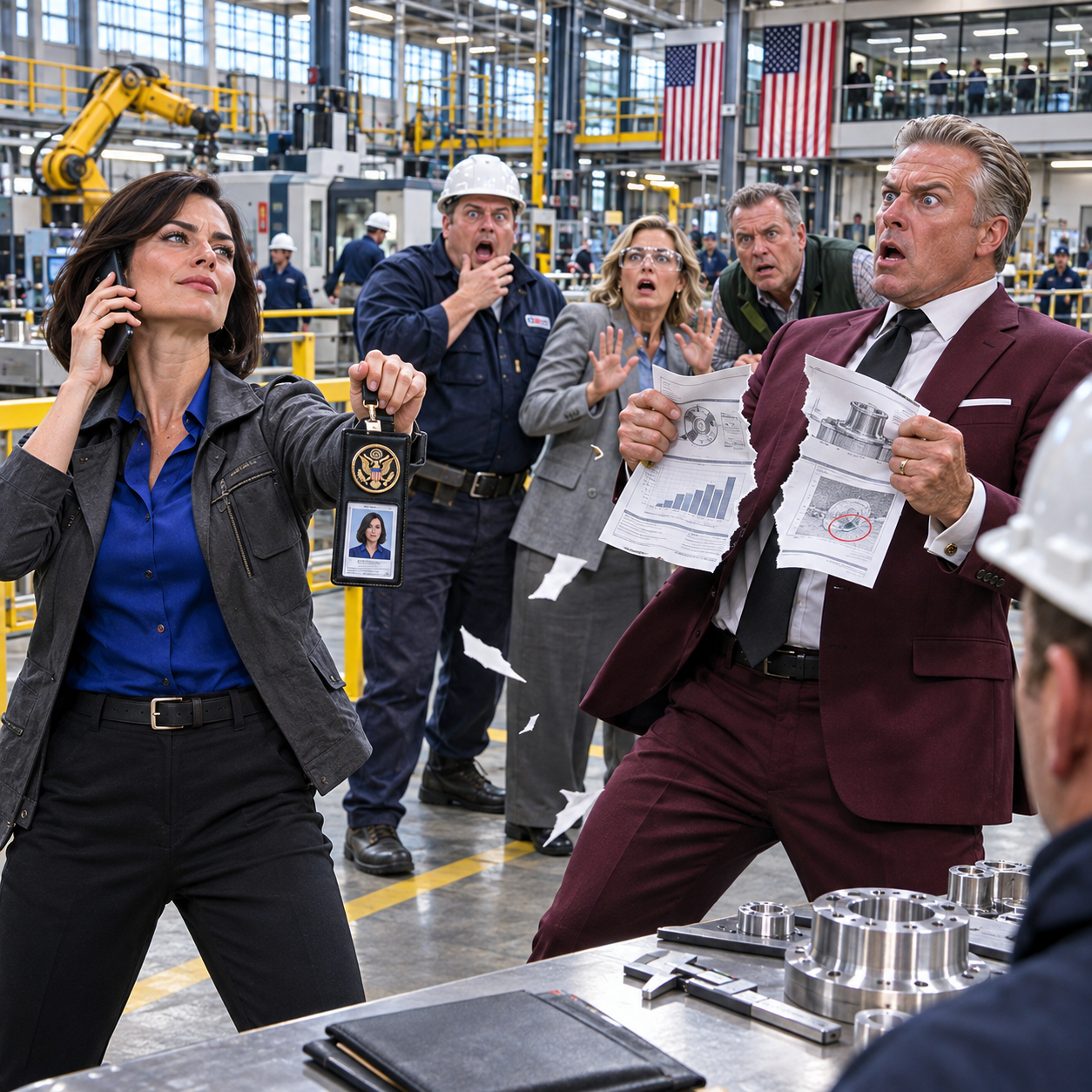
“I Tried To Hand Him The Defect Report.” The New Owner Ripped It In Half: “Temps Don’t Question My Factory.” The Floor Managers Laughed. I Unclipped My Pentagon ID And Called My General: “Fail Their Audit. Pull The $50M Contract.”
When Holden Voss tore my safety report in half, the factory managers laughed and the machinists stayed silent. He called me an eighteen-dollar-an-hour temp and ordered me off his floor, so I picked up the pieces and left. By morning, his fifty-million-dollar Pentagon renewal had been suspended. I thought the trouble began with one shipment of questionable titanium. Then a former inspector called, terrified, and asked me to look for an old calibration book someone had taken pains to erase.
## Part 1
What I noticed about Bellwether Aerospace was the silence between its machines. In a healthy factory, people talk over the whine of cutters, curse at stubborn fixtures, and argue about whose turn it is to clean the coffee pot. At Bellwether, outside Dayton, the men and women operating the lathes kept their eyes down whenever a supervisor crossed the floor. I had spent twelve years investigating defective aircraft components for the Defense Department, and I knew fear could compromise a production line faster than a broken gauge.
My badge identified me as Wren Ellis, temporary inventory clerk, eighteen dollars an hour. My real name was Mara Ellery, and I was an Army major assigned to a defense contract quality team that had received three warnings about Bellwether’s rotor attachment brackets. The assignment had been approved as part of a limited, documented inquiry, which meant my observations could point investigators toward evidence but could never replace independently verified tests. That distinction mattered to me, with a fifty-million-dollar renewal approaching. A rumor could ruin a business, and a missed defect could ruin an aircraft full of people.
The factory had made reliable parts for decades, under its founder, a machinist named Silas Mercer. Six weeks earlier, an investment group led by Holden Voss had bought the plant, announced a bold efficiency program, and replaced the quality director before anyone finished learning the new time-clock software. Workers were now rewarded for faster throughput, while rejected materials had begun vanishing from the system. I had come to find out whether those changes were clumsy management or something deliberate. I hadn’t expected the answer to be sitting in a gray plastic bin beside Line B.
The bin held unfinished brackets tagged as Heat 409, supposedly cut from certified high-strength titanium stock. Their dull surfaces looked ordinary beneath the lights, but one piece had a deep machining mark that should not have appeared after that particular finishing process. I lifted it with gloved hands, checked the tag, and felt the weight of a bad possibility settling into my stomach. Across the aisle, a broad-shouldered foreman with silver in his beard set down his wrench and moved toward me without looking directly at the bin.
“You should be counting boxes in receiving,” he said. His name patch read ELIAS ROOK, and his voice was low enough to vanish beneath the ventilation system. “I was told to reconcile that inventory,” I replied, holding up my clipboard. He studied me for a moment, then nodded toward the mezzanine, where a supervisor watched us through the railing. “Count fast,” he said, “because people who ask about Heat 409 don’t keep their badges long.”
At lunch, I sat beneath a vending machine that hummed louder than the refrigerator in my hotel room. A machinist named June Navarro slid into the opposite chair with a paper cup of instant noodles and asked whether I had found the missing cartons. When I mentioned Heat 409, her fork stopped halfway to her mouth. She said the night shift had complained about unusual tool wear, but management blamed old cutting inserts and ordered the crew to keep moving. Before I could ask more, a floor manager named Travis Pike entered the break room, and June became suddenly fascinated by her noodles.
My approved portable analyzer was secured with the inspection equipment, and later I took comparative readings on material selected through the inquiry’s controlled sampling procedure. The preliminary chemistry did not match the supplier specification; subsequent lab testing would be needed to establish mechanical performance and any actual failure rate. I compared them against the heat certificates attached to the inventory records and found an even more troubling discrepancy. The electronic certificates listed one supplier, while the cartons carried another supplier’s faded shipping code. Somebody had done more than make a purchasing mistake.
I phoned my technical lead from an empty stairwell and described the discrepancy without naming a culprit. She instructed me to preserve the readings, notify the plant’s authorized quality representative, and request a controlled hold before any material moved. That was the correct path, and I intended to follow it. But Holden Voss had just walked onto the floor with two managers and a photographer, smiling as though every machine in the building were a prop for his next investor presentation.
I found the quality office locked, its glass window covered by a taped notice saying all exceptions now required executive approval. The old nonconformance forms were still in a rack beneath the window, so I placed copies of my preliminary observations and the certificate discrepancies inside a red folder. I approached Voss near Line B and introduced myself as the clerk assigned to the affected inventory. “I need someone with authority to stop these brackets from shipping until the material is verified,” I said. “There are conflicting certificates, and the initial readings don’t match the stated alloy.”
Voss looked at my yellow badge before he looked at my face. “An inventory temp is giving me a metallurgy lesson?” he asked, inviting his companions to enjoy the joke. I offered him the folder, explaining that the reports could be checked against the source documents and that the hold would protect his company as much as anyone else. He took the folder, tore it in half without opening it, and let the pages drift onto the concrete between our boots. “You’re just a temp, so get out of my factory,” he said.
The photographer lowered his camera; neither manager said a word. From a machine twenty feet away, June watched with her hand resting motionless on the emergency stop switch, while Elias stared at the damaged papers as if they were something alive. I knelt, collected both halves, and placed them in a clean evidence sleeve from my bag. Voss was already walking away when Travis Pike leaned toward the shipping clerk and said, loud enough for me to hear, “Move the 409 pallets tonight. Don’t put the hold request in the system.”
## Part 2
The guard at the exit accepted my temporary badge without looking up from his phone. I had spent eleven hours in the plant, and my boots smelled of hot coolant, yet what bothered me most was the way Travis Pike had spoken about moving the pallets. He hadn’t sounded confused. He’d sounded like a man trying to finish an errand before anyone changed his mind, which made the departure time more important than Holden Voss’s humiliation of me.
In my rental car, I photographed the torn pages where the damaged edges aligned, logged the time of the exchange, and contacted Colonel Adrienne Shaw, our review coordinator. I explained what the initial instrument readings showed, what I had personally witnessed, and what remained unconfirmed. “Don’t confuse his behavior with proof of the alloy’s strength,” she reminded me, a warning I appreciated. “Get a government lab involved, preserve the source records, and let contracting counsel decide what can be stopped tonight.”
At the hotel, I changed into jeans and spread records across a desk barely wide enough for my laptop. Bellwether’s shipping system showed eighteen crates due out at eight thirty the next morning, all assigned to the same defense production order. The certificates had been uploaded at 2:14 a.m. on Monday, after the procurement records said the titanium had already arrived. That could have been a clerical delay, except the digital files bore the revision initials of an employee whose account had supposedly been disabled during the ownership transition.
I called that former employee, a retired quality inspector named Ruth Halden, using a number from our interview file. She didn’t answer, but her voicemail told callers to leave a message after the tone, followed by the bark of a dog. I asked her to contact our office, then sent the certificate discrepancy to the forensic document team. A part of me still wanted an ordinary explanation: rushed paperwork, a confused receiving department, a manager showing off for investors. Then the first laboratory screening result arrived from an earlier sample provided through the whistleblower channel.
It showed a titanium composition inconsistent with the high-strength grade required by the drawings. The result was preliminary, and we had yet to test a finished bracket under load, but it was enough to justify serious concern about the entire heat. I pictured a maintenance crew tightening those brackets onto a helicopter and trusting markings that should have meant something. My father had been an aircraft mechanic, and he used to say the most dangerous words in a hangar were “probably good enough.” I had never found a reason to disagree.
At nine seventeen, an unfamiliar number lit my personal phone. “This is Elias Rook,” a man said, with traffic rushing behind him. “June gave me the number off the paperwork you left near receiving, and I know you aren’t just counting cartons; I need to tell you something before those trucks leave.” I sat upright and asked him to tell me only what he had seen firsthand. Pike had ordered the night supervisor to sign release tags despite a missing quality approval, and Voss had come to the dock himself to ask whether the trailers would be loaded by sunrise.
“I refused to sign anything, and Pike told me to go home and think about my pension,” Elias said. His voice broke on the last word, not from fear for himself but from anger at being made disposable after twenty-eight years. I told him not to touch the records, confront Pike, or put himself in danger, and gave him a direct number for our protected reporting team. He hesitated, then added, “A woman caught this before, Ruth Halden, and they said she retired, but she cleaned out her locker crying.”
When we ended the call, I checked my email and found a message from a government contracts attorney. Based on the documented quality risk, the pending renewal ceremony had been suspended while the contracting officer prepared written notice, and the agency was seeking immediate access to isolate the suspect stock. The notice did not cancel the existing agreement or declare anyone guilty; those decisions required evidence and process. But the fifty-million-dollar renewal Voss planned to celebrate in front of cameras was no longer going forward in the morning. He had created an emergency by disregarding an opportunity to contain one.
Colonel Shaw joined a secure conference call with the contracting officer, investigators, and the agency quality director. We mapped the shipping chain, identified the carrier scheduled to collect the crates, and arranged an authorized preservation visit at first light. The carrier agreed to delay pickup after being advised that the goods were under a formal quality review. An independent accredited lab received instructions to prioritize additional sealed samples. At ten forty-six, I finally drank the tea I had made two hours earlier; it was cold and tasted faintly of the hotel room’s paper cups.
Shortly before midnight, Ruth Halden returned my call. She sounded older than her personnel photograph, her breathing uneven as she said she had already packed a suitcase. “If you’re asking about the new titanium, you’re looking at the wrong beginning,” she told me. “Ask what happened to the old calibration books, and why the same inspector signed certificates on days he wasn’t even in Ohio.” When I asked which inspector, Ruth went quiet, then named the man I had seen beside Voss: Travis Pike.
I looked again at the certificate bearing Pike’s initials and noticed a second embedded document ID beneath the visible header. It matched a file created four years before Holden Voss bought Bellwether, at a time when the plant’s spotless inspection record had helped it win its first major defense order. Whatever Voss had done to Heat 409, he had stepped into a system that knew how to conceal trouble. At 12:03 a.m., while the heater clicked uselessly, a new message appeared from an internal factory address with no subject line: “They are deleting the old test archive now.”
## Part 3
At six fifteen the next morning, my phone rang. The forensic team had recovered a duplicate of the threatened test archive from an off-site backup, but the live system showed a bulk deletion attempt originating from Travis Pike’s workstation at 11:58 p.m. The backup was being preserved, and investigators documented access. I lay in the dark listening to a truck hiss outside, trying to understand how many people had spent years looking away from the same problem.
I dressed in my Army service uniform, pinned my nameplate straight, and met Colonel Shaw and our technical team beside two government vehicles. Brigadier General Celia Merritt, who supervised the broader quality initiative, had come because Bellwether’s production affected several military programs and because she wanted decisions made without drama. She reviewed the written directives before we left, including the suspended renewal and record-preservation obligations. “We are not here for revenge,” she said. “We are here to keep unverified parts out of aircraft and find out who signed for them.”
Bellwether’s parking lot was crowded with cars that usually belonged to executives, plus a catering van unloading trays of pastries. A banner stretched above the entrance: FIFTY MILLION REASONS TO BUILD THE FUTURE. I recognized the photographer from yesterday standing near a bank of windows, now photographing investors beneath the banner. Inside, the receptionist saw my uniform and did a double take, but it was General Merritt’s identification that made her hurry to call upstairs. We asked to go directly to the receiving dock, where the suspect crates were supposed to be waiting.
As we passed Line B, the machines were running slowly. Elias stood near a tool cabinet, and June gave me the smallest nod before returning her attention to a gauge. Holden Voss appeared on the metal stairs with his tie loosened and a smile he had clearly prepared for a different occasion. He welcomed the general, then saw me. His expression changed in stages: confusion, recognition, calculation, and finally the brief naked panic of a man discovering that yesterday had not ended when he said it did.
“You told me you were a temp,” he said, stopping halfway down the steps. I answered that my temporary assignment had been authorized, and I had given him a straightforward description of the material problem without demanding he accept my word. General Merritt introduced me as Major Mara Ellery, the lead metallurgical specialist documenting the quality concern. Voss looked toward Pike, who stood at the top of the stairs clutching a tablet. Pike’s face had lost its usual color, but he still managed to say, “She disrupted operations, and we thought she was stealing documents.”
“If you believed that,” I said, “why did you order the suspect shipment moved after I requested a hold?” Without an answer, our agency quality representative presented the written inspection and preservation notices, then asked Voss to identify the authorized company official responsible for the pending shipment. He gestured toward Pike and said the details were below his level. General Merritt turned to him. “Ownership doesn’t require you to understand every test,” she said, “but it does require you to respond when someone warns that your product might fail.”
At the dock, the eighteen crates stood beneath fluorescent lights, their straps tight and their shipping labels newly printed. The carrier’s trailer was parked outside, empty, exactly where our coordination with the shipper had left it. We documented the seals, matched the heat numbers to the inventory records, and began a controlled hold of the suspect goods under contract inspection provisions. The lab results were still developing, so I resisted the temptation to speak in final conclusions. I showed Voss the contradictory material certificates and the preliminary elemental readings, then placed the torn report on the inspection table between us.
For the first time, he studied the numbers. “Fine, if it’s the wrong titanium, we’ll remachine the brackets,” he said, as though conceding a sales point, “and my people can fix the paperwork.” I explained that machining could not turn an incorrect material grade into certified stock and that some components might need to be destroyed. He swore under his breath and asked whether we understood how much a delayed renewal would cost. “That’s a financial question,” I said, “but ours is whether these parts can safely enter the supply chain.”
The contracting officer joined by secure call while two investors hovered near the dock doors. She confirmed that the morning renewal event had been canceled, and that an award could not proceed while the supplier’s material controls and certifications were under serious question. She was also reviewing available remedies under the existing agreement; no one had yet signed a final termination. One investor stepped away to make a phone call, another opened his laptop, and Voss’s carefully staged celebration began collapsing without a single raised voice. The photographer was already taking down the banner.
Then a forensic specialist showed me a photograph of the deleted archive’s index. It listed hundreds of retired inspection entries, including rejected brackets from four years earlier that had later been marked accepted with no new test results. Beside several entries were electronic approvals attributed to Pike, who had been the quality systems supervisor even before the sale. Voss looked over my shoulder and said something that changed the room. “We paid extra for that clean historical compliance record,” he muttered, “and they promised there were no old failures.”
Pike stepped backward toward the stairs, but Elias had appeared in the doorway and was watching him. I wondered whether Voss was telling the truth about the purchase or trying to create a defense before anyone asked about his own decisions. Then the specialist scrolled down to a scanned letter dated five years earlier, addressed to Bellwether’s founder and copied to Pike. It warned that a sample-substitution practice could conceal dangerous parts, and it bore Ruth Halden’s signature. Below hers, in ink dark enough to survive every scan, was a second acknowledgment: HOLDEN VOSS, RECEIVED.
## Part 4
For several seconds, no one spoke. Voss reached toward the scanned letter, but the specialist tilted the tablet away, preserving a record that had already been secured independently. “That can’t be right,” Voss said, “because I didn’t own this place five years ago.” I agreed that he hadn’t, then asked why his name appeared on a warning about sample substitution during a period when he claimed to know nothing about Bellwether. He refused to answer until his attorney arrived, which was the first sensible decision I’d seen him make.
Our immediate work didn’t stop for his silence. A government laboratory confirmed that the retained Heat 409 samples were not the specified aerospace-grade titanium and lacked the required documented mechanical properties. The sample results could not tell us exactly how every finished bracket would perform, or where the next problem would emerge, but they were enough to reject the heat pending comprehensive assessment. The quality team expanded the hold to associated work orders and began tracing whether anything from that heat had moved beyond the plant. Every hour spent on those records reduced the chance that an unverified component would reach a maintenance hangar.
Near midday, I met Ruth Halden in a small office at the county library, accompanied by an investigator authorized to take her statement. She carried a shoebox of old notebooks wrapped in a kitchen towel, and her hands trembled as she set them on the table. Five years earlier, she said, a newly installed automated testing system had repeatedly recorded results for samples that weren’t physically in the lab. Management had been under pressure to win an expansion contract, and Travis Pike had discovered how to reuse passing measurements from certified lots. At first, Ruth had thought the errors were a software problem.
When she challenged Pike, he told her the production pieces had passed “somewhere in the system” and that repeating tests would make the plant miss deliveries. Ruth documented the discrepancies, wrote a formal letter to founder Silas Mercer, and copied an outside financial adviser who was reviewing the company’s quality exposure during a refinancing. That adviser was Holden Voss, then a junior partner at a manufacturing investment firm. She showed me a registered-mail receipt bearing his signature, along with a reply from his office saying the concern had been “addressed internally.” The testing discrepancies continued anyway.
“Silas told me shutting down would destroy families,” Ruth said, rubbing the towel, “as if asking for honest tests was the selfish choice.” She had been offered an early retirement package, and Pike was promoted after she left. She had spent years wondering whether a defective part would hurt somebody and whether the people who once trusted her had decided she was a troublemaker. I told her that her records could help us separate genuine evidence from what the live database claimed. I didn’t tell her everything would be fine, because I couldn’t know that yet.
The recovered archive identified twenty-seven historical lots needing review, several shipped under earlier contracts and some potentially installed in service aircraft. Our agency issued technical alerts through the appropriate program offices, helping maintainers identify affected serial numbers and prioritize inspections before another unit unknowingly installed a questionable replacement during routine maintenance operations. There was no confirmed accident linked to those lots, a fact I repeated whenever anyone tried to turn uncertainty into a headline. What frightened me was the pattern of missing negative results, not a dramatic test chamber explosion. A system built to conceal exceptions could make almost any certificate look reassuring until somebody checked the underlying measurements.
Back at Bellwether, the union committee met in the cafeteria beneath a wall of employee service photographs. Elias asked the question everyone had been carrying since the trucks stopped moving. “If the Pentagon walks away, what happens to the two hundred people who didn’t sign those forms?” I explained the distinction between isolating suspect production and shutting down every legitimate job, while Colonel Shaw described the agency’s conversations with the contracting officer and possible qualified replacement suppliers. I couldn’t promise a painless outcome, only that their firsthand knowledge would be treated as evidence, not as collective guilt.
June stood and described being ordered to replace worn tooling without recording why the inserts were failing. Another machinist admitted he had copied inspection identifiers when the electronic system refused to accept new entries, after Pike called the errors routine. They weren’t confessing to a conspiracy; they were explaining the small accommodations a frightened workforce had been trained to make. Elias finally revealed that he had kept a handwritten log of every material tag he disputed, tucked behind the drawer of his garage workbench. He offered it to the investigators, and for the first time that day the room sounded like people speaking without permission.
By evening, the investors had removed Voss from operational control pending an independent investigation, and Bellwether’s lenders had appointed a turnaround manager with experience in regulated manufacturing. The existing contract was placed under heightened oversight while contracting officials considered suspension, corrective action, and termination remedies. A prospective buyer agreed to fund a limited payroll bridge and keep the unaffected machining lines staffed while the plant’s future was negotiated; it was a business decision contingent on verified orders, not a rescue invented by a general. Some workers would still face genuine uncertainty, and I knew what that meant for mortgages and daycare bills.
Investigators eventually retrieved Voss’s internal acquisition presentation. Buried in its appendix was a slide labeled LEGACY QUALITY EXPOSURE, citing Ruth’s five-year-old warning as a reason to demand a lower purchase price. A later slide projected an eighteen-percent margin gain through reduced material and inspection costs. Voss hadn’t merely inherited a compromised system and discovered it too late; he had already identified the weakness, used it to negotiate his acquisition, and then pushed it harder. Another note in the presentation caught my eye: “Verify Mercer side agreements before renewal,” suggesting the missing failures had helped somebody besides Pike and Voss.
## Part 5
The side agreements were not secret bank accounts or dramatic envelopes of cash. They were ordinary service invoices from a small outside laboratory, renewed every quarter and described as expedited certification support. Investigators found that the laboratory had been paid for tests it could not have performed: its equipment was offline on several recorded dates, and its technician had left the company months before his initials appeared on approvals. The payments had begun under Silas Mercer, long before the takeover.
There was no dramatic confession, just invoices nobody had challenged. His reputation as a careful machinist had become a shield for practices he allowed because he feared losing contracts. His former employees remembered his generosity, but generosity had never been a substitute for the willingness to accept bad news.
Mercer agreed to an interview after investigators served preservation notices on his former business partners. He arrived wearing an old Bellwether jacket, its faded logo almost identical to the one sewn onto Elias’s work shirt. “I never ordered anybody to put bad metal on an aircraft,” he said, but the investigators asked why he approved invoices after Ruth reported unreliable tests. He looked at the tabletop and admitted he had accepted Pike’s assurance that the problem was administrative. Asked why he pushed Ruth out rather than verify her evidence, he stopped speaking.
That silence was harder for me to hear than Voss’s insults. Voss had been easy to recognize as reckless because he performed his contempt in public; Mercer’s choices had been wrapped in concern for payroll and the families who relied on him. Both men had treated the consequences of accurate testing as more frightening than the consequences of inaccurate testing. The distinction did not disappear because one man drove a luxury car and the other still wore a decades-old jacket. I thought of Ruth carrying her notebooks into retirement, convinced that every unanswered question was hers alone.
The independent review took weeks, not hours. Several older lots passed new verification, others remained under restriction, and a small number of components were replaced as a precaution where their documentation could not establish reliable traceability. No one could claim those parts would certainly have failed in flight; the danger lay in certifying performance that had never been demonstrated. Investigators referred evidence of falsified records to federal authorities, and civil proceedings began against individuals and businesses linked to the approvals. Prosecutors would decide whether criminal charges were warranted, and the people accused would have a chance to respond.
The pending fifty-million-dollar renewal never received a signature. After reviewing the material substitutions, destruction of the warning, and unreliable quality controls, the contracting authority declined to award it to Voss’s company. Work under existing orders was separated from the tainted lots and reassigned where legally and technically possible, while Bellwether negotiated a transfer of its usable equipment and qualified staff to a supplier with an established inspection program. Voss’s investors sought to recover losses from him, and he later faced a civil complaint tied to his representations about quality compliance. His public interviews stopped.
The consequences weren’t tidy. Two shifts were shortened during the transition, and families argued over whether staying at the factory was worth another round of uncertainty. The payroll bridge kept employees paid while the new operator qualified its processes, but several workers accepted jobs elsewhere rather than gamble their savings. Our agency couldn’t fix that with a speech or a medal. I spent more time answering technical questions from the new inspection team than attending meetings about executive misconduct, because the objective had always been reliable parts, not an impressive ending to someone’s career.
Ruth testified about the archived test results and turned over her notebooks. Elias provided the handwritten tag log, including dates that allowed investigators to reconstruct which materials had been quarantined, reclassified, or quietly returned to production. June helped the new quality manager redesign the reporting screen so a failed measurement couldn’t be overwritten without a visible explanation and independent review. Those changes sounded boring when described in a conference room. On the factory floor, they meant a machinist could stop a questionable part without betting the next mortgage payment on whether a supervisor liked being challenged.
Four months later, I returned to Bellwether for a scheduled follow-up. The entrance banner was gone, replaced by a plain sign naming the new operator, and the floor smelled of coolant, hot metal, and coffee as terrible as I remembered. The workers still wore hearing protection and argued about the break room thermostat. That was the sound I had missed on my first visit: ordinary irritation, the kind people allow themselves when they aren’t afraid of every manager who passes. At Line B, Elias was checking a set of brackets beside a newly installed testing station.
He had become operations director, a promotion that embarrassed him enough to make him complain about the paperwork. “We had a bad morning last week,” he said, showing me a rejected part and the electronic record of its failure, “because we scrapped a whole lot, and the customer wasn’t happy.” He waited for my reaction, then gave a small, crooked smile. “But nobody asked us to make the test disappear,” he said. I signed the inspection acknowledgment after checking the calibration records, the original heat certificate, and the independent measurements, all of which matched.
Before I left, June handed me a folded copy of the new reporting policy, marked with grease from the corner of her glove. At the bottom, written in a dozen different handwritings, were the names of employees who had helped revise it, including Ruth’s. Ruth signed hers in blue ink, and I kept that page in my briefcase, not the red folder Voss had torn, because it represented something more durable than proof of a man’s arrogance. He had thought my temporary badge made me harmless. What finally cost him his deal was the decision to destroy a warning, and what saved the work was a factory learning to listen.
THE END!
Disclaimer: Our stories are inspired by real-life events but are carefully rewritten for entertainment. Any resemblance to actual people or situations is purely coincidental.