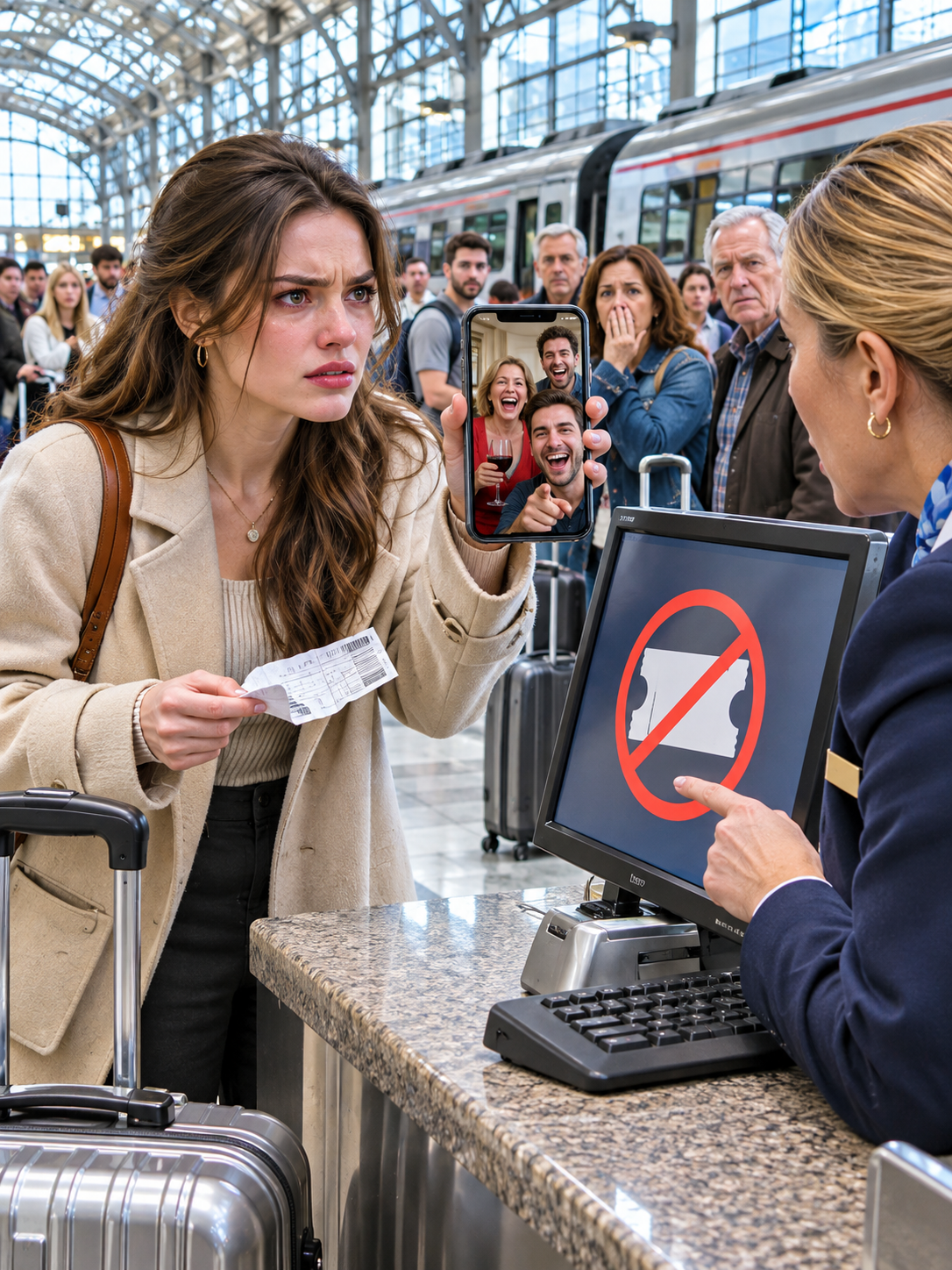
## Part 2: Their Declined Cards Revealed What Their Apologies Were Really Worth
The train gathered speed, its wheels striking the tracks in a steady rhythm. Outside my window, houses slipped past with yellow light glowing behind their curtains. I imagined families eating dinner, arguing about ordinary things, then clearing plates together. I wondered how many of those people knew what it felt like to be loved without being useful.
My phone kept lighting up.
Tyler called four times before leaving a voicemail.
“Maddie, seriously, what’s happening? I’m at the gas station, and my card won’t work. You can’t just mess with my money.”
I nearly answered.
Then I remembered that the card was mine.
He’d been an authorized user for eleven months, ever since he’d promised to use it only until his finances improved.
Last weekend, he’d used it to buy expensive sneakers.
When I questioned the charge, he’d called me controlling.
The next message came from Brandon.
“My rent transfer isn’t showing. Did you cancel it? Fix this before my landlord gets involved.”
Then Rachel.
“We can’t even order dinner. What’s wrong with the cards?”
I waited for one person to ask whether I’d found another train.
Nobody did.
The conductor stopped beside my seat, and I handed him my replacement ticket. He scanned it, nodded, and moved along. Such a small exchange, yet I felt an unexpected rush of relief.
For once, I had solved my own problem without rescuing someone else first.
At 10:38, I arrived in Philadelphia.
Rain had turned the sidewalks silver. I walked three blocks to a modest hotel I’d booked for my interview, checked in, and carried my suitcase into a room with faded carpet and an air conditioner that rattled whenever it started.
It wasn’t beautiful.
But nobody inside expected me to pay their bills.
I sat on the bed and listened to my mother’s voicemail.
“Maddie, honey, something’s wrong. I checked the account for the mortgage payment, and the money isn’t there. Please call me.”
A second message followed.
“Your brother says you canceled everything. Surely you aren’t going to punish your whole family over a little joke?”
I stared at the wall.
A little joke.
That was what she called taking away my ticket before an important interview, driving home, and laughing while I tried to board a train.
I opened our message thread.
“You knew why I needed that train,” I typed. “You knew I had an interview tomorrow.”
Her reply came immediately.
“Then you should’ve taken a joke and called us for a ride.”
I read those words until the screen dimmed.
There was no apology.
Only the familiar expectation that I would accept whatever they did, repair whatever they broke, and somehow feel guilty for being hurt.
Then Rachel requested a video call.
I answered.
Her hair was messy, and her eyes were red. Somewhere behind her, I heard a television playing.
“Maddie, you have to stop this,” she said. “The kids need food. I don’t have enough money.”
My stomach tightened.
Her children were eight and six. Whatever Rachel had done, they deserved no part in our argument.
“Are the kids safe?”
“Yes, but—”
“Do you have breakfast for them?”
She hesitated. “Some cereal.”
“I’ll order groceries for them to pick up tomorrow. I’ll pay the store directly.”
Her expression changed.
“What about everything else?”
“What about it?”
“Rent. Utilities. My card.”
“Those are your responsibilities, Rachel.”
She stared at me.
“You’ve never talked to me like this.”
“I’ve never been left at a train station for entertainment before.”
She wiped her eyes, then glanced toward someone outside the camera.
I heard my mother’s voice.
“Ask her about the mortgage.”
Something inside me went still.
Rachel closed her eyes.
I ended the call.
Then I ordered groceries for my niece and nephew, arranging pickup at a nearby supermarket. I sent Rachel the confirmation and made it clear that helping the children did not mean restoring her access to my accounts.
For another hour, the messages arrived.
Tyler accused me of being selfish. Brandon warned that his landlord would become angry. My mother said a missed mortgage payment could eventually put the house at risk.
I knew she was frightened.
I also knew the mortgage wasn’t suddenly in foreclosure because one expected transfer hadn’t arrived.
They’d grown so accustomed to my money appearing that they no longer planned for anything else.
Finally, I wrote one message in our family group chat.
“You canceled my ticket because watching me panic amused you. I’ve canceled the financial arrangements I can no longer afford emotionally or financially. I won’t argue about it tonight.”
Tyler immediately replied.
“So you’re trying to ruin us?”
I looked at the new train ticket resting on my nightstand.
“No,” I wrote. “I’m no longer willing to ruin myself to keep you comfortable.”
I switched off my phone.
For the first time in years, I slept without checking whether someone needed money.
But when I woke the following morning, an unexpected message from Rachel was waiting.
It contained a screenshot from a family group conversation I’d never been invited to join.
And what I saw changed the meaning of everything that had happened at the station.
## Part 3: A Secret Family Conversation Revealed Why They Canceled My Train
Morning sunlight slipped through the hotel curtains while I enlarged Rachel’s screenshot.
The group conversation was dated the previous afternoon.
Its name was “Operation Keep Maddie Home.”
I stared at those four words.
My mother’s message appeared first.
“If she gets that job in Philadelphia, who’s going to help us with the house?”
Tyler had answered.
“She’ll still send money. She always does.”
Then Brandon wrote something that made my fingers turn cold.
“Cancel her ticket after we drop her off. She’ll have to come home, miss the interview, and quit talking about moving.”
My mother had responded with a laughing emoji.
Then she’d written, “Maybe she’ll finally understand family comes first.”
I read the messages again.
And again.
The canceled ticket hadn’t been an impulsive prank.
It had been a plan.
They hadn’t simply wanted to laugh at me.
They wanted me to miss an opportunity that might finally make me independent of them.
Rachel had included one final message.
“I was part of it. I thought we’d pick you up after a few minutes. I didn’t know Mom and Tyler wanted you to miss the interview. I’m sorry.”
My first instinct was to call her.
Instead, I placed the phone on the desk and looked at the interview clothes hanging beside the bathroom door.
A navy jacket. A white blouse. Black trousers I’d pressed before leaving home.
I’d saved for weeks to make this trip.
Two months earlier, my supervisor had encouraged me to apply for a senior financial analyst position in Philadelphia. It offered better pay, more responsibility, and a chance to build a life that didn’t revolve around family emergencies.
When I’d told my mother, she hadn’t congratulated me.
She’d asked how far Philadelphia was from home.
Then she’d asked whether I’d still be able to help with the mortgage.
At the time, I’d mistaken her reaction for fear of losing her daughter.
Now I understood that she was afraid of losing something else.
At nine o’clock, I stood in front of the bathroom mirror and fastened my jacket.
I looked exhausted.
But I also looked like someone who had finally stopped apologizing for existing.
The interview began at ten.
Three people sat across from me at a polished conference table. The hiring manager, a gray-haired woman named Patricia, reviewed my résumé and asked how I’d handled difficult financial decisions.
For a moment, my mind returned to the station.
Then I answered.
“I’ve learned that keeping something running isn’t always the same as keeping it healthy. Sometimes you have to stop funding a problem before anyone will take responsibility for solving it.”
Patricia studied me for a second.
Then she smiled.
“That’s an interesting way to put it.”
For the next hour, we talked about budgets, reports, deadlines, and managing complicated accounts.
For once, my ability to handle money was being treated as professional skill instead of a family obligation.
When I left the building, the rain had stopped.
I walked to a café, ordered coffee, and turned my phone back on.
Thirty-seven missed calls.
Twelve voicemails.
One message from my mother stood above the rest.
“Come home. We need to discuss what you’ve done.”
I called her.
She answered on the first ring.
“Oh, thank goodness. Madison, listen to me—”
“I saw the group messages.”
Silence.
I heard a chair scrape against the floor.
“What messages?”
“The ones where you planned to make me miss my interview.”
Her breathing changed.
“Rachel had no right to show you that.”
“Is that your apology?”
“Sweetheart, you don’t understand. The house is expensive. Tyler’s struggling. Brandon needs help. I was terrified you’d move away and forget about us.”
I gripped my coffee cup.
“So you tried to sabotage my future?”
“We were only trying to keep the family together.”
“No, Mom. You were trying to keep my paycheck close.”
She began crying.
For years, that sound had been enough to make me surrender. I’d sent money to stop her tears, apologized to stop her anger, and canceled plans to keep the peace.
But something was different now.
I could hear her crying without believing I had caused everything wrong in her life.
“I worked double shifts while Tyler took vacations,” I said. “I paid late fees while you bought party clothes. I covered Brandon’s rent while he ordered new electronics. And whenever I asked for repayment, you called me selfish.”
“That isn’t fair.”
“Neither was what happened yesterday.”
Her voice hardened.
“Are you really going to abandon your mother?”
I looked down at Rachel’s screenshot.
The answer was suddenly simple.
“I’m not abandoning you. I’m refusing to be sacrificed.”
She started speaking again, but I interrupted.
“The canceled payments aren’t coming back. You need to call the mortgage company and make a plan. Tyler needs to pay his own bills. Brandon needs to speak with his landlord. Rachel needs a budget that doesn’t depend on my credit cards.”
“You make it sound so easy.”
“It wasn’t easy when I was doing it for everyone.”
I ended the call.
For several minutes, I sat without moving.
Then an email appeared from Patricia.
She wanted a second interview the following afternoon.
I covered my mouth, suddenly overwhelmed.
My family had tried to make me miss the opportunity of a lifetime.
Instead, I was still here.
And the opportunity was still waiting.
## Part 4: I Chose My Future While My Family Faced the Truth
The following afternoon, I returned for my second interview.
This time, I didn’t check my phone before entering the building. I didn’t worry about Tyler’s car payment or whether Brandon had argued with his landlord. I focused on the questions, the people across the table, and the career I’d worked so hard to build.
When Patricia shook my hand afterward, she said, “Madison, I think you could do very well here.”
I carried those words back to the hotel like something fragile and precious.
That evening, I listened to the voicemails I’d ignored.
Tyler’s anger had softened into frustration.
“I talked to the bank. I can make the car payment if I stop spending so much. I just didn’t think I’d have to figure everything out this month.”
Brandon had left a shorter message.
“My landlord agreed to give me a little extra time if I make a partial payment. I’m looking for a roommate.”
Then came Rachel.
“The groceries were ready. Thank you for making sure the kids had what they needed. I shouldn’t have used them to make you feel guilty.”
I replayed her message.
It was the first time anyone had acknowledged doing something wrong without immediately asking me to fix another problem.
My mother’s voicemail came last.
Her voice sounded smaller than I’d ever heard it.
“I called the mortgage company. They explained the options if I can’t make the full payment. I should’ve done that instead of expecting you to take care of everything.”
She paused.
“I keep thinking about the station. About you standing there with your suitcase while we were laughing.”
Another silence.
Then she said, “I knew how important that interview was. I wanted you to come home because I was scared of what would happen if you didn’t need us anymore.”
I sat on the edge of the bed.
There it was.
The truth beneath every joke, every demand, every accusation that I was selfish.
My mother didn’t simply want her daughter nearby.
She wanted to remain certain that I could never choose a different life.
“I was wrong,” she whispered. “And I’m sorry.”
I wanted that apology to erase what had happened.
It didn’t.
But I was grateful she’d finally said it.
I called her the next morning.
“Mom, I heard your message.”
“Are you coming home?”
“Not right now.”
She exhaled slowly.
“I understand.”
“I love you,” I said. “But I can’t keep paying for everyone’s lives.”
“I know.”
“And if we’re going to have a relationship, things have to change. No more jokes at my expense. No more demands. No more treating my money as something you’re entitled to.”
She was quiet for a long time.
Then she said, “I don’t know how to be the mother you need.”
My throat tightened.
“Maybe we can figure that out. But you have to start by being responsible for yourself.”
We ended the call without making promises neither of us knew how to keep.
Over the next ten days, I stayed in Philadelphia.
I walked unfamiliar streets, visited apartments, and began imagining what my mornings might look like if I woke up thinking about my own future instead of somebody else’s overdue balance.
I still checked on Rachel’s children. I made sure they were safe and that she understood where to find help when money was tight. But I stopped sending cash whenever someone became uncomfortable.
That distinction changed everything.
Tyler picked up extra shifts. Brandon found a roommate willing to split his rent. Rachel began tracking her expenses instead of assuming she could use my cards.
My mother rented out the spare bedroom and arranged a payment plan with her lender.
None of them enjoyed these changes.
Neither had I enjoyed working overtime to finance their comfort.
One Friday morning, Patricia called.
“Madison, we’d like to offer you the position.”
For several seconds, I couldn’t speak.
Then I laughed.
Not the cruel laughter I’d heard from my family at the station.
A startled, breathless laugh of relief.
“Yes,” I said. “I’d love to accept.”
After we hung up, I sat beside the hotel window and cried.
I cried for the twenty-three-year-old who’d emptied her savings to cover Tyler’s rent. For every birthday I’d spent working late because somebody needed help. For the countless nights I’d convinced myself that being exhausted was simply the price of being a good daughter.
Most of all, I cried because I finally understood something I’d refused to believe.
I could love my family without funding their choices.
I could forgive an apology without immediately restoring access to my life.
And I could walk away from people who hurt me without wishing them harm.
Three weeks later, I moved into a small apartment with wide windows and a view of a tree-lined street.
On my first evening, I unpacked the suitcase I’d dragged through the station that night.
At the bottom was the canceled ticket confirmation.
I held it in my hands, remembering the bright lights, the clerk’s sympathetic expression, and my mother’s laughter.
For a moment, I considered throwing it away.
Instead, I slipped it into the back of a drawer.
Not because I wanted to remember being humiliated.
Because I never wanted to forget what happened when I finally stopped accepting it.
That Sunday, my mother called again.
She didn’t ask for money.
She asked how my apartment looked.
I told her about the sunlight pouring through the windows, the little kitchen, and the coffee shop around the corner.
She listened.
Then she said something I hadn’t heard from her in years.
“I’m proud of you, Madison.”
I closed my eyes.
“Thank you, Mom.”
We talked for another ten minutes.
There were still wounds between us. Trust wouldn’t return because of a single conversation, and I had no intention of pretending otherwise.
But for the first time, our relationship wasn’t built around a payment deadline.
After hanging up, I stepped onto my balcony.
A train passed in the distance, its whistle drifting above the city.
I thought about how differently that night could have ended.
I could have called Tyler, apologized, and begged him to pick me up. I could have returned home, laughed along with everyone, and spent another year proving how much I loved them by making myself smaller.
That was what they’d expected.
But the final twist was something none of us had anticipated.
Their plan had been to frighten me into staying.
Instead, it had given me the courage to leave.
I hadn’t canceled my family’s future. They were finally learning to take responsibility for it.
And the woman they’d abandoned at the station?
She hadn’t been left behind at all.
She’d simply boarded a different train.
One that was finally taking her somewhere she wanted to go.
THE END.
All characters and events in this story are fictional, created for storytelling and entertainment purposes. Thank you sincerely for reading. Your feedback and support are invaluable and motivate me to continue sharing more stories with you.