“She Eats Last, After My Soldiers, And Only If There’s Anything Left.” The Major Said It Loud Enough For 140 Soldiers In The Sleet. I Walked To The Back. A Private Set His Tray Down. “Pick That Back Up. Now.”
Major Grant Hensley pointed toward the back of the chow line and announced that I would eat only after his soldiers, assuming they left me anything. His officers laughed, and I quietly obeyed. But when a nineteen-year-old private set down his dinner, 139 others followed, standing hungry in the freezing sleet rather than accept what their major had done. By morning, a forgotten convoy report from seven years earlier had resurfaced, and the truth behind one soldier’s death was beginning to unravel.
Part 1/5
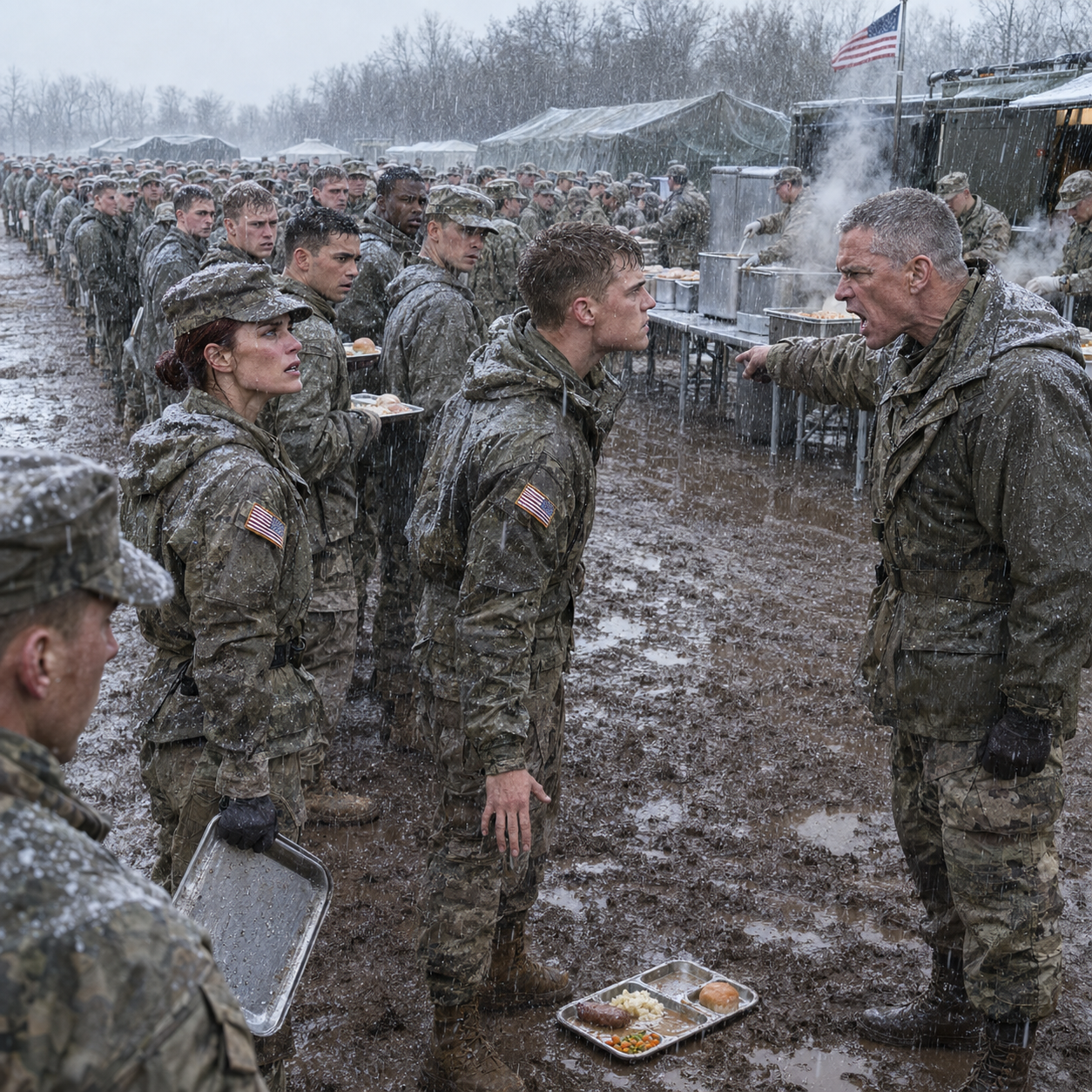
The first thing I noticed was the sound of sleet striking the canvas roof. The second was the way Major Grant Hensley smiled when he decided to humiliate me. “She eats last,” he told the kitchen crew, speaking loudly enough for every soldier beneath that sagging tarp to hear. “After my men are finished, and only if there’s something left.” Two officers standing beside him laughed, although one hesitated just long enough to make it obvious he was laughing because his superior expected him to.
I stood beside a stack of empty fuel containers with rainwater dripping from my hood and felt 140 pairs of eyes turn toward me. It was February at the National Training Center in Fort Irwin, California, and the Mojave Desert was doing its best impression of a miserable northern winter. Wind swept across the training area, carrying a mixture of freezing rain and sleet that soaked through gloves and gathered in the folds of our uniforms. Somewhere behind the serving table, a diesel burner rattled beneath a pan of chicken and rice, filling the cold air with the smell of onions, steam, and burnt fuel.
“Understood, sir,” I answered.
That was all I gave him. No argument, no wounded expression, and certainly no explanation of why his words had landed somewhere he couldn’t possibly understand. I turned away from the serving table and started walking toward the end of the line, my boots sinking into the muddy ground.
My name is Master Sergeant Tessa Whitcomb, and at forty-one years old, I had spent more than twenty years in the United States Army. I wasn’t assigned to Major Hensley’s battalion, at least not anymore. I was an observer-controller-trainer, which meant I followed units through exhausting simulated combat operations, documented their mistakes, and explained afterward how those mistakes might cost lives in an actual deployment.
That assignment did not make me popular, especially with officers who mistook criticism of their plans for criticism of their character. The previous evening, I had informed Hensley that his distribution schedule had left two infantry companies without hot meals for thirty-six hours. I had also pointed out that his field kitchen had less than two days of usable fuel and that the convoy route he intended to reuse had already been disrupted twice during the exercise. He listened without interrupting, then told me that observers should learn to observe instead of interfering with command decisions.
At five that morning, Sergeant First Class June Kessler had confirmed my calculations inside our freezing observation truck. June was thirty-eight, a former transportation specialist from Idaho who could estimate a truck’s remaining fuel by listening to its engine and had no patience for officers who treated logistics like paperwork. She had tapped the clipboard against the dashboard and said, “He’s going to blame you when those companies miss another meal.” I had answered that our responsibility was to identify the problem, not make ourselves liked by the people responsible for fixing it.
Now, thirteen hours later, Hensley had found his opportunity to make a point. He didn’t know that I hadn’t come to his kitchen for dinner. I had come to verify the remaining fuel inventory before completing my assessment, but explaining that would only have made him look foolish in front of his soldiers. I had learned years earlier that wounded pride in a command position could become dangerous when everyone nearby was expected to protect it.
What Hensley also didn’t know was that I recognized the battalion insignia painted on his vehicles. Seven years earlier, I had served in that same unit as a first sergeant, leading the enlisted soldiers of its forward support company through one of the hardest deployments of my career. Most of the officers were new, and I had convinced myself that everyone who remembered me had either transferred or left the Army. Then, on the second day of the rotation, Sergeant First Class Amos Duvall had turned around in the field kitchen with flour on his sleeves and nearly dropped the ladle in his hand.
Amos had been a young specialist when I first met him overseas. I remembered him singing old country songs while stretching rations into meals and pretending he wasn’t afraid whenever distant explosions shook the kitchen equipment. He was now responsible for the battalion’s food operations, and when he recognized me, I gave him a small shake of my head. He understood immediately and spent the next week treating me exactly like any other evaluator.
The line that evening stretched beyond the tarp into a darkness broken by portable work lights. Soldiers stood shoulder to shoulder, their ponchos shining with freezing water, waiting for their first decent meal since the previous day. I passed a young private with freckles across his nose and a name tape reading MADDOX, who held a paper tray with green beans and a bread roll sliding dangerously toward the edge.
He stared at me as though trying to match my face with something he had heard. I continued walking, keeping my eyes on the muddy ground ahead of me. Behind me, a tray scraped against the wooden serving table, followed by the sudden silence of someone who had stopped moving.
“Private Maddox,” Major Hensley snapped, “pick up your dinner.”
I stopped walking. The private had placed his tray on the table, and although his hands were trembling from the cold, he made no attempt to retrieve it. Then I heard him say something so quietly that the wind nearly carried it away.
“Sir, I don’t think she’s supposed to eat alone.”
I turned around, and for the first time that evening, I recognized something in the expressions of the soldiers watching me. It wasn’t pity, and it wasn’t outrage at a superior’s insult. It was recognition, the unsettling kind that reaches backward into a life you believed everyone had forgotten.
Part 2/5
Seven years earlier, I had commanded no one above me and very nearly run out of food for everyone below me. Our forward support company had deployed to an isolated position in eastern Afghanistan, where a narrow mountain road connected our outpost to the nearest reliable supply point. The installation consisted of reinforced shelters, plywood buildings, fuel storage areas, and a kitchen tent that never quite lost the smell of diesel. We had barely settled into our routine when a rockslide closed the access road, followed by a storm that made helicopter resupply impossible.
The supply report said we had enough food for two days. The weather forecast suggested the road could remain closed twice that long, and no one at the outpost liked what those numbers meant. I remember standing with Amos Duvall beside a row of half-empty ration containers while he worked calculations on the back of a cardboard box. He looked at me and said, “First Sergeant, I can make this last longer, but I can’t manufacture dinner.”
I grew up outside Fayetteville, Arkansas, where my grandmother fed half our church every Sunday without ever having enough money to explain how she managed it. She taught me that a kitchen revealed more about a person’s character than almost any other room in a building. When I joined the Army, I started in food service because I understood the work, and later I became a first sergeant because I understood what happened to people when leaders forgot the basics. So I took a marker, wrote a rule on cardboard, and taped it beside the serving line: Privates first. Sergeants next. Officers afterward. First sergeant last.
A young captain challenged me that morning because he wanted breakfast before a briefing. I explained that the nineteen-year-olds returning from overnight guard duty would eat before either of us, and he reminded me that he outranked me. “Yes, sir,” I told him, “which means you understand exactly why you should wait.” He stared at the line behind him, adjusted his gloves, and quietly joined the end without another complaint.
For four days, Amos stretched rice, canned vegetables, and whatever protein remained into meals that looked less impressive every time he opened a serving container. We reduced portions, prioritized the soldiers working the longest shifts, and kept a careful record of every box brought out of storage. I noticed the younger soldiers watching their leaders’ plates, trying to determine how worried they should be. That was when I began slipping my own food back into the kitchen, pretending I had already eaten in the operations tent.
By the third evening, my hands shook when I tried to write, and the smell of food made my stomach ache. I had convinced myself I could manage another day when I found an eighteen-year-old private named Owen Bell sitting alone beside an equipment shelter. He had just finished twelve hours of security duty, and the only things left on his tray were a few crackers and a spoonful of peanut butter. He was crying without making a sound, his shoulders hunched as if embarrassment were heavier than exhaustion.
I sat beside him and placed the emergency crackers from my pocket on his tray. He looked up with the bewildered expression of someone who had expected another lecture about endurance. “Eat, Owen,” I said, and I remained there until he finished, discussing the weather and the football team he missed watching back home. He thanked me three times before returning to his barracks, while I stayed outside looking at the empty wrapper and trying not to think about breakfast.
The following morning, I climbed onto a generator platform to check a fuel gauge and woke on the ground with a medic leaning over me. Amos stood nearby, holding a bowl of soup he had saved without telling anyone. He watched me eat every spoonful and then said, “You can’t make everyone else strong by becoming the weakest person here.” The helicopters arrived that afternoon, bringing supplies and mail, and I remember hearing the soldiers cheer while Amos quietly placed another serving of soup in front of me.
That should have been the story I carried home, but September brought a different kind of shortage. We had resumed regular supply convoys, and a distribution platoon leader named Lieutenant Nolan Sutter was responsible for moving fuel and food to the outpost. Nolan was twenty-three, bright and eager, the sort of officer who studied the regulations carefully but still believed confidence could overcome bad judgment. I liked him, which made what happened next considerably harder to live with.
On September 14, Nolan arrived in the operations tent holding a map and proposed using the shorter valley road because his convoy had fallen behind schedule. Engineers had previously identified loose rock above that route, and I had already warned the platoon leaders against using it after another small slide. “Take the ridge road,” I told him, pointing to the longer route marked across the map. “I’ll explain the delay to battalion, but I won’t explain another truck under that cliff.”
Nolan acknowledged the instruction and left. Less than two hours later, the radio crackled with a report that a fuel truck had gone off the valley road after a slab of shale struck its cab. I rode out with the recovery team, praying that the broken transmissions meant the driver had simply lost his radio.
Specialist Milo Kearns was twenty-two and had planned to open a repair shop when he finished his enlistment. He had once spent two evenings fixing our coffee machine because he was tired of listening to me complain about how badly it worked. When I reached the overturned truck, his passenger was injured but alive, and Milo was already gone.
The investigating officer called me into a plywood room several days later and asked who had approved the convoy route. I knew Nolan had disobeyed my instruction, and I knew the inquiry would eventually discover that unless someone changed the story. But I also remembered the young lieutenant standing outside the investigation room, pale and shaking, believing his career and his entire future were over.
“I approved the route, sir,” I said.
The investigator wrote it down. I lost my first sergeant position within weeks, although the Army classified the incident as an accident and issued no formal punishment. Over the following years, I learned how quietly reputations traveled through military units, especially when people preferred a simple story with someone to blame.
I never corrected the record. I carried a green steel footlocker from assignment to assignment, and inside its lid, written in grease pencil, was Milo Kearns’s name. I thought protecting Nolan was the last useful thing I could do after failing to bring Milo home.
Standing in that California sleet, watching Private Maddox refuse his dinner, I began to understand that the story had never belonged to me alone.
Part 3/5
“Private, I’m not interested in your opinions about dinner,” Major Hensley said, stepping around the corner of the serving table. “You were issued a meal, and I expect you to eat it.” Eli Maddox looked at the tray, then toward me, and finally at the soldiers standing behind him. His face was red from the cold, and I could see the effort it took for him to keep his voice steady. “Sir, Sergeant Bell told us about the first sergeant who wouldn’t eat until everyone else had something.”
My stomach tightened. Hensley folded his arms and demanded to know what first sergeant the private was talking about, explaining sharply that I was only an evaluator attached to the training center. Maddox swallowed and looked toward the middle of the line, where a soldier with a familiar narrow face had begun moving forward.
Staff Sergeant Owen Bell was no longer the skinny eighteen-year-old who had cried over crackers beside an equipment shelter. At twenty-five, he carried himself with the confidence of someone who had spent years leading younger soldiers through miserable conditions. He passed several men, approached the serving table, and placed his untouched tray beside Maddox’s.
I recognized him before he turned toward me. The ears were the same, although his face had hardened, and he had a thin scar along his chin that hadn’t been there in Afghanistan. When his eyes finally met mine, he gave me a small nod, the kind soldiers exchange when words would only complicate something they already understand.
“Staff Sergeant Bell, what exactly are you doing?” Hensley demanded.
“Sir, I’m waiting,” Owen answered.
“For what?”
“For everyone to be served, sir.”
The major looked toward his two officers, expecting someone to explain the absurdity unfolding around him. Before either could speak, another soldier stepped out of line and placed his tray beside Owen’s. Then two more followed, and the sound of cardboard scraping against wood began traveling through the serving area.
I watched the movement spread with a dreadful sense of familiarity. Soldiers who had already collected meals carried them back toward the table, while those who had not been served moved aside and stood with their hands folded in front of them. Nobody issued an instruction, and nobody raised a voice, but within minutes, the entire line had stopped eating.
There were 140 soldiers standing in the sleet. Some had served with me overseas, but most were too young to remember the deployment, and several hadn’t even enlisted when Milo died. They knew about a kitchen on a mountain, a cardboard sign, and a first sergeant who believed the people carrying the greatest responsibility should never take the first plate. Somehow, that ordinary rule had traveled through seven years of transfers, promotions, and new recruits without anyone asking me to preserve it.
Under the tarp, Amos Duvall reached for the kitchen controls and lowered the burners to keep the food from drying out. His cooks stood motionless beside the serving containers, their spoons suspended above steaming pans. Amos looked directly at me, and I realized that the small shake of my head on the second day had never stopped him from remembering.
Major Hensley finally left the serving area and walked toward me, splashing through muddy puddles with the two officers trailing behind. He stopped close enough that I could see ice crystals melting along his collar. “Master Sergeant Whitcomb, whatever demonstration you’ve organized, you’re going to stop it immediately,” he said. I told him I hadn’t organized anything and reminded him that I had been walking to the back of the line when the first soldier put his tray down.
“I have an entire battalion’s worth of witnesses watching soldiers refuse a direct order,” he said, lowering his voice. “Do you understand how this looks?” I understood perfectly, although I was increasingly uncomfortable with the amount of attention being directed toward me. Soldiers were shivering, hot food was cooling, and the field kitchen still had serious fuel problems that wouldn’t disappear because its executive officer had embarrassed himself.
June Kessler approached from the darkness, carrying the clipboard we had been using to verify the fuel inventory. She studied the silent line, then looked at me with an expression I couldn’t quite read. “Tessa, you don’t have to clean up his mistake,” she said quietly. Hensley warned her to stay out of the conversation, but June remained beside me, refusing to be intimidated into leaving.
For a moment, I considered telling the soldiers to collect their dinners and forget the whole incident. I had spent seven years choosing silence whenever the truth threatened to become uncomfortable, and I knew how easily an entire situation could disappear when the right person agreed not to discuss it. Then I saw Maddox standing beneath the leaking tarp, his lips trembling from the cold, and I remembered what that cardboard sign had actually been intended to accomplish.
I walked toward the serving table and picked up a clean tray. One of the cooks looked toward Amos, who nodded and reached for a serving spoon. The cook filled the tray with chicken, rice, green beans, and a roll, and I carried it directly to Maddox.
“Eat your dinner, Private,” I told him.
He hesitated. “But First Sergeant, you’re supposed to go last.”
“I will,” I answered, holding the tray closer. “That doesn’t mean everyone has to wait for me to start helping.”
Maddox accepted the food, and I returned for another plate. Owen joined me, followed by two squad leaders and a platoon sergeant, until soldiers were carrying meals to one another instead of standing in a frozen line. They began talking again, quietly at first, while the cooks worked faster and the smell of warm bread drifted back into the clearing.
I had almost convinced myself the worst moment was over when I noticed a captain standing beyond the work lights. He wore the insignia of the forward support company, my former company, and held his helmet beneath one arm. Captain Nolan Sutter stepped forward, looked at the silent major, and said, “Sir, before anyone leaves, there’s something these soldiers deserve to know about Master Sergeant Whitcomb.”
I felt the blood drain from my face. Nolan had spent seven years avoiding the truth I had helped him bury, and I recognized the expression of a man who had finally decided he couldn’t carry it into another morning.
Part 4/5
Nolan Sutter stood beside the serving table while water dripped from his sleeves onto the muddy ground. Major Hensley looked irritated enough to dismiss him, but something in the captain’s expression made him stop. Several soldiers lowered their trays, and I wanted desperately to tell Nolan that whatever he intended to say could wait until everyone had finished eating. Instead, he glanced at me once, then faced the major.
“Sir, Master Sergeant Whitcomb served as first sergeant of this company during our Afghanistan deployment,” he began. “I was a lieutenant under her, responsible for a distribution platoon, and on September fourteenth, we lost Specialist Milo Kearns when a rockslide struck his fuel truck.” The familiar name seemed to change the temperature around me, and I gripped the tray I was holding until its cardboard edge bent beneath my fingers.
Nolan continued in a measured voice, describing the ridge road, the unsafe valley route, and the order I had given him that morning. He explained that he had chosen the shorter road despite my objection because he was behind schedule and believed the danger had been exaggerated. “The official investigation states that First Sergeant Whitcomb approved that route,” he said, pausing to steady himself. “She didn’t, sir, and I knew she was giving the investigator an answer that wasn’t true.”
Nobody interrupted him. The two officers beside Hensley stared at the ground, while Owen Bell stood near the serving table with his meal untouched. Nolan looked directly at me and said, “She accepted responsibility for my decision, and I allowed her to lose her position and reputation because I was afraid of what admitting the truth would mean for me.”
I had rehearsed countless conversations with Nolan over the years, and in every imagined version, I knew exactly what I wanted to say. Standing there with his confession finally spoken aloud, I couldn’t find a single useful word. I had expected to feel relieved, perhaps even vindicated, but all I could think about was Milo’s mother receiving the news that her son would never come home.
Amos set his serving spoon on the counter and spoke before the major could respond. “Sir, during that deployment, we spent four days isolated with food meant to last two, and First Sergeant Whitcomb made sure every soldier received something before she ate.” He described finding me dizzy and exhausted near the generator, including details I had never realized anyone remembered. Owen then stepped forward and added that he had been one of the youngest soldiers on that outpost, and that I had given him the emergency food I had been saving for myself.
“I told my squad about her because I wanted them to understand what leadership looks like when nobody’s taking pictures,” Owen said. His voice remained level, but I could see how much the memory meant to him. “Private Maddox didn’t know she was here until I recognized her yesterday.”
The sound of an approaching Humvee interrupted the conversation. Command Sergeant Major Everett Rowan climbed out beneath the work lights and crossed the muddy clearing with the purposeful walk of a man who had already received a troubling telephone call. He had been a platoon sergeant during that deployment, and although his hair had turned almost entirely gray, I recognized him immediately.
Rowan took in the stacked trays, the soaked soldiers, and the captain standing beside Hensley. He listened as Nolan repeated the essential details, then looked at the major with a disappointment that required no raised voice. “Sir, when we were trapped on that mountain, the first sergeant was the last person to receive a meal,” he said. “What most of us didn’t realize until later was that sometimes she didn’t receive one at all.”
Hensley stared at the soldiers for several seconds. Then he walked to the serving table, picked up a clean tray, and asked a cook to fill it. I watched him approach, holding the plate carefully in both hands, and for a moment I believed he intended to offer it to me as some kind of apology.
“Master Sergeant,” he said quietly.
I looked past him toward the far end of the clearing, where three young soldiers were still waiting for food. “Thank you, sir, but they haven’t eaten yet,” I answered. He followed my gaze, turned around without another word, and carried the meal to the last soldier standing in the rain.
That night, everyone was fed, including me. Amos placed two rolls on my tray and refused to acknowledge my questioning expression, while Rowan sat across from me and asked about people we had served with years earlier. Nolan remained nearby, and although I wasn’t ready to discuss everything he had said, I appreciated that he didn’t attempt to turn his confession into a demand for immediate forgiveness.
After dinner, Hensley found me behind the kitchen, where I had returned to the reason I originally came: counting fuel containers. The sleet had softened into a cold mist that glowed beneath the portable lights. He stood silently while I finished recording the remaining inventory, then said, “I used my position to embarrass you because I didn’t like being told my plan was failing.”
I closed my clipboard. “Your plan is still failing, sir, and Bravo and Charlie need food before morning.” He asked what I intended to include in my evaluation, and I told him the report would document the missed meals, the fuel shortage, and the problems with his resupply route. I also explained that the appropriate correction was to use the eastern access road and move the available hot food in insulated containers instead of waiting for another delivery cycle.
He listened, asked two practical questions, and wrote the answers in a small notebook. Before leaving, he said, “I can’t undo what I said to you, but I can stop making decisions that punish my soldiers for my pride.” He called the logistics officer before I had finished putting away my clipboard, and at two the next morning, a supply convoy departed on the safer route.
By sunrise, both companies had received hot meals and replacement fuel. I documented that improvement alongside the earlier failures because the truth mattered in both directions. At seven, Lieutenant Colonel Mara Haldane summoned me to the battalion operations tent, where Hensley stood at attention beside the commander’s desk.
A folder lay open beneath Haldane’s hand, and the first page carried a date I hadn’t seen on an official document in seven years: September 14.
Part 5/5
Lieutenant Colonel Mara Haldane stood behind a folding desk with her reading glasses resting beside the old investigation report. She was a precise, soft-spoken officer who rarely needed to raise her voice to make people uncomfortable. “Master Sergeant Whitcomb, Major Hensley came to see me at five this morning and explained what happened at the kitchen,” she said. “He began by telling me that his treatment of you was deliberate and that he had used his authority to punish someone for identifying a legitimate operational failure.”
Hensley stood perfectly still as Haldane continued. She explained that the corrected resupply plan demonstrated he was capable of solving the problems his staff had identified, but that his conduct toward me had damaged the trust of his soldiers. “I’m relieving you as battalion executive officer, effective immediately,” she told him. “You will finish this rotation with the brigade staff, and your evaluation will reflect the leadership failures that brought us here.”
“Understood, ma’am,” Hensley answered. His face had gone pale, but he made no attempt to argue or shift responsibility. When Haldane asked whether he had anything to add, he turned toward me and said, “I intended to make you feel insignificant in front of my soldiers, Master Sergeant, and I was wrong. I’m sorry.”
I considered his apology carefully. “I appreciate you acknowledging it, sir, but I’m not ready to forgive what happened,” I answered. “Your soldiers deserved better than having their dinner turned into a punishment, and the fact that the problem involved me doesn’t change that.”
Hensley nodded without demanding anything more. Before leaving, he asked Haldane to ensure the successful overnight resupply appeared in the unit’s assessment, regardless of what happened to him. She confirmed that it would, and I watched him walk into the morning mist, carrying the consequences of a decision he could no longer take back.
After he left, Haldane turned the old investigation report toward me. Nolan had already submitted an initial written account of the convoy incident, and the commander wanted to know whether I would cooperate with a formal review. She warned me that correcting the historical record would also require examining my inaccurate statement, including why I had given it. “I’m not promising this will be comfortable,” she said, “but an official record should not remain wrong simply because the truth is difficult.”
I looked at the sentence I had spoken seven years earlier. For so long, I had believed that taking responsibility for Nolan was proof that I had been strong enough to protect someone younger. Now I understood that I had also allowed a dangerous decision to disappear from the record, leaving other leaders without the chance to learn from it. “I’ll tell them everything, ma’am,” I said, and for the first time, I felt more frightened of continuing the lie than of admitting it.
Nolan visited my observation tent the following afternoon with a signed statement inside a clear plastic folder. He described my warning, his decision to ignore it, and the circumstances surrounding Milo’s death without asking anyone to excuse him. When I asked why he had finally spoken, he sat on the edge of a field cot and looked at his hands. “Because you spent seven years paying for something I did, and I spent seven years pretending that your sacrifice made me a better man,” he said. “It didn’t.”
I told him I wasn’t angry that he had survived his mistake, but I was angry that we had both allowed fear and guilt to determine what the Army remembered. He accepted that without defending himself. Before leaving, he told me that Milo had once joked about replacing my coffee maker with a cheaper model because no machine deserved the punishment mine received, and we laughed for a moment before the memory caught up with us. It was the first time in years that remembering Milo had felt like remembering a person instead of an accident.
The rotation ended four days later. Amos arranged a final outdoor dinner beneath the same tarp where everything had begun, with two long tables, hot food, and a handwritten sign beside the serving station. It read, “Privates first. Sergeants next. Officers afterward. First sergeant last.”
I joined the end of the line, where Command Sergeant Major Rowan stood behind me with an empty tray. Farther back was Grant Hensley, visiting from brigade, waiting quietly without anyone telling him where to stand. Nobody made a speech, and nobody expected the evening to erase what had happened.
I sat beside Nolan and Owen, listening as they traded stories about the men we had known overseas. Owen eventually reached into his jacket and placed a small package of crackers and a cup of peanut butter beside my plate. “Figured I owed you dinner, First Sergeant,” he said, smiling before walking away.
Several months later, the Army amended the old investigation after reviewing Nolan’s testimony, supporting records, and my corrected account. The findings acknowledged that I had directed the safer route and that the convoy had taken the valley road against my instructions. My inaccurate statement was also documented and examined, and I accepted the discomfort of that process because I finally understood that accountability could not belong only to the people whose mistakes were easiest to see.
The review also led to changes in how route warnings and disagreements over convoy decisions were recorded. Meanwhile, I received notice that I had been selected for promotion to sergeant major, though I never knew whether the corrected investigation had influenced the decision. I was content not to ask.
I kept Milo’s name inside my green footlocker, along with the amended report and the crackers Owen had given me. I added Nolan’s statement, not as proof of my innocence, but as a reminder that protecting someone should never require hiding the truth from the people who depend on it. I eventually wrote to Milo’s mother and told her what had been corrected, making no excuses for the years it had taken.
I still cook for my soldiers whenever I have the opportunity. Last month, I prepared a large pot of chicken gumbo from my grandmother’s recipe, served everyone in the office, and waited until the last young specialist had a full bowl before making my own. Nobody applauded or reminded me what I had done in Afghanistan, and that was exactly how I wanted it.
There was enough food for everybody.
And this time, I ate without feeling that I owed someone an explanation for being alive.
THE END!
Disclaimer: Our stories are inspired by real-life events but are carefully rewritten for entertainment. Any resemblance to actual people or situations is purely coincidental.