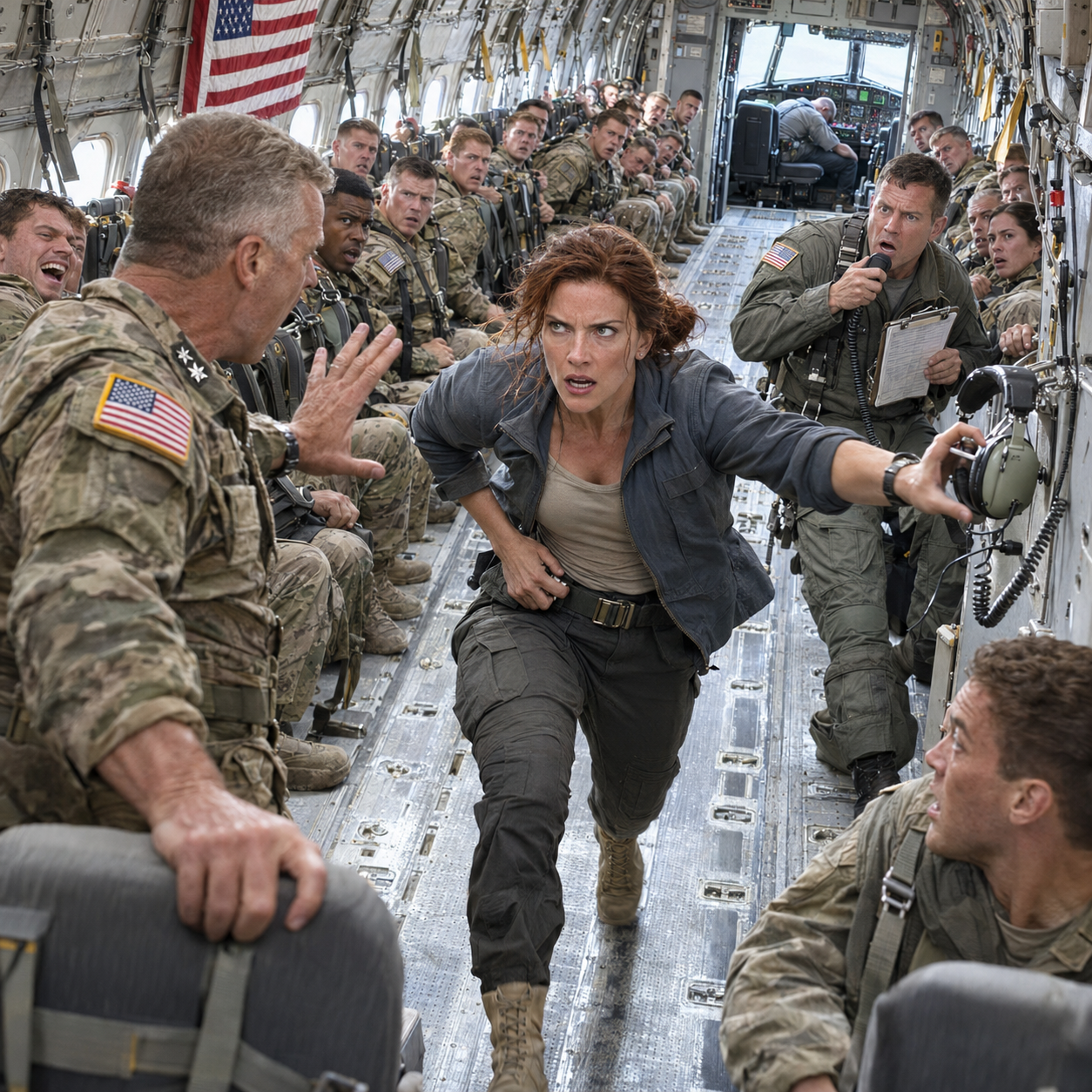
“Protractor? Cute.” The Captain Held His Tablet Up. Thirty-One Soldiers Laughed. Then Every Screen Went Gray. I Folded My Map And Walked Toward A Missing Nineteen-Year-Old. His Platoon Sergeant Watched Me Go, Then Picked Up His Ruck. “Sergeant, Where Do You Think You’re Going?”
Captain Owen Dacre held up his expensive GPS tablet and laughed at the plastic protractor resting on my paper map. Thirty soldiers laughed with him, and not one questioned why I was there. I simply checked my watch and waited. Minutes later, every GPS screen went blank, and a nineteen-year-old soldier was missing in the freezing woods. By afternoon, that soldier was in a hospital, the captain was facing an investigation, and I discovered a training certification that exposed something far more troubling than one officer’s arrogance.
## Part 1/5
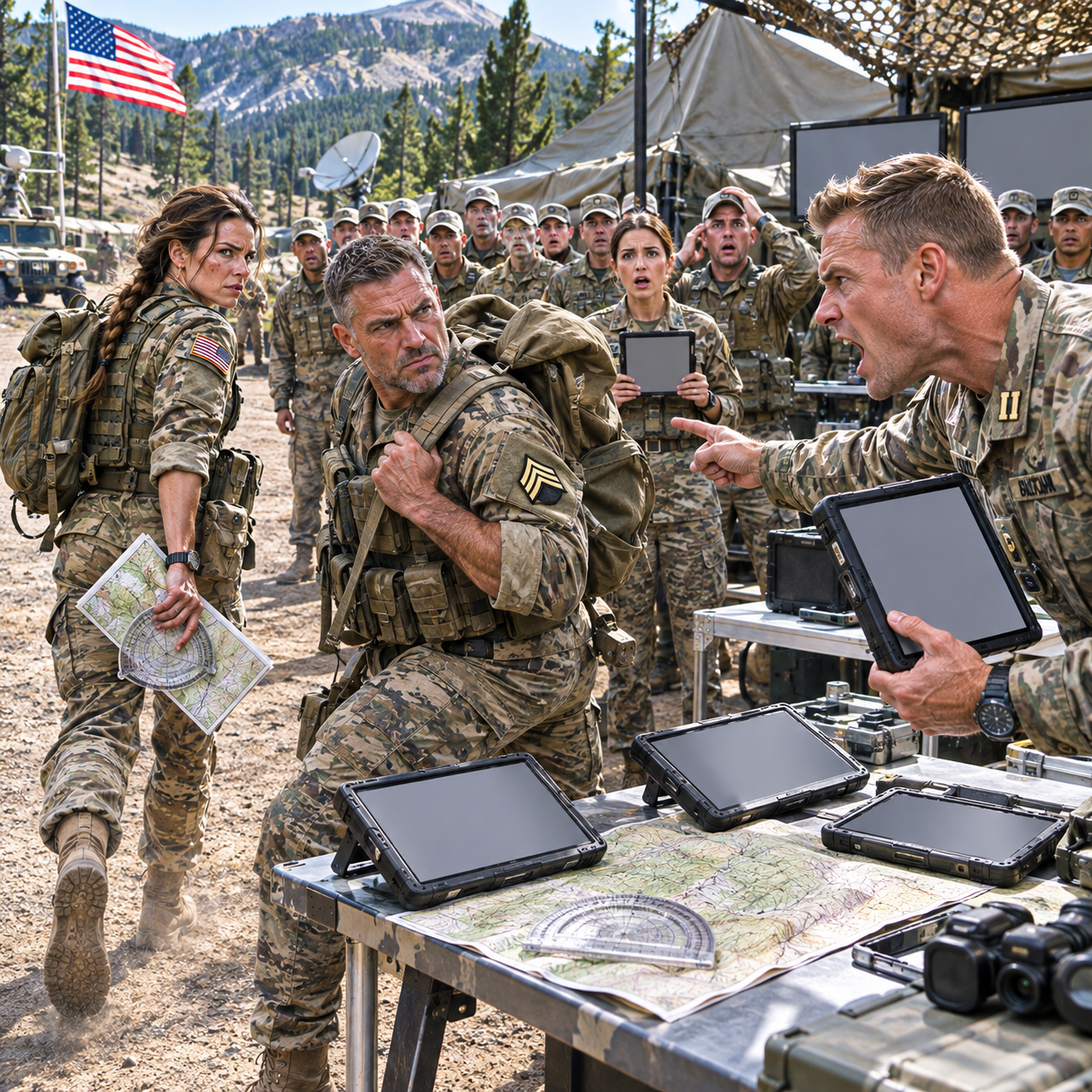
“Protractor? Cute.” Captain Owen Dacre said it with a grin wide enough to invite the entire formation into the joke, then raised his GPS tablet like a salesman displaying the latest miracle of modern technology. Thirty soldiers stood in the gravel turnout behind him, rain dripping from their helmets and pooling around their boots, and several laughed loudly enough to be heard over the wind. I was sitting on the tailgate of a government pickup with a laminated topographic map spread across my knees, a transparent protractor in one hand, and a compass hanging from a cord around my neck. “No disrespect, ma’am,” Dacre continued, “but the Army moved into the twenty-first century quite a while ago.”
I looked at his tablet, then at my watch, which read 5:58 a.m. “Technology is useful when it works, Captain,” I said, folding the map along its familiar creases. He smiled as if I’d delivered the setup to another joke, and a young lieutenant beside him studied her boots instead of meeting my eyes. The temperature was thirty-five degrees, the rain was coming sideways off Lake Ontario, and thirty-one soldiers had climbed out of the trucks twenty minutes earlier. Only thirty remained in formation, and that missing person concerned me considerably more than the captain’s opinion of my equipment.
My name is Mara Kessler, and I was forty-two years old that October morning at Fort Drum, New York. I’d spent twenty-two years in the Army, most of them in field artillery, before retiring as a master sergeant and accepting a civilian position overseeing land-navigation training. I grew up outside Duluth, Minnesota, where winter taught children to respect weather before they were old enough to drive, and I enlisted at eighteen because I wanted a life bigger than the town where everyone knew my father’s drinking habits. What I found instead was an institution that taught me how much damage could happen when confident people stopped listening to quieter ones.
In artillery fire direction, numbers matter more than personalities, because an incorrect calculation can put an explosive round hundreds of yards from its intended target. My first instructor, Sergeant First Class Esther Pike, made us master paper maps, plotting boards, and manual calculations before she’d allow us to touch a computer. “Machines don’t take responsibility,” she told us, tapping her pencil against the edge of my desk. “People do, so put your initials beside every answer you give.” For years, I followed that instruction so faithfully that I could recognize my own handwriting from across a crowded operations tent.
That changed during a deployment to Afghanistan, when a digital targeting system produced coordinates that contradicted my manual calculations. I warned the officer supervising our fire direction center, but he trusted the computer, authorized the mission, and dismissed my concerns in front of everyone. The round landed dangerously close to a friendly patrol, no one was injured, and the official report eventually attributed the incident to faulty digital information without mentioning my warning. The officer received praise for helping stop further firing, while I learned how easily an inconvenient voice could disappear from the record.
For the next fourteen years, I became an expert at being useful without being noticed. I still checked the calculations, corrected mistakes, and quietly prepared backup procedures, but I stopped insisting that my name appear on work other people would eventually present as their own. After retiring, I accepted the land-navigation position at Fort Drum because maps made more sense to me than office politics. I personally walked the training lanes, documented dangerous terrain, maintained emergency supplies, and wrote field notes on the reverse side of every laminated map issued to visiting units.
That morning’s exercise was supposed to test an infantry company’s ability to navigate when satellite signals became unavailable. At exactly 6:00 a.m., range control would activate an authorized GPS-denial exercise across the designated training area, leaving soldiers dependent on maps, compasses, terrain features, and ordinary radio communications. The weather made the training particularly valuable, because wet clothing and limited visibility could turn a simple navigational error into a medical emergency. Frank Delaney, the retired command sergeant major supervising range operations, had explained the conditions twice during the 5:00 briefing.
Captain Dacre had barely listened. At thirty-two, he possessed the polished confidence of an officer whose evaluation reports had always contained phrases like exceptional potential and future battalion commander. During the briefing, he’d been discussing transportation schedules with his executive officer, nodding occasionally without looking up whenever Delaney mentioned the GPS restrictions. I noticed his distraction, recognized the danger, and considered walking over to make certain he’d understood. Instead, remembering too many officers who had dismissed my warnings, I remained seated and allowed myself the satisfaction of imagining his embarrassment when the screens went dark.
I would regret that silence more than anything he said about my protractor.
At the turnout, Sergeant First Class Silas Benton stood near the back of the formation, quietly studying the surrounding tree line. He was thirty-nine, broad-shouldered, and experienced enough to check his soldiers’ faces rather than simply counting their equipment. Second Lieutenant Joelle Whitcomb waited beside the captain, gripping a compass that appeared almost decorative against her expensive navigation watch. Near the last truck, I’d previously noticed Private First Class Nate Harlan, a thin nineteen-year-old whose pale face and trembling fingers suggested something more serious than ordinary discomfort.
At 6:00 precisely, Captain Dacre’s tablet lost its position indicator. He tapped the display, restarted the application, and raised the device toward the gray sky as though a stronger signal might be hiding above the clouds. Around him, soldiers checked their watches and handheld receivers, exchanging bewildered looks when their screens displayed the same useless information. Lieutenant Whitcomb quietly reminded him about the scheduled GPS-denial exercise, and the expression on his face changed as he remembered the briefing he’d barely attended.
“Fine,” he said, taking the lieutenant’s paper map. “We’ll navigate manually until the system comes back.”
I counted the formation again and found thirty soldiers. Benton was already looking toward a narrow trail descending into the hemlocks, his expression tightening as he questioned a specialist in the back rank. The specialist pointed downhill and explained that Harlan had left nearly twenty minutes earlier because he felt sick and needed privacy. Benton immediately called him over the radio, and after several unanswered seconds, a frightened voice finally emerged through the static.
“Sergeant, I got turned around,” Harlan whispered. “I’m really cold, and I don’t know where I am.”
Dacre reached for his handset and instructed the young soldier to remain where he was until the GPS exercise ended. I watched Benton look toward the black trees, then at the rain collecting on his gloves, while Harlan struggled to answer another question. There was something in that young man’s voice I recognized from years of watching soldiers become dangerously cold: a strange, exhausted calm that could arrive just before confusion overtook them. I unfolded my paper map, knowing that waiting three hours could be the worst decision we made all day.
## Part 2/5
“Sergeant Benton, ask him what he can hear.” I stepped beside the platoon sergeant and pointed toward the creek valley on my map, where the elevation lines crowded together around an abandoned nineteenth-century farm. Dacre interrupted immediately, reminding me that he commanded the company and had established a procedure for recovering missing personnel. I acknowledged him without argument, but Benton had already raised his handset and asked Harlan to describe any distinctive sounds nearby. After several seconds, the young soldier replied, “Water, Sergeant, something really loud, like a truck that never stops.”
I felt my stomach tighten. Cole Creek spilled over an old concrete diversion wall roughly two miles downhill, producing a continuous roar that traveled through the woods long before the water became visible. Near that creek stood the remnants of the abandoned Haskell farmhouse, including a tall fieldstone chimney and a cellar I had converted into an emergency shelter. “Nate, can you see a stone chimney?” Benton asked after I touched his elbow. “Yeah,” came the exhausted reply, “but there’s no house, just rocks and some steps.”
I turned my map over and showed Benton the handwritten field notes printed beneath the navigation instructions. Three years earlier, after a soldier on another training lane suffered a frightening cold-weather emergency, I’d installed a weatherproof supply container inside that abandoned cellar. It held dry wool blankets, emergency heat packs, reflective coverings, and instructions for requesting medical assistance. The reverse side of every issued map described the chimney, the nearby water sounds, and the shelter’s exact location. Benton read the information twice, then raised his eyes toward the trees with the sudden recognition of someone who had just been handed a solution.
“Captain, we know where he is,” Benton announced. “The Haskell ruins, near Cole Creek, and there’s a shelter there.” Dacre examined the map but seemed unable to reconcile the information with the uncertainty surrounding his electronic devices. He insisted that moving soldiers through unfamiliar terrain without satellite guidance could create additional casualties, particularly with visibility deteriorating. “We hold our position,” he ordered. “Range control can establish a reliable location once the signal returns.”
I understood the argument, because caution has prevented countless unnecessary deaths in the Army. But the regulations concerning lost personnel also assumed commanders would assess medical urgency rather than treat every missing soldier as a healthy person awaiting directions. Harlan was wet, ill, disoriented, and already showing signs of dangerous cold exposure. I reminded Dacre that radio contact could disappear or the soldier’s condition could deteriorate before the scheduled restoration of GPS. He repeated his order, this time with enough firmness that everyone nearby understood the discussion was finished.
For a moment, I stood motionless, remembering that officer in Afghanistan and the targeting calculation nobody wanted to question. Then I folded the map, slipped the protractor into my jacket pocket, and stepped toward the trail leading into the hemlocks. I wasn’t part of Dacre’s chain of command, and I had no intention of pretending that a civilian employee could issue orders to his soldiers. What I could do was contact range control, report the emergency, and use a route I knew to reach a nineteen-year-old who might already be losing consciousness.
Behind me came the unmistakable sound of a rucksack being lifted from wet gravel. Sergeant Benton caught up, tightened his shoulder straps, and said, “I’m going to get my soldier.” Lieutenant Whitcomb and Specialist Devon Price, the company medic, joined us almost immediately, followed by two soldiers carrying additional medical equipment. Dacre called for Benton to return, but the sergeant answered calmly that he was responding to a medical emergency and would maintain radio contact. After a tense exchange, the captain authorized the recovery team to proceed while ordering the remaining soldiers to establish accountability and communications at the turnout.
The woods swallowed the sound of the trucks within minutes. I held my compass level, corrected for the map’s magnetic declination, and followed a bearing that would bring us toward the old farm without forcing us directly into the flooded creek bottom. Whitcomb stayed beside me, counting her pace intervals aloud while studying how I selected distant trees to maintain direction. She stumbled twice in the mud, once dropping to a knee, but recovered without asking anyone to slow down. “Where did you learn to do this so confidently?” she asked, and I told her about Sergeant Pike, plotting boards, and the value of trusting calculations you’d actually checked.
Benton contacted Harlan every few minutes, asking simple questions to keep him responsive. At first the soldier answered clearly enough, although his speech was slow and he repeatedly apologized for causing trouble. After we passed the first low ridge, his replies became shorter, and he began forgetting questions before he finished answering them. Benton looked at me, and I could see the growing fear behind his controlled expression. We increased our pace, leaving deeper footprints in mud that was already turning to standing water.
Halfway down the slope, Captain Dacre appeared behind us with another soldier carrying communications equipment. He had reconsidered the seriousness of the emergency and assigned temporary control of the turnout to his executive officer before following our route. “How certain are you about this location?” he asked, struggling to match his breathing to our pace. I showed him the back of his map, where my notes described the creek, the chimney, the cellar entrance, and an alternate access road for emergency vehicles. He stopped questioning the route, turned the map over again, and quietly admitted, “I’ve never read this side.”
We were still several hundred yards from the clearing when Benton called Harlan and received no reply. He tried again, then a third time, the radio producing nothing but static and the low crackle of rain against the handset. Ahead of us, through the dark trunks of the hemlocks, I finally heard the distant mechanical roar of the spillway. I took Benton’s radio, contacted range control, identified myself by name and position, and transmitted the ten-digit grid coordinates I’d calculated from the map.
“Those coordinates are verified,” I said, repeating the numbers. “I plotted them myself, and I know the access road.”
Delaney acknowledged the transmission and dispatched an ambulance toward the nearest usable approach. We pushed through the last stand of trees, and the abandoned chimney rose from the clearing like a gray monument against the rain. At its base, Nate Harlan sat hunched over on a stone step, his hands resting loosely between his knees. He wasn’t moving, and when Benton shouted his name, the young soldier didn’t even raise his head.
## Part 3/5
Specialist Price dropped beside Harlan and immediately checked his breathing and pulse while Benton removed his own jacket to shield the private from the rain. The young soldier’s skin was unnaturally pale, his movements barely perceptible, and the violent shivering Benton had noticed earlier was gone. Price spoke to him steadily, but his confused eyes drifted past her face as if he were searching for something beyond the clearing. “We need him out of this wind,” she said, directing us toward the cellar entrance while she prepared to treat him for suspected hypothermia.
I found the weathered wooden hatch exactly where I’d left it, although fallen branches had collected across the entrance. Benton cleared them away, and we carefully carried Harlan down the stone steps into the sheltered space while Price supervised every movement. The emergency container opened with a metallic snap, revealing dry wool, sealed blankets, and warming supplies that had remained untouched through three winters. Price replaced his wet outer layers, wrapped him in insulation, and positioned the warming materials according to her training while monitoring his condition. Lieutenant Whitcomb crouched beside them with a flashlight, quietly speaking to Harlan whenever his eyes began closing.
The ambulance reached the designated access point shortly after seven, following the directions I’d provided from the map. By then Harlan could answer simple questions, although he didn’t recognize the farmhouse ruins or understand how far he’d wandered from the turnout. The medics transferred him carefully onto a stretcher and continued treatment during the evacuation to the hospital. Benton stood in the rain watching the vehicle disappear, his hands shaking slightly as he adjusted the straps on his gloves. When I touched his shoulder, he looked at me and said, “He told me he wasn’t feeling well before we unloaded, and I told him to drink some water.”
That admission stayed with me as we returned to the training building. Benton had overlooked one warning, Dacre had ignored another, and I had deliberately remained silent during a briefing because I wanted an arrogant officer to discover his own limitations. Harlan’s emergency wasn’t the result of a single spectacular mistake, but of smaller decisions that seemed reasonable until they accumulated around a sick young soldier. Nobody intended to hurt him, which somehow made the morning more difficult to accept. The absence of malice didn’t make the consequences less real.
At three that afternoon, Lieutenant Colonel Tamsin Brooks arrived to conduct the initial after-action review. The training building smelled of reheated coffee and damp uniforms, and a drying rack near the entrance overflowed with soaked jackets. Dacre stood before his soldiers with a laptop ready to display the standard presentation, but he closed it before the first slide appeared. “I’m not going to pretend this was a successful training event,” he began, looking directly at his commander. “I failed to understand the briefing, made a joke about the one person who knew the terrain, and delayed an urgent recovery because I didn’t want to admit I was wrong.”
The room remained silent while he described the missing soldier, the unsuccessful attempts to restore GPS, and Benton’s decision to follow me into the woods. He acknowledged that I’d identified Harlan’s likely location and that he’d initially dismissed the information despite the deteriorating medical situation. Brooks listened without interruption, occasionally writing something in a small notebook. When he finished, she asked Benton whether the captain’s account was accurate. Benton confirmed it, then added that the company’s reliance on electronic navigation had become so complete that many soldiers could barely establish a starting grid without assistance.
Brooks looked toward the assembled lieutenants and asked how recently their platoons had practiced navigation without electronic devices. Nobody answered immediately, and Whitcomb finally admitted that their most recent qualification exercise had included satellite-assisted position checks. She said soldiers had demonstrated compass use in classrooms but rarely operated without a digital location available somewhere in the formation. Brooks asked whether the company had formally certified its manual-navigation proficiency before arriving at Fort Drum. Dacre answered yes, although his expression suggested he was beginning to understand the implications of the question.
“Then I want the certification records,” Brooks said, turning to the executive officer. “Every practical exercise, every evaluation sheet, and whoever signed the completion reports.” She suspended further training until soldiers could demonstrate basic competence and requested a separate review of Harlan’s medical response. Dacre was temporarily removed from command duties pending that review, with his executive officer assuming responsibility for the company. After dismissing the formation, Brooks asked me to remain because she wanted to understand exactly how I’d established the casualty’s location.
I showed her the reverse side of the map and explained the emergency shelter, the landmarks, and the route verification procedures. She studied the field notes before asking why no author’s name appeared beneath them. “They don’t need to know who wrote the instructions,” I said automatically. “They only need accurate information.” Brooks looked at me for a moment, then replied, “Accurate information matters, Ms. Kessler, but so does knowing who can answer questions when something goes wrong.”
Later that evening, I returned to my office to document the condition of the cellar supplies and arrange replacements. A folder had been delivered to my desk containing copies of the company’s navigation training records, which Brooks wanted me to review for technical accuracy. Most were ordinary checklists, until I reached a certification dated three weeks before the exercise. Every platoon had supposedly completed a successful land-navigation evaluation with GPS unavailable, all personnel had been marked proficient, and the final approval bore Captain Dacre’s signature.
I examined the evaluation location and felt my chest tighten. The form listed a training area where, according to the attached range restrictions, no satellite-denial exercise had been authorized on the date claimed. Even more troubling, the document identified an evaluator whose name I recognized from another record. That person had left Fort Drum months earlier, yet someone had certified that he had personally observed the entire exercise.
## Part 4/5
The following morning, I carried the disputed certification to Brooks’s office with copies of the range schedule and the earlier evaluator roster. Frank Delaney accompanied me, confirming that the supposed field assessment could not have occurred under the conditions described. The listed evaluator, a retired warrant officer named Russell Vane, had completed his contract the previous spring, and his signature appeared to have been copied from an old training packet. Brooks compared the documents, made three telephone calls, and instructed her staff to assemble the original submissions rather than relying on scanned summaries.
By lunchtime, the explanation was beginning to emerge. The brigade had faced pressure to certify several mandatory training requirements before an upcoming readiness inspection, and manual navigation was one of the skills commanders had been directed to verify. Instead of conducting the complete practical assessment, the company’s training administrator had combined classroom attendance records with GPS-assisted exercise results and used an older evaluation document as a template. Somewhere along the approval chain, those incomplete records became a formal declaration that every soldier could navigate independently without satellite assistance. Dacre had signed the final certification without inspecting the supporting evidence.
When Brooks confronted him with the paperwork, he didn’t attempt to deny his signature. He explained that the administrator had assured him the documentation was ready and that headquarters expected the certification before the deadline. “I knew we’d done navigation training,” he said, “and I assumed the evaluation criteria had been satisfied.” Brooks placed the documents between them and asked whether he understood the difference between attending instruction and proving competence in the field. He stared at the paper for several seconds before answering, “I do now, ma’am.”
The investigation expanded beyond Dacre’s immediate decisions, because the company administrator had not created the misleading certification process entirely alone. Other units had been using similar shortcuts, often accepting digital tracking results as sufficient evidence that soldiers understood manual navigation. Nothing suggested a coordinated plan to endanger anyone, but the inspection deadlines had encouraged a culture in which completed paperwork gradually became more important than demonstrated ability. Brooks ordered the questionable certifications withdrawn for review and required the affected soldiers to complete properly observed evaluations. She also referred the inaccurate records to the appropriate command channels for an administrative investigation.
Two days later, I helped supervise a controlled assessment on a short training course where no GPS devices were permitted. Of the thirty soldiers from Dacre’s original formation, only six could confidently establish their position, calculate a bearing, and navigate the assigned route without substantial assistance. Others could remember isolated classroom procedures but struggled when those procedures had to be used together. Lieutenant Whitcomb was among the six, although she admitted she’d practiced with the compass every evening since Harlan’s rescue. The results were uncomfortable, but nobody was allowed to disguise them as something they weren’t.
At the follow-up review, Brooks formally addressed Dacre’s failure to understand the original briefing and his delayed response to a soldier showing signs of medical distress. His willingness to acknowledge the mistakes mattered, she explained, but it did not erase the danger those decisions had created. He received a written reprimand, remained relieved of company command, and was subsequently reassigned to a battalion logistics position while the administrative process concerning the certifications continued. Brooks also required improved accountability procedures, realistic navigation training, and clear instructions empowering soldiers to report illness without fearing humiliation. I agreed with every measure, yet something about the discussion left me uneasy.
When Brooks asked whether anyone had additional observations, I stood before I could persuade myself to remain silent. I told the room about the Afghanistan incident, about having my calculations ignored, and about spending years removing my name from work to avoid another confrontation. Then I described watching Dacre disregard the GPS briefing and deliberately choosing not to intervene. “I knew he wasn’t listening,” I admitted. “I could have spoken to him directly, and I didn’t, because part of me wanted him to be embarrassed.”
Nobody interrupted me, although I saw Benton turn toward the floor. I explained that I couldn’t know whether another warning would have changed the morning, particularly Harlan’s decision to leave the turnout without telling someone how ill he felt. But I had recognized a potential problem and withheld information that might have prevented confusion during an emergency. “Experience doesn’t mean much if I only use it when somebody asks nicely,” I said. “I let an old grievance influence a new decision, and somebody else could have paid for it.”
Brooks thanked me for speaking and asked that my account be included in the official review. Afterward, Dacre approached while I was collecting my maps and admitted he had believed his career was supposed to depend on making decisions quickly and appearing certain. “I thought asking for help meant I wasn’t ready to command,” he said quietly. I told him that no reasonable soldier expected a captain to know every answer, but they had every right to expect him to recognize when somebody else did. He accepted that without arguing, which was more than I could have said about him three days earlier.
Before leaving, I visited the hospital, where Harlan was recovering from moderate hypothermia and the illness that had contributed to his exhaustion. He sat upright in bed, embarrassed by the attention and still struggling to understand why so many people considered his survival extraordinary. When I asked why he’d gone so far down the trail, he explained that he’d been afraid of slowing the company and had kept walking downhill until he could no longer see the turnout. “I thought I could rest by that chimney,” he said. “Then I couldn’t remember how to get back, and I didn’t want to make anybody mad.”
I sat beside him for a long moment, looking at the young face above the hospital blanket. The certification records had shown me that soldiers weren’t being properly tested, but Harlan had revealed something those forms could never measure. He’d been more afraid of being considered a burden than he was of admitting he needed help, and that fear had nearly killed him. Before I left, he asked whether I could teach him to use the plastic protractor everyone had laughed at. I promised I would, but on the drive home I realized the first lesson needed to be for the adults who had taught him that asking for help was weakness.
## Part 5/5
The first Saturday after Harlan left the hospital, I arrived at the navigation course shortly before six carrying a thermos of coffee, a stack of blank maps, and several inexpensive plastic protractors. Lieutenant Whitcomb was already waiting beside the starting marker, accompanied by Benton and three squad leaders who had volunteered to improve their navigation skills. Captain Dacre appeared a few minutes later without his tablet, wearing an ordinary field uniform and carrying a notebook tucked into his jacket. He approached quietly and asked whether he could participate, despite no longer commanding the company. I handed him a map and told him that everyone started with the same fundamentals.
For the first hour, nobody touched an electronic device. I taught them how to orient a map using surrounding terrain, determine a grid coordinate, convert between grid and magnetic bearings, and estimate distance through pace counting. Dacre made several mistakes, particularly when the uneven ground disrupted his pace count, but he recorded each error instead of blaming the equipment. Benton, who had rarely spoken more than necessary during the rescue, surprised me by asking detailed questions about identifying safer routes through low ground during heavy rain. By eight o’clock, their uniforms were muddy, their calculations were improving, and nobody had complained about the absence of a blue dot.
Harlan joined us the following week with medical clearance and a determination that made me worry he might push himself too hard. I gave him a shorter practice route and told Benton to monitor his progress without making him feel singled out. He spent nearly twenty minutes calculating his first bearing, erased the answer twice, and finally announced that he wanted to check his work before moving. The others waited while he did, and nobody made a joke about his uncertainty. When he reached the correct checkpoint, his smile was so sudden and unguarded that I remembered why I’d loved teaching young soldiers long before I ever accepted the civilian position.
The formal investigation concluded several weeks later, confirming that the company had submitted inaccurate navigation certifications and that the approval procedures had failed to identify the problem. The responsible administrator received corrective administrative action, and the brigade revised its documentation requirements to distinguish classroom instruction from independently demonstrated field proficiency. Dacre’s removal from command remained in effect, and his reassignment became permanent rather than a temporary inconvenience. He wrote to Harlan’s parents, explaining his decisions and accepting responsibility for the delay in initiating the recovery, and he made no attempt to persuade anyone that his subsequent cooperation canceled what had happened.
The changes extended beyond one company’s records. Fort Drum’s training staff introduced additional practical exercises using maps and compasses, while visiting units were required to demonstrate basic navigation skills before participating in more demanding GPS-denial scenarios. Revised emergency procedures included positive personnel accountability, clearer medical escalation requirements, and regular inspections of designated shelter supplies. My field notes were incorporated into briefing materials rather than left as information that soldiers might discover only after turning over a map. It was satisfying to see those changes, although I understood that a written procedure meant little unless someone was willing to enforce it.
One afternoon, Brooks invited me to review a draft of the new training guide. The document included diagrams I’d drawn, route-planning examples I’d developed, and a section describing how Harlan’s rescue had exposed weaknesses in the previous certification system. At the bottom of the technical acknowledgments, I noticed a blank space where the author’s name belonged. For fourteen years, I’d asked people to leave that space empty, convincing myself that disappearing behind the work was a form of professionalism. This time, I picked up a pen and wrote my full name without being asked.
That evening, I sat at my kitchen table and wrote a letter to Esther Pike, the retired instructor who had first taught me to check my calculations and initial my work. I hadn’t spoken to her in several years, although I still remembered her standing behind my shoulder at a plotting board, refusing to accept an answer I couldn’t explain. I told her about Afghanistan, the years I’d spent avoiding recognition, and the young soldier whose rescue had forced me to reconsider what responsibility actually meant. Two weeks later, she replied on a single sheet of lined paper, her handwriting as sharp and unmistakable as I remembered. “You were never supposed to sign your work for the people who might praise you,” she wrote. “You sign it because somebody might need to find you when the numbers matter.”
I kept that letter in the same desk drawer as my protractor.
By spring, the Saturday navigation sessions had grown into an informal tradition. Soldiers from other companies began arriving before sunrise, sometimes bringing friends who had failed their first practical assessments and were determined not to fail again. Benton became one of the most reliable instructors, and Whitcomb developed a talent for explaining bearings to soldiers who struggled with classroom instruction. Dacre continued attending whenever his logistics duties permitted, although he never again tried to dominate the discussion. He had lost a command because of decisions he could not undo, but he seemed determined not to repeat the habits that had led to them.
Harlan eventually completed his navigation qualification and returned to full duty with his platoon. One morning, he arrived carrying a battered map whose edges had begun separating from the laminate, and he asked whether I could replace it. I offered him a new copy, but he hesitated before handing over the old one. “This is the map Sergeant Benton gave me after the hospital,” he explained. “I’ve been reading the back every time we train, and I guess I don’t want to lose it.” I repaired the damaged corner instead, and he left with his original map folded carefully inside his jacket.
A few months later, I received a letter from him describing how he’d helped two new soldiers find their way through an unfamiliar training lane without relying on satellite guidance. He said the experience had been frightening at first, because both soldiers expected him to know every answer immediately. Instead, he’d stopped them, unfolded the map, and worked through the calculations together until they could establish their location confidently. At the bottom, he added a sentence that made me smile: “I told them being sure isn’t the same thing as being right, and checking twice doesn’t mean you’re weak.”
I thought about the girl I’d been at eighteen, the instructor who had refused to let her hide behind a computer, and the experienced sergeant who later decided that silence was safer than being dismissed. I thought about Captain Dacre standing in the rain with a useless tablet, Benton lifting his rucksack, and Harlan sitting beside a stone chimney too cold to understand how close he was to shelter. None of us could change that morning, and I had no interest in turning it into a comforting story where everyone’s mistakes vanished because a soldier survived. What mattered was that Harlan went home, the false certifications were corrected, and the next group entering those woods would be better prepared.
On the first morning of the new training cycle, I stood beside the gravel turnout at six o’clock, holding a freshly printed map as soldiers gathered around me. The back still contained my familiar notes about Cole Creek, the Haskell chimney, and the emergency shelter, but the final line had changed. Beneath the instructions, in clear block letters, it now read, “Prepared and verified by Mara Kessler, Land Navigation Program Manager.”
I checked the compass, looked at the soldiers waiting to learn, and asked them to turn their maps over before we began. No one laughed, and when a young private raised his hand to ask a question he thought might sound foolish, I answered him carefully. I had spent too many years believing that the safest way to serve was to make myself invisible, but that morning in the woods had taught me something different.
A reliable map can save a life, but only if someone knows how to read it, someone takes responsibility for its accuracy, and someone is willing to speak when the people in charge refuse to listen.
For the rest of my career, I intended to be that someone.
THE END!
Disclaimer: Our stories are inspired by real-life events but are carefully rewritten for entertainment. Any resemblance to actual people or situations is purely coincidental.