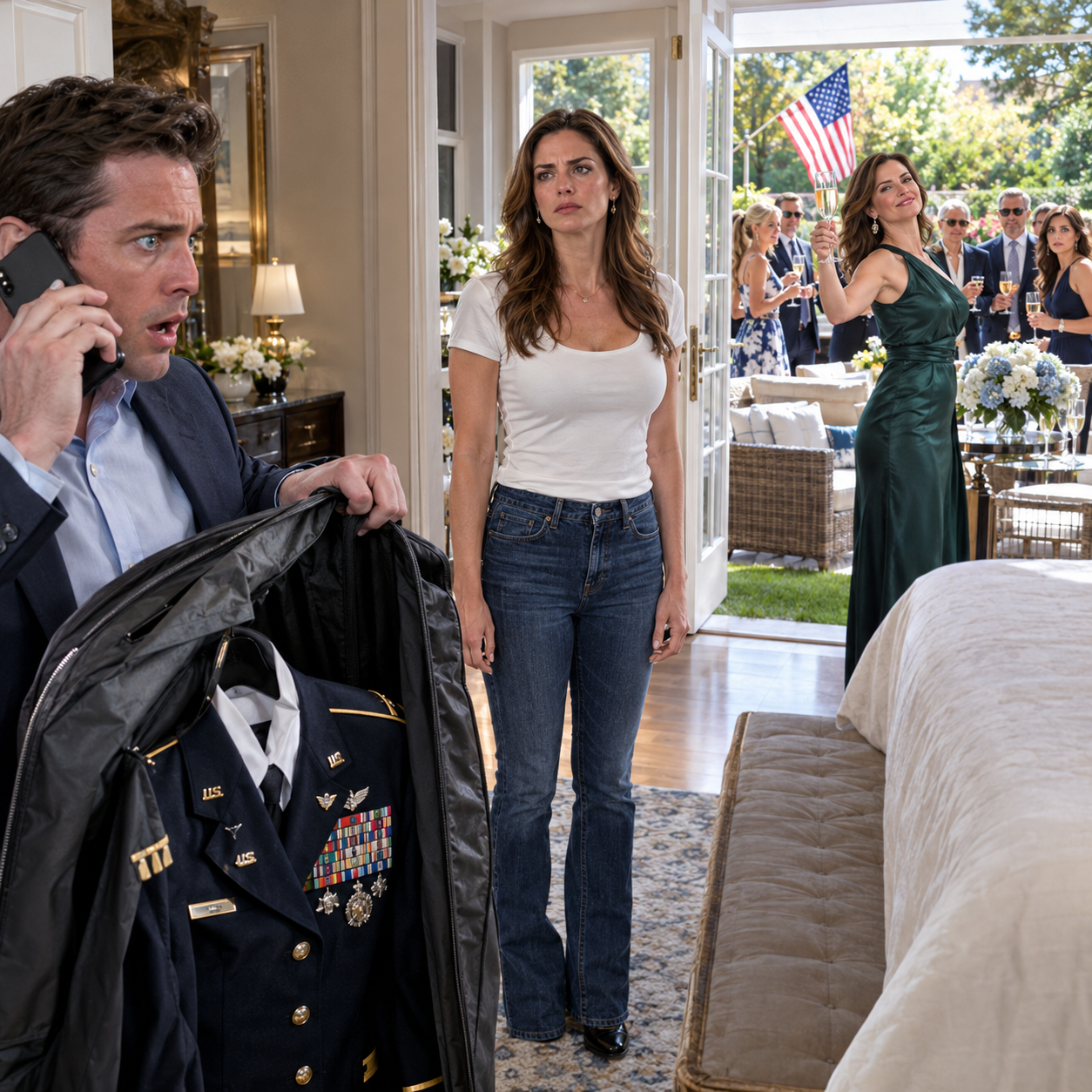
“You’ve Upstaged Him Enough For One Lifetime,” My Sister Whispered, And Pulled My Dress Blues Off The Hanger Herself. “Jeans. Go.” I Changed. I Said Nothing. That Night, Her Husband Went For Towels In The Guest Room. The Garment Bag Was Open. Four Rows Of Ribbons. He Counted Them Twice. Went White. Called Someone. Out In The Yard, She Was Still Toasting Him. “SIR. IT’S HER. SHE’S IN MY HOUSE.”
My younger sister took my Navy dress uniform off its hanger the morning her husband returned from deployment and told me I had already stolen enough attention from her family. Our mother saw what happened and pretended she hadn’t. I changed into jeans, attended the homecoming, and kept my mouth shut. That evening, my brother-in-law opened the wrong closet and made a phone call that changed our family. Three days later, a stranger sent me a receipt bearing my sister’s name and a promise I had never authorized.
## Part 1
At 6:17 on a Saturday morning in August, my younger sister stood in the doorway of her guest bedroom, staring at the Navy uniform I had spent forty minutes pressing the night before. The room smelled faintly of lavender detergent and the salt air drifting through the open window, and the coffee maker was clicking in the kitchen. Tess had a ceramic mug in her hand and wet hair falling against the shoulders of her white sundress. She looked at the gold stripes on my sleeves, then at the aviation wings above my ribbons, and said, “Take it off, Mara. I’m not having you turn my husband’s homecoming into another celebration of yourself.”
I was forty-two years old, a commander in the United States Navy, and responsible for more than three hundred sailors at Naval Air Station Whidbey Island. My younger sister was thirty-eight, worked as a dental hygienist, and had spent nine months waiting for her husband to return from a deployment aboard a Navy destroyer. I could handle emergencies in an aircraft without raising my voice, but standing in that bedroom, I couldn’t think of one sentence that wouldn’t make the situation worse. So I told her the only thing I thought mattered: “Mom asked me to wear it.”
“Mom doesn’t have to live with Evan,” Tess answered. “I do.”
Then she set down her coffee and reached for the top button of my coat.
To understand why I let my sister remove my uniform without so much as pushing her hand away, you have to understand the house where we grew up. Our childhood home was a pale yellow stucco ranch in Chula Vista, twenty minutes south of downtown San Diego, with a cracked driveway and an avocado tree that never produced anything worth eating. Our father, Frank Whitcomb, worked as a machinist at a shipbuilding contractor, while our mother, Elaine, handled appointments and insurance claims at a medical office. We had everything we needed, but every purchase was discussed, every vacation involved a cooler, and every birthday cake came from the same supermarket bakery.
Dad loved being able to tell people I was his oldest daughter, especially when there was something impressive to attach to the introduction. When I won the county science fair at eleven, he carried my blue ribbon into work and left it beside his time clock for a week. When I made the honor roll, he took the certificate to church and showed it to people who hadn’t asked. Whenever Tess stood beside me, he would smile and add, “And this is our little Tess. She’s the one who keeps us laughing.”
I remember the first time I noticed that her smile changed when he said it. We were at an elementary school assembly, and she was wearing a red cardigan Mom had bought on clearance because its sleeves were slightly too long. Dad was telling another parent that I had been accepted into an advanced mathematics program, and Tess was trying to show him a picture she’d drawn of our dog. He brushed the paper aside without looking and told her to wait until the grown-ups finished talking. On the drive home, she folded the drawing into a tiny square and pushed it between the seats.
I was eleven and thought jealousy was something children outgrew.
By seventeen, I was taking calculus classes at the community college, running cross-country, and filling out an application to the United States Naval Academy. Tess was thirteen, brilliant at calming frightened animals and making friends with people twice her age, but nobody seemed to think those things deserved a certificate. When my appointment to Annapolis arrived, Dad cried at the kitchen table, something I’d seen him do only when his mother died. He said, “My girl is going to see the world,” and then hugged me so tightly that my ribs hurt.
That evening, I found Tess sitting on the back steps with our old dog asleep against her leg. I sat beside her, expecting questions about Maryland or military life, but she kept pulling dry leaves from a flowerpot and crumbling them between her fingers. Finally, she asked, “Do you think Dad will ever talk about something besides you?” I remember telling her he was proud of both of us, which was the answer I believed and the one that required the least thought. She nodded and said, “Sure,” in a voice that should have told me I had missed the point.
I left for Annapolis the following summer, and our relationship slowly became a series of birthday calls, Christmas visits, and increasingly careful conversations. Tess stayed in Southern California, earned her dental hygiene license, and eventually became the person everyone called when something went wrong. She handled Mom’s appointments after a hip replacement, brought groceries when Dad’s hours were cut, and repaired the family relationships I kept assuming would survive my absence. Whenever I returned home, though, Dad still introduced me first, even if Tess had spent the previous six months keeping their lives together.
My own life moved through flight school, long maritime patrols over the Pacific, deployments overseas, and an unsuccessful marriage to a man named Daniel who never stopped hoping I would eventually choose a job that kept me home. We divorced quietly in 2015, after three years of separate calendars and postponed conversations, and I kept his last name, Whitcomb, having never changed it when we married. I learned to be good at work that demanded patience, long attention spans, and the ability to make decisions with incomplete information. At home, however, I remained the older daughter who couldn’t recognize a problem until it was standing directly in front of her.
By the time I made lieutenant commander, Tess had begun treating every mention of my career as a personal insult. At Dad’s sixty-fifth birthday dinner, he asked about a recent patrol, and I had barely explained where we’d been flying when Tess put down her fork. “Does every dinner have to become a briefing about Mara?” she asked, looking around the table as though someone might finally agree with her. Mom immediately offered more potatoes, Dad changed the subject, and I apologized, although I wasn’t sure what I had done.
After that, I started telling relatives that I mostly handled paperwork. It was easier than watching my sister’s face tighten whenever someone asked about aircraft or promotions. Dad began joking that the Navy had finally grounded me behind a desk, and Tess laughed more readily when he said it. Over time, the joke became the version of my life everyone remembered, and even people who knew I wore wings seemed to forget what those wings meant.
I didn’t realize how much I had surrendered until years later, when a young lieutenant looked at my personnel record during a routine inspection and said, “Ma’am, your family’s probably proud of everything you’ve accomplished.” I had been reviewing maintenance reports, and his comment embarrassed me more than it should have. I told him they were proud, and technically, that was true. What I didn’t say was that I had stopped giving them anything new to be proud of because I was tired of watching it hurt someone else.
Then Tess met Lieutenant Evan Mercer, a Navy helicopter pilot stationed at Naval Air Station North Island. He was thoughtful, funny in a dry way, and so polite that he once apologized to my mother for taking the last biscuit after she’d offered it to him three times. Tess adored him, and for the first time in years, she had someone in her life whose accomplishments made our father brag about her. When Evan proposed, Dad told everyone his youngest daughter was marrying a naval aviator, and I watched Tess glow in a way I hadn’t seen since childhood.
I was genuinely happy for her.
But when Evan learned I was also an aviator, something shifted between us that Tess noticed immediately. He asked what aircraft I flew, and when I answered that I’d spent much of my career in maritime patrol aviation, his expression filled with professional curiosity. Tess interrupted before he could ask another question, saying, “Mara’s basically management now. Ask her about spreadsheets.” I smiled and let him believe it because I was visiting for four days and didn’t want to spend three of them repairing another argument.
I told myself that was kindness.
Looking back, it was the beginning of an arrangement that eventually demanded more from me than silence.
## Part 2
Tess married Evan in June of 2023 at a vineyard outside Temecula, beneath an enormous oak tree decorated with white roses and warm string lights. I wasn’t there because my squadron was operating overseas, but I recorded a short video for the reception in a storage room with aircraft equipment stacked behind me. I congratulated them, told a story about Tess rescuing an injured bird when she was little, and said that Evan was marrying the most dependable person I’d ever known. I thought I had given her something simple and loving, until Mom called afterward and said the video had made everyone cry.
Tess called me three weeks later while I was preparing for an early flight. “People are still talking about that video,” she said, and I thought she sounded pleased until she added, “You weren’t even at my wedding, Mara. Somehow, you still managed to be the thing everyone remembered.” I stood in a narrow corridor listening to a ventilation fan rattle against the ceiling and tried to explain that I hadn’t intended to take attention away from her. She told me intent didn’t matter when the result was always the same, then ended the call before I could answer.
I didn’t see her again until Christmas of the following year, by which time I was serving as executive officer of a patrol squadron at Whidbey Island. Tess and Evan hosted dinner in their little Imperial Beach house, which had mismatched dining chairs, a narrow kitchen, and a backyard she’d transformed with potted citrus trees and a wooden pergola. Evan’s squadron had several pilots over, and I was perfectly content discussing football and the quality of the brisket until one of them recognized my name. Within minutes, he was asking about maritime patrol operations, and I watched Tess’s expression change across the room.
Evan approached afterward while I was rinsing plates and apologized for his friend’s enthusiasm. “He has a habit of turning barbecues into professional-development sessions,” he said with a smile, reaching past me for a dish towel. Then he asked whether I’d ever considered taking command of a squadron, and I told him I was already on that track. He congratulated me quietly, calling me “ma’am” out of professional habit, and Tess appeared in the doorway just in time to hear it.
“She’s my sister, Evan,” she said. “You don’t have to salute her in my kitchen.”
He looked startled. “I wasn’t going to salute anybody.”
“Then stop acting like you’re one of her sailors.”
I put the dish towel down and told Tess she was making an argument out of nothing. That was the wrong thing to say, because her eyes filled immediately and she asked whether I realized how often people said that to her. Evan suggested they talk later, but she walked outside without answering, leaving us beside a sink full of dishes and a roomful of guests who had suddenly found reasons to speak more quietly. The following morning, I changed my flight and went home early.
Eight months later, I assumed command of a maritime patrol squadron I’ll call the Harbor Watch. It was August of 2025, and the ceremony took place inside an aircraft hangar with a gray P-8 Poseidon parked behind the assembled sailors. My command master chief, Teresa Vega, stood near the front with the kind of expression that could make an entire division straighten its posture without a word. During my remarks, I promised the sailors that I would never ask them to accept a risk I wasn’t prepared to understand and defend, a sentence I remembered because I would spend much of the following year wondering whether I’d honored it.
None of my family attended. I’d mentioned the ceremony to Mom without inviting her, and she told me Tess had been stressed about Evan’s approaching deployment and probably wouldn’t handle another celebration very well. Dad mailed me a handwritten card saying he wished he could have been there, although he hadn’t known the date until after it happened. I put the card in my desk drawer, beside a photograph of my first flight crew, and convinced myself that no ceremony needed an audience to matter.
Evan deployed that November with a helicopter detachment assigned to a destroyer operating alongside a carrier strike group. Tess marked every day of the deployment on a paper calendar attached to her refrigerator with a magnet shaped like a lemon. She crossed out the days in red, posted photographs of their wedding whenever she missed him, and attended meetings organized for squadron families. During our occasional phone calls, she told me about the care packages she mailed and how difficult the holidays had been without him.
In January, she became one of the volunteers helping coordinate support for deployed families. Some spouses needed rides, some wanted help with childcare, and others simply needed somebody to answer the phone after midnight. Tess was good at organizing those things, and I was glad she had found a place where being reliable was recognized instead of taken for granted. She mentioned setting up a small online fundraising page to help with unexpected family expenses during deployment, but I assumed it was an ordinary informal effort among spouses and never asked for details.
My mother, meanwhile, kept pressing me to call Tess more often. “She’s carrying a lot,” Mom said one Sunday when I phoned from Washington. I was carrying a great deal myself, including responsibility for flight schedules, personnel issues, aircraft readiness, and an upcoming detachment overseas, but I knew better than to make the comparison. I told Mom I’d send Tess a care package and ask whether she needed anything, and she sounded relieved that she wouldn’t have to explain either daughter’s obligations to the other.
By February, part of my squadron had deployed to Bahrain for maritime surveillance operations, and I traveled with the detachment. The work was familiar: long flights, difficult schedules, maintenance headaches, and constant adjustments to changing operational requirements. We flew over stretches of ocean that looked almost featureless in daylight and became an expanse of black glass after sunset. Every flight reminded me why I had chosen the Navy, even on days when I spent more time fixing administrative problems than sitting in an aircraft.
On March 9, I was scheduled to fly a nighttime mission aboard one of our P-8s. My copilot was Lieutenant Aaron Bell, a meticulous officer who carried two pens because he didn’t trust one not to fail, and our crew included sensor operators, mission specialists, and enlisted sailors I’d worked with for years. Master Chief Vega joined us that night to observe a training evolution during the patrol. Before takeoff, we reviewed emergency procedures, weather, alternate landing fields, and the fuel figures that determined how long we could remain on station.
Nothing in that briefing suggested we were about to become involved in a rescue.
The weather was manageable, with scattered clouds and light winds, and our first hours in the air were uneventful. I remember drinking coffee from a thermos that had lost its seal and watching a dark line of weather move across one of the displays. Bell made a joke about the breakfast we’d miss if we returned late, and I told him the mess hall’s powdered eggs weren’t worth worrying about. Just after two in the morning, a priority transmission interrupted our routine radio traffic.
A helicopter operating from one of the escort ships had suffered a serious mechanical emergency over the water.
Contact had been lost during an attempted recovery, and the ship reported that the aircraft had gone down well beyond immediate visual range. Four personnel were aboard, but there was no confirmation that any of them had escaped. The nearest surface rescue assets were still some distance away, and weather conditions were complicating the response. Our aircraft had the sensors and communications equipment to help locate survivors, so we were redirected to the search area while rescue coordination personnel organized other resources.
I asked Bell for revised fuel calculations and directed our crew to prepare the search equipment. The cabin became quieter in the way it always does when everyone understands that the next few minutes matter. We turned toward the reported position, descending as the operators adjusted their sensors and began sweeping the water. Beneath us, the ocean was completely dark, with no visible horizon and only the faintest scattered reflections of moonlight between the clouds.
Then a voice came through the intercom.
“Ma’am, we’ve got a possible heat source.”
A few seconds later, another operator said, “Four contacts. They’re moving together.”
I leaned toward the display, looking at the small shapes emerging from the darkness, and asked for the coordinates.
I didn’t know who was in the water.
I only knew that four people were still alive, and our airplane was the closest help they had.
## Part 3
The four shapes on the infrared display were clustered so closely together that I initially mistook them for debris drifting beside a larger object. Our sensor operator adjusted the image, and suddenly I could distinguish heads, shoulders, and small flashes from emergency strobes attached to flotation equipment. The crew had survived the impact, but they were exposed in open water, and the reports from the ship suggested it would be some time before anyone could physically reach them. We had found them; now the question was whether we could keep them alive until help arrived.
We descended into a search pattern while our mission crew prepared an emergency survival kit designed for delivery to people in the water. The first pass established wind direction and the survivors’ drift, and on the next pass, we released the package at a position calculated to bring it within reach. I watched the operators’ display as the flotation equipment deployed, painfully aware that a few pixels represented four human beings fighting cold and exhaustion. When the first survivor reached the raft, a cheer started in the cabin and stopped almost immediately because the other three were still outside.
One after another, the shapes moved closer to the raft until all four were aboard. We passed their updated coordinates to the rescue coordinator and the destroyer, then began circling above them while the ship made its way toward their position. I could see their emergency light blinking on the screen, a small point against miles of darkness. Bell monitored fuel and distance while the rest of the crew maintained visual and electronic contact, knowing that losing sight of the raft could turn a difficult rescue into another search.
By four in the morning, the fuel calculations had become uncomfortable. Our original flight plan had allowed for a lengthy patrol, but the diversion and low-altitude search had changed our consumption, and staying over the survivors was steadily reducing our options. Bell gave me our planned departure fuel figure, then reminded me that our designated recovery airfield was farther away than the coastal alternate. I asked him to calculate the alternate’s requirements and to include an additional margin for unexpected complications, because the last thing I wanted was to save four people and endanger the crew responsible for helping them.
The revised numbers bought us additional time, but not unlimited time. I reported our endurance to the rescue coordinator, requested updated estimates from the approaching ship, and told Bell we would remain as long as we could maintain a defensible margin. Every new calculation brought the same question back to my mind: how long could I justify keeping a large aircraft above a life raft when my first responsibility was also to the nine people aboard? There wasn’t a heroic answer to that question, only a series of decisions that would eventually have to stand up to review.
As the night wore on, we received reports that one survivor appeared less responsive than the others. Through the thermal imagery, we could see the remaining three moving around the raft, apparently trying to keep him alert and sheltered. The rescue coordinator asked us to continue monitoring while a surface team prepared medical assistance, and I could hear the urgency beneath the carefully controlled voices. I thought about those people waiting in the cold and pictured their families at home, sleeping without knowing how close their lives had come to changing.
Near dawn, the ship transmitted a confirmed list of the helicopter crew. The names were read over the radio for identification and medical coordination, and I wrote them on the laminated card clipped beside my seat. The first name was Lieutenant Evan Mercer, followed by Lieutenant Junior Grade Sofia Reyes, Aviation Warfare Systems Operator First Class Marcus Hill, and Aviation Warfare Systems Operator Second Class Caleb Foster. I stared at the first line, convinced for a second that my exhausted brain had put a familiar name where it didn’t belong.
Bell noticed that I had stopped writing. “Skipper, everything okay?” he asked, and I told him my brother-in-law was in the raft, which made him glance toward the display before turning back to his instruments. I ordered him not to discuss the connection until after we landed because I didn’t want anyone wondering whether my decisions had become personal. Privately, I felt something cold settle beneath my ribs as I imagined Tess answering a phone call she had spent four months hoping would never come.
At last, the approaching surface rescue team reached the raft. We watched the transfer through our sensors as four exhausted sailors were brought aboard a boat, one of them requiring assistance to move. Only after the rescue coordinator confirmed everyone was accounted for did we turn toward the coastal airfield. We landed with considerably less fuel than anyone aboard found comfortable, and I spent the next several hours documenting the choices we’d made, knowing some of them would be questioned.
The crew’s persistence was recognized afterward, and I received a decoration along with a formal discussion about fuel management and command judgment. I accepted both without argument because our successful outcome did not erase the risk we had taken. Bell and Vega agreed that the rescued sailors deserved something from the people who had watched over them, so we mailed each survivor a Harbor Watch patch depicting a lighthouse beneath a night sky. The accompanying cards carried only a short message: “We saw your lights. We’re glad you made it home.”
I insisted that no personal names be included. Part of that decision came from professional modesty, and part came from knowing what Tess would say if she learned I’d been involved. I remembered her wedding, our Christmas argument, and every occasion when my presence had turned into something she felt obliged to defend. I wanted Evan to come home knowing his crew had survived because many people did their jobs, not because his wife’s older sister happened to be in the right airplane.
In April, Tess called from California and told me Evan had been released from medical observation and had chosen to return to his ship. His physical injuries were limited, but he was sleeping poorly, waking to noises, and avoiding conversations about the accident. Tess had heard him cry during a telephone call from Bahrain, and she sounded frightened in a way I’d never heard before. I wanted to tell her what I knew, but before I could find the words, she said, “Please don’t turn this into a Navy conversation. I don’t want advice about what he should do.”
I asked whether she was getting support from the other squadron families. She said she was, then mentioned that she’d expanded the fundraising page into something called the Safe Harbor Family Relief Fund to help families dealing with the aftermath of the accident. I offered to contribute, but she refused so sharply that I wondered whether I’d offended her. “I can handle one thing without your help,” she said, and I let the subject drop because the call had already become difficult.
She finished by asking me not to contact Evan about the accident or appear at his homecoming in anything that might draw attention away from him. I promised not to discuss the rescue, although I didn’t promise anything about the uniform because nobody had mentioned it yet. Afterward, I took the kneeboard card from my flight bag and placed it in my desk drawer beneath a stack of maintenance forms. Evan’s name was written at the top in my own handwriting, and I wondered how long it would take before I could look at it without hearing my sister’s frightened voice.
In July, Mom called to say Evan’s squadron was expected home at the end of August. She wanted me to fly down for the homecoming and wear my service dress blues, insisting that Tess would appreciate having another Navy officer in the family photograph. I explained that Tess might feel differently, but Mom said the deployment had changed her and that everyone wanted the day to be special. I agreed to visit, partly because I wanted to see Evan safe and partly because I had begun to believe that avoiding my family was becoming another form of dishonesty.
Two weeks before the homecoming, Tess sent me a message asking whether I was staying in a hotel. When I told her Mom had suggested the guest bedroom, she replied that the room was available and asked what time my flight arrived. I took that as a hopeful sign, though she never asked what I planned to wear. I booked my ticket, packed the uniform in a garment bag, and tried not to think about the last time I’d stood beneath a deployment banner with a family waiting nearby.
On the Friday evening before Evan’s return, I arrived at Tess’s house to find her arranging photographs across the dining table. There were pictures of Evan in flight school, photographs from their wedding, and a recent image of him standing beside his helicopter aboard the destroyer. Near the center lay a small square patch showing a lighthouse against a dark sky, the same design my crew had mailed to the survivors. Tess saw me notice it and immediately slid a stack of photographs over the patch.
“He keeps that thing in his flight bag,” she said, without looking at me. “Says somebody up there stayed with them until the ship came.”
I waited for her to say something else, but she picked up a roll of tape and began attaching photographs to a display board. Before I went to bed, I heard her talking on the telephone in the backyard, speaking too quietly for me to understand. I thought she was discussing last-minute party arrangements, and I closed the guest room door without listening.
The next morning, she came into my room and saw me wearing the uniform.
That was when she told me I had upstaged her husband enough for one lifetime.
## Part 4
Tess didn’t shout when she took my uniform off. She unbuttoned the coat carefully, removed it from my shoulders, and placed it on the hanger with the same practiced movements she used when helping elderly patients at work. She told me to change into something ordinary, then folded the trousers and shirt into my garment bag, placed my cover on top, and pushed everything into the guest room closet. Before closing the sliding door, she noticed my leather flight jacket, which carried the Harbor Watch insignia, and hung it beside the bag where it would be out of sight.
I stood there in a white undershirt, looking at my sister’s reflection in the dresser mirror. “Tess, you know Mom asked me to wear it,” I said again, and this time she turned toward me with an expression that made me think of the thirteen-year-old girl sitting beside our dog on the back steps. “You know what I remember about Dad?” she asked. “Every time something good happened to me, he found a way to mention something bigger that had happened to you.” I told her I couldn’t change what he had done, but she said I could stop helping him do it.
When she left, I changed into dark jeans and a pale blue blouse I’d packed for the flight home. Mom knocked a few minutes later and asked why I wasn’t wearing my uniform, glancing past me toward the closet before I answered. I told her Tess wanted the day to belong to Evan, and for a moment, Mom looked as though she might go downstairs and confront her younger daughter. Instead, she smoothed the collar of my blouse and said, “Well, honey, you look lovely anyway.”
I had flown more than a thousand miles at my mother’s request, and she couldn’t bring herself to ask why the uniform she’d wanted me to wear was hanging behind a closet door. That small surrender hurt more than Tess’s anger because it felt familiar, as though Mom had been choosing quiet over fairness for so long that she no longer recognized the difference. I went downstairs, helped Dad load coolers into the car, and decided I would stay for the day and leave in the morning. I had no intention of turning Evan’s homecoming into a fight over clothes.
At North Island, the hangar was crowded with families carrying homemade signs, balloons, and children who had been awake since dawn. Large doors opened onto the flight line, where the morning sun reflected off parked aircraft and made the concrete shimmer. I stood toward the back near a row of maintenance cabinets, watching Tess rearrange her hair and check the arrival information on her phone. She wore a bright yellow dress and a silver necklace Evan had given her before deployment, and I wanted her to have the joyful reunion she’d imagined.
The helicopters arrived a little after nine-thirty, their rotor noise filling the hangar before anyone could see them clearly. Families surged toward the designated waiting area as four gray aircraft settled onto the flight line, and I felt the familiar vibration of turbine engines beneath my shoes. Evan stepped out of the second helicopter looking noticeably thinner than he had in his deployment photographs. He scanned the crowd, flinched at a sharp noise from a rolling luggage cart, then found Tess running toward him.
She threw her arms around his neck, and he held her for so long that people began moving around them to reach the other returning sailors. I could see his shoulders shaking slightly, though I couldn’t tell whether he was laughing or crying. When he finally released her, he touched her cheek and studied her face as if confirming she was real. I stayed where I was, applauding with everyone else, grateful that four people who had once appeared as tiny shapes on a screen were now standing on solid ground.
Evan eventually noticed me near the back and came over to give me a hug. He thanked me for making the trip, asked about work, and looked briefly at my civilian clothes before turning toward Dad. “I thought you’d be in uniform today,” he said with a faint smile. I told him I’d wanted to keep things casual, and Tess immediately called him away for photographs. He glanced back once, looking puzzled, but the crowd swallowed the moment before either of us could say more.
By three that afternoon, Tess’s backyard was full of folding tables, plastic cups, barbecue smoke, and conversations interrupted by laughter. A banner stretched across the fence reading “WELCOME HOME, EVAN!” in letters she’d painted herself, and her friends from the dental office had brought enough food for twice the number of guests. Evan’s parents sat under the pergola while neighbors moved between coolers and trays of grilled chicken. I stayed near the grill with Dad because there was always another batch of food to turn and because working with my hands made the afternoon easier.
Evan tried hard to enjoy himself, but I noticed how frequently his attention moved toward the gate or the kitchen door. When someone dropped a stack of paper plates behind him, he turned so sharply that his chair struck the fence. Nobody commented except Tess, who touched his shoulder and asked whether he’d eaten enough. I recognized the strained alertness in his expression from sailors returning after difficult deployments, and I wished I’d been able to tell Tess that loving someone through an experience like that was rarely simple.
Around five, she gave a toast about the deployment calendar and the two hundred seventy-three days she’d spent crossing out squares. She thanked his fellow aviators, the families who had supported one another, and the Navy for returning him safely. The crowd applauded, and Evan smiled, but he kept rubbing his thumb over the ring on his left hand. Later, when guests began asking about the accident, Tess redirected them toward happier stories, explaining that the crew had been through enough and wanted to enjoy being home.
I appreciated that until she noticed Evan talking to me about aircraft and interrupted us again. “Mara spends enough time doing Navy stuff all week,” she said, slipping her arm through his. “She didn’t come here to talk about helicopters.” Evan looked at me with a question in his eyes, but I told him Tess was right and asked whether he’d tried the barbecue sauce. He seemed disappointed, though he politely accepted the change of subject, and I began wondering whether silence was doing either of us any favors.
After sunset, the string lights above the patio made the yard look warm and festive. Someone brought out a chocolate cake, and Evan’s father began telling a story about his son’s first attempt to repair a lawn mower when he was twelve. I went inside to refill a pitcher of iced tea and noticed that the kitchen floor was wet from a cooler someone had tipped near the doorway. Evan had gone inside a few minutes earlier to get towels, and I could hear drawers opening in the guest room.
Then the house went unusually quiet.
I was standing near the refrigerator when Evan appeared in the hallway holding my leather flight jacket. His expression had changed so completely that I set the pitcher down without thinking. He wasn’t looking at me, though; he was staring at the name patch sewn above the jacket’s pocket, where my aviation wings and the words “COMMANDING OFFICER” had been stamped into the leather. Behind him, the guest room closet stood open, and my garment bag hung from its rail.
Evan looked up slowly. “Mara,” he said, “why do you have this patch?”
I could have told him it was my squadron insignia and left the rest for another day. Instead, I saw his fingers trembling against the worn leather and realized how much he had already understood. I told him the patch belonged to the Harbor Watch, the squadron I commanded, and watched the blood drain from his face. He turned toward the closet, where my dress coat was visible inside the partly opened garment bag, its ribbons reflecting the hallway light.
He reached into his pocket and removed the small lighthouse patch he had carried since March. He held it beside the one on my jacket and stared at the matching design until his breathing became shallow. “The airplane,” he whispered. “The one that stayed over us.”
I told him I had been aboard.
For several seconds, he couldn’t speak. Then he asked whether I’d known who was in the water, and I explained that the rescue coordinator had read me the names while we were still circling the raft. He closed his eyes, pressed his patch between both hands, and leaned against the wall. When he opened them again, he asked whether we’d known how little time they had left.
I told him we’d known enough.
Evan looked back toward the backyard, where Tess was laughing with one of her friends. “She told me you worked behind a desk,” he said, and something in his voice made me realize he was thinking about far more than a hidden uniform. Before I could answer, he took out his phone and called his commanding officer, Commander Joseph Vale. He turned toward the open closet as the call connected and said, “Sir, I found the officer from the rescue. You’re not going to believe where she is.”
## Part 5
Commander Vale arrived twenty minutes later in civilian clothes, still wearing the jacket he’d apparently grabbed on his way out of a restaurant. Evan met him at the side gate, and the two men spoke quietly beside the garage while I remained inside with my hands resting on the kitchen counter. I had told Evan everything I knew he needed to hear, but I wasn’t prepared for the way his discovery had affected him. It was as though the rescue had happened all over again, except this time he could finally see the people who had been above him.
When I walked into the backyard, Vale was standing beside the grill talking with my father. Evan saw me first and stepped aside, allowing his commanding officer to approach. Vale extended his hand and said, “Commander Whitcomb, I’ve been trying to get your squadron to accept a proper thank-you for months.” His grip was firm, but his expression was unusually serious, and I could see that he was having difficulty keeping his emotions out of his voice.
Dad looked between us, confused. “You know Mara?”
Vale nodded. “I know what her crew did for four of my sailors.”
Several conversations stopped at once. Evan’s mother rose from her chair, and Tess came around the patio table holding an almost-empty champagne glass. She asked what was happening, but Evan answered before I could say anything. He told the guests about the helicopter going down, the water being so cold that his hands had stopped working properly, and the fear that settled over them when they realized no rescue boat could reach them quickly.
He spoke without embellishment, describing how Sofia Reyes had pulled Caleb Foster toward the raft when he became too weak to help himself. Then he explained how an aircraft appeared above them, delivered survival equipment, and remained nearby for hours while they waited. “We counted the circles,” he said, glancing at me. “Every time we thought the airplane had gone, its lights came back.”
My father stood absolutely still while Evan described the rescue. He looked at me when Evan mentioned the fuel concerns and asked whether I’d been flying that night, and I told him I had been in command of the aircraft. I explained that the whole crew had contributed and that the rescue team from the ship had ultimately brought everyone aboard. Dad lowered his eyes toward the grill, where a piece of chicken had begun burning unnoticed against the metal rack.
Vale said that our squadron had declined multiple invitations to speak about the incident and that the survivors had wanted to thank us personally. I could feel everyone looking at me, but my attention remained on Tess, who had placed her champagne glass on the patio table and was staring at her husband. Her expression wasn’t the relieved astonishment I had expected. She looked cornered, and when Evan reached for her hand, she pulled away.
“Did you know?” she asked me across the yard.
I answered that I’d learned Evan was among the survivors during the rescue. She looked toward her parents, then back at me, and asked whether I’d deliberately kept the truth from her for almost six months. I reminded her that she’d asked me not to interfere in Evan’s deployment or make his accident about my career. Her face tightened, and she said, “So you decided to let me look like an idiot in front of everyone instead?”
I wanted to argue, but the guests were watching, and I had already spent enough of Evan’s homecoming being the subject of an unwanted conversation. I told Tess we could discuss it privately and walked toward the house. She followed me into the kitchen, closing the sliding door with enough force to make the dishes rattle. For a few seconds, neither of us spoke, and the only sound came from the refrigerator motor and the faint applause outside as someone thanked the returning sailors.
“You knew exactly what would happen if he found out,” she said.
“No. I didn’t.”
“You walk in here with your ribbons and your flight jacket, and suddenly I’m supposed to be grateful because my sister saved my husband.”
I told her I hadn’t asked for gratitude and hadn’t even intended to tell anyone that day. She crossed her arms and asked why I’d brought the uniform if I wanted to stay unnoticed. I said Mom had requested it and that Tess herself had hidden it, which was why Evan discovered everything in a closet rather than hearing it from me. She looked away when I said that, but instead of apologizing, she accused me of planning the whole thing to embarrass her.
Something in me finally hardened. I told her that I’d spent years pretending my work meant less than it did because she couldn’t bear to hear about it, and that the rescue had happened whether either of us liked the circumstances. She replied that I had never understood what it was like to spend a lifetime being introduced as the daughter who stayed home. I told her I understood more than she believed, but it didn’t give her permission to erase me whenever my existence became inconvenient.
When I came out of the kitchen, Evan was standing near the doorway, and I realized he’d heard enough to understand the argument. He didn’t confront Tess in front of the guests, but the expression he gave her was colder than anything she’d said to me. I collected my overnight bag, explained to my parents that I was staying at a hotel, and asked Dad to make sure Evan had a quiet evening after everyone left. I didn’t take the garment bag from the closet because I couldn’t bear to open it while my sister watched.
I checked into a hotel near the airport shortly before eleven. The room overlooked a parking lot, and I sat beside the window listening to cars move along the highway while my phone filled with messages from relatives who had heard different versions of what happened. Mom wanted to know whether I was upset, Dad wanted to apologize for introducing me as someone who flew a desk, and Evan sent a short message thanking me again. Tess sent nothing.
At midnight, I called Master Chief Vega, who listened patiently while I explained the uniform, the discovery, and the argument. She let me finish, then asked why I believed hiding the rescue had protected my sister. I told her it had kept Tess from feeling overshadowed, and Vega answered, “Skipper, you didn’t give her peace. You gave her the freedom to tell everyone whatever version of you she wanted.” I sat with that sentence after we ended the call, looking at the empty chair where I’d placed my travel bag.
The next morning, my parents met me for breakfast at a diner on Palm Avenue. Dad admitted he’d made Tess feel invisible for years and said he hadn’t understood how deeply his careless comparisons had affected her. Mom acknowledged that she’d seen Tess remove my uniform and deliberately decided not to intervene. I listened, then told them I loved them both but was finished accepting family invitations that required me to pretend I was less than I was.
Before my flight, Evan called and asked whether I would be willing to meet the other survivors once they settled back into life at home. I agreed, explaining that my crew deserved the chance to see the people they’d helped keep alive. He thanked me, then hesitated long enough that I knew he had another question. “Mara,” he said, “did your squadron ever authorize fundraising in connection with our accident?”
I told him absolutely not. He asked me to check my email when I returned to Washington and said he was trying to straighten out something Tess had told him. Before I could ask what he meant, he said he needed to speak with someone else and ended the call.
Three days later, an email arrived from a woman named Lauren Hill, whose husband Marcus had been rescued alongside Evan. The subject line read, “Question About the Safe Harbor Fund,” and attached was a donation receipt naming my sister as the organizer. Beneath her name was a sentence claiming that contributions were being coordinated with Commander Mara Whitcomb’s rescue crew.
I read it twice.
Then I opened the second attachment and discovered that somebody had raised nearly forty thousand dollars using a promise neither I nor anyone in my squadron had ever made.
## Part 6
Lauren Hill’s email was polite, but there was an exhaustion beneath its carefully chosen words that made me uneasy. She explained that after the helicopter accident, her husband had required additional medical appointments and several weeks away from normal duties, leaving her to manage their children and household responsibilities alone. Tess had contacted her through the squadron’s family support network and promised help with childcare and travel expenses from an online relief fund. Lauren had never received the assistance, and when she asked where the donations had gone, Tess told her the money was being held until the Navy completed some unspecified paperwork.
The attached screenshots showed a professionally designed fundraising page titled “Safe Harbor: Supporting the Four Who Came Home.” It included photographs of the destroyer, descriptions of the rescue, and an account of the four surviving sailors that was emotional enough to bring in donors who had never met them. One paragraph stated that the project was working with my maritime patrol squadron to make sure donations reached the families most affected. Below that was a photograph of me standing beside an aircraft at my change-of-command ceremony the previous summer.
I stared at the photograph because I recognized the exact image. It had appeared on our squadron’s public social media page, and someone had cropped out the sailors standing behind me. The caption didn’t mention my name directly, but it referred to “the dedicated commanding officer whose rescue crew kept watch throughout the night.” I hadn’t authorized my photograph or our squadron’s connection to the fundraiser, and I knew our public affairs staff hadn’t done so either.
I telephoned Lauren and asked her to explain how she’d become involved. She said Tess had approached several spouses after the accident and offered to coordinate donations for unexpected expenses that weren’t immediately covered by existing assistance programs. Families had donated generously, as had friends, neighbors, and members of a local church that Dad attended. Lauren had initially been grateful because her youngest son was having difficulty sleeping after learning what had happened to his father, and she had been paying for additional childcare during medical appointments.
Then the promised assistance never arrived.
Lauren told me she had borrowed money from her sister for childcare and travel expenses, while another family had received only a small grocery gift card after being told that significant support was available. “I didn’t want to embarrass anyone,” she said. “I kept thinking maybe I misunderstood the arrangement. But when I heard your name at Evan’s homecoming, I realized the woman in the photograph was his sister-in-law, and I thought you should know what people were being told.”
I thanked her and promised to make inquiries through the appropriate channels without involving her husband unnecessarily. After the call, I sent the screenshots to our command legal adviser and public affairs representative, explaining that our squadron had neither organized nor endorsed the fundraiser. They advised me to preserve the information and avoid confronting Tess until I understood the scope of the claims. I also contacted Evan, who agreed to discuss the matter that evening after speaking with Lauren and the other families.
He called from his car outside the house, his voice quiet enough that I could hear traffic passing on the street. He explained that Tess had told him the fundraising page was a modest effort for deployment families and that she had closed it before he returned. He hadn’t known she’d used the helicopter accident or my squadron’s name to solicit additional donations. When I told him the publicly visible total, he was silent for so long that I checked whether the call had disconnected.
“I don’t know where that money is,” he said finally.
Evan explained that they kept a joint checking account for household bills and maintained separate accounts for personal expenses. After returning home, he’d noticed several overdue notices and unusual transfers but assumed Tess had been overwhelmed during the deployment. She had told him she’d taken care of the finances and that everything was under control. Now he wanted to review the statements himself, though he sounded ashamed that he’d accepted her assurances without asking questions.
That evening, I received a message from Dad asking whether I had anything to do with the relief fund he’d been promoting at church. I called him immediately, and he explained that Tess had asked him to share the donation link after the helicopter accident because several families supposedly needed urgent financial assistance. He’d contributed five hundred dollars and convinced two friends from his former workplace to donate as well. When I asked whether he’d been told the money was being coordinated through my squadron, he said Tess had mentioned that my unit was involved.
The room seemed to tilt around me. My sister had insisted that I remain silent about the rescue, but she had apparently used the rescue crew’s identity to make her fundraising effort more credible. She had taken my photograph from a public page and attached it to a promise my sailors had never made. Whatever jealousy or fear had motivated her to hide my uniform, something more deliberate had been happening for months.
I told Dad to save his donation receipt and to stop sharing the page until its claims could be verified. He asked whether Tess had done something illegal, and I told him I didn’t know but that misrepresenting how money would be used was serious. He became defensive, saying she had worked tirelessly for military families and would never intentionally hurt anyone. I reminded him that good intentions didn’t explain why families had received little assistance while donors were being told otherwise.
By Friday, Evan had gathered the household financial statements and contacted a Navy legal assistance office for guidance about his options. He didn’t send me the private records, but he described the discrepancies after seeking advice about what he could share. The donation platform had transferred funds into an account controlled by Tess, and several large withdrawals had occurred around the same time as payments toward personal credit cards and home improvement expenses. He was careful to say those transactions hadn’t yet been fully traced, but they were enough for him to demand an explanation.
Tess insisted that all the money had gone toward legitimate expenses. When Evan asked for receipts, she produced grocery bills, fuel purchases, and records of a few small payments to families, none of which came close to explaining the amount raised. She then accused him of believing me over her and said I had been waiting for an excuse to ruin her reputation. Evan told her the question had nothing to do with my opinion and everything to do with whether people had donated money under false pretenses.
I heard about the argument the following morning when Mom called in tears. She said Evan was staying with a fellow pilot and that Tess had spent the night at our parents’ house, insisting everyone was conspiring against her. Mom wanted me to telephone Tess and reassure her that the situation could be resolved privately. I said I wouldn’t interfere with a legitimate review of the donations and that Tess needed to account for the money directly to the people who had contributed.
Mom accused me of being unforgiving. I asked her whether she would feel the same way if a stranger had used my photograph to collect donations for injured sailors who then received almost nothing. She didn’t answer, and I could hear Dad speaking somewhere behind her, apparently telling her to stop asking me to fix a problem I hadn’t created. It was the first time I’d heard him challenge her instinct to smooth things over.
On Monday, the fundraising platform acknowledged our report and confirmed that the page was under review. I forwarded the information to the appropriate Navy officials because the project had falsely suggested an affiliation with our squadron. Evan and several donors also began pursuing advice about recovering the money and whether further reporting was warranted. I avoided making accusations beyond what the records showed, but I no longer believed this was simply a misunderstanding.
That night, Evan sent me a photograph of a handwritten note he’d found inside Tess’s desk. It listed the names of the four survivors, the amount of money raised, and several dates corresponding to withdrawals. At the bottom, in Tess’s distinctive slanted handwriting, was a sentence that stopped me cold: “Don’t let Evan connect the lighthouse patch to Mara before the party.”
I called him immediately.
“Where did she get that information?” I asked.
Evan said he had no idea, but the date beside the note was April 18.
My sister had known far more about the rescue than she’d admitted, and she’d known it for more than four months before she hid my uniform.
## Part 7
I spent the next two days trying to understand how Tess had learned the identity of the rescue crew before any of us had acknowledged it. Evan found a saved photograph on her laptop showing my squadron’s change-of-command ceremony, downloaded from a public Navy page in September of the previous year. The Harbor Watch lighthouse insignia appeared clearly on the aircraft behind me, and the webpage identified me as the commanding officer. She had apparently connected the patch Evan received after the accident with that photograph, then searched for information about my squadron.
The discovery explained why she’d been so determined to prevent Evan from seeing my uniform, but it didn’t explain what had happened to the donations. I asked Evan to keep the note and photographs with the other records and to avoid deleting or altering anything while the fundraising review continued. He told me he’d already sought legal advice about preserving the evidence, and I heard how exhausted he was when he said, “I keep thinking there must be a version of this where she’s just made a terrible mistake.” I wished I could give him that version, but I had seen too many people suffer because others wanted a comfortable explanation more than an accurate one.
On Thursday evening, Tess finally called me. I was sitting at my kitchen table reviewing paperwork for an upcoming training exercise when her name appeared on the screen. I considered ignoring it, then answered because I wanted to hear what she had to say without learning it secondhand from our parents. She didn’t apologize or ask how I was doing; she immediately wanted to know whether I had contacted the fundraising platform and whether I understood that Evan might leave her.
I told her that the people who had donated deserved to know where their money had gone. She replied that she’d used some of it for household expenses during Evan’s deployment because she’d been struggling financially and hadn’t expected the situation to get out of control. When I asked why she’d described the donations as emergency support for the rescued sailors’ families, she said the money had started as a legitimate project and that she’d intended to replace whatever she borrowed. I asked why she’d used my name and photograph without permission, and she went quiet.
Finally, she said, “People trusted you. They were more willing to donate when they thought your crew was involved.”
I stared at the dark window above my sink, watching my own reflection remain perfectly still. For years, Tess had told me that my career made her feel invisible, yet when she wanted people to believe her fundraising promises, she had used the very identity she demanded I conceal. I asked whether she’d realized the rescue crew was mine before she collected the largest donations, and she admitted she’d recognized the lighthouse patch in April. She hadn’t told Evan because she feared he’d contact me, discover how she’d described the fundraiser, and ask questions she wasn’t ready to answer.
“Then you knew when you took off my uniform,” I said.
“Yes.”
“And you let me think it was about protecting his homecoming.”
“It was about that, too,” she answered, beginning to cry. “I didn’t want you walking into his life as the person who saved him. I was the one waiting at home, Mara. I was the one who picked up the phone every time he called and wondered whether he was going to tell me something was wrong.”
I told her those things mattered, but they didn’t excuse lying to her husband, exploiting the accident, or keeping donations meant for other families. She accused me of making everything sound simple because I’d never had to worry about money the way she had. I reminded her that I’d spent years on deployments, missed weddings and funerals, and dealt with financial difficulties after my divorce without collecting contributions under false pretenses. She said I had always believed I was better than her, and the conversation collapsed into the same old accusations we’d been repeating since we were children.
Then she told me something I hadn’t known.
During the years I’d been away, she’d regularly covered expenses for our parents when Dad’s retirement savings weren’t enough. She had paid for household repairs, helped with medical costs, and taken unpaid time off to drive them to appointments. After Evan deployed, her own finances deteriorated, and she began relying on credit cards to keep up with payments. The relief fund offered access to money she convinced herself she’d borrow temporarily, but each withdrawal made the next one easier, and eventually she couldn’t afford to replace what she’d taken.
I asked why she hadn’t told me our parents needed help. She answered, “Because every time you came home, Dad acted like you were the one who had accomplished something. I wanted to be the person who could handle things without calling you.” She sounded angry with herself as much as with me, but when I asked whether she had told donors how she’d spent their contributions, she admitted she hadn’t. Her financial problems were real, yet the people who had donated hadn’t agreed to pay her personal debts.
I ended the call after telling her that I wouldn’t help conceal the situation or persuade Evan to forgive her. She could cooperate with the review, account for the money, and make restitution, but our relationship would not return to what it had been. Tess asked whether I was really prepared to lose my sister over money, and I told her it wasn’t the amount that had broken my trust. It was the months of decisions she’d made while knowing other families were counting on help that never arrived.
That weekend, I met my parents at a quiet restaurant in Washington while they were visiting relatives nearby. Dad looked older than he had at the homecoming, and Mom kept turning her coffee cup between her hands. They admitted that Tess had been contributing far more to their household than they’d realized and that they’d accepted her help without asking whether she could afford it. Dad said he’d spent decades boasting about the daughter who left home while depending on the daughter who stayed, creating expectations neither of us had understood how to escape.
I told him that his favoritism had hurt Tess and that I regretted not recognizing it sooner. But I also told him that her resentment didn’t make me responsible for the choices she’d made as an adult. Mom began crying and asked whether there was any possibility we’d eventually become close again, and I said I didn’t know what the future would bring but wouldn’t promise reconciliation. I couldn’t keep offering forgiveness before anyone had finished telling the truth.
Dad reached across the table and rested his hand beside mine. “I thought praising one of you meant I was doing something good,” he said. “I didn’t see what I was teaching the other one to believe.” I told him I understood that he had meant well, but he’d need to change more than the way he talked about us. He nodded, and for once, he didn’t try to end the conversation with a joke.
The following week, Evan told me he’d moved into temporary housing while he considered the future of his marriage. The fundraising platform had restricted the campaign, and the donors were receiving instructions about submitting records for the financial review. Tess had retained legal counsel and agreed to provide an accounting of the money, though it was clear that substantial funds had been spent and couldn’t be returned immediately. Evan said he still loved her but no longer trusted the person she’d become when she was afraid of losing control.
I asked whether he’d spoken to the other survivors about visiting our squadron. He said Sofia, Marcus, and Caleb were still interested, though they wanted the gathering to be private and focused on the crew rather than the scandal. Commander Vale supported that approach, and we scheduled a Saturday evening visit at Whidbey Island, with the original aircrew and the four survivors present. Evan asked whether I would be comfortable wearing my dress uniform, and I explained that I’d left it in Tess’s closet.
For a moment, neither of us spoke.
Then Evan said, “She knows exactly what she did with that uniform, Mara. She should be the one to return it.”
Two days later, a package arrived at my house. Inside was the garment bag, neatly folded and professionally cleaned, along with a small envelope containing a handwritten note from Tess. I recognized her handwriting immediately, the same slanted letters she’d used on birthday cards when we were children. She wrote that she was sorry for hiding my uniform, for using my name, and for allowing her resentment to influence decisions that had hurt people who trusted her.
I read the note standing beside my kitchen counter, with the afternoon sun falling across the polished buttons of the coat. I could see that she’d made an effort to acknowledge what she’d done, but I couldn’t separate those words from the other families who had been waiting for help. An apology didn’t repay the donations, restore Evan’s trust, or erase the months of lies. I placed the note in a drawer, hung the uniform in my closet, and decided I would not answer until I had something honest to say.
For the first time in my life, I wasn’t going to rush to make my sister feel better.
## Part 8
On September 19, I arrived at the squadron hangar shortly after four in the afternoon, carrying a folder of flight photographs and the kneeboard card I’d kept since the rescue. The weather was cool and overcast, with a steady breeze moving across the flight line and the smell of jet fuel drifting through the open doors. Our P-8, the same aircraft that had circled above the survivors in March, stood outside on the apron with its gray fuselage reflecting the pale afternoon light. Master Chief Vega had arranged chairs near the maintenance area, along with coffee and a few trays of sandwiches, because we’d agreed there would be no podium, no formal speeches, and no photographers.
The nine members of the rescue crew began arriving in their flight suits, talking quietly while pretending the meeting was nothing unusual. Lieutenant Bell kept checking his watch, and one of our sensor operators, Petty Officer Jenna Brooks, had brought a small notebook in case the survivors wanted to know which equipment we’d used that night. Everyone remembered particular moments from the rescue, but none of us had seen the people we’d watched on those displays since they were brought aboard the boat. I could feel a nervous energy moving through the group as the scheduled arrival time approached.
I had chosen to wear my service dress blues, though I’d spent several minutes looking at them in the mirror before leaving home. The ribbons were properly aligned, the jacket pressed, and the buttons polished, exactly as they should have been. For years, wearing the uniform around my family had felt like inviting an argument, but standing in the hangar among my sailors, I felt comfortable in it. It represented years of work, mistakes, responsibility, and people who had trusted me with their lives, none of which needed to be minimized.
Just after five, a Navy van came through the gate and stopped beside the hangar. Commander Vale stepped out first, followed by Evan and the three survivors who had shared the life raft with him. Sofia Reyes carried a small canvas bag, Marcus Hill walked beside his wife Lauren, and Caleb Foster looked younger than I remembered from the photographs in the accident report. They stood together for a moment, taking in the aircraft and the people waiting near the door.
Then Evan walked toward us.
He shook Bell’s hand first and held it longer than an ordinary greeting, then moved down the line thanking the other crew members. Sofia hugged Jenna Brooks, who had been one of the operators tracking their positions through the night, and Caleb asked whether he could meet the person who had kept their raft centered on the sensor display. The formality disappeared almost immediately as everyone began talking, comparing memories, and filling in details that had seemed unimportant until we heard them from the other side.
I watched Marcus Hill speak with Master Chief Vega near the aircraft. He was a broad-shouldered man in his thirties, but when he described how the cold had affected him, his voice became unexpectedly small. Vega listened without interruption, then told him how she’d watched the emergency raft open on the display and how relieved the crew had been when all four survivors reached it. Marcus wiped his eyes with the heel of his hand and said he’d thought nobody would ever know how frightened he’d been.
Evan approached me while the others gathered near the aircraft. “I didn’t know what to expect when I found your uniform,” he said, looking briefly at the ribbons on my coat. “I thought maybe I’d finally understand why the airplane stayed, but I didn’t expect to learn how much of the story we’d all been missing.” I told him that the mission belonged to everyone who had helped, including his own crew, whose determination had kept them alive until rescuers reached them. He nodded, then asked if he could show me something he’d brought.
He took the lighthouse patch from his pocket, its edges worn from months of being carried in his flight bag. On the back, someone had written the number 41 in black ink. I asked where it came from, and he told me Sofia had counted the aircraft’s circles while they waited, using the repetition to keep everyone talking and focused. When Marcus became increasingly drowsy, she made him repeat each number, and after the thirtieth pass, Caleb began saying, “One more,” whenever the aircraft came around.
Bell, who had walked up behind us, heard the phrase and stopped moving. He looked at Evan, then at me, and said, “That’s what we kept saying too.” During the rescue, he’d repeatedly given me our remaining fuel figures, and after each calculation, I’d asked whether we could maintain one more safe orbit while waiting for the approaching boat. We had been watching the same patch of water from opposite directions, connected by a few flashing lights and the stubborn decision to keep going as long as our judgment allowed.
Sofia stepped forward with the canvas bag she’d carried from the van. She removed a small wooden plaque and handed it to me, explaining that she’d made it in the squadron’s workshop after returning home. Mounted at the center was a nonfunctional emergency strobe from her survival equipment, recovered after the accident, and beneath it she’d engraved the number 41. The plaque was simple, with carefully sanded edges and no elaborate inscription.
I held it for several seconds, unable to find the right words. Sofia told me she’d kept counting after the rescue because the numbers had become the only way she knew to measure how close she’d come to dying. When she learned that our crew had also been counting the orbits, she decided the number belonged to both groups. I thanked her, then asked whether she’d mind if we displayed the plaque in the squadron spaces where future crews could see it.
She smiled and said, “That’s exactly where I wanted it to go.”
Later, we walked out onto the apron and stood beside the aircraft while the survivors examined the exterior and asked questions about the equipment we’d used. Evan rested his hand briefly against the fuselage, looking up at the cockpit windows. I wondered whether seeing the airplane in daylight would make the memory easier for him, or whether it would remain complicated no matter how much he learned. He told me afterward that he felt grateful, frightened, and relieved all at once, and I said there was no reason he had to choose one feeling over the others.
My parents had asked to attend, and I’d invited them on the condition that they came to listen rather than turn the evening into a celebration of me. They arrived after the survivors and stood quietly near the hangar entrance, watching the conversations unfold. Dad spoke with Marcus and Lauren for several minutes, listening as they described the months following the accident and how difficult it had been to manage everything afterward. When Lauren mentioned the fundraising problems, he apologized for having encouraged people to donate without verifying how the money would be distributed.
He didn’t mention Tess’s good intentions or ask Lauren to understand why things had gone wrong. He simply acknowledged that he’d made assumptions and that those assumptions had contributed to the problem. I watched from a short distance away, surprised by how much effort it seemed to take him to resist explaining himself. It was a small moment, but it showed me that he was beginning to understand the difference between feeling sorry and accepting responsibility.
Mom approached me afterward and asked whether I’d heard anything from Tess. I told her that I’d received the uniform and an apology but hadn’t answered, and she nodded without immediately suggesting that I should. She said Tess was continuing to work with her attorney on repayment arrangements and had begun meeting with a counselor, though her relationship with Evan remained uncertain. I told Mom I hoped Tess would take responsibility for what she’d done, but I wasn’t ready to be part of her recovery from the consequences.
Mom took my hand and said she understood.
As evening settled over the airfield, another P-8 prepared to depart on a routine training mission. We moved toward the hangar doors to watch, the survivors standing together with their families while our crew gathered nearby. The aircraft’s lights appeared against the darkening sky, and its engines rose into a steady roar as it rolled down the runway. For a moment, I remembered the black water beneath us in March, the small blinking strobes, and Bell’s voice reminding me how little fuel remained.
I looked at the people standing beside me and realized how different the moment felt from every family gathering I’d endured for years. Nobody was trying to compare accomplishments, claim attention, or pretend someone else’s work mattered less. The survivors were grateful to the crew, the crew was relieved to see them healthy, and my parents were beginning to understand that pride didn’t have to come at somebody else’s expense. Tess’s absence was painful, but I didn’t regret setting the boundary that had kept the evening peaceful.
In the months that followed, the fundraising review confirmed substantial misuse of donations, and Tess entered a formal repayment arrangement while the parties involved pursued their available remedies. The platform recovered part of the money, and the remaining claims continued through the appropriate process. Evan eventually decided to separate permanently, telling me that although he hoped Tess would rebuild her life, he couldn’t return to a marriage built around explanations he no longer believed. I didn’t offer advice about his decision, and I made sure our conversations remained focused on his recovery and the practical connection between our families.
My parents began handling their finances differently, seeking outside advice instead of relying on Tess to quietly fill every gap. Dad stopped introducing us through comparisons and started talking about each of us as separate people with different lives and accomplishments. I continued visiting them, though less often than before, and I made it clear that I would leave any gathering where my career or character became an excuse for old resentments. The first few visits were awkward, but the awkwardness was easier to bear than the false peace we’d maintained for decades.
Tess wrote to me again the following spring. Her letter was longer than the first, without excuses about the deployment or accusations that I had embarrassed her. She described the ways she’d allowed jealousy to shape her decisions and acknowledged that using my identity to collect donations had been deliberate, not accidental. She said she was sorry and hoped someday we could sit together as sisters without carrying the weight of our childhood into every conversation.
I read the letter twice and placed it with the first one.
I didn’t answer immediately, and when I eventually did, I kept my response brief. I told her I appreciated that she was beginning to acknowledge what she’d done, but an apology couldn’t restore the trust she’d broken. I wished her well in making restitution and rebuilding her life, while explaining that I didn’t want regular contact or a return to the relationship we’d had. Forgiving her would have been easier for everyone else, but I wasn’t willing to pretend I felt something I didn’t.
By then, the wooden plaque with the emergency strobe had found a permanent place in my office, beside the original kneeboard card listing the four survivors’ names. Sometimes young sailors asked why the number 41 was engraved beneath the light, and I told them about the rescue, the crew, and the decisions we’d made when the margin for error began shrinking. I also told them about the review afterward, because successful outcomes didn’t mean every choice had been beyond criticism. The lesson I wanted them to remember was that responsibility meant accepting the entire record, not just the parts that made you look good.
One evening, after a long day of meetings, I stayed behind to finish paperwork while the hangar outside grew quiet. The strobe plaque caught the last light coming through my office window, and I thought about Tess standing in her guest bedroom, carefully removing my uniform because she believed my accomplishments threatened everything she’d worked to build. I had spent years trying to become smaller for her, believing that surrendering pieces of myself was a form of love. But the truth was that my silence had never healed the resentment between us, and it had allowed both of us to avoid conversations we should have had long before the accident.
I took the kneeboard card from behind the plaque and looked at the names written in my own handwriting. Evan Mercer, Sofia Reyes, Marcus Hill, and Caleb Foster were alive, back with their families, and beginning to move forward from the night we’d shared over the ocean. Their survival was the result of many people doing their jobs, making difficult decisions, and refusing to abandon one another when circumstances became frightening. It remained the most meaningful experience of my career, not because anyone knew my name, but because four people had been given the chance to live the lives waiting for them at home.
I returned the card to its place, switched off the office light, and stepped into the hallway. Somewhere beyond the hangar doors, an aircraft was starting its engines, preparing for another flight into the dark. I paused long enough to hear the sound rise, then continued toward the parking lot, thinking about the years I’d spent apologizing for being the person I’d worked so hard to become.
My sister had hidden my uniform because she couldn’t bear to see me wearing it.
I had finally learned that I didn’t need her permission to stand upright in my own life.
THE END!
Disclaimer: Our stories are inspired by real-life events but are carefully rewritten for entertainment. Any resemblance to actual people or situations is purely coincidental.