“Salute. I Won’t Ask Twice.” The Lieutenant Blocked The Motor Pool Gate. Twelve Mechanics Stopped Working. I Kept My Hands At My Sides. Behind Him, A Two-Star Froze. His Coffee Hit The Gravel. The Lieutenant Smirked. “I’m Waiting.” “LIEUTENANT. TURN AROUND. SLOWLY.”
The young lieutenant ordered me to salute him in front of twelve soldiers, certain that a grease-stained staff sergeant needed a lesson in respect. My commander stood nearby, pretending not to hear, while I quietly explained why I wouldn’t obey. Then a two-star general appeared behind the lieutenant, dropped his coffee, and did something nobody expected. I thought that morning would destroy the ordinary life I’d spent seven years rebuilding. Three days later, I discovered someone had forged my signature on a military safety report.
## Part 1
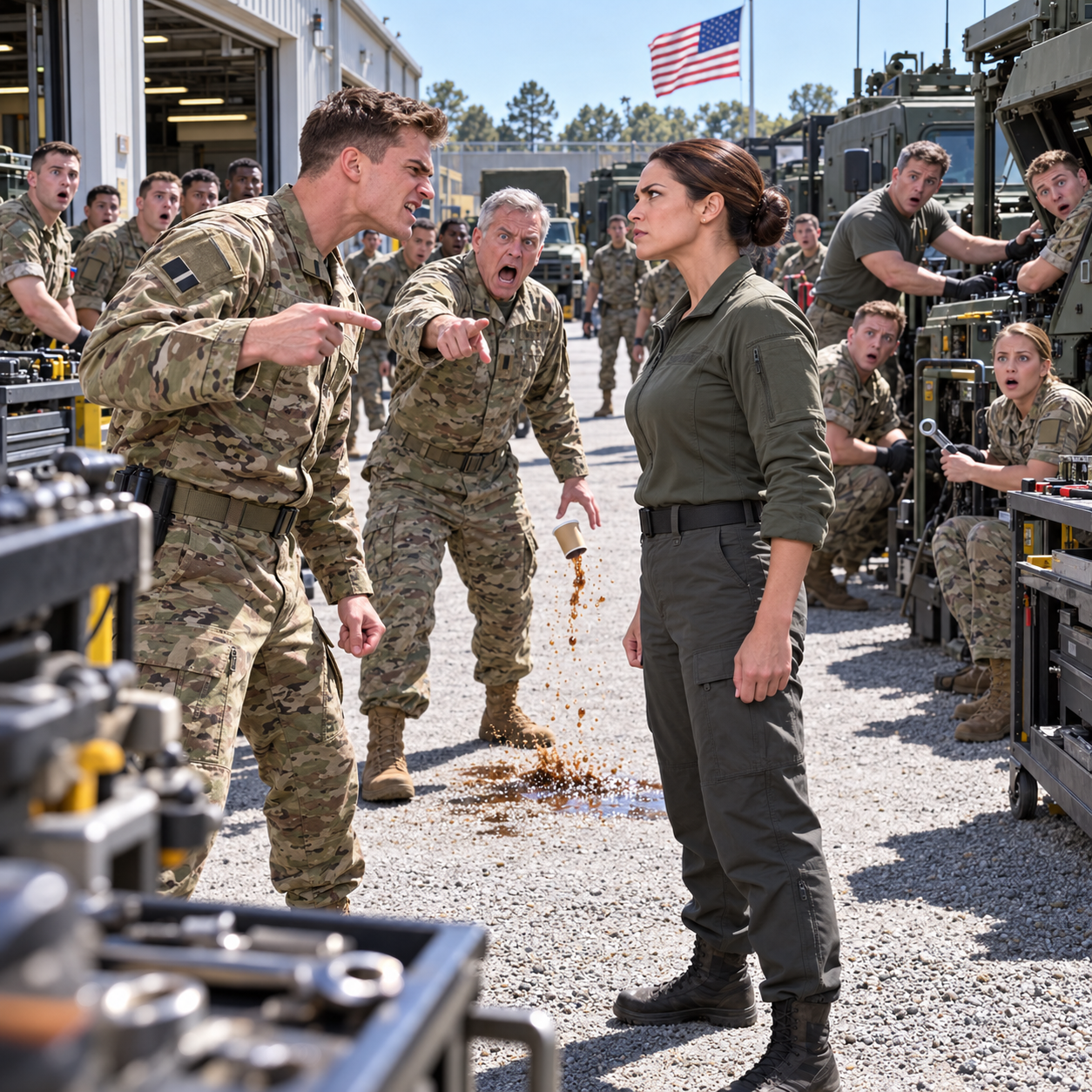
“Find your cover, Staff Sergeant. Salute. I won’t ask twice.”
First Lieutenant Graham Pierce stood eight feet from me outside the headquarters battalion motor pool at Fort Carson, Colorado, looking like someone had ironed him along with his uniform. His boots were immaculate, his patrol cap sat perfectly level, and a gold braided cord hung from his shoulder, identifying him as an aide to a general officer. He held a black leather portfolio against his ribs and spoke with the particular confidence of a man who had never encountered a situation that couldn’t be solved by announcing his rank.
I was standing beneath the shallow overhang of our gate shack, holding a maintenance clipboard with one hand and a greasy shop rag with the other. My cover was hanging on a hook inside, exactly where I’d left it before crawling under a truck to inspect a leaking hydraulic line. It was 6:47 on a Monday morning in early October, the temperature was thirty-eight degrees, and the first snow of the season had settled across Pikes Peak like powdered sugar on a gray countertop.
“Good morning, sir,” I said, coming to attention. “I’m uncovered and standing beneath the overhang. I’ve rendered the appropriate greeting.”
Pierce glanced at my name tape. “Moreno, is it?”
“Yes, sir.”
“Then, Staff Sergeant Moreno, I suggest you retrieve your cover and render the salute I just requested.”
I could have done it, of course. My patrol cap was fifteen feet away, and walking inside to get it would have taken less time than explaining why his demand was unnecessary. But something about the way he was looking at me bothered me, particularly the small smile on his face and the fact that he had chosen to correct me loudly enough for everyone in the motor pool to hear.
Behind me, an impact wrench stopped rattling. Sergeant First Class Luis Salazar, a weathered mechanic everyone called Bear, emerged from Bay Two with a torque wrench in his hand and a suspicious expression beneath his bushy eyebrows. Private First Class Jonah Reed slid out from underneath an LMTV on a rolling creeper, his boots scraping across the concrete as he tried to see what was happening.
“Sir,” I said, “I’m happy to follow a lawful instruction, but I don’t believe this situation requires a hand salute.”
Pierce tucked his portfolio beneath his arm. “What it requires, Staff Sergeant, is for you to stop explaining military customs to a commissioned officer.”
That was when the radio in the tool room went quiet.
I’d served seventeen years in the United States Army, long enough to recognize the difference between a correction intended to improve discipline and a public confrontation intended to establish someone’s importance. Pierce had arrived at the motor pool less than five minutes earlier, asking about a vehicle readiness report that I’d refused to sign the previous Friday. He hadn’t mentioned the report again after learning that I was the staff sergeant responsible for the inspection.
Instead, he’d begun talking about my appearance, my dirty coveralls, and what he considered my insufficient military bearing.
“Understood, sir,” I said. “Would you like me to retrieve my cover now?”
“That’s what I’ve been telling you.”
“Then I’ll be right back.”
“Don’t walk away while I’m addressing you.”
I stopped. The soldiers behind me had gone completely still, and somewhere beyond the perimeter fence, a diesel engine coughed unsuccessfully through another cold start. Pierce stepped closer, lowering his voice just enough to make the next words feel personal.
“I’ve seen your name on a report, Moreno. Apparently, you have a habit of challenging officers who give you instructions.”
I looked at the black portfolio beneath his arm. “Would that report happen to concern vehicle B-17, sir?”
His expression changed.
It lasted less than a second, but I’d spent too many years reading faces in dangerous situations to miss it.
“That isn’t your concern right now,” he said. “Your concern is showing the appropriate respect.”
I was about to answer when I noticed someone coming around the corner of Bay Three.
Major General Thomas Avery walked toward us carrying a paper cup of coffee, his free hand tucked casually behind his back. He wore his camouflage duty uniform with two black stars on his chest, and the gray hair beneath his patrol cap had grown considerably thinner since the last time I’d seen him. He was looking toward the vehicle line, apparently examining the condition of the trucks, until his gaze passed over Pierce and settled on my face.
He stopped so suddenly that I thought he’d stumbled.
Then his fingers opened.
The coffee cup struck the concrete, bounced once, and split along the seam. Hot coffee spread around his boots in a dark brown puddle, steam rising into the freezing air while the empty cup rolled against a tire.
Pierce didn’t notice.
“Staff Sergeant,” he said, “I’m still waiting.”
I hadn’t seen Thomas Avery in almost eight years, but I recognized the expression on his face immediately.
I’d seen it once before, in Afghanistan, when he’d stood on the running board of a burning military truck and looked through its open driver’s door at a twenty-year-old soldier who couldn’t stop crying.
That soldier had been me.
“Lieutenant,” I said quietly. “You should turn around.”
Pierce’s shoulders tightened. “Don’t tell me what to—”
“Sir. Please.”
Something in my voice finally reached him. He turned, saw the two stars on Avery’s uniform, and snapped to attention so quickly that his portfolio slipped from his arm and landed in the gravel.
“General Avery! Sir, good morning. I was just correcting a—”
“Lieutenant Pierce.”
The general’s voice was soft.
“Yes, sir.”
“Step aside.”
Pierce moved.
Avery approached me without looking at anyone else, stopping where the concrete changed from sunlight to shade. For several seconds, neither of us spoke, and I was suddenly aware of the cold against my bare head and the weight of twelve pairs of eyes on my back.
“Rachel,” he said.
Nobody at Fort Carson called me Rachel during duty hours.
“Good morning, General.”
He swallowed. “I didn’t know you were assigned here.”
“Since February, sir.”
“Seven months.”
“Yes, sir.”
He looked down at the clipboard in my hand, then at the grease stains on my coveralls. His mouth moved slightly, almost a smile, but it vanished before reaching his eyes.
“Still keeping the trucks moving?”
“Trying to, sir.”
He nodded, and for a moment I thought he would ask about Afghanistan, about the soldiers I’d pulled from the overturned vehicle, or about the one I hadn’t been able to bring home. Instead, he glanced toward the gate shack.
“Do you have your cover nearby, Staff Sergeant?”
I knew what he intended to do.
Every muscle in my body wanted to refuse, but I also knew refusing would make the moment even larger.
“Inside, sir.”
“Would you mind putting it on?”
I turned toward Jonah. “Reed, would you grab my patrol cap? It’s on the hook beside the dispatch board.”
He disappeared through the doorway, while Pierce stood frozen beside his fallen portfolio. Avery waited without moving, his boots inches from the spreading coffee, and Bear slowly straightened beside Bay Two.
Jonah returned with my patrol cap and handed it over.
I pulled it onto my head, adjusted the brim, and stepped beyond the overhang into the open morning air.
“Sir,” I said, “I’m covered.”
Major General Thomas Avery came to attention.
Then the two-star general raised his right hand and saluted me.
And behind my shoulder, I heard Lieutenant Pierce whisper, “Oh, my God.”
## Part 2
A general officer saluting an enlisted soldier isn’t something you see every morning, but the United States military maintains a longstanding tradition concerning recipients of the Medal of Honor. Regardless of rank, service members may salute the person who has received the nation’s highest military decoration, recognizing an act of extraordinary courage rather than the insignia on a uniform. I had spent years avoiding situations where that tradition might become relevant, which was difficult considering that my photograph had once appeared in newspapers, on television, and across military websites.
I returned Avery’s salute, holding my hand steady even as an old, familiar pressure gathered behind my ribs. The general lowered his arm after I answered, and for three seconds the motor pool remained silent. Then Bear’s voice cracked across the concrete like a rifle shot.
“Motor pool! Attention!”
Twelve soldiers came to attention in a ragged wave of boots and startled movements. Jonah almost dropped the flashlight he’d been carrying, while Specialist Elena Torres stood beside a tool cart with both hands pressed against the seams of her coveralls. Pierce looked from the general to me, his mouth slightly open, trying to reconcile what he’d just witnessed with the dirty staff sergeant he’d spent five minutes attempting to humiliate.
Avery turned toward him. “Lieutenant, do you recognize Staff Sergeant Moreno?”
Pierce’s throat moved. “No, sir.”
“You may know her by another name. Sergeant Rachel Ellis.”
The color drained from Pierce’s face.
“Sir,” he whispered. “The Medal of Honor recipient?”
“The same.”
I wanted to disappear beneath the nearest truck.
Avery glanced toward the other soldiers. “At ease. Please get back to work.”
Nobody moved immediately, but Bear had enough sense to restart the morning’s activities before the situation became a public ceremony. He clapped his hands and ordered Jonah back to the transmission he’d abandoned, although Jonah continued staring at me until Bear physically pointed him toward Bay One.
Pierce remained standing at attention.
“Staff Sergeant Moreno,” he said, “I apologize for my behavior.”
I studied him. The arrogance had vanished, replaced by genuine embarrassment, but I had learned that humiliation doesn’t necessarily produce understanding. Sometimes it simply teaches people to be more careful about whom they mistreat.
“Sir, I appreciate the apology,” I said. “But nothing about my medal changes whether I deserved respect before you knew who I was.”
He looked down. “Understood.”
I wasn’t convinced.
Avery retrieved the empty coffee cup while Bear sent someone for paper towels. Once the immediate commotion settled, the general asked if we could step inside the small maintenance office, and I followed him through a door that squealed every time the temperature dropped below forty degrees. The office smelled of burnt coffee, printer toner, and rubber floor mats, with a wall calendar still displaying September because nobody had remembered to turn the page.
“Close the door, Lieutenant,” Avery said.
Pierce complied.
The general sat at the battered desk, placing his empty cup beside a stack of maintenance worksheets. He looked considerably older than I remembered, and that surprised me because the man in my memories had remained frozen at forty-something, wearing dusty body armor beside an armored truck in Afghanistan.
“Why didn’t you tell me you were here?” he asked.
“Because I thought you might arrange something like what just happened.”
His expression softened. “Fair answer.”
“I requested a regular assignment, General. No ceremonies, no speaking engagements, no special duties. I wanted to supervise mechanics and make sure our vehicles were safe.”
“And you’re doing that?”
“Most days.”
He looked toward Pierce. “Apparently today has been different.”
The lieutenant stared at the floor.
Avery leaned back. “Lieutenant Pierce has been reviewing our headquarters maintenance operations because the division has a major field exercise approaching. Colonel Kessler reported concerns about discrepancies in readiness documentation.”
I felt my stomach tighten.
Lieutenant Colonel Victor Kessler was the brigade operations officer responsible for coordinating several of the vehicles supporting the exercise. He rarely visited the motor pool, preferring spreadsheets, briefings, and reports that displayed percentages in green boxes. Two weeks earlier, he’d announced that ninety-five percent of our transportation fleet needed to be mission capable before an upcoming inspection.
The problem was that machinery didn’t care what percentage a colonel wanted.
“Those discrepancies concern B-17,” I said.
Pierce looked up sharply.
Avery nodded. “Explain.”
“B-17 is a light medium tactical vehicle assigned to support the communications section. Last Thursday, Specialist Torres discovered inconsistent braking pressure during an inspection. We found additional evidence of a hydraulic leak, so I marked the vehicle non-mission-capable and documented the fault.”
“Was the defect repaired?”
“No, sir.”
“Then why does the readiness report list the vehicle as fully operational?”
“That’s what I’ve been trying to find out.”
Pierce shifted uneasily.
I continued, explaining how our maintenance system had shown the truck as deadline status on Thursday afternoon, only for a revised report to appear Friday morning removing the restriction. When I checked the vehicle, the leak remained untouched. I’d declined to sign the revised inspection paperwork and requested clarification through my chain of command.
Avery listened without interrupting.
“Who submitted the revised report?” he asked.
“The operations section, according to the electronic record.”
He turned toward Pierce. “Lieutenant, is that why you came here?”
Pierce’s eyes widened. “Sir, I was instructed to obtain an explanation for Staff Sergeant Moreno’s refusal to acknowledge the readiness correction.”
“By whom?”
“Colonel Kessler’s office, sir.”
“And did anyone instruct you to investigate whether the vehicle was actually safe?”
“No, sir.”
Avery folded his hands.
The silence that followed was different from the one outside. It was the sort of silence that meant a senior officer was deciding whether something was an isolated mistake or evidence of a larger problem.
“Staff Sergeant,” he finally said, “I want the original inspection, the revised report, and every maintenance entry concerning B-17 preserved.”
“Yes, sir.”
“Lieutenant, you will assist her. You are not here to make her apologize. You’re here to establish what happened.”
Pierce straightened. “Understood, sir.”
“And Graham?”
The use of his first name startled him.
“Yes, sir?”
“The next time an enlisted soldier tells you a truck is unsafe, I suggest you inspect the truck before inspecting the soldier’s attitude.”
For the first time that morning, I almost smiled.
Avery rose, but before leaving, he stopped beside me. His expression changed, and for an instant I could see the officer who had once crouched beside a hospital bed and told me that three men would survive because I’d refused to leave them behind.
“How are you doing, Rachel?” he asked softly.
It wasn’t a question about the motor pool.
“I’m doing my job, sir.”
He looked at me for another moment. “That’s not quite what I asked.”
“I know.”
He didn’t push.
After he left, Pierce collected the paperwork while I called Torres into the office. She brought her original inspection worksheet, her hands shaking slightly as she explained that she’d reported the same brake problem twice before. Both times she’d been told the readings were probably inaccurate and that the truck needed to remain available.
“I kept my copies,” she said. “Sergeant Moreno told us to keep everything when something doesn’t match.”
Pierce examined the papers without speaking.
Then Jonah appeared at the doorway carrying a sheet he’d found on the dispatch printer that morning.
“Staff Sergeant J, I think you need to see this.”
The document was a finalized maintenance authorization for B-17, time-stamped Sunday evening, when our motor pool had been closed. It declared that the brake defect had been corrected, the vehicle inspected, and the truck approved for operational use.
At the bottom was my name.
Staff Sergeant Rachel Moreno.
Beneath it was an electronic signature.
Mine.
I stared at the report, then looked toward the vehicle sitting outside Bay One.
I hadn’t signed that document.
And whoever had submitted it had done so eighteen hours before Lieutenant Pierce arrived demanding that I show him respect.
## Part 3
There are certain things a soldier can forgive another soldier for: a forgotten tool, an incorrectly filed form, even a mistake that costs the unit an entire afternoon of repairs. But approving a vehicle you know is unsafe doesn’t belong in that category. A truck carrying a dozen people down a mountain road doesn’t care whether a signature was added for convenience, whether an inspection deadline was approaching, or whether some officer needed a favorable readiness percentage for his next promotion board.
I read the authorization three times, checking the date, equipment number, and signature field. The report had been entered through a headquarters administrative account, then attached to my maintenance record as though I’d personally completed the inspection. Whoever submitted it understood enough about the system to make the paperwork appear legitimate, but hadn’t considered that I kept a separate notebook recording every vehicle I inspected.
“Don’t touch that record again,” I told Pierce.
He frowned. “Staff Sergeant?”
“Print the audit information, save an authorized copy, and document where it came from. We’re going to report the discrepancy, not try to fix it ourselves.”
Pierce nodded and moved toward the computer.
Outside, Jonah was explaining the morning’s salute to anyone who would listen. I could hear his voice through the office door, along with Bear ordering him to stop talking and finish removing the transmission pan. It would have been funny under different circumstances, but I knew my quiet assignment was over. By lunchtime, half the installation would probably know that a Medal of Honor recipient had been working in the headquarters motor pool without anyone realizing it.
I used to believe the hardest part of my service was the day I earned that medal.
I was wrong.
The hardest part was living afterward.
On June 14, 2010, I was a specialist assigned to a transportation unit in Afghanistan, driving an armored cargo truck through the Arghandab River Valley. We’d been moving supplies for several hours, and the sun had already turned the road into a white ribbon of dust and glare. Specialist Wesley Bell, my gunner and closest friend, was sitting above me in the turret, talking about a barbecue restaurant he planned to open when he returned to Odessa, Texas.
Everybody called him Wes.
He was twenty years old, with oversized ears, a laugh that carried across crowded rooms, and an almost supernatural ability to find the candy I hid inside the truck. His mother, Evelyn, mailed him care packages containing homemade cookies, barbecue seasoning, and family photographs, but Wes preferred stealing my Skittles because, according to him, stolen candy tasted better.
“Rachel,” he called down through the hatch, “how much money does a person need to open a restaurant?”
“More than you’ve got.”
“That’s not encouraging.”
“I’m trying to keep you realistic.”
“I’m going to name it Bell’s Smokehouse. You can drive the delivery truck.”
“I already drive trucks.”
“Then you’re qualified.”
I remember laughing.
It’s strange what stays with you after someone dies. I can’t remember what we ate for breakfast that morning, or the names of every soldier traveling in the convoy. But I can remember the exact sound of Wes tearing open a candy bag, the way he tapped his fingers against the turret ring, and how he kept insisting that the restaurant needed a bright red sign.
The first explosion struck the lead vehicle shortly after seven.
There was no warning. One moment, the road ahead was ordinary, with dust rolling behind the convoy and sunlight flashing across the windshield. The next, the ground lifted, a thunderous concussion slammed through my chest, and the lead truck disappeared inside a wall of dirt and smoke.
Training took over before fear had time to organize itself.
I pulled our vehicle onto the shoulder and positioned it between the disabled truck and the direction of incoming fire. Wes swung the turret toward the threat while I climbed out through the driver’s door, grabbed my medical bag, and ran toward the overturned vehicle. Someone was shouting over the radio, someone else was screaming for a medic, and the sharp smell of burning fuel made my throat tighten.
The disabled truck had rolled into a drainage ditch beside an irrigation canal. Its rear access point was jammed, and flames were crawling around the engine compartment. I climbed onto the exposed side, burned my hands through my gloves trying to force open an access hatch, and finally managed to pull the first soldier through.
Then the second.
Then the third.
I went back for the fourth soldier, a young man whose name I still say aloud on the anniversary of that morning. He wasn’t breathing, and I knew there was almost nothing I could do, but knowing something and accepting it are two different things. I stayed until another explosion struck nearby and someone below me shouted that the fire was spreading.
Wes continued covering us from the turret.
I could hear the weapon above the noise, short bursts separated by shouted warnings, until suddenly there was a silence where his voice should have been.
I turned toward our truck.
He was no longer moving.
The next minutes exist in my memory as fragments. A soldier grabbing my shoulder, the metallic taste of blood in my mouth, and the horrifying realization that my friend had been killed while helping me save people who couldn’t save themselves. Somebody ordered me back into the truck, and I obeyed without remembering how I’d reached the driver’s seat.
I put my hands on the steering wheel.
They wouldn’t move.
I was shaking so badly that my teeth kept striking each other. My sleeve was burned, my arms hurt, and I couldn’t stop staring at the empty opening above my head where Wes should have been. When Lieutenant Colonel Thomas Avery climbed onto the running board and leaned through the open driver’s window, I barely recognized him.
“Specialist Ellis,” he said. “Rachel, look at me.”
I tried.
“You’re safe for the moment. I need you to let go of the wheel.”
“I left him,” I whispered.
Avery shook his head. “You didn’t leave him.”
“I couldn’t get him.”
“I know.”
He placed his hands over mine, speaking quietly while other soldiers worked around us. When my fingers finally loosened, he helped me climb down and remained beside me until the medical team arrived. He never told me to stop crying or reminded me that soldiers were supposed to be strong.
Three years later, the President placed the Medal of Honor around my neck.
The public version of that morning described the lives I’d saved and the enemy fire I’d endured. It mentioned my burns, the danger, and the courage of the soldiers involved. Everything in the citation was true, but whenever someone called me a hero, I thought about Wes lying motionless in the turret while I sat below him, still breathing.
By 2019, after years of ceremonies, interviews, and public appearances, I couldn’t stand being introduced as the woman who’d survived a day that destroyed another family.
I requested ordinary assignments, changed my last name after a marriage that eventually ended, and gradually stopped attending events where someone might ask me to describe the worst morning of my life. My personnel file still contained the decoration, of course, but I asked each new command to let me perform my assigned duties without public attention.
For seven years, that arrangement mostly worked.
Now, standing in the Fort Carson office, I looked at the falsified inspection report and felt an anger I hadn’t experienced in a very long time.
Wes had understood something I taught every young driver under my supervision: equipment failures don’t become less dangerous because someone needs a vehicle to look ready on paper. He’d checked his turret, his equipment, and his emergency gear before every movement, even when the rest of us complained about the delay.
I pulled my old maintenance notebook from a drawer.
“Lieutenant,” I said, “find out who authorized this report through headquarters. I’ll contact our maintenance control officer.”
Pierce hesitated. “What if Colonel Kessler tells us to stop?”
“Then we’ll document that instruction, too.”
An hour later, Torres discovered another irregularity. B-17 wasn’t the only vehicle whose recorded defects had disappeared. Over the previous eighteen months, several trucks had been declared operational despite unresolved safety complaints, and one equipment number appeared repeatedly in the older inspection summaries.
I recognized the number because I’d seen it during my initial review when I arrived at Fort Carson.
It belonged to a truck involved in a serious training accident in 2024.
The driver, a young specialist named Hannah Webb, had been blamed for losing control on a downhill road. According to the report, she’d failed to inspect her vehicle properly before departure.
But the maintenance history now showed that somebody had reported a braking problem three days before her accident.
And just like B-17, that warning had disappeared.
## Part 4
By Wednesday afternoon, the motor pool had become the most uncomfortable workplace I’d known outside a combat zone. Two civilian investigators from the installation safety office were examining our maintenance records, our company commander had been pulled into a series of closed-door meetings, and Lieutenant Pierce had been temporarily removed from his normal duties while headquarters reviewed the circumstances surrounding the falsified authorization. Nobody had been accused formally, but everyone understood that an investigation involving vehicle safety and a two-star general was unlikely to disappear quietly.
The story about the salute was spreading even faster.
Someone had taken a photograph of Avery standing at attention in front of me, and by Tuesday evening, it had appeared on a military-related social media page. The caption described a young lieutenant humiliating an enlisted Medal of Honor recipient before a general corrected him. It wasn’t completely inaccurate, but it turned an uncomfortable encounter into entertainment, stripping away everything that mattered to the people involved.
Jonah found the photograph first.
“Staff Sergeant J,” he said, holding out his phone, “there are thirty thousand people commenting on this.”
“Then thirty thousand people need something more useful to do.”
“Somebody called you the most decorated mechanic in Colorado.”
“That somebody hasn’t seen Bear’s collection of stolen socket wrenches.”
From across the bay, Bear shouted, “I heard that, Moreno.”
Jonah laughed, but I could see the concern beneath his amusement. He’d stopped calling me Staff Sergeant J whenever unfamiliar officers were nearby, and the other soldiers had begun standing straighter when I entered a room. It was the very behavior I’d hoped to avoid by keeping my past private.
“Reed,” I said, “what did I tell you about the torque specifications on those rear wheel assemblies?”
He blinked. “Follow the manual, Staff Sergeant.”
“And what happens if I tell you to ignore the manual?”
“I tell you you’re wrong.”
“Good. Nothing about Monday changes that.”
He smiled, a little more comfortably this time, and went back to work.
An hour later, Colonel Kessler requested that I report to his office.
I found him sitting behind a polished desk beneath a framed photograph of his commissioning ceremony. He was a tall man in his late forties, with thinning blond hair, pale blue eyes, and a voice that sounded friendly until you noticed he never asked questions unless he already had an answer prepared.
“Staff Sergeant Moreno,” he began, “you’ve certainly attracted attention.”
“Not intentionally, sir.”
“I believe you. General Avery speaks very highly of you.”
He gestured toward a chair, and I sat.
Kessler folded his hands. “Unfortunately, the attention has complicated a routine administrative issue. People are interpreting a paperwork discrepancy as evidence of misconduct.”
“The paperwork authorizes an unsafe vehicle for use, sir.”
“Allegedly unsafe.”
“Specialist Torres documented the brake defect. I verified it personally.”
“Equipment classifications occasionally change as updated information becomes available.”
“Then there should be a repair record.”
His smile faded.
“You’re an experienced noncommissioned officer, Moreno. Surely you understand how readiness reporting works under operational pressure.”
“Yes, sir. That’s why I didn’t sign the correction.”
Kessler leaned back and studied me.
“I’d hate to see your distinguished service reduced to a disagreement over administrative procedures.”
There it was.
It wasn’t a direct threat, and he was too experienced to phrase it as one. But the meaning was unmistakable: stop asking questions, return to the motor pool, and allow the people above you to resolve the matter without further embarrassment.
I placed my notebook on his desk.
“Sir, I’ve already submitted the original documents to the safety investigators. I intend to cooperate fully.”
“That may not be necessary.”
“I believe it is.”
For several seconds, he said nothing.
Then he stood, ending the meeting.
“Very well, Staff Sergeant. Dismissed.”
I walked into the hallway feeling the same instinctive tension I’d felt in Afghanistan whenever a road looked too empty. Something was wrong, but I couldn’t yet see how large the problem had become.
That evening, I found Bear sitting alone in Bay Three, working on an old hydraulic pump beneath a hanging fluorescent light.
“You look like you just had lunch with a rattlesnake,” he said.
“Colonel Kessler wanted to discuss teamwork.”
Bear grunted. “That usually means somebody wants you to do their work and take the blame.”
I sat on an overturned bucket beside him.
“How long has Kessler been involved in the maintenance readiness reports?”
“Since before I got here. He took over the operations section in 2023.”
“And the accident in 2024?”
Bear stopped turning his wrench.
“Webb’s truck?”
I nodded.
He set the tool aside and wiped his hands.
“Hannah Webb was twenty-two. Good driver. Careful, too. She kept reporting a soft brake pedal on a cargo truck that had just come back from maintenance.”
“What happened?”
“Training convoy out near the range roads. Long downhill section, sharp curve near a drainage culvert. Truck didn’t slow the way she expected. She left the road trying to avoid the vehicle ahead.”
“Was anyone killed?”
“No. Two other soldiers were hurt, and Webb spent months in rehabilitation. Shattered her lower leg badly enough that she eventually left the Army.”
I looked down at the concrete.
“The accident report blamed her inspection.”
“That’s what it said.”
“Did you believe it?”
Bear stared toward the open bay.
“I wasn’t assigned here then. But I knew the maintenance warrant officer who reviewed the equipment afterward. He told me the brakes had been a problem before the accident.”
“What happened to his findings?”
“He transferred out six months later.”
Bear lowered his voice.
“Rachel, there are things people learn not to say when their careers depend on the people who control the paperwork.”
I thought about the lieutenant standing in front of me on Monday, ordering me to salute instead of addressing a safety report.
“Somebody taught Pierce that lesson pretty well.”
Bear looked at me. “Maybe. But he didn’t invent this problem.”
The next morning, I met with Captain Lena Cho, an installation safety investigator who had spent eleven years reviewing vehicle incidents and workplace injuries. She had dark hair pulled into a tight bun, reading glasses hanging from a cord, and a practical manner I appreciated immediately. She didn’t ask about my medal, the viral photograph, or my history in Afghanistan.
She wanted documents.
I brought everything I had.
Cho examined the inspection records, compared the original and revised entries, and asked me to identify which reports I’d personally authorized. When she reached B-17’s Sunday authorization, she enlarged the signature block on her computer.
“Staff Sergeant, does this look familiar?”
“It looks like my name.”
“I mean the formatting.”
I leaned closer.
The signature wasn’t generated from my current account authentication. It was a copied image from an older signed inspection, placed into a scanned maintenance authorization that had then been uploaded through headquarters. The investigator compared the two documents and found an identical flaw in the lower corner, a thin black mark left by a malfunctioning scanner.
Someone had reused my signature.
Cho sat back slowly.
“That changes things.”
“Can you identify who uploaded it?”
“We can identify the originating account and trace the document’s handling. But I want to preserve the audit evidence before we approach anyone.”
She turned the screen toward me.
The upload had originated from an administrative workstation assigned to Master Sergeant Alan Dugan, the senior maintenance coordinator working directly under Colonel Kessler’s operations section.
I recognized Dugan’s name.
He was also listed on the maintenance approval chain for Hannah Webb’s truck in 2024.
And that meant the two incidents weren’t just similar.
They were connected by the same man.
## Part 5
Master Sergeant Alan Dugan had a reputation for getting things done. During my first month at Fort Carson, I’d heard three different officers describe him as the person who could find a replacement part, secure a transportation slot, or solve a paperwork problem when normal procedures moved too slowly. He was fifty-one, close to retirement, and wore the relaxed expression of someone who’d spent long enough inside the institution to understand which rules people followed and which ones they quietly worked around.
I’d met him twice.
Both times, he’d suggested that our maintenance section spent too much time recording problems that could be resolved later.
When Captain Cho showed me his name in the audit trail, I felt less surprise than disappointment.
“Is there any chance he uploaded the document without knowing it was false?” I asked.
“Yes,” she said. “That’s one reason we’re investigating instead of assuming.”
It was an answer I respected.
I had no interest in destroying someone’s career because their name appeared on a computer screen. But I also knew the harm that could follow if investigators accepted a convenient explanation without examining what really happened.
Cho requested that the relevant records be preserved through official channels, while another investigator began comparing archived inspection documents from 2023 onward. The investigation expanded beyond our motor pool, revealing irregularities across several transportation units that submitted readiness reports to the same headquarters office.
The pattern wasn’t dramatic at first glance.
A brake complaint reclassified as an advisory note. A replacement part recorded as installed before its delivery date. An inspection marked complete while the assigned mechanic was on approved leave. Each discrepancy could be explained individually as a clerical mistake, but together they suggested a system in which accurate reports were being altered to satisfy operational targets.
The following Monday, Pierce appeared at the motor pool shortly before the end of the duty day.
He wasn’t wearing the gold cord he’d worn during our first encounter.
“I was told I could speak with you, Staff Sergeant,” he said.
“About what, sir?”
“Monday morning.”
I was checking a shipment of replacement filters and didn’t particularly want to revisit it, but something about his expression made me set down the packing slip. He looked tired, with dark circles beneath his eyes and a careful stiffness in his posture that hadn’t been there before.
“Go ahead.”
“I wanted to explain why I behaved the way I did.”
I waited.
“Colonel Kessler’s office contacted me Friday afternoon. They said you were refusing to cooperate with the readiness review, and that you had a history of challenging supervisors.”
“Did they tell you about the brake defect?”
“No.”
“Did you ask?”
He looked down. “No.”
I leaned against the workbench.
“Then what did you think you were supposed to accomplish?”
“Get you to acknowledge the correction. Establish that headquarters’ instructions would be followed.”
“By arguing about my cover?”
He winced.
“I know how it sounds now.”
“How did it sound then?”
Pierce was silent for several seconds.
“Like leadership,” he finally admitted.
I looked at him more carefully.
He couldn’t have been older than twenty-six. He’d graduated from college, completed his officer training, and probably spent his entire adult life being told that confidence was an essential leadership quality. Somewhere along the way, he’d mistaken confidence for certainty and authority for proof that he was right.
“My first platoon sergeant told me something years ago,” I said. “He said the worst officer wasn’t the one who didn’t know something. It was the one who couldn’t admit he didn’t know.”
Pierce nodded.
“I’m receiving formal counseling for Monday,” he said. “General Avery also reassigned me while the investigation continues.”
“That sounds appropriate.”
“I agree.”
That surprised me.
He glanced toward the vehicle line. “Could I ask you something else?”
“Depends.”
“Why didn’t you tell me who you were?”
I looked toward Jonah, who was struggling to remove a stubborn bolt while Bear offered increasingly unhelpful advice from a nearby tool cabinet.
“Because you shouldn’t need to know somebody’s achievements before deciding to treat them decently.”
Pierce absorbed that without defending himself.
Then he asked whether I would be willing to teach him how to conduct a proper vehicle inspection once he was cleared to return to normal duties.
I considered him for a moment.
“Ask through the proper chain of command,” I said. “And bring clothes you don’t mind getting dirty.”
He gave a small, embarrassed smile.
“Yes, Staff Sergeant.”
Three days later, Captain Cho called me into her office.
She had located Hannah Webb.
Hannah was living outside Pueblo, Colorado, working part-time for a medical supply company while completing a business degree. She walked with a permanent limp, had undergone several surgeries, and still experienced pain during cold weather. Her departure from the Army had been medically approved, but the accident investigation had left a formal reprimand in her record stating that she’d failed to identify and report an obvious mechanical defect.
According to Cho, Hannah had spent nearly two years trying to correct that conclusion.
“She’s agreed to speak with us,” Cho said. “She also knows that you’re involved.”
“Does she want to meet me?”
“She asked.”
We arranged to meet at the safety office the following afternoon, with Cho present so the discussion could be documented properly.
Hannah arrived wearing jeans, a dark green sweater, and a pair of flat walking shoes. She was twenty-four now, with auburn hair falling just below her shoulders and a small scar near her eyebrow. When she stood to greet me, I noticed the uneven way she shifted her weight from one leg to the other.
“Staff Sergeant Moreno,” she said.
“Rachel is fine.”
She smiled nervously. “I saw your picture online.”
“I wish you hadn’t.”
That earned a real laugh.
We sat beside a window overlooking a parking lot where the autumn leaves had collected against the curbs. Hannah opened a folder containing copies of medical appointments, correspondence, and an old maintenance worksheet she’d kept folded inside a plastic sleeve.
“I reported the brakes,” she said. “Three times.”
Her voice was steady, but her hands tightened around the folder.
“First to my team leader, then to maintenance, then on the inspection sheet before the convoy. I told them the pedal wasn’t responding normally.”
“What did they say?”
“That the truck had been cleared. That the mechanic had tested it. That we were short on vehicles and I needed to stop looking for reasons not to drive.”
She swallowed.
“After the accident, they showed me a report saying I’d inspected the truck and found no problems.”
“Did you sign it?”
“No.”
Cho placed the preserved worksheet on the table.
“Is this your original?”
Hannah nodded immediately.
“I kept it because my team leader told me to throw it away.”
I watched her eyes fill with tears.
“Everybody kept telling me I’d made a mistake,” she whispered. “Eventually, I started wondering if maybe I had.”
I remembered the sound of Wes’s voice disappearing above me and the terrible habit grief has of turning every memory into an accusation.
“You reported the problem,” I said. “You did what you were supposed to do.”
Hannah wiped her cheeks.
“That doesn’t change what happened.”
“No,” I answered. “It doesn’t.”
Cho then showed us the maintenance authorization submitted before Hannah’s training accident. The inspection had been approved through Dugan’s office, and the document contained a handwritten notation indicating that the reported brake problem had been resolved.
Beside the notation were two initials.
A.D.
Hannah stared at the letters.
“I remember him,” she said.
“Master Sergeant Dugan?” Cho asked.
She shook her head.
“No. Colonel Kessler. He was a major then. He came to the motor pool before the exercise and told everyone we couldn’t afford another vehicle going down for maintenance.”
She looked directly at me.
“After the accident, he visited me in the hospital. He said accepting responsibility would help me move forward.”
For the first time, the connection between the falsified reports and the people benefiting from them became painfully clear.
They hadn’t simply altered the paperwork.
They’d made an injured young soldier believe the accident was her fault.
## Part 6
The investigation lasted longer than anyone at the motor pool expected, which was probably a good thing. I had seen too many situations where senior leaders demanded immediate answers, then accepted whatever explanation allowed them to return to their schedules. Captain Cho didn’t work that way. She checked documents against equipment records, interviewed soldiers separately, and refused to treat someone’s rank as evidence of honesty.
By the end of October, investigators had identified eleven questionable maintenance authorizations submitted through the operations office during the previous three years. Six involved vehicles with documented safety defects, while others concerned repairs recorded before replacement parts had arrived. Not every discrepancy was criminal, and several turned out to be ordinary clerical errors. But five documents contained signatures or inspection confirmations that the named soldiers denied providing.
Two of those soldiers had since left the Army.
One was Hannah Webb.
The other was a mechanic named Specialist Daniel Foster, who had transferred to Georgia after receiving a poor evaluation that described him as difficult to supervise. Foster had repeatedly challenged maintenance records on vehicles assigned to major training exercises. When investigators contacted him, he provided copies of emails he’d sent requesting written authorization before changing equipment status.
One message from Master Sergeant Dugan instructed him to stop creating unnecessary documentation.
Another warned that his attitude would be considered during his next performance review.
I read those emails in Cho’s office and felt my anger settle into something colder and more deliberate. This wasn’t one dishonest form or one officer trying to look good during an inspection. It was an established way of doing business, reinforced through promotions, evaluations, and the fear of being labeled disloyal.
The people who objected were treated as problems.
The people who kept the numbers favorable were rewarded.
And eventually, a young woman ended up in a hospital bed with a shattered leg while the paperwork said she had failed to do her job.
I asked Cho what would happen to Hannah’s reprimand.
“The command is reviewing the accident findings in light of the new evidence,” she said. “She’ll also have grounds to pursue correction of her military records. It won’t happen overnight.”
“She deserves more than a correction.”
“I know.”
“An apology would be a start.”
Cho removed her glasses.
“Rachel, investigators can establish facts and recommend action. We can’t make people become decent.”
I thought about that sentence for the rest of the afternoon.
That evening, Avery asked me to meet him in a small conference room at division headquarters. He was alone when I arrived, standing beside a window overlooking the parade field, and a half-finished cup of coffee sat on the table behind him.
“Please tell me you’re going to keep hold of that one, sir,” I said.
He looked at the cup and smiled.
“I’ve endured two weeks of jokes about the other one.”
“You could have picked a less dramatic way to say hello.”
“I suppose I could have.”
He gestured toward a chair.
For a while, we talked about the investigation. Avery explained that the command had ordered an independent review of the affected vehicle records and temporarily restricted several officers’ access to maintenance reporting systems. Dugan had been removed from his administrative responsibilities pending further inquiry, and Kessler was no longer overseeing the readiness process.
Neither action meant they had been found guilty of every allegation.
That distinction mattered to Avery, and it mattered to me.
“The evidence needs to survive scrutiny,” he said. “Otherwise, we accomplish nothing.”
I nodded.
He leaned forward.
“Rachel, there’s something else I wanted to discuss.”
I knew from his tone that we were finished talking about maintenance.
“The photograph from Monday has brought your name back into public attention. We’ve received several requests for interviews, and the Veterans Day gala committee has asked whether you’d consider attending this year.”
I looked toward the window.
“No, sir.”
He didn’t seem surprised.
“They’re not asking you to give a speech.”
“No.”
“Mrs. Bell is planning to attend.”
That made me look back.
“Evelyn?”
Avery nodded.
“She called me last week. She’d seen the photograph.”
I pressed my hands together.
Evelyn Bell had been part of my life since the White House ceremony in 2013, although our relationship had changed over time. At first, she called every few weeks, asking whether I was eating properly, whether the Army was treating me well, and whether I remembered the stories Wes had told about home. Eventually, I began avoiding her calls because hearing her voice brought back memories I didn’t know how to carry.
She kept calling anyway.
On Christmas mornings, she left messages wishing me peace. On Wes’s birthday, she sent pictures of the barbecue restaurant he’d wanted to open, occasionally describing the empty building on the edge of Odessa where she’d once imagined helping him set up his first smoker.
I loved her, and I was ashamed of how badly I’d handled that love.
“How is she?” I asked.
“Still stubborn,” Avery said.
I smiled despite myself.
“That sounds right.”
He studied me carefully.
“She doesn’t want a public appearance, Rachel. She wants to see you.”
I looked down at my hands.
“She was there in 2013. She watched them put that medal around my neck while her son was buried in Texas.”
Avery’s expression tightened.
“Yes.”
“I never understood how she could stand looking at me.”
“Have you asked her?”
I shook my head.
He sat back.
“Then maybe you should.”
I left headquarters without agreeing to attend the gala.
When I reached my apartment, I found a small cardboard package outside the door. It had been forwarded from an old mailing address, and the return label carried Evelyn’s familiar handwriting.
Inside was a photograph of Wes standing beside a rusted barbecue grill in his parents’ backyard. He was wearing an oversized apron, holding a spatula like a weapon, and grinning so widely that his eyes had nearly disappeared.
Behind the picture was a note.
“Rachel, I found this while cleaning the garage. He was twenty when I took it, and he was absolutely convinced you would be his first employee. I thought you should have it. Love, Evelyn.”
I sat at my kitchen table for a long time.
Then I walked into the bedroom and opened the top drawer of my dresser.
The flat blue presentation case rested beneath a stack of folded shirts. I hadn’t opened it since moving to Colorado, although I’d checked that it was there every time I packed for another assignment.
I carried it to the kitchen.
Inside was the Medal of Honor, suspended from its pale blue ribbon. The metal caught the overhead light, and I felt the familiar tightening in my throat as I remembered the White House, the cameras, and the faces of the soldiers who had survived.
I touched the ribbon.
Then my phone rang.
Evelyn’s name appeared on the screen.
For the first time in months, I answered.
“Hello?”
There was a pause.
Then her warm Texas voice filled my kitchen.
“Well, honey,” she said. “I was starting to think you forgot how a telephone works.”
I laughed, and to my embarrassment, the laugh immediately turned into tears.
“I’m sorry, Evelyn.”
“Oh, sweetheart.”
I could hear her settling into a chair.
“I’ve missed you.”
“I’ve missed you, too.”
We spoke about ordinary things at first: her garden, the weather, a neighbor’s dog that kept stealing mail from her porch. Eventually, the conversation turned toward Wes, and I told her something I’d never managed to say aloud.
“I still think about what I could have done differently.”
She was quiet.
“I know you do.”
“If I’d moved the truck another few feet, or stayed in the cab, or—”
“Rachel.”
Her voice stopped me.
“My son died in a war. You didn’t take him from me.”
I closed my eyes.
“He was protecting me.”
“He was protecting everybody. That’s the kind of boy I raised.”
I put my hand over my mouth, trying not to sob.
Evelyn waited until I could breathe again.
“Now, I want to ask you something,” she said.
“What?”
“Will you come to that Veterans Day dinner with me?”
I looked at the open blue case.
For seven years, I’d told myself that keeping the medal hidden was the only honest way to remember Wes.
But as Evelyn waited on the telephone, I began to wonder whether hiding had become another way of leaving him behind.
## Part 7
I arrived at the Veterans Day gala on November 11 wearing my Army dress uniform and carrying a small black handbag that belonged to a younger version of myself. The uniform still fit, although I’d spent twenty minutes adjusting the collar before leaving my apartment. Around my neck hung the Medal of Honor, its pale blue ribbon resting against the fabric, the medal itself feeling heavier than I remembered.
I hadn’t worn it publicly in seven years.
The gala was being held at a hotel in Colorado Springs, where enormous chandeliers hung above a ballroom filled with military families, veterans, and local community leaders. Outside, the air smelled of pine trees and fresh rain, and a steady line of vehicles was depositing guests beneath the covered entrance. I stayed in my car for several minutes, watching people walk inside while my fingers tightened around the steering wheel.
Then someone tapped gently on the passenger window.
Evelyn Bell stood beside the car wearing a dark blue dress, a cream-colored coat, and a small silver necklace bearing Wes’s initials. She had more gray hair than when I’d last seen her, and her face had grown thinner, but the smile she gave me was unmistakable.
I unlocked the door.
She climbed in without waiting for an invitation.
“Well,” she said, looking me over, “aren’t you a sight?”
I tried to smile. “I’m thinking about driving home.”
“I figured.”
“Really?”
“Sweetheart, you’ve been sitting out here long enough for me to finish a cup of tea.”
She took my hand.
“Nobody’s making you go inside. We can leave and get hamburgers if that’s what you want.”
I looked toward the hotel entrance.
“After you came all this way?”
“I didn’t fly here for a ballroom. I came to see you.”
Something in my chest loosened.
I had imagined that Evelyn wanted the woman from the newspapers, the decorated soldier everyone applauded. But sitting beside me in the passenger seat, she looked like any mother who had traveled a long distance to visit someone she loved and didn’t particularly care how the evening unfolded.
“Would Wes have hated this?” I asked.
She considered the question.
“He’d have complained about the food being too fancy, stolen three dinner rolls, and tried to find out whether the kitchen had a smoker.”
I laughed.
“And then he’d have told everybody you were the best truck driver in the Army,” she added.
I looked down at the steering wheel.
“Even after all these years?”
“Honey, he would’ve told anybody who’d listen.”
We walked toward the entrance together, Evelyn’s hand tucked through my arm.
Near the main doors, Lieutenant Pierce stood beneath the hotel portico, wearing his service uniform and speaking with another young officer. He noticed us approaching, finished his conversation, and moved toward us with an expression that was both respectful and slightly nervous.
“Staff Sergeant Moreno,” he said. “Mrs. Bell.”
I was surprised he knew Evelyn.
“Good evening, Lieutenant.”
He came to attention.
Then he saluted.
This time, there was no demand, no audience being deliberately summoned, and no effort to establish whose authority mattered more. It was simply a soldier recognizing another soldier, while an elderly woman watched with tears gathering in her eyes.
I returned the salute.
“Good evening, sir.”
He lowered his hand.
“I wanted to thank you for agreeing to help me with those inspections.”
I’d forgotten that Bear had arranged for Pierce to spend two afternoons observing preventive maintenance procedures once his duties permitted it. His visit had gone through the chain of command, and apparently he’d taken the request seriously.
“Have you learned anything useful?” I asked.
“That I know considerably less about trucks than I thought.”
“That’s a beginning.”
His smile was small but genuine.
Evelyn squeezed my arm.
“Young man,” she said, “do you know what Rachel’s friend Wes used to say about people who thought they knew everything?”
Pierce shook his head.
“He said, ‘Never take directions from somebody who refuses to look at a map.'”
Pierce laughed.
“I’ll remember that, ma’am.”
Inside the ballroom, I immediately regretted coming.
Hundreds of people in uniforms and evening clothes filled the room, and several turned when they noticed the medal around my neck. Conversations softened, heads turned, and a few guests approached to shake my hand. I answered their greetings, but my shoulders tightened with each introduction, and the old sensation of being watched through a glass wall began creeping back.
Evelyn noticed.
She guided me toward a quieter table near the side of the ballroom.
“Sit,” she instructed.
I obeyed.
“You’re thirty-six years old, Rachel. You can tell people you don’t want to talk.”
“I know.”
“Then do it.”
I looked at her.
“You sound like Wes.”
“Good. Somebody needs to.”
For the first time that evening, I relaxed.
General Avery joined us shortly afterward, accompanied by his wife, Margaret, a cheerful woman who remembered sending care packages to Afghanistan while her husband was deployed. Avery took Evelyn’s hand in both of his and asked about her family in Texas.
Then he said something that made her face change.
“Do you remember Wesley telling me about his barbecue restaurant?”
She nodded.
“He was going to call it Bell’s Smokehouse.”
“That’s right,” Avery said. “He told me the sign would be red because red made people hungry.”
Evelyn laughed through her tears.
“He argued with his father for two weeks about that sign.”
Avery smiled.
“He also insisted that a proper brisket needed enough time to rest before anyone cut it. He lectured me about that during a convoy briefing.”
I had never heard that story.
“Really?” I asked.
“Absolutely. He said I might know something about military operations, but I had no business interfering with barbecue.”
Evelyn covered her mouth, laughing and crying at once.
For several minutes, the three of us talked about Wes as a person rather than a casualty. We remembered his terrible jokes, the ridiculous photographs he mailed home, and his insistence that he would retire from the military before thirty because he planned to become extremely wealthy selling smoked meat.
It was the first time in years that remembering him hadn’t felt like reopening a wound.
Later, during the formal recognition of attending Medal of Honor recipients, Avery asked whether I would be comfortable standing with Evelyn while my name was introduced. I almost refused, but she looked at me and nodded.
So I stood.
The audience rose, and applause moved through the room like a wave. I could see soldiers in dress uniforms, elderly veterans holding their spouses’ hands, and young service members looking at the medal with the same awe I’d once felt toward decorated soldiers when I first enlisted.
I wanted to tell them that the day behind the decoration hadn’t felt glorious.
It had smelled like burning rubber and dust. It had been filled with fear, confusion, and the terrible weight of knowing that not everyone would come home.
When Avery offered me a microphone, I surprised myself by accepting.
“I wasn’t planning to speak tonight,” I said.
A few people smiled.
“But there’s someone I want you to know about. Specialist Wesley Bell was twenty years old when he died in Afghanistan. He wanted to open a barbecue restaurant in Texas, and he believed he made the best brisket in the world, even though I never once saw him cook one.”
Laughter moved gently through the ballroom.
“He talked too much, stole my candy, and took care of the people around him without expecting anyone to thank him. On the day I received this medal, I wished more than anything that he could have been standing beside me.”
I looked toward Evelyn.
“Tonight, his mother is standing beside me. And that means more to me than I can explain.”
I handed back the microphone before my voice failed.
The applause that followed wasn’t loud at first. It grew slowly, filling the ballroom while Evelyn held my hand so tightly that my fingers began to ache. I didn’t try to stop my tears, and I didn’t turn away from the people watching.
When we returned to our table, Evelyn reached up and straightened the ribbon at my collar.
“There,” she whispered. “That’s how he would’ve wanted to see you.”
I shook my head.
“I’m not sure I believe that.”
She smiled sadly.
“Well, I knew him a little longer than you did.”
After the gala, we drove to a twenty-four-hour diner and ordered hamburgers, fries, and two slices of chocolate pie. Evelyn insisted on paying, and I let her because arguing with her about a restaurant bill was a battle I had no hope of winning.
Before we left, she took a folded envelope from her handbag.
“There’s something I’ve been carrying for years,” she said. “I think you’re ready for it now.”
Inside was a letter Wes had written to her from Afghanistan, two weeks before he died.
Near the bottom, beneath a description of the food and an argument about whether his father needed a new grill, he’d written a sentence that made my hands begin to shake.
“If I ever get in trouble out here, Mom, I hope Rachel’s driving. She’s the one person I trust to get us home.”
I read it twice.
Then I laid the letter on the table and cried until the diner waitress quietly brought us another box of tissues.
For sixteen years, I’d believed the most important thing Wes left me was the responsibility to remember how he died.
That night, I understood he’d left me something else.
He’d trusted me while he was alive.
And I was finally beginning to believe that his trust hadn’t been misplaced.
## Part 8
The investigation reached its first major conclusion in December, nearly ten weeks after Lieutenant Pierce had ordered me to salute him outside the motor pool. By then, the photograph had mostly disappeared from social media, the news cycle had moved on, and Fort Carson had returned to its normal rhythm of early formations, vehicle inspections, and soldiers complaining about the cold. But behind the ordinary routine, the review continued, and the evidence was finally strong enough for the command to begin taking action.
Master Sergeant Dugan admitted that he had altered maintenance documentation to improve reported vehicle readiness. He maintained that he’d acted under pressure from senior officers who demanded operational targets without providing enough equipment, personnel, or repair time to meet them honestly. Investigators confirmed that his office had reused signatures from previous inspections, including mine, and that several altered records had been submitted after mechanics reported safety defects.
Dugan’s explanation didn’t excuse what he’d done.
It did, however, help investigators understand how the system had operated for so long.
Colonel Kessler had repeatedly received warnings about unresolved maintenance problems while continuing to demand favorable readiness reports. Investigators also uncovered correspondence showing that his office had pressured maintenance personnel to reconsider vehicle classifications shortly before major exercises. In Hannah Webb’s case, those communications directly contradicted the original conclusion that her unit had received no advance warning about the truck’s braking problem.
Kessler was relieved of his operational responsibilities following the command investigation. His conduct was referred for further administrative and legal review, while Dugan faced separate proceedings concerning the falsified documents. Additional supervisors received formal counseling or corrective action, depending on what the evidence established about their individual involvement.
There was no dramatic courtroom confrontation.
Nobody stood in front of the entire installation and announced that justice had been served.
Instead, reports were corrected, officials were removed from positions of responsibility, and soldiers who had been dismissed as troublemakers finally had their complaints examined seriously.
I found that more satisfying than any public humiliation could have been.
In January, Hannah called me after receiving notice that the Army was reopening the findings concerning her accident. The new review acknowledged the previously unreported maintenance warnings and removed the original investigation’s central assertion that she’d failed to report the vehicle’s braking defect. The formal process to correct her personnel record was still underway, but she finally had official documentation supporting what she’d been saying for almost three years.
“I thought I’d feel happier,” she admitted.
I was sitting at my kitchen table, drinking coffee while snow collected against the apartment windows.
“What do you feel?”
“Tired.”
I understood.
“They sent me a letter,” she continued. “From the command. It says they regret the failures that affected the investigation.”
“How do you feel about that?”
She hesitated.
“I appreciate it. But I don’t think I can forgive the people who knew I was telling the truth and let me believe I wasn’t.”
“Then don’t.”
She was quiet for a moment.
“Is that terrible?”
“No, Hannah. You can move forward without pretending what happened was acceptable.”
I heard her exhale.
“Thank you.”
Before hanging up, she told me she’d been accepted into a business management program and was considering starting a company that supplied adaptive workplace equipment. Her injury had changed the future she’d imagined, but she was building another one without asking permission from the people who’d nearly ruined the first.
That afternoon, I went back to the motor pool feeling better than I had in weeks.
Lieutenant Pierce was waiting beside B-17 wearing a set of dark blue coveralls, his sleeves rolled up and a maintenance checklist balanced against the truck’s fender. The vehicle had finally received its replacement components and was undergoing a full inspection before being returned to service.
“Good afternoon, Staff Sergeant,” he said.
“Lieutenant.”
He pointed toward the front axle.
“I found something.”
“Should I be worried?”
“Probably not. But I’d like you to check it.”
I crouched beside him and examined the fitting he’d indicated.
“What’s wrong with it?”
“Nothing obvious. But it looks dry, and the previous maintenance entry says it was serviced.”
I handed him a grease gun.
“Then let’s find out.”
He pressed the nozzle against the fitting, applied the correct amount, and checked the surrounding components before moving to the next inspection point.
A few months earlier, that same man had considered a staff sergeant’s refusal to salute him a challenge to his authority. Now he was kneeling on cold concrete, checking a truck for problems that might inconvenience someone with a much higher rank.
“Sir,” I said, “can I ask you something?”
“Of course.”
“Would you have questioned that report if the general hadn’t shown up Monday morning?”
He stopped working.
For a moment, I thought he might offer a comfortable answer.
“No,” he said.
I appreciated that.
“I probably would’ve accepted what Colonel Kessler’s office told me and moved on.”
“What changed?”
He considered the question.
“Seeing General Avery salute you embarrassed me. But finding out why you refused to sign that report made me realize how badly I’d misunderstood the job.”
I nodded.
“Good. Hold on to that.”
He looked up.
“Do you think I’ll become a decent officer?”
“That depends on what you do when nobody important is watching.”
He smiled faintly.
“Fair enough.”
I left him to finish the inspection.
Later that week, I received a brief written apology from Dugan through the appropriate channels. It acknowledged that he’d used my signature without authorization and claimed that pressure from headquarters had influenced his decisions. I read it once, placed it with my records, and didn’t respond.
I didn’t need to forgive him to stop thinking about him.
The soldiers he had endangered mattered more to me than his desire to feel absolved.
By February, I had made another decision.
I submitted a request for reassignment to the Army transportation school at Fort Leonard Wood, Missouri, where I hoped to teach young soldiers the practical skills that had defined most of my military career. I wanted classrooms, training vehicles, and students who didn’t yet understand how quickly an ordinary maintenance decision could become a matter of life and death.
General Avery called me into his office when the request reached his desk.
“You’re leaving Colorado?” he asked.
“If the Army approves it, sir.”
“Any particular reason?”
I thought about the motor pool, about Jonah and Bear, and about the strange chain of events that had begun with a lieutenant demanding a salute.
“I think I’ve done what I came here to do.”
Avery studied the paperwork.
“You know, when I saw you that morning, I thought you’d disappeared because you couldn’t bear to remember Afghanistan.”
“That was part of it.”
“And the other part?”
“I needed to know whether I could still be useful without everyone treating me like a medal on two legs.”
He smiled sadly.
“Did you find out?”
“Yes, sir.”
He signed the recommendation.
Before I left, he extended his hand.
“Rachel, I’ve spent years worrying about what happened to you after the ceremony.”
“You didn’t need to.”
“I know that now.”
I shook his hand.
“Thank you for coming back for me that morning, sir.”
His face changed.
He knew which morning I meant.
“I couldn’t have left you in that truck.”
“I know.”
He held my hand for another second.
“Neither could Wesley.”
On my final morning at Fort Carson in March, I arrived at the motor pool at six, carrying a thermos of coffee and the same battered clipboard I’d used since my first week. Snow had fallen overnight, leaving a thin white coating across the parked vehicles, and the fluorescent lights inside the maintenance bays cast yellow rectangles onto the frozen concrete.
Jonah was already underneath an LMTV.
“Morning, Staff Sergeant J,” he called. “You’re blocking my light.”
I stepped aside.
“Good morning, Reed.”
He slid out from beneath the vehicle.
“You’re really leaving?”
“Afraid so.”
“Who’s going to tell me when I’m doing something stupid?”
“Bear.”
Jonah grimaced.
“That’s what I’m worried about.”
I laughed.
Then he surprised me by standing and giving me a firm hug.
“Thank you for teaching me how to do things right,” he said.
I hugged him back.
“Keep checking your work.”
“I will.”
Bear was waiting near the gate when I finished saying goodbye to the rest of the section. He held the old aluminum clipboard I’d been complaining about for months, its bent metal clip still barely capable of holding a piece of paper.
“For your new students,” he said.
“I thought you hated that thing.”
“I do.”
“Then why give it to me?”
“Because you apparently enjoy working with broken equipment.”
I smiled.
He looked away, cleared his throat, and shoved a small packet into my hand.
Skittles.
I stared at the candy.
“Found those in the tool cabinet,” he said. “Figured you might need them for the drive.”
Bear knew about Wes.
He’d known since shortly after I arrived, although he’d never mentioned it until the morning Avery recognized me. My service record had told him enough to understand why I avoided ceremonies, and he’d respected my wish to be treated like any other staff sergeant.
“Thank you, Bear,” I whispered.
He nodded.
Then he pointed toward my truck.
“Get out of here before somebody finds another inspection for you to finish.”
I drove through the installation gate shortly after seven.
In my rearview mirror, the motor pool grew smaller until the buildings disappeared behind a row of trees. I expected to feel relief, but instead I felt a strange combination of gratitude and grief. I’d arrived wanting to become invisible, only to discover that being known didn’t necessarily mean losing the ordinary person I wanted to remain.
The following summer, I visited Evelyn in Odessa.
We spent a Saturday afternoon cooking barbecue in her backyard, using Wes’s old notes to prepare a brisket that required considerably more patience than either of us possessed. Her neighbors stopped by, her grandchildren played beneath the pecan trees, and somebody brought a homemade chocolate cake that collapsed slightly in the center.
Above the patio door hung a small red sign.
BELL’S SMOKEHOUSE.
Evelyn had ordered it years earlier but never managed to hang it.
When I asked why she’d put it up now, she glanced toward the photograph of Wes sitting on the kitchen windowsill.
“Figured he’d complain if we kept putting it off.”
I laughed.
Then I helped her serve dinner.
At Fort Leonard Wood, I eventually settled into a routine that felt wonderfully familiar. I taught young soldiers how to inspect vehicles, recognize mechanical problems, and understand that responsibility doesn’t disappear simply because an order comes from someone with more rank.
Occasionally, a student would recognize my name.
Sometimes, one would ask about the medal.
I answered honestly when I could, and when I couldn’t, I told them that some stories required more time than we had between training sessions. Most understood, and the ones who didn’t usually became too occupied with their first complicated maintenance assignment to keep asking.
In my small house near the installation, the Medal of Honor no longer lived in a drawer.
It rested inside its presentation case on a shelf in the living room, beside a photograph of Wes standing in the turret of our truck. His eyes were half-closed against the sun, his ears stuck out beneath his helmet, and his expression suggested he’d just said something ridiculous.
Next to the photograph sat a packet of Skittles.
Sometimes, when the house was quiet, I would sit in the armchair across from that shelf and remember the road in Afghanistan. The grief hadn’t vanished, and I no longer expected it to. But other memories had begun returning alongside it: Wes laughing over a terrible joke, explaining his restaurant plans, or accusing me of being unreasonably possessive about candy.
I had spent years believing I needed to choose between being the soldier who had climbed onto a burning truck and the woman who wanted an ordinary life.
I didn’t understand then that I could be both.
The medal represented something I had done on the worst day of my life. It did not define every other day I would live.
And Lieutenant Pierce’s demand for a salute had taught me something I would carry into every classroom.
Respect wasn’t something a uniform could guarantee. Rank could establish authority, and a medal could recognize extraordinary courage, but neither could make a person worthy of another human being’s trust.
That had to be earned through decisions nobody might ever celebrate.
One morning, during a maintenance exercise, a nineteen-year-old private raised his hand while the rest of the class prepared to inspect their vehicles.
“Staff Sergeant Moreno?”
“Yes?”
“What happens if an officer tells us a truck is safe, but we find something wrong?”
I looked at the young faces waiting for my answer.
I thought about Hannah Webb, about Lieutenant Pierce, and about the coffee spreading across the concrete at Fort Carson.
Then I remembered Wes telling his mother he trusted me to bring everyone home.
“You report what you found,” I said. “You document it accurately, and you make sure the problem gets addressed before anyone gets hurt.”
The private nodded.
“But what if the officer gets angry?”
I handed him the inspection checklist.
“Then you stay professional, Private. Being responsible for other people’s lives sometimes means having an uncomfortable conversation.”
He looked down at the paper, then back at the truck.
“Roger that, Staff Sergeant.”
I watched him begin his inspection.
Outside, sunlight spilled across the training field, engines rumbled to life, and another group of young soldiers prepared to learn the responsibilities that came with wearing the uniform.
Nobody saluted me that morning.
Nobody asked about my medal.
And when the private discovered a loose fitting, he called me over, pointed out the problem, and waited for me to check his work.
I knelt beside him on the concrete, examined the component, and handed him the correct tool.
“Good catch,” I said.
Then we fixed it together.
THE END!
Disclaimer: Our stories are inspired by real-life events but are carefully rewritten for entertainment. Any resemblance to actual people or situations is purely coincidental.