“Just One Last Dance,” His Childhood Friend Begged At Our Wedding. My Groom Left Me Standing Alone Before 300 Guests. His Best Man Warned Him. He Ignored It… Then Found The Divorce Papers I’d Prepared A Month Ago.
My husband abandoned our first dance to hold the woman he had spent years telling me not to worry about. Three hundred wedding guests watched him choose her, and his mother smiled as though nothing unusual had happened. I didn’t scream or beg him to stop. I picked up the divorce papers I’d brought just in case, walked out of our reception, and took a cab away from everything we’d planned. Nine days later, an email arrived containing my architectural drawings—and a contract bearing my husband’s signature.
## Part 1: The Dance That Ended My Marriage Before Midnight
The first thing I remember about my wedding day is the smell of white gardenias. They were everywhere, tucked into the centerpieces, climbing the ceremony arch, spilling over the entrance to the ballroom at the Hawthorne Estate in Westchester County. I had spent four months planning that wedding, right down to the brass candleholders and the little handwritten cards explaining why we’d chosen each song. By eleven that morning, everything looked exactly the way I had imagined, which should have made me happy, but I was standing in the bridal suite staring at a message on my future husband’s phone that had been delivered to me by mistake.
It was a screenshot from his mother, Diane Mercer, with a short message underneath: “Nathan, sweetheart, make sure Lila gets her moment today. She’s been through so much.”
I stood beside the window in my wedding dress, reading those words while my best friend, June Park, struggled with the clasp of my necklace. “Please tell me you’re not checking work emails,” she said, and I turned the screen toward her without answering. June read the message, then looked at me through the mirror with the expression she usually reserved for particularly dishonest witnesses. “Mara, what exactly is her moment supposed to mean?”
“I don’t know,” I said. “And I don’t think I want to spend my wedding morning finding out.”
June had been my closest friend since graduate school, and she knew enough about Nathan’s childhood friend to understand why that message bothered me. Lila Hart had grown up three houses away from Nathan, lost her parents in a highway accident when she was seventeen, and become almost another daughter to the Mercer family. Nathan had spent years driving her to appointments, helping with rent, fixing her car, and answering late-night calls whenever something in her life went wrong. He called it loyalty, his mother called it family, and I had spent nearly three years trying not to call it what it sometimes felt like: a relationship that left very little room for me.
The first year Nathan and I dated, he made me feel like the most interesting woman in New York. He was a commercial development manager with a crooked smile, a restless mind, and a habit of remembering tiny details, like how I preferred the end piece of cornbread and hated hotel pillows that collapsed under my head. When my architectural firm lost a major client, he brought dinner to my office every night for a week, sitting on the floor beside my drafting table while I worked. I fell in love with the man who did those things, and for a while, I believed he would always be that man.
But somewhere between our second anniversary and our engagement, I became the person responsible for keeping our lives running while Lila remained the person who received Nathan’s undivided attention.
If I reminded him that his father’s birthday was approaching, he asked me to choose the gift. If the kitchen faucet leaked, he told me to call a plumber. But when Lila’s washing machine stopped working, Nathan left my parents’ anniversary dinner halfway through dessert because she was frightened about water damaging the downstairs apartment. I sat beside his empty chair while my father quietly divided the remaining cake, and when Nathan returned after midnight, he kissed my forehead and said, “You understand, right?”
I had answered, “I understand what happened.”
He heard, “It’s fine.”
That difference became the defining feature of our relationship.
Two months before the wedding, I found a wooden box while looking for the property survey Nathan had promised to bring to our accountant. The box was tucked behind old college textbooks in the home office, and inside were birthday photographs, postcards, movie tickets, and letters written in Lila’s careful blue handwriting. Some were harmless memories from childhood, but others belonged to the years Nathan had supposedly been building a life with me. One note dated the previous Christmas said, “Sometimes I think we missed our chance, but I still believe certain people belong to each other.”
I remember sitting on the carpet with that paper in my hand, hearing Nathan laugh on a conference call through the wall. I wasn’t angry that he’d once loved someone else; I had loved people before him, too. What unsettled me was the care with which he’d preserved every piece of Lila’s affection while repeatedly telling me that their relationship had never been complicated.
When I finally asked him about the box, he looked irritated rather than embarrassed. “Mara, those are childhood memories. You really think I’m going to throw away half my life because you’re insecure?”
“I didn’t ask you to throw anything away,” I told him. “I asked why you never mentioned that she was still writing to you like this.”
He shrugged, glanced toward his ringing phone, and said, “You know how Lila gets.”
I did know, unfortunately.
That night, after Nathan fell asleep, I sat at the kitchen island and wrote down every time I could remember being asked to make myself smaller for somebody else’s comfort. The list began with a ruined birthday dinner and ended with the engagement party, when Lila had cried in the bathroom because Nathan’s mother called me her future daughter-in-law. By the time I finished, there were seventeen entries, and I was shocked by how many ordinary evenings I had trained myself to forget.
June wanted me to postpone the wedding. Instead, I asked her to help me prepare for the possibility that I might need to leave, including a consultation with a matrimonial attorney at her firm and drafts of the necessary separation documents. She warned me that signing a marriage certificate would turn a painful breakup into an actual legal process, and she made certain I understood that an unsigned divorce petition wasn’t the same thing as a filed case. I told her I understood, but I still wanted one final chance to believe the man I loved could make the right choice without being instructed.
At the ceremony, Nathan looked genuinely moved when he saw me. He squeezed my hands during our vows, stumbled over a sentence, and whispered, “You’re beautiful,” when the officiant turned away. I felt something in my chest soften despite everything, because love doesn’t disappear just because you’ve collected enough reasons to question it. For a brief, foolish moment, I thought we might actually have found our way back to each other.
Then the reception began.
Lila arrived wearing a pale champagne dress with a neckline considerably lower than the one she’d shown me when I helped her choose an outfit. Diane greeted her like a celebrity and escorted her to a table directly beside ours, even though I’d assigned that space to my elderly aunt and uncle. When I asked the wedding coordinator about the change, she glanced toward Diane and murmured, “Mrs. Mercer requested a family adjustment this morning.”
I looked across the ballroom and saw Diane smoothing Lila’s hair while Nathan stood beside them laughing. My own mother caught my eye from the opposite side of the room, and the concern on her face made me straighten my shoulders. I had become so good at appearing comfortable that I sometimes forgot how to recognize discomfort in myself.
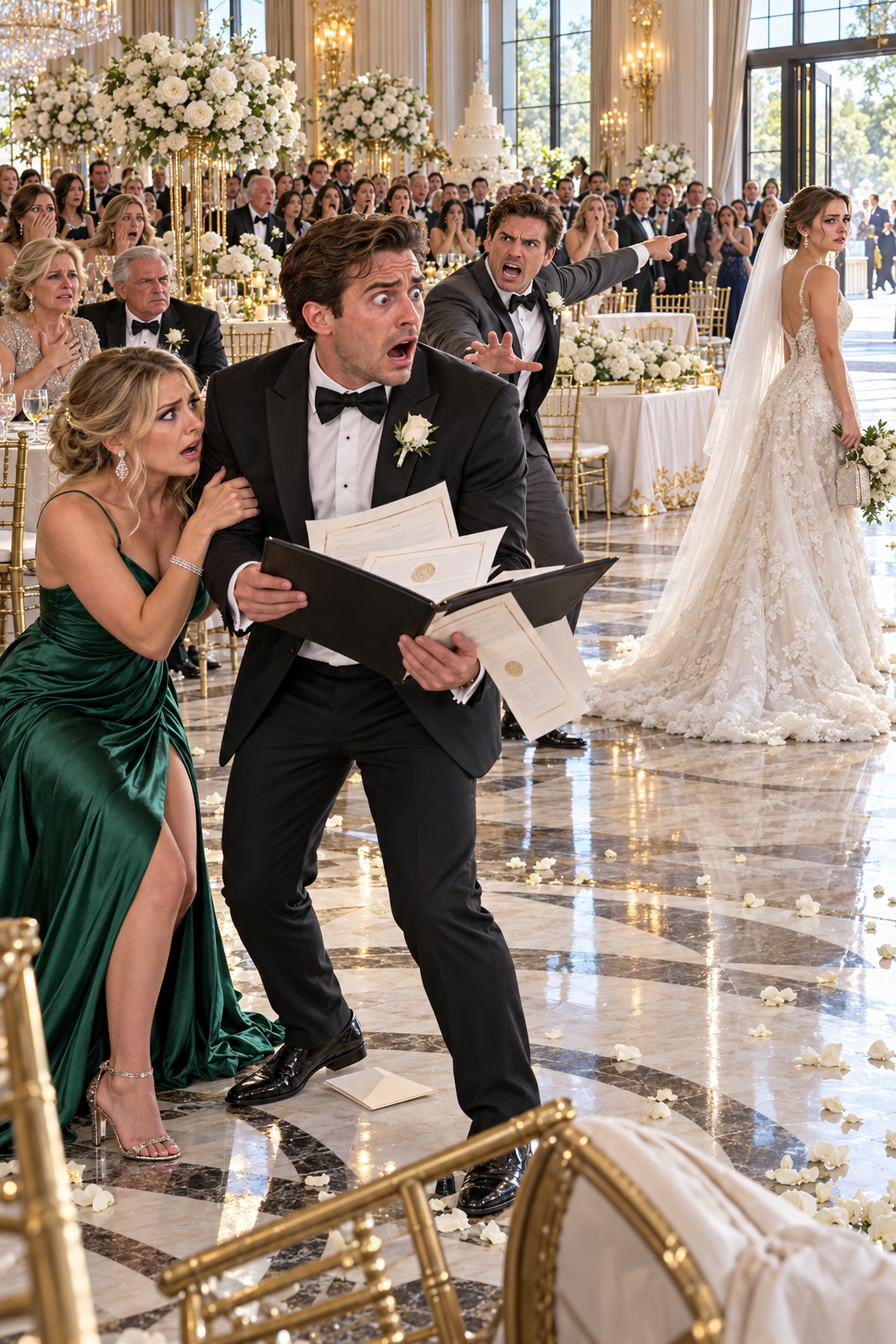
At seven forty-five, the bandleader announced our first dance. Nathan took my hand, and for the first time that evening, we stood alone beneath the crystal chandeliers with everyone waiting for us to begin. The opening notes of “At Last” floated from the speakers, the song we’d practiced to in our cramped living room, stepping around our dog and laughing whenever Nathan got the timing wrong.
Before he could pull me close, Lila stepped onto the dance floor.
“Nathan,” she said, her voice trembling loudly enough to reach the nearest tables. “Can I ask you for something?”
The band faltered. Guests turned in their chairs, and Nathan’s fingers loosened around mine as if he had already anticipated what she would say. Lila pressed one hand to her chest and smiled through tears.
“Remember when we were kids, and you promised that if nobody wanted to dance with me, you always would? I know this is your wedding, but could we have one last dance before everything changes?”
I heard someone gasp near the head table. Across the room, Diane was smiling.
Nathan looked at me with an expression I recognized immediately: the pleading look he gave whenever Lila needed something inconvenient. “Mara,” he whispered, “she’s emotional. It’s just one dance.”
“Our first dance?” I asked.
He hesitated, then gave a nervous laugh. “You know what I mean.”
Behind him, his best man and business partner, Owen Russo, rose so abruptly that his chair scraped against the floor. He caught Nathan by the elbow and pulled him toward the hallway, speaking through clenched teeth. I couldn’t hear everything, but I heard enough.
“Don’t do this,” Owen said. “You’re going to destroy your marriage.”
Nathan glanced back at me before answering.
“Mara won’t mind.”
When he returned, he took Lila’s outstretched hand. The band resumed playing, a few guests began clapping, and Nathan placed his palm against the small of another woman’s back while I stood in the dress I’d spent six months paying for. Lila leaned toward him as they turned, smiling with the expression of someone who had finally received something she’d been promised.
I didn’t walk out immediately.
I watched one rotation, then another, and noticed Nathan glance at me only after Lila whispered something in his ear. By the third turn, I had removed my wedding ring and placed it beside my untouched champagne. I picked up my small satin purse, crossed the ballroom past three hundred people who suddenly seemed afraid to look directly at me, and handed June my phone.
“Please tell my parents I’m safe,” I said. “And give Nathan the envelope after I’m gone.”
June looked at the papers inside my purse, then back at my face. “Are you certain?”
“I’ve never been more certain of anything.”
Outside, the evening air smelled of rain and freshly cut grass. I climbed into a waiting cab, gathered my dress around my knees, and watched the estate disappear behind the trees without looking back.
I thought the worst thing Nathan had done was humiliate me in front of our families.
I was wrong.
## Part 2: The Life I Had Been Building for Someone Else
I didn’t learn what happened after I left until the following afternoon, when June finally convinced me to turn my phone back on. There were fifty-three missed calls from Nathan, nine from Diane, and one brief message from Owen that read, “I’m sorry. I tried.” My mother had left a voicemail saying my father was driving her home and neither of them wanted me to worry about the guests, while Nathan had sent the same question six different ways: Where are you?
I was sitting at the kitchen table of my grandmother’s old house in Maple Hollow, a small town two hours north of the city, when I listened to those messages. The house had been empty since Grandma Ruth died the previous winter, and the kitchen still smelled faintly of lavender soap and the cedar blocks she’d kept in her drawers. There were green glass bottles on the windowsill, a crocheted blanket over the couch, and a calendar permanently open to December. For the first time in months, I was somewhere nobody expected me to arrange dinner, soothe an argument, or explain why another adult couldn’t manage her own problems.
June had driven me there after the cab dropped me at a gas station outside the city. She’d helped me change out of my wedding dress in the restroom, folding the satin into a garment bag while I stood in leggings and an old college sweatshirt. The sight of my carefully embroidered veil lying beside a rack of motor oil had nearly made me laugh, but the sound that came out of me was closer to a sob. June held my shoulders until I could breathe normally again, then asked whether I wanted her to remain overnight.
“No,” I told her. “I think I need to hear myself think.”
Before leaving, she placed a folder on the table containing copies of the documents I’d prepared. The divorce petition would have to be completed and filed now that we were legally married, and Nathan would need to be formally served if he refused to cooperate. June promised to handle the administrative steps, though an attorney experienced in matrimonial litigation would represent me if the case became contested.
“You can change your mind about the marriage,” she said. “You don’t have to change your mind about what happened.”
After she left, I walked through the house opening windows and collecting dead leaves that had blown under the back door. Grandma Ruth had been a school librarian, the kind of woman who labeled leftovers with masking tape and considered a broken promise a serious character flaw. She had loved Nathan when I first brought him to visit, but during our last Thanksgiving together, she’d asked me a question I’d pretended not to understand.
“Does that man ever make room for your life, honey, or are you always squeezing into his?”
At the time, I’d told her relationships required compromise. She’d nodded and gone back to peeling potatoes, leaving me with an uncomfortable feeling I hadn’t been willing to examine.
Now, standing in her kitchen, I remembered exactly how tired I had been that Thanksgiving. Nathan had insisted we leave early because Lila was hosting a dinner with friends and wanted him there before dessert. I had objected, and he spent the drive home telling me how important it was not to abandon people who had lost their families.
I never argued that Lila deserved abandonment.
I argued that I didn’t.
The next morning, I went to the hardware store for cleaning supplies and stopped at the diner across the street. A waitress named Nora, who remembered me from childhood summers, brought coffee without asking and studied my face while I unfolded a newspaper. “Your grandmother used to sit in that booth every Tuesday,” she said. “She always said you were going to build something important someday.”
“I’m an architect,” I replied, attempting a smile.
“I know that, sweetheart. I meant something important to you.”
Nora went back behind the counter before I could answer, leaving me staring at a plate of toast I suddenly couldn’t swallow. I was thirty-one years old, a senior architect at a respected Manhattan firm, and I had spent the previous year planning the perfect wedding for a man who couldn’t be bothered to choose between two tablecloth samples. The realization was embarrassing, not because I had loved him, but because I’d let his indifference become an ordinary part of my life.
That afternoon, I opened my laptop and checked the work emails I’d ignored during wedding week. My supervisor, Evelyn Price, had approved my three-week leave, but she had also forwarded a note about a portfolio presentation that had been delayed until July. Beneath that message was a reminder from our IT department about confidential project files, and I thought of the portable drive Nathan sometimes borrowed when he needed more storage for his company’s presentations.
Nathan worked for Mercer Development Group, his father’s commercial real estate business. He handled client relationships and project financing, while Owen oversaw construction operations and Lila worked as a freelance communications consultant on several of their campaigns. My employer had collaborated with Mercer Development on two projects before we became engaged, and I’d always been careful to keep my professional work separate from my relationship.
Or so I thought.
For six years, I’d been developing a personal architectural concept for small public schools in communities vulnerable to flooding. It had begun as my graduate thesis and slowly grown into a practical proposal involving flexible classrooms, raised mechanical systems, and low-cost construction materials. I called the design Open Doors, and the drawings lived on my personal computer alongside photographs of the rural schools I’d visited during college.
Nathan knew about the project. I’d shown him early sketches when we first started dating, and he’d once suggested that his company’s foundation might help fund a pilot building if I found a suitable community. I had been excited by the possibility, but after several conversations went nowhere, I stopped mentioning it.
That evening, I opened the old folder and realized the most recent working copy wasn’t where I expected.
I checked my backup drive, the shared home computer, and the folder where I’d stored files from our previous apartment. After an hour, I found a version dated three months earlier, along with a message from Nathan asking whether he could borrow the drawings for “an internal conversation about community development.”
I’d forgotten the message because we’d argued that same evening about Lila calling during my father’s birthday dinner.
I replied to Nathan’s original text.
“Did you ever show my school plans to anyone?”
He called within seconds.
I watched the phone vibrate across Grandma Ruth’s kitchen table until it stopped, then read his response.
“Mara, please. Can we talk about us first?”
I typed, “Answer the question.”
A minute passed.
Then another.
Finally, he wrote, “I mentioned the concept to a few people. Nothing serious.”
I closed the conversation without replying.
The following morning, June called with details about the reception. According to her, Nathan had stopped dancing when Owen told him I was gone, then rushed outside searching for me while the band continued playing. Diane had tried to persuade the wedding coordinator to announce that I wasn’t feeling well, but my father refused to let anyone invent an excuse on my behalf.
“He told her that his daughter wasn’t sick,” June said. “He said she had been insulted.”
I pictured my father, a retired postal worker who rarely raised his voice, standing beneath those expensive chandeliers while Diane tried to manage the story. My throat tightened more at that image than it had while watching Nathan dance. Dad had never asked me to be impressive or perfect; he’d only wanted the people in my life to treat me kindly.
June hesitated before adding something else. “There’s a photographer named Amelia who wants to speak with you. She says Lila changed the reception schedule before the wedding.”
“Changed it how?”
“Apparently she requested an additional dance and a series of portraits with Nathan. Amelia thought it was something you’d approved.”
I remembered Diane’s message about making sure Lila had her moment, and for the first time, the interruption on the dance floor didn’t feel entirely spontaneous. I asked June to obtain the revised schedule and any related communications, then spent the rest of the morning scrubbing the kitchen floor because sitting still made my hands tremble.
Just before sunset, an unfamiliar email address appeared in my inbox.
The subject line read: “Mercer Community Foundation — Open Doors Initiative.”
Attached was a glossy presentation containing photographs of children, proposed school buildings, and a rendering I recognized down to the arrangement of trees beside the entrance.
It was my design.
And on the cover, directly beneath the name of Nathan’s family company, were the words: “Project Leadership: Nathan Mercer and Lila Hart.”
## Part 3: The Secret Hidden Beneath Our Perfect Wedding
I enlarged the presentation until individual pixels broke apart across my screen. The main rendering showed a two-story school with a covered entrance, wide windows, and a courtyard designed to double as an outdoor classroom. I’d drawn the first version at twenty-four after visiting a flood-damaged elementary school in Pennsylvania, where children had been attending lessons in temporary trailers for nearly eighteen months. I could identify every element because I’d spent years thinking through the problems each one was meant to solve.
Someone had changed the building’s exterior color, added the Mercer Foundation logo, and removed my name.
The rest was worse.
One slide listed the project as being in the “advanced design and financing phase,” although I’d never agreed to participate in a commercial proposal. Another identified Lila as community engagement director and Nathan as development lead, while a photograph of the two of them at a charity luncheon occupied almost half the page. The final slide invited prospective donors to pledge funding toward a demonstration campus before the end of the summer.
I called June and asked her to come north.
She arrived late that night carrying her laptop, a legal pad, and takeout containers from the Thai restaurant we used to visit after difficult weeks at work. We sat at Grandma Ruth’s dining table beneath a light fixture that buzzed whenever the refrigerator started. June went through the presentation twice, then leaned back and asked the question I had been avoiding.
“Did you authorize any of this?”
“No.”
“Did Nathan have written permission to use these drawings?”
“No.”
“And were any of these plans developed using resources from your employer?”
I considered that carefully. “The early design began in graduate school, and everything in this presentation came from versions I worked on personally. But I need to verify that against my firm’s records before I make any ownership claims.”
June nodded. “Good. We establish what belongs to you before we accuse anyone of taking it.”
We spent the next three hours gathering dated sketches, archived emails, backup files, and messages documenting my work. I had a habit of saving multiple versions of every project, something Nathan used to tease me about, and now that habit became unexpectedly useful. Several drawings in the presentation contained small design decisions I’d later corrected, including a rainwater collection detail that would need revision before any real building could be constructed.
The copied material wasn’t even the finished version.
At one in the morning, June discovered that the email had come from a woman named Caroline Bell, a grants coordinator for a nonprofit education foundation. Caroline’s accompanying message explained that she’d been trying to confirm the architectural firm’s involvement in the project and had received conflicting answers from Lila. She had found my name buried in an earlier file and contacted me directly because her organization required written confirmation from design professionals before releasing grant funds.
I called Caroline the next morning.
She spoke carefully, like someone aware that an ordinary business conversation might already have become a legal problem. “Ms. Ellis, I apologize if contacting you during your honeymoon was inappropriate,” she began. “But your husband’s company has been using these materials during fundraising discussions, and I need to know whether you’re the architect responsible for the design.”
“I created the original concept,” I said. “I haven’t approved its use in this proposal, and I haven’t agreed to serve as architect of record.”
There was a long silence.
Caroline finally asked, “Then why did Mr. Mercer provide a document stating that his development group had permission to present your plans?”
I felt the chair beneath me turn strangely unstable.
“Could you send me that document?”
She hesitated, explaining that she would need to consult her organization’s counsel before sharing internal materials. I told her I understood and asked her to preserve anything bearing my name while we worked through the proper channels. When the call ended, I sat with my hands flat against the table and listened to the clock ticking above the stove.
Nathan had never been particularly interested in my architecture work unless he could describe it at dinner parties. He liked telling people that I designed buildings and sometimes joked that marrying an architect meant he would never have to pay for renovations. I’d laughed at that joke more than once, not realizing he might have developed a very different understanding of what my professional work belonged to.
June watched me from across the table.
“This isn’t just about the wedding anymore,” she said.
“I know.”
She set down her pen. “But the wedding may explain more than you realize.”
She turned her laptop toward me and opened an email from Amelia, our wedding photographer. Attached was a revised photography schedule sent four days before the ceremony, with Lila’s name in the sender field and Diane copied on the message. The original schedule showed portraits of the bride and groom, immediate family, and wedding party; the revised version added a separate section labeled “Mercer Family Legacy—Nathan and Lila.”
Beneath that heading was a note asking for photographs of the pair dancing together, preferably with the family company’s longtime business associates visible in the background.
I stared at those words.
“She arranged it,” I said.
“She arranged the photography,” June corrected. “We still don’t know exactly what Nathan agreed to.”
I appreciated that distinction, even though I hated it.
A photograph couldn’t prove a person’s private intentions, and I wasn’t prepared to accuse anyone of deliberately humiliating me without evidence. But the schedule established that Lila’s supposedly spontaneous request had been anticipated, coordinated, and treated as important enough to interrupt the normal wedding timeline. Someone had planned for my husband’s attention to move away from me during the reception.
June had also obtained an invoice from the photographer showing that Diane had approved the additional coverage. The notation beside the charge described it as “brand and family heritage imagery,” language that belonged in a marketing proposal, not in the records for a wedding.
I remembered how Nathan’s parents had invited several trustees, investors, and nonprofit directors to our reception. At the time, I’d assumed they were old friends because Nathan insisted his family knew everyone in the county. Now I wondered whether my wedding had been intended to serve another purpose.
When I finally called Nathan, he answered before the second ring.
“Mara?” His voice sounded exhausted. “Where are you? I’ve been calling everybody.”
“I’m safe. That’s all you need to know right now.”
“Can we please talk about what happened?”
“We’re going to talk about the school presentation.”
He went silent.
I heard traffic in the background, followed by the muffled sound of a car door closing. “I was going to tell you about that,” he said.
“When?”
“After the wedding. I didn’t want to bother you while you were dealing with everything.”
“You used my drawings to raise money.”
“That’s not fair. We haven’t collected the full funding yet, and it’s still a preliminary concept.”
“You told potential donors the design was advancing toward construction.”
“Lila handled the presentation.”
“Did you approve it?”
He breathed heavily into the phone.
“Nathan, did you approve it?”
“Yes,” he said at last. “But I thought you’d be happy. You’ve been talking about building schools for years.”
I closed my eyes.
That sentence was painfully familiar. He had spent three years doing things without asking my permission and then treating my reaction as the problem. The difference was that this time, his assumptions had extended beyond birthdays and family dinners into my professional responsibilities.
“You never asked me,” I said.
“I was trying to make something happen for you.”
“Then why is Lila’s name on the cover instead of mine?”
Silence.
I waited long enough to hear a truck rumble past on his end of the call.
“She’s been working on the fundraising,” he eventually answered. “You know she’s good with people.”
“And the dance? Was that part of the fundraising, too?”
“What are you talking about?”
I described the photography schedule, the additional coverage, and Diane’s approval. Nathan sounded genuinely startled by some of the details, but when I mentioned the photographs intended for their foundation campaign, he admitted that Lila had discussed using the wedding as an opportunity to capture images of longtime Mercer family connections.
“I didn’t think she’d actually interrupt our first dance,” he said.
“You knew she wanted to dance with you?”
He didn’t answer immediately.
“Mara, she asked me earlier that week. I told her we’d figure something out.”
I looked through the kitchen window at the old magnolia tree Grandma Ruth had planted forty years earlier. Its branches scraped softly against the siding, and a bird was building a nest beneath the porch roof. Everything outside seemed ordinary, which made what I was hearing feel even more grotesque.
Nathan had known the request was coming.
He had known it might embarrass me.
And he’d still told his best man I wouldn’t mind.
“I need you to communicate through my attorney about the divorce,” I said. “And you must stop using my designs until the ownership and permissions are resolved.”
“Mara, please don’t do this.”
“I’m not the one who created this situation.”
I ended the call.
Twenty minutes later, Caroline sent another message. Her foundation’s counsel had authorized her to share a limited portion of the documentation for verification, including an authorization form signed by Nathan several weeks before our wedding.
The form wasn’t the final agreement, but one sentence near the bottom made my stomach drop.
It represented that Mercer Development had obtained all necessary permissions to use the architectural materials.
Nathan’s signature appeared beneath it.
And the date was May 12—three days after I’d told him I was no longer comfortable having Lila involved in our professional lives.
## Part 4: The Paper Trail That Exposed Years of Deception
On the ninth day after my wedding, a lawyer representing the Mercer Community Foundation sent June a complete copy of the disputed project agreement. The document was seventeen pages long, with sections covering preliminary fundraising, donor representations, proposed development services, and a conditional licensing arrangement for the architectural concept. Nathan had signed on behalf of Mercer Development, certifying that his company had the necessary authorization to include the drawings in its campaign materials. My name appeared repeatedly, but my signature wasn’t anywhere on the document.
I read it twice before calling June.
“He didn’t forge my signature,” I said.
“No,” she replied. “But he represented that he had authority he apparently didn’t have, and that distinction matters. We need to examine exactly what he supplied, what they relied on, and whether any rights belong to your firm.”
“I trusted him with a folder of sketches.”
“I know.”
“I never imagined I’d need a written agreement to protect my work from my own fiancé.”
June didn’t offer an easy answer. She asked me to forward every relevant email, including the conversations I’d had with Nathan years earlier about the Open Doors concept. That afternoon, I searched my archives and discovered something that changed the way I understood the entire relationship.
Eighteen months before our wedding, Nathan had sent Lila an early version of my school presentation. His accompanying message said, “Mara doesn’t want this commercialized yet, but the foundation could help us move it forward. Keep it preliminary until I figure out how to bring her around.”
Lila had replied, “She’s talented, but she doesn’t see the bigger picture. We can handle the strategy and let her concentrate on the actual design.”
I stared at the exchange for several minutes. Nathan hadn’t simply misunderstood an enthusiastic conversation about the future; he had acknowledged my hesitation and proceeded anyway. I remembered the evening we’d discussed licensing the concept, when I’d explained that I wanted to work directly with communities before attaching it to a developer’s fundraising campaign.
He had smiled and said, “That’s why we’re such a good team. You worry about the details, and I think about the opportunities.”
At the time, I’d thought it was affectionate teasing.
Now, it sounded like a business arrangement I’d never agreed to.
I drove into Manhattan the following Monday to meet with Evelyn and the general counsel at my architectural firm. I was nervous enough to park two blocks away and sit in my car rehearsing what I needed to say, because I’d spent years establishing my reputation and couldn’t bear the idea of losing it over Nathan’s choices. Evelyn listened without interrupting while I explained the documents, my personal research history, and the possibility that someone had incorporated firm-owned materials into an unauthorized proposal.
When I finished, she folded her hands across the conference table. “Mara, I wish you’d told us sooner that your fiancé was interested in commercializing your independent work.”
“I wish I’d known how interested he was.”
She almost smiled, but her expression remained serious.
The legal review took several weeks. My firm’s counsel examined my employment agreement, dated design files, computer records, and the materials Nathan had used. They concluded that the underlying concept and most of the specific drawings in the proposal had been developed independently, although two presentation graphics incorporated firm resources and would need separate treatment. I cooperated with the review, removed those graphics from my personal materials, and signed an agreement clarifying what work I could develop outside the firm going forward.
Evelyn also gave me news I hadn’t expected.
“We’re restructuring the civic design department,” she said. “You’ve been doing this kind of work on your own time for years, and we haven’t given it the attention it deserves. When you’re ready to return, I’d like to discuss whether there’s a way to support it.”
I should have felt relieved.
Instead, I found myself wondering whether I wanted to return to the same life at all.
Back in Maple Hollow, I began spending my mornings at the diner and my afternoons walking around town. The streets were lined with aging brick buildings, narrow sidewalks, and storefronts that had survived mostly because their owners refused to give up. One afternoon, while waiting for a rainstorm to pass beneath the awning of the public library, I noticed that the children’s entrance had three concrete steps and no accessible ramp.
I went inside to ask about it.
The librarian directed me to the school district’s facilities office, where a tired-looking superintendent named Dr. Helen Reese explained that the elementary school had been operating with recurring maintenance problems for almost fifteen years. Its heating system failed during cold snaps, water collected near the playground after heavy rain, and several classrooms were too small for the number of students assigned to them. The district had requested state assistance, but construction costs kept pushing meaningful improvements beyond reach.
“We’ve had architects come through,” Dr. Reese told me. “They take photographs, give us numbers we can’t afford, and disappear.”
I asked whether she had a copy of the most recent facilities assessment.
She looked surprised. “Why?”
“Because I might have some ideas.”
She studied me for a moment before reaching into a cabinet and pulling out a thick folder. The pages smelled like old paper and dust, and I spent the next two hours reviewing drainage reports, maintenance logs, classroom measurements, and cost estimates. For the first time since the wedding, I became so absorbed in something that I forgot to check my phone.
Dr. Reese found me still sitting there when the office closed.
“You’re taking this pretty seriously,” she said.
“I don’t know another way to approach a building.”
She laughed, then asked whether I’d be interested in presenting some preliminary options at the next school board meeting.
I agreed before I had time to invent a reason not to.
Meanwhile, the situation at Mercer Development was becoming increasingly complicated. Caroline’s foundation had paused consideration of its proposed grant, and several donors wanted clarification about the architectural team and the claims made during fundraising. Nathan’s father had ordered an internal review of the campaign, which meant Owen was suddenly examining communications he’d previously trusted other people to manage.
Owen contacted June rather than calling me directly.
He provided records showing that he’d raised concerns about the incomplete design agreements three months before the wedding. Nathan had assured him that I’d approve the arrangement once the proposal reached the appropriate stage, and Lila had repeatedly described my consent as an administrative detail. Owen hadn’t seen my independent project files, but he had believed Nathan when he said the matter was being handled.
I didn’t excuse Owen entirely, though I appreciated his willingness to acknowledge the mistake.
His statement ended with a sentence that stayed with me.
“Nathan didn’t think he was taking anything from Mara because he’d started treating everything she created as something he could use.”
A week later, I received a letter from Diane.
She wrote about family loyalty, Nathan’s heartbreak, the embarrassment of the wedding, and the unfairness of allowing a misunderstanding to become a public dispute. She insisted that Lila had never intended to hurt me and suggested that I was reacting too strongly because my professional ambitions had made me sensitive to ordinary family expectations.
I read the letter while sitting on Grandma Ruth’s porch.
Then I noticed the final paragraph.
Diane wrote that Nathan’s father had always envisioned Lila and Nathan leading the foundation together, and that my architectural experience would have made their charitable projects considerably stronger.
I finally understood the future they’d imagined.
Nathan and Lila would stand in front of donors, accepting praise for helping struggling communities, while I stayed behind them producing the work that made their promises possible.
And apparently, I was supposed to be grateful for the opportunity.
## Part 5: The Woman They Expected to Remain Quiet
I didn’t answer Diane’s letter immediately. Instead, I placed it in a folder with the other records and drove to the school board meeting in Maple Hollow, where fifteen folding chairs had been arranged beneath fluorescent lights in the middle school cafeteria. There were no chandeliers, wealthy donors, or impressive speeches about community leadership. There were parents carrying water bottles, teachers with stacks of papers, and a maintenance supervisor named Glenn who had spent thirty-two years keeping the district’s buildings functioning with a budget that seemed determined to defeat him.
I brought six drawings and a rough cost comparison.
Dr. Reese introduced me as a local resident with architectural experience, which was technically true, though I hadn’t lived in Maple Hollow since childhood. I explained that the district didn’t necessarily need a completely new school to solve its most urgent problems. A phased renovation, combined with a modest classroom addition and improved drainage, might allow the building to remain open while the work proceeded.
A board member named Harold Finch immediately asked whether I had any idea how difficult it was to secure funding.
“Yes,” I said. “But a proposal with clear priorities, realistic costs, and a schedule has a better chance than a proposal asking for everything at once.”
Glenn leaned forward and pointed at my drainage sketch. “If we move the runoff away from that back entrance, can we stop the basement flooding?”
“Possibly,” I replied. “We’d need a civil engineer to verify the site conditions before anyone made that promise.”
He nodded approvingly, and I realized how refreshing it felt to speak with people who wanted accurate answers more than impressive claims.
The meeting lasted almost three hours. By the end, the board had authorized a preliminary feasibility study funded through an existing planning allocation, subject to a formal professional-services agreement. I walked outside into cool evening air with my drawings under one arm and felt an unfamiliar excitement growing inside me.
Nothing had been built.
No grant had been awarded.
But for once, the beginning belonged to the people who would actually use the building.
The next morning, I called Evelyn and told her about the project. She listened as I described the school’s needs, the limited budget, and the possibility of extending my leave to develop the feasibility study independently. We discussed the professional responsibilities involved, including insurance, licensing, conflicts of interest, and the fact that a larger construction phase would require a properly assembled design team.
At the end of the conversation, Evelyn surprised me by saying, “You sound more alive than you have in a year.”
I sat on Grandma Ruth’s back steps, staring at the wildflowers growing between the stones.
“I think I am.”
We agreed that I would take an unpaid leave through the end of the summer and revisit my position afterward. It wasn’t a romantic leap into an effortless new career; I had savings to examine, health insurance to arrange, and a mortgage on the city apartment I’d owned before meeting Nathan. I spent two evenings building a spreadsheet that accounted for those responsibilities, then realized that I could afford to pursue the Maple Hollow work without risking everything I’d spent a decade building.
Nathan called again that Friday.
I hadn’t spoken to him since our argument about the school presentation, and when his name appeared on my screen, I almost let it ring out. But I wanted to hear what he had to say now that the foundation’s review was underway.
“Mara,” he began, “I’ve been going through the emails.”
“So have I.”
“I didn’t realize how far things had gone.”
“You signed the agreement.”
“I know.”
“You told Owen I’d approve it.”
He exhaled. “I know that, too.”
I waited, wondering whether he would finally say something that acknowledged the actual problem rather than describing his surprise at its consequences.
“After your presentation at that nonprofit conference,” he said, “I thought someone should do something with the concept. You kept talking about research and community meetings, and I thought we were losing time.”
“Whose time?”
“What?”
“Who was losing time, Nathan? I wasn’t selling the project. I wasn’t asking investors to hurry. I was trying to do the work responsibly.”
He didn’t answer.
“Did you ever consider that my hesitation might have been informed judgment instead of something you needed to overcome?”
“I thought we wanted the same future.”
“So did I.”
The conversation remained quiet for several seconds, and I could hear him moving around our old kitchen. I pictured the blue ceramic bowl by the sink, the chipped refrigerator handle, and the stack of takeout menus I’d organized in the drawer. Once, those details had meant home to me.
Then Nathan asked, “Is there anything I can do to make you reconsider the divorce?”
“Yes,” I said. “Stop delaying the process.”
He sounded as though I’d struck him.
“Mara, we were married for less than a day.”
“We were together for three years.”
“Doesn’t that count for something?”
“It does. That’s why this hurts.”
I ended the call before either of us could turn the conversation into another argument about my willingness to understand him.
That evening, Diane called my mother.
Mom told me about it the next day while we were shopping for groceries. Diane had apparently suggested that my family’s pride was encouraging me to destroy a marriage over a dance, and that the foundation disagreement could be settled privately if everyone stopped involving attorneys. My mother had listened for several minutes before asking Diane whether she understood why a woman should need legal representation to protect something she’d created herself.
“Diane said she thought we were all one family,” Mom told me.
“What did you say?”
“I asked her when she planned to start treating you like one.”
My mother placed a bag of apples in the cart and continued shopping as though she’d merely discussed the weather. I loved her fiercely in that moment.
Two weeks later, the foundation announced that it would not proceed with the Mercer proposal under its existing terms. The trustees had concluded that the design rights and project readiness had not been adequately established, and they declined to release the conditional grant while those matters remained unresolved. Mercer Development had to notify potential donors that the campaign was being restructured, and money already collected for restricted purposes would be handled according to the applicable donation agreements.
The news didn’t make me triumphant.
I knew the foundation had supported legitimate programs, and I knew that people who had nothing to do with Nathan’s decisions would now face additional work and disappointment. But I also knew that allowing an inaccurate proposal to advance would have created greater problems when somebody eventually tried to turn those promises into an actual building.
Owen called me after the announcement.
He told me Lila had been removed from the campaign while the internal review continued, and Nathan had agreed to step aside from decisions involving the foundation’s architectural work. Then he hesitated, asking whether he could share something personal.
“Go ahead,” I said.
“That night at the wedding, I told Nathan he was choosing the wrong person. He said you’d understand.”
“I remember.”
Owen’s voice grew quieter.
“I think he believed understanding him was your job.”
I looked across Grandma Ruth’s yard, where a contractor had delivered the first stack of materials for repairing the porch.
“For a long time,” I said, “I believed it was my job, too.”
## Part 6: The Truth Finally Reached Everyone Who Had Looked Away
By September, the wedding had become something I could remember without feeling physically sick. I still disliked seeing photographs from that night, and I avoided the satin garment bag hanging in Grandma Ruth’s spare bedroom, but I no longer woke up replaying Nathan’s expression when Lila interrupted our first dance. Most mornings began with a walk down Main Street, coffee at Nora’s diner, and a drive to the elementary school, where Glenn had started referring to my clipboard as “the book of bad news.”
“The boiler’s making that noise again,” he told me one Tuesday, leading me into the maintenance room.
The equipment rattled so violently that we had to raise our voices to hear each other. I took photographs and made notes for the mechanical engineer, then followed Glenn through a corridor where students had taped paper stars above their lockers. A little boy with untied sneakers stopped me and asked whether I was the woman who was going to give them a new library.
“I’m working on a plan to improve your school,” I said.
“Can you make the windows open?”
I crouched beside him. “Why?”
“Because sometimes it smells like wet socks in here.”
Glenn laughed so hard he had to lean against the wall, but I wrote the request down. A good building had to work for the people inside it, even when their requirements were expressed in the least technical language imaginable.
The feasibility study was harder than I’d expected. Structural assessments revealed deterioration in one section of the existing school, and the original renovation budget couldn’t accommodate every improvement the board wanted. I spent weeks working with engineers, reviewing estimates, adjusting classroom layouts, and helping Dr. Reese prepare a realistic capital plan with separate phases for safety repairs, accessibility improvements, and future expansion.
There were mornings when I missed the resources of my Manhattan office. I missed the specialized software, the junior architects who could revise a drawing while I spoke with a client, and the certainty of a paycheck arriving on schedule. But every time I considered returning permanently, I remembered the feeling of standing in that cafeteria explaining a plan to parents who cared about every dollar.
The work mattered differently here.
One afternoon, June arrived for a weekend visit carrying a box of legal documents and a bottle of sparkling cider. Our divorce case was moving forward under New York’s no-fault process, although Nathan’s initial resistance had delayed resolution of some financial issues. June had helped coordinate counsel for me, and she wanted to review a proposed settlement that separated our premarital property, divided the limited marital funds, and addressed the jointly purchased furniture and wedding expenses.
Nathan had finally agreed not to contest the fact that the marriage was over.
“He still wants to speak with you once before everything is finalized,” June said.
“He can write a letter.”
“He has.”
She handed me a sealed envelope.
I opened it at the kitchen table after dinner, while June washed dishes and pretended not to watch my face. Nathan’s handwriting was familiar, slightly uneven when he wrote quickly, with long strokes on the capital letters. The first page contained an apology that was more specific than anything he’d said since the wedding.
He admitted that he’d spent years allowing Lila’s needs to take priority over mine. He acknowledged that he’d been aware of her romantic attachment and had avoided establishing boundaries because he enjoyed being indispensable to her. He also admitted that he’d taken my professional work seriously only when it offered a way to advance an opportunity he understood.
I read that last sentence twice.
Nathan explained that his father had been pushing him to create a more visible role for the family foundation. Lila had proposed using Open Doors as its flagship initiative, and Diane had encouraged the two of them to present themselves as the project’s public leaders. Nathan had convinced himself that once the funding was secured, I would be excited enough to overlook the way they’d gone about obtaining it.
He hadn’t intended to exclude me permanently, he wrote.
He’d intended to present me with a decision that had already been made.
I sat back in my chair, feeling the terrible clarity of that admission.
The wedding photographs had been part of the same thinking. Nathan said he’d known Lila wanted a dance and that she planned to incorporate images from the reception into a foundation announcement. He claimed he hadn’t understood how aggressively she intended to stage the moment, but admitted that he’d dismissed Owen’s warning because he couldn’t imagine I would actually leave.
“I believed you would eventually forgive anything if I waited long enough,” he wrote. “I treated your patience as proof that I was being a good partner, when it should have made me ask whether I was asking too much.”
There was no request that I return home at the end of the letter.
Instead, he wrote that he would cooperate with the divorce, respect my work, and accept whatever boundaries I established. He had begun attending counseling, stepped down from the foundation’s steering committee, and told his parents they were no longer permitted to contact me about reconciliation.
For several minutes, I sat with the letter open in my lap.
I had imagined receiving an apology like that countless times while we were dating. I’d thought that if Nathan could just recognize what was happening, we could change the patterns that made me feel so lonely. But the person reading his letter wasn’t the woman who had once waited up until midnight for him to return from Lila’s apartment.
I was no longer waiting for Nathan to understand me.
I had already started understanding myself.
June sat down across from me.
“How do you feel?”
“Sad,” I answered. “And relieved that he’s finally telling the truth.”
“Do you want to respond?”
“Not tonight.”
I folded the letter and put it back into the envelope, then asked June whether she wanted another piece of pie. She looked at me for a long moment before nodding, and we spent the rest of the evening discussing ordinary things: her new apartment, the ridiculous cost of parking in Manhattan, and the neighbor who kept leaving zucchini on my porch.
Three days later, another message arrived, this time from Lila.
She wrote that she’d never meant for the wedding to end the way it had. She said she’d thought Nathan and I were secure enough for one harmless dance, and she described feeling abandoned by the Mercers after the foundation review. Her contract had been terminated when the internal investigation concluded that she’d repeatedly presented the design’s permissions and development status as settled despite receiving warnings to the contrary.
Then she asked whether I would tell Nathan that she hadn’t intended to ruin his life.
I stared at the message, astonished by how completely she’d managed to center herself in the consequences of her own actions.
I didn’t answer immediately.
Instead, I opened the folder containing the archived correspondence, the unauthorized presentation, and the wedding photography schedule. There was more than enough evidence to remind me that Lila hadn’t merely made an emotional request on the dance floor. She’d participated in a professional arrangement that depended on my continued cooperation, even after I had explicitly withheld consent.
I finally wrote a short reply.
“Lila, I understand that the consequences are painful. I won’t speak to Nathan on your behalf, and I don’t want further contact with you. I hope you take responsibility for your own decisions.”
I sent it, blocked her number, and returned to the drawings spread across my kitchen table.
The following Friday, Dr. Reese called with news that the district had secured a combination of state capital support and a local funding commitment for the first phase of the school project. It wasn’t enough to build everything we’d imagined, but it would fund the urgent safety improvements and allow us to begin detailed design for a modest classroom addition.
I drove to the school that afternoon and found Glenn standing beside the old gymnasium, watching a group of children play basketball.
“We got it?” he asked.
“We got the first phase.”
He removed his baseball cap and ran one hand through his thinning hair.
“Well,” he said, “I guess we’d better make sure we don’t screw it up.”
For the first time in months, I laughed without any sadness behind it.
That evening, I made a decision I’d been postponing since June brought Nathan’s letter.
I called my attorney and authorized her to move forward with finalizing the divorce settlement.
Nathan could become a better man.
But I no longer wanted to be his wife.
## Part 7: The Apology Came After I Had Stopped Waiting
The first major snowstorm of winter arrived while we were finalizing the school’s construction documents. For three days, freezing rain rattled against Grandma Ruth’s windows, turning the yard into a sheet of ice and leaving branches scattered across the driveway. I worked from my dining table with drawings spread beneath the yellow glow of an old lamp, reviewing cost estimates while the electric heater clicked beside my feet. When the storm finally passed, I found a message from Dr. Reese saying the district wanted to announce the first phase of construction at a small public ceremony in March.
I was delighted until she called again the following afternoon.
“There’s something I need to ask you about,” she said. “A woman from the Mercer family contacted the board president. She wants to discuss making a donation.”
I closed my laptop.
“What woman?”
“Diane Mercer. She says the family has longstanding connections to you and wants to help with the school.”
My stomach tightened. Diane had spent months insisting that I was responsible for embarrassing her son, yet apparently she still believed our relationship could provide an opportunity for her family to attach its name to a project. I explained the history to Dr. Reese without embellishment, including the previous dispute over my drawings and the foundation’s suspended proposal.
“I don’t want to tell the board what donations it can accept,” I said. “But I’d recommend reviewing any offer through your normal procedures, with appropriate conflict disclosures. And I don’t want my involvement used to suggest I’ve endorsed a Mercer campaign.”
Dr. Reese was quiet for a moment.
“Understood,” she said. “I had a feeling there was more to this than a generous stranger discovering our little school.”
Two days later, Diane appeared at Grandma Ruth’s house.
I was carrying a bag of groceries through the front gate when a black SUV pulled to the curb. Diane stepped out wearing a camel-colored coat, polished boots, and the same pearl earrings she’d worn to my wedding. She looked older than I remembered, though her posture remained perfectly straight as she approached the porch.
“Mara,” she said. “I’d like five minutes.”
I set my groceries on the porch railing.
“You should have called.”
“You wouldn’t have answered.”
“Then you already knew I didn’t want this conversation.”
She glanced at the neighboring houses as though worried somebody might overhear us. I had seen that expression before, usually when a family gathering threatened to become less pleasant than Diane believed appearances required.
“I came because Nathan is suffering,” she said. “He’s lost weight, he barely comes to family dinners, and he refuses to speak to Lila. He’s not the same person.”
“His relationship with Lila is his decision.”
“He’s your husband.”
“Not for much longer.”
Diane’s face tightened. She told me that marriage required forgiveness, that the wedding had been a terrible mistake, and that Nathan had already paid dearly for it. When I mentioned the unauthorized project proposal, she insisted the foundation had been trying to accomplish something worthwhile.
“Your drawings could have helped hundreds of children,” she said.
“Then you should have asked me whether I wanted to participate.”
“We thought you’d be pleased.”
“That’s what Nathan said.”
Diane looked toward the magnolia tree, its branches bare against the gray sky. For a moment, I thought she might finally recognize how absurd that explanation had become. Instead, she asked why I couldn’t accept that families sometimes made decisions together.
I looked directly at her.
“You didn’t make a decision with me, Diane. You made a decision about me.”
She didn’t answer.
I told her that I had no intention of returning to Nathan, that my work in Maple Hollow wasn’t an invitation for the Mercers to repair their public reputation, and that future contact should go through the appropriate legal channels. When she suggested I was being unnecessarily harsh, I remembered how carefully I’d tried to earn her approval during the previous three years.
“I was kind to you,” I said. “I organized your birthday dinners, helped you after your surgery, and listened whenever you were worried about your family. But kindness doesn’t mean giving you permission to decide what I should tolerate.”
Diane’s eyes filled with tears.
I felt sympathy for her, but I didn’t change my answer.
After she left, I stood in the cold until my fingers started aching. I wasn’t shaking with anger, and I didn’t feel victorious. I felt the quiet exhaustion that comes after explaining something important to a person who has spent years benefiting from not understanding it.
That evening, Nathan sent me a message through our attorneys acknowledging that his mother had contacted me without his knowledge. He said he’d asked her to stop and had informed the foundation that any proposed donation to the school must be handled independently of me. For once, I didn’t have to argue with him about the boundary.
He simply respected it.
The divorce settlement was finalized a few weeks later, and we arranged to meet briefly at a café near the courthouse before the remaining paperwork was submitted. It was the first time I’d seen Nathan in person since our wedding. He wore a navy overcoat and looked thinner, with deeper lines around his eyes, but he stood when I approached and waited for me to choose where to sit.
“Thank you for coming,” he said.
“I wanted us to finish this properly.”
We ordered coffee neither of us particularly wanted. Outside, people hurried past beneath umbrellas, while inside the café a barista argued cheerfully with a customer about whether oat milk made a cappuccino taste better. The ordinary sounds made it easier to remember that our marriage, however painful its ending, was only one part of the world.
Nathan rested his hands around his cup.
“I’ve wanted to apologize in person since the wedding,” he said. “But I kept thinking an apology would mean asking you for another chance.”
“And now?”
“Now I think apologizing means admitting what I did without expecting anything in return.”
I studied his face. He told me that counseling had forced him to examine why he’d spent so many years confusing being needed with being loved. He’d enjoyed Lila’s dependence, avoided difficult conversations, and treated my independence as permission to give me less attention.
“I thought you were strong enough to handle everything,” he admitted.
“I was,” I said. “But I shouldn’t have had to.”
He nodded.
We talked about the foundation review, the professional consequences, and the ways his parents had influenced him. He didn’t try to blame Lila for decisions he’d made himself, and he didn’t ask whether I’d found somebody else. When he finally mentioned the wedding, he looked down at the table.
“Owen told me that night exactly what I was doing,” he said. “I remember telling him you wouldn’t mind. I can still hear myself saying it.”
“I remember, too.”
“I wish I’d listened.”
“So do I.”
He looked up, his eyes wet.
“Do you think you could ever forgive me?”
I considered the question carefully. I no longer wanted to punish Nathan, and I didn’t need him to remain miserable in order to validate what I’d experienced. But forgiveness, reconciliation, and permission to return were three separate things.
“Maybe one day I’ll think about our marriage without any hurt at all,” I said. “But that doesn’t mean I want it back.”
Nathan swallowed, then nodded.
“I understand.”
We left the café together and stopped beneath the awning while the rain continued. He asked whether he could walk me to my car, and I told him I was fine. For a moment, we stood facing each other like strangers who happened to know an extraordinary number of details about one another.
“Take care of yourself, Mara,” he said.
“You too, Nathan.”
I crossed the street without looking back.
Six weeks later, the final divorce judgment was entered.
When June called to tell me, I was standing on the elementary school’s construction site watching workers install the first section of an accessible entrance. I thanked her, ended the call, and returned my attention to the work.
For the first time in years, my future wasn’t waiting for someone else to make a decision.
## Part 8: The Life I Built After Walking Away From His
Fourteen months after my wedding, I stood outside Maple Hollow Elementary School holding a pair of oversized ceremonial scissors. The morning was cool and bright, with sunlight catching the new windows and freshly painted entrance canopy. Parents gathered beside the playground while teachers tried to keep excited children organized in something resembling straight lines. The first construction phase was complete, and for the first time in decades, the school had an accessible main entrance, repaired drainage, safer mechanical systems, and classrooms that no longer required buckets whenever heavy rain swept through town.
It wasn’t the spectacular new building I’d once imagined creating.
It was something better suited to the people who needed it.
The work had required more compromises than any project I’d managed in Manhattan. A material shortage forced us to revise the exterior finish, unforeseen conditions added costs to the plumbing repairs, and one subcontractor had to redo an entire section of flashing after an inspection revealed improper installation. I spent countless evenings reviewing revised estimates with Dr. Reese, arguing over schedules with contractors, and reassuring Glenn that we weren’t going to leave him maintaining equipment he couldn’t afford to repair.
There were days when I went home frustrated enough to sit in my car for ten minutes before opening the front door.
But every difficult decision had been made in collaboration with people who knew what they were responsible for. Nobody treated my drawings as an unlimited resource they could claim through marriage, and nobody demanded that I smile while someone else took credit for the work. When a change affected the budget, we documented it; when a decision required the board’s approval, we asked for it.
I hadn’t realized how peaceful honest cooperation could feel.
Dr. Reese stood beside me during the ribbon-cutting ceremony, holding a small handwritten speech. She thanked the district staff, the engineers, the construction crews, the state officials who helped navigate funding requirements, and the parents who attended meeting after meeting. When she reached my name, she paused and looked toward me with a smile.
“Mara reminded us that a school doesn’t have to be beautiful in a photograph to change the lives of the children inside it,” she said. “It has to be safe, welcoming, and built with care.”
I had promised myself I wouldn’t cry.
I failed.
A little girl in a yellow sweater came running up after the ceremony and tugged on my sleeve. She introduced herself as Sophie and announced that her favorite thing about the renovated school was the reading alcove beside the library. Then she asked whether I’d built it myself.
“I helped design it,” I said. “A lot of people worked together to make it happen.”
She considered that answer.
“Can girls be architects?”
“Absolutely.”
She smiled, satisfied, and hurried back to her classmates.
I watched her disappear through the new doors and thought of Grandma Ruth, who’d spent thirty-five years telling children that a library could take them anywhere. I wished she’d lived long enough to see me standing there.
My life had changed considerably during those fourteen months. I had resigned from my Manhattan firm on good terms and established a small architectural practice specializing in community facilities and adaptive reuse. Evelyn remained a mentor, occasionally referring projects that were too small for her firm’s priorities but exactly the kind of work I wanted.
I hadn’t become wealthy overnight.
Some months were tighter than others, and I still worried about unpredictable construction costs, client schedules, and whether I could afford to hire another architect. But I had enough work to support myself, a growing reputation across several neighboring counties, and a clear understanding of what I wanted my practice to become.
The clinic renovation was underway. A nearby town had commissioned an accessibility study of its public library, and another school district had requested a feasibility proposal. I had also started mentoring two architecture students who wanted experience working on smaller civic projects.
I worked hard, but I was learning to recognize the difference between being committed and making myself indispensable at the expense of everything else.
On Saturdays, I usually left the computer closed.
Sometimes I drove to the farmers market, bought too many vegetables, and tried recipes Nora insisted were impossible to ruin. Other weekends, I visited my parents or met June in the city for lunch. We still laughed about our terrible graduate-school apartments, argued about books, and occasionally sat together without talking because neither of us felt the need to fill every silence.
Nathan’s name rarely came up.
Through June, I knew that he’d continued working in development after leaving the foundation’s leadership. He and Owen had introduced stricter review procedures for outside design materials, and Nathan had apparently spent considerable time rebuilding relationships damaged by the failed fundraising campaign. Lila had moved to another state and started working for a communications agency after leaving the Mercer projects.
I didn’t follow either of their lives closely.
I was glad the professional dispute had been resolved, and I hoped they’d learned something from the consequences. Beyond that, their futures were no longer my responsibility.
The one lingering object from our wedding was my dress.
For months, it had remained in Grandma Ruth’s spare bedroom, carefully folded inside its protective bag. I couldn’t bear to sell it immediately, but I also knew I’d never wear it again. Eventually, I contacted a local nonprofit that repurposed formalwear for women who couldn’t afford special-occasion clothing.
The volunteer coordinator asked whether I was certain I wanted to donate something so expensive.
“Yes,” I told her. “I’d rather see the fabric become part of somebody else’s happy memory.”
When I delivered it, I didn’t feel as though I was giving away a piece of my past. I felt as though I was finally deciding what that piece of my past could become.
Later that autumn, I repaired the old stone patio beneath Grandma Ruth’s magnolia tree. A local mason helped reset the uneven pavers, and I replaced the rotting wooden chairs with a sturdy table and four mismatched metal seats. I planted lavender along the fence, installed a small outdoor light, and arranged my grandmother’s old ceramic planters beside the steps.
The yard became my favorite place to spend quiet evenings.
One Friday, my father came to help me plant a young dogwood tree near the driveway. We worked together until sunset, struggling with stubborn roots and arguing good-naturedly about whether the hole was deep enough. When we finally stepped back to examine our work, Dad wiped his forehead with a handkerchief and looked toward the house.
“Your grandmother would be proud of what you’ve done here,” he said.
“She’d probably tell me I planted the tree crooked.”
“She absolutely would.”
We laughed, and he slipped an arm around my shoulders.
After a moment, he asked whether I ever regretted the wedding.
I looked at the house, the garden, and the little stack of drawings visible through my office window.
“I regret marrying someone who didn’t know how to make room for me,” I said. “But I don’t regret leaving when I finally understood what that meant.”
Dad nodded.
“That’s a pretty important distinction.”
We finished cleaning up the yard, and I drove him back to my parents’ house before returning to Maple Hollow. By the time I arrived home, the sky had turned deep blue and the porch light illuminated the new dogwood’s thin branches.
I went inside, made a cup of tea, and opened my laptop to review the preliminary plans for the town clinic. A message from Dr. Reese was waiting in my inbox, containing a photograph from the morning’s school ceremony. In it, Sophie stood beside the reading alcove, smiling so broadly that her eyes nearly disappeared.
Underneath the photograph, Dr. Reese had written, “She told her teacher she’s going to design schools when she grows up.”
I saved the picture in a folder labeled Reasons.
It sat beside photographs of the repaired entrance, the first completed classroom, the construction crew standing in front of the building, and Grandma Ruth’s old house on the day I arrived with nothing but a suitcase and a wedding dress.
I thought about the woman I’d been that day, trying so hard not to cry that she’d barely noticed the countryside passing beyond the cab window. She’d believed she was leaving behind the future she’d spent years building. She hadn’t yet understood that a future shaped entirely around another person’s choices was something she could set down.
Outside, the magnolia leaves moved softly in the evening breeze.
I closed my laptop and walked onto the porch, carrying my tea into the cool air. Somewhere down the street, someone was playing music through an open window, and I could hear the faint rhythm of an old love song drifting between the houses.
I smiled, remembering the wedding reception and the dance that had once seemed important enough to determine the rest of my life.
Nathan had believed I’d always remain in my seat, ready to understand, ready to forgive, ready to wait until he’d finished giving someone else his attention.
He had been wrong.
I didn’t need another man to replace him, an expensive gift to make up for what happened, or a dramatic public apology to prove that walking away had been the right decision. The divorce was final, the legal dispute was behind me, and I had built a life that no longer depended on being chosen by someone who took my presence for granted.
The song down the street continued, its melody rising and falling beneath the evening wind.
I set my cup on the table, stepped into the quiet yard, and looked at the little dogwood tree my father and I had planted.
For years, I had worked so hard to belong in Nathan’s world that I’d forgotten I was allowed to create one of my own.
Now I knew.
And when the music ended, I stayed exactly where I wanted to be.
THE END!
Disclaimer: Our stories are inspired by real-life events but are carefully rewritten for entertainment. Any resemblance to actual people or situations is purely coincidental.