I Cooked Our Church’s Free Thanksgiving Dinner For 300 People For 11 Years. 2 Days Before, The New Pastor’s Wife Pulled My Name Off The Kitchen Board In Front Of The Volunteers: “We Need A Family Woman.” So I Handed Her My Keys.
For eleven years, I made Thanksgiving dinner for everyone who came through our church doors, whether they belonged there on Sundays or not. Two days before the twelfth dinner, the new pastor’s wife removed my name from the kitchen board because I was divorced. I handed over my keys and drove home quietly. By the next morning, someone was trying to transfer forty-two donated turkeys into her name—and I discovered she had been making plans I was never supposed to see.
## Part 1/5
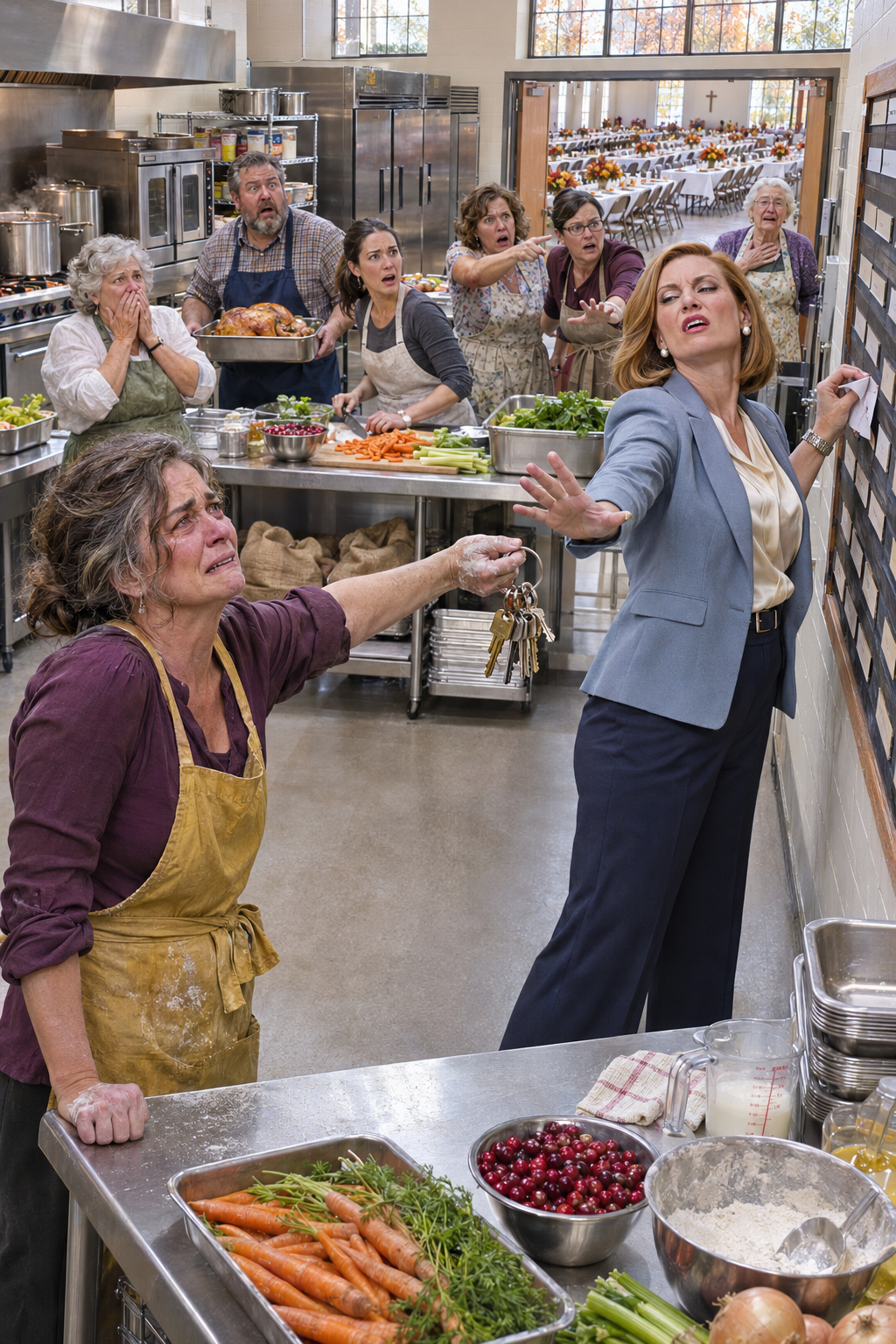
The thumbtack hit the fellowship hall floor with a sound no bigger than a dropped grain of rice. Daphne Voss held up the laminated card that had said HEAD COOK: TESSA ROUSSEL for eleven Thanksgivings, then pinched it between two perfectly manicured fingers. “With the television station coming Thursday,” she announced, “we need a family woman representing our church’s table.”
I was forty-five, divorced, and raising a thirteen-year-old boy, and every person in that room knew exactly what she was saying. Hollis Dugas, who had been scrubbing our roasting pans since before I joined the church, bent to retrieve the tack and stayed down a moment longer than necessary. I could feel my cheeks heating, but I kept my hands steady as I worked three keys off my ring: pantry, cooler, kitchen. “The wide black roasting pan is for the dressing,” I told Daphne, placing the keys on top of my name card, “and the back oven runs twenty degrees hot.”
I folded my apron beside the sink, walked past the empty serving line, and pushed through the side door into the wet November air. Across Johnston Street, the windows of Riverton Elementary glowed above the bus lot where I parked Route 14 every afternoon. I sat behind my steering wheel for ten minutes, staring at those lights as though a school building could tell me what to do with the Thursday I had spent six weeks planning.
At my second service at Cypress Grove Community Church, Lucille Mouton, a tiny woman in a purple felt hat, stopped me beside the parking lot and asked whether I could peel potatoes without wasting half of them. She and her husband, Elias, had begun a free Thanksgiving meal in their living room in 1971, feeding thirty-four people when the church had neither a hall nor a proper stove. Lucille believed a hungry person deserved dinner before a lecture, and by the time she handed me a vegetable peeler, the meal served several hundred.
In 2015, arthritis made it difficult for her to lift the stockpots, so she invited me to her kitchen and spread three papers beside a plate of pecan cookies. One registered me as the program’s organizer with the parish, another authorized me to receive the food bank’s donations, and the third named me director of the Mouton Community Table, a nonprofit she had formed years earlier. “The church gives us a roof,” Lucille said, pushing a pen toward me, “but it doesn’t get to decide who’s worthy of a plate.” I signed, thinking I was helping an elderly friend complete forms that somebody had to complete.
Then Reverend Graham Voss arrived that summer with a thoughtful manner, sensible sermons, and his wife, Daphne, who seemed most interested in how the church looked in photographs. She moved Jude and me to a directory page marked INDIVIDUAL HOUSEHOLDS, though we were the only two-person family placed there. In September she asked a deacon to lead the volunteers’ prayer instead of me, and in October she asked, in front of Jude, whether he had a suitable male influence at home. That night he left his church cookie untouched and asked if we counted as a real family.
We counted, I told him, even if Daphne didn’t know how to see us. I stayed because Lucille, now eighty-eight, relied on my Sunday rides, and because seventy-year-old men in trailer parks and children staying in temporary housing expected a hot meal on Thanksgiving. Walking away from Daphne’s cruelty felt simple; walking away from them didn’t. That Tuesday night I told Jude only that someone else would be cooking, and he looked at the unused apron in my hands as though I had misplaced part of myself.
At nine-thirty Lucille called, already informed by a volunteer who knew better than to keep a secret from her. She asked whether I remembered what I had signed at her kitchen table, and when I said, “Some permits,” she made a sharp little sound. “Those papers were never meant to protect you from paperwork, honey,” she said. “They were meant to protect the table from people who thought they owned the chairs.”
The next morning, while I was inspecting my bus tires, my phone rang from the Acadiana Community Food Bank. Sabine Arnaud, who had arranged our Thanksgiving deliveries for nearly a decade, sounded uneasy as she asked why Daphne had requested that forty-two turkeys, boxes of produce, and three hundred sixty rolls be transferred from the Mouton Community Table to a church account. I said I had handed over kitchen keys, not the nonprofit, and Sabine replied that she had refused the transfer. Then she told me Daphne had claimed to be the program’s new director—and had already sent a document to prove it.
## Part 2/5
Sabine emailed me the document before my first pickup. It was a letter on church stationery, signed by Daphne as director of Thanksgiving outreach, asking the food bank to treat the church as the owner of “its annual feeding program.” Beneath the signature was a sentence asserting that the former coordinator had resigned voluntarily. I stood in the bus lot reading that line while the diesel engine throbbed beneath my feet, wondering how quietly surrendering three keys had become permission for someone to rewrite eleven years.
“We haven’t released anything,” Sabine assured me when I called back. The food bank’s records named the Mouton Community Table, and my signature was the only one authorized to direct its donations; Daphne could purchase food for a separate church event, but she could not claim ours. The pickup had to happen by two that afternoon or the refrigerated truck would move on to another program. “I have the food,” I told her, “but I don’t have a kitchen anymore.”
After I asked Hollis whether we could use Riverton’s ovens, the principal agreed to sponsor the event, subject to written district approval and the parish’s food-service requirements. Hollis, Riverton’s cafeteria manager, secured both, and our amended site authorization covered the licensed school kitchen. At ten-forty I asked Sabine to reroute the truck to Riverton Elementary, directly opposite the church.
I was still searching my contacts when Jude came home holding his phone so tightly that his knuckles were white. The local television station had posted a preview titled A Thanksgiving Tradition, Renewed, showing the Cypress Grove serving line filled with people from last year. Jude had taken the photograph, and in his original I was laughing in the center with a ladle raised above the dressing. In the station’s version, the image had been cropped just beyond my shoulder, leaving the ladle suspended in the frame without the woman holding it.
The caption credited Daphne with leading the dinner and quoted her speaking about the importance of showing families that they belonged. “She cut you out of my picture,” Jude said, with the wounded precision only a child can manage. I wanted to comfort him, but the tightness in my throat made speech difficult. Instead I called the station’s community desk, explained that the image was his and the program belonged to a separate nonprofit, and offered the documentation to whoever was responsible for the story.
At five I called the church office to check on the sixty homebound neighbors who expected meals at their doors. The secretary told me Daphne had hired a caterer in nearby Broussard and canceled all deliveries because volunteer drivers were supposedly an insurance problem. “She says this year’s meal needs to be a seated, family-centered experience,” the secretary whispered, “and the camera crew needs one location.” My fingers went cold on the phone; I pictured Mr. Benoit on Breaux Bridge Highway, who always set out a small plate for the cranberry sauce before we arrived.
“Jude, put on your shoes,” I said when I hung up. I asked him to message his youth-group friends, not to complain about Daphne but to find people who could wash greens, peel potatoes, and pack takeout boxes. By six-thirty, thirty-one people had come to the cafeteria, including nine original volunteers, three bus drivers, and parents who brought children old enough to handle a vegetable peeler. Hollis pinned a sheet of paper over the cafeteria clock and began assigning stations, while our food-bank delivery sat stacked in the walk-in cooler.
The first onions hissed in butter as I opened a carton of stock and remembered how Lucille used to stand at my elbow correcting the sage. Through the cafeteria windows I could see the lit church doors, the banner advertising its Thanksgiving broadcast, and the catering van parked beside the fellowship hall. Daphne appeared just before eight, surveyed our volunteers, and told me people would never abandon the church’s beautiful dining room for a school cafeteria. I kept stirring and answered that the sixty people waiting at home had already been abandoned once, and I would not do it to them again.
She left without offering to carry a single crate, but Reverend Voss called ten minutes later to say two competing dinners would divide the congregation. When I explained the food bank account, his voice softened into genuine surprise, then turned defensive as he asked why I had not discussed it with him first. “Your wife dismissed me in a room full of witnesses,” I said, “and you were twenty feet away.” He went quiet, and after he hung up, I found the sponsor’s email in my inbox: a request to confirm whether Cypress Grove truly operated the Mouton Community Table, as Daphne had written in its funding application.
## Part 3/5
I sat on an overturned milk crate and read the sponsor’s email twice while Hollis supervised the turkeys. The Greater Acadiana Community Fund was considering a grant to expand neighborhood meals, and Daphne’s application claimed our volunteer hours, donation history, and home-delivery figures as church achievements under her leadership. Attached was a proposed publicity schedule that replaced home deliveries with a single televised luncheon. I recognized the columns of numbers because I had compiled them myself, year after year, on the battered laptop Jude used for homework.
I answered with the truth and attached the nonprofit registration, food-bank records, and the amended cafeteria authorization. Lucille called before I left the school, and when I told her about the application, she became quiet. “In 1993, some church trustees tried to close our dinner because they didn’t like the people waiting outside,” she said, “and that’s why Elias and I put it beyond their reach.”
At four Thursday morning, Jude and I reached Riverton through fog that smelled of wet leaves and distant wood smoke. Hollis had already warmed the ovens, and volunteers came in carrying foil pans, aprons, and thermoses of coffee. We worked in tight rows under the fluorescent lights, scraping dressing into hotel pans and checking turkey temperatures while the district’s approved serving plan hung beside the sink. At nine the drivers left with sixty home-delivery boxes, including Mr. Benoit’s extra cranberry sauce, and I felt the first knot inside me begin to loosen.
By ten-thirty, we were ready for the three hundred walk-in guests we had planned for, plus a little extra. Someone had set out paper turkeys made by Riverton third graders, and Jude taped a crooked sign to the door that said FREE THANKSGIVING DINNER, EVERYONE WELCOME. I stepped outside to breathe and found a long line forming across the road at Cypress Grove, exactly where it always had. Daphne stood near the television camera in a cream suit, welcoming people beneath a banner that said FAMILY STARTS HERE.
At the church entrance, Jude helped Lucille out of a friend’s car, and the line parted before the tiny eighty-eight-year-old woman in her purple hat. Daphne opened her arms, called her the honored guest, and promised a table near the front. Lucille asked, loudly enough for the microphone, “Where is Tessa?” When Daphne replied that I’d started a separate dinner because the church needed a proper family woman in charge, Lucille looked at the people waiting and shook her head.
“My husband and I started this meal in our living room,” she said, and the cameraman lowered his lens toward her face. “Tessa runs the organization that feeds you, and those donations were never the church’s to give away.” She pointed her cane at Riverton’s cafeteria, where I was still standing with my hand on the rail, and asked who would like to come with her. People began walking to the signalized crossing in small groups, with volunteers guiding families and traffic stopped at the light, until the church’s line moved across Johnston Street like a slow procession.
I went inside before they reached us, because my knees didn’t feel reliable and somebody had to put the serving spoons in the pans. We served three hundred nine guests in the cafeteria, and the delivery drivers returned with sixty empty containers and stories about neighbors who had feared they’d been forgotten. Lucille tasted the dressing, announced it needed less sage, and took another helping. I laughed so hard that I cried into the sleeve of my apron, the way you sometimes do when your body has been frightened for too long.
Daphne came through the cafeteria doors twenty minutes after the first plates went out, her smile gone. She accused me of humiliating her on television, then offered to describe the two events as one church partnership if I let her handle the interviews. I showed her the cropped photograph on Jude’s phone and told her I would not erase myself again so that she could appear generous. Reverend Voss came in behind her, heard enough to understand, and finally admitted that he had known she intended to replace me but had chosen not to intervene.
He took off his jacket, asked Hollis for an apron, and began carving turkey while Daphne stood silent at the edge of the serving line. Later we offered the caterer across the street a place to bring his untouched side dishes, with his permission, and our drivers delivered the surplus to a shelter and a fire station. By dusk the cafeteria was clean, the last dish machine cycle finished, and Lucille was asleep in my passenger seat holding her hat. I thought the worst thing Daphne could do had happened on camera, until two weeks later a certified letter arrived from the school district’s human resources office.
## Part 4/5
The letter alleged that I had used district property for an unauthorized religious gathering and diverted food donations meant for a church. It instructed me to appear at a formal review with permission to bring a representative, but it did not say who had made the complaint. My first thought was not about defending my pride; it was about the rent due in January, Jude’s braces, and the health insurance attached to sixteen years of driving a school bus. I sat on the kitchen floor with the envelope in my lap until Jude came home and found me there.
The next morning I forwarded copies to the community fund and the television producer, along with Jude’s uncropped photograph and a simple timeline of the dinner. The fund’s director called and explained that their reviewers had placed Daphne’s application on hold after discovering that the church had listed a nonprofit’s work as its own. The request wasn’t just for publicity; it sought eighteen thousand dollars for a new outreach program, using our deliveries and annual guest counts as evidence of the church’s operating history. When the fund asked Daphne for authorization from our board, she had provided no such permission.
A successful televised lunch would have made her look like the person who had inherited decades of community work, and the grant would have supplied money for an outreach expansion she controlled. But there was no need to invent a conspiracy with meetings in dark rooms: she had simply assumed that the work of an unmarried woman could be relabeled as the church’s property. Once the paperwork contradicted her, she’d tried to make the records—or the person who held them—disappear from the story.
At the district office, a human resources administrator named Maribel Hebert read the complaint aloud without expression. It accused me of using students’ facilities for a church service, which was easy to answer because there had been no service, invitation to worship, or religious requirement for receiving food. Hollis supplied the school-use agreement and the parish authorization, then laid the donation receipt on top. Maribel checked the dates, called the facilities department to confirm the approval, and told us there was no policy violation and the review would be closed in writing.
Reverend Voss visited our porch that Friday, with Jude beside me. He brought a copy of the church board’s minutes from a meeting held after the district complaint reached his attention. The board had learned that Daphne signed the grant application without its authorization and described the Mouton Community Table as a church program, though its own financial records showed no ownership. The members withdrew the application, removed her from oversight of community events, and asked the fund to correct its records.
I asked him who had complained to my employer, and he said Daphne had admitted making the call because she believed I had embarrassed the church. “I should have stopped this when she took your card off that board,” he said. “You should have,” I answered, because I had no reason to make the truth easier for him.
He asked whether I would attend the next Sunday service so he could apologize publicly. I said I would attend for Lucille and for Jude, but his apology would not decide whether we stayed at Cypress Grove. Then I asked him something that mattered more than words: Would the church acknowledge, in writing, that the meal belonged to the Mouton Community Table and could not be used as leverage against its director? He said the board was preparing an agreement and invited me to review it before anyone signed.
On Sunday morning, he stood at the pulpit without opening his Bible and told the congregation he’d watched someone be shamed for her divorce and done nothing. He acknowledged that an unauthorized complaint had threatened my employment and that the church had claimed credit for work it did not own. He apologized to Jude as well as to me, which was the part that nearly broke my composure. Daphne sat in the front pew and did not turn around, and when the service ended, she walked past us without speaking.
I didn’t chase her or demand an apology, because the paper in my purse was worth more to the future of the dinner than anything she could say. It was the draft of a new agreement: the church could offer a kitchen and hall, but the nonprofit controlled its donations, volunteers, guest list, and home deliveries. The document also required that every public appeal using the meal’s history be approved by the nonprofit board. For the first time since the thumbtack struck the floor, I felt that our work might outlast the next person who mistook a building for the people inside it.
## Part 5/5
Jude quit the church youth group after Christmas, not with a dramatic announcement but with the plain observation that he no longer wanted to spend Wednesday evenings in a place where his mother had been treated like an embarrassment. I let him choose a community basketball league instead, and he came home from his first practice complaining about his sore calves and talking excitedly about a boy named Marcus who could shoot from anywhere. We still visited Lucille on Sundays, sometimes attending church with her and sometimes bringing groceries instead. She never once suggested that forgiveness was the price of belonging to our little family.
On Christmas Eve, Lucille asked me to stop by alone and brought out a wooden recipe box polished smooth where generations of hands had touched it. Inside were cards for gumbo, pralines, pickled okra, and the cornbread dressing she’d made for the first Thanksgiving meal in 1971. At the bottom of that card, in her late husband’s slanting handwriting, were five words: “Less sage, sweetheart. Love, Elias.” Lucille smiled when I read it, and for the first time I pictured him not as a founder in an old photograph but as a man standing over her shoulder in a warm kitchen.
“He complained about my dressing every November for forty years,” she said, “and ate three helpings anyway.” She wanted me to take the box, and I protested until she reminded me that a recipe locked in a drawer couldn’t feed anybody. Then she placed her weathered hand over mine and said she had never meant for me to spend my life proving I deserved a place at a table I helped set. I drove home with the box buckled into the passenger seat, absurdly afraid that a sudden stop might scatter its contents.
After the church board signed our agreement at Christmas, we updated the nonprofit’s rules so nobody could quietly redirect food again. The following September, Reverend Voss asked whether we would use Cypress Grove’s hall again, with Riverton as our second kitchen. I said yes after Hollis confirmed that the district would approve our second-kitchen use, and the nonprofit board voted on a written schedule for both locations. When a new volunteer asked who would appear on the church’s publicity poster, I said we could print the founders’ names and the words FREE DINNER, EVERYONE WELCOME, and leave my face off entirely.
Daphne no longer chaired the outreach committee, and she did not get her television segment or the grant she’d requested. She attended one volunteer training that fall and signed up to greet guests, a task nobody could use to claim control of the nonprofit’s accounts. She was courteous to me, and I was courteous to her, but I kept the boundaries written in the agreement and never put her in charge of anything that belonged to the Table. When she quietly asked whether we might start fresh, I told her, “We can work in the same building, Daphne, but what happened to my job and my son doesn’t disappear because a year has passed.”
Just before dawn on Thanksgiving, I opened the kitchen door and found a small wooden sign Jude had made in shop class. It read MOUTON COMMUNITY TABLE — FOUNDED 1971, and beneath that, in smaller letters, EVERYONE HAS A PLACE. He had not put my name on it, and I loved him for knowing by then that the work was bigger than either of us. I hung it beside the serving window where the old corkboard remained, its little laminated cards pinned in neat rows under the names of every person helping.
Lucille arrived before lunch in her purple hat and settled at the first table with two old friends who had been eating this meal since the 1980s. I carried her a serving of dressing, and she tasted it with the solemnity of a judge deciding an important case. “Too much sage, honey,” she declared, then held out her plate for seconds. Across the room, Jude laughed, Hollis called for more rolls, and seventy-three dinners were already traveling through Lafayette toward people who could not join us.
I had once believed losing the kitchen keys meant losing the place I’d built inside those walls. The keys came back, but they were no longer the part of the story I cared about, and Daphne never became the friend I was supposed to be grateful to have regained. What mattered was that her attempt to claim the dinner had exposed why Lucille protected it in the first place, and that we had finally put those protections where everyone could read them. I turned back to the oven when its timer rang, because there were still people to feed, and no one needed to ask whether I belonged there.
THE END!
Disclaimer: Our stories are inspired by real-life events but are carefully rewritten for entertainment. Any resemblance to actual people or situations is purely coincidental.