“Ever Seen A Real Wound, Ma’am?” The Sergeant Yanked His Shirt Up For The Whole Class. A Long Scar Under His Ribs. Twenty Marines Laughed. “Bet You Can’t Even Say What Did That.” I Looked Once. The Stitches. The Angle. I Answered Him. “Ma’am… Who Told You That?”
For nine years, a Marine I had once kept alive believed I had abandoned his best friend to die. I didn’t know he was still carrying that story until he challenged me in front of an entire class, lifted his shirt, and asked whether I had ever seen a real wound. I answered with the date, the time, and one detail about his body he had never understood. Three weeks later, an envelope arrived at my office containing a copy of an old casualty report—and a handwritten note that suggested our misunderstanding had never been as accidental as I thought.
Part 1
At 5:30 on my third Monday with 2nd Battalion, the training lane was still dark enough that I needed a headlamp to unlock the equipment container. The dirt track ran beneath eucalyptus trees toward a set of aluminum bleachers, and the Pacific air carried that damp, cold smell Southern California gets before sunrise. Inside the container were twelve full-body trauma mannequins, each heavy enough to make my lower back complain when I dragged them outside, each capable of bleeding through simulated wounds at whatever rate I programmed from a tablet. By six, I had them arranged in two rows and had counted the gauze, tourniquets, chest seals, training needles, and casualty cards twice.
Counting was something I did whenever I was new somewhere. My name was Chief Hospital Corpsman Caroline Lindell, though everyone who knew me well called me Cara, and at thirty-three I had spent fifteen years in the Navy, most of them attached to Marines. Two deployments had taught me that people lied when they were hurt, usually because they were frightened, embarrassed, protective of someone else, or convinced they could keep moving until their body proved otherwise. Mannequins did none of those things, which was one reason I respected them more than some instructors did.
Gunnery Sergeant Nolan Mercer arrived at six carrying two coffees and handed me one without ceremony. He was forty-two, gray beginning at his temples, with the permanently narrowed eyes of a man who had spent half his adult life inspecting things other people hoped he would overlook. He studied the mannequins and said, “Previous corpsman made the students set all this up themselves.” I told him the previous corpsman had apparently designed a different course, and he gave the smallest hint of a smile.
Then his expression changed. “Twenty Marines today, mostly corporals and lance corporals, couple sergeants with deployments,” he said. “One of the sergeants is probably going to test you. Good squad leader, good Marine, but he’s got an issue with docs.” When I asked how serious an issue, Mercer shrugged and said, “Four corpsmen in three years have complained about him checking everything they do.”
At 7:30, a truck delivered the class, and I recognized the problem before anyone introduced him. Sergeant Mason Devereaux sat at the top left of the bleachers, lean and hard-faced, maybe twenty-eight, with dark hair clipped close and arms folded across his chest. He wasn’t joking with the others or looking at his phone; he was watching me with the flat concentration Marines use when they believe a new person is about to disappoint them. I had seen that stare from corporals studying young lieutenants and from patients studying inexperienced nurses.
The first ninety minutes went well. I demonstrated tourniquets, made them practice on one another, corrected six that were too loose, and embarrassed nobody because humiliation is a terrible teaching tool when you want someone to remember what you said under stress. Devereaux completed every task quickly and correctly, but when I checked his work, he looked toward the tree line rather than at me. He had already decided what I was before I had spoken twenty sentences to him.
At nine, we started wound packing. I knelt beside a mannequin pumping bright artificial blood from a deep thigh wound and showed the class how to push gauze firmly into the cavity, fill every space, then maintain pressure for three full minutes. “At two minutes,” I said, watching the clock, “your shoulders will hurt and your hands will tell you the bleeding has stopped. Your hands can be wrong.”
That was when Devereaux spoke. “Chief, how many of those have you done?” I glanced up and asked whether he meant mannequins, and he shook his head. “No. Real ones.”
The bleachers changed immediately. Twenty Marines became quiet in the interested way people do when they sense an argument and have not yet decided whose side they are on. I told him, “Enough,” and returned my attention to the timer.
He stood. “That’s not really an answer.”
“It’s the answer you’re getting during instruction, Sergeant.”
He came down the bleachers one level at a time, and I remember thinking his anger seemed strangely personal for a man who had met me that morning. “With respect, ma’am,” he said, and that word told me exactly what he intended. A Navy chief attached to Marines is Chief, and he knew it; ma’am was his way of putting me somewhere softer and more civilian, someone who had wandered onto his lane carrying schoolhouse knowledge.
I let the insult pass. The timer beeped, I removed my hands, and the simulated bleeding remained stopped. “Have a seat, Sergeant.”
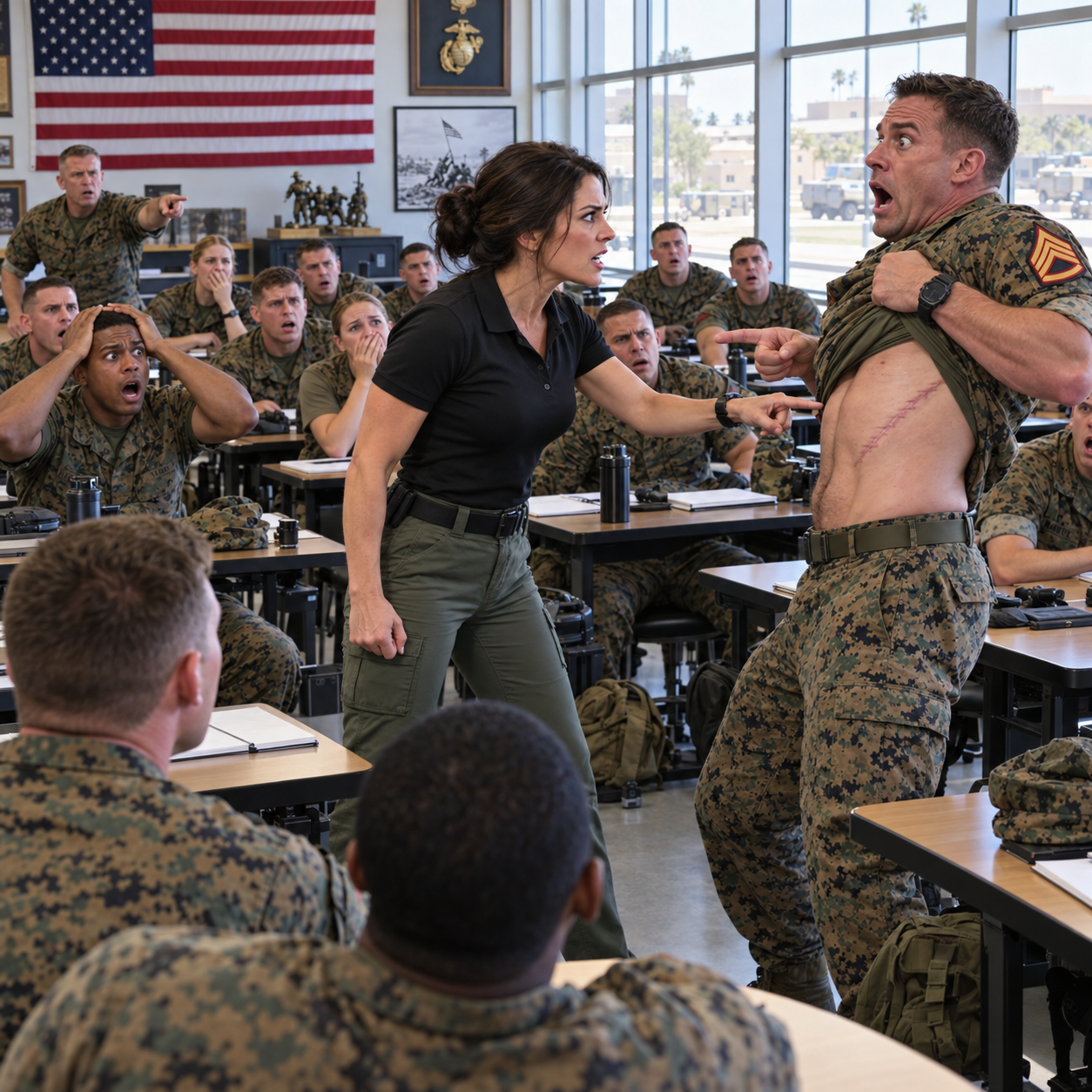
Instead, he grabbed the hem of his T-shirt and lifted it to his chest.
A pale scar ran diagonally beneath his right ribs toward his back, thick at the entry point and cleaner where surgeons had reopened him. Old staple marks bordered part of it. A few of the younger Marines laughed approvingly, not because anything was funny but because Devereaux had just turned an argument into a performance.
“There,” he said, tapping the scar. “Real wound. Think you can tell me what made that?”
I looked at the main scar once. Then I looked higher.
Beneath his right collarbone was another mark, so small most people would never notice it, faded almost white and no wider than a pencil eraser. My stomach tightened before my mind admitted why. I knew the location, the angle, the imperfect little crescent at the edge, because I had made it myself with a red flashlight clenched between my teeth while someone screamed another man’s name into the dark.
I stood slowly.
“June 9, 2017,” I said. “About 2:40 in the morning. A rocket landed short of the berm, roughly fifteen feet to your left. Fragment entered below your right ribs and damaged your lung.”
The laughter vanished.
Devereaux’s hand stopped on his shirt.
I pointed toward my own collarbone. “By the time I reached you, the pressure around that lung was building fast. Somebody put a needle right there so you could breathe.”
He stared at me.
“Who told you that?” he asked.
“Nobody.”
His face didn’t turn pale. It became younger. For one strange second, the twenty-eight-year-old sergeant disappeared, and I was looking at a nineteen-year-old Marine lying in Syrian gravel, grabbing my sleeve with both hands and begging me to leave him.
He lowered his shirt.
Then, without another word, he turned and walked off the training lane.
Part 2
I let him go because chasing a man in front of his Marines would have turned memory into spectacle. Gunnery Sergeant Mercer looked at me from beside the litter rack, and when our eyes met, I gave him a slight shake of my head. He understood and stayed where he was. I turned back to the class, assigned partners, and told them to begin packing wounds.
For the next hour, I corrected hand placement, reminded eleven separate Marines that three minutes meant three minutes, and never once looked toward the tree line. I could feel Devereaux standing out there anyway, the same way you can feel cold air from a door that has been left open behind you. At 10:30, he returned, spoke briefly to Mercer, climbed into the cab of the truck, and remained there through lunch. Nobody asked me what had happened because junior Marines are often much better at recognizing dangerous silence than senior leaders give them credit for.
Mercer sat beside me on the lowest bleacher with two field-mess trays. “Want to tell me what that was?” he asked. I said Devereaux had asked me a question and I had answered it, and Mercer chewed for a while before saying, “Three years I’ve known that Marine. Never seen him walk off training.”
“He had a reason.”
“You were there in 2017.”
I kept eating.
Mercer nodded once. “All right.”
After lunch, I went inside the equipment container and stood alone among plastic torsos, rubber tubing, medical bags, and the metallic smell of simulated blood. My hands were steady. They were always steady, which sounds like a gift until you have lived long enough to understand that sometimes you want your hands to shake because then your body would be admitting that something mattered. I whispered one name into the dim container, a name I had not spoken aloud in years.
Tommy.
On June 9, 2017, I was twenty-four and a second-class petty officer attached to a Marine artillery battery supporting operations in northern Syria. The firing position was a gravel pad behind a dirt berm, flat country in every direction, brutally hot by afternoon and unexpectedly cold after midnight. Enemy rockets usually landed wide, and we became familiar with the difference between our artillery leaving and theirs arriving. Familiarity is not safety; it merely teaches you which sound should make your body move before your thoughts catch up.
At approximately 2:40 that morning, I woke to the incoming whistle. The rocket struck near an ammunition position where two young Marines had been sitting watch. I knew they were there because I had walked past them two hours earlier on my way to the latrine, and Lance Corporal Thomas Reyes had asked whether I had gum. I gave him spearmint because it was what I had.
The other Marine was Mason Devereaux.
I reached them within a minute. Dust hung in the air, voices were calling for a corpsman from several directions, and Reyes was closest to the impact. I checked him first.
Airway. Breathing. Pulse.
Nothing.
The injuries to his head and chest were catastrophic. I checked for a pulse again because I had been trained never to let panic decide something irreversible. There was still nothing.
I said his name. Nothing.
Maybe twenty seconds passed.
Then I moved to Mason.
He was on his right side, conscious and gasping, trying to crawl toward Reyes despite the wound beneath his ribs. He caught my sleeve with both hands as soon as I rolled him over. “Tommy,” he kept saying. “Doc, go to Tommy.”
“I already did.”
I don’t think he heard me.
His breathing deteriorated rapidly, and I knew the fragment had caused more than the visible wound. One side of his chest was moving poorly, pressure was building around the lung, and if I did not relieve it, his ability to breathe would continue collapsing. He fought me as I worked, pushing at my arms and twisting toward his friend.
“Go to Tommy.”
“I’m with you, Mason.”
“Leave me.”
“I’m with you.”
I used my knee to keep his shoulder down, located the correct position beneath his collarbone, and performed the emergency procedure. When trapped air released, he took a full breath and stared at me with the stunned expression of someone whose body has abruptly remembered how to work. Two seconds later, he was fighting me again.
The evacuation helicopter took fifty-two minutes.
I know because I timed it.
For most of that hour, Mason begged me to go back to Tommy until medication, blood loss, and exhaustion finally pulled him unconscious. I maintained pressure on the wound, reassessed his breathing, repeated treatment when necessary, talked to him even after he could no longer answer, and handed him alive to the flight crew. Tommy Reyes was later placed in a transfer case under an American flag, and I was one of the people who prepared him for the journey home.
The next morning, I completed two casualty reports. For Tommy, I wrote the time of death as 0240 because the rocket had killed him before I ever reached him. For Mason, I documented everything I had done and the time he was evacuated.
Then a story began moving through the battery.
According to that story, the new female corpsman had panicked. She had chosen the easier casualty instead of the one who needed her most. I had abandoned Tommy Reyes and saved Mason Devereaux because I had made the wrong decision.
Nobody asked me whether it was true.
Part 3
Rumors in military units rarely arrive as accusations. They live in unfinished sentences, jokes that stop when you approach, and conversations in chow lines where someone speaks just loudly enough for you to understand you are supposed to hear. A sergeant I had treated for heat exhaustion stopped meeting my eyes. One lance corporal who used to ask me for athletic tape every other morning suddenly began walking to another aid station.
My senior chief, Dolores Avery, eventually came to my tent and sat on the empty cot opposite mine. She asked exactly what happened, and I gave her the sequence without defending myself: Reyes first, no pulse, unsurvivable trauma, then Devereaux, respiratory compromise, treatment, evacuation. She listened, then asked, “You’re certain about Reyes?” I told her I had checked twice.
“Then you made the right call.”
A routine review supported that conclusion. Lieutenant Commander Evan Whitaker, the battalion surgeon, examined the reports and wrote that Reyes had sustained injuries incompatible with life, that my triage decision was appropriate, and that the interventions performed on Devereaux had materially contributed to his survival. One paragraph settled the medical question.
The problem was that paragraphs in official files do not speak.
Nobody gathered the battery and explained the finding. Nobody corrected the rumor. Two weeks later, I rotated to a hospital assignment, and whether that transfer had already been scheduled or became convenient because of what happened, I never learned. The battery finished the deployment without me.
A year later I asked about Mason and heard that he had recovered, remained in the Marines, and transferred to an infantry unit. I considered writing him several times. Every version of the letter sounded weak compared with what he remembered: himself on the ground, his friend nearby, and a corpsman refusing to move when he begged her.
So I wrote nothing.
Nine years later, he walked onto my training lane carrying the same story.
By midafternoon of that first course day, Mason remained in the truck while the other Marines practiced chest seals. Mercer approached while I corrected a student who had managed to apply one backward. “Devereaux wants out of the course,” he told me.
“Why?”
“Says he’ll take it next quarter with a different instructor.”
That sentence landed harder than the confrontation had.
Mercer lowered his voice. “Chief, I’m going to tell you something. That man has burned through four docs since he’s been in my company. Questions everything. Checks medication labels behind them, argues triage calls, watches every procedure. Two corpsmen asked to transfer platoons.”
I looked toward the truck.
For years, I had imagined Mason’s anger as something aimed specifically at me. Suddenly I understood that I had been wrong. He had turned one night into a rule for the world.
Every corpsman was eventually going to choose wrong.
Every medic needed watching.
Every wounded Marine might become another Tommy unless Mason was close enough to stop it.
That evening, Battalion Sergeant Major Howard Kell called me. His tone was careful, reasonable, almost kind, which somehow made the request worse. He told me Mason was respected, combat wounded, and being considered for promotion; I was new to the battalion and had an excellent record; there was no benefit, he said, in allowing an old deployment issue to become “a thing.”
His suggestion was simple. Let Mason withdraw quietly.
Another instructor could certify him later.
“Nobody needs to reopen 2017,” Kell said.
I stood beside the equipment container watching fake blood darken the dirt where we had trained all day. I had heard variations of that sentence for most of my career: let it go, don’t drag it out, the finding is documented, don’t make people uncomfortable over something that already happened. Every version sounded mature and practical.
Every version required the person already carrying the weight to keep carrying it.
I asked the sergeant major for one night to think.
Then I sat alone on the bottom bleacher.
I thought about my twenty-four-year-old self writing the word deceased in block letters and assuming facts would eventually outrun gossip. I thought about the nineteen-year-old who had begged me to leave him and then awakened in Germany with no one explaining why I hadn’t. Most of all, I thought about four corpsmen Mason had distrusted because I had allowed silence to finish a conversation I had been too frightened to continue.
At 5:17, I texted Mercer.
Tell Sergeant Devereaux I’ll be at the battalion aid station at 1800. Door will be open. He doesn’t have to come.
Mercer replied two minutes later.
Copy.
At six, I unlocked the clinic, turned on the treatment-room lights, and sat on a stool beside the exam table.
At 6:06, Mason appeared in the doorway wearing jeans and a gray T-shirt.
For several seconds neither of us spoke.
Then he said, “You picked me.”
Part 4
Mason remained near the door with both hands in his pockets. Without camouflage, rank, and twenty Marines watching him, he looked less like the confrontational sergeant from the lane and more like a tired man who had driven somewhere against his better judgment. I told him he could come inside or leave and that either choice was his.
He stepped in.
“You picked me,” he repeated.
“I treated you.”
“Tommy was three yards away.”
“I know.”
“I told you to go to him.”
“I know.”
His jaw tightened. “I watched you kneel next to him for maybe two seconds. Then you came to me. I begged you to go back.”
“It wasn’t two seconds.”
His eyes hardened immediately.
“About twenty,” I said. “You were losing air and blood. Your sense of time was not reliable.”
I gave him the rest the way I had given reports throughout my career, because facts were the only safe surface I had. I had checked Tommy’s airway, breathing, wrist, and neck. I had checked his pulse twice, spoken his name, assessed the injuries, and concluded there was nothing medicine could do.
“Tommy was already dead when I reached him.”
Mason shook his head once.
“Yes.”
“Nobody told me that.”
His voice broke on the final word.
“I know.”
“Nobody told me.”
“That part should have been handled differently.”
He turned away, pressing one hand over his mouth. For years I had imagined this conversation ending in anger, accusation, maybe someone walking out. I had never imagined Mason folding against the counter and covering his eyes while his shoulders began to move.
I stayed seated.
Eventually he lowered his hand.
“There was an inquiry?” he asked.
“Yes.”
“And?”
“The surgeon found the triage appropriate. Tommy’s injuries were not survivable. The report said your survival was connected to the treatment you received before evacuation.”
Mason stared at the tile between his boots.
“Where was that report?”
“In the medical chain. Archived somewhere now.”
“And nobody told us.”
“No.”
He laughed without humor. “Nine years.”
“I know.”
He looked at me then. “Why didn’t you tell me?”
That question hurt more than anything he had said on the lane.
“Because I was twenty-four,” I answered. “Because people senior to me said the review settled it. Because I thought you wouldn’t believe a letter over your own memory.”
“And because letting it go was easier.”
I considered denying it.
“Yes.”
For a long time, all we heard was the fluorescent light buzzing above the exam table.
“I hated you,” he said. “Didn’t know your name. Barely remembered your face. I remembered a red light and somebody holding me down while Tommy was lying over there.”
“I had the flashlight in my teeth.”
He looked up.
“That explains the red light.”
He sat on the exam table, elbows on his knees. “Every doc since then, I’ve watched them. When they say someone is fine, I check. When they say we move this casualty first, I ask why. I thought if I caught it fast enough, I could stop somebody from making the same choice.”
“You weren’t trying to protect your Marines from bad corpsmen.”
“No?”
“You were trying to prevent June 9 from happening again.”
He closed his eyes.
I had finally found the wound his scar had been hiding.
We talked for nearly two hours. He asked whether Tommy had spoken, and I told him no, but I remembered Tommy asking me for gum around midnight. Mason immediately said, “Spearmint.”
“It was.”
That small detail struck him harder than the casualty report had. Suddenly we were not discussing a dead Marine preserved in paperwork; we were remembering a twenty-year-old kid who hated cinnamon gum, received spoiled homemade food from California, and ate it anyway because his mother had mailed it across the world.
At 7:40, Mason stood to leave.
“The sergeant major called you,” he said.
“Yes.”
“Told you to let me drop.”
“He suggested it.”
Mason looked embarrassed. “Don’t.”
“I wasn’t planning to.”
He nodded, then straightened the way Marines do before addressing a superior formally. “Chief Lindell, I owe you an apology for this morning. And probably for things I said about you before I knew your name.”
“Accepted.”
“No speech?”
“You have training at seven.”
That almost made him smile.
“Needle decompression,” I added.
He touched the tiny mark below his collarbone.
“I might know something about that.”
The next morning I arrived at the lane at 5:30.
Six mannequins were already outside.
Mason was kneeling beside a seventh, adjusting its bleed rate.
“Morning, Chief.”
“Sergeant.”
“Couldn’t sleep.”
We set up the rest together.
At seven, when all twenty Marines were seated, Mason raised his hand.
“Permission to address the class.”
I knew what it would cost him.
“Go ahead.”
He turned toward his Marines.
“Yesterday, I asked Chief Lindell whether she’d ever seen a real wound,” he began. “I’m going to correct the record.”
Part 5
Mason told them he had known me before I knew him. He explained that in Syria a rocket had killed his closest friend and nearly killed him, that I had treated both casualties, and that he had spent nine years believing I chose the wrong man. Nobody moved while he spoke.
Then he pulled his collar aside and exposed the tiny scar. “Chief Lindell put this here in the dark when my lung was failing. She stayed on me for fifty-two minutes while I fought her and told her to leave me.”
His eyes swept the bleachers.
“She checked Tommy first. Tommy was already gone. I was wrong about her.”
He paused.
“I’ve also been hard on every corpsman I’ve worked with since. Some of you have seen it. That’s on me, not them.”
Then he turned back to me.
“That’s all, Chief.”
“Thank you, Sergeant. Sit down.”
The class resumed, but something had changed. Mason sat in the front row instead of the top. When I demonstrated the decompression station, he watched my hands without hostility for the first time.
At the practical lane that afternoon, every Marine passed.
Corporal Daniel Cho, one of the youngest students, almost lifted pressure from a packed wound after two minutes, then caught himself and held for the full three. When he finished, he looked at me and exhaled like he had been underwater.
Afterward, Mercer brought over a clipboard.
“Devereaux submitted an instructor-assistant request for next quarter.”
I looked at Mason helping load mannequins.
“He did?”
“Says he has relevant experience.”
“That he does.”
Mercer stayed beside me after I signed.
“My first deployment,” he said, “we had a corpsman everyone blamed when one wounded Marine died and another lived. I believed the guys talking. Never asked the corpsman what happened.”
“Where is he now?”
“Got out.”
“You know his name?”
Mercer nodded.
“Then you can ask.”
He looked uncomfortable. “It’s been eighteen years.”
“It isn’t too late because you’re embarrassed about how late it is.”
A month later, Mercer told me he had found the former corpsman living in Ohio and sent him a message. They planned to meet for a beer when Mercer visited family at Christmas. He told me this while pretending to be fascinated by a supply inventory, which was his way of preventing me from noticing that it mattered.
Mason did something larger.
He found an old battery roster.
Then he began calling people.
The first message reached me ten days after the course. It came from a former corporal named Aaron Bishop, now a truck driver in Oklahoma. He told me he remembered standing in a chow line in 2017 and repeating the rumor about me loudly enough that I could hear.
“I don’t remember exactly what I said,” he wrote. “I remember you heard it. I remember you sat alone. We all believed Mason. Nobody checked. I’m sorry.”
I replied with two sentences.
Thank you for writing. Drive safe.
Four more messages arrived that month.
Then eight.
Mason eventually admitted he had made thirty-one calls.
Some former Marines apologized immediately. Some argued at first. A few told Mason they had always suspected the story was incomplete but had never challenged it.
Each conversation forced him to repeat the truth.
Tommy could not have been saved.
Cara Lindell checked him first.
She saved me.
It would have been easy to treat those calls as my vindication, but that was not what they became. The deeper consequence belonged to Mason because every apology he helped send me also required him to confront another person he had misled.
His mistake had not remained inside him.
It had spread through other people.
So had mine.
I had allowed the silence because defending myself felt humiliating, and leaders had convinced themselves that avoiding discomfort was the same thing as protecting everyone involved. That decision had left Mason alone with guilt, Tommy’s family with false hope, other corpsmen facing distrust they did not understand, and dozens of Marines carrying a story that was simply wrong.
One Tuesday night, I called retired Master Chief Dolores Avery.
She answered with, “Lindell, who died?”
“Nobody.”
“Then why are you calling?”
I told her everything.
When I finished, she was quiet.
“I had Whitaker’s report in my hand,” she finally said. “Back in Syria.”
I sat straighter.
“I considered reading it to the battery. I decided it would keep the whole thing alive.”
I said nothing.
“I thought I was protecting you.”
“I know.”
“No,” she said. “I was protecting the unit from an uncomfortable conversation. Different thing.”
Hearing Dolores say that mattered because she had been one of the people whose judgment I trusted most.
“I was wrong, Cara.”
She had never called me Cara during that deployment.
I closed my eyes.
Then she said something I wrote down afterward.
“A correct decision can still leave damage when nobody explains it.”
Three weeks later, an envelope appeared in my office mail.
Inside was a photocopy of the original 2017 medical review.
Beneath it was a handwritten note.
I recognized the name immediately.
Lieutenant Commander Evan Whitaker—the surgeon who had written the paragraph that cleared me—wanted to know if I remembered what happened after he filed it.
Part 6
Whitaker was retired now and living in North Carolina. His note included a phone number and one sentence that bothered me more than anything else I had learned: I should have told you this years ago.
I called him that evening.
He remembered the case immediately.
“Reyes and Devereaux,” he said.
“Yes, sir.”
There was a long exhale.
“I’ve followed your career from a distance. Saw when you made chief.”
“Thank you.”
“I owe you something less pleasant than congratulations.”
According to Whitaker, after he completed the medical review in 2017, he recommended that the findings be briefed to the battery. He believed rumors about the triage decision were affecting morale and potentially undermining trust in medical personnel.
The recommendation was declined.
“By whom?”
He hesitated.
“Command.”
That answer was too broad.
“Why?”
“Because they thought formally correcting the rumor would reopen the death, make Reyes’s family ask questions, and create an appearance that the unit had a medical problem.”
“So they knew what people were saying.”
“Yes.”
That changed the shape of the story.
For nine years, I had believed nobody addressed the rumor because nobody understood its reach. Instead, at least some leaders had known and chosen silence as a management strategy.
Whitaker sounded ashamed.
“I signed the review and assumed the finding would speak for itself.”
“It didn’t.”
“No.”
“Why tell me now?”
“Someone contacted me.”
I already knew who.
“Mason.”
“Yes.”
Mason had tracked him down during his thirty-one calls.
Whitaker sent me copies of old emails he had retained in archived personal records, mostly administrative exchanges discussing whether a formal correction was necessary. There was no sinister conspiracy, no deliberate plan to destroy a young female corpsman’s reputation, and in some ways that made the truth more frustrating.
Everyone involved had thought they were being sensible.
Don’t amplify gossip.
Don’t force grieving Marines through another briefing.
Don’t expose the command to unnecessary questions.
Move the corpsman according to schedule.
Let time solve it.
Time had solved nothing.
I showed the material to the current sergeant major, Howard Kell. He read it quietly in his office, then leaned back.
“So when I told you not to reopen 2017…”
“You were repeating the same solution they used in 2017.”
He winced.
“Yes.”
I wasn’t interested in punishing people who had retired years earlier, and I told him so. The emails showed poor judgment, not malicious intent, and dragging names through a formal investigation would not return nine years to anyone.
But I wanted one thing changed.
“What?”
“How we handle contested casualty decisions.”
He listened.
“If a medic’s decision is formally reviewed because people are questioning it, the finding cannot disappear into a file. The people affected need an explanation whenever operationally and legally appropriate.”
Kell nodded slowly.
“Put it in writing.”
So I did.
With the battalion surgeon and training office, we created a simple after-action process for medical incidents that generated significant confusion or rumor. It did not guarantee everyone would agree, and it did not turn private medical information into public property. It simply required leaders to identify whether silence itself could cause additional harm.
That was the consequence I had never expected when Mason lifted his shirt.
His public challenge forced a private truth into daylight.
His years of mistrust exposed a structural problem.
My years of silence showed what that problem could cost.
The following quarter, Staff Sergeant Mason Devereaux stood beside me as assistant instructor.
He had been promoted in August.
On the first morning, a corporal asked why our simulated casualties were not set to maximum bleeding.
Mason answered before I could.
“Because panic isn’t training.”
He glanced at me.
“And because sometimes your hands tell you something that isn’t true.”
I pretended not to notice the reference.
During the needle block, Mason told the class a shortened version of his casualty story. He never used Tommy’s death to make himself look heroic. He used it to explain how memory becomes unreliable during trauma and why wounded people may sincerely remember events incorrectly.
“I’m not saying don’t trust your memory,” he told them. “I’m saying don’t worship it.”
That was better teaching than anything in my slides.
Later that afternoon, I received a phone call from a woman named Elena Reyes.
Tommy’s mother.
Mason had called her before he ever called Whitaker.
For nine years, she had believed some version of the same story.
A doctor chose another Marine.
Tommy might have lived.
She asked whether she could meet me.
I said yes.
Part 7
In May, Mason asked me to drive with him to Riverside National Cemetery. He visited Tommy every June 9, but Elena wanted to meet earlier, in a month that did not already belong to grief. We drove north on a Saturday morning in Mason’s truck, mostly in silence.
Outside Temecula, he reached into the console and handed me a package.
Spearmint gum.
I put it in my jacket pocket.
Tommy’s grave sat midway along a flawless row of white headstones on a green slope. Elena Reyes was already there, sitting in a folding chair with a paperback novel and a thermos beside her. She was a small woman with silver threaded through dark hair, and when she saw Mason, she stood and opened her arms.
She hugged him for a long time.
Then Mason introduced me.
“This is Chief Lindell. She was Tommy’s corpsman.”
I had prepared what I intended to say.
It was concise, clinical, careful.
Elena did not let me use it.
She stepped forward and took both my hands.
“Mason told me.”
Her fingers tightened around mine.
“For nine years, I thought there was a chance.”
I could not lie to make the moment easier.
“There wasn’t.”
“He was gone before you reached him?”
“Yes.”
“Did he suffer?”
“No.”
She closed her eyes.
The sound she made was not quite a sob. It was more like someone finally releasing air after holding it for years.
Then she nodded.
“Good.”
We sat on the grass.
Elena had brought only two coffee cups, so Mason drank from the thermos lid while complaining about it, and she told him he deserved worse for arriving twenty minutes late. Their argument was so ordinary and affectionate that I began to understand how deeply he had remained connected to her after Tommy died.
She told stories about her son.
Bad grades.
Old cars.
A habit of losing wallets.
The boxes of homemade tamales she mailed to Syria even though the shipping time made the entire idea ridiculous.
“They always arrived ruined,” she said.
“He ate them anyway,” I answered.
She turned toward me.
I remembered one box arriving five days before the attack. Everyone near Tommy complained about the smell, and he sat outside eating every one while insisting his mother was the greatest cook in California.
Elena began laughing.
Then she cried while laughing.
Mason put an arm around her shoulders.
For the first time since 2017, Tommy Reyes became more than a casualty in my memory.
Before we left, I removed the spearmint gum from my pocket.
I placed one piece on the top edge of his marker.
Mason put another beside it.
Elena stared at both pieces and shook her head.
“Marines.”
“She’s Navy,” Mason said.
“Same bad influence.”
She hugged us before we left.
On the drive back, Mason said he wanted to make Tommy’s story part of future training, but only if Elena approved. She did, with one condition: Tommy could not become “the dead guy in the lesson.”
So we changed the presentation.
We started with a photograph Elena gave us of Tommy at seventeen, grease on his cheek, leaning over the engine of a battered pickup. We told the class he loved cars, hated school, called his mother every Sunday, and preferred spearmint gum.
Only then did we tell them he died.
It changed the room every time.
Casualties stopped being numbers.
Medical decisions stopped being abstract.
Mason and I taught together for the next year.
Our friendship was not sentimental. He still argued with me when he thought training scenarios were unrealistic, and I still told him when his suggestions were ridiculous. The difference was that disagreement no longer meant betrayal.
One evening, my mother called while I was reviewing course material.
She had spent twenty-six years as a night-shift nurse in Minnesota and had never told me much about work when I was growing up. I told her about Tommy, Elena, the cemetery, and the gum.
When I finished, she said, “You never told me about Syria.”
“You never told me about the hospital.”
She laughed.
Then, after a silence, she told me about a sixteen-year-old boy brought into her emergency department after a winter car crash in 1994. She had been the nurse standing beside his mother when the physician explained he could not be saved.
My mother had carried that night for thirty-two years without telling anyone.
When she finished, she said, “There. Now we’re even.”
We weren’t.
But we were closer.
Part 8
Two years after Mason challenged me on the training lane, I still taught combat lifesaver courses every quarter. Mason had moved to another battalion by then, but whenever schedules allowed, he returned as a guest instructor. He still performed the decompression drill slowly, and he still went quiet for a second when the training torso released its artificial hiss.
Most students never knew why.
They did not need to.
Some memories belong to the people who were there.
The policy we created after discovering Whitaker’s old correspondence eventually moved beyond our battalion. It was not dramatic enough for headlines and not important enough for medals. It simply became one small paragraph in local medical guidance reminding leaders that after contested casualty events, unresolved misinformation can become its own operational problem.
I liked that.
A paragraph had once failed me.
Now another paragraph might help someone else.
Mason continued making calls long after the original thirty-one. Not all of them were apologies on my behalf. He began contacting corpsmen and medics he had treated badly over the years.
One wrote back immediately.
One never answered.
Another told him, “I appreciate the apology, but I still don’t like you.”
Mason showed me that message and said, “Fair.”
He had learned something I wished more people understood: apologizing does not purchase forgiveness.
You repair what you can because you damaged it.
What the other person does afterward belongs to them.
I learned a similar lesson about silence.
For years, I believed refusing to defend myself made me disciplined. Sometimes it did. Not every accusation deserves a response, and not every misunderstanding can be corrected.
But silence is not automatically dignity.
Sometimes it is fear wearing good manners.
I had been afraid Mason would not believe me.
Afraid the battery would think I was making Tommy’s death about myself.
Afraid that speaking would reveal how deeply the rumor had hurt.
So I convinced myself the official record was enough.
It wasn’t.
A file cannot walk into a room.
A paragraph cannot sit under fluorescent lights and answer the question a man has been carrying since he was nineteen.
A report cannot call thirty-one people and say, “I told you something that wasn’t true.”
People have to do those things.
On June 9 the following year, Mason texted me a photograph from Riverside.
Two pieces of spearmint gum rested on Tommy’s headstone.
Beneath the photo he wrote:
Still tastes terrible after sitting in the sun.
I replied:
Don’t eat cemetery gum, Staff Sergeant.
He answered:
That’s why you’re the medical professional.
I laughed alone in my kitchen.
Nine years earlier, the memory of that date had always ended the same way for me: gravel beneath my knees, red light between my teeth, Mason gripping my sleeve and begging me to go to Tommy.
Now the memory had other endings.
Mason sitting on the exam table touching the tiny scar he had forgotten.
Elena laughing about spoiled tamales.
Mercer admitting he had once followed a rumor because everyone else did.
Dolores telling me she should have read the report aloud.
My mother finally telling me about the boy from 1994.
None of those moments changed what happened in Syria.
Tommy remained dead.
I remained the corpsman who had to make the decision.
Mason remained the nineteen-year-old I chose to treat.
Healing did not rewrite the night.
It changed what the night was allowed to control afterward.
The last time Mason helped teach my course, we had twenty-two students. Near the end of day one, a young corporal stayed behind while everyone else walked toward the trucks.
“Chief?”
I turned.
He looked embarrassed.
“My dad was a medic in Afghanistan.”
I waited.
“He doesn’t talk about it.”
I nodded.
The corporal stared at the empty training lane.
“Should I ask him?”
There was a time when I would have told him to let his father decide.
Instead, I said, “Ask once. Don’t demand an answer. Just make sure he knows the door is open.”
The corporal nodded.
Then he ran to catch his unit.
Mason had heard the exchange from beside the equipment container.
“Look at you,” he said. “Giving life advice.”
“Load the mannequins.”
“Yes, Chief.”
We carried the last trainer inside together.
Before closing the container, I checked the supplies out of habit.
Tourniquets.
Gauze.
Chest seals.
Training needles.
Everything counted.
Everything where it belonged.
Mason stood outside waiting.
“You still count twice?”
“Always.”
“You know I already counted.”
“I don’t trust you.”
He grinned.
“That hurts.”
“Real wound?”
He stared at me.
For half a second, neither of us moved.
Then he laughed so loudly Mercer, standing fifty feet away, turned to see what was happening.
I locked the container.
The sun was dropping behind the eucalyptus trees, throwing long shadows across the same strip of dirt where Mason had once lifted his shirt and asked whether I knew anything about real wounds.
I had spent years thinking the large scar beneath his ribs was the important one.
It wasn’t.
The important scar was the tiny one beneath his collarbone.
The mark left by a decision he never understood.
The proof that while he was begging me to leave him, somebody had chosen to stay.
I think most of us carry something like that.
Not necessarily a scar.
Maybe a sentence.
A phone call.
A door somebody kept open.
An explanation we misunderstood because we were hurting too much to hear it correctly the first time.
Sometimes we spend years staring at the large wound because it is easier to see.
Then one day, if we are fortunate, someone points toward the smaller mark and tells us what actually happened.
Maybe we discover we were wrong.
Maybe somebody else was.
Maybe nobody was cruel at all and everyone simply made frightened, reasonable decisions that produced consequences none of them expected.
Whatever the truth is, it rarely repairs itself in a cabinet.
Someone has to carry it into the room.
Someone has to speak first.
Someone has to stay long enough for the other person to come back.
For Mason and me, it took nine years.
It still counted.
THE END!
Disclaimer: Our stories are inspired by real-life events but are carefully rewritten for entertainment. Any resemblance to actual people or situations is purely coincidental.