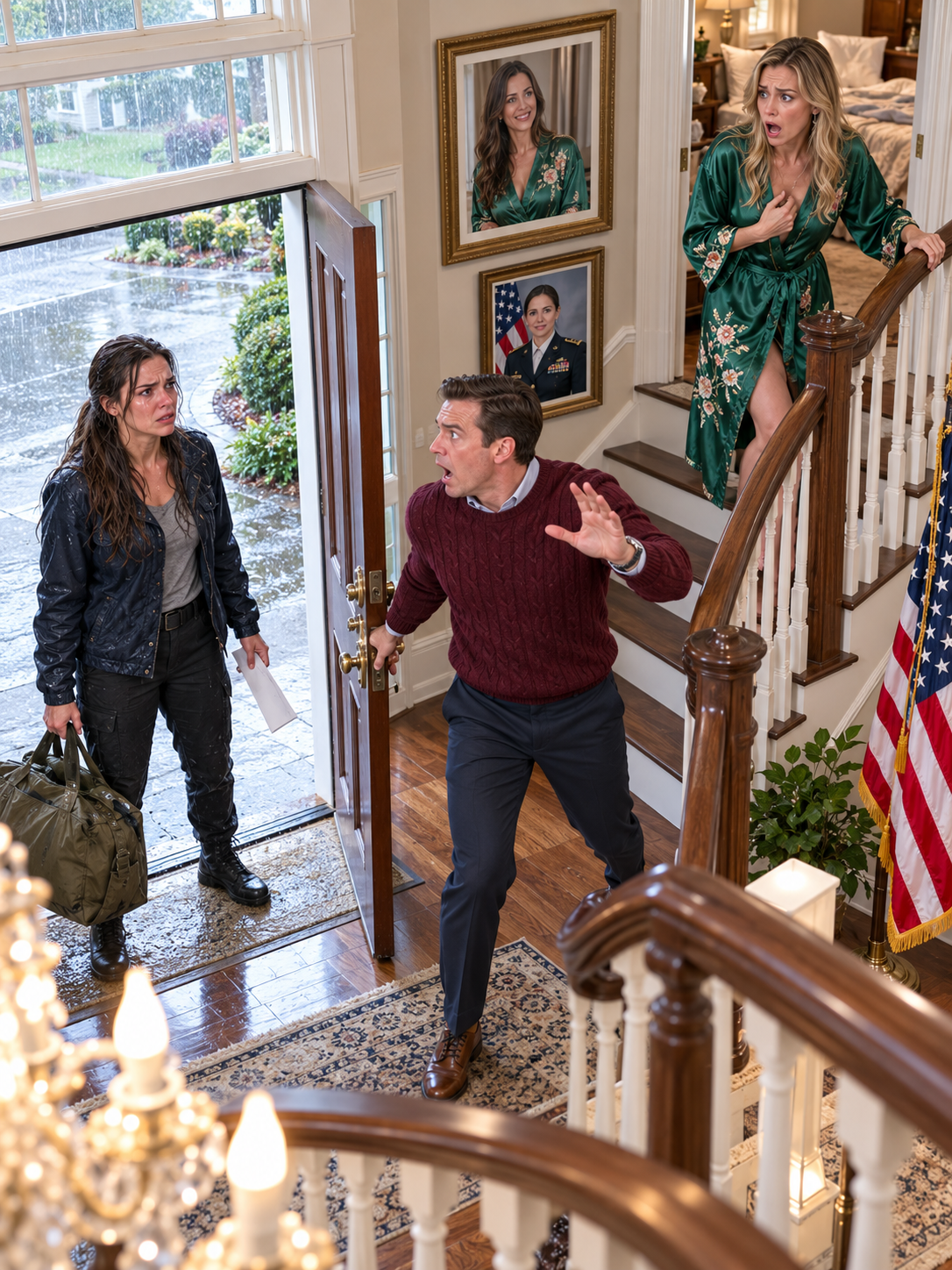
For 3 years, I survived a military prison by believing my husband was waiting for me and my best friend was fighting to clear my name. Then my conviction was overturned, and I came home without warning, soaked from the rain and desperate to see the people I loved. My husband opened the door wearing the sweater I had given him, while my best friend walked out of my bedroom wearing something that belonged to me. They thought prison had destroyed me. They had no idea I already knew enough to destroy every lie they had built.
### Part 1
The rain was coming down so hard that I could barely see the house from the end of the driveway, yet I recognized every line of it immediately—the white columns, the wide porch, the maple tree Ethan and I had planted after our first anniversary. Three years had passed since I had stood there as a free woman, and as the taxi disappeared behind me, all I could think was that I was finally home.
My name is Rachel Mercer, and at twenty-eight years old, I had already spent more than a thousand days inside a military correctional facility for a crime I did not commit. Forty-eight hours earlier, an appellate military court had vacated my conviction after new forensic evidence proved that someone had manipulated the digital trail used to send me to prison, but Ethan did not know that yet.
I had asked my attorney to keep my release confidential for as long as legally possible because I wanted one thing before the calls, paperwork, hearings, and public apologies began. I wanted to open my own front door, look into my husband’s face, and find out whether the man whose letters had kept me alive still loved me.
I climbed the porch steps with one duffel bag hanging from my shoulder, rainwater running down the collar of my jacket and into my shirt. My old key was already between my fingers when the lock clicked from the other side.
The door opened, and Ethan stood there holding a glass of red wine.
For one beautiful, stupid second, I forgot everything that had happened to me. He was wearing the charcoal sweater I had bought him during our last Christmas together, and his hair was slightly longer, but he was still the man whose photograph I had kept folded inside my locker for three years.
Then I saw his face.
The smile vanished so quickly that it was almost violent, and the hand holding the wineglass jerked hard enough to spill a red streak across his fingers. “Rachel?”
I waited for him to grab me, kiss me, cry, do anything a husband might do after seeing his wrongfully imprisoned wife standing alive on his porch. Instead, he stepped backward and whispered, “What are you doing here?”
The question hit harder than any prison door ever had.
“My conviction was overturned,” I said, watching every muscle in his face. “I’m free.”
His mouth opened, but nothing came out.
“Aren’t you happy to see me?”
“Of course I am.” He said it too quickly, setting his glass onto the narrow table by the door while his eyes flicked past me toward the driveway. “I just wasn’t told anything. Rachel, this is a shock.”
I stepped into the foyer before he could stop me, bringing the cold smell of rain inside with me. The house still smelled faintly of cedar from the built-in cabinets Ethan and I had installed ourselves, but underneath it was a floral perfume I didn’t recognize.
Then I heard heels on the hardwood.
“Ethan, honey, who’s at the door?”
I knew that voice before the woman appeared.
Vanessa Hale had been my best friend since college, the woman who had stood beside me at my wedding, brought soup when I was sick, knew where I kept my spare key, and cried so hard at my sentencing that a courtroom officer had brought her tissues. She came around the hallway corner fastening the belt of a pale silk robe.
My silk robe.
Vanessa stopped.
Her lips parted, and her face turned the color of printer paper.
None of us moved.
I heard the refrigerator humming in the kitchen, rain striking the windows, and the tiny nervous clink of Ethan’s wedding ring against the edge of the table as his hand started trembling. After three years of wondering why his letters had stopped, I finally had an answer standing barefoot in my hallway.
“Rachel,” Vanessa whispered.
I looked from her to Ethan, then at the framed photographs on the foyer wall. Our wedding pictures were gone, replaced by photographs of Ethan and Vanessa smiling at beaches, restaurants, and a mountain cabin I didn’t recognize.
Something inside me went very still.
“When?” I asked.
Ethan rubbed both hands across his face. “It’s complicated.”
“It usually is when your wife comes home from prison and finds her best friend in her bedroom.”
Vanessa’s expression tightened. “Don’t do this.”
I almost laughed.
“Don’t do what?”
“Walk in here acting like we’ve spent three years celebrating what happened to you,” she said, recovering enough to pull the robe more tightly around herself. “You disappeared, Rachel. There were lawyers, investigators, reporters, bills, everything falling apart, and Ethan was alone.”
“I didn’t disappear.”
My voice was quiet enough that she stopped.
“I was locked inside a cell.”
Ethan stepped between us. “Nobody planned for this.”
That sentence mattered more than he knew.
Because I had spent the previous forty-eight hours sitting in a hotel room with my new attorney, Daniel Cross, staring at bank transfers, property records, computer logs, and documents bearing signatures that were technically mine but obtained under circumstances I now understood very differently. I had not come to the house simply because I missed my husband.
I had come because Daniel had asked me a question that morning.
“If they believe you’re still incarcerated, how comfortable do you think they’ll be?”
Comfortable people made mistakes.
So I had told him to stay ten minutes away.
I walked slowly into the living room, and that was when I truly understood how completely they had removed me. My grandmother’s blue armchair was gone, the shelves Ethan and I filled with travel photographs had been replaced with minimalist decorations, and even the old rug my mother had helped me choose had disappeared.
Vanessa’s taste was everywhere.
“You redecorated,” I said.
Ethan followed me. “Rachel, please sit down.”
“I’ve been sitting down for three years.”
His jaw tightened.
Vanessa walked into the room behind him, and for the first time I noticed something else—a thin gold bracelet on her wrist that had belonged to me. My parents had given it to me when I graduated from officer training.
I stared at it.
She instinctively covered it with her other hand.
That tiny movement answered another question.
I had spent years believing the case against me had been an unimaginable bureaucratic disaster, but Daniel and I had recently uncovered evidence showing that my secure credentials had been used from my residential network while I was away on mandatory training weekends. Someone had accessed my personal laptop, duplicated authorization files, and carefully built a digital trail designed to look like mine.
Only a handful of people had regularly been inside this house.
Two of them were now standing in front of me.
Ethan suddenly straightened. “You shouldn’t be here.”
I turned toward him.
“This property isn’t yours anymore,” he continued. “You signed power of attorney before sentencing, and the house was legally transferred afterward. Whatever happened with your conviction doesn’t automatically change that.”
I felt the last fragile memory of the man I had married collapse.
He wasn’t surprised that I knew about the house.
He was prepared to defend taking it.
Vanessa stepped beside him. “You need to leave before this becomes ugly.”
I reached into my coat.
Both of them tensed.
I pulled out my phone.
Ethan gave a humorless laugh. “Who are you calling?”
I tapped one number, then raised the phone to my ear.
Daniel answered before the second ring.
“I’m here,” he said.
I looked directly at Ethan and Vanessa.
They still thought I had come home as a frightened former prisoner with a duffel bag and nowhere else to go.
They did not know that my conviction was only the first thing we had overturned.
“Daniel,” I said quietly.
Ethan’s face changed when he heard the confidence in my voice.
“Your time is up.”
And for the first time since I stepped through the door, Vanessa looked genuinely afraid.
### Part 2
Three years earlier, I had been twenty-five years old and a captain assigned to a regional military intelligence command, working with sensitive logistics systems that required the sort of meticulous attention most people found unbearable. I loved it—the sealed rooms, the checklists, the double authentication procedures, even the quiet hum of servers behind locked doors—because everything had rules and every action left a record.
Outside work, my life looked almost embarrassingly perfect. Ethan and I had been married for two years, Vanessa lived fifteen minutes away and came over constantly, and on Friday nights the three of us often crowded around our kitchen island eating takeout while I complained about harmless office politics without ever discussing classified work.
Vanessa used to tease me for being paranoid about my laptop. “You act like the country will collapse if somebody touches that thing,” she once said, laughing as I locked it inside my home-office cabinet before dinner.
“Maybe not the country,” I answered, “but definitely my career.”
I remembered that conversation later.
The morning my life collapsed began with burnt coffee.
I was sitting at my desk reviewing ordinary logistics reports when two investigators entered the secure office with expressions that immediately made everyone around me go quiet. One asked me to step away from my computer, while the other informed me that I was being detained in connection with the unauthorized transmission of restricted military logistics information.
I actually laughed.
“I’m sorry, what?”
Nobody smiled.
Within an hour my identification badge had been taken, my clearance suspended, and my wrists restrained while people who had worked beside me for years avoided meeting my eyes. The smell of burnt coffee followed me down the corridor because someone had left the break-room pot running, and absurdly, that detail remained sharper in my memory than the first accusation.
The evidence was devastating.
Encrypted files had been transmitted using credentials linked to me, portions of the digital trail appeared to originate from my personal laptop, and the authorization record carried a secure signature associated with my access profile. I sat through hours of questioning in a windowless room insisting there had to be an error while investigators calmly placed page after page of technical evidence in front of me.
My first call was to Ethan.
He sounded horrified.
“Rachel, listen to me,” he said. “We’re going to fix this.”
I cried so hard I could barely answer.
“Call Vanessa.”
“I already will. You’re not alone.”
For weeks, I believed him.
Vanessa visited whenever she was allowed, pressing her palm against the glass divider while promising she would help Ethan handle everything outside. Her eyes were red during nearly every visit, and I hated myself for worrying them.
The prosecutors, meanwhile, built a brutally simple story.
I had access.
The records pointed to me.
Financial pressure supposedly provided a motive.
That last part came from Vanessa.
When she testified during my court-martial, she wore a conservative navy dress and twisted a tissue between her fingers while describing an alleged conversation we had never had. According to her, I had once complained that my military pay would never give me the life I wanted and joked about how much valuable information passed across my desk.
I stared at her from the defense table in disbelief.
She refused to look at me.
“Vanessa,” I whispered when she stepped down.
She walked straight past.
My attorney objected to parts of her testimony, but the damage was already done because she wasn’t presented as an enemy. She was presented as my grieving best friend reluctantly telling an uncomfortable truth.
Ethan never testified against me directly.
He did something more useful to them.
During a visitation shortly before sentencing, he arrived carrying a folder and explained that my accounts and our house could become vulnerable to legal fees, liens, or administrative restrictions. He wanted temporary power of attorney so he could “protect us.”
I hesitated.
He put his hand against the glass.
“Do you trust me?”
That question haunted me for three years.
“With my life,” I said.
I signed.
Weeks later, I was convicted.
I remember standing while the sentence was read, staring past the judge toward Ethan and Vanessa because they were the only familiar faces in the room. Vanessa covered her mouth and cried against Ethan’s shoulder while he looked down at the floor.
I thought they were devastated.
Years later, Daniel would place photographs from that exact afternoon in front of me.
Less than four hours after I had been transported away, Ethan and Vanessa had eaten dinner together at an expensive restaurant.
The prison reduced life to routine almost immediately.
Wake up.
Inspection.
Meals.
Assigned work.
Count.
Lights out.
At first, Ethan’s letters saved me.
He wrote about the maple tree, neighborhood gossip, the squeaky kitchen cabinet I had always meant to repair, and how much he missed hearing me come through the garage after work. I slept with those letters folded beneath my mattress.
Then they became shorter.
One page became half a page.
Weekly became monthly.
Eventually nothing arrived.
I called whenever I could, but our home number stopped working and Ethan rarely answered his cell. When he did, his voice sounded distant and impatient, and once I heard a woman laughing somewhere behind him before the call abruptly ended.
I knew the laugh.
But I refused to recognize it.
The mind can become incredibly creative when the truth hurts more than a lie.
By my third year, I had stopped waiting beside the mail distribution cart.
I started spending those hours in the legal library instead.
Military appellate procedure led me into forensic evidence standards; forensic standards led me into metadata, remote-access logs, preservation requirements, and every technical weakness my original defense team had failed to challenge. The work gave structure to my anger.
Then Daniel Cross requested to meet me.
He had spent decades handling military defense and appellate cases before moving into private practice, and he carried himself like a man who had learned not to waste words. He sat across from me in the visitation room, placed a thick folder between us, and said, “Your evidence bothers me.”
“Why?”
“It’s too perfect.”
That was the first hopeful thing anyone had said to me in years.
Daniel had discovered that portions of the forensic data introduced at my trial were summaries rather than complete raw system logs. He petitioned for preserved backups from the regional network, records my original defense team had never obtained.
Months of filings followed.
Then one afternoon he arrived with a laptop.
“Rachel,” he said, turning the screen toward me, “you need to look at these timestamps.”
The restricted transfers attributed to me had been authenticated through my credentials, but several remote-access sessions began while I was physically away at field exercises documented by military attendance records. Even more important, the connection path repeatedly led back to my home internet network.
I stared at the screen until the numbers blurred.
Someone had been inside my house.
Someone had used my computer.
Someone close enough to know when I would be gone.
Daniel watched me understand.
“Who had access?”
I thought of Ethan.
Then Vanessa.
And finally the memory I had spent three years refusing to examine—the sound of a familiar woman’s laugh in the background of Ethan’s call.
“Two people,” I said.
Daniel closed the laptop.
“Then we find out what they gained.”
What he discovered next made the false conviction look less like the entire crime and more like the first move in something much larger.
### Part 3
Daniel began following the money while I remained behind the walls, which meant I experienced the destruction of my old life through photocopies laid across a metal visitation table. There is something uniquely brutal about seeing your marriage reduced to transaction dates, account numbers, signatures, and property filings.
Ethan had started moving money less than six weeks after my conviction.
At first the withdrawals were small enough to appear connected to household expenses and legal fees, but soon larger amounts left my personal savings and flowed into an account controlled by a newly created consulting company. Daniel circled the ownership information with a black pen before sliding the page toward me.
Ethan Mercer: fifty percent.
Vanessa Hale: fifty percent.
I read it three times.
“When was this formed?”
“Twenty-three days after sentencing.”
The room suddenly felt too warm.
Daniel produced another document.
Three months after I went to prison, Ethan had used the authority I granted him to transfer our house through a series of transactions that eventually left Vanessa listed as a co-owner. The sale price was dramatically below market value, and documents claimed circumstances that were now being challenged as fraudulent.
“They didn’t simply have an affair,” I said.
“No.”
“They dismantled me.”
Daniel’s expression did not change.
“That’s what it looks like.”
I thought about Vanessa’s courtroom tears.
I thought about Ethan asking whether I trusted him.
For a few minutes I wanted to throw every document across the room, but prison had taught me something useful: anger burned energy, while information created leverage.
“What do we need to prove?”
Daniel almost smiled.
That was when I stopped being only his client.
We worked like investigators.
I reconstructed my schedule from three years earlier, listing every field exercise, overnight duty assignment, and weekend Vanessa had been inside the house. Daniel compared those dates with preserved access logs and financial activity.
Patterns emerged.
One suspicious remote session occurred during a training weekend when Vanessa had offered to “check on Ethan because he seemed lonely.” Another occurred on the same night Ethan texted me that his laptop had malfunctioned and asked where I kept a backup drive.
At the time, neither question had seemed important.
Now they were fingerprints.
Daniel’s technical consultant eventually linked repeated access sessions to hardware identifiers associated with devices registered to Ethan’s home office. The process was complicated, but the conclusion was simple enough to make my stomach twist.
The frame had originated under my roof.
The military appellate court granted an evidentiary review.
My original conviction began collapsing quickly after that.
Prosecutors who had once described the digital trail as indisputable were suddenly forced to acknowledge that crucial remote-access evidence had not been properly examined. Additional records showed anomalies inconsistent with the theory presented at trial.
Then Daniel uncovered something neither of us expected.
One of the accounts associated with the stolen funds had paid a private technical contractor several times before my arrest.
The payments were disguised as routine consulting expenses.
Daniel traced them to a man who had previously done networking work for Ethan’s employer.
“We don’t have to guess anymore,” he told me during our final prison meeting. “We’re building corroboration.”
The contractor eventually agreed to cooperate after investigators confronted him with financial records.
He admitted he had been asked to configure remote-access tools on a private computer under the explanation that Ethan needed to help his wife manage work-related material from home. He denied knowing the full purpose, but the installation dates aligned almost perfectly with the first manipulated records.
My appellate hearing happened behind closed doors.
I wore a plain uniform and sat beside Daniel while judges questioned forensic experts for hours. No dramatic speech cleared my name; it happened through technical contradictions, chain-of-custody failures, authenticated location records, and evidence showing that the government’s original theory could no longer stand.
When the ruling finally came, the presiding judge looked directly at me.
“The conviction is vacated.”
Four words.
I had imagined hearing them for more than a thousand nights.
I expected to cry.
Instead, I felt strangely empty.
The military liaison apologized for what he called a catastrophic investigative failure and explained that administrative restoration of my rank, benefits, and record would begin immediately. Daniel requested that public notification be delayed within lawful limits because a separate criminal investigation was developing.
By then, investigators were interested in more than my wrongful conviction.
They were looking at fraudulent transfers, forged representations, obstruction, conspiracy, and the manipulation of military systems that had been used to frame me.
I walked out through the gates two days later carrying everything I owned in one bag.
No Ethan.
No Vanessa.
No cameras.
Only Daniel waiting beside a dark sedan.
“How does freedom feel?” he asked.
“Too quiet.”
“It gets louder.”
We spent the next two days in a hotel reviewing the case against them.
Several accounts had already been identified for emergency preservation, investigators had prepared applications for electronic searches, and Daniel was challenging the property transfer. We still needed certain procedural approvals before anything could happen openly.
“Do you want to see them?” he asked.
“Yes.”
“Why?”
I looked out the hotel window at people crossing the street with umbrellas, ordinary people irritated by ordinary rain.
“Because for three years they got to control the last moment of my old life,” I said. “I want to control the first moment of the new one.”
Daniel considered that.
“Don’t confront them alone.”
“You’ll be nearby.”
“I’ll be closer than nearby.”
That was how I ended up in the living room two nights later while Ethan threatened to call the police.
When I told him my conviction had been vacated, the confidence left his face in stages.
Vanessa grabbed the back of a chair.
“That’s impossible.”
“It happened forty-eight hours ago.”
Ethan stared at me. “Why weren’t we notified?”
The word we nearly made me laugh.
“Because neither of you is my family anymore.”
His eyes hardened.
“You can’t prove anything.”
That sentence told me everything.
An innocent man would have asked what I meant.
Ethan asked what I could prove.
I raised my phone.
“Daniel,” I said. “Your time is up.”
The call ended.
Ethan watched me put the phone away and suddenly seemed to realize that there might be people outside.
He moved toward the front window.
I stepped between him and the curtains.
“Don’t.”
“Rachel, what have you done?”
I looked at the man who had once promised to grow old beside me and felt no heartbreak anymore, only distance.
“Less than you did.”
A knock sounded at the front door.
Three slow, heavy strikes.
Vanessa started crying before anyone even entered.
Ethan whispered, “Please.”
It was the first sincere word he had spoken all night.
I opened the door.
Daniel stood beneath the porch light with a sealed packet in one hand.
Behind him were military investigators and local officers.
For three years, Ethan and Vanessa had lived comfortably because they believed the door had closed behind me forever.
Now the same door was standing wide open.
And the people waiting outside had warrants.
### Part 4
Daniel entered first, shaking rain from his umbrella before placing the sealed papers on the dining table, and the calm expression on his face terrified Ethan more than shouting ever could. Two investigators followed him, then a local detective and a technical evidence team carrying empty cases for computers, phones, storage devices, and networking equipment.
“Rachel,” Ethan said, backing away, “tell them there’s been a misunderstanding.”
I looked at him.
“That’s what I said three years ago.”
The lead investigator identified himself and explained the scope of the search warrant while another officer instructed Ethan and Vanessa not to interfere. Nobody slammed them against walls or created the dramatic chaos they probably expected; the process was controlled, methodical, and almost painfully polite.
That made it worse.
A technician unplugged the router from the office.
Another photographed the desktop computer before disconnecting it.
Vanessa watched each cable disappear into evidence bags like pieces of her future being removed one by one.
Daniel opened the legal packet.
“Emergency orders have been entered preserving and restricting several financial accounts linked to disputed assets,” he explained. “There is also an active civil action challenging the transfer of Captain Mercer’s property and funds.”
Ethan laughed nervously.
“Captain?”
I saw the exact moment he understood.
“My rank was restored.”
Vanessa sank into a dining chair.
Ethan looked at her as if this were somehow her fault.
Then he turned back to me. “Rachel, whatever you think happened, Vanessa had nothing to do with the computer.”
Her head snapped toward him.
I almost admired the speed of the betrayal.
“Ethan.”
“Be quiet, Vanessa.”
“You said we weren’t saying anything.”
“We aren’t.”
“You just did.”
Daniel and I exchanged one glance.
Three years of partnership between them had survived less than ten minutes of consequences.
The lead investigator requested Ethan’s phone.
Ethan hesitated.
“Do I need a lawyer?”
“That would be your decision.”
He surrendered the device.
Vanessa was asked for hers next, and her trembling hands nearly dropped it.
As technicians searched the house, Daniel placed several documents in front of Ethan.
One showed remote-access timestamps.
Another documented the contractor payments.
The third contained financial transfers from accounts that had once belonged to me.
“Do these look familiar?” Daniel asked.
Ethan stared at them.
“I want counsel.”
“Good choice.”
Vanessa started sobbing harder.
“I didn’t know everything,” she blurted.
Ethan spun around.
“Vanessa, stop talking.”
“I didn’t!”
Her face was blotchy and wet now, nothing like the carefully composed woman who had warned me fifteen minutes earlier that nobody would believe a disgraced prisoner.
“I knew he was moving the money,” she told the investigators, words tumbling out faster as panic took over. “But he said the conviction was real, and he said Rachel was never getting out.”
I felt something colder than anger.
“You testified against me.”
She looked at me.
“Rachel, I was scared.”
“You invented a conversation.”
“Ethan told me the prosecutors already had everything they needed.”
“So you gave them more.”
“I didn’t know they would sentence you like that.”
The excuse was so insulting that I almost interrupted her, but Daniel touched my arm lightly.
Let her talk.
Vanessa looked toward the investigators as if searching for the face most likely to rescue her.
“I can explain the accounts.”
Ethan swore under his breath.
That did it.
Their united front shattered completely.
Vanessa accused Ethan of designing the financial plan.
Ethan accused Vanessa of pushing him to move faster because she was afraid I would win an appeal.
Within minutes, the two people who had coordinated their lies against me were trying to place each other beneath the falling debris.
I watched without satisfaction.
For years, I had fantasized about a moment when the truth would hurt them the way their lies had hurt me, but revenge looked smaller in person than it had inside my cell. They were not brilliant villains anymore.
They were frightened people who had gambled my life for money and each other.
An investigator came downstairs carrying a labeled evidence bag.
Inside was an old external storage drive.
He spoke quietly to the lead investigator, who looked toward Ethan.
“Mr. Mercer, we need you to step over here.”
Ethan’s face collapsed.
“What is that?” Vanessa asked.
Nobody answered her.
The drive had apparently been found inside a locked cabinet in Ethan’s office.
I knew it immediately.
It was mine.
The same model I had once used for ordinary personal backups before my arrest.
Ethan saw recognition on my face.
“Rachel, I can explain.”
“No.”
I had waited three years for explanations.
I didn’t need them anymore.
The investigators formally detained both of them shortly afterward as part of the continuing criminal investigation. Ethan demanded an attorney while Vanessa cried and repeatedly asked whether cooperation would help her.
When restraints were placed around Ethan’s wrists, he finally looked at me.
Not at Daniel.
Not at the investigators.
Me.
“I loved you.”
The sentence landed between us almost gently.
I walked closer.
“You loved what belonging to me gave you.”
His eyes filled.
“That’s not fair.”
I nearly smiled.
“Fair?”
He looked away.
Vanessa was escorted through the foyer behind him wearing ordinary clothes she had been allowed to change into, her wet hair pulled back and her face stripped of makeup. She stopped beside me.
“Rachel, please.”
I said nothing.
“We were best friends.”
“Were.”
Her mouth trembled.
“I am sorry.”
“So was I.”
She misunderstood for half a second.
Then I finished.
“I was sorry I trusted you.”
The officers walked them outside.
I followed as far as the porch.
Rain hammered the driveway, turning the flashing emergency lights into streaks of red and blue across the wet pavement. Ethan and Vanessa were placed in separate vehicles, and neither looked at the other.
That seemed appropriate.
Daniel stood beside me until the last car disappeared.
“You okay?”
I inhaled slowly.
The air smelled like wet earth and maple leaves.
“No.”
He nodded.
It was the right answer.
“But I think I will be.”
The criminal cases took months, not minutes.
Evidence recovered from the house strengthened what investigators already knew, and additional forensic analysis connected Ethan’s devices to unauthorized access activity tied to my original case. Financial records documented the movement of my assets, while Vanessa’s false statements and participation created problems of her own.
Their attorneys eventually negotiated separate outcomes rather than risk everything at trial.
Ethan received a substantial prison sentence after pleading guilty to multiple serious offenses connected to the digital scheme, fraud, and obstruction. Vanessa also received a custodial sentence after admitting her role in financial fraud and false testimony, and the deal required cooperation regarding how the original setup had been planned.
I attended the final sentencing hearing.
Ethan looked older.
Vanessa looked smaller.
Neither looked powerful.
Before she was led away, Vanessa turned toward me and mouthed, “I’m sorry.”
I felt nothing.
Not triumph.
Not love.
Not grief.
Just an ending.
Outside the courthouse, Daniel asked whether I wanted coffee.
“I want my house back.”
He smiled.
“Then let’s finish it.”
The criminal case had punished them.
The next battle was about reclaiming what they had stolen.
And I was about to make one decision that surprised almost everyone—including the military that was preparing to welcome me home.
### Part 5
The deed to my house was restored several months later after the disputed transfer was invalidated, and the financial proceedings returned the substantial majority of my stolen money while additional restitution orders covered what remained. I walked through the front door holding the new paperwork, expecting to feel victorious, but the rooms seemed filled with people who were no longer there.
I stood in the master bedroom where Vanessa had appeared in my robe that rainy night.
Then I walked back downstairs and called a moving company.
Everything Ethan and Vanessa had purchased went out.
Furniture with no connection to my old life was sold or donated, the cold artwork disappeared from the walls, and I packed the few remaining objects that still mattered to me. My grandmother’s missing bracelet was eventually recovered from Vanessa’s possessions and returned in a small evidence envelope.
I held it in my palm for a long time.
Then I put it inside a drawer.
Some things could be recovered without needing to be worn again.
The military restoration process moved more quickly than I expected.
My record was formally corrected, my rank restored, and back pay associated with the years I had lost was approved. Senior officers personally acknowledged that the original investigation had failed to examine critical evidence, and I was offered the opportunity to return to active service with a path toward promotion.
Three years earlier, I would have considered that everything I wanted.
I sat at my kitchen table reading the reinstatement packet while morning light stretched across the floor.
For the first time, I realized I did not want my old life back.
Not because the military uniform meant less to me.
It meant too much.
I had entered service believing systems built on discipline and evidence could always correct human weakness if good people followed the rules. My experience had shown me how dangerous that assumption could become when investigators trusted a neat story more than uncomfortable questions.
So I declined active reinstatement.
The colonel handling my case called personally.
“You earned the right to come back, Captain Mercer.”
“I know.”
“We can make room for you.”
“I appreciate that.”
“Then why leave?”
I looked at the boxes stacked around my living room.
“Because spending the rest of my life rebuilding the woman who existed before prison would still let those three years control me.”
There was silence.
Then he said, “I understand.”
I don’t know whether he truly did, but it didn’t matter.
Daniel introduced me to specialists working in corporate security, internal fraud prevention, and digital-risk investigations. My intelligence background, combined with the legal and forensic knowledge I had taught myself in prison, turned out to be valuable in a way I had never anticipated.
At first, I consulted on small internal cases.
An employee manipulating access records.
A partner quietly diverting company funds.
Executives ignoring warning signs because accusing someone trusted felt harder than believing a convenient explanation.
I understood that last problem better than anyone.
Within two years, I had established my own consulting practice.
The irony wasn’t lost on me.
Ethan and Vanessa had tried to destroy my career using manipulated data, and I eventually built a new career helping people recognize exactly that kind of deception.
The house was another question.
Friends assumed I would keep it because fighting to recover it had required so much work, but one Saturday morning I sat on the porch beneath the maple tree and realized I was preserving a battlefield simply because I had won it.
So I sold it.
Not because they had ruined it.
Because I didn’t owe my future to any place where my past had happened.
I bought a smaller home near the coast, where mornings smelled like salt instead of wet pavement and nobody knew me as the woman from a military scandal. The first night there, I slept with my bedroom window cracked open and woke around dawn confused by the sound of waves.
For years I had awakened to doors, counts, footsteps, and keys.
That morning, nobody was checking whether I was still there.
I was simply free.
Ethan wrote to me once.
The envelope arrived through Daniel because I had refused all direct contact.
I considered throwing it away unopened.
Instead, I read it exactly one time.
He apologized.
He said greed had started small, that Vanessa had understood his resentment about my career, and that together they had convinced themselves my conviction would happen regardless of anything they did. He insisted he had loved me once and claimed there were nights during my imprisonment when guilt had nearly made him confess.
Nearly.
That word told me everything.
He asked whether someday, after enough years passed, I might forgive him.
I folded the letter.
Then I shredded it.
Forgiveness was not something he was entitled to request simply because consequences had finally reached him.
Vanessa sent no letter.
I heard through Daniel that she had provided extensive cooperation and eventually accepted responsibility for lying during my case. Perhaps she was genuinely sorry.
Perhaps prison had given her enough quiet to understand what she had done.
Either way, her understanding no longer belonged to me.
People sometimes believe refusing forgiveness means carrying hatred forever.
I discovered the opposite.
I stopped hating Ethan and Vanessa because hatred required attention, and they no longer deserved any meaningful space inside my life. I didn’t need to wish them pain, reconcile with them, hear another apology, or watch their sentences pass year by year.
I simply stopped looking backward.
Daniel remained my attorney and eventually became one of the few people I trusted without reservation, but there was never some convenient romance waiting to repair everything my marriage had damaged. He had a life of his own, and I needed to learn how to build mine without making another person responsible for holding it together.
That became the greatest difference between twenty-five-year-old Rachel and the woman I am now.
The old Rachel believed love meant handing someone the keys to every locked room inside her life.
The woman I became understands that trust should be generous but never blind.
Three years after I moved to the coast, I was invited to speak to a group of young investigators about confirmation bias and digital evidence. I stood behind the podium looking at rows of uniforms and civilian analysts and told them something I wished someone had remembered during my original investigation.
“Perfect evidence should make you more curious, not less.”
The room went completely silent.
“A clean story is not necessarily a true story. Sometimes the reason every piece fits is because somebody cut the pieces themselves.”
Afterward, a young officer approached and asked whether I missed serving.
“Sometimes,” I admitted.
“Do you regret leaving?”
I thought about the prison cell.
The rainy porch.
Ethan dropping his phone.
Vanessa wearing my bracelet.
Daniel turning the laptop toward me and showing me the timestamps that gave my life back.
“No.”
That evening I drove home with the windows down.
The sun was dropping toward the water, turning the surface of the ocean bright and silver, and when I reached my neighborhood I parked several blocks away just because I wanted to walk.
There was no one waiting inside my house.
For once, that didn’t feel lonely.
It felt peaceful.
I made coffee, opened the back doors, and carried my cup onto the porch while the wind moved through the beach grass. Somewhere beyond the dunes, waves struck the shore with the same patient rhythm they had followed long before I arrived and would continue long after every terrible thing that happened to me became nothing more than memory.
Ethan and Vanessa had wanted my house.
They took it.
They wanted my savings.
They spent them.
They wanted my marriage, my reputation, my career, and even my name to become things people whispered about with disgust.
For three years, I believed they had succeeded.
But the truth was that the most valuable part of my life had never been stored in a bank account, written on a deed, attached to a military rank, or protected by a wedding ring.
It was the part of me that refused to accept a lie merely because everyone else had decided it was convenient.
They stole three years.
I made sure they didn’t get a fourth.
And I never forgave them.
I simply built a life so completely my own that eventually, neither of them mattered anymore.
THE END!
Disclaimer: Our stories are inspired by real-life events but are carefully rewritten for entertainment. Any resemblance to actual people or situations is purely coincidental.