For three years, my family believed I spent my days behind a desk moving supplies around a Nevada air base, while my younger brother was celebrated as the fearless pilot carrying on our father’s legacy. I never corrected them, even when he mocked my “paper-pushing” career in front of forty officers. Then he raised a champagne glass and bragged that he could destroy the mysterious aggressor pilot known as Phantom Ghost in seconds. I already knew exactly how wrong he was—because I had shot him down that morning.
### Part 1
My name is Claire Halston, and I learned a long time ago that the loudest person in a room is rarely the most dangerous one.
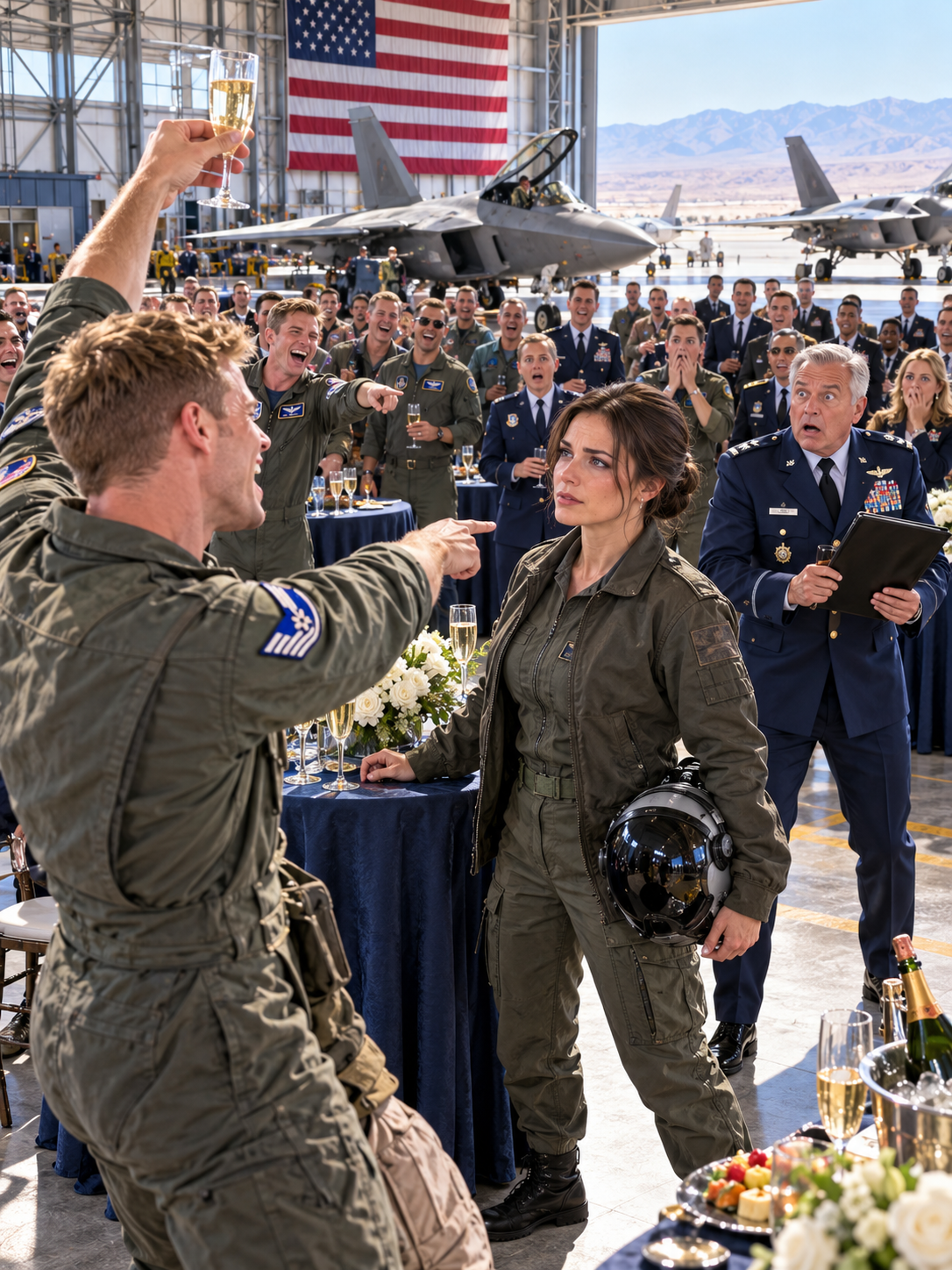
That lesson was difficult to remember while my younger brother Ethan stood beneath the white lights of the officers’ banquet hall at Falcon Ridge Air Base, holding a champagne flute above his head as forty pilots cheered his name. The room smelled like grilled steak, cigar smoke, floor polish, and the faint metallic desert dust that came through the doors whenever someone stepped outside, while I sat near the far end of a long table in charcoal slacks and a plain navy blazer, turning a glass of ice water slowly between my palms.
“To the newest strike pilot in the Halston family,” one of Ethan’s squadron friends shouted, and another officer answered, “Just like his old man.”
Ethan loved that.
Our father, Richard Halston, had spent twenty-two years flying military aircraft before retiring, and growing up in our house meant hearing cockpit stories the way other families heard bedtime stories. Dad framed photographs of himself beside jets in the hallway, kept an old flight helmet in a glass cabinet, and taught Ethan and me before we were teenagers that hesitation was dangerous, preparation was sacred, and the Halston name meant something in the air.
The problem was that somewhere along the way, Dad had decided Ethan was the heir to that legacy.
I had joined the Air Force first, but my assignments were never discussed much because the details I could share sounded painfully ordinary. Whenever relatives asked what I did in Nevada, I told them I worked in operational support and logistics coordination, which was technically true in the same way saying a surgeon worked with paperwork would be technically true.
Security rules required understatement.
My family interpreted understatement as insignificance.
At Thanksgiving, Dad would spend ninety minutes asking Ethan about formation training, flight hours, simulator scores, instructors, and aircraft handling before turning to me and saying, “Everything running smoothly with the inventory systems, Claire?”
I would answer, “Yes, Dad.”
Then Ethan would smirk.
Eight years of that had made silence feel like another uniform.
That Friday evening, Ethan had just officially joined a frontline strike squadron after completing advanced training, and his celebration was packed with young officers who had spent months hearing about the legendary Richard Halston and his equally talented son. Ethan stood near the head of the table with his service coat open at the collar, soaking up attention like sunlight, while I remained exactly where I preferred to be—watching.
Eventually, he noticed me.
He pointed the stem of his champagne flute in my direction. “Look at Claire over there. Three years in Nevada and she still dresses like she’s here to audit somebody.”
Laughter rolled through the table.
I smiled faintly and lifted my water.
Ethan continued, “Don’t get me wrong, sis. We appreciate you making sure the right equipment ends up in the right warehouse, but some of us actually have to pull Gs for a living.”
A captain beside him laughed into his beer.
Someone farther down the table muttered, “Cold.”
Ethan grinned wider because he thought he had won something.
What none of them knew was that my ribs were still sore from the high-G maneuvering I had pulled before sunrise that morning.
I had been awake since 4:10 a.m.
By 6:30, I had been strapped into a cockpit over the Nevada desert, breathing controlled bursts through an oxygen mask while four blue-force aircraft attempted to hunt me across restricted airspace.
One of those aircraft had belonged to Ethan.
He simply didn’t know it yet.
I had recognized his tail number immediately when the exercise package arrived on my encrypted tablet two days earlier, and I had considered removing myself from the engagement. Professional standards allowed me to request another instructor, but after reviewing his training notes, I decided there was no conflict because Ethan had no idea who I was and therefore could not alter his behavior around me.
His flying that morning had confirmed my decision.
He had been aggressive.
Fast.
Technically gifted.
And dangerously impatient.
Now, eight hours later, he leaned against the banquet table and said, “Speaking of people who are actually flying, who here has heard about Phantom Ghost?”
The laughter changed.
Several officers exchanged glances.
A younger lieutenant stopped smiling.
I took another sip of water.
Ethan noticed the reaction and enjoyed it. “Come on, don’t tell me you guys actually believe the stories.”
Everybody stationed around Falcon Ridge had heard them.
Over the previous year, a classified aggressor instructor operating during high-level combat exercises had developed a reputation for dismantling entire formations with unnerving efficiency. Trainees were not given the instructor’s identity, background, age, hometown, or even gender, because the point was to face an unpredictable adversary rather than study a recognizable personality.
The only thing most crews knew was the call sign.
Phantom Ghost.
Three frontline formations had been eliminated during one simulated engagement the previous month.
Another squadron had lost six aircraft in under nine minutes.
That was how rumors started.
Some pilots insisted Phantom Ghost was a former combat ace brought back under a classified contract.
Others claimed there were actually three pilots rotating under one identity.
Ethan believed neither.
He planted one hand against the table. “Phantom Ghost is command’s favorite bedtime story. Scare the new pilots, bruise a few egos, make everybody respect the aggressor program.”
One officer said carefully, “The telemetry from last month looked pretty real.”
Ethan laughed. “Telemetry doesn’t make somebody unbeatable.”
“No,” I said quietly.
He looked toward me.
For the first time that night, our eyes met directly.
“Discipline does,” I finished.
The table went briefly quiet.
Then Ethan chuckled as though his older sister had made an adorable attempt to participate in a conversation she couldn’t understand.
“Claire,” he said, “with all due respect, you arrange equipment.”
I lowered my glass.
He leaned forward. “You don’t know what happens when two fighters meet at twenty thousand feet.”
I almost smiled.
He continued, louder now because he had regained his audience. “Put me against Phantom Ghost tomorrow. Clear sky, twenty thousand feet, equal starting energy, and I’ll have a weapons-quality solution before Ghost even realizes I’m there.”
Several officers shifted uncomfortably.
Ethan raised his champagne flute.
“No one outflies me,” he declared. “Not even a ghost.”
The doors behind him opened.
A gust of hot desert air rolled through the banquet hall, stirring napkins and cutting a temporary path through the cigar smoke.
Then every officer in the room stopped moving.
Brigadier General Marcus Keene had entered.
He commanded the entire combat readiness wing.
Silver-haired, broad-shouldered, and famous for speaking only when he had something worth saying, General Keene had the kind of presence that emptied noise from rooms without effort.
Forty chairs scraped backward at once.
Ethan nearly knocked his flute against the table in his hurry to straighten his uniform.
“Attention!”
General Keene waved them down. “At ease.”
Ethan’s face brightened.
I knew exactly what he was thinking.
The general had arrived during his celebration, which in Ethan’s mind could only mean one thing.
Recognition.
He stepped into the aisle and extended his hand with a polished smile. “General Keene, sir. Captain Ethan Halston. It’s an honor to have you here.”
General Keene walked past him.
He did not shake Ethan’s hand.
He barely seemed to see him.
The silence became uncomfortable enough that I could hear the refrigeration unit behind the bar humming.
General Keene crossed the entire room.
Straight toward me.
I set my water glass down.
His shoes stopped exactly two paces from my chair.
Then the brigadier general snapped to attention and raised his right hand in a razor-sharp salute.
“Lieutenant Colonel Halston,” he said. “I need your debrief from this morning’s sortie before the range review.”
Somewhere behind him, glass slipped from Ethan’s hand.
His champagne flute hit the hardwood floor and shattered.
And as forty pilots stared at me in stunned silence, I realized my brother was about to discover that Phantom Ghost had been sitting across from him all evening.
### Part 2
For several seconds after Ethan’s glass shattered, nobody reacted.
Champagne spread beneath his polished shoes in a glittering puddle, tiny pieces of crystal catching the overhead lights, while General Keene continued holding his salute and every officer in the hall stared between us as though one of reality’s basic rules had suddenly changed. I pushed my chair back, stood, straightened my blazer, and returned the salute with the automatic precision of thousands of repetitions.
“Good evening, General.”
“At ease, Colonel.”
“Sir.”
General Keene lowered his hand.
I did the same.
Behind him, Ethan whispered, “Colonel?”
Nobody answered him.
General Keene glanced toward the tactical folio beside my chair. “Operations wants your assessment before tomorrow’s training package is finalized. We also need to discuss the performance deficiencies you identified in Blue Flight.”
“Yes, sir.”
Ethan took one step forward. “General, excuse me.”
Keene slowly turned.
My brother’s face looked completely different from the one that had been laughing five minutes earlier. His skin had gone pale, his mouth was slightly open, and for the first time since he received his pilot wings, Ethan looked unsure of where to put his hands.
“Sir,” he said, “there must be some misunderstanding. Claire works at the administrative annex.”
The silence sharpened.
General Keene stared at him. “Captain Halston, I strongly recommend that your next sentence be more carefully considered than your last one.”
Ethan swallowed.
I could feel forty sets of eyes pressing into my back.
Keene continued, “Lieutenant Colonel Claire Halston has more than twenty-four hundred tactical flight hours, commands an aggressor training element, and has personally instructed pilots from multiple combat wings in advanced threat replication.”
The young lieutenant who had warned Ethan about the telemetry slowly looked toward him.
General Keene’s jaw tightened. “She has evaluated some of the most experienced aviators in this command, and when she speaks about discipline in tactical aviation, you would be wise to listen.”
Ethan looked at me.
I had seen him shocked before.
I had never seen him completely emptied of an answer.
“You fly?” he asked.
“Yes.”
His eyes narrowed as though he could force the pieces into a different picture. “Since when?”
“Long enough.”
“But Dad said—”
“Your father,” General Keene interrupted, “does not have clearance to receive Lieutenant Colonel Halston’s operational assignment.”
That sentence hit Ethan even harder.
It explained everything without explaining nearly enough.
One of his squadron mates stared at me. “Ma’am, are you attached to the aggressor cadre?”
General Keene looked at me rather than answering.
The identity issue remained restricted inside training channels, but the pilots in that room had all recently received authorization for the exercise package.
I crouched, unzipped my olive tactical folio, and removed a black flight-log binder.
Then I placed a fabric patch beside it.
The patch was dark gray and black, intentionally plain except for the outline of a smoke-shrouded eagle and two words embroidered beneath it.
PHANTOM GHOST.
Nobody laughed.
Ethan stared at the patch.
Then at me.
Then back at the patch.
“No,” he whispered.
One pilot breathed, “Oh, man.”
Ethan’s expression tightened. “That call sign belongs to—”
“Me,” I said.
His face changed again.
The humiliation came first.
Then disbelief.
Then memory.
He had spent twenty minutes boasting about defeating me while I sat ten yards away.
Worse, he had mocked the exact profession he desperately wanted respect from.
General Keene nodded toward the front of the room. “Since we already have most of Blue Flight present, we might as well conduct the debrief here.”
That was the moment Ethan’s embarrassment became something else.
Fear.
I recognized it because I had seen the same expression through cockpit cameras when young pilots realized their mistakes were about to be replayed frame by frame.
I walked toward the podium.
The room followed without being told.
A projector came alive above us, washing the screen in pale blue light while officers moved chairs into rows. The celebration had vanished so completely that the broken glass remained untouched behind them.
I connected my encrypted system.
A range map appeared.
Red tracks.
Blue tracks.
Altitude markers.
Time stamps.
Ethan sat in the second row.
He looked like he wanted to disappear.
“This morning’s exercise began at 0630,” I said. “Four blue-force aircraft entered the western corridor in an offensive spread against two aggressor aircraft.”
Nobody moved.
I advanced the recording.
Four blue tracks appeared on the screen.
“Blue Flight’s mission was not to destroy every adversary immediately. Your mission was to protect the strike corridor, maintain mutual support, identify threats, and preserve sufficient energy to react.”
One blue track accelerated ahead.
Ethan recognized it before I said anything.
His jaw tightened.
“Viper One separated from supporting radar coverage thirty-eight seconds after first contact.”
I froze the playback.
“Captain Halston.”
His head lifted.
“What was your reasoning here?”
The question was professional.
That made it worse.
He stared at the screen. “I believed I had a valid intercept opportunity.”
“You believed?”
“Yes, ma’am.”
“What did your instruments show?”
He hesitated.
“Partial contact.”
“And your wingman?”
“Still building track.”
“So you had incomplete information.”
“Yes, ma’am.”
“Yet you accelerated anyway.”
“Yes.”
I resumed the playback.
His aircraft surged forward.
A few officers leaned toward the screen.
“Viper One then committed into a hard climb, attempting to force positional advantage.”
Ethan’s blue vector curled upward.
The red track representing my aircraft barely moved.
“You traded nearly two hundred knots of usable energy for an angle you had not confirmed you needed,” I explained. “You also exposed your thermal signature and separated yourself from mutual support.”
A warning tone sounded through the speakers.
Ethan stared straight ahead.
Thirty-two miles from his aircraft, my red track shifted.
A simulated weapons cue appeared.
The screen flashed.
KILL CONFIRMED.
Time elapsed: forty-one seconds.
Someone inhaled sharply.
I paused the recording.
“Captain Halston was removed from the engagement before he completed his first offensive maneuver.”
The room remained silent.
Ethan rubbed one thumb against the edge of his chair.
I could have stopped there.
I didn’t.
Not because he was my brother.
Because he was my student.
“The problem was not lack of skill,” I said. “Captain Halston has excellent aircraft control.”
His eyes moved toward me.
“The problem was that he made a decision before the information supported it. Once committed, he continued because reversing course would have felt like admitting uncertainty.”
Several pilots looked down.
They knew that temptation.
I knew it too.
“Arrogance is not confidence,” I continued. “Confidence lets you wait. Arrogance tells you waiting makes you look weak.”
Ethan’s face turned red.
I advanced the simulation.
After his aircraft disappeared, the remaining three tightened their formation, communicated, adapted, and survived another six minutes.
One eventually scored a simulated kill against my wingman.
Another escaped the engagement entirely.
“They lasted because they stopped trying to look impressive and started trying to stay alive.”
General Keene crossed his arms.
Nobody spoke.
When the debrief ended, I shut down the system.
For a moment, there was only the low whir of the projector fan.
Then chairs began moving.
Pilots approached me one by one.
Some asked technical questions.
Others simply said, “Thank you, ma’am.”
Nobody approached Ethan.
He remained seated beneath the cold projector light, staring at his tail number frozen in the corner of the blank screen.
As I gathered my equipment, General Keene leaned closer. “You handled that correctly.”
“He needed the lesson.”
“So did half the room.”
I zipped my folio.
Then Keene’s expression changed.
“There’s one more issue.”
I looked at him.
He lowered his voice. “Your father called headquarters this afternoon.”
My hands stopped moving.
“Why?”
“He was asking questions about your assignment.”
That made no sense.
Dad had never cared enough to ask.
General Keene watched my face carefully. “Apparently Captain Halston told him something two days ago about proving he was the best pilot in the family.”
I turned toward Ethan.
He was already watching me.
And suddenly I understood that tonight’s humiliation had not begun in this banquet hall.
It had begun at home years earlier.
### Part 3
Ethan followed me outside twenty minutes later.
The Nevada night had cooled quickly, and the dry wind carried the smell of aviation fuel, dust, and hot metal from the flight line. Maintenance crews moved beneath white floodlights around parked aircraft while distant auxiliary generators produced a steady mechanical hum, and I walked toward the operations building with my folio tucked beneath one arm.
“Claire.”
I kept walking.
“Claire, wait.”
I stopped near a painted safety line.
Ethan approached more slowly than usual.
His collar was crooked now.
The perfect officer from the banquet had disappeared.
“Why didn’t you tell me?” he asked.
I studied him.
There were a dozen possible answers.
Most of them would only protect him from the real one.
“Because you never asked.”
He frowned. “That’s not fair.”
“No?”
“For eight years, I thought you worked support.”
“You thought I worked support because that was convenient.”
His expression tightened. “You literally told us you worked logistics.”
“I told you I worked operational support and logistics coordination. I also told you there were parts of my assignment I couldn’t discuss.”
“You knew what Dad thought.”
“Yes.”
“You knew what I thought.”
“Yes.”
“And you just let us keep believing it?”
I shifted my folio beneath my arm. “What exactly was I supposed to do, Ethan? Violate security restrictions because Thanksgiving dinner made me uncomfortable?”
“That’s not what I mean.”
“Then what do you mean?”
He looked toward the runway.
A pair of ground vehicles moved slowly in the distance, amber lights rotating across the concrete.
Finally, he said, “Dad treated you like you didn’t matter.”
The sentence surprised me.
Not because it was wrong.
Because Ethan had never admitted noticing.
“He would spend hours talking to me,” Ethan continued. “Then he’d ask you about spreadsheets like you were somebody’s assistant.”
“Yes.”
“And you never corrected him.”
“No.”
His voice dropped. “Why?”
The wind tugged at his jacket.
I remembered one Christmas six years earlier when Dad had given Ethan an expensive aviation watch engraved with the family initials, then handed me a gift card because he said he “didn’t understand office stuff well enough” to choose something related to my work. I remembered smiling, thanking him, and leaving early because I had a classified mission planning call at 0500 the next morning.
“Because I stopped needing his approval,” I said.
Ethan looked at me.
“That easy?”
“It wasn’t easy.”
I leaned against the concrete barrier behind me.
“It took years.”
My brother said nothing.
“When I was twenty-seven, I got selected for advanced threat training,” I continued. “Dad was disappointed because he thought I’d chosen another staff assignment instead of applying for a more visible track.”
Ethan’s forehead creased.
“He told me I was wasting my potential.”
“I remember.”
“I had just completed the hardest evaluation of my career.”
That silenced him.
“I wanted to tell him,” I said. “I wanted to throw the orders on the table and watch his face change, but I couldn’t.”
“So you said nothing.”
“Yes.”
“And eventually you stopped wanting to tell him?”
“Eventually I realized that if someone only values you after discovering an impressive title, they never valued you. They valued the title.”
Ethan looked down.
The arrogance from earlier seemed very far away.
“I didn’t know.”
“You didn’t want to know.”
That one hurt him.
I could see it.
He took a slow breath. “You’re right.”
I hadn’t expected that either.
He rubbed his hands together against the cold. “I’ve spent my whole life trying to impress Dad.”
“I know.”
“When I got my wings, he cried.”
“I know.”
“When I got assigned here, he called everybody he knew.”
“I know.”
Ethan laughed once, bitterly. “And I loved it.”
“There’s nothing wrong with wanting your father to be proud.”
“No, but there’s something wrong with needing everybody else to be smaller so you can feel bigger.”
I said nothing.
That realization needed room.
He looked toward me. “I did that to you.”
“Yes.”
“I’m sorry.”
The apology hung between us.
It was sincere.
Sincerity mattered.
But it did not erase history.
“I accept that you mean it,” I said.
His eyes narrowed slightly. “That doesn’t sound like forgiveness.”
“It isn’t.”
The answer startled him.
I kept my voice calm.
“You embarrassed me at birthdays, family dinners, graduations, and tonight in front of forty officers. You called my career meaningless without ever bothering to learn what I could safely tell you.”
He looked down.
“You don’t get to discover that I outrank you and suddenly reset eight years of behavior.”
“I’m not asking to reset it.”
“Good.”
He nodded.
For once, Ethan did not argue.
The next morning, my phone rang at 6:12.
Dad.
I watched his name flash across the screen while I stood in my kitchen making coffee.
I almost ignored it.
Then I answered.
“Morning.”
“Claire.”
His tone was strange.
Too careful.
“I heard about last night.”
Of course he had.
I poured coffee into a steel travel mug. “I assumed you would.”
“Ethan said General Keene saluted you.”
“Yes.”
“He says you’re a lieutenant colonel.”
“Yes.”
A pause.
“He says you fly.”
I closed the coffee maker.
“Yes.”
“How long?”
“Years.”
Another pause.
“What aircraft?”
“I’m not discussing operational details over the phone.”
“I’m your father.”
“And I’m still not discussing them.”
His breathing changed.
Not anger.
Disorientation.
“You’re Phantom Ghost.”
I said nothing.
That was confirmation enough.
Dad exhaled.
“Claire, do you understand what that means?”
“Yes, Dad. I’ve been doing the job.”
“I mean to this family.”
That sentence irritated me more than I expected.
“What does it mean to the family?”
“You carried our legacy.”
“No.”
He went silent.
“I carried my career.”
“Claire—”
“I didn’t spend eight years building myself so the Halston family could claim another trophy.”
His voice hardened slightly. “That isn’t fair.”
I almost laughed.
He and Ethan had used the exact same words.
“Isn’t it?”
“I was proud of you.”
“You were proud of the version of me you invented because you never bothered asking about the real one.”
“I asked.”
“You asked whether my spreadsheets were organized.”
Silence.
The coffee smelled suddenly bitter.
Dad finally said, “Come to dinner Sunday.”
“Why?”
“Because we need to talk.”
“We’re talking now.”
“No. Your mother wants you home. Ethan will be there.”
I leaned against the counter.
“Dad, if this dinner is about celebrating Phantom Ghost, I’m not coming.”
“It isn’t.”
“What is it about?”
He hesitated too long.
That told me everything.
“Your old flight helmet is still in the display cabinet, isn’t it?” I asked.
“Yes.”
“And there’s an empty shelf beside Ethan’s graduation photo.”
Another silence.
My stomach tightened.
“You already cleared space for me.”
“Claire, I thought—”
“I know exactly what you thought.”
I ended the call.
Ten minutes later, Ethan texted me.
Dad is planning something. I told him not to.
A second message followed.
He won’t listen.
I stared at the words while the desert sunrise filled my kitchen with pale white light.
For years my father had treated me like the child who had failed to continue his legacy.
Now that he knew the truth, he wanted to turn my silence into another family monument.
And for the first time, I wondered whether revealing Phantom Ghost had changed Ethan more than it ever could change our father.
### Part 4
I went to Sunday dinner for one reason.
My mother asked me.
She had never participated in Dad’s comparisons as aggressively as he had, but she had rarely challenged them either, and her quietness had protected the family peace at my expense more times than I could count. Still, when she called Saturday afternoon and said, “Claire, I’m not asking you to pretend nothing happened, but I would like you here,” I agreed.
I arrived at 5:40.
Dad’s house looked exactly as it always had.
White siding.
Blue shutters.
A flag moving gently over the porch.
Through the front window, I could see the display cabinet that had dominated our living room since childhood.
Something new sat inside it.
I knew before entering.
Mom opened the door.
“Hi, sweetheart.”
“Hi.”
She hugged me.
I returned it.
Then I stepped into the living room.
Dad had created an entire shelf.
My college commissioning photograph sat beside one of my old academy insignia pins, a framed copy of an aviation magazine article about aggressor training, and a black decorative plaque displaying the words PHANTOM GHOST in silver lettering.
I stopped.
Mom closed her eyes briefly.
“Richard,” she called.
Dad entered from the dining room wearing a sweater and the nervous expression of someone expecting praise.
“What do you think?”
I stared at the shelf.
“Take it down.”
His smile disappeared.
“Claire.”
“Take it down.”
“I thought you’d be pleased.”
“That’s the problem.”
He looked genuinely confused.
I walked toward the cabinet. “You spent eight years treating my career like a clerical assignment, and now that you know it involves airplanes, you built a shrine.”
“It isn’t a shrine.”
“What changed?”
“You didn’t tell us.”
“You keep saying that like it excuses everything.”
Dad’s jaw tightened. “How was I supposed to be proud of something I didn’t know?”
“Maybe you could have been proud of me before knowing whether my job impressed you.”
That landed.
Mom stood near the doorway with her hands clasped.
Dad looked toward the display cabinet.
“I always believed you were capable.”
“You believed Ethan was exceptional.”
Dad opened his mouth.
I continued before he could rewrite history.
“When Ethan talked about flying, you listened. When I talked about work, your eyes went to the television.”
“That’s not true.”
“It is.”
“You’re exaggerating.”
A voice behind us said, “No, she isn’t.”
Ethan had entered from the hallway.
Dad turned sharply. “Stay out of this.”
“No.”
I looked at my brother.
He wore jeans and a plain button-down instead of anything military.
Dad’s face reddened. “This is between me and your sister.”
“It’s about both of us.”
Ethan walked into the room.
“You made everything a competition.”
“I encouraged you.”
“You compared us.”
Dad shook his head. “I pushed you to succeed.”
“You pushed me to think success made me better than Claire.”
That silenced the room.
Ethan glanced at me.
“I didn’t need much encouragement.”
Dad stared at him.
“You’re blaming me for your arrogance?”
“No. I’m responsible for that.”
I watched Ethan carefully.
Two weeks earlier, he would have fought to protect his pride.
Now he looked tired of carrying it.
“But you rewarded it,” he continued. “Every time I bragged, you laughed. Every time I talked over Claire, you let me. Every time I made her job sound stupid, you joined in.”
Dad’s shoulders lowered slightly.
Mom said softly, “Richard, he’s right.”
Dad turned toward her.
The betrayal on his face would have been funny in another life.
“You too?”
Mom’s eyes filled with something that looked like regret. “I should have stopped it.”
Nobody spoke.
The smell of roasted chicken drifted in from the kitchen.
A wall clock ticked loudly above the hallway.
Finally, Dad sat down.
He looked suddenly older.
“I don’t know what you want me to say.”
I answered honestly.
“Nothing.”
His head lifted.
“I don’t want a speech.”
“Then what do you want?”
“I want you to understand that knowing what I do now does not entitle you to the years you ignored.”
Pain crossed his face.
That was difficult to watch.
It was still true.
“I can apologize.”
“You can.”
“I am sorry.”
I nodded.
“But?”
“There’s no but.”
Dad searched my expression.
“You forgive me?”
“No.”
Mom inhaled quietly.
Dad looked stunned.
I sat across from him.
“Forgiveness isn’t something you request because the truth made you uncomfortable. You treated Ethan like the family legacy and me like background noise for years.”
“I can change.”
“I hope you do.”
“For us?”
“For yourself.”
He stared at his hands.
I stood.
“Take the display down.”
He nodded slowly.
Ethan followed me onto the porch twenty minutes later.
The evening air smelled like cut grass and rain from a storm somewhere beyond the mountains.
“You leaving?”
“Yes.”
“Mom made pie.”
I smiled faintly. “That almost changes everything.”
He laughed.
A real one this time.
Then his expression sobered.
“I’ve got advanced formation trials tomorrow.”
“I know.”
“They put me on Viper One again.”
“I know that too.”
He studied me.
“Are you evaluating?”
“Possibly.”
“Meaning yes.”
“Meaning operational assignments are none of your business.”
He smiled.
Then he shoved his hands into his pockets.
“I’ve been reviewing the telemetry.”
“Good.”
“All of it.”
“Better.”
“I made seven mistakes.”
“Nine.”
His head snapped toward me. “Nine?”
“Eight if I’m feeling generous.”
He groaned.
For the first time, I laughed with him instead of at him.
Then he looked toward the driveway.
“Claire?”
“Yes?”
“I’m going to earn your respect back.”
I considered that.
“Don’t.”
He frowned.
“Earn your own.”
Something in his face settled.
He nodded once.
“All right.”
The next morning, I watched Ethan’s aircraft taxi toward the runway from an elevated tactical control room.
His voice came through the headset.
Calm.
Professional.
No unnecessary chatter.
He waited for his wingman before moving.
He checked his systems twice.
And for the first time since this began, I saw no trace of the young man who had raised a champagne glass and declared the sky belonged to him.
Then the range controller announced an unexpected change.
“Red Air is active.”
Ethan’s voice answered immediately.
“Copy.”
I reached for my helmet.
Because if my brother truly wanted to become better, he was going to have to face Phantom Ghost one more time.
### Part 5
Thirty-four minutes later, the desert stretched beneath my canopy like a sheet of burned copper.
The horizon was perfectly clear, the morning sunlight bright and white against the mountains, and my breathing filled the helmet in measured intervals while tactical information moved across the display in front of me. Somewhere beyond visual range, Ethan and his wingman were entering the exercise corridor.
This time, he knew I might be there.
That changed the psychological problem completely.
Knowing your opponent can be more dangerous than ignorance because knowledge creates expectations, and expectations tempt pilots to fight the person they imagine rather than the situation actually unfolding. I had spent years teaching aviators to break that habit, and Ethan had spent his whole life believing he knew me better than anyone.
“Red Two, status?”
My wingman answered immediately.
“Ready.”
“Hold western lane.”
“Copy.”
Blue Flight entered.
I watched their formation.
Clean.
Patient.
No premature acceleration.
Ethan stayed connected to his wingman.
Good.
We created a false opening.
Old Ethan would have taken it instantly.
This Ethan waited.
Better.
I shifted altitude.
He reacted without overcommitting.
My wingman tried to pressure his left side.
Ethan communicated, redistributed coverage, and preserved energy.
For six minutes, nobody scored.
That alone was a transformation.
Then Ethan made a decision that surprised me.
He disengaged.
Not because he was afraid.
Because continuing offered no tactical advantage.
“Viper One resetting south,” he transmitted. “No clean solution. Maintaining mutual support.”
I smiled behind my mask.
Six months earlier, he would rather have been shot down than admit an attack wasn’t working.
Now he chose survival over ego.
The fight continued.
At minute eleven, Blue Flight forced my wingman defensive.
At minute thirteen, I created another apparent vulnerability.
Ethan ignored it.
Smart.
At minute fourteen, I moved to threaten his wingman.
He responded instantly.
Not by charging toward me.
By creating pressure that forced me to break the attack.
“Nice,” I whispered.
Then the exercise ended.
No winner.
No dramatic kill.
No heroic story.
And that was exactly why I was proud of him.
Back in the control building, Ethan entered the debrief room with sweat still darkening his undershirt beneath his flight gear.
He stood when I entered.
“Colonel.”
“Captain.”
A few pilots looked between us.
There was no smirk on his face.
No joke.
No attempt to announce that his sister was Phantom Ghost.
He simply waited for the evaluation.
I activated the screen.
“You lasted fourteen minutes and thirty-seven seconds.”
Someone behind him murmured, “Not bad.”
Ethan didn’t react.
“You protected your wingman twice,” I continued. “You rejected three weak opportunities and preserved enough energy to reset four times.”
His eyes remained on the screen.
“You also missed a possible firing window at minute nine.”
His mouth tightened.
“I thought so.”
“Why didn’t you take it?”
“Insufficient identification confidence.”
“Correct.”
A small pause.
“That decision cost you a possible simulated kill.”
He nodded.
“It also prevented you from committing to a bad track.”
Another nod.
I shut off the screen.
“Pass.”
Ethan exhaled.
Not dramatically.
Just enough that I noticed.
“Thank you, ma’am.”
The other pilots filed out.
He remained behind.
When the door closed, he looked at me. “Did I beat Phantom Ghost?”
“No.”
He laughed.
“Did Phantom Ghost beat me?”
“No.”
“So what do I tell Dad?”
“Nothing.”
That made him laugh harder.
A week later, Dad called.
I answered while walking across the parking area after work.
“I took the shelf down,” he said.
“Thank you.”
“I kept your commissioning photo.”
“That’s fine.”
He hesitated.
“Claire, I’ve been thinking about what you said.”
I waited.
“I don’t know how to fix eight years.”
“You can’t.”
“I know.”
That answer was new.
He continued, “So I’m not going to ask you to pretend I can.”
The desert wind pushed loose hair against my cheek.
“All right.”
“I’m proud of you.”
I closed my eyes briefly.
Months earlier, those words would have mattered differently.
Now they still mattered.
They simply did not control me.
“Thank you.”
“That’s it?”
“That’s it.”
He chuckled softly.
“I suppose I earned that.”
“You did.”
“Dinner next month?”
I considered it.
“Maybe.”
Not yes.
Not forgiveness.
But not nothing.
Ethan changed faster than Dad did.
Over the next year, he stopped being the officer who needed every room to know he was talented and became the one junior pilots sought out when they had made mistakes. He learned that confidence did not require an audience, that admitting uncertainty could save lives, and that sometimes the most important decision a pilot made was the one nobody noticed.
Our relationship changed too.
We did not become inseparable.
Eight years of resentment did not disappear because of one shattered champagne glass.
But Ethan stopped competing with me.
That gave us room to become brother and sister again.
Dad and I remained more distant.
He apologized more than once.
I believed him.
I simply never returned to the version of myself that waited for his approval.
That woman had spent too many dinners sitting quietly while other people decided whether her life was impressive enough to deserve attention.
She was gone.
Three months after the banquet, our unit held another training cycle.
I stood near the observation deck overlooking the runway as a formation of aircraft prepared for departure.
Ethan was among them.
He had earned a new responsibility leading two younger pilots through their first major exercise.
Before climbing into his aircraft, he spotted me behind the glass.
He did not wave dramatically.
He did not point me out.
He simply touched two fingers briefly to the edge of his helmet.
I returned the gesture.
Minutes later, his voice entered my headset.
“Tactical command, Viper One. Flight ready.”
I pressed the transmitter.
“Viper One, cleared to proceed.”
A pause.
Then Ethan added, “Ghost?”
“Go ahead.”
His voice softened slightly.
“Thanks for checking my six.”
I looked through the glass as his aircraft began moving toward the runway.
“Always,” I answered. “Watch your instruments.”
“Copy.”
The engines rose into a deep roar.
One aircraft moved.
Then another.
Then Ethan followed, holding perfect spacing while the formation accelerated beneath the bright Nevada sky.
I watched them climb.
For most of my life, I had believed strength meant proving you could survive being underestimated.
I had been wrong.
Real strength was realizing you no longer needed anyone to estimate your worth at all.
I did not need Dad’s display cabinet.
I did not need Ethan’s admiration.
I did not need forty officers whispering about Phantom Ghost.
The work mattered because the pilots returned home better than they arrived.
That was enough.
As Ethan’s formation disappeared toward the mountains, General Keene stepped beside me.
“He’s improving.”
“He is.”
“Think he’ll ever stop telling people he almost beat Phantom Ghost?”
I smiled.
“He better.”
Keene laughed.
Then a new group of trainees appeared on the tactical board behind us.
Young.
Fast.
Confident.
The kind who still believed talent alone could conquer anything in the sky.
General Keene glanced toward me.
“Ready?”
I picked up my helmet.
The familiar black Phantom Ghost patch rested against my flight suit.
“Always.”
Outside, another aircraft waited beneath the white desert sun.
I walked toward it without applause, without an audience, and without needing anyone in my family to understand why.
Because excellence had never been the noise people made when you entered a room.
It was what remained when the noise finally stopped.
THE END!
Disclaimer: Our stories are inspired by real-life events but are carefully rewritten for entertainment. Any resemblance to actual people or situations is purely coincidental.