Part 2: The Forged Documents Revealed Who Planned To Take Our Home
Patricia Monroe had been our attorney since the days when I still carried invoices to her office in a shoebox. She was seventy, wore reading glasses attached to a silver chain, and had little patience for people who preferred reassurance over evidence. When I arrived that morning, she spread the application across her conference table and asked whether I’d ever granted Andrew power of attorney over my property. I told her I hadn’t.
“Then somebody has a serious problem,” she said, tapping the signature. “But first we need to make certain they haven’t already created another one for you.”
She contacted the title company while I called Daniel Price, a retired forensic accountant who’d helped my business recover money after a purchasing manager submitted fraudulent invoices years earlier. Daniel agreed to examine the company records with my authorization. Patricia began preparing objections to the development application and gathering the evidence needed to seek a court order preventing unauthorized transactions involving the property.
That afternoon, Vanessa sent me photographs of table settings. There were white candles, linen napkins, and an elaborate arrangement of artificial autumn branches. Beneath the pictures she wrote, “I’ve already ordered everything. Please stop making this difficult.” I stared at the images, noticing that she’d photographed them inside the lake house dining room. She wasn’t asking permission anymore.
When I called Andrew, he admitted they’d visited the property the previous weekend. “We were checking measurements,” he said. “Vanessa thought the dining table might need extensions.” I asked him to return the security account to me immediately. He said he would, then changed the subject to Margaret’s recovery, asking how soon she might be able to travel.
It was the first time he’d asked about his mother’s condition in nearly three weeks.
Two days later, Daniel came to Patricia’s office carrying a thick folder and an expression I’d seen on men delivering bad news to construction owners. Over fourteen months, Andrew had authorized more than $280,000 in transfers from Weller Mechanical into accounts tied to a newly established real estate company. The payments had been categorized as consulting expenses, equipment deposits, and management fees. Several vendor names were unfamiliar, and the supporting invoices didn’t match any work our employees had performed.
“Andrew owns thirty percent of that new company,” Daniel explained. “Vanessa owns the rest and serves as managing member. They’re negotiating with a developer to turn your property into a boutique lakeside resort.”
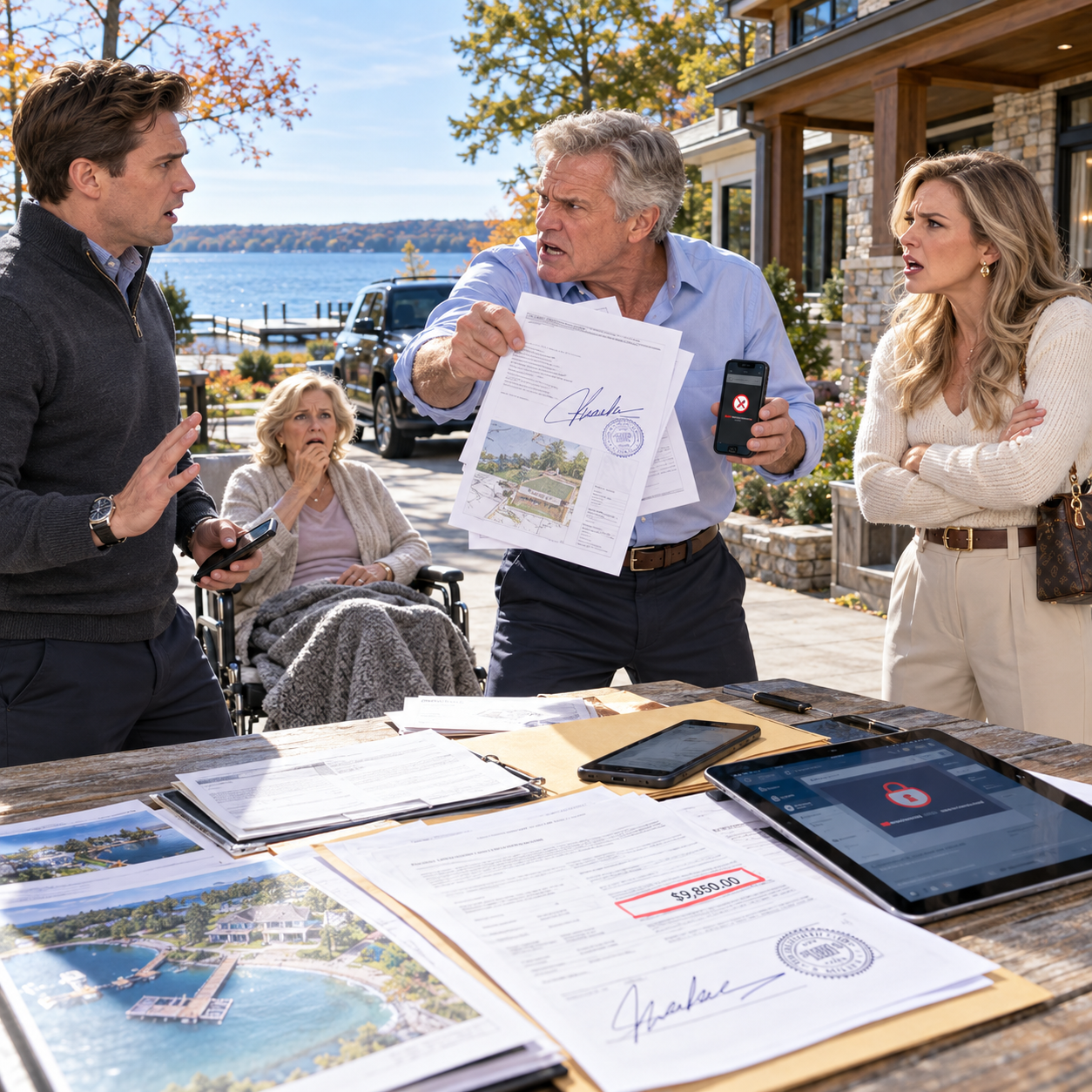
Patricia opened a copy of the preliminary agreement. The developer was willing to provide substantial financing once the land-use approval and property authorization were established. My lake house appeared on the first page as the principal asset supporting the venture. The agreement also contained a personal financial guarantee Andrew had signed, contingent on obtaining control of the property.
“He doesn’t own that property,” I said.
“No,” Patricia answered. “But he’s represented that he has authority to commit it.”
Then Daniel placed one more statement in front of me. The checking account that paid Margaret’s supplemental medical insurance premiums had been redirected, and the most recent payment had failed. A letter from the insurer showed that her coverage had been suspended pending payment. The same account had been used to fund part of the development application.
I remembered Margaret holding a heating pad against her abdomen the previous evening, apologizing because she needed another nursing visit. I’d told her not to worry about the expense.
I called the insurer from Patricia’s office. After a lengthy conversation with a supervisor and payment of the overdue amount, the company agreed to reinstate the supplemental policy without a break in coverage. I obtained written confirmation before leaving. Then I drove home, placed the letter in our medical folder, and sat beside Margaret while she ate a bowl of chicken soup.
She looked at the papers in my hand. “That’s not just a problem with the cottage, is it?”
“No.”
“Is Andrew involved?”
I couldn’t make myself answer immediately. Margaret set down her spoon, and I pulled a chair close enough that our knees touched. I told her about the property application, the money, and the unauthorized documents, leaving nothing important out. She listened without interrupting, except to ask whether her medical care would continue.
“Yes,” I told her. “I’ve made certain of that.”
She picked up her spoon again but didn’t eat. After a long moment, she said, “He used to call me every Sunday.”
I had expected anger or disbelief. Instead, she was remembering something small that had already disappeared.
The next morning, Patricia obtained a temporary court order restricting transactions involving the lake property while the authenticity of the authorization was investigated. The township was notified, and the title company flagged the property against unauthorized conveyances or liens. Separately, our business attorney suspended Andrew’s access to company accounts and records while an independent examination proceeded.
The developer received formal notice before Andrew did. By Friday afternoon, its representative had contacted Vanessa to say the proposed agreement could not move forward under the circumstances. Andrew called me seven times, leaving increasingly anxious messages. The last one said, “Dad, please don’t do anything permanent until we talk. There are things you don’t understand.”
I listened to it twice. Then I sent him a message explaining that he and Vanessa had no permission to use the lake house for Thanksgiving, that his business access was suspended, and that any discussion of the financial matters would need to involve our attorneys. He responded with a single sentence: “You’re letting strangers turn this into something it doesn’t have to be.”
Margaret read the message over my shoulder. “He still thinks you’re going to fix it for him,” she said.
Sunday evening, the house telephone rang. Vanessa’s mother, Linda, was calling to confirm whether we wanted her to bring additional folding chairs. She sounded cheerful until I explained that no gathering would take place at the property. “But Vanessa says everything’s arranged,” she protested. “Even her uncle and his wife are driving from Ohio.”
I asked whether Vanessa had told them Margaret was recovering from surgery. Linda hesitated. “She said Margaret was resting and you’d rather have everyone out of your way.”
I understood then that nineteen people were still expecting to arrive at our lake house.
Patricia suggested sending another written notice, which we did. We also arranged for a local property manager to secure the house and meet us there Thanksgiving morning. Margaret insisted on coming with me, saying she wanted to sit by her own fireplace rather than spend another holiday feeling like an invalid.
I spoke with her doctor, arranged a comfortable place for her to rest, and agreed we would leave whenever she felt tired.
On Thanksgiving morning, Patricia met us at the property with the court documents and a copy of the disputed authorization. She had a legitimate reason to be there: Andrew had finally agreed to discuss the matter in person with counsel present. Unfortunately, he’d neglected to tell his guests that Thanksgiving dinner had been canceled.
At eleven thirty, the first three cars turned into the driveway.
Part 3: Nineteen Guests Arrived And Learned What Andrew Had Concealed
Margaret was sitting beside the living room fireplace when I heard tires crunch over the gravel. She wore a soft blue sweater and had a blanket across her knees, with a cup of tea resting on the small table beside her. Patricia stood near the entrance, checking the papers in her leather folder. Outside, the property manager was directing the arriving cars toward the wider section of the driveway so nobody would block the road.
Linda stepped out of the first vehicle carrying a covered casserole dish. Behind her came two couples, three teenagers, and a man balancing a cardboard box filled with pies. They were laughing about traffic and how cold the lake looked in November. When Linda reached the porch and saw Patricia standing beside me, her expression changed.
“Robert? What’s going on?”
“Thanksgiving isn’t being hosted here, Linda. I’m sorry Andrew and Vanessa didn’t tell you.”
She looked past me into the house, where Margaret could be seen sitting beneath the lamp. “But she’s here.”
“She’s recovering in her own home. She isn’t receiving dinner guests.”
Linda slowly lowered the casserole against her hip. Behind her, more cars were arriving, bringing the number of expected visitors to nineteen. Several people looked confused, and one elderly uncle asked whether someone had become ill. I explained that there had been a misunderstanding about permission to use the property and that we’d arranged a restaurant in town willing to accommodate their party.
I didn’t mention the financial investigation. Those people had driven hours because they’d been told they were welcome. They didn’t deserve to become an audience for my son’s mistakes.
Andrew and Vanessa arrived last, in a black SUV packed with serving trays and grocery bags. Vanessa walked toward the porch carrying a shopping tote, then stopped when she recognized Patricia. Andrew remained by the driver’s door for several seconds, watching the family members gather near their vehicles.
“Why is your lawyer here?” Vanessa asked.
“Because we need to discuss the property authorization,” I answered. “Privately.”
Her eyes moved toward the open doorway. “You brought Margaret all the way up here to make a point?”
From inside, Margaret heard her. She rose carefully from the chair, rested one hand against the doorframe, and said, “I came because I wanted to see my lake.”
Vanessa looked at her, then at the people standing along the driveway. For the first time since I’d known her, she seemed unable to find words that would organize everyone around her preferred version of events.
Patricia quietly asked Andrew and Vanessa to join us in the small study. Linda took charge of directing the other guests toward the restaurant while Margaret settled back into her chair. Nobody raised a voice. The conversation happened behind a closed door, where Patricia placed the authorization and court order on the desk.
Andrew recognized the document immediately.
“Dad, I can explain the financing,” he said.
“Then explain why my signature is on a paper I never signed.”
He rubbed both hands over his face. Vanessa answered first, saying the property had been unused for much of the year and that their investment would have increased its value. She spoke about the developer’s experience, the demand for waterfront accommodations, and the money Andrew had already committed.
Patricia interrupted. “Was Robert’s signature placed on this document with his permission?”
Vanessa looked toward Andrew. He stared at the floor.
“Andrew,” I said, “I’m asking you.”
He sat down heavily in the chair beside the desk. “I knew about the authorization. Vanessa said we needed something to get the planning process started. I thought we’d talk to you before anything became final.”
“You knew I hadn’t signed it?”
He nodded.
For several seconds, I watched my son turn his wedding ring around his finger. Then I asked about the money taken from my company. He admitted he’d borrowed against expected investment returns after losing money in an earlier development project. He had intended to repay everything when the resort financing closed.
Vanessa’s voice sharpened. “We weren’t trying to steal the house. We were trying to build something independent.”
“Using my house,” I replied. “And my company’s money.”
She looked toward the window. “You always made Andrew feel like he had to ask permission to do anything.”
There was enough truth in that accusation to hurt. I’d supervised him closely when he first joined the business, corrected him in meetings, and sometimes treated his decisions as though he were still an apprentice. But I had also offered him opportunities, money, and responsibilities that he had willingly accepted.
“You could have left the company,” I said. “You could have built your own business. You couldn’t sign my name.”
Andrew began crying quietly. It wasn’t an attempt to persuade me; he seemed embarrassed by the tears and kept wiping them away before they reached his chin. When I asked about Margaret’s insurance, he admitted he’d approved transferring funds from the account that paid it, but claimed he hadn’t realized a premium would be missed.
“I believed the account had enough,” he said.
“You didn’t check.”
“No.”
I remembered all the years I’d spent checking payroll figures on Friday afternoons, afraid a mistake would leave one of our workers unable to pay his mortgage. My son had been given the authority that came from those years of careful work, without having developed the same fear of letting someone down.
Patricia explained the court order and the next steps. The property couldn’t be used for the proposed development while the case proceeded, and the disputed corporate transfers would be addressed through a formal investigation. Andrew and Vanessa would need independent legal representation. There would be no private agreement that afternoon and no family negotiation around the documents.
When they left the study, Margaret was standing near the living room window. Andrew stopped beside her, his face wet and his shoulders bowed.
“Mom, I’m sorry.”
She regarded him for a long moment. “I needed you when I was sick, Andrew. Not to manage anything. Just to be my son.”
He tried to speak, but Margaret shook her head gently. “I can’t listen to promises today. Go take care of what you’ve done.”
He nodded and walked out. Vanessa followed without looking back.
The legal proceedings lasted nearly a year. Financial investigators confirmed the unauthorized business transfers, and the notary eventually admitted that the authorization had been prepared without my knowledge. Andrew accepted responsibility for his participation, pleaded guilty to financial offenses, and entered a restitution agreement that cost him his ownership interest in Weller Mechanical. He received probation and was barred from holding financial authority over the company.
Vanessa faced more serious consequences for her role in arranging the documents and presenting the property as available for development. She eventually received a custodial sentence. Their marriage did not survive the investigation, although I learned that through Andrew’s attorney rather than from Andrew himself.
I didn’t celebrate either outcome. We’d lost the version of our son we’d believed in, and no judgment could return the years when his mistakes might still have been corrected by a difficult conversation instead of a courtroom.
I transferred day-to-day management of the business to two longtime employees and established updated financial protections for Margaret’s care and our property. We recovered some of the missing company funds through restitution and civil settlements, but not all of them. I stopped calculating the loss in dollars after a while. Margaret’s medical expenses were secure, and our home was no longer at risk.
Andrew began writing letters to his mother the following spring. At first she kept them unopened in a kitchen drawer. Eventually, she read them, one at a time, and answered a few. Their conversations remained brief and cautious, without any promises about the future.
One Saturday in late April, Margaret and I returned to the lake house. Snow lingered beneath the cedars, and the bay was a deep gray-blue beneath a clearing sky. I made coffee while she settled into her favorite chair on the porch, now strong enough to walk there without assistance. When I joined her, she pointed toward a pair of ducks moving across the water.
“Do you think Andrew will ever come here again?” she asked.
“I don’t know.”
She held her cup between both hands. “I hope someday he understands why we couldn’t just forgive this and pretend it was over.”
I watched the ducks disappear beyond the dock. “Maybe understanding has to come before we decide what forgiveness looks like.”
Margaret leaned against my shoulder. We stayed there until the coffee cooled, listening to water touch the stones beneath the porch. The house still carried the marks of the years we’d spent building it together, and for the first time in a long while, neither of us needed to discuss what might happen to it.
When the breeze became too cold, I helped her inside. She paused at the kitchen doorway, looked around at the cupboards she’d chosen so many years ago, and asked whether I’d make pancakes for supper.
I told her I would, and she laughed, saying that after everything we’d been through, she intended to have them with extra maple syrup.
The End .
All characters and events in this story are fictional, created for storytelling and entertainment purposes. Thank you sincerely for reading. Your feedback and support are invaluable and motivate me to continue sharing more stories with you.