Part 2: One Dollar Bought Me Something Thirty-One Years Never Had
The payment went through at 7:14 p.m.
I expected my mother to call within minutes.
She did.
I watched her name flash across my screen.
Mom.
For years, seeing that word had triggered the same automatic response in me: answer quickly, sound pleasant, prepare to explain myself.
I let it ring.
Thirty seconds later, she called again.
Then again.
A text appeared.
Very funny, Myra.
Another followed.
Call me.
Then:
This is embarrassing.
That last message almost made me laugh.
Not Lily sitting beneath pink balloons asking whether Grandma had forgotten.
Not an eight-year-old watching a gate for two hours.
My one-dollar payment was embarrassing.
I went upstairs.
Lily was sitting cross-legged on her rug, coloring a horse purple.
“Purple horse?”
She glanced up.
“It’s magical.”
“Obviously.”
She smiled and returned to her picture.
I stood in her doorway longer than necessary.
There are moments when motherhood turns into a mirror. You suddenly see exactly what your child is learning from watching you.
For thirty-one years, I had been trained in accommodation.
My mother was never openly cruel. That would have been easier to name. She was selective.
She could spend days organizing favors for relatives who impressed her, then tell me she was “too overwhelmed” when I asked for something small.
She could remember details about my cousins’ graduations and engagements while forgetting appointments or events involving me.
Whenever I objected, she had a familiar response.
“Why are you making everything personal?”
So I learned not to.
I learned to apologize first.
I learned to tell myself that disappointment was maturity.
I learned that being the easy daughter was safer than being the honest one.
The morning after I sent the dollar, I called a locksmith.
“Lost your keys?” the man asked when he arrived.
“No.”
He waited.
“I just don’t want an old key working anymore.”
He nodded like he had heard that answer before.
My mother had possessed a spare house key for years. I had handed it to her after Lily was born, believing that family having access to your home was another form of security.
The locksmith removed the old cylinder from the front door and placed it in his toolbox.
Metal clicked against metal.
It was an ordinary sound.
It felt enormous.
By noon, every exterior lock had been changed.
After he left, I sat at the dining table with my phone.
My mother had sent eleven messages.
My father had sent two.
Both brothers had finally appeared in the family chat.
One wrote:
Seriously, Myra?
The other:
Can everyone calm down?
Interesting.
Nobody had asked Lily whether she enjoyed her birthday.
I blocked my mother.
Then my father.
Then both brothers.
My finger hovered before each confirmation, but only for a second.
I did not block their wives. I had no argument with them personally. I did not make an announcement. I did not post anything online. I did not tell the extended family my side.
I simply removed access.
That evening, my doorbell camera recorded my mother standing on the porch.
She tried the knob before ringing.
Once.
Then twice.
Then she reached into her purse.
A key appeared in her hand.
I watched from the upstairs hallway as she inserted it.
It did not turn.
She stared at the lock.
Then she looked directly toward the camera.
“Myra.”
I stayed inside.
She rang again.
“Myra, open the door.”
Lily was in the living room watching television.
“Who is it?”
“Grandma.”
“Are we going somewhere?”
“No, sweetheart.”
My mother knocked harder.
“This is ridiculous.”
I walked into the living room, lowered the television volume, and sat beside Lily.
After another minute, the knocking stopped.
The camera showed my mother walking toward her car with the useless key still in her hand.
I expected anger after that.
I did not expect the police.
Two mornings later, shortly after breakfast, someone knocked on my door.
Not the frantic pounding my mother preferred when she was angry.
Three measured knocks.
I checked the camera.
Two uniformed officers stood on my porch.
I opened the door.
“Ms. Eaton?”
“Yes.”
The older officer spoke carefully.
“We received a welfare concern regarding you.”
“A welfare concern?”
“A family member reported that you recently cut off communication and may be acting unpredictably.”
I looked past them toward the street.
My mother’s car was not there.
Of course it wasn’t.
“Was the family member Renee Eaton?”
Neither officer answered directly.
That was answer enough.
I stepped aside.
“You can come in.”
Part 3: The Police Saw Evidence My Family Preferred to Ignore
The officers entered a home that looked aggressively normal.
Breakfast dishes sat in the sink. Lily’s backpack leaned against a chair. A basket of clean laundry waited on the staircase because I had been ignoring it since Tuesday.
The younger officer glanced toward the hallway.
“Is your daughter home?”
“She’s at school.”
I folded my arms, then lowered them because I realized how defensive the gesture looked.
The older officer gave me a reassuring nod.
“This doesn’t mean you’re in trouble. We just need to make sure you’re safe.”
“I understand.”
“What happened with your family?”
There were several ways I could have answered.
I could have given them thirty-one years.
Instead, I gave them Saturday.
“My daughter turned eight last week.”
I walked to the hall closet and pulled out a cardboard storage box.
Inside were the decorations I had packed away after the party. Deflated pink balloons. Silver streamers. Unused paper cups.
On top sat Lily’s little spiral notebook.
I opened it.
There, in careful handwriting:
Grandma and Grandpa.
Two lines underneath.
“They all confirmed they were coming,” I said. “My parents. My brothers. Nobody arrived.”
The younger officer’s expression changed slightly.
“Did they give a reason?”
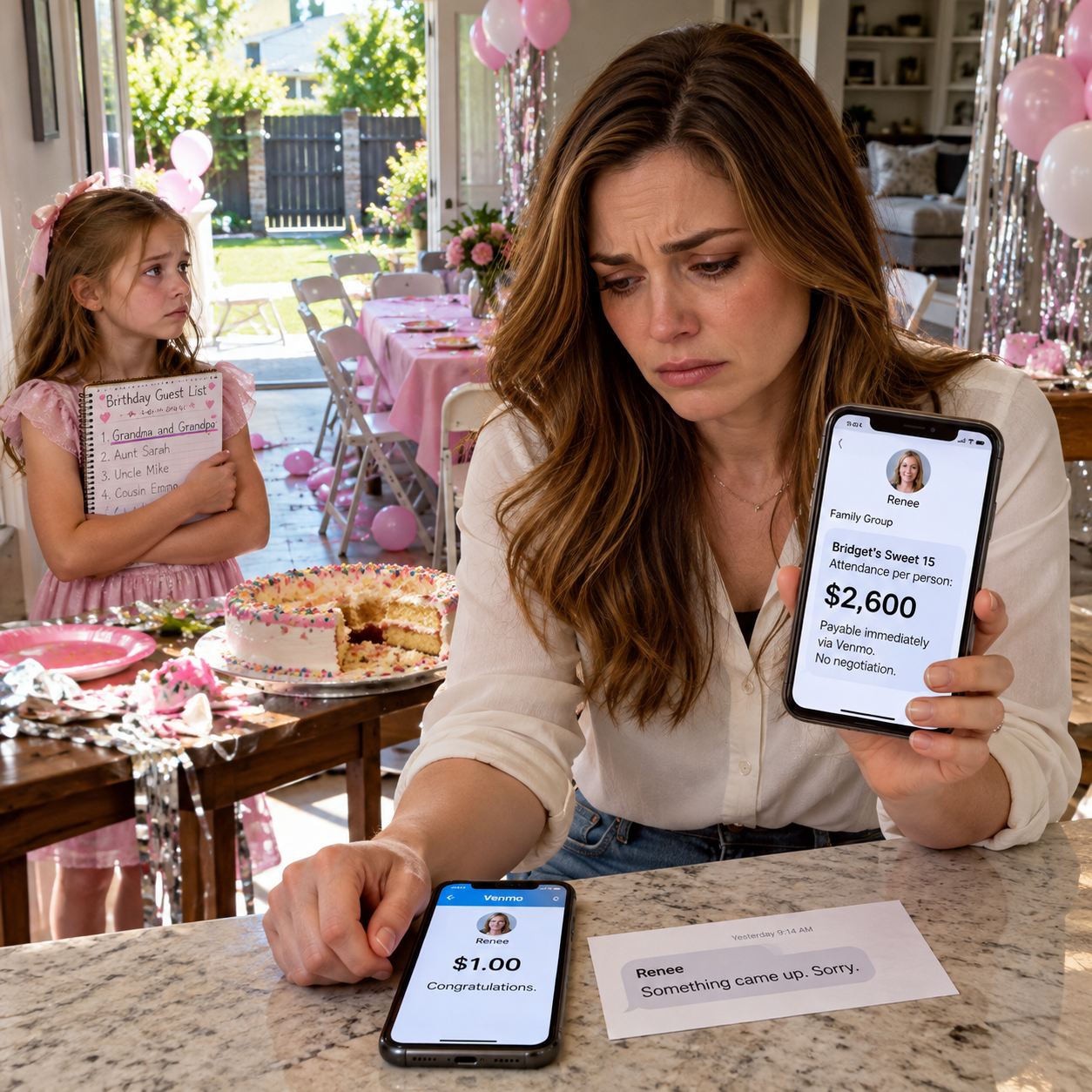
“My mother sent this.”
I handed him my phone, where I had screenshotted the message before blocking her.
Something came up. Sorry.
He passed it to his partner.
Then I showed them the next screenshot.
My mother’s cheerful group invitation.
The $2,600 demand.
The Venmo request.
My one-dollar payment.
The older officer looked at me over the phone.
“You sent one dollar?”
“Yes.”
“What was the note?”
“Congratulations.”
His mouth twitched before professionalism reclaimed it.
“And after that?”
“I changed my locks and blocked them.”
“Any threats?”
“None from me.”
“Any threats from them?”
“Not exactly.”
I showed them the doorbell footage of my mother trying her old key.
The officers watched silently.
“She had permission to have a key previously?” the younger one asked.
“Yes.”
“And you revoked that permission?”
“Yes.”
“Your house?”
“My house.”
The older officer returned my phone.
“Ms. Eaton, are you taking any medications that you recently stopped taking?”
“No.”
“Any thoughts of hurting yourself or anyone else?”
“No.”
“Do you feel unsafe?”
I thought about that.
“No. Actually, I feel safer than I have in a while.”
He nodded.
The two officers exchanged the smallest glance.
Then the older one said, “Ma’am, you seem completely fine to us.”
Fifteen minutes after they arrived, they were gone.
I closed the door and leaned against it.
For most of my life, my family had known exactly how to interpret me.
If I was upset, I would eventually apologize.
If I objected, I could be convinced I had overreacted.
If somebody disappointed me, I would find an explanation on their behalf.
The woman who sent one dollar and changed the locks did not fit the role.
So my mother had searched for another explanation.
Myra must be unstable.
Myra must be having some kind of episode.
Because the alternative was much more threatening:
Myra meant no.
That afternoon, my father emailed me.
Your mother was worried.
I stared at the sentence.
Not sorry.
Not we handled this badly.
Not tell Lily we love her.
Your mother was worried.
I typed several responses.
Deleted all of them.
Finally, I wrote:
Calling the police because I set a boundary is not concern. Please do not come to my home without invitation.
I sent it.
Weeks passed.
The extended family began reaching me through people I had not blocked.
Apparently I had “humiliated” my mother with the one-dollar payment.
Apparently changing my locks had been “dramatic.”
Apparently the police visit was being described as a misunderstanding.
My aunt called once.
“Your mother says you’ve completely shut everyone out.”
“I shut out four people.”
“She says she doesn’t understand why.”
I looked through the kitchen window.
Lily was outside drawing with sidewalk chalk.
“She understands.”
My aunt became quiet.
Then she said, “Well, family is family.”
I had heard that sentence all my life.
Usually spoken by the person asking the hurt person to tolerate one more injury.
“I know,” I said. “That’s why I expected them at Lily’s birthday.”
There was nothing useful to say after that.
A few weeks later, Lily and I were sitting on the couch when she asked the question I had known would eventually come.
“Why don’t we go to Grandma’s anymore?”
She held a green crayon in one hand and a half-finished drawing in the other.
I turned off the television.
“Grandma and I are having some grown-up problems.”
“Because she missed my birthday?”
Children notice where adults step carefully.
“That’s part of it.”
“Is she mad at me?”
“No.”
I said that quickly enough that Lily looked up.
“No, honey. None of this is because of you.”
She studied my face.
“Are you mad at her?”
I chose my next words slowly.
“Sometimes people we love don’t show up the way we need them to. And sometimes we can love somebody and still take some space so our home can stay peaceful.”
Lily thought about that.
Then she nodded.
“Okay.”
She returned to her drawing.
No interrogation.
No grand speech.
Children often understand boundaries before adults learn to argue with them.
Part 4: Changing My Locks Finally Ended a Lifetime of Emotional Debt
The months afterward were quieter than I expected.
Quiet, I discovered, can feel uncomfortable when you have spent your entire life preparing for somebody else’s reaction.
At first I checked my phone constantly, even though the numbers were blocked.
I imagined family meetings happening without me.
I imagined my mother explaining my behavior in that wounded voice she used whenever accountability came too close.
Then gradually, I stopped wondering.
Grief arrived instead.
Not because anyone had died.
Because I finally stopped waiting.
I grieved the mother I had always hoped would appear if I explained myself clearly enough. The father who might someday say, “Your mother was wrong.” The brothers who might call because they genuinely wanted to know how Lily was doing.
I grieved birthdays from my own childhood that I had taught myself not to remember too carefully.
And I grieved the version of myself who spent decades believing that peace meant keeping everyone else comfortable.
One evening in early summer, I found Lily’s birthday notebook while cleaning a drawer.
The guest list was still there.
Grandma and Grandpa remained underlined twice.
For a moment, I considered throwing it away.
Instead, I closed the notebook and placed it in a keepsake box.
Not every painful thing needs to disappear.
Some things become evidence that you finally learned.
Our life gradually filled the empty spaces.
A neighbor invited Lily over for a backyard movie night.
One of the mothers from her school started joining me for coffee.
Friends who had never shared my last name began appearing at recitals, school events, and Saturday lunches without needing six weeks of reminders.
That was perhaps the strangest lesson of all.
Showing up was not complicated.
People either made room for you or they repeatedly explained why they couldn’t.
Near the end of summer, an envelope arrived.
No return address.
Inside was the spare key my mother had once carried.
The old one.
The useless one.
There was no note.
I held it between two fingers, remembering the afternoon I had first given it to her.
Lily had been a baby then. I had told my mother, “Keep this in case I ever need you.”
She had slipped it onto her key ring.
“Of course.”
Now the same key lay in my palm, incapable of opening anything in my life.
I could have treated it as an insult.
Instead, I smiled.
Then I dropped it into the small tray beside the door.
Not because I wanted it back.
Because it no longer mattered.
A few days later, my father sent one final email.
Your mother misses Lily.
I read it twice.
Then I replied:
Missing a child and showing up for a child are not the same thing.
If there is ever a relationship again, it will begin with accountability, not access.
There was no answer.
Maybe one day there will be.
Maybe there won’t.
I am no longer building my life around the possibility.
Lily turned nine the following April.
Her party was smaller.
She chose chocolate cake this time, proving eight-year-old opinions are not legally binding.
We hung silver stars from the porch and set up a projector in the backyard. Her friends arrived carrying sleeping bags, popcorn, and gifts wrapped badly by enthusiastic parents.
At 2:00, people were already there.
At 2:30, more arrived.
Nobody stood near the gate wondering who had forgotten them.
At one point, Lily ran past me laughing, a paper crown sliding sideways on her head.
She stopped.
“Mama?”
“Yeah?”
“Come take a picture.”
I walked over.
She pulled me into the center of a group of people who had shown up because they wanted to.
The camera clicked.
That night, after everyone left, I stepped onto the porch alone.
The house was quiet.
Behind me were dishes to wash, wrapping paper to gather, and a daughter sleeping upstairs with frosting probably still hidden somewhere in her hair.
I touched the new lock absentmindedly.
A year earlier, changing it had felt severe.
Now it felt ordinary.
A lock is only a boundary made visible.
For thirty-one years, I had believed love meant keeping the door open no matter how someone entered.
I know better now.
Love does not require unlimited access.
Forgiveness does not require pretending.
And family is not measured by blood, invitations, shared names, or expensive celebrations.
It is measured in something much simpler.
Who comes through the gate when they said they would.
I changed the locks on my house after my mother demanded $2,600 for someone else’s party.
But the money was never the real issue.
The dollar I sent her was not revenge.
It was the cheapest lesson I had ever paid for.
I finally understood that belonging should not cost your dignity, your peace, or your child’s trust.
My mother’s old key still sits in the little tray near my front door.
Sometimes I see it when I leave for work.
A small piece of brass.
A relic from a life where access was automatic.
It opens nothing now.
And neither does guilt.
The End .
All characters and events in this story are fictional, created for storytelling and entertainment purposes. Thank you sincerely for reading. Your feedback and support are invaluable and motivate me to continue sharing more stories with you.