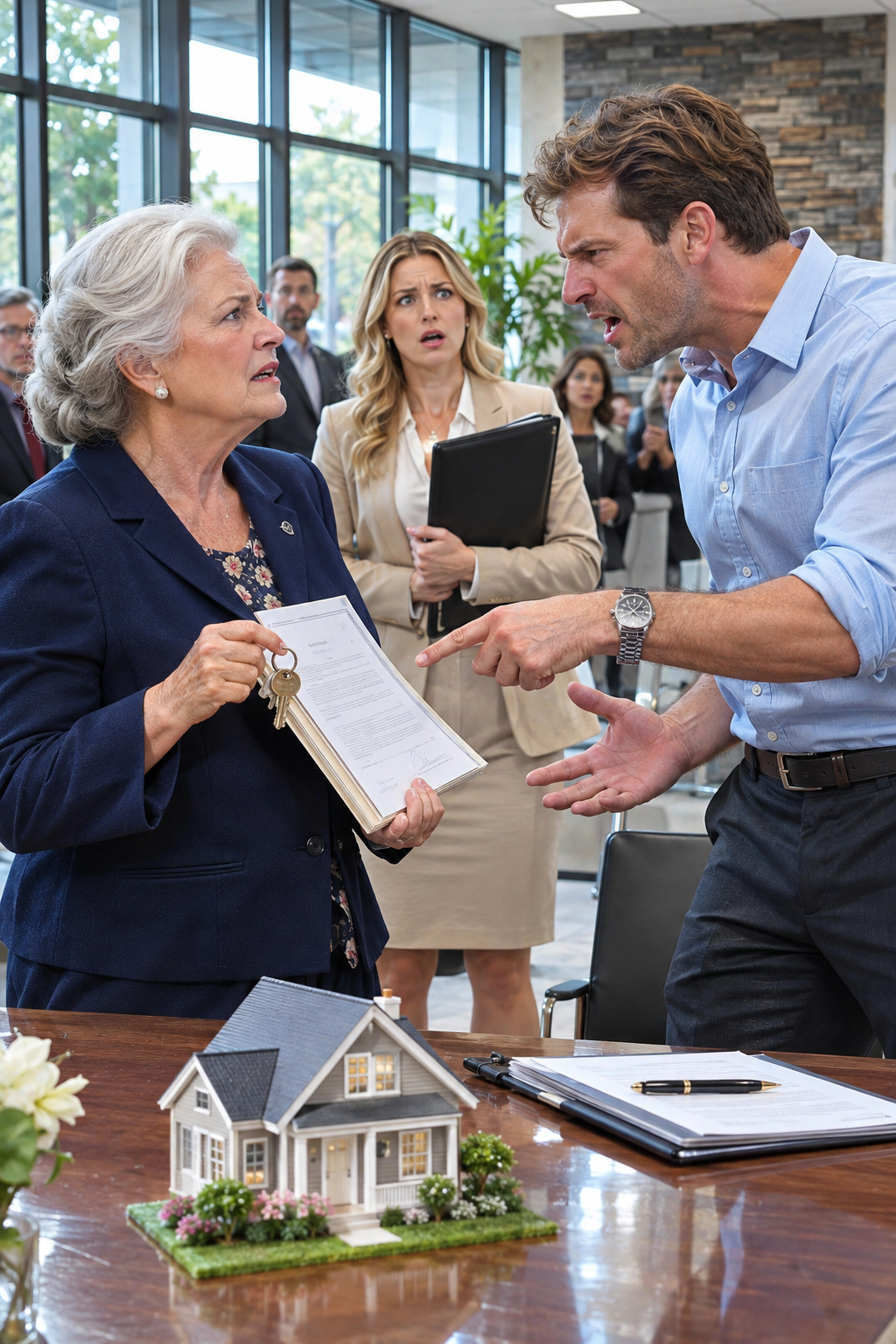
### Part 2: One canceled payment reveals a terrifying scheme behind the celebration.
I sat at the kitchen table while music and laughter filled a house thirty minutes away. With Florence listening on the telephone, I canceled every voluntary payment I had been making for Derek and Whitney. Car expenses, household contributions, insurance assistance, and other recurring transfers disappeared from my banking instructions, one after another.
The total was $3,045 every month.
I left the property’s insurance intact and never interfered with its utilities. I wasn’t interested in frightening anyone or making their home unsafe. I simply refused to keep financing two adults who had decided their benefactor was an embarrassment.
When the final confirmation appeared, I covered my face and cried.
“Marjorie?” Florence asked quietly.
“I’m here.”
“Do you want me to come over?”
“No. I want my lawyer.”
Vincent answered that evening. After hearing what had happened, he remained silent for several seconds.
“What would you like to do?” he finally asked.
“Sell the house.”
On Sunday, we reviewed the deed and occupancy agreement. Vincent explained that I could contract to sell my property, but Derek and Whitney’s right to occupy it had to end lawfully. There would be no surprise eviction, changed locks, or pressure tactics.
“I want everything handled properly,” I told him. “Whatever my son has become, I won’t become someone I despise.”
Monday’s title search confirmed that I was the sole recorded owner. No transfer to Derek existed, and no mortgage or lien he had arranged appeared against the property.
That afternoon, broker Russell Pembroke introduced a prospective buyer named Nathan Cole.
Nathan offered $512,000, provided the house was lawfully vacant by the end of the seventh week. We signed a conditional sale contract on Tuesday, making clear that closing could occur only after the occupancy ended legally and the property was empty.
Vincent sent Derek and Whitney formal notice inviting them to negotiate an early termination.
By Wednesday morning, Derek had called seventeen times.
At eight o’clock, I heard tires screech into my driveway. Through the window, I watched him stumble from his car and hurry toward my porch. My neighbor, Nora Bennett, was watering roses when Derek suddenly dropped to his knees on the concrete.
“Mom, please!” His voice cracked. “Tell Vincent to cancel the sale!”
I opened the door but remained on the top step.
“Why, Derek?”
“Because you’re destroying everything!”
“What exactly am I destroying?”
He looked toward Nora, who stood motionless beside her flower bed.
Then the truth burst out.
“Travis has a business opportunity. We were raising $250,000, and the house was supposed to secure the financing. If the investors find out I don’t own it, everything collapses!”
The coffee cup trembled in my hand.
“You planned to mortgage my house?”
“I was going to make enough money to pay you back! You would’ve gotten everything you wanted.”
“I wanted my son to have a safe home for his family.”
He buried his face in his hands.
“Please forgive me.”
“Stand up, Derek. If you want forgiveness, start by telling Vincent everything.”
After he left, I retrieved the packet he’d called insurance updates.
That afternoon, Vincent’s paralegal, Rachel Donnelly, scanned the documents and arranged them across the conference table. The first pages contained ordinary insurance information, emergency contacts, and security details.
Then Rachel stopped.
“Vincent, look at this.”
Beneath the routine forms lay a prepared deed transferring ownership from Marjorie Blackwood to Derek Blackwood.
My printed name appeared above an empty signature line.
I remembered Derek tapping the bottom of that packet, urging me to sign without reading.
Vincent examined the document carefully.
“It’s unsigned, unrecorded, and legally ineffective,” he explained. “But this tells us what Derek intended to get from you.”
I twisted my wedding ring until my finger hurt.
“He didn’t ask me to update insurance,” I whispered. “He asked me to give away my house without knowing it.”
Vincent called Derek on speakerphone.
“Your mother has discovered the deed hidden in your paperwork.”
“It’s just a draft,” Derek snapped. “I was trying to protect our future.”
“By deceiving me?” I asked.
“I needed people to believe I owned the house. Travis had important contacts coming to the party.”
The room went terribly quiet.
Suddenly, the expensive furniture, the thirty guests, and the strange man measuring my basement made perfect sense.
The housewarming hadn’t merely celebrated a new home.
It had been a performance designed to convince potential investors that Derek possessed an asset he could offer as collateral.
That evening, Whitney arrived at my door carrying a laptop. Her eyes were swollen, and her hands shook as she opened a folder of emails from their joint business account.
“Marjorie,” she said, “I found the messages Derek sent Travis before the party.”
One email stated that the $250,000 financing depended on transferring my property into Derek’s name. Another warned that my presence at the housewarming could expose the truth to the funding contacts.
Whitney looked up at me, tears spilling down her cheeks.
“He didn’t keep you away because my mother objected.”
She turned the laptop toward me.
“He kept you away because you were the only person who could tell everyone the house wasn’t his.”
### Part 3: Hidden documents expose a son’s lies and unravel his plans.
Friday morning, my telephone rang again.
This time, it was Constance Holloway, Whitney’s mother.
“Marjorie, I’ve just learned what Derek told you,” she said. “And I need you to know I never said you couldn’t attend that party.”
She sent me screenshots of her messages to Whitney.
One made my throat tighten.
“Please seat Marjorie at the head of the table. She bought the house, and she deserves to be honored.”
Constance had even offered her mother’s serving spoons for the celebration.
For several moments, I couldn’t speak.
My son hadn’t merely excluded me. He had deliberately turned two mothers against each other to protect his lie.
Whitney came to Vincent’s office that afternoon. When Rachel showed her the concealed deed, she collapsed into a chair, staring at the blank signature line.
“He told me those were insurance papers,” she whispered.
“You helped keep me away,” I said.
Whitney nodded, crying. “I knew my mother hadn’t forbidden you. But Derek insisted everything would be easier if you stayed home. I chose not to challenge him.”
“Why?”
“Because I wanted the beautiful house and the beautiful party. I didn’t want to know what they were costing someone else.”
Her admission hurt, but it was the first honest thing she had said to me in months.
During the following week, Vincent helped me review five years of financial assistance. Rachel compared bank transfers with the receipts Derek had provided for supposed emergencies.
One group of payments stood out.
$42,000.
Derek had requested that money for urgent medical care and repairs at their previous rental. Yet some medical invoices described routine treatment, and one repair invoice predated their lease.
Vincent asked Derek to explain the discrepancies.
My son stared at the conference table.
“Some of the money went where I said,” he admitted. “But most went into Travis’s business project.”
I felt the blood drain from my face.
“You used money I gave you for medical bills to finance a business gamble?”
“I thought I’d replace it before you found out.”
“You were gambling with money you knew I gave for emergencies.”
Derek said nothing.
Vincent insisted that Derek obtain independent legal advice before discussing repayment. After doing so, my son returned and voluntarily signed a written agreement acknowledging the $42,000 and establishing affordable monthly payments.
I signed nothing promising further assistance.
By the third week, Travis’s funding company had completed its own title investigation. Its report confirmed exactly what Vincent had warned Derek: my son possessed temporary occupancy rights, not ownership, and had no authority to mortgage the property.
The proposed $250,000 financing was terminated immediately.
No funds had been disbursed. No mortgage had been created against my house.
Travis telephoned Vincent’s office while I was there.
“Mrs. Blackwood, Derek represented that the ownership transfer was coming. I should have verified it before examining the property. The financing is canceled.”
After the call, I sat motionless.
For weeks, I had feared losing my savings to a scheme I hadn’t understood. Now the danger had passed, but I could barely recognize the man who had created it.
Without the expected financing, Derek’s financial troubles surfaced. He sold his SUV, expensive watch, and golf clubs. Whitney moved temporarily into Constance’s home, saying she needed distance from the lies.
Derek rented a small apartment with a single bedroom and a window overlooking a parking lot.
But their right to remain in my house still existed under the original occupancy agreement.
Vincent arranged a meeting and explained the choices. Derek and Whitney could remain according to the existing agreement while any dispute followed lawful procedures, or they could voluntarily agree to end their occupancy early.
Whitney requested time for her own attorney to review the proposal. Derek agreed to do the same.
Neither was rushed.
At the end of the sixth week, they returned with the signed legal reviews completed. Rachel read the agreement aloud: both would remove their belongings, return every key, and surrender possession by the agreed weekend.
Whitney signed first.
Derek studied the paper for several seconds before adding his signature.
Then he looked directly at me.
“Mom, I thought owning that house would finally make me somebody.”
I looked at the man I’d raised, remembering how proudly he’d once carried his father’s tools.
“You were somebody long before that house, Derek. You just stopped believing it was enough.”
He lowered his eyes.
For the first time, he had no argument.
### Part 4: A lawful goodbye gives a broken family room to heal.
That weekend, I returned to the house with Vincent’s paralegal to witness the handover.
Cardboard boxes lined the hallway. The expensive sectional was gone, and bare patches marked the walls where decorations had hung during the party. Whitney carried her remaining belongings toward a moving truck while Derek checked the bedrooms.
I found him standing in the smallest room.
Sunlight spilled across the floor where I had once imagined a baby’s crib.
“This was supposed to be the nursery,” he said.
“I remember.”
He held an empty picture frame against his chest.
“You saw a grandchild here. I showed Travis the basement and told him how much money the property could bring.”
He looked at me, his face tight with shame.
“I ruined something beautiful before it even existed.”
I wanted to embrace him. Instead, I helped carry the last box outside.
Whitney handed over her key. Derek removed his from a worn metal ring and placed it in my palm.
Rachel photographed the empty rooms, checked the property’s condition, and documented the handover.
I locked the door myself.
Seven weeks after the housewarming, Nathan Cole sat across from me at the closing table and signed the documents purchasing the property for $512,000.
The transaction was complete.
Afterward, Nathan collected his keys at the house. Across the street, Derek watched beside a borrowed truck.
When Nathan went inside, my son approached.
“Mom, there’s a better apartment closer to work. The landlord wants someone to guarantee the lease. If you could just put your name on it…”
I looked at him.
“Do you remember what you promised when I bought this house?”
He swallowed. “That I’d never ask you for money again.”
“I’m not signing anything, Derek. Your next home must be something you can afford yourself.”
His shoulders sank, but he didn’t argue.
He climbed into the truck and drove away.
For six months, we spoke rarely.
Then, on a cold November evening, someone knocked on my door.
Derek stood outside in muddy work boots, holding a grocery bag containing pork chops, collard greens, and lemon pie.
“Could I make you dinner, Mom?”
I stepped aside.
“Wash those hands first.”
He laughed, and for one unexpected moment, I heard the boy who used to run through my kitchen after playing in the yard.
While dinner cooked, he placed a folder on the table.
Inside were pay records from a construction company where he’d started doing cleanup and scheduling. His supervisor, Owen Barrett, had recently promoted him to site manager after watching him manage two renovation projects responsibly.
Beneath those records were statements documenting his monthly repayments toward the $42,000 debt.
Not one payment was missing. A balance remained, and Derek had not asked for it to be forgiven.
“I wanted you to see something real,” he said. “Not another promise.”
After dinner, he washed the dishes without being asked.
Then he noticed the oak clock hanging on my kitchen wall.
The very clock I had wrapped for a housewarming I hadn’t been permitted to attend.
“Dad made that with his hands,” he whispered.
“Yes.”
“And you were going to give it to us.”
“I was.”
He lowered the dish towel.
“I lied about the money. I hid the deed. I kept you away because I couldn’t let anyone know the truth. I even blamed Whitney’s mother.”
His voice trembled.
“I used to think you were trying to control my life. Now I realize I kept asking you to pay for a life I hadn’t earned.”
The clock ticked steadily between us.
“I’m sorry, Mom. I’m not asking for the house, or money, or help with rent. I just want to know whether you can forgive me.”
I watched his face.
He looked older than forty now. The confidence he once performed for strangers had been replaced by something quieter.
Accountability.
“I can forgive you, Derek,” I said. “But forgiveness doesn’t mean going back to the way things were.”
He nodded.
“I understand.”
“No more financial support. No loans, guarantees, or hidden emergencies. Those days are finished.”
“I know.”
“But you can come here for dinner once a month. Bring the groceries. Tell me about your work. We’ll learn how to be mother and son again without money standing between us.”
Tears filled his eyes.
“I’d like that.”
Before leaving, he hugged me tightly.
Outside, an old used sedan waited at the curb, purchased with his own wages. I watched him climb inside and drive toward the apartment he could afford without my help.
Then I closed the door and returned to the kitchen.
My husband’s oak clock continued ticking above the table, measuring another ordinary evening in the home we’d built together.
I had once believed that loving my son meant giving him everything I possessed.
But that night, I finally understood something my husband had spent his life teaching me.
A strong home isn’t built by handing someone the keys.
It’s built by teaching them to carry their own weight, honor their promises, and protect the people who love them.
My son had lost a house worth half a million dollars.
I had almost lost my independence, my savings, and the quiet years my husband worked so hard to give me.
But we hadn’t lost each other.
And when Derek returned the following month, carrying groceries instead of asking for a check, there was a chair waiting at my table.
Not because he owned anything.
Because he had finally learned what it meant to belong.
THE END.
All characters and events in this story are fictional, created for storytelling and entertainment purposes. Thank you sincerely for reading. Your feedback and support are invaluable and motivate me to continue sharing more stories with you.