
## Part 2: A Midnight Intruder Reveals The Secret Beneath Our Feet
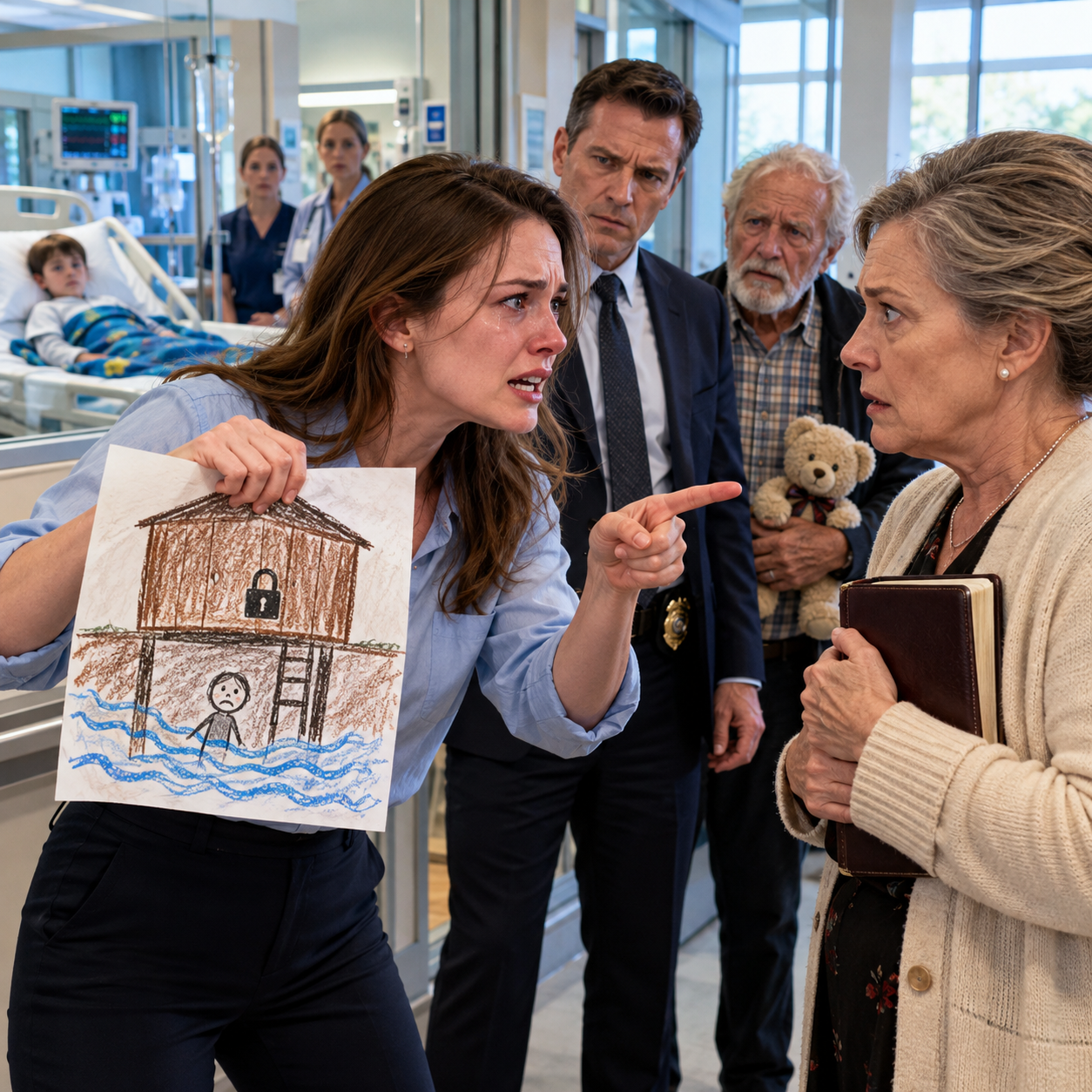
I made one terrible mistake that evening. I called my mother and told her the police would return with a warrant at eight. She remained silent for several seconds before saying, “You’ve always had a dramatic imagination, Emily. I’m coming to sit with my grandson.”
She arrived carrying a cardigan and her Bible, positioning herself where every passing nurse could see her. I watched her excuse herself shortly afterward and disappear toward the stairwell. Through the narrow window, I saw her speaking into a cheap black flip phone. When she noticed me, she snapped it shut.
“Who were you calling?”
“The dog sitter,” she answered.
My mother didn’t own a dog.
Earlier that evening, a hospital social worker had informed me that someone in our family claimed Noah frequently wandered at night and that I’d irresponsibly left him while traveling. Child Protective Services would investigate. Madison, my younger sister, wouldn’t meet my eyes when I asked whether she knew who had made the report.
At eleven thirty, I was half asleep in the recliner beside Noah when a janitorial cart rolled into the room.
The man pushing it wore blue scrubs and a gray cap pulled low over his forehead. He pretended to empty a waste container, but Noah suddenly scrambled backward against his pillows.
“Mommy!” he screamed. “That’s him!”
The man lifted his head.
A pale scar crossed his jaw.
I reached for the call button. He shoved his cart between us and lunged toward Noah’s IV tubing. I knocked the cart sideways, sending supplies scattering across the floor. A nurse shouted from the hallway, and Detective Harris appeared with a security guard.
The intruder grabbed a metal stand and smashed through the glass doorway. By the time Harris pursued him into the stairwell, he was already racing toward the parking garage.
Twenty minutes later, Harris returned with a security photograph.
“Calvin Reed,” he said. “Wanted for shooting a gas station clerk in 2014. He disappeared the same week your father vanished.”
My mother stared at the photograph without speaking.
“He rented my shed,” she finally said. “I didn’t know anything about his past.”
“Then why were you calling him?” I demanded.
Her hand tightened around her purse.
Before Harris could respond, Noah spoke from behind me.
“Mommy, the water’s getting loud.”
I hurried to his bed. “What water, sweetheart?”
“The bad man turned it on before he hurt me. Grandpa can’t climb out.”
Harris reached for his radio.
Within minutes, firefighters and police officers were racing toward my mother’s house. Harris drove me there with his emergency lights flashing, neither of us speaking as Dallas storefronts blurred past the windows.
We arrived shortly after midnight.
Firefighters had dragged my father’s old workbench onto the lawn. Beneath a rotten rug and several inches of packed dirt, they’d uncovered a square plywood hatch secured with a steel hasp and a new brass padlock.
Water seeped through the seams.
I fell to my knees beside it. Beneath the wood, I heard a steady rushing sound, like a faucet left running into an overflowing sink.
Then someone knocked.
Two quick taps.
One slow.
“Daddy!”
I pounded the hatch until a firefighter pulled me backward. Bolt cutters snapped through the padlock, and two men heaved the heavy wooden panel aside.
A concrete shaft descended into darkness. Water had risen almost to the top of a wooden ladder. A firefighter lowered his flashlight and illuminated a figure pressed against the far wall.
An elderly-looking man stood with water reaching his chin, one arm hooked around an overhead pipe.
His left ankle was chained to the plumbing.
Rescuers climbed down with cutting equipment while I lay across the opening, calling his name. When they finally lifted him out, his white beard hung against his chest, and his thin arms trembled uncontrollably.
He was only sixty-two.
He looked ninety.
A paramedic wrapped him in a thermal blanket, and I knelt beside him, searching his face for the man who had taught me to ride a bicycle.
His eyes opened.
“Emily,” he rasped. “You cut your hair.”
I laughed and cried at once, holding his cold hand against my cheek.
Then his fingers closed around my sleeve.
“Listen to me,” he whispered.
I leaned closer.
“Calvin didn’t put me down there.”
His eyes filled with tears.
“Your mother did.”
## Part 3: My Sister Confesses The Truth That Our Mother Buried
My father survived the rescue, but twelve years underground had devastated his body. Pneumonia filled both lungs, his bones were dangerously weak, and doctors placed him on a ventilator at Methodist Dallas. A police officer guarded his room while another remained outside Noah’s.
Margaret was arrested for helping conceal a wanted fugitive, but she posted bond the following morning. Harris explained that proving she’d imprisoned my father required more than words whispered during a medical emergency.
“Once he wakes and gives a statement, we’ll move,” he promised.
Meanwhile, my life collapsed around two hospital beds.
My employer emailed to announce that my position had been eliminated during a regional restructuring. Two weeks of severance, no further explanation. I had $3,100 in checking, rent due in five days, and a child welfare investigation hanging over my head.
On the fourth afternoon, I sat in the hospital parking garage gripping my steering wheel when another driver activated a turn signal.
Tick. Tick. Tick.
I remembered my mother’s call at 11:49.
Then I remembered something else.
Madison hadn’t driven after dark since she hit a deer on Loop 12 at nineteen. If my mother had been driving that night, Madison had almost certainly been sitting beside her.
I found my sister that evening at the home of a woman from our mother’s Sunday school group. Madison sat on the back steps smoking a cigarette, although she’d quit years before.
“You were in the car,” I said.
Her cigarette trembled.
“You heard her tell me Noah was asleep. You knew he wasn’t.”
Madison stared at the ground. “Mom said I’d go to prison if I talked.”
“For what?”
She wiped her face with her sleeve.
“I found Daddy four years ago.”
I lowered myself onto the step beside her.
“She was away at a church retreat,” Madison continued. “I heard knocking outside and went into the shed. I found the hatch, Emily. I heard him calling for help.”
Her voice broke.
“Mom came home early. She caught me crying beside the lock, and she explained everything.”
According to Madison, Calvin had arrived in 2014 seeking somewhere to hide from police. My father discovered who he was and threatened to report him.
But Calvin knew secrets about our mother, too.
“She wanted Daddy gone permanently,” Madison whispered. “Calvin wouldn’t do it. He said keeping Daddy alive meant she couldn’t report him without exposing everything.”
For twelve years, my father had been Calvin’s protection and my mother’s prisoner. She supplied food, maintained the hidden room, and controlled the lock. When she traveled, Madison sometimes delivered supplies.
“And Noah?” I asked.
Madison covered her mouth.
“He followed Calvin into the shed. He saw the hatch open and heard Daddy talking. Calvin panicked when Noah tried to help.”
I stood up, fighting to keep my voice steady.
“You can’t change what happened. But you can decide whether you’re going to help them keep lying.”
For the first time, my sister looked directly at me.
She took out her phone and called her attorney.
Over the next nine days, Madison gave investigators detailed statements. She drew the underground chamber, identified the pipes and chains, and explained how a valve beneath the kitchen sink controlled the water supply.
Police also examined my mother’s burner phone.
Its call records led Texas Rangers to a motel near Laredo, where Calvin Reed was attempting to dye his gray hair black. They arrested him before he could disappear again.
On the twelfth day, doctors removed my father’s breathing tube.
On the thirteenth, he gave Harris a four-hour statement.
On the fifteenth, two detectives entered the fellowship hall at Cliff Temple Baptist Church during Wednesday supper and arrested my mother in front of her prayer committee.
She was drinking tea when they approached.
“May I finish?” she asked calmly.
“No, ma’am.”
Fourteen months later, the trial finally began.
I thought I already knew every terrible secret my mother had kept.
Then Calvin’s attorney placed an old photograph on the courtroom screen, and I discovered there was one more.
## Part 4: A Courtroom Photograph Reveals The Father Who Chose Me
By the time the trial reached its eighth day, Noah and I were living in Colorado Springs. He was seven, his wrist had healed, and he slept with the hallway light on. Our rented house had no basement because Noah couldn’t bear walking down stairs that led underground.
I worked dispatch for a freight company that let me leave early enough to pick him up from school. My father lived nearby and attended rehabilitation three mornings a week. He used a wheelchair for longer distances and carried a small oxygen tank he jokingly called his sidekick.
He remembered everything.
That was both a blessing and a terrible thing.
In court, the jury had already seen photographs of the padlock, the underground cell, and the chain. They’d heard Walter explain the screaming he’d heard that night and watched a phone company representative display records placing my mother’s phone away from the house while she claimed Noah was sleeping.
They’d seen the burner phone records showing that Margaret warned Calvin shortly after I told her about the approaching warrant.
Madison testified under her plea agreement, admitting her role without once looking toward our mother’s table.
Then Calvin Reed took the witness stand.
He spoke for forty minutes about being frightened and desperate in 2014. He described Margaret providing shelter, food, and instructions, making himself sound like a man trapped by circumstances beyond his control.
Several jurors appeared moved.
Then his attorney asked why Margaret had imprisoned her husband.
Calvin requested an old Polaroid photograph.
The image appeared above the jury box.
My mother stood smiling beside Calvin, his arm around her waist. Her hair was styled in the oversized fashion of the early nineties, and she was visibly pregnant.
Someone had written MAY 1994 along the white border.
I was born June 2, 1994.
Calvin turned toward me.
“Robert learned I was Emily’s real father,” he announced. “Margaret kept him alive because he knew whose child he’d been raising.”
The judge ordered him to stop, but he continued speaking until the courtroom dissolved into murmurs.
I couldn’t look at him.
I looked at the thin, elderly man sitting beside me.
My father was gripping the arms of his wheelchair.
“Daddy,” I whispered. “Did you know?”
He stared at his hands.
“Since you were seven. You fell from the monkey bars and broke your arm. The hospital did blood tests.”
“And you never told me?”
He shook his head.
“I was afraid you’d think it changed something.”
Tears blurred his face.
“Emily, you were my little girl before I knew anything about blood types. You stayed my little girl afterward.”
I took his hands and slowly opened his clenched fingers.
For twelve years, I’d believed he’d abandoned us in a flooded river. For twelve years, he’d survived beneath our backyard, hearing footsteps overhead and waiting for a door that never opened.
Now he was terrified that another man’s photograph might take his daughter away.
I leaned closer.
“You’re my dad,” I whispered. “You always were.”
After the recess, prosecutor Ms. Whitfield approached Calvin with one sheet of paper.
“Mr. Reed, you claim Emily is your biological daughter?”
“Yes.”
“Then Noah is your biological grandson?”
Calvin hesitated. “Yes.”
“Is that the six-year-old boy you injured inside the shed when he discovered Robert Carter?”
Calvin shifted in his chair.
“He shouldn’t have been there.”
“And when you entered intensive care disguised as a hospital employee and approached his IV line, you knew he was your grandson?”
Calvin opened his mouth, then closed it.
Ms. Whitfield waited.
The courtroom went completely silent.
“No further questions,” she said.
The jury deliberated for three hours and twenty minutes.
Both Calvin Reed and Margaret Carter were convicted and ultimately sentenced to life in prison without parole. Madison received twenty years under her plea agreement. The insurance company pursued recovery of the $350,000 paid after my father’s supposed death, and my mother’s white-quartz kitchen was destined for auction.
At sentencing, I was offered an opportunity to speak.
I’d prepared a statement on the back of an electric bill, but when I approached the microphone, I folded it into my palm.
“You’ve seen a photograph of my mother with Calvin Reed,” I began. “I’d like to tell you about another photograph.”
I looked toward my father.
“It’s a picture of me when I was eleven, holding a catfish at Lake Texoma. I told everyone I’d caught it. The truth is my dad caught that fish and let me take the credit.”
A few people smiled.
“He’s sitting right there. He’s the man who taught me to ride a bike, drove me to college, and loved me without conditions. He’s the only father I’ve ever had.”
I glanced once toward Calvin.
“I don’t know the man sitting at that table.”
Then I returned to my seat.
My father reached over and squeezed my knee.
Outside, Dallas rain fell hard enough to bounce from the courthouse steps. Walter stood beneath the awning holding an enormous blue umbrella over Noah, who had insisted on bringing his Triceratops blanket despite the warm weather.
When Noah saw my father, he hurried toward him and wrapped his arms carefully around his neck.
“Did we win, Grandpa?”
My father smiled.
“We won, buddy.”
“Good,” Noah said seriously. “Because my feet are freezing.”
I looked down.
He had only one sock on.
My father started laughing, a rich, wonderful laugh that turned into a cough before rising again. Walter laughed with him, shaking his head beneath the umbrella.
For the first time in years, I felt something loosen inside my chest.
I helped Noah into the back seat and fastened his belt. Then I folded my father’s wheelchair into the trunk while Walter climbed into his own car.
Through the rear window, I saw my father turn toward Noah.
He lifted one crooked finger and tapped gently against the glass.
Two quick knocks.
One slow.
Noah smiled and tapped the same rhythm back.
I stood motionless in the rain, remembering the little girl who used to wait for that sound at her bedroom door.
My father had once told me what those three knocks meant.
I’m here. Open up.
Twelve years had been stolen from us. Nothing could return the birthdays, Christmas mornings, or ordinary Sunday dinners we’d lost.
But when I climbed into the driver’s seat, my father was beside me, and my son was laughing behind us.
For the first time in twelve years, all three of us were going home together.
THE END.
All characters and events in this story are fictional, created for storytelling and entertainment purposes. Thank you sincerely for reading. Your feedback and support are invaluable and motivate me to continue sharing more stories with you.


