
## Part 2: An Invisible Monthly Payment Reveals Another Painful Family Truth
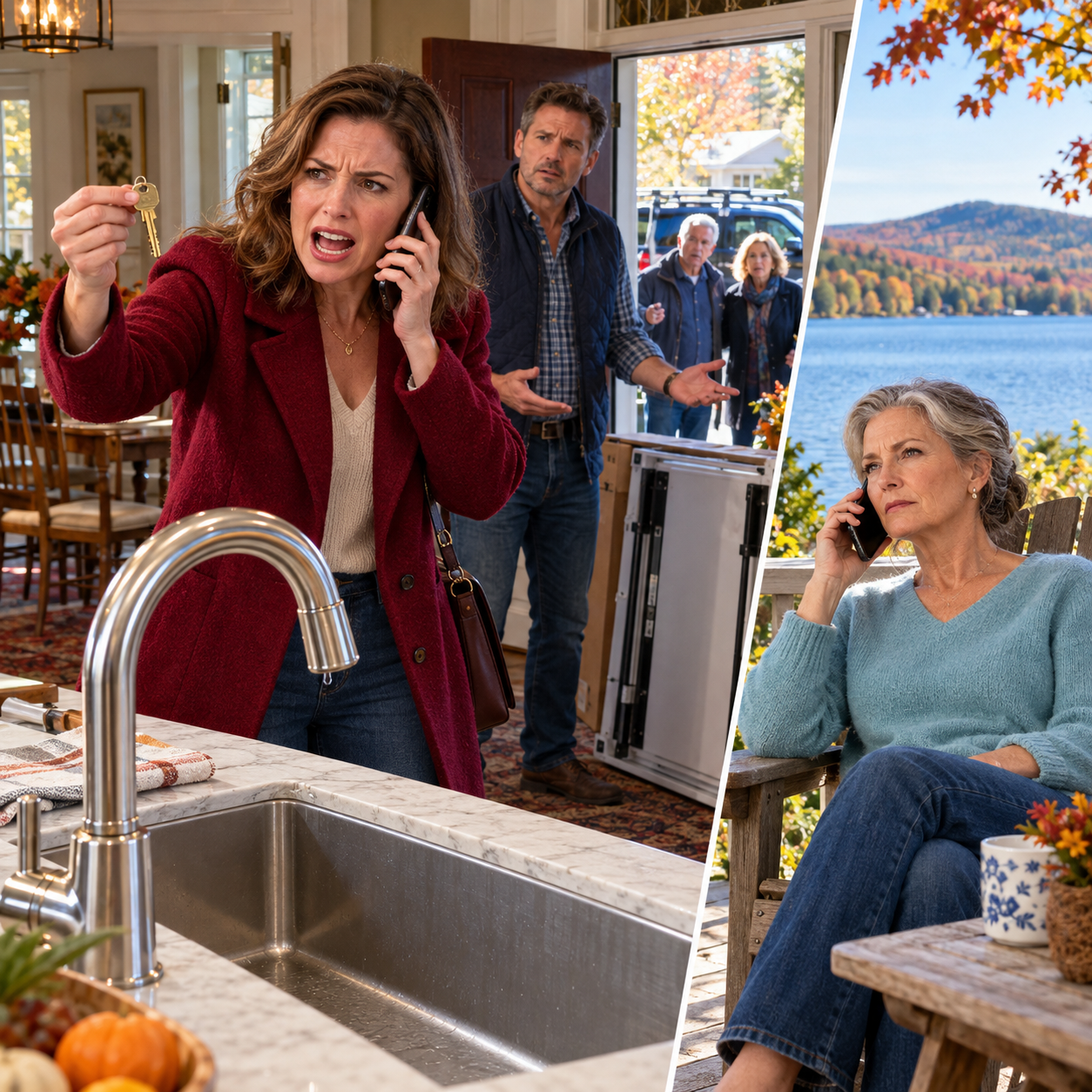
That evening, Claudia sent six messages, each more furious than the last. She accused me of embarrassing her, ruining the holiday, and making Reed’s family think she couldn’t organize a simple dinner. Not one message acknowledged that she’d entered my house without permission.
I sat at the cottage’s little wooden desk with a cup of chamomile tea and opened my laptop. I wasn’t planning to write an angry response, because I’d learned that arguments often became invitations for Claudia to negotiate. Instead, I logged into my bank account and looked at a payment I’d barely thought about in three years.
Five hundred dollars.
Automatically transferred to Claudia’s checking account on the first day of every month.
I’d arranged it when Reed’s construction business went through a difficult year. They’d fallen behind on their second mortgage, and Claudia had called me crying because she feared they couldn’t afford the children’s activities. I’d quietly started sending money because I couldn’t bear the thought of my daughter struggling while I had enough to help.
But that crisis had ended.
Reed’s business had recovered. They’d renovated their kitchen in March, spent January vacationing in Costa Rica, and purchased a newer Honda Pilot. Somehow, the five hundred dollars continued leaving my account every month without either of them mentioning it.
I stared at the payment history.
Three years.
Eighteen thousand dollars.
Not once during the past year had Claudia asked whether I could still afford it.
I moved my cursor over the cancellation button. My finger hesitated, not because I doubted my decision, but because I could almost hear my late husband telling me that generosity should never become an obligation someone else imposes.
I clicked.
Recurring transfer canceled.
The confirmation appeared without ceremony. I closed the computer, washed my teacup, and went to bed.
Two days later, my son Owen called. At thirty-eight, he had mastered the delicate art of avoiding family arguments while somehow getting pulled into every single one.
“Hey, Mom. How’s the lake?” he asked.
“Beautiful. What did your sister say?”
He sighed. “She booked a private room at an event space on Church Street. Apparently, it’s expensive. She wants me to convince you to come home.”
“Are you offering to host twenty-two people instead?”
“Mom, my apartment barely holds six.”
“Are you offering to pay for the venue?”
He gave a nervous laugh. “I can’t afford that.”
“Then why are you responsible for solving her problem?”
He didn’t answer immediately. I could almost picture him rubbing his forehead, trying to think of something diplomatic to say.
“She keeps saying you embarrassed her.”
“Did she mention entering my house while I was away?”
Another silence.
“She said she was setting up tables.”
“She used an emergency key to enter a house I hadn’t invited her into, Owen. What would you call that?”
He exhaled. “A really bad idea.”
I smiled faintly. “That’s a start.”
Then his voice softened. “Mom, I think she’s gotten used to you doing everything. Maybe we all have.”
That admission hurt more than Claudia’s angry messages, because it was sincere. I looked down at my hands, remembering how many Christmas mornings I’d spent washing roasting pans while everyone else relaxed in front of the television.
“I loved taking care of you,” I told him. “But I’m tired of being taken for granted.”
“I know,” he said quietly. “And I should’ve noticed.”
For a moment, neither of us spoke. Then he asked whether he could visit the cottage before I left, and I told him the door was always open.
Thanksgiving arrived beneath a pale winter sky.
I roasted a small chicken with rosemary, made mashed potatoes in one saucepan, and opened a bottle of Pinot Noir I’d been saving for a special occasion. I ate beside the cottage window, watching the lake darken as the afternoon faded.
There were no extra chairs to unfold, no arguments over serving times, and no mountain of dishes waiting afterward.
Owen sent me a photograph from a friend’s Thanksgiving dinner. He looked genuinely happy, holding a plate piled with food.
Claudia sent nothing.
I didn’t chase her.
When I returned home after November 30, I found the house exactly as I’d left it. The dining table stood beneath its chandelier, my china remained untouched, and the folding tables were still stacked in the garage.
But I remembered watching that emergency key turn in my lock.
On my first trip into Burlington, I stopped at a hardware store on Williston Road and bought two solid-brass deadbolt sets.
By afternoon, both exterior locks had been replaced.
I stood in the entryway with my new keys in my palm and tested the front door twice. The bolt slid smoothly into place, and I felt a quiet satisfaction I hadn’t expected.
I wasn’t shutting my daughter out of my life.
I was taking back the right to decide who walked into it.
## Part 3: My Daughter Threatens Our Relationship After Losing Her Financial Support
On January second, I was organizing the hall closet when Claudia called. Her name flashed across my phone, and I answered while balancing a stack of folded blankets.
“Mom, where’s the five hundred dollars?”
I placed the blankets on a shelf.
“Good morning to you too, Claudia.”
“The transfer didn’t come through. I checked the bank twice.”
“That’s correct. I canceled it in November.”
Silence.
Then, “You canceled it without telling me?”
“It was financial assistance I started when Reed’s business was struggling. His business has recovered, so the assistance has ended.”
“We depend on that money!”
I leaned against the closet door. “You’ve renovated your kitchen, taken an international vacation, and paid for an expensive Thanksgiving venue. I think you can manage without my monthly contribution.”
“That’s Hazel’s dance classes, Mom! That’s part of our household budget!”
I closed my eyes briefly.
When had my generosity become something she believed she owned?
“Then you and Reed need to adjust your budget.”
Her voice sharpened. “You’re punishing me because of Thanksgiving.”
“I’m making decisions about my own money. The fact that you’re upset doesn’t make those decisions punishment.”
“You’ve changed,” she said bitterly.
“Yes,” I answered. “I have.”
For a moment, I thought she might cry. I could hear her breathing, and a small part of me wanted to soften my words, offer another month, or promise to reconsider. It was the same instinct that had kept me cooking dinner for twenty-two people long after my knees began aching from standing all day.
Then Claudia spoke again.
“Maybe we need some space. Maybe the kids shouldn’t come over on Sundays anymore. Maybe you won’t see Hazel and Jonah as much.”
My fingers tightened around the phone.
There it was.
The one thing she knew could hurt me more than losing money or missing Thanksgiving.
I loved my grandchildren. Hazel always ran into my arms before removing her coat, and Jonah could spend an entire afternoon asking me to help with the same puzzle. Their youngest sibling had only recently started remembering which cupboard held my cookie tin.
Claudia knew how much those Sunday visits meant to me.
I swallowed the ache in my throat.
“You’re their mother, Claudia. You decide their schedule. But I will not pay for access to my grandchildren.”
“That’s not what I said!”
“Then don’t make their visits part of an argument about money.”
She hung up.
I stood in my hallway longer than I wanted to admit, staring at the silent screen. This time, my heart hurt, but I didn’t call her back.
Three weeks passed.
One afternoon in late January, I was making vegetable soup when I heard footsteps on the front porch. A key scraped against the lock, followed by a confused pause and another attempt.
Then came three sharp rings of the doorbell.
I wiped my hands on a towel and opened the door.
Claudia stood outside, her cheeks red from the cold, holding her old key between two fingers.
“You changed the locks!”
“Hello, Claudia.”
“Why would you do something like that?”
I kept one hand on the doorframe. “Because you entered my house without permission while I was away.”
“I grew up here!”
“Yes, you did. And I loved raising you here. But you moved out twenty years ago, and this house belongs to me.”
She stared at me as though I’d spoken in another language.
“You actually don’t trust me?”
“I trusted you with an emergency key. You used it to arrange a dinner I’d already refused to host.”
Her eyes filled, but I stayed where I was.
“You’ve made me feel like a stranger,” she whispered.
I felt that accusation land. This was the girl whose scraped knees I’d bandaged, whose school plays I’d attended, whose frightened midnight phone calls I’d always answered.
“I don’t want you to feel like a stranger,” I said. “But I need you to treat me like a person with choices, not someone who exists to make your life easier.”
She looked down at the useless key.
Then, for the first time that afternoon, she asked a question instead of making a demand.
“Can I come inside?”
I glanced toward the kitchen, where soup simmered on the stove. My heart was pounding, and I knew neither of us was ready for a productive conversation.
“Not today. Call me this week, and we’ll arrange lunch.”
She blinked, clearly expecting me to surrender.
“You’re really saying no?”
“Yes.”
I closed the door gently and turned the deadbolt.
Through the frosted glass, I watched my daughter stand motionless on the porch before walking back to her car.
I didn’t feel victorious.
I felt sad that something so ordinary as saying no had become the hardest lesson my daughter and I had ever faced.
## Part 4: A Long-Hidden Lie Finally Gives Our Family A New Beginning
Claudia called during the second week of February. She didn’t mention the locks or the money, and I didn’t offer to discuss either over the phone. Instead, we agreed to meet for lunch at a small Burlington restaurant she’d been wanting to try.
When I arrived, she was already seated near the window, turning a napkin between her fingers. She stood awkwardly when she saw me, as though she couldn’t decide whether to hug me.
I made the decision for both of us.
“Hello, sweetheart,” I said, embracing her briefly.
She smelled like the same floral perfume she’d worn for years. For one fragile second, I remembered her at seventeen, leaning against me before leaving for college and promising she’d call every Sunday.
We ordered soup and sandwiches.
For the first twenty minutes, we spoke about harmless things. Reed’s work was steady, Hazel had an upcoming dance recital, and Jonah was becoming obsessed with astronomy. Then Claudia laid her fork down and stared at the table.
“Reed was really upset about Thanksgiving,” she said.
“I imagine the venue cost quite a bit.”
“It did.”
She folded her napkin again.
Then she said something that made me put down my water glass.
“Mom, Reed didn’t know I hadn’t asked you.”
I stared at her.
“What do you mean?”
Claudia’s face reddened. “I told him you’d agreed to host. I told his parents the same thing. I thought if everything was already arranged, you wouldn’t want to disappoint anyone.”
The restaurant sounds seemed to recede.
All those angry phone calls. All those accusations. The emergency key, the folding tables, the insistence that I return home.
She hadn’t merely assumed I would agree.
She’d deliberately made a promise in my name.
“Claudia,” I said slowly, “you knew I might say no, so you told everyone I’d said yes?”
She looked miserable.
“I thought you’d change your mind.”
“And when I didn’t?”
“I told them you weren’t feeling well and couldn’t manage the dinner.”
I leaned back in my chair.
There it was—the truth beneath months of resentment.
She’d been willing to make me look unreliable rather than admit she’d promised something that wasn’t hers to give.
“I wasn’t sick,” I said. “I was tired of being volunteered.”
Tears gathered in her eyes. “I know that now.”
“Have you told Reed the truth?”
She shook her head.
I took a long breath. “Then that’s where you need to start.”
We finished lunch without resolving everything. Claudia didn’t offer a proper apology, and I didn’t demand one, but she listened when I told her that I wanted a relationship built on invitations rather than obligations.
Before leaving, she reached across the table and touched my hand.
“Will you still come to Hazel’s recital?”
“Of course,” I answered. “I’d love to.”
By April, the snow had melted from the yard, and the first flowers were beginning to emerge beside my back fence. Claudia called one Saturday and asked whether she and the children could visit the following afternoon.
She asked.
I noticed.
“Sunday at two would be lovely,” I told her.
The next afternoon, the doorbell rang once.
When I opened the door, Hazel rushed toward me with a delighted squeal, wrapping her arms around my waist. Jonah followed carrying a puzzle box, while the youngest headed straight for the familiar cookie cupboard.
Claudia remained on the porch.
“Is now still a good time?” she asked.
I smiled. “Come in.”
We spent the afternoon in the living room. Jonah spread puzzle pieces across the rug, Hazel talked excitedly about her friends, and the youngest sat beside a basket of picture books. Claudia watched them quietly before turning toward me.
“Reed knows everything now,” she said.
I looked up.
“I told him I never asked you about Thanksgiving. I told him I’d used your emergency key after you refused.”
“And what did he say?”
“That I should’ve been honest from the beginning.”
She swallowed.
“He’s right.”
I didn’t rescue her from the silence.
Then Claudia reached into her handbag and placed a small envelope on the coffee table. Inside was a handwritten note, folded once.
“I wanted you to have something from me,” she said. “Not because I need anything.”
I unfolded the paper.
Mom, I’m sorry I treated your time, your house, and your kindness like things I could claim without asking. I made you responsible for a promise I had no right to make. I don’t expect the old arrangements back. I just want to be your daughter again.
I read it twice.
This wasn’t a request for another five hundred dollars. It wasn’t a demand for the spare key or an invitation to resume hosting every holiday.
It was the apology I’d stopped expecting.
I looked across the room at my daughter, who was sitting with her hands clasped together, waiting.
“You’re still my daughter,” I told her. “That never changed.”
Her eyes filled.
“But things do need to be different.”
She nodded. “I know.”
Outside, the afternoon sunlight moved across the forsythia blooming along the fence. Inside, Hazel climbed onto the arm of my chair and rested her head against my shoulder.
Claudia glanced toward the bright windows.
“I forgot how beautiful this room looks in the afternoon,” she murmured.
“I repainted in February,” I said. “Finally got around to it.”
She smiled faintly. “It looks good, Mom.”
For a while, we watched the children play, and I realized I wasn’t measuring the afternoon by how much work remained. Nobody was expecting a huge dinner. Nobody needed me to polish silverware or wash twenty-two plates.
I had invited my family because I wanted them there.
The monthly transfer never resumed. Claudia never received another emergency key, and I never again agreed to host a holiday without being asked.
But she kept calling, and she learned to wait for an answer.
That was enough for us to begin again.
As Hazel leaned closer, I kissed the top of her head and looked at my daughter across the room. We still had difficult conversations ahead, but for the first time in years, I believed we could have them without either of us pretending.
At sixty-three, I’d finally learned something I wished I’d understood decades earlier.
I could love my daughter without surrendering my home, my money, or my peace.
And the most beautiful part wasn’t that I’d learned to say no.
It was that my daughter was finally learning how to hear it—and stay.
THE END.
All characters and events in this story are fictional, created for storytelling and entertainment purposes. Thank you sincerely for reading. Your feedback and support are invaluable and motivate me to continue sharing more stories with you.


