### Part 2: The Property Deed Exposed Everything My Son Was Hiding
On Wednesday morning, I drove downtown wearing Dale’s favorite blue cardigan and carrying a folder of bank statements. Adam Graham, the attorney who had handled my husband’s estate, greeted me with concern when I explained what happened at dinner. He retrieved the original property records, placed them between us, and pointed to a line bearing my name. “Joan, the main house and cottage are one legally recorded property. You own everything outright. Neither Devon nor Erica has any ownership interest.”
“Can they claim tenant rights?” I asked. Adam adjusted his glasses. “Without a written lease, their arrangement is likely month-to-month, subject to Ohio law and the circumstances. We can prepare proper notice and establish clear terms for their continued occupancy.” I considered his words while studying Dale’s signature on the old documents. “Then give them sixty days to decide,” I said. “They can pay market rent, cover their utilities, maintain the grounds, and account for any damage, or they can leave.”
Adam nodded. “That’s more generous than most people would be.” I almost laughed. Generosity had brought us here, but this time I wanted every condition written, every payment documented, and every deadline legally sound. Adam promised to handle the notices and review the rental terms before anything was served.
The next afternoon, Hannah accompanied me through the main house to document its condition, following Adam’s instructions and arranging an authorized inspection. I barely recognized the rooms. Paint samples covered photographs of Dale and me, furniture had been dragged across hardwood floors, and the dining room bore a deep gouge near the window. Then Hannah opened a stack of cardboard boxes in the garage and froze.
“Mom, come look at this.”
Five of Dale’s mother’s Persian rugs lay rolled together, each bearing a yellow sales tag. Erica had told me they were donated months earlier, yet a printed sheet advertised them for pickup through an online marketplace. Beneath the sheet was a receipt showing that the sixth rug had already been sold for two hundred dollars. Hannah photographed everything while I held the receipt, remembering how Dale’s mother used to kneel beside those rugs and smooth their edges with her hands.
“They weren’t hers to sell,” Hannah whispered. “I know,” I answered. “And now we can prove it.”
Adam arranged for the written notice to be served that Friday. Over the following days, I contacted every company whose bills I had been paying, organizing lawful transfers, cancellations, and account changes for the beginning of the next month. Electricity, gas, internet, lawn care, gutter cleaning, and entertainment subscriptions went onto a spreadsheet. It wasn’t revenge; it was the first accurate accounting my family had faced in years.
For four weeks, Devon and Erica barely acknowledged me. When we crossed paths on the lawn, Erica would turn away dramatically, while Devon studied the ground as though avoiding my eyes could make the paperwork disappear. I planted flowers beside my cottage and waited. They had mistaken my silence for surrender before, and I suspected they were making the same mistake again.
On the first morning of the following month, Devon marched across the yard clutching several envelopes. “Mom, what’s going on? The utility accounts have changed, the internet service is gone, and there’s a rental agreement demanding twenty-four hundred dollars a month!” I set down my coffee. “That’s what Maggie Bennett determined the house is worth. You can accept the terms or move before the deadline.”
“We can’t afford that!”
“Then use the money you’ve been saving.”
His mouth opened, but nothing came out. I watched his expression change from irritation to embarrassment, then something close to panic. Finally, he stared at his shoes. “There’s only about two hundred dollars left,” he admitted. “Erica invested everything in her business. Branding, website design, a leased car, and a deposit for a retreat.”
I gripped the porch railing. For more than two years, he’d allowed me to finance their lives while telling me they were building a future. “What retreat?” I asked, but he couldn’t bring himself to answer.
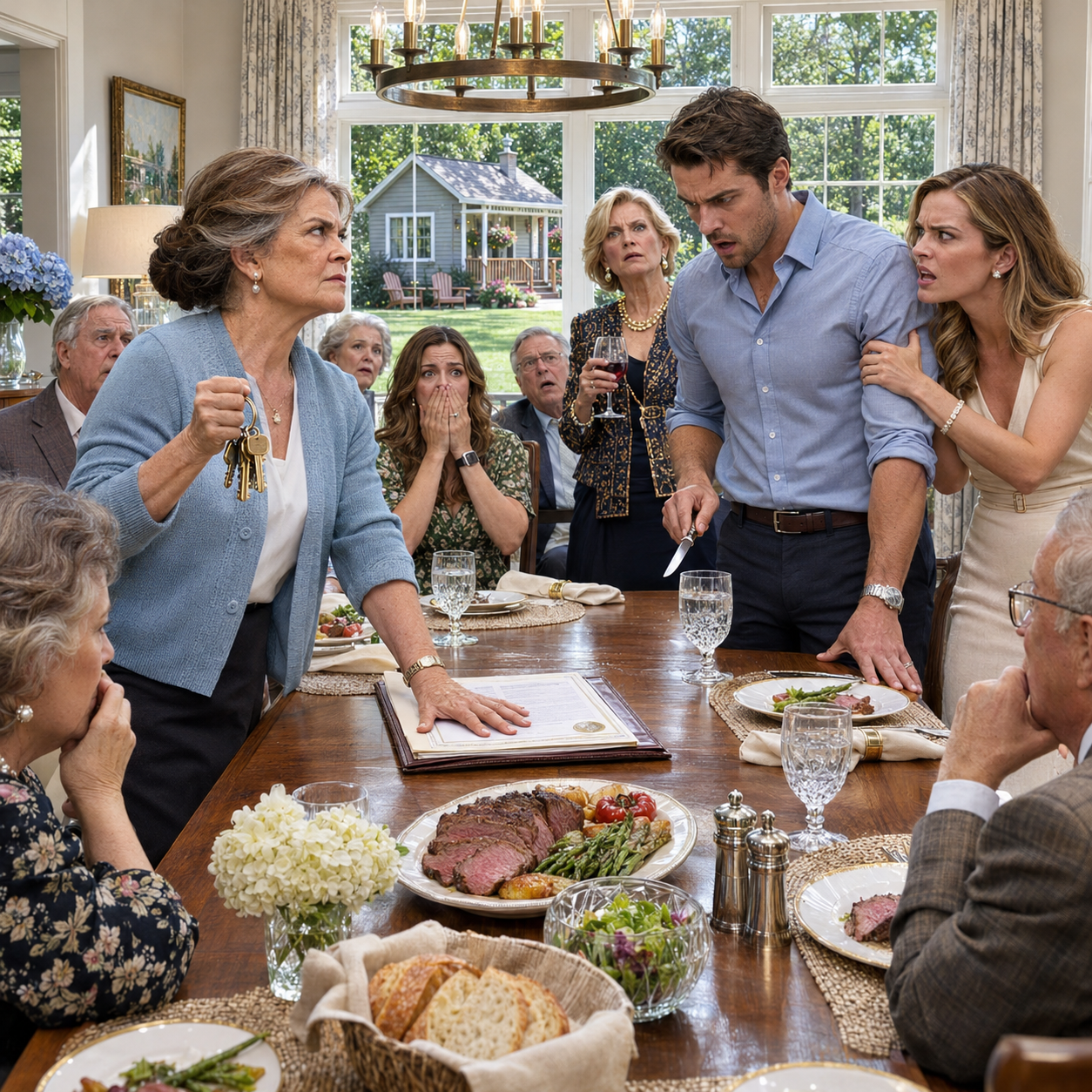
Two days later, Erica arrived with Angela walking confidently beside her. Devon followed several steps behind. Erica announced that I was ruining their financial future and then delivered the threat she’d apparently saved for the occasion. “We’re planning to have children, Joan. If you keep acting like this, don’t expect to be part of their lives.”
Hannah stiffened beside me. I looked from Erica to Angela, whose approving expression told me exactly where that threat had originated. “A grandchild is a blessing,” I replied. “Not something you use to make another person pay your bills.”
Angela folded her arms. “A decent mother would support her children while they’re building something.”
“And yet,” I said, “you have spare bedrooms in Dublin. Why haven’t you offered them somewhere to live?”
Her face tightened. “That wouldn’t be appropriate.”
I held her gaze. “Neither is demanding another woman’s home.”
For the first time, Angela had no answer.
### Part 3: Three Paying Guests Arrived For A Retreat That Wasn’t Theirs
Hannah called me the next evening with a discovery that made the Sunday dinner announcement look even more calculated. Three weeks before that gathering, Angela had posted in her church’s online group that her daughter was opening an exclusive wellness retreat on beautiful family property in Ohio. The post had forty-one likes and several congratulatory comments. When Hannah showed me the screenshots, I finally understood that Erica hadn’t merely hoped to take my cottage; she’d been advertising it as hers before anyone bothered asking me.
Then Hannah found the booking website. There were glossy photographs of my porch, my stone fireplace, and the garden Dale had planted, all promoted under the name Cottage Reset Weekend. A scheduled retreat was accepting paying guests. I forwarded the evidence to Adam, who advised me on protecting my property and documenting any unauthorized business activity.
The following Saturday, at a little after nine, three cars turned slowly into my gravel driveway. I was wearing gardening gloves when the first woman stepped out carrying a yoga mat and a canvas tote bag. Two more women followed with rolling suitcases. “Good morning,” the first woman called cheerfully. “We’re here for Erica Wells’s retreat. We each paid twelve hundred dollars. Is this the cottage?”
I felt sick for those women. They had traveled expecting a peaceful weekend, and their excitement was about to become humiliation. “I’m terribly sorry,” I told them. “This is my private residence. No retreat has been authorized here.”
The woman’s smile disappeared. Before she could respond, Erica came hurrying across the lawn in leggings, her hair only half styled. She started explaining that there had been a scheduling misunderstanding, but the woman turned on her. “You told us this property belonged to your family. You accepted thirty-six hundred dollars!”
Devon arrived moments later, looking bewildered. I faced the guests. “My husband built this cottage for his mother twenty-three years ago. Erica does not own it and has never had permission to operate a business here.”
“I’ll refund everyone,” Erica blurted.
“With what money?” I asked. “You already spent the deposits, didn’t you?”
Her silence answered.
One woman pulled out her phone and announced that she would be leaving a review. Another demanded written confirmation of her refund. For the next forty minutes, Devon stood beside the driveway with his checkbook, writing three checks from the account receiving his actual wages. The women checked the amounts and left with tight expressions, carrying away a story none of them had paid to experience.
When the last car disappeared, Devon turned toward me. “Mom, I didn’t know she’d actually booked people.”
“You didn’t ask,” I said. “That’s what you’ve been doing for two years. Not asking where the money goes, not asking what she’s promised, and not asking what any of it costs me.”
He lowered his head. This time, I didn’t rush forward to comfort him.
They refused to sign the rental agreement. Devon attempted one final compromise, offering fifteen hundred dollars monthly if I resumed paying certain expenses. I reminded him that twenty-four hundred was the market rate and that Maggie already had prospective tenants willing to pay it. Erica sent a basket of muffins with a card about forgiveness and family unity. I placed the basket in the compost.
On the fifty-eighth day, a moving truck backed toward the main house.
Hannah arrived early, and Adam came with the final inspection documents. Angela supervised the loading from the curb, dressed in immaculate linen despite the moving dust. Their destination wasn’t the house Devon had supposedly been saving for; it was Angela’s finished basement in Dublin, a cramped space with low ceilings and a single small window.
Devon carried the mattress down the steps himself. Erica emerged last, wearing sunglasses and carrying a designer bag with the same silver tape measure clipped to its side. She crossed the lawn toward my porch, where Adam stood beside me.
“I want you to know what you’ve done,” she said, pushing her sunglasses into her hair. “The car company took back my leased vehicle. My business website is down. Nobody returns my calls after those reviews. And my mother is charging us a hundred dollars a week to stay in her basement.”
“You lost a business built on property you didn’t own,” I answered.
“I just wanted an opportunity!”
“You had one. You had free housing, two years to save, and a family willing to support you. But you wanted my home, too.”
I held out the final damage assessment. Eighteen hundred and fifty dollars for the missing rug, ruined landscaping, and damaged flooring. Devon had already agreed to repay it, but the documents needed Erica’s acknowledgment of what she’d done.
She spun toward my son. “Devon, tell her this is ridiculous! Tell her we’re family!”
He stood beside the truck, exhausted and pale. For several seconds, he said nothing. Then he looked directly at Erica.
“I’m paying it,” he said. “Because I should have stopped you at that dinner. Actually, I should have stopped you long before then.”
Erica stared at him. “You’re taking her side?”
“I’m finally taking responsibility for mine.”
She signed the acknowledgment, her pen trembling against the paper. Then she reached into her purse and surrendered her remaining key to the main house. I accepted it and told her that she was no longer welcome on my property.
“You can’t keep my future children away from their grandmother,” she snapped.
“I’m not discussing children who don’t exist,” I replied. “I’m telling you that you don’t get to use my love for family as permission to take what belongs to me.”
For once, she had nothing clever left to say.
Angela took her daughter’s elbow and guided her toward the car. Devon climbed into the moving truck without looking back. I watched it disappear beyond the trees, carrying away furniture, broken promises, and the last remains of a life I’d financed far longer than I should have.
### Part 4: The Last Key Revealed Who Had Truly Changed
After the truck disappeared, the property became so quiet that I could hear the wind moving through the oak leaves. Hannah stood beside me, studying the empty driveway. “I almost feel sorry for Devon,” she admitted. I folded the last inspection sheet and handed it to Adam. “He’s thirty-two,” I answered. “If he’s ever going to become the man his father hoped he’d be, he has to learn to carry his own responsibilities.”
We walked through the main house that afternoon, photographing every room now that the furniture was gone. Sunlight streamed across the scarred dining room floor, illuminating pale rectangles where Dale’s photographs had hung for decades. Hannah found a forgotten Christmas ornament behind a cabinet, a tiny wooden rocking chair Dale had carved when Devon was six. I held it in my palm, remembering the little boy who once promised he’d buy me a castle when he grew up.
That memory hurt worse than anything Erica had said.
For several nights, I found myself wondering whether I’d gone too far. I had a house again, but my son was sleeping in his mother-in-law’s basement, and the woman he’d married blamed me for everything. Then I remembered the dinner announcement and the guests who had paid for a retreat in my private home. Every consequence had followed a choice, and none of those choices had been mine.
Two weeks after the move, an envelope arrived without a return address.
Inside was a check for six hundred and fifty dollars, signed by Devon. A folded note accompanied it, written in the careful handwriting I remembered from his elementary school years.
Mom, I’m sorry. I should have asked.
I read those six words three times. He hadn’t asked me to forgive him, rescue him, or reduce the debt. He had finally acknowledged what he’d done, and the check was the first installment on the damage he had promised to repay.
I didn’t telephone him that evening. Instead, I placed his note in the drawer beside Dale’s reading glasses.
October arrived with clear blue skies and cold mornings. Hannah helped me restore the house, returning five Persian rugs to their proper places and replacing the missing sixth with a simple wool runner from a shop in Granville. We repaired the damaged flooring and uncovered the wedding photographs that Erica had hidden beneath paint samples. On October twelfth, Hannah and I planted twelve new rose bushes along the south fence, each one honoring a year of Dale’s life when he’d been healthy and strong.
While we worked, Hannah asked whether I would ever trust Devon again. I pushed soil around the roots of a young rosebush and considered the question. “Trust isn’t something I can hand him because he’s sorry,” I said. “He’ll have to build it again, one honest decision at a time.”
Maggie Bennett soon found tenants for the main house: a hospital nurse and her husband, a kind young couple with a golden retriever. They signed a proper lease, paid their deposit, and arrived carrying boxes marked with the names of the rooms where they belonged. On moving day, the nurse noticed Dale’s old rocking chair on my cottage porch and said it reminded her of her grandfather. I smiled and told her it reminded me of the finest man I’d ever known.
Their monthly rent covered my property taxes and left enough to put money aside. Their golden retriever spent his mornings racing along the fence, chasing squirrels he never managed to catch. Sometimes the nurse brought me a cup of coffee before her shift, and her husband helped carry heavy bags of garden soil without expecting anything in return.
The difference was so simple that I wondered how I had forgotten it: kindness could be appreciated without becoming an obligation.
Then, on a Sunday afternoon near the end of October, Devon called.
For several seconds, neither of us knew how to begin. He asked about the roses, and I told him all twelve had taken root. He said he’d rented a small one-room apartment across town and was working additional shifts to get his finances under control. Then his voice grew quiet. “Erica and I separated, Mom. It’s over.”
I closed my eyes. I’d suspected their marriage was unraveling, but hearing him say it still carried a strange sadness. “I’m sorry you’re hurting,” I told him.
“I know you never liked how she treated you.”
“This isn’t about whether I liked Erica. You were there, Devon. You watched her make decisions about my life, and you supported her because it was easier than standing up to her.”
He didn’t argue. “I know,” he said. “I’ve been thinking about that a lot. Dad would have been ashamed of me.”
I glanced toward Dale’s rocking chair. “Your father would have wanted you to learn from it,” I answered. “And I still want that.”
Then Devon said something I hadn’t heard from him in nearly three years.
“I don’t need anything, Mom. I just wanted you to know I’m doing better.”
I looked down at the brass keys resting beside my tea.
“Come to dinner next Sunday,” I said. “Just you. And bring the next payment.”
He gave a small, surprised laugh. “I will.”
After we hung up, I sat for a long time thinking about how little had actually changed and how much had changed at once. Devon was still my son, still imperfect, still capable of disappointing me. But he was paying his own bills, living under his own roof, and beginning to understand that an apology without changed behavior meant very little.
I hadn’t forgiven everything. Perhaps I never would. But I no longer believed forgiveness required returning to the arrangements that had allowed someone to hurt me.
That afternoon, Hannah arrived with a box of pastries from our favorite bakery. We carried them to the porch and watched golden leaves drift across the lawn. The new neighbor’s dog barked furiously at a squirrel, while sunlight caught the windows of the house where Dale and I had raised our children.
“Are you happy, Mom?” Hannah asked.
I considered the question carefully. I didn’t have the crowded Sunday dinners I’d once imagined growing old with. My family wasn’t perfect, and my relationship with my son would need time and patience. Yet the cottage was peaceful, the roses were growing, and nobody was making plans for my life without asking me.
“Yes,” I said. “I think I finally am.”
Hannah leaned against my shoulder, and for a while we sat without speaking.
Later, when she went home, I carried our empty cups inside and hung the brass keys on the hook beside the door. There were only two now: one for my front entrance and one for the deadbolt. I touched the little wooden rocking-chair ornament, which I’d placed beneath them, and thought about the man who had built this cottage with his own hands.
Dale had spent forty-one years showing me that love meant making another person’s life safer, not smaller. Somewhere in the confusion of grief, I had forgotten that lesson and allowed my generosity to become an endless debt I was expected to pay.
I had thought protecting my home might cost me my family.
Instead, it had shown me which relationships could survive an honest boundary and which had depended on my silence.
As the evening settled over the trees, I turned off the porch light, closed the door, and listened to the lock click into place.
For once, there was no guilt waiting on the other side.
Just the quiet certainty that I was home.
THE END.
All characters and events in this story are fictional, created for storytelling and entertainment purposes. Thank you sincerely for reading. Your feedback and support are invaluable and motivate me to continue sharing more stories with you.I laid my butter knife beside the Christmas china and looked straight at my husband. His mother had just introduced a beautiful blonde as his future wife, in front of thirty guests. Liam wouldn’t meet my eyes. Then I said one sentence about the house he’d promised her, and his face went white.