## Part 2: Hidden Camera Footage Revealed the Betrayal Inside My Marriage
I watched Priscilla remove several bills from Mom’s wallet, straighten the remaining money, and return everything to its original position. She moved without hesitation, as though she’d performed the same routine many times before. When she finished, she glanced toward Mom’s chair and slipped out of the room. The recording ended, leaving me staring at the woman I’d trusted for six years.
“She comes every Thursday afternoon while you’re at work,” Mom explained, her voice barely above a whisper. “At first, I thought I was getting forgetful because twenty dollars or forty dollars would disappear, and I couldn’t remember spending it.” Then her grandmother’s pearl earrings vanished from the velvet jewelry box she kept inside her purse. “Your father always said those pearls should stay in our family,” she added, lowering her eyes. “When they disappeared, I knew something was terribly wrong.”
I swiped to another recording, this one dated just two weeks earlier. Priscilla entered Mom’s living room, glanced toward the armchair, and opened a small leather hearing-aid case sitting beside her handbag. She removed the expensive device, examined it briefly, and slipped it into her coat pocket before closing the empty case. Mom watched my reaction as I replayed those few seconds, her expression carrying the exhaustion of someone who’d lived with a terrible secret for too long.
“Your father helped me buy that hearing aid before he passed away,” she said. “It was expensive, and it worked better than the older one I still wear in my other ear.” She explained that after it disappeared, ordinary conversations had become exhausting, particularly in crowded rooms where voices overlapped. “Priscilla knew exactly what I couldn’t hear, Desmond, because she was the one who took it.”
I remembered our Sunday dinners, when Priscilla would ask Mom a question from across the table and sigh impatiently when she didn’t respond. Sometimes she would exchange concerned glances with our relatives or gently suggest that Mom’s memory wasn’t what it used to be. I remembered nodding along, believing my wife was simply noticing changes I was too frightened to acknowledge. Every one of those moments suddenly felt different.
“Why didn’t you show me this immediately?” I asked, ashamed of how defensive my voice sounded. Mom stared at our joined hands before answering. “Because I know how much you love her, and I didn’t want to be the reason your marriage fell apart.” She swallowed hard, then continued, “I kept hoping she’d stop, or that somehow I’d misunderstood what I was seeing.” Her eyes moved toward the bandage on her ear.
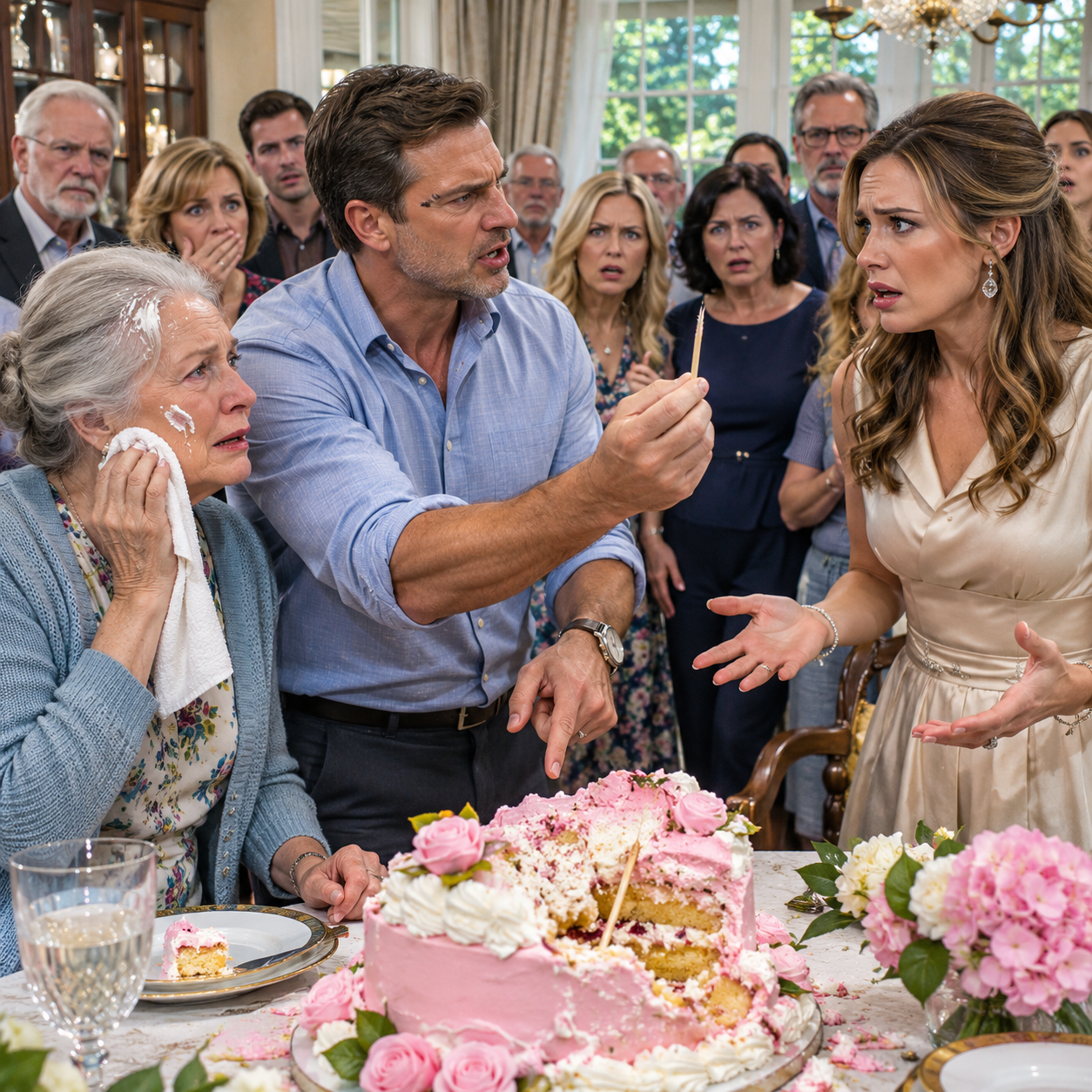
“And tonight?” I asked, although I already feared her answer. “Tonight, she embarrassed me in front of everyone, and I ended up here because of something she did,” Mom replied. “I can’t prove she knew that toothpick would hurt me, and I won’t accuse her of something I can’t prove.” Then she looked directly into my eyes and said, “But I know she was willing to make me look helpless, and I know she enjoyed watching people believe it.”
I leaned back against the wall, remembering something Priscilla had said several evenings earlier while we washed dishes. She’d suggested that if Mom entered assisted living, we could help manage her finances and make sure her house and savings were handled responsibly. I’d dismissed the conversation because Mom still lived independently, paid her own bills, and maintained her garden without assistance. Now I wondered how long Priscilla had been planning for a future in which my mother no longer controlled her own life.
Mom touched the edge of her bandage and gave a tired smile. “I’m seventy-three, sweetheart, but I still know when someone is taking things that belong to me.” Her words struck harder than any accusation because they were spoken without anger. She wasn’t demanding revenge, or even asking me to choose between her and my wife. She simply wanted me to believe what she’d spent months proving.
A familiar voice drifted down the hallway. “Desmond? Is everything okay in there?” Priscilla sounded cheerful again, as though the hospital visit were merely an inconvenient interruption to our evening. I slipped Mom’s phone into my jacket pocket and stood beside her bed. For the first time in six years, I wasn’t relieved to hear my wife’s voice approaching.
Priscilla entered carrying two paper cups of coffee, smiling until she noticed my expression. “How’s our birthday girl?” she asked, placing one cup on the counter. Mom remained silent while Dr. Ainslie appeared in the doorway to check whether she needed anything else. I looked at Priscilla and asked a question that seemed to drain the warmth from the entire room.
“Did you know there were toothpicks inside that cake?”
## Part 3: One Hospital Room Confrontation Destroyed Six Years of Trust
Priscilla blinked, then gave an uncomfortable laugh. “Of course I knew there were toothpicks, Desmond. I made the cake, remember?” I asked whether she’d considered what might happen if someone’s face struck one of them, and her expression hardened. “I wasn’t trying to hurt your mother,” she replied. “It was supposed to be funny, and you’re making it sound like I planned some terrible accident.”
“Then explain the hearing aid,” I said quietly. Priscilla stared at me without speaking, and I watched her fingers tighten around the paper cup. “The one you took from Mom’s purse two weeks ago,” I continued. “Was that supposed to be funny, too?”
Her face went pale. She glanced toward Mom, then toward the doctor standing near the doorway. “I have no idea what you’re talking about,” she said, but the confidence had disappeared from her voice. I took out Mom’s phone, opened the recording, and held the screen where she could see herself taking the hearing aid. When the video ended, Priscilla slowly lowered herself into the nearest chair.
For several seconds, nobody spoke. Then she covered her face and whispered, “You don’t understand what I’ve been dealing with.” She admitted she’d accumulated debts she hadn’t told me about and had been quietly using money from our savings account to keep up with payments. “I didn’t want to worry you,” she insisted. “Your mother has money sitting around, Desmond, and jewelry she never wears.”
I stared at her, waiting for some sign that she understood what she’d just confessed. “So you decided to steal from her instead of telling me you needed help?” I asked. She lifted her head, anger briefly replacing shame. “I was going to put everything back when things improved,” she said. “I never wanted any of this to happen.”
“Then why did you take my hearing aid?” Mom asked. Her voice remained calm, but her eyes were wet. “You watched me struggle for two weeks, Priscilla, and you told everyone I was becoming confused.” Priscilla opened her mouth, then closed it again. There was no explanation that could make those two facts fit together innocently.
I remembered my wife’s repeated suggestions about assisted living and the way she’d spoken about Mom’s finances as though they were already ours to manage. “You weren’t just hiding theft,” I told her. “You were making people think Mom couldn’t take care of herself so nobody would question what was disappearing.” Priscilla shook her head, but she couldn’t look at either of us. “I was worried about her,” she whispered, sounding less convinced with every word.
Dr. Ainslie stepped forward and explained that the hospital would involve its social worker and make the appropriate report regarding suspected elder abuse. He spoke professionally, without accusing Priscilla of deliberately causing the cake injury, but he made clear that the theft allegations and possible exploitation required attention. Priscilla immediately stood and reached toward me. “Please, Desmond, we can handle this ourselves. We don’t need strangers involved in our family.”
I stepped away from her hand. “You had three months to handle this honestly,” I said. “Every Thursday, you walked into my mother’s home, took what you wanted, and then came to our dinner table pretending to care about her.” She began crying, but I couldn’t find the sympathy I’d once offered whenever she was upset. I could only remember Mom apologizing to our relatives because she couldn’t hear their questions.
The following weeks stripped away any hope that the evening could be dismissed as an unfortunate family misunderstanding. Police officers reviewed the recordings, took statements, and documented the missing money, jewelry, and hearing aid. The hospital’s report became part of a larger investigation, while relatives who had witnessed the birthday incident described what they’d seen. I hired a divorce attorney, an act that felt strangely unreal after six years of believing I understood the person sleeping beside me.
Priscilla’s attorney described her behavior as financial desperation rather than deliberate exploitation. But the recordings showed repeated, purposeful theft, and witnesses remembered how persistently she’d questioned Mom’s mental abilities. Investigators also examined financial records that revealed debts I’d never known existed. The woman who had claimed she was protecting our household had been hiding a crisis while making my mother pay for it.
Then a document arrived that made the investigation even more disturbing. An assisted-living facility had received an inquiry from Priscilla weeks before the birthday party, describing Mom as increasingly confused and suggesting that her family supported arranging an assessment. I had never agreed to anything of the kind. The inquiry contained no proof that Mom needed residential care, but it showed that Priscilla had already begun acting on the story she’d been telling everyone.
I laid the document on Mom’s kitchen table, unable to disguise my anger. She read it carefully, then removed her glasses and folded them beside her coffee. “She wasn’t waiting for me to lose my independence,” Mom said quietly. “She was trying to make everyone believe I’d already lost it.”
For the first time since the birthday party, I understood that our marriage hadn’t collapsed because of one dreadful joke. That joke had merely exposed what was happening beneath the surface, and the worst betrayal was how patiently my wife had prepared everyone to doubt the person she was exploiting.
## Part 4: The Final Revelation Restored My Mother’s Dignity and Freedom
Six months after the birthday party, my divorce was finalized. Priscilla accepted a plea agreement on the theft charges, agreeing to restitution and probation rather than facing a lengthy contested criminal proceeding. The investigation into her treatment of Mom had consequences beyond the money she was ordered to repay. Yet when I signed the final divorce papers, I felt no satisfaction, only the hollow recognition that the marriage I’d defended so fiercely had never been the marriage I thought I had.
The hearing aid was eventually recovered, and Mom received an upgraded replacement properly fitted to her needs. The difference was immediate. At our first family dinner after everything settled, she followed every conversation, laughed at my sister’s stories, and corrected my nephew when he exaggerated how many fish he’d caught that summer. Nobody suggested she was confused, and nobody needed to repeat a question three times.
One evening, I visited her house and found her sitting in the living room where she’d secretly recorded those Thursday visits. The little camera was still perched on a bookshelf, almost hidden behind a framed photograph of my father. Mom noticed me looking at it and sighed. “I suppose I should take that thing down,” she said. “I don’t want to spend the rest of my life watching the people I love.”
I sat beside her, carrying the question that had followed me through every legal appointment and sleepless night. “How did I miss it, Mom?” I asked. “You were struggling right in front of me, and I believed Priscilla when she said you were getting confused.” Mom turned toward me, her expression gentle but serious. “You trusted your wife, Desmond, and I understood why. What matters is that when you finally saw the truth, you didn’t turn away from it.”
I told her I still couldn’t forgive myself for that birthday party. The image of her standing before the cake, smiling just before Priscilla’s hand struck her head, returned whenever I closed my eyes. Mom reached across the sofa and squeezed my fingers. “I’m still here,” she said. “And I’m not going to give that woman the rest of my life just because she took a few months of peace away from me.”
Several weeks later, my attorney forwarded the completed case records, including the assisted-living inquiry that had initially shocked us. Among the documents was an earlier message Priscilla had sent to the facility, claiming that I was having difficulty accepting my mother’s decline and needed guidance on how to persuade her to cooperate. The message was dated three days after the recording showed Priscilla stealing Mom’s hearing aid. Reading those words, I realized the timing was more revealing than anything Priscilla had admitted.
She had removed the device that helped Mom understand conversations, then used Mom’s difficulty hearing as evidence that she couldn’t understand the world around her. Whether she’d intended the birthday injury remained unproven, but the manipulation surrounding it no longer depended on suspicion. The recordings, messages, and financial evidence showed a deliberate attempt to turn a capable elderly woman into someone whose judgment could be dismissed. What Priscilla had called concern was a disguise for control.
I brought the message to Mom, expecting her to be devastated. Instead, she read it twice, placed it neatly on the table, and walked to the kitchen window. Outside, the garden she’d tended for decades was beginning to bloom again. “Your father used to tell me that people show you who they are when they believe nobody is watching,” she said. “I suppose he never imagined I’d need a camera to prove it.”
I asked whether she regretted waiting so long to tell me. Mom considered the question before answering. “I regret that I was afraid you’d choose her version of me over the woman you’ve known your whole life,” she admitted. “But I’m glad you finally saw me clearly.” Her words settled somewhere deeper than the anger I’d carried since the hospital.
Two years later, I married again. The woman I married, Caroline, never treated Mom’s age as a weakness or her independence as an inconvenience. She visited because she enjoyed Mom’s company, remembered the stories about my father, and never touched anything in the house without asking. Mom welcomed her slowly at first, then with the wholehearted affection I’d once mistakenly believed Priscilla deserved.
On Mom’s seventy-sixth birthday, we gathered around the same dining table where everything had gone wrong. My sister’s children chased one another through the living room while Caroline brought out a simple strawberry cake, decorated with fresh fruit and three small candles arranged in the shape of a star. Mom studied the cake, then looked up at me with a mischievous smile. “You’re not going to let anybody smash this one into my face, are you?”
Everyone laughed, including Mom, and I felt something inside me finally loosen. “Not a chance,” I promised, moving the cake closer so she could reach the candles comfortably. She leaned forward and blew them out in one breath, her hearing aids tucked discreetly beneath her silver hair. When we applauded, she heard every clap.
Later, as the others cleared the dishes, Mom stood beside me at the kitchen sink. She handed me a small photograph she’d found while cleaning out an old drawer, showing my father holding me as a child, both of us laughing at something outside the frame. On the back, in his familiar handwriting, he’d written, “Take care of each other, especially when it isn’t easy.”
I ran my thumb over those words, wishing he could have been there to see how close we’d come to losing one another’s trust. Mom rested her hand against my shoulder and glanced toward the dining room, where Caroline was helping the children divide the remaining cake. “Some people learn how to look loving,” she said softly. “Others simply love you when nobody’s watching.”
I thought about Dr. Ainslie and the quiet way he’d closed that consultation-room door three years earlier. He had treated a small physical injury, but he’d also listened when my mother told him she was afraid, and he’d given her the privacy to speak. Without that moment, I might have continued mistaking her hearing difficulties for confusion and my wife’s calculated behavior for concern.
Mom picked up her photograph and smiled at the family gathered in the next room. She had her home, her independence, and the confidence to speak without wondering whether anyone would believe her. I had lost a marriage, but I hadn’t lost my mother, and that was a difference I would never take for granted again.
The worst thing Priscilla stole wasn’t the money, the pearls, or even the hearing aid my father had helped Mom buy. It was the certainty that my mother could trust the people closest to her.
And the greatest thing we recovered wasn’t something the police found or a court ordered returned.
It was her right to be heard.
THE END.
All characters and events in this story are fictional, created for storytelling and entertainment purposes. Thank you sincerely for reading. Your feedback and support are invaluable and motivate me to continue sharing more stories with you.