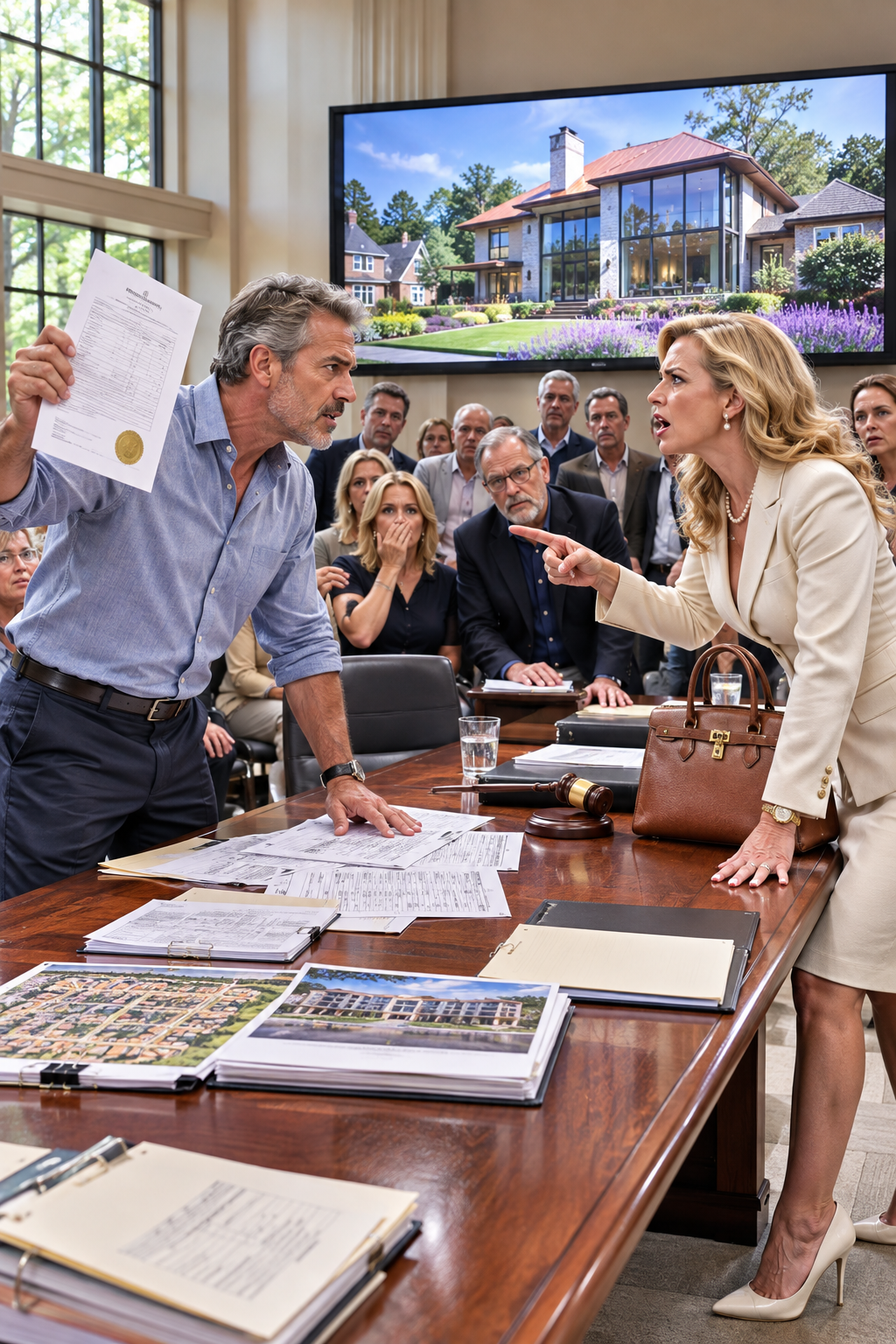
## Part 2: A fraudulent land scheme revealed why my home had to disappear.
The cardboard box landed on my kitchen table with a heavy thud. Inside were 212 pages of public property records, corporate filings, and financial documents that I had spent weeks assembling with Harrison Wells. I spread them beneath the pendant light Elena had designed, lining up dates, names, and addresses until the pattern became impossible to ignore. Every suspicious transaction pointed toward Glenn Ashford, the quiet husband who smiled at neighborhood cookouts while Victoria terrorized the families living around him.
Glenn controlled three property companies: Ashford Properties LLC, Ridge Partners LLC, and Peachtree Holdings Inc. Over nine years, those companies had purchased fourteen houses in Ridgewood Estates, most at prices thirty to forty percent below their estimated market values. Each purchase followed months of aggressive HOA fines, frightening inspection notices, or threatened legal action against the previous owners. Victoria created the pressure, frightened families sold their homes, and Glenn appeared with an offer.
One document made my hands go cold.
It was a letter of intent between Glenn’s property operation and Meridian Development Group, outlining a proposed $40 million luxury condominium project containing approximately two hundred units. The developer needed clear title to every parcel in Block Seven before construction could proceed. My property, 412 Ridgewood Lane, was the last parcel Glenn had failed to acquire.
I sat at the table staring at Elena’s photograph on the mantel. Victoria hadn’t been fighting over roofing materials or flowers; she’d been trying to remove the final obstacle between her husband and a fortune. The threats, false violations, and fabricated engineering report suddenly fit together like carefully machined parts. What she’d called neighborhood protection was a land-acquisition operation disguised as community governance.
The financial records uncovered something uglier.
Over six years, approximately $380,000 had left the HOA operating account through payments attributed to Ashford Consulting Services. Our searches found no legitimate business matching the payment records, and Victoria had authority over the association’s disbursements. Harrison obtained additional bank records through legal process, uncovering transfers that appeared to connect the suspicious payments to her personal spending. One $18,500 luxury purchase occurred shortly after an almost identical HOA withdrawal, and the amount matched the handbag she displayed beside her gavel at meetings.
“She’s using the homeowners’ money to help control the homeowners,” I told Harrison.
He examined the documents for a long moment before closing his glasses. “Tom, we’re no longer looking at a dispute over architectural guidelines. We’re looking at evidence of coordinated fraud, financial misconduct, and a scheme involving multiple families.”
We spent the next several weeks preparing rather than confronting Victoria. Harrison interviewed former residents, including Sandra Kemp, whose family had sold their house at a painful loss after years of HOA harassment. Sandra sat across from me in her small Marietta apartment, gripping a coffee mug while explaining how Victoria had convinced neighbors that her family was dangerous and irresponsible. “She made us feel ashamed of owning our own home,” Sandra said, and when I showed her the property records, she covered her mouth with both hands.
The Hendersons, Taylors, and Bartons described similar experiences. Their stories contained different details but followed the same sequence: questionable citations, escalating penalties, public humiliation, and eventual sales to companies connected to Glenn. Each family agreed to help Harrison establish the pattern. For the first time, Sandra told me, she believed someone might actually listen.
I installed six high-definition security cameras around my house and arranged for the recordings to be stored on a system in my neighbor Nate Brooks’s garage. Copies of our evidence went into Harrison’s office, a bank safe-deposit box, and Nate’s attic. I also asked Harrison to seek urgent legal protection against demolition, because the possibility of losing Elena’s house had become terrifyingly real.
An emergency court request was filed, but before the matter could be fully resolved, Victoria accelerated her campaign. Her newest letter demanded removal of the supposedly unsafe structure and claimed the HOA had authority to proceed with enforcement. Harrison sent formal notice that the resolution was disputed, the county had certified the house as safe, and no demolition could lawfully proceed on the strength of her private decree.
Victoria ignored the warning.
That Saturday, Claire competed in the Georgia State Piano Championship in Savannah. She played Chopin’s First Ballade, a piece Elena used to hum while sketching at the dining room table. When Claire finished, the audience rose, and I stood applauding with tears running down my cheeks. She won second place and carried her trophy from the auditorium as if it were made of gold.
I didn’t check my phone until we reached the car.
Four missed calls from Nate.
One message.
“Tom, please come home. I’m so sorry.”
I called immediately, but when Nate answered, all I heard at first was heavy breathing and machinery in the distance.
“Tom,” he said, his voice shaking, “Victoria brought demolition trucks. I tried to stop them.”
I pulled onto the highway, gripping the steering wheel so tightly my fingers ached. Claire looked over from the passenger seat, her trophy resting against her knees. “Dad, what’s wrong?”
I stared at the road ahead, searching for words that wouldn’t destroy the joy she’d carried out of that auditorium.
“Something happened at home, sweetheart.”
When we reached Ridgewood Lane, I saw an empty space between numbers 410 and 414. Where Elena’s copper roof should have caught the afternoon sun, there was only broken concrete, twisted metal, and bare Georgia clay.
Claire’s trophy slipped from her hands and cracked against the floor.
## Part 3: Six hidden cameras captured the destruction of everything my wife left.
I stepped out of the car and stood before the wreckage without moving. Our house, the one I’d built from Elena’s drawings, had been flattened into a mound of splintered timber, shattered glass, and folded copper. The lavender garden was gone, and the living room window where Will once watched sunsets had disappeared beneath crushed masonry. Behind me, Claire whispered, “Daddy, where’s Mom’s house?”
I had no answer.
Nate stood near the sidewalk with Will, who had been staying at a friend’s house when the demolition began. My eleven-year-old son held a broken ceramic vase against his chest, its painted lavender sprigs still recognizable beneath the dust. Elena had made it before she became ill, and Will looked at me with an expression I will remember for the rest of my life. “I couldn’t save the other half,” he said.
I knelt beside him and pulled him into my arms.
Nate explained that Victoria had arrived at nine that morning in her white Range Rover, followed by three demolition trucks. She wore a white pantsuit and stood on the curb while workers unloaded equipment and prepared to enter the property. Nate had challenged the crew and contacted authorities, but the machinery was already moving by the time anyone could intervene. Victoria simply pointed toward our front entrance and ordered, “Tear it down. I want everything flat by lunch.”
I walked slowly across the ruins, finding pieces of the life we’d built. A bent copper panel lay near the curb, its edges beginning to turn the gentle green Elena had predicted. Beneath a fractured piece of drywall, I discovered our wedding photograph, the glass shattered but Elena’s smiling face miraculously untouched. I slipped it into my jacket, then turned toward Nate.
“Did the cameras survive?”
He nodded. “Every recording is safe in my garage.”
We watched the footage that evening after the children had settled into Nate’s guest rooms. The first camera showed Victoria directing the machinery toward my house, while another captured the walls collapsing under the impact. Nate’s phone footage recorded her turning toward him and smiling as she insisted the demolition was authorized community action. Later, one of the cameras caught her examining dust on her expensive shoes before climbing into the Range Rover, checking her reflection, and applying fresh lipstick.
Harrison arrived before midnight. He watched the recordings twice, then compared them against the county inspection, Victoria’s notices, and the pending legal filings. “There was no valid court order authorizing this destruction,” he said, placing his pen on the table. “And we’ve got her issuing the commands herself.”
I looked through the doorway toward Claire, who sat on the borrowed bed staring at her broken trophy.
“How much is a house like that worth?” I asked.
Harrison followed my eyes. “The building has a monetary value, Tom, but what she destroyed goes beyond lumber and glass. We will document every loss, and we will ask the court to hold everyone responsible.”
I slept on the floor between my children’s beds that night. Will kept the broken vase beside his pillow, and sometime after midnight, Claire asked whether her mother’s paintings had survived. I remembered the watercolors Elena had painted during chemotherapy, framed carefully in our hallway, and felt my throat close. “I don’t know, sweetheart,” I answered, because I couldn’t bring myself to offer another promise I might be powerless to keep.
Victoria returned the next morning.
Her Range Rover rolled slowly to the curb while I stood beside the empty lot holding a cup of coffee. She stepped onto the disturbed earth, adjusted her sunglasses, and surveyed the destruction with obvious satisfaction. “I warned you, Thomas,” she said. “Your house violated our rules, and now the community can move forward.”
Across the street, Nate stood on his porch watching us.
I studied Victoria’s face for several seconds before taking out my phone and calling Harrison. “She’s here,” I told him, keeping my voice steady. “And the cameras caught everything.”
Victoria narrowed her eyes. “Calling your lawyer won’t change what happened.”
“No,” I answered. “It won’t.”
Her expression stiffened when I added, “But the people who ordered this will have to explain why.”
Four months later, I sat in Fulton County Superior Court while Harrison displayed the recording on a large courtroom screen. Victoria arrived wearing an immaculate cream-colored dress, with Glenn sitting beside her in an expensive navy suit. She smiled at the jurors as if she were attending a charity luncheon, but that smile disappeared when the first image of my demolished home filled the screen.
Harrison began with Ray Patterson’s official inspection confirming that my house had no structural deficiencies. He then questioned Craig Donovan about his engineering qualifications, the measurements he had supposedly taken, and his relationship with Glenn’s companies. Craig shifted repeatedly in the witness chair, admitting he held no professional engineering license and had signed proxy forms for properties controlled by Glenn.
Next came the recordings.
Victoria’s voice rang through the courtroom: “Tear it down. All of it.”
A juror lowered her eyes, and another stared directly at Victoria. Harrison then projected the property transfer records, showing fourteen families whose houses had been purchased by Glenn’s companies after repeated HOA enforcement actions. The Meridian development agreement appeared next, its $40 million projection displayed above the clause requiring acquisition of Block Seven.
Finally, Harrison introduced a text message obtained during discovery. The screen showed Victoria writing to Glenn about my property being the last remaining parcel and how the development deal could close once the house was flattened.
Victoria gripped the edge of her table.
Her attorney leaned toward her, whispering urgently, but she didn’t respond.
Harrison let the silence settle before displaying one final photograph: Victoria’s expensive handbag resting beside the HOA gavel. He then presented financial records linking association funds to luxury purchases, including the $18,500 transaction. Sandra Kemp testified afterward, looking directly at Victoria as she described losing her home and discovering that Glenn’s company had been waiting to purchase it.
“You told us we were the problem,” Sandra said, her voice trembling. “But you were the one who wanted our property.”
For the first time since I’d met her, Victoria had nothing to say.
The jury retired to deliberate, and I walked into the courthouse hallway carrying Elena’s wedding photograph in my jacket pocket. Harrison joined me beside a window overlooking the city.
“Whatever happens,” he said, “she can’t bury the truth anymore.”
Ninety minutes later, the courtroom clerk opened the doors and announced that the jury had reached a verdict.
## Part 4: A $12 million judgment exposed the truth and restored our future.
The courtroom fell silent when the jury returned. Victoria sat perfectly upright, her hands folded beside the handbag she’d carried through every HOA meeting, while Glenn stared down at the polished wooden table. Harrison placed a hand against my shoulder, and I thought of Claire’s broken trophy, Will’s shattered vase, and Elena’s drawings hidden somewhere beneath the rubble. The jury foreperson stood, unfolded a sheet of paper, and began reading.
The first award was $1.8 million for the destruction of my property and related economic losses. The second was $3.2 million for additional compensatory damages, including proven emotional harm and the loss of irreplaceable belongings. Then came $7 million in punitive damages for the deliberate, fraudulent conduct the jury had found. Together, the awards totaled twelve million dollars.
Victoria made a faint sound, almost a gasp.
Judge Catherine Moore reviewed the verdict and announced the $12 million judgment, subject to the court’s remaining post-trial procedures. She looked toward Victoria, her expression controlled but unmistakably stern. “An HOA is entrusted with protecting a community,” she said. “It is not a private government empowered to destroy lawful property whenever its president wishes.”
I lowered my head as Harrison squeezed my shoulder.
Twelve million dollars could finance an extraordinary home, but I would have given every cent to walk through my old front door one more time and see Elena’s watercolors hanging on the hallway wall. I would have traded the entire verdict for a single ordinary evening, with Claire playing piano upstairs and Will complaining about homework beneath the windows his mother designed. Money could punish what Victoria had done; it couldn’t return the years she had erased.
The verdict was only the beginning of her collapse.
The civil proceedings had exposed evidence that prosecutors were already reviewing in a separate criminal investigation. Outside the courtroom, federal officers served Victoria with an arrest warrant connected to alleged fraud, conspiracy, and misuse of association funds. Her handbag slipped from her fingers onto the marble floor as the officers approached, and she stared at it without moving while they explained the charges.
Glenn’s composure lasted another forty-eight hours. Authorities intercepted him at Hartsfield-Jackson International Airport while he was preparing to board a flight to Grand Cayman. Investigators subsequently obtained financial and corporate records connecting his companies to the disputed property acquisitions and the planned development deal. Meridian Development’s chief executive, Doug Mercer, cooperated with investigators and provided years of correspondence describing the negotiations.
The criminal cases proceeded separately from my civil judgment, with their own legal process. But the public evidence changed Ridgewood Estates almost immediately. Homeowners demanded access to association records, challenged the legitimacy of Victoria’s private addendum, and replaced the board that had allowed her to dominate the neighborhood. A newly elected board adopted safeguards requiring independent legal review and proper judicial authorization before any proposed enforcement involving destruction of property.
Doris, the former HOA secretary, called me shortly after the election.
“I used to dread going to work,” she admitted. “Every time the telephone rang, I wondered whose life she was ruining next.”
I thanked her for finally providing the records that helped expose the scheme. Then I attended the first open community meeting, where neighbors apologized to the families they had once treated as troublemakers. Sandra Kemp sat beside me, holding tissues as residents acknowledged how easily they’d accepted Victoria’s accusations without questioning the evidence.
The process of collecting the judgment took time, and the final recoveries involved assets and settlements connected to the defendants. Once sufficient funds were secured, I committed one million dollars to establish the Elena Garrett Community Legal Defense Fund. Its purpose was simple: help families facing unlawful HOA fines, abusive enforcement, and fraudulent property schemes obtain legal advice before they lost everything. Sandra agreed to serve on its advisory board, telling me that helping someone else keep a home might finally make sense of what her family had endured.
Then I began rebuilding.
I used the same plot, the same copper roof design, and the same floor-to-ceiling windows Elena had sketched in her hospital bed. The foundation rose from the same Georgia soil, and every structural connection was inspected as carefully as the first time. Nate showed up with a ladder and tools, Sandra brought lavender seedlings from Marietta, and new neighbors arrived carrying food or offering an afternoon’s labor.
When the final window was installed, Claire stood beside me in the living room and watched sunlight spill across the unfinished floor. “Mom would like this,” she said quietly. I looked at the blueprints spread across a workbench and nodded, unable to speak for a moment.
The new house opened its doors one year after the demolition.
Claire placed her piano trophy on the mantel, its cracked base repaired with glue but still marked by a thin visible line. When I offered to have it professionally restored, she shook her head. “Leave the crack, Dad,” she said. “It reminds me that something can break and still be worth keeping.”
Will carefully arranged the surviving half of Elena’s ceramic vase inside a glass display case. Beside it, I placed our wedding photograph in a new frame, preserving the tiny scratches left behind when its original glass shattered. I wanted the house to remember what had happened without allowing the destruction to define every room.
The final surprise came during cleanup, when a worker found a folded sheet of graph paper lodged between two broken pieces of the original foundation. The edges were stained, but I recognized Elena’s handwriting immediately. It was a drawing of the lavender garden, complete with planting measurements and a tiny handwritten instruction in the corner.
I carried it inside and flattened the paper beneath a sheet of glass.
At the bottom, in Elena’s familiar looping script, were six words I hadn’t seen before.
“Leave room for everything to grow.”
I stared at the sentence until tears blurred the ink. For years, I’d believed that building Elena’s dream exactly as she designed it was the only way to keep my promise. Standing in the new house, surrounded by people who had helped us rebuild, I finally understood that her dream had always been bigger than copper, timber, or glass.
She wanted a place where our children could grow without fear, where the windows opened toward the sky, and where the people inside felt safe enough to call it home.
That evening, Sandra and Nate joined us for dinner, and the children carried plates onto the back porch overlooking the newly planted garden. We talked about ordinary things—school, repairs, the weather—and nobody mentioned Victoria Ashford or the judgment. When everyone had gone home, I stood beside Elena’s framed sketch and watched the moonlight settle over the lavender.
The flowers were beginning to bloom.
I touched the corner of the frame and remembered something Elena used to say whenever the winter frost damaged her garden.
“Don’t pull the roots, Tom. Give them spring.”
Victoria had believed that destroying my house would force me to surrender the land beneath it. Instead, her actions exposed a scheme that had harmed fourteen families, ended her control over Ridgewood Estates, and gave those families a chance to reclaim their dignity.
The twelve million dollars was a judgment against her cruelty, but it wasn’t the victory I treasured most.
The real victory came when Will walked into the living room, curled up beneath the window his mother had designed, and opened a book without looking over his shoulder.
Claire began playing the piano upstairs, the same melody Elena used to hum while she drew.
And for the first time since the bulldozers came, our house sounded like home again.
THE END.
All characters and events in this story are fictional, created for storytelling and entertainment purposes. Thank you sincerely for reading. Your feedback and support are invaluable and motivate me to continue sharing more stories with you.