
## Part 2: I surrender the inheritance and discover freedom beyond their walls.
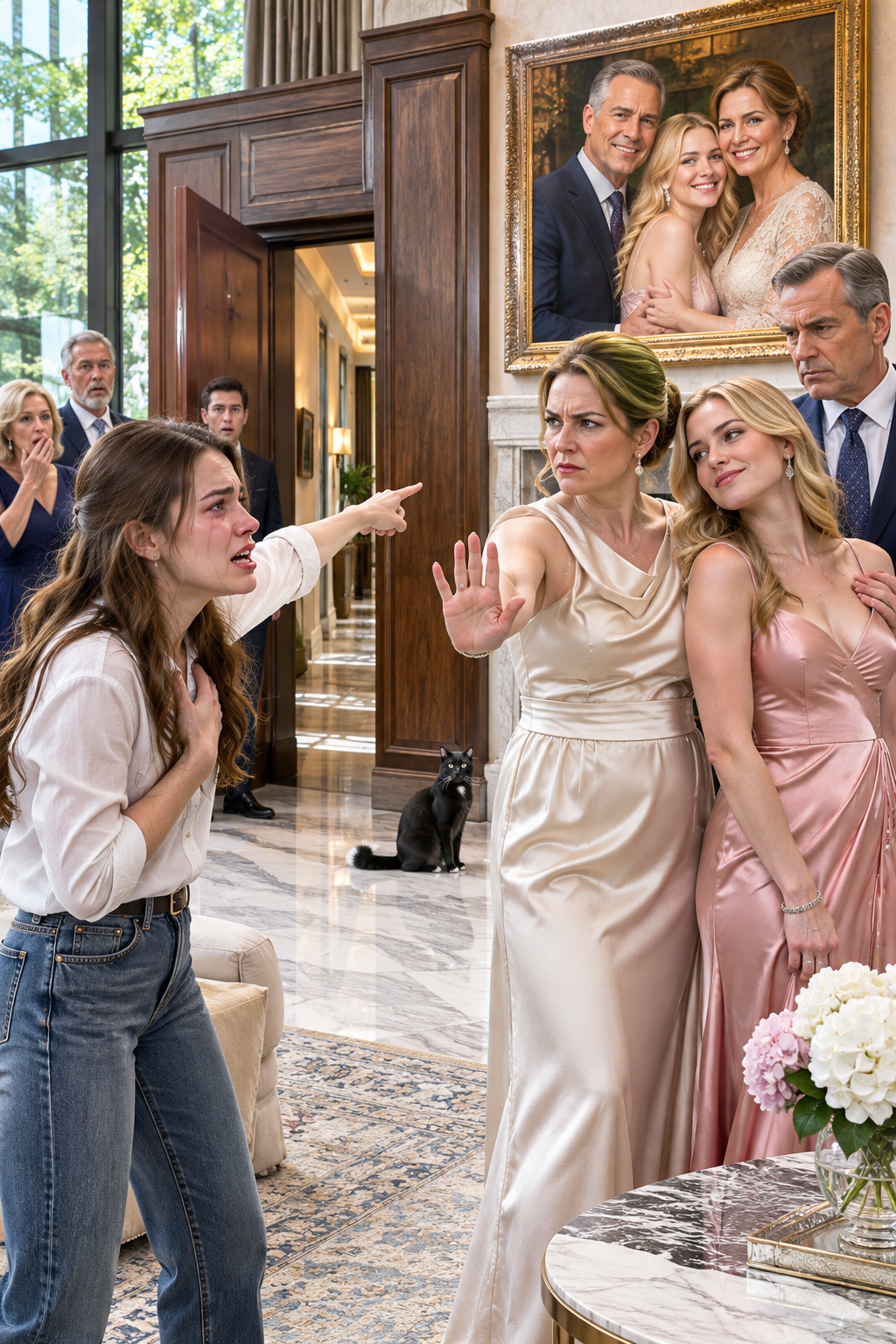
“Danielle, what are you doing in here?” Father’s angry voice interrupted my thoughts, and I turned to find my parents standing in the doorway with Suzanne. Mother rushed toward the family portrait as though she expected me to destroy it, while Suzanne stepped forward with an accusing glare. “She came here to ruin everything,” Suzanne complained, reaching for my shoulder, but I moved aside before she could touch me. When she stumbled, Mother immediately caught her and demanded to know why I couldn’t leave her precious daughter alone.
“I’m not here to fight,” I answered quietly. “Suzanne grew up with you, and she’s the daughter you’ve chosen. I understand that now.”
Mother’s anger disappeared so quickly it almost frightened me. “Wonderful! Then there’s no reason to keep two houses separate,” she exclaimed, turning toward Father with excitement. “We’ll finally live together, and preparing Suzanne’s wedding will be so much easier.” I nodded without arguing, although I knew that whatever Mother meant by together, she wasn’t imagining a future that included me.
Within hours, my parents began moving their belongings through the hidden passage. I returned to my bedroom expecting to hear furniture being carried into our house, but the hallway grew strangely silent instead. When I opened their bedroom door, the closets were empty, the drawers stood open, and the secret entrance led toward the warm lights of Suzanne’s villa. They hadn’t brought their family home; they had simply abandoned the house where I lived.
Through the passage, I watched them raise champagne glasses around Suzanne’s dining table. Mother stroked Suzanne’s hair and murmured, “You’ve suffered so much, sweetheart. At last, everything is going to be right.” I remembered arriving home years earlier with bruises from my childhood, while Mother worried about packing Suzanne’s jewelry for her supposed departure. I had mistaken their coldness for exhaustion until that night proved how tender they could be when they wanted to.
The following morning, Mother summoned me to the neighboring villa and placed several photographs of eligible men across the table. “Since Suzanne is marrying into the Klein family, we’ve found some excellent candidates for you,” she announced. I recognized the familiar strategy from the future I had witnessed underwater: my parents would arrange another marriage, hoping to silence any complaint about their favoritism. In that other future, my resentment had helped place me near the researcher whose stolen radioactive material eventually caused my illness.
Father cleared his throat before delivering another announcement. “Suzanne deserves a proper start in married life, so we’re planning to give her our available cash as a wedding gift. We’ll arrange something for you afterward.”
“Give her everything,” I replied.
Suzanne’s eyes widened, and Mother immediately reached across the table to squeeze her hand. They seemed convinced that I had finally become obedient, never realizing that my agreement was the first decision I had made entirely for myself. That afternoon, I submitted my final paperwork for an overseas research transfer, packed the few clothes I owned, and retrieved my great-grandfather’s leather notebook from the attic. I had spent years secretly studying his handwritten medical formulas, finding comfort in the work whenever my parents forgot I existed.
Less than a month later, my transfer was approved, and Suzanne’s wedding preparations were complete. On the wedding morning, I slipped through the garden with my suitcase, only to hear Suzanne arguing behind the hedges with Stanley and Trudy Pard. “We’re your real parents,” Stanley insisted. “You can’t keep us away from our daughter’s wedding.”
Suzanne glanced toward the house before lowering her voice. “Stop embarrassing me. Once the marriage is official, I’ll bring Martin to your reception, and everyone can see who his real in-laws are.” Trudy immediately began discussing the expensive gifts their relatives would bring, while Suzanne promised that all the wedding money would remain in their family. I realized she intended to abandon the Westons as soon as their wealth had secured her position.
What Suzanne didn’t understand was why the Kleins had honored a seventy-year-old marriage agreement in the first place. Their powerful family carried a hereditary illness, and my great-grandfather had left behind research that might hold the key to treating it. The agreement concerned his biological descendants, not simply whoever happened to be raised beneath the Weston name. Suzanne believed she was marrying into unimaginable wealth, but Martin Klein was actually pursuing a medical legacy she knew nothing about.
Before I could escape, my parents spotted me beside the garden path. Father barely glanced at my suitcase before thrusting a camera into my hands and ordering me to photograph the departing wedding party. I obeyed, taking pictures while Suzanne climbed into the decorated limousine and my parents waved beneath a shower of flower petals. Then, when no one was watching, I turned the camera toward myself and took one final photograph.
I was smiling as I waved goodbye.
For once, that smile wasn’t meant to convince my parents I was happy.
It was real.
## Part 3: A wedding deception destroys two fortunes while my hidden legacy awakens.
At the airport, I watched the departure board change while my phone vibrated against my passport. Mother was calling, furious because I’d disappeared before anyone could make me clean up the wedding decorations. “Suzanne has always wanted a giant piece of coral for her bedroom,” she snapped. “Go find one before her reception in three days, and stop making everything difficult.”
“I’m leaving the country,” I replied. “I won’t be attending the reception, and I’m not coming home.”
Mother accused me of staging another jealous tantrum and disconnected the call before I could explain. Instead of worrying about where I was going, she announced that Suzanne’s celebration would be twice as extravagant to prove that nobody could spoil her happiness. I boarded my flight without sending another message.
Three days later, eighty banquet tables glittered beneath crystal chandeliers at the Grand Hyatt. Richard and Eleanor Weston had invited prominent executives, wealthy relatives, and business partners, but the newlyweds were nowhere to be seen. After an hour of waiting, Mother called Suzanne, whose cheerful answer left her staring at the phone. “Of course I’m at the reception,” Suzanne said. “I’m celebrating with my real parents.”
Across the city, Suzanne stood beside Martin Klein in a crowded banquet hall filled with Pard relatives. Stanley raised his glass and loudly introduced himself as Martin’s father-in-law, while Trudy collected envelopes of money from guests who believed their daughter had married into one of the country’s wealthiest families. Suzanne proudly announced that she had no biological connection to the Westons, apparently forgetting that hundreds of people were watching her livestream. Beside her, Martin lowered his champagne glass, his expression hardening as the truth became impossible to ignore.
Back at the Grand Hyatt, a Klein Enterprises representative entered carrying a leather folder. He walked directly toward my parents and announced that Martin had instructed the family’s lawyers to seek annulment and terminate their business agreements. “The marriage covenant concerns the direct descendants of Danielle Weston’s great-grandfather,” he explained before the stunned guests. “Your daughter Suzanne has publicly acknowledged that she has no biological claim to that lineage.”
Father protested that Suzanne was their daughter in every meaningful sense. The representative replied that the Kleins had entered the arrangement to obtain legitimate access to ancestral medical research, not to finance a deception. When he demanded my whereabouts, Mother suddenly remembered our last telephone conversation, the one in which she had refused to hear where I was going. She searched her contacts with trembling fingers, but I had already removed my old SIM card.
Within days, Klein Enterprises suspended its investments and initiated legal action over the misrepresented marriage agreement. Suppliers began demanding immediate payment, banks reviewed outstanding loans, and business partners who once praised my father’s judgment stopped returning his calls. The Westons’ pharmaceutical empire, which had seemed invincible throughout my childhood, began collapsing under debts my parents had never expected to face.
Meanwhile, I was beginning work at the Institute of Molecular Therapeutics in Basel, Switzerland. Professor Weber handed me laboratory results derived from compounds described in my great-grandfather’s notebook, their chemical structures matching patterns I had spent years painstakingly deciphering. “Danielle, the early stabilization results are extraordinary,” he said, placing the printouts beside my coffee. “We may have something worth developing into a genuine treatment.”
I ran my finger along the figures, remembering the attic where I had studied those formulas beneath a weak desk lamp. My parents had dismissed the notebook as worthless folklore, yet its pages contained insights their expensive laboratories had never fully explored. “Then we keep working,” I told Professor Weber. “And whatever comes from it must be evaluated properly, with patients’ welfare ahead of family profit.”
Back home, Suzanne’s marriage was already disintegrating. Martin’s lawyers had challenged the union, and he refused to give her access to his family’s fortune. She returned to the Weston mansion demanding that my parents produce the secret formula immediately, threatening to expose their hidden arrangement if they failed. Father admitted that the original manuscript belonged to me, and Mother finally remembered watching me carry an old leather notebook out of the attic.
“Then bring Danielle back!” Suzanne screamed. “You promised me everything!”
Father stared at her, slowly realizing that the affectionate daughter they had protected for ten years cared only about what their money could buy. When Mother confronted Suzanne about missing jewelry and millions transferred to the Pards, Suzanne admitted she had helped her biological parents take the money. She also reminded them that the neighboring villa legally belonged to her, because they had transferred its deed into her name years earlier.
“You can’t throw me out of my own property,” she declared. “I’ll sell it before you take another dollar from me.”
She left them standing inside a house already marked for financial ruin. The girl they had chosen over me was preparing to sell the very home where they had secretly spent their happiest years. And for the first time, my parents began searching for the daughter they had never bothered to understand.
## Part 4: Ten years of forgotten suffering reveal the daughter they lost forever.
Three months after my departure, Weston Pharmaceuticals had lost most of its market value. Banks were seizing assets, longtime employees were leaving, and the family fortune was vanishing beneath lawsuits and unpaid obligations. Desperate to locate my great-grandfather’s research, Father climbed into the attic and searched through the room where I had slept during school vacations. He found no medical manuscript, only a narrow bed, a thin quilt, and several composition notebooks stacked inside a wooden desk.
He opened the first notebook and recognized my handwriting.
“October 14. Mom and Dad left before midnight again. The storm flooded the street, and I climbed onto the roof because the water was rising. I called Mom ninety-nine times, but she never answered. When they came home at eight, she told me to stop being dramatic.”
Father turned another page.
“December 3. Dad said the kitten I rescued ran away. I saw Suzanne holding it on the balcony next door. It still has the white spot on its tail.”
The next entries recorded lonely birthdays, untreated fevers, boarding-school departures, and the nights I had waited outside my parents’ bedroom, hoping they might return before morning. On one page, I had written that I didn’t understand why they hated being near me. On another, I wondered whether becoming a better daughter might convince them to stay.
At the bottom of the drawer, Father discovered the photograph I had taken on Suzanne’s wedding morning. Beneath my smiling face was a handwritten farewell: “Thank you for bringing me into this world. I have repaid that gift with ten years of solitude. From today, we owe each other nothing.”
When Mother entered the attic, she found Father sitting beside the desk with tears running down his cheeks. She picked up one of my notebooks and slowly read about the night they had locked me inside while I was sick because I had interrupted their plans to visit Suzanne. Then she sat on the edge of my narrow bed and pulled the faded quilt into her arms. For the first time, she saw the room not as a convenient place for an inconvenient child, but as proof of a childhood she could never return to me.
Two years later, I stood before an international medical congress in Geneva, presenting the results of our team’s advanced research into hereditary cellular degeneration. Our experimental therapy, alkaloid NX-9, had achieved a 98 percent stabilization rate in its fictional Phase 3 clinical program, offering hope to families previously facing relentless illness. When the auditorium erupted in applause, I looked toward Professor Weber, who smiled from the front row. Nothing in that moment belonged to the Weston fortune, the Klein marriage, or the people who had once decided I wasn’t worth their time.
After the presentation, Professor Weber informed me that the Klein Foundation wanted exclusive regional distribution rights. “They’re offering thirty million euros,” he said, studying my reaction. I handed him the proposal without opening it and instructed our team to pursue transparent licensing through the institute instead. No family would be given preferential access because of its wealth or its history with me.
A disturbance near the entrance interrupted our conversation. Two security officers stood beside Richard and Eleanor Weston, who looked decades older than when I had last seen them. Father’s expensive suits had been replaced by a worn jacket, and Mother’s once-perfect hair had turned gray. Behind them stood Martin Klein, leaning on a cane as the hereditary illness I had spent years researching steadily weakened his body.
“Danielle,” Mother whispered when she saw me. “Please, sweetheart. We’ve been looking everywhere.”
I told the guards to let them approach. Mother reached toward my sleeve, but I stepped back, and her hand remained suspended between us. Father lowered his eyes and admitted that Weston Pharmaceuticals had gone bankrupt, their remaining properties sold to repay creditors.
“We read your notebooks,” Mother said, struggling to steady her voice. “We know what we did, and we’re so sorry. We thought Suzanne needed us more because you were stronger.”
“You saw me frightened,” I replied. “You saw me lonely. You knew I needed you, but you kept leaving anyway.”
Father began crying as he asked whether we could share one meal, just one chance to become a family. I remembered the little girl who had once waited beside an untouched dinner plate, listening for footsteps that never came. “I wanted that meal for ten years,” I told him. “But you can’t give a child her childhood back after she’s grown.”
Martin stepped forward, gripping his cane. “Danielle, I was deceived about Suzanne,” he said, offering marriage, wealth, and the Klein family name if I would secure his treatment. I looked at him for a moment before explaining that qualified patients would eventually be able to seek access through the same regulated medical channels, regardless of their surnames. His expression collapsed when he realized that no fortune could purchase the special place he believed he deserved.
Mother began pleading again, but I asked security to escort them outside. “I hope you find peace,” I told my parents. “But I’m not coming back.”
A year later, an old school acquaintance sent me an article reporting that Suzanne had been convicted of financial crimes following a series of fraudulent schemes involving the Pard family. The neighboring villa was gone, its sale proceeds exhausted, and Stanley and Trudy were also facing legal consequences. Richard had taken work as a night watchman, while Eleanor earned money doing laundry for small hotels.
At the bottom of the message was a detail I couldn’t forget. Every night, just before midnight, Mother walked to the iron gates of our former neighborhood carrying a small flashlight. She remained there until eight in the morning, watching the dark windows of the house where I had once waited for her. The neighbors said she believed that if she stood there long enough, she might finally be present when her frightened daughter needed her.
I closed the email and walked toward the windows of my home overlooking Lake Geneva. Sunlight spilled across the mountains, illuminating the books on my table, the flowers beside my desk, and the black cat I had adopted after settling in Switzerland. Its tail curled around my wrist as I lifted it into my arms, and the familiar warmth of a small creature trusting me without hesitation brought an unexpected smile to my face.
For ten years, I had measured love by the hours my parents were willing to give me. I had counted every midnight departure, every unanswered call, and every morning they returned without wondering how I had survived the night. Now I finally understood that a family wasn’t defined by blood, money, or the number of hours people spent beneath the same roof.
It was defined by who stayed when staying mattered.
Outside, the lake glittered beneath the morning sky, and somewhere in the distance, church bells began to ring. I opened the balcony door, letting the fresh mountain air sweep through my home, and watched the sunlight move across the water.
For the first time in my life, I wasn’t waiting for anyone to return.
I was already home.
THE END.
All characters and events in this story are fictional, created for storytelling and entertainment purposes. Thank you sincerely for reading. Your feedback and support are invaluable and motivate me to continue sharing more stories with you.

