Part 2: The Truth About Brooklyn’s Bicycle Changes the Entire Fight
Shayla recovered first.
“No.”
It came out too quickly.
I reached into my pocket for my phone.
“No what?”
“That wasn’t for Brooklyn.”
“It was the manufacturer’s replacement for her defective bike. They upgraded it after I sent photographs and spoke with their claims department.”
Mom’s face tightened. “Catherine, don’t turn this into some courtroom performance.”
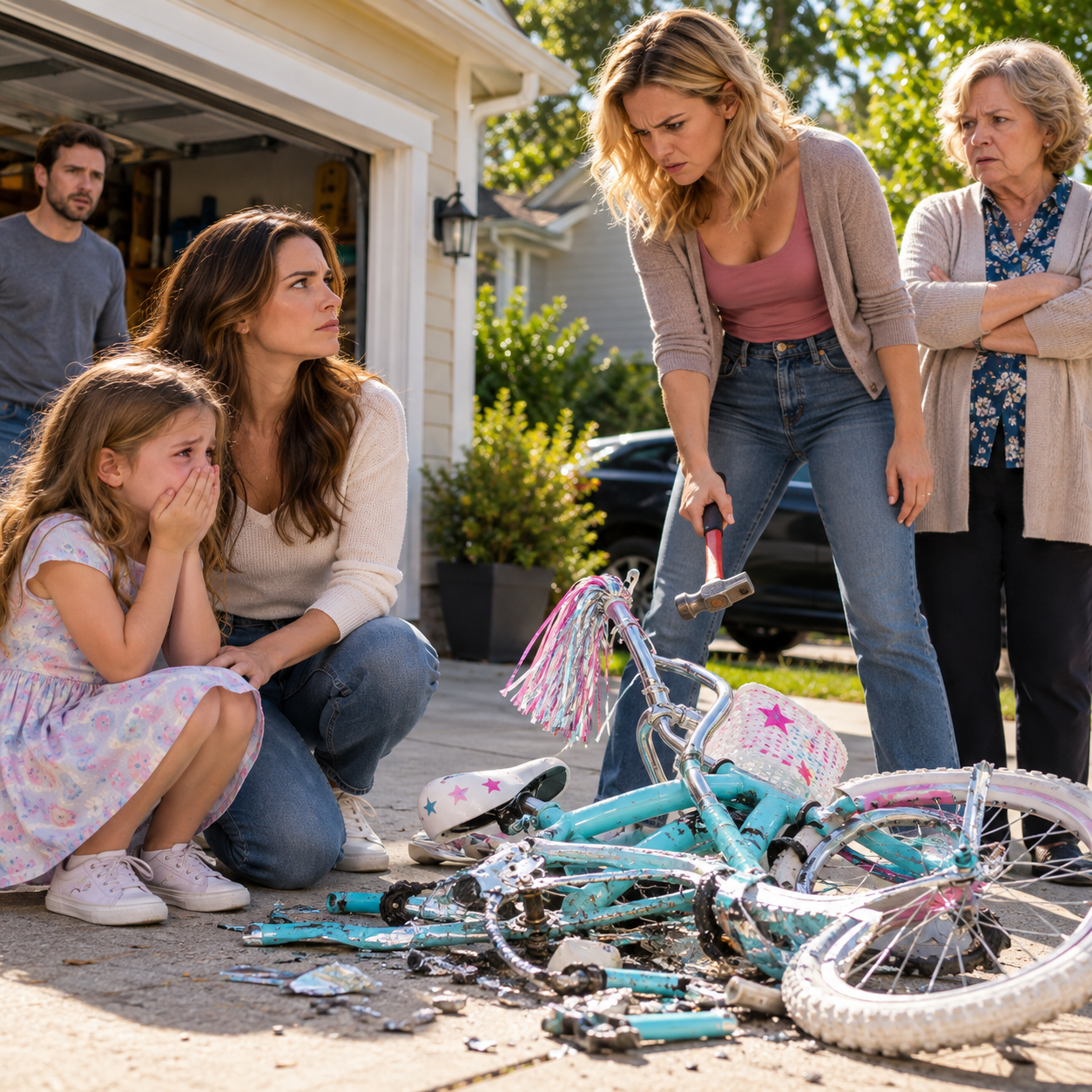
I looked at the mangled wheel.
“I didn’t bring the hammer.”
Shayla stared at the bicycle as if it had betrayed her personally.
“You expect me to believe you did this for my daughter?”
“I have the email.”
She looked away.
That small gesture told me she believed me.
I opened the correspondence anyway and held out the phone. The subject line included the claim number and Brooklyn’s replacement authorization.
Shayla didn’t take it.
Mom stepped closer. “Fine. There was a misunderstanding.”
David made a soft sound from behind us—not quite a laugh.
“A misunderstanding?” I asked.
“Everyone was upset.”
“Eliza wasn’t.”
My daughter stood partly behind me now, one fist twisted into the hem of my sweater.
Mom lowered her voice. “Think about what you’re doing before you make this worse.”
That sentence had controlled me for decades.
It meant: protect Shayla from whatever Shayla had done.
I looked at my sister.
“You’re leaving.”
She gave a short laugh. “Oh, stop.”
“My house. My daughter. You came onto my property, picked up a hammer, and destroyed something in front of her because you were angry.”
“I thought she broke Brooklyn’s bike.”
“And if she had?”
Shayla opened her mouth.
Nothing came out.
“Would that make this normal?”
Mom stepped between us slightly. “Nobody said it was normal.”
“You said I shouldn’t have bought it.”
“I was trying to calm things down.”
“No. You were agreeing with her.”
Shayla folded her arms. “So what now? You’re going to hold this over me forever?”
“No.”
That seemed to surprise her.
“I’m simply done participating.”
“With what?”
“With this.”
I gestured between the three of us.
“You do something cruel. Mom explains why somebody else caused it. Then I fix the problem.”
Mom’s lips thinned. “We’re family.”
“That word has been doing a lot of unpaid labor around here.”
David stepped beside me.
“Time to go,” he said.
Mom turned to him. “David, please talk some sense into your wife.”
“I think she’s making perfect sense.”
Shayla’s anger shifted into something less certain.
“We can replace it,” she said. “Insurance or whatever. We’ll tell them it was an accident.”
“Eliza watched you do it.”
Her eyes moved toward my daughter.
I stepped sideways, blocking the view.
“That,” I said, “is the part you still don’t understand.”
They left without another argument. David closed the door gently behind them.
For several seconds, none of us moved.
Then Eliza tugged my sleeve.
“Mom?”
I crouched.
“Did I do something bad?”
“No.”
“But Aunt Shayla was mad at me.”
“She was.”
Eliza waited.
“People are allowed to be angry,” I said. “They are not allowed to scare you or break things because they’re angry.”
She considered this with the solemn concentration children sometimes give to the sentences adults most need to hear themselves.
“Is Brooklyn mad?”
“I don’t think Brooklyn knows any of this yet.”
Eliza looked through the window toward the destroyed bicycle.
“That was supposed to be hers?”
“Yes.”
Her face crumpled.
“Can she still get one?”
“We’ll figure it out.”
That night, after Eliza had eaten enough chocolate ice cream to create a medical concern, I sat at the kitchen island with my laptop.
For years, I had been attached to accounts belonging to Mom and Shayla. Electricity. Phone bills. Groceries. Subscriptions. Things that started as temporary help and quietly became obligations.
I removed my payment information from each one.
No angry message.
No announcement.
Just a series of confirmation screens.
David sat across from me.
“You sure?”
I clicked the final button.
“Yes.”
The calls began twenty minutes later.
Mom.
Shayla.
Mom again.
Then texts.
Why was your card removed?
Put it back.
This is childish.
Call me immediately.
I turned the phone facedown.
It buzzed against the counter until David put a folded dish towel underneath it.
The next morning, the messages stopped.
For several hours, I mistook that silence for acceptance.
Then my cousin Melissa sent me a screenshot from the extended family group chat.
According to Shayla, Eliza had destroyed Brooklyn’s bike.
According to Mom, I refused to take responsibility.
And according to both of them, I had suddenly cut off financial support because I was angry that somebody dared discipline my spoiled daughter.
There was no mention of a hammer.
I read the messages twice.
Then I opened the security-camera app on my phone.
Part 3: Security Footage Exposes the Story My Family Invented
Our porch camera had been installed because David was tired of packages disappearing.
That Saturday, it captured something more valuable than a delivery.
The video showed Shayla coming out of our house with the hammer.
It showed Eliza standing near the bicycle.
It recorded every strike.
Then my mother’s voice came clearly through the microphone.
“You shouldn’t have bought it for her.”
I watched the clip once.
I didn’t need to watch it twice.
David stood over my shoulder. “You’re going to send that, aren’t you?”
“They’re using Eliza to justify what happened.”
He nodded.
“That answers my question.”
I posted the complete clip into the family group chat with one sentence:
For the record, that bicycle was the manufacturer’s replacement for Brooklyn. Shayla destroyed it herself.
Then I set the phone down and made coffee.
The replies arrived before the machine finished brewing.
Melissa: Oh my God.
An uncle who had previously told me to “be the bigger person” deleted his earlier message.
Another cousin asked, Shayla, what were you thinking?
Mom called.
I answered this time.
“Catherine.” Her voice was tight. “Take that video down.”
“No.”
“You’ve embarrassed your sister in front of everyone.”
“She made a six-year-old watch her smash a bicycle.”
“She overreacted.”
“That’s an interesting word for it.”
“You are enjoying this.”
I looked through the kitchen window. Eliza and David were in the backyard examining a ladybug on the fence.
“No, Mom. I’m tired.”
“You don’t expose family.”
I closed my eyes briefly.
“Why does protecting family always mean protecting Shayla?”
She didn’t answer.
“Why didn’t it mean protecting Eliza?”
Again, nothing.
Then the line disconnected.
The video didn’t stay inside the family chat. Someone shared it. Then someone else did.
By that evening it had traveled far enough that Shayla’s husband, Mark, called me.
Mark and I had never been close. He usually looked exhausted at family gatherings, as though he had learned years earlier that the safest response to conflict was becoming furniture.
“Is the video edited?” he asked.
“No.”
“Was Brooklyn’s broken bike really defective?”
“Yes. I have the photographs and manufacturer correspondence.”
He was quiet.
“Can you send those to me?”
“Why?”
Another pause.
“Because Shayla told me Eliza destroyed the bike on purpose.”
I sent everything.
Ten minutes later, he called again.
“Did she know the replacement was for Brooklyn?”
“Not until after she smashed it.”
He exhaled slowly.
Then he said something I hadn’t expected.
“This isn’t the first time.”
He didn’t offer details, and I didn’t ask.
Over the next few days, the family conflict became secondary to the consequences inside Shayla’s own house. Mark took Brooklyn and stayed with his brother. Soon afterward, he retained an attorney and filed for divorce and custody.
Shayla blamed me.
Her voicemail was nearly three minutes long.
“You posted one video and destroyed my marriage. Do you understand that? You always have to prove you’re right. You couldn’t just let one mistake go.”
I listened until the end.
Then I deleted it.
My mother sent a shorter message.
Think of your niece.
That one stayed on my screen longer.
Because I was thinking of Brooklyn.
I thought about a little girl learning that adults could rewrite facts until the loudest person became innocent. I thought about all the times I had been expected to accept that lesson.
So I forwarded Mark the original manufacturer email and offered to give his attorney the unedited camera footage if it was legally needed.
Then I replaced nothing.
I did not resume paying anyone’s bills.
I did not issue a public victory speech.
I went back to work, packed Eliza’s lunches, argued with her about brushing her hair, and tried to make our home feel ordinary again.
A week later, a delivery truck pulled into our driveway.
The bicycle company had reviewed what happened.
They were sending another replacement.
This time, I called Mark before opening the box.
“I have something for Brooklyn.”
Part 4: Two Little Girls Receive the Lesson Adults Failed to Learn
We met Mark and Brooklyn at a neighborhood park on Sunday afternoon.
Eliza came with us.
Brooklyn climbed out of her father’s car looking uncertain, like a child who had overheard too many conversations that stopped whenever she entered the room.
I kept the new bicycle hidden behind our SUV.
“Your aunt has something to show you,” Mark said.
Brooklyn looked at me.
“Am I in trouble?”
The question landed harder than any accusation Shayla had made.
“No, sweetheart.”
I rolled the bicycle into view.
Turquoise frame.
White tires.
Silver streamers.
Star-patterned seat.
Brooklyn covered her mouth.
For one terrible second, the gesture reminded me of Eliza in the driveway.
Then Brooklyn laughed.
It was small at first, then enormous.
“Is that mine?”
“It was always supposed to be yours.”
She ran her fingers over the handlebars.
“Mom said Eliza broke my other one.”
Eliza stood beside me.
“I didn’t,” she said.
Brooklyn looked at her.
“My dad told me.”
There was no dramatic apology between them because six-year-olds are often wiser than adults about what actually requires ceremony.
Brooklyn touched the bell.
Eliza said, “You have to ring it twice because once sounds weird.”
Brooklyn rang it twice.
Then they were off, taking turns while David adjusted the seat and Mark stood beside me with his hands in his jacket pockets.
“I’m sorry,” he said.
“You didn’t swing the hammer.”
“No.”
He watched his daughter ride past us.
“But I ignored a lot of smaller things because dealing with them was exhausting.”
That was the first explanation from anyone in Shayla’s world that sounded like an explanation instead of an excuse.
“I understand that,” I said.
He nodded.
“I’m trying not to do it anymore.”
The divorce became messy, but not spectacular. Real family endings rarely resemble television. There were lawyers, schedules, uncomfortable exchanges, temporary agreements, accusations, and expensive hours billed in six-minute increments.
The video mattered.
So did the manufacturer’s documentation.
But neither automatically made Shayla a monster or Mark a saint. It simply made one event impossible to deny.
Months later, my mother asked to meet me for coffee.
I almost refused.
Then I decided curiosity was not the same thing as surrender.
She arrived early and had already ordered my usual drink.
For years, that would have softened me immediately.
This time, I let the coffee sit.
“I miss Eliza,” she said.
“I’m sure.”
She looked down at her hands.
“Your sister is having a very hard time.”
“I’m sure of that too.”
“You sound cold.”
“No. I sound finished with solving every hard thing for her.”
Mom’s eyes lifted.
“I made mistakes.”
It was the closest she had ever come to saying the words.
I waited.
She rubbed one thumb over the other.
“When you girls were little, Shayla was harder. Louder. Everything became a crisis. You were easier.”
I gave a small, humorless smile.
“So you punished the easier child.”
Her face changed.
“I wouldn’t call it punishment.”
“What would you call teaching one daughter that she has to absorb the other daughter’s consequences?”
She looked toward the window.
Cars passed outside. A barista called somebody’s name.
Finally, Mom said, “Survival, maybe.”
“For you.”
Her eyes returned to mine.
“Yes.”
That answer mattered because it was finally honest.
Not good.
Not enough.
But honest.
“I won’t keep paying your bills,” I said.
“I know.”
“You don’t get unsupervised time with Eliza right now.”
Her mouth tightened, but she nodded.
“And if Shayla is there, we leave.”
Another pause.
“Okay.”
I picked up my coffee.
Mom’s eyes filled, but she didn’t use the tears as an argument.
That was new.
As for Shayla, we did not reconcile.
She sent apologies that usually arrived attached to explanations.
I was stressed.
You humiliated me first.
I thought you were rubbing it in Brooklyn’s face.
Mom said you bought it for Eliza.
Eventually, one message arrived without a defense.
I scared Eliza. I know that now.
I read it several times.
Then I wrote back:
Yes, you did.
Nothing more.
Because forgiveness and access are not the same thing.
Understanding someone’s wounds does not require handing them your child and hoping they behave better this time.
By spring, Brooklyn had become comfortable visiting us during Mark’s custody weekends.
She and Eliza rode their bikes up and down our sidewalk until the bells drove David insane.
One afternoon I stood in the driveway watching them.
The sunlight flashed off two sets of silver streamers.
Eliza stopped beside me.
“Mom?”
“Yes?”
“Do you remember when Aunt Shayla broke the other bike?”
I crouched beside her.
“I remember.”
She thought for a moment.
“I used to think she broke it because I was bad.”
I felt something tighten behind my ribs.
“And now?”
She looked toward Brooklyn, who was impatiently ringing her bell.
“Now I think she was just really mad and did a bad thing.”
I brushed a strand of hair from her forehead.
“That’s exactly right.”
Eliza smiled.
Then she climbed back on her bicycle and pedaled toward her cousin.
For most of my life, I believed keeping the peace meant absorbing the damage quietly enough that nobody else had to feel uncomfortable.
I know better now.
Peace is not a driveway where everyone pretends the broken thing was your fault.
Sometimes peace is a boundary.
Sometimes it is evidence saved on a phone.
Sometimes it is telling the truth once and refusing to argue with people determined to rewrite it.
And sometimes it is simply two little girls riding bicycles in the sunshine, learning that someone else’s anger does not decide what they deserve.
The End .
All characters and events in this story are fictional, created for storytelling and entertainment purposes. Thank you sincerely for reading. Your feedback and support are invaluable and motivate me to continue sharing more stories with you.