## Part 2: A secret trip to Charleston turns into a public revelation.
Emory was sitting on his porch when I reached the shop, watching bats circle above the field. He listened while I described the birthday dinner, the stolen phone, and the extraordinary sound the lottery scanner had made. When I handed him the ticket, he studied both sides beneath the porch light before looking at me. “Your daddy know?”
“Not yet.”
“Good,” he said. “Let’s make sure you’re protected before anybody starts telling you what belongs to whom.”
He placed the ticket inside a sandwich bag and locked it in the green floor safe beneath his office desk. Then he gave me the spare room above the shop and told me we’d leave for Charleston at six the next morning. Before walking away, he pointed one thick finger at my chest. “Money changes people, Brennan. Monday morning, you’re still here at seven, and those gate hinges aren’t going to weld themselves.”
I barely slept. At eleven, Mom texted to ask whether I was at Emory’s, and I told her I was safe. By sunrise, we were driving toward Charleston in Emory’s battered work van, the farm report murmuring on the radio. He asked what I planned to do with the winnings. “Pay for school, buy my own welding equipment, and keep working,” I answered. Emory nodded. “Then you’ve already got more sense than most rich men.”
The lottery office wasn’t glamorous. A woman named Charlotte checked my identification, noticed my birthday had been the previous day, and congratulated me. She explained that federal and state taxes would reduce the payout and that processing would take time. Twenty minutes later, my signed ticket disappeared into an official file drawer, and I walked out holding a stamped claim form.
On the ride home, I stared at that paper until the lettering blurred. “Feels like nothing happened,” I murmured. Emory shifted gears and said, “That’s how important things usually happen. Quietly.”
We stopped at a credit union, where I opened an account in my name alone. My old savings account still had Mom’s name attached because she’d helped me open it when I was fourteen. I loved her, but after twenty-five years of marriage, she had never kept anything from Dad, especially when he demanded answers.
Back home, I packed my work boots, graduation folder, clothes, welding hood, and cracked phone into a duffel bag. Mom stood in my bedroom doorway, twisting a dish towel between her hands. “Brennan, your father didn’t mean to hurt you. Savannah was upset, and he wanted to make things right.”
“He made things right for Savannah,” I answered.
Her eyes dropped to the floor. She asked whether I was coming home after a few days, and I hugged her without promising anything. I nearly told her about the money, but the stamped claim form burned against my back pocket. I couldn’t risk Dad finding out before I had somewhere safe to stand.
Thursday passed beneath the sparks and roar of Emory’s workshop. I repaired a cracked trailer hitch and finished some porch railings, stopping only when Savannah posted a photograph of herself holding my birthday phone inside a pink case. Her caption read, “When your daddy loves you the most.” Emory saw it over my shoulder and quietly removed the toothpick from his mouth.
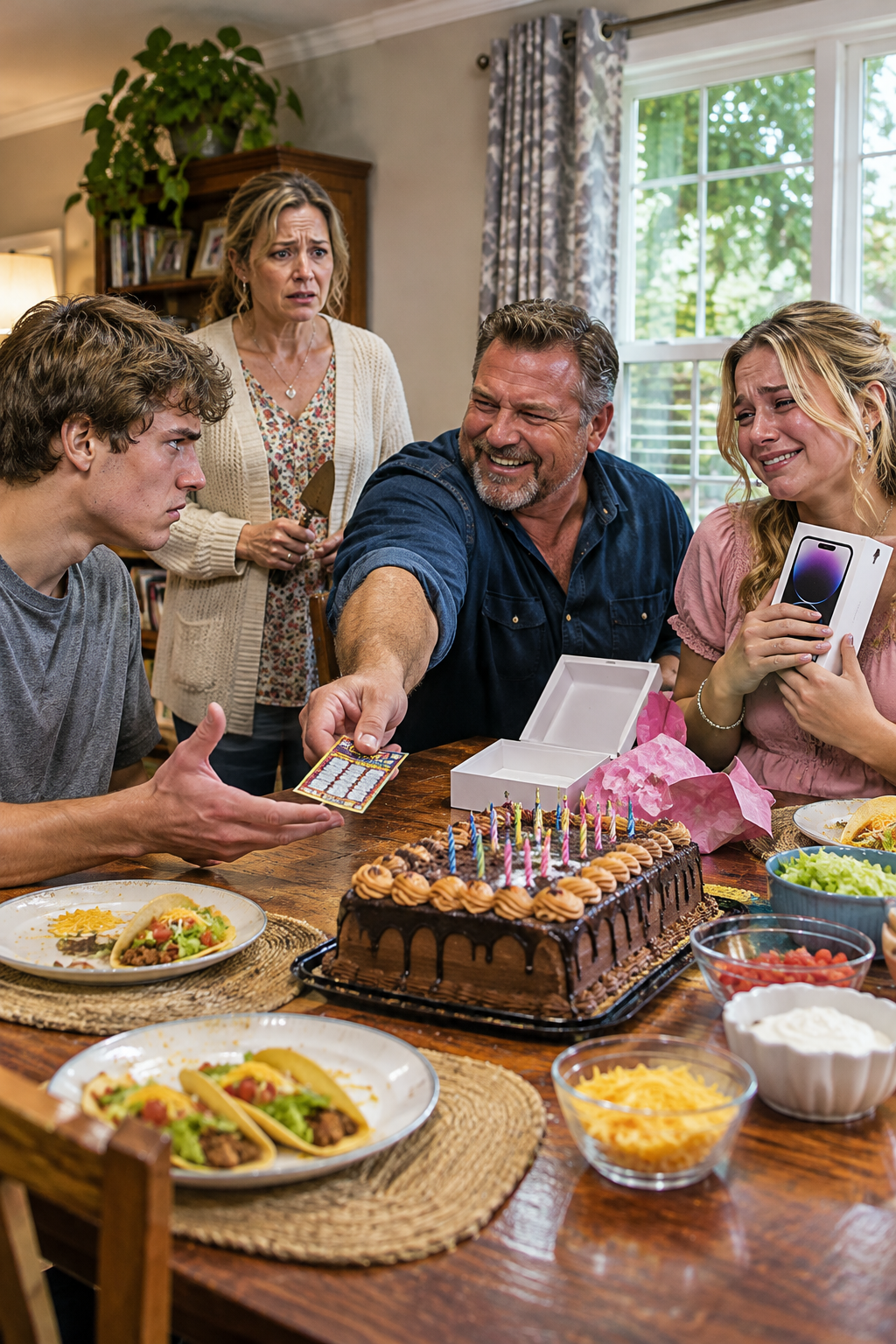
Friday morning, exactly three days after my birthday, Dad walked into Toiver’s at 6:15. Buzz, a retired mail carrier, and Pokey, who drove for the county, were already drinking coffee. Dad lifted one of his usual two-dollar tickets and proudly told them how he’d replaced my birthday present with a scratch-off. Everybody laughed until Velda stepped forward from behind the register.
“Rocky,” she said, “your boy did get lucky.”
Dad grinned. “What’d he win? Twenty bucks?”
“Two hundred thousand dollars.”
Buzz later told me Dad dropped his full coffee onto his work boots without noticing. His face drained as Velda explained she’d personally scanned the ticket. “That’s my ticket,” Dad insisted. “I paid for it.”
“You just told everyone you gave it to Brennan,” she replied.
By 6:31, my battered phone was vibrating across Emory’s workbench. Dad called repeatedly, followed by Mom and Savannah. Text messages arrived demanding that I explain myself and return what belonged to the family. I kept welding, watching the screen flash until the phone slid into a bucket of hinge pins.
At noon, tires scattered gravel across the shop entrance.
Dad climbed from his pickup, followed by Mom and Savannah. Emory switched off his grinder, removed his safety glasses, and leaned against his workbench. My father marched toward me with his fists clenched, stopping beneath the humming industrial fan.
“Where’s my ticket, Brennan?”
I lowered my welding hood and looked him straight in the eyes.
“Charleston, Dad. It’s already been claimed.”
## Part 3: Dad demands half the winnings and receives his own gift.
Dad stared at me as if I’d spoken another language. “Claimed? What do you mean, claimed?” I explained that Emory had driven me to Charleston Wednesday morning, where the lottery office had accepted my ticket and recorded my name. Dad swung toward Emory, searching his face for some sign of betrayal, but Emory merely folded his arms and waited. “You had no right,” Dad finally said.
“You gave it to me.”
“I bought it!”
“You also bought that phone, Dad. Didn’t stop you from giving it away.”
His jaw tightened. Savannah stood behind him clutching the pink phone, while Mom remained near the doorway, her purse pressed against her stomach. Dad jabbed a finger toward me. “I was making a joke. I didn’t know that ticket would win!”
“Neither did I,” I said. “That’s the whole point of a lottery ticket.”
For several seconds, the shop was silent except for the fan turning above us. Dad’s eyes darted toward Mom, searching for the familiar support he’d always received. “Mona, tell him that ticket belongs to me.”
Mom swallowed. I could see her fighting the old instinct to smooth everything over, to apologize for everybody, to find something else to occupy her hands. But this time she stood still.
“Rocky,” she said quietly, “you gave Brennan that ticket.”
Dad blinked.
“I sat right there,” she continued. “You took his phone away, handed him the scratch-off, and laughed. You told him he might get lucky.”
Dad turned to Savannah. “Tell your mother what really happened.”
Savannah looked down at her phone. “That’s what happened, Daddy.”
Something changed in Dad’s expression. The anger didn’t disappear, but it became calculated. He took a slow breath and straightened his shoulders.
“All right,” he said. “We’re family. Nobody’s trying to take everything from you. Half is yours, half comes home. One hundred thousand dollars for you, one hundred thousand for the family. That’s fair.”
I looked at the man who had watched me wear boots with holes in their soles while buying Savannah a car. The man who had called me strong whenever there wasn’t enough left for me. Now he was standing in another man’s workshop, describing half my winnings as generosity.
“Half comes home?” I repeated.
“That’s right.”
“Like half that car was supposed to be mine?”
Dad’s face darkened. Savannah took a small step backward.
“Like my birthday phone?” I continued. “Or my braces? Or the senior trip I didn’t take because there wasn’t enough money?”
“That’s ancient history.”
“It’s my history, Dad.”
I turned toward Savannah. “Keep the phone. I’ll get my own.” She opened her mouth, then closed it again, her cheeks reddening. For once, there was nothing she could cry about that would change my mind.
Then I reached into my shirt pocket.
The previous evening, I’d stopped at Toiver’s and bought one two-dollar Ridgerunner Riches ticket. Velda had looked at me strangely but said nothing. Now I crossed the shop floor, placed that unscratched ticket in Dad’s palm, and gently folded his fingers around it.
“I’ve scratched one of these,” I said. “I won two hundred thousand dollars.”
Dad looked down at the bright cardboard.
“Maybe you’ll get lucky.”
Emory slowly removed the toothpick from his mouth. Savannah stared at the floor, while Mom’s eyes filled with tears. Dad held the ticket like he couldn’t decide whether it was worthless or priceless.
“He’ll blow that money in a year,” he muttered.
“The welding program starts August fourteenth,” I said. “It’s paid for. You’re welcome at my graduation, Dad.”
Emory stepped forward. “Rocky, this is my property. I’d like you to leave.”
Dad glanced at him, then turned and walked out. Savannah hurried after him, still carrying my phone. Mom paused at the entrance, looked back at me, and gave one small, deliberate nod before following.
That afternoon, Dad removed me from the family phone plan. My old phone stopped connecting shortly after three. Emory drove me to buy a modest replacement, and I signed my first phone contract using my own money.
The following Monday, Dad called Mr. Fleming, the lawyer who had written his will. Mom later told me the lawyer asked how many witnesses had seen the ticket change hands. When Dad admitted his wife and daughter had watched him give it away, and that he’d bragged about it at Toiver’s, Mr. Fleming told him the gift was already made. He declined to pursue the matter.
Dad stopped buying coffee at Toiver’s after Buzz and Pokey began greeting him with, “Feeling lucky, Rocky?” Savannah sent a long apology containing several paragraphs about family and several more asking whether I was truly keeping every dollar. I replied, “Hope the camera’s as good as they say.”
She never answered.
I thought that would be the end of it.
But money wasn’t the only thing my family had to learn how to live without.
## Part 4: The winning ticket reveals what real family loyalty means.
The money arrived several weeks later, substantially reduced by taxes but still enough to change my future. I paid every semester of welding school upfront, then bought a reliable welding machine, grinder, clamps, torch setup, and toolbox. I rented the small room above Emory’s shop, the one with the stubborn dresser drawer and the window overlooking the gravel lot. When I offered to pay for a new roof as thanks, Emory shook his head.
“A man pays his own rent,” he told me. “And a man doesn’t need to buy somebody’s affection.”
He charged me a fair monthly amount and insisted I hand him the payment personally. The remaining winnings stayed in my private bank account, untouched except for necessities. Nobody knew the exact balance, and I intended to keep it that way.
I was back welding gate hinges at seven on Monday morning, exactly as promised. Emory inspected the first one, tapped its edge with a gloved finger, and grunted, “Huh.” I smiled behind my hood, because that single sound meant more to me than a hundred compliments.
In July, Mom drove to the shop alone. She carried a container of leftover chocolate cake and sat on Emory’s porch while I showed her my college schedule. She read every line, tracing the class hours with her finger. Then she folded the paper carefully and handed it back.
“Are you coming home, sweetheart?”
“No, Mom.”
Her fingers tightened around the empty container.
“But you can come here whenever you want,” I added. “Just you.”
She studied my face for a long time. “I should’ve stopped him that night,” she whispered.
I had spent weeks imagining apologies from Dad, but hearing those words from Mom nearly broke me. She wasn’t asking for forgiveness, and she wasn’t trying to excuse what had happened. For once, she was simply telling the truth.
“I needed you to say something,” I answered.
“I know.”
She reached across the porch table and covered my hand with hers. We sat in silence while the summer breeze stirred the leaves around us. Eventually, she opened the cake container and cut my piece first.
After that, Mom began visiting most Wednesdays. She never asked for money, never mentioned Savannah’s phone, and never tried convincing me to return home. Sometimes she brought dinner, sometimes cake, and sometimes she simply watched me work from the doorway. Our relationship wasn’t magically repaired, but for the first time, we were building something without Dad deciding what shape it should take.
I started welding college in August. My instructor examined my first test plate for several seconds, tilted it toward the light, and said, “Huh.” I almost laughed. Apparently, good welders spoke the same language everywhere.
In October, Emory hired me as a real apprentice at a proper wage, just as he’d promised years earlier. When my first paycheck arrived, I stood beside the shop’s old office desk, staring at my name on the stub. Then I pinned it to the wall above my workbench, beside the stamped lottery claim form I’d kept from Charleston.
Emory came over and studied the two papers.
“Which one’s worth more to you?” he asked.
I pointed at the paycheck.
He nodded. “Good answer.”
That Friday evening, we closed the shop and walked down to Toiver’s. Velda was behind the register, smiling through her reading glasses. Emory bought one two-dollar scratch-off, and I bought another. We sat on the old church pew beneath the parking lot lights and scratched them with our house keys.
Neither ticket won anything.
Emory crumpled his into a ball and dropped it in the trash beside the pumps. “Luck’s for people who don’t know how to weld,” he said.
I laughed harder than I had in months.
Dad still drove past the shop occasionally, slowing just enough to look toward the open bay doors before continuing down the road. Mom said he hadn’t forgiven me for keeping the winnings, though he’d stopped talking about lawyers. What surprised me was something else she told me during one of her Wednesday visits.
“Your father still has that ticket you gave him,” she said.
“The one from the shop?”
She nodded. “Keeps it tucked in his truck’s sun visor. Every now and then, he takes it down and studies it.”
“Did he ever scratch it?”
“No.”
I looked at her.
“He says he doesn’t want to know what’s underneath,” she added softly.
That was the final twist I hadn’t expected. For twenty-two years, my father had scratched two tickets every morning, always hunting the prize that might finally change his life. But when I handed him a ticket of his own, he couldn’t bring himself to uncover it. Maybe he was afraid it would lose. Maybe he was even more afraid it would win, because then he’d have to remember exactly what he’d taken from me the night he made his little joke.
I never asked him.
That evening, I took the old phone with its cracked, taped screen out of the dresser drawer. It still held the photographs I’d taken outside Toiver’s on my eighteenth birthday, including the two sides of the ticket and my shaky signature. I looked at them once, then placed the phone back in the drawer.
Downstairs, the shop lights were on, my tools were arranged above my workbench, and the paycheck stub hung beside the lottery claim form. Two pieces of paper represented two different kinds of fortune, but only one reminded me what I could build with my own hands.
Dad had spent his life hoping a two-dollar ticket would make him rich. I had spent mine hoping he would finally treat me like I mattered.
I couldn’t make that second wish come true, even with $200,000.
But I could stop waiting.
I turned out the bedroom light and listened to the quiet hum of the shop below. In the morning, Emory and I had a trailer hitch to repair, and on Monday, my classes would begin again. I had a job, a home, a future, and people who respected me without knowing how much money was in my account.
My father had given me a lottery ticket because he thought it was worth almost nothing.
What he never understood was that the most valuable thing I won that night wasn’t the money.
It was the freedom to decide what I was worth.
THE END.
All characters and events in this story are fictional, created for storytelling and entertainment purposes. Thank you sincerely for reading. Your feedback and support are invaluable and motivate me to continue sharing more stories with you.