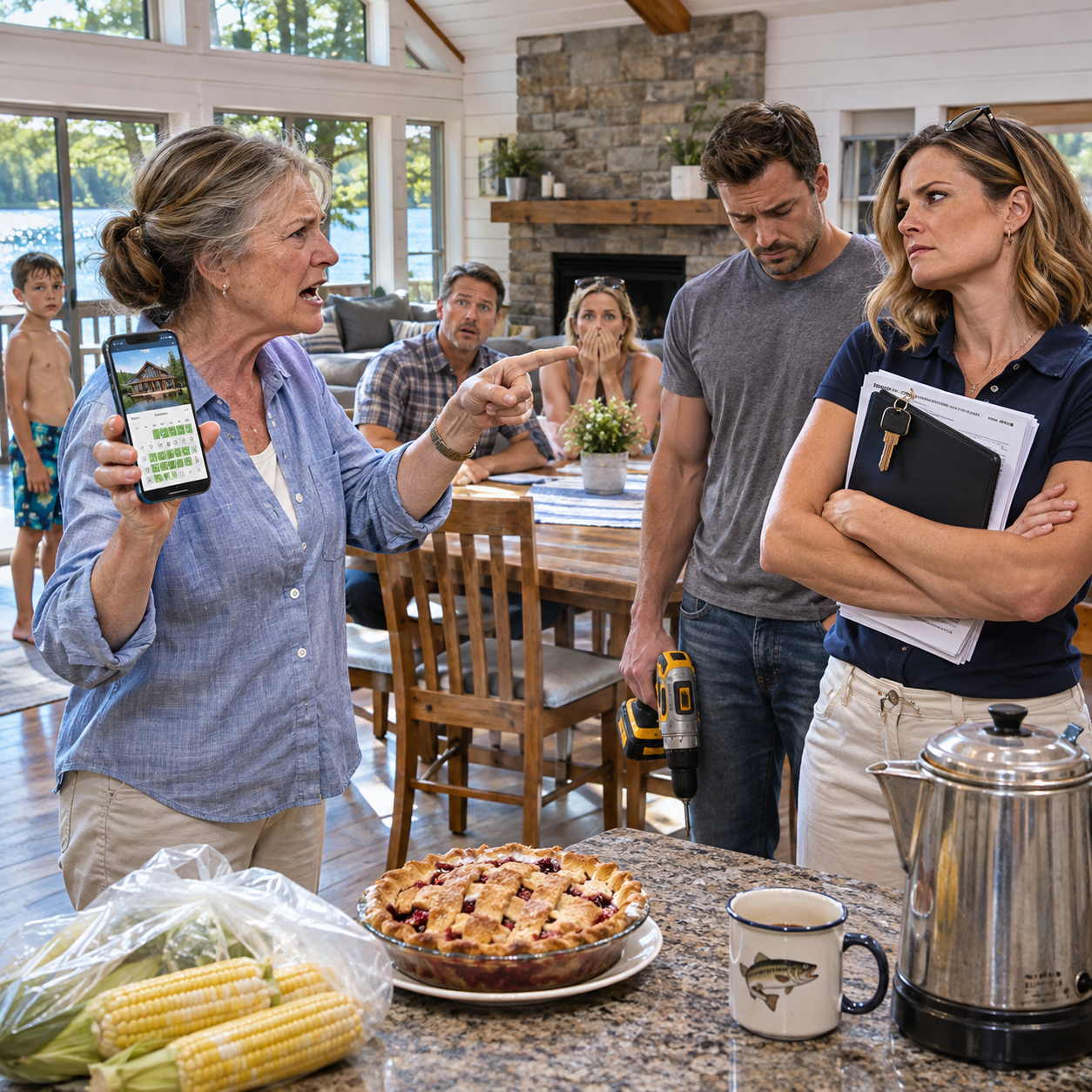
I pushed open the door of my lake cabin with a rhubarb pie tucked under my arm and a bag of sweet corn in my hand. A strange woman stood at my stove, pouring coffee into my dead husband’s favorite mug. Then a little boy ran across my living room, shouting that they weren’t leaving until Sunday.
### Part 1: I Found Strangers Living Inside My Late Husband’s Beloved Cabin
For a moment, I honestly thought I had entered the wrong house. The woman at the counter, barefoot and wearing a yellow sundress, gave me a pleasant smile as she stirred cream into her coffee. “Oh, you’re early,” she said. “The host told us check-in was at four, but she let us come this morning.” Behind her, a television played cartoons while the little boy tracked wet footprints across the pine floor Walt and I had refinished together.
I stood frozen, still holding my groceries, trying to understand how strangers had gotten inside a cabin I had owned for more than thirty years. I was sixty-six, and I had driven six hours from Des Moines for two peaceful weeks beside Pine Hollow Lake in Wisconsin. My husband had been gone four years, and this was supposed to be my first real summer alone here since his funeral. Instead, someone else’s bacon was sizzling in my kitchen, and someone else’s suitcase lay beside my fireplace.
Then I noticed the white banner hanging beside the front door, advertising something called Northwood’s Nest, Lakeside Escape. It had replaced Walt’s handmade cedar sign, the one he’d carved with our family name and deliberately hung a little crooked. Inside, the pine walls had been painted white, our old braided rug was missing, and Walt’s favorite recliner had vanished. Even the wooden loon his father had carved fifty years earlier was gone from above the fireplace.
“Excuse me,” I whispered, placing the pie on an unfamiliar gray sofa. “Who exactly rented this place to you?”
Before the woman could answer, the sliding door opened, and my daughter-in-law Courtney stepped inside carrying fresh towels. She stopped so abruptly that several towels slipped onto the floor. Behind her came my son Derek, holding an electric drill and a laminated sign. “Mom?” he said, staring at me. “We thought you weren’t coming until Labor Day.”
“I told you August fifteenth, Derek,” I answered. “I told you in June that I was staying two weeks.”
Courtney recovered first, smoothing the front of her navy polo shirt as though she were preparing to greet an important customer. “Marlene, please don’t get upset before we explain. This cabin sits empty almost all year, and it’s worth at least three hundred thousand dollars. We decided it was ridiculous to let an investment like that go unused.” She gestured toward the new furniture with a proud little smile. “We’ve turned it into a vacation rental.”
I looked directly at my son, waiting for him to laugh and tell me this was an elaborate misunderstanding. He only lowered his eyes to the drill in his hand. Courtney continued explaining that they’d already booked eleven stays through October and had received wonderful reviews. When I asked who had authorized them, she replied, “Derek handled everything with the power of attorney you gave him.”
That paper had been signed two years earlier while I was recovering from hip surgery, when simply walking to the mailbox had felt impossible. I had trusted Derek to pay bills and keep the utilities running until I recovered. I had never authorized him to turn my home into a business. “You and Dad always said this place would belong to us eventually,” Derek muttered. “We just thought we could start making something of it now.”
“Eventually?” I repeated, watching his expression. “Your father is dead, Derek. I am not.”
Across the kitchen, the vacationing couple sat silently at my old table, looking mortified. Their young son stood nearby with a juice box, glancing anxiously between the adults. I could have shouted until the windows shook, but that child had done nothing wrong. So I stepped onto the porch, sat on Walt’s old wooden bench, and took out my phone.
Three years earlier, my daughter Beth had installed a smart lock registered under my name, giving me the owner’s account. I’d added Derek as a family member so he could admit repairmen during my recovery. Now the screen displayed eleven temporary guest codes, complete with names and arrival dates, including a September wedding reservation. I removed Derek’s access, then Courtney’s unauthorized access, and deleted every future guest code except the one belonging to the family already inside.
When I returned, the father stood and apologized, offering to pack immediately. “Absolutely not,” I told him. “You paid for a vacation, and your family deserves one. I’ll make sure you get your money back.” His wife, Anna, started crying, while their son Matteo asked whether he could still have some pie. I told him he could have the biggest slice.
Courtney watched me serve dessert, apparently convinced I had surrendered. She bragged that the business already had $18,400 in bookings and that the profits were paying for improvements, including a hot tub scheduled to arrive the following morning. Derek nodded along, insisting the money was being reinvested. Neither understood why the sight of their new furniture made me feel as though strangers had been sorting through Walt’s belongings after his funeral.
Late that night, after our guests went upstairs and Derek and Courtney retreated to the smaller sleeping cabin, I opened their rental listing on my laptop. Forty-one beautiful photographs appeared, followed by a smiling picture of me taken at my retirement party. Under the heading “Meet Your Host,” Courtney had written three paragraphs pretending to be me, a retired dental hygienist delighted to share the cabin she and her late husband had built.
Then I opened the private messages.
A young couple named Sophie and Marcus had been arranging their September wedding at the cabin. Someone impersonating me had encouraged them to avoid the rental platform’s fees and send a $3,200 deposit directly to Courtney through Venmo. I stared at the payment confirmation, suddenly understanding that my daughter-in-law hadn’t merely taken control of the property. She had stolen my identity to make strangers trust her.
I photographed every document and submitted an unauthorized-listing report with my deed and property tax records. At midnight, I called Beth, an emergency-room nurse in Madison, and told her everything. She listened without interrupting, then said, “Mom, call the sheriff tomorrow. I’m coming first thing in the morning.”
At 3:07 a.m., my phone lit up with a notification.
The rental listing had been suspended, all upcoming reservations canceled for refunds, and every pending payout frozen.
I closed my eyes, hearing the lake moving gently against the dock outside my window. For the first time since arriving, I could almost imagine having my summer back.
Then, just before seven the next morning, someone began pounding on my bedroom door.
### Part 2: An Expired Document Exposed Their Carefully Planned Family Betrayal
I had already finished my first cup of coffee when Courtney started hammering on my bedroom door. Derek stood behind her, pale and disheveled, while she waved her phone inches from my face. “Eleven reservations canceled!” she shouted. “They’ve frozen our money! We have a hot tub coming today and a wedding booked for September!” I waited until she stopped talking before explaining that I had reported an unauthorized rental operating under my identity.
“Mom, just tell them it was a misunderstanding,” Derek pleaded. “You gave me power of attorney, remember?”
I reached into my nightstand and removed the manila folder I’d brought from Des Moines. “Read paragraph two,” I said, holding it toward him. He hesitated, so I read the provision aloud, explaining that I had authorized him only to manage household bills, deposits, utilities, and property taxes during my recovery. The document had been valid for ninety days, beginning in November almost two years earlier.
“It expired long before you listed this cabin,” I said. “It never gave you permission to rent anything, create a company, or represent yourself as the owner.”
Courtney folded her arms. “That’s a technicality.”
“No,” I replied. “That’s the difference between helping your mother and taking advantage of her.”
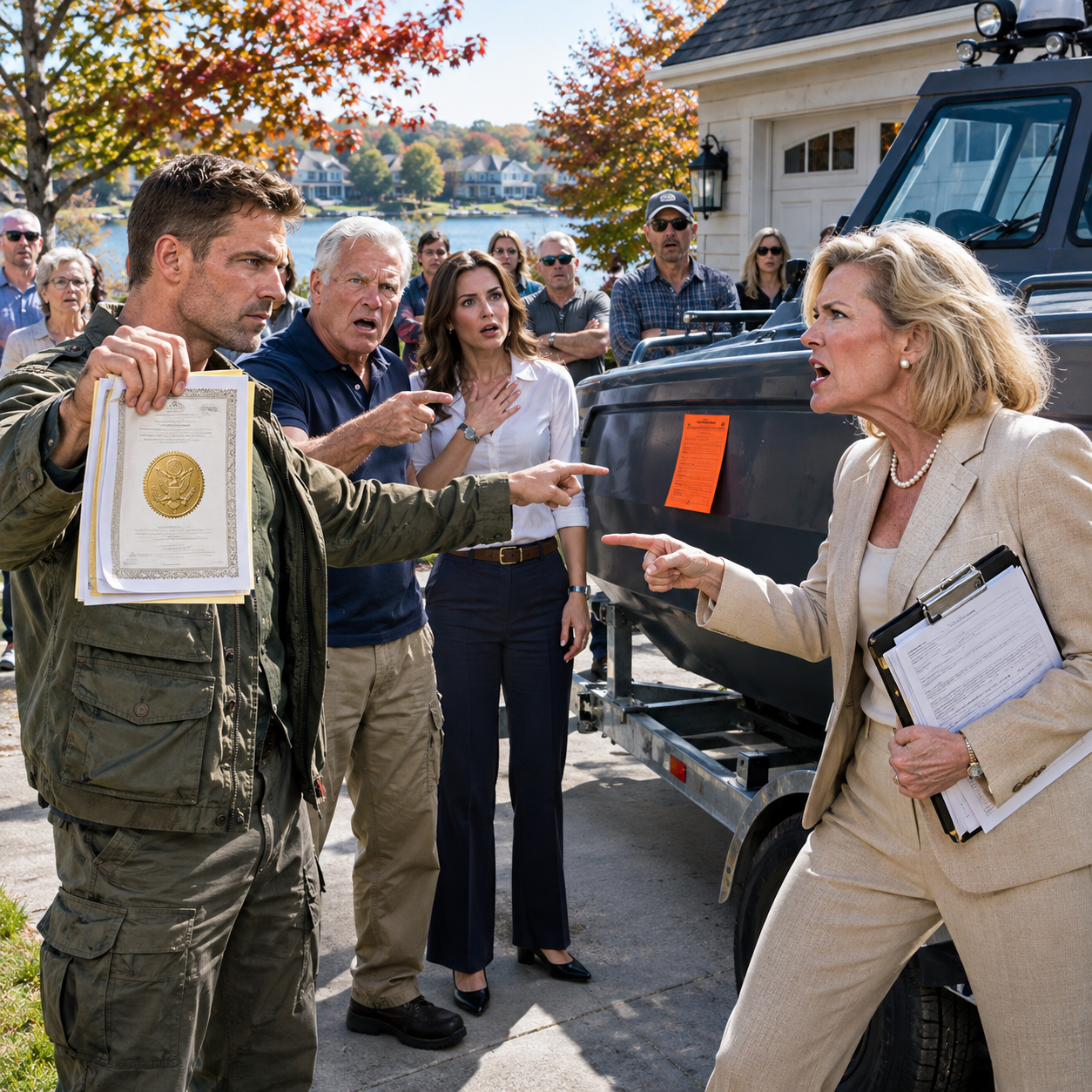
At 9:40, a flatbed truck rumbled up our gravel driveway carrying a brand-new hot tub wrapped in white plastic. Its driver, a sturdy man named Dale, climbed down with a clipboard and asked for the property owner’s signature. Courtney immediately stepped forward, announcing that she managed Northwood’s Nest. When Dale insisted on speaking with the owner, I showed him the property deed on my phone.
He inspected the orange stakes Courtney had planted near the lake and asked to see the electrical permit and shoreline approvals. She admitted those arrangements hadn’t been completed, then tried offering to pay the $5,400 balance immediately. Her debit card was declined twice. I quietly explained that the company’s rental payouts were frozen, and Dale refused to unload equipment without the owner’s authorization or the required approvals.
His truck eventually disappeared down the driveway with their hot tub still strapped to it, taking their nonrefundable $2,500 deposit with it. Derek stood beside the empty delivery stakes, looking more frightened than angry. “Mom,” he whispered, “we’ve put everything we have into this.”
I watched him rub his forehead with both hands. “That’s what scares me, Derek. You gambled money you couldn’t afford on property you didn’t own.”
Beth arrived at 10:30 in her gray Subaru, wearing gym shorts and a Wisconsin Badgers sweatshirt. She took one look at the rental banner, pulled it down, and folded it neatly before handing it to her brother. Then she carried their luggage from the sleeping cabin and placed it beside their car. Courtney protested, but Beth simply told her that I expected them to leave before sundown.
I secured the sleeping cabin by switching off its power and locking the exterior breaker enclosure, while Beth disconnected the rental Wi-Fi extender. Then we drove into Hayward, where I called the Sawyer County Sheriff’s Office and requested a deputy to document what had happened and witness their departure. I wasn’t interested in a shouting match. I wanted a record that no one could rewrite afterward.
At a small café, I ordered a walleye sandwich and called my insurance agent. Her answer frightened me more than Courtney’s threats. My homeowner’s policy excluded commercial vacation rentals, meaning an accident involving paying guests could have left me exposed to enormous financial claims. Derek and Courtney hadn’t simply risked their savings; they had jeopardized the property Walt and I had spent decades building.
Beth reached across the table and squeezed my wrist. “Call Aunt Judy,” she suggested.
My sister answered from Dubuque and listened as I explained the situation. Then she revealed something that made my stomach tighten. At Thanksgiving, Courtney had asked her to sign documents concerning her own lake lot, describing them as routine paperwork for tax purposes. Judy had refused until her attorney reviewed them, and Courtney never brought the subject up again.
Beth slowly set down her fork. “Mom, she tried something similar with Aunt Judy. This wasn’t one impulsive mistake.”
We agreed that none of us would sign property documents, share access codes, or authorize financial favors without discussing them together first. It was a family meeting we should have held years earlier. On the drive back, I watched the trees racing past the windshield and tried to decide whether Derek had knowingly joined Courtney’s scheme or simply chosen not to question it.
Either answer hurt.
And when we turned into the driveway at sunset, a sheriff’s cruiser was already waiting beside my cabin.
### Part 3: A Hidden Guest Book Revealed What They Planned To Steal
Deputy Larson stepped out of his cruiser as Derek rose from the porch steps, his face exhausted and his shoulders slumped. Courtney was pacing near their car, while the Delgado family remained safely down by the dock, roasting marshmallows beside the water. “Why are you doing this to us?” Derek demanded when he saw me. “We’re your family, Mom.”
I wanted to embrace the little boy I remembered, the one who used to carry minnows in a bucket and beg his father for another hour of fishing. But the grown man standing before me had turned my grief and my trust into an opportunity. “Family asks permission, Derek,” I said. “You used a document I signed when I was vulnerable, and you let your wife pretend to be me. You didn’t protect me. You protected your business.”
Courtney immediately assured the deputy that this was a private family disagreement. He examined my expired power of attorney and explained that it did not authorize their rental activity. Whether prosecutors eventually considered criminal charges was not his decision, but his report would officially document the incident. I then told Courtney that she and Derek were leaving that evening, and that neither could use my property, name, or photograph again without permission.
For several seconds, nobody moved. Then Derek picked up their bags and carried them to the car, while Courtney marched ahead with her jaw clenched tight. I followed because I wanted to make sure everything belonging to Walt remained inside the cabin. When Courtney opened the trunk, I caught sight of something familiar beneath a folded beach towel.
“Wait,” I said, placing my hand on the raised lid.
There was Walt’s cedar welcome sign, wrapped in plastic, and beside it lay his father’s carved wooden loon. Underneath both was our old green guest book, the one that held nearly thirty summers of family memories. Courtney insisted she had only removed the items temporarily for photographs, but she’d packed them among her belongings. I lifted the book and opened it near the end, where Walt had written during his final Labor Day at the lake.
“Fish biting. Wife beautiful. Don’t change a thing.”
His handwriting was unsteady, but I recognized every letter. I pressed the book against my chest, suddenly unable to speak. Beth gently took the cedar sign and the loon from my trembling hands. Derek saw his father’s message, turned away, and climbed into the driver’s seat without another word.
Their taillights disappeared between the pines as the deputy completed his report. Beth restored the sleeping cabin’s power, and the Delgados quietly returned from the dock. That night, I sat beside the lake with the guest book resting on my knees. My son had driven away angry, my daughter’s hand was resting on my shoulder, and I finally had the silence I’d traveled six hours to find.
On Sunday morning, another car pulled into the driveway. A young woman stepped out clutching a blue wedding binder, accompanied by a nervous young man. They introduced themselves as Sophie and Marcus, the couple whose September booking had disappeared. They had come to see the place they had chosen for their wedding, hoping there had been some terrible mistake.
Sophie explained that her grandfather had worked as a fishing guide on Pine Hollow Lake for forty years. Her grandmother, who rarely traveled anymore, had been looking forward to returning for the ceremony, along with forty family members. When I told them Courtney had impersonated me, Sophie’s eyes filled with tears. She admitted sending the $3,200 deposit directly to my daughter-in-law and feared it was gone forever.
I went inside, wrote her a check for the full amount, and insisted she accept it. Then I offered them something else: my dock, free of charge, for their September thirteenth wedding. Marcus tried to protest, but I told him that my name had been used to make the promise, and I wanted that promise to mean something honorable. Sophie hugged me so tightly that I nearly dropped my checkbook.
On Monday, I met attorney Gail Ostrowski in Hayward and laid every document across her desk. She studied the messages, the unauthorized company, the expired power of attorney, and the sheriff’s report. She explained that the impersonation and misuse of my property could support serious legal claims, including possible financial exploitation of an older adult. Meanwhile, the county had identified unlicensed tourist-rental activity and issued a $1,200 forfeiture.
“I don’t want my son dragged away in handcuffs,” I told Gail. “I want my home secure, every loss accounted for, and proof that this happened.”
Gail removed her reading glasses and opened a fresh legal pad.
“Then we’ll give them a chance to make it right,” she said. “But this time, Marlene, every promise will be written down.”
### Part 4: My Son Finally Learned The Price Of Betraying Trust
Three weeks later, Derek and Courtney sat across from me in Gail’s office, looking as though they had come to negotiate a business merger instead of answer for what they’d done. Courtney carried a leather folder filled with financial projections, but Gail never asked to see them. Instead, she placed a detailed accounting on the table, supported by receipts, estimates, and copies of every relevant document. For once, nobody could claim the numbers were merely my opinion.
The expenses included $3,200 to reimburse Sophie and Marcus, $4,150 to restore the painted pine paneling, $2,600 to replace missing furniture, and $950 for new security measures. Added to those were $3,500 in legal fees and the county’s $1,200 forfeiture, bringing the total to $15,600. Gail proposed repayment over forty-eight months at $325 per month. The agreement also required Northwood’s Nest to be dissolved, all advertising removed, and any future use of my identity or property prohibited without written authorization.
I had one additional condition. The cabin would be protected through a family trust, with Beth serving as co-trustee. No one could sell, rent, or borrow against it without both our signatures, and Derek and Courtney would need a written invitation before entering the property again. The old power of attorney would be formally revoked, and any unpaid restitution remaining at my death would be deducted from Derek’s inheritance.
Courtney dropped her pen onto the table. “You’re punishing us for trying to improve something that’s eventually going to belong to Derek.”
“That’s the part you still don’t understand,” I answered. “My life isn’t an advance payment on your inheritance.”
Gail placed the impersonation messages beside the agreement and calmly explained that the sheriff’s report and supporting evidence remained available for legal review. Courtney argued that she had invested money, increased the property’s value, and acted in everyone’s best interests. Derek listened without defending her. Then he quietly picked up the pen and asked whether the payments really had to continue for four years.
“You’re thirty-eight,” I told him. “You’ll still have plenty of life ahead of you when they’re finished.”
He stared at me for a long moment, then signed. Courtney held out for another minute before signing beside him. I felt no triumph watching them leave; only the exhaustion of a mother who had finally stopped confusing forgiveness with permission. The first monthly check arrived folded around a yellow note saying it was only payment one, with no apology attached.
Two months later, I received a different message from Derek. He told me he had started counseling, understood that he’d betrayed my trust, and was sorry for treating my home like something he had already inherited. He said he wasn’t asking for anything, not even a phone call. I read the message twice before replying that I was glad he was getting help, but I still needed time.
September thirteenth arrived with clear skies and a soft breeze crossing Pine Hollow Lake. Forty people gathered around my dock as Sophie walked down the lawn in a simple white dress, her father holding her arm. Marcus waited beside the water, fighting tears, while Sophie’s grandmother watched from a comfortable chair near the end of the pier. I stood quietly behind the photographer, carrying a tray of homemade rhubarb bars.
After the ceremony, Sophie asked whether she and Marcus could write something in my old guest book. I opened it to the first blank page after Walt’s final entry and handed her a pen. She wrote about love, second chances, and the kindness of a stranger who had become part of their wedding story. Their names marked the thirtieth summer recorded in that book.
By autumn, the pine walls had been restored, a replacement hutch stood by the window, and Walt’s wooden loon had returned to its place above the fireplace. His cedar sign hung crooked beside the door, exactly where he’d left it. Every rental advertisement had disappeared, the security system was under my control, and only my personal access code remained active.
One evening, I opened the guest book again and read Walt’s final message beneath the soft glow of the reading lamp. I used to think keeping a family together meant accepting every disappointment quietly, no matter what it cost me. Now I understood that love could survive boundaries, but trust could not survive without them.
I closed the book, stepped onto the porch, and listened to the loons calling across the darkening water. I still loved my son, and perhaps someday he would sit beside me there again. But I would never hand him the keys simply because he expected them.
The cabin belonged to me, and the peace inside it was finally mine to keep.
THE END.
All characters and events in this story are fictional, created for storytelling and entertainment purposes. Thank you sincerely for reading. Your feedback and support are invaluable and motivate me to continue sharing more stories with you.