I pressed the reunion booklet against my husband’s chest, pointing to the sentence that had stolen six years of my life. Two hours earlier, he’d told me he was ashamed to be seen with me. Now the guest of honor stood beside us, waiting for Richard to explain why my accomplishments carried his name.
## Part 1: A College Reunion Exposes the Husband Who Erased My Name
“Stay here, Claire. I’m embarrassed to be seen with you.” My husband delivered those words beside the coatroom of a beautiful Ohio hotel, then straightened his jacket and walked toward a crowd of people he considered important. I stood frozen beneath the ballroom’s crystal chandeliers, holding a glass of iced tea while the man I’d loved for twenty-seven years disappeared without looking back. At fifty-two, I thought I understood what humiliation felt like, but Richard Bennett had just introduced me to an entirely new kind.
We were attending his thirtieth college reunion at Whitmore University, a private school about two hours from our home in Columbus. I’d bought a navy dress at Macy’s specifically for the occasion, and Richard had approved it before we left. On the drive, he’d talked endlessly about Greg Hollis, a successful commercial property businessman from Cincinnati, and the influential alumni he hoped to impress. Richard was a regional sales director, and lately he treated every social gathering as an opportunity to advance his career.
At the reception, he’d introduced me to Diane Mercer, an alumni committee member, as the woman who kept our household running while he handled the complicated things. When Diane asked what I did, I explained that I coordinated Second Chapter, an adult literacy program I’d helped establish through a Columbus library six years earlier. Richard laughed before I finished. “She helps out with books. Gives her something to do.” I watched Diane’s interested expression fade as he steered the conversation back toward university connections.
A week earlier, Richard had asked me to email him our latest program report, claiming he wanted to show his classmates what I’d accomplished. I’d spent several evenings preparing that document with our library manager, detailing our volunteers, student progress, and plans to expand into more branches. For the first time in years, I’d believed my husband was genuinely proud of me. That little flicker of hope survived until he spotted Greg Hollis near the bar and ordered me to remain out of sight.
I lowered myself into an upholstered chair beside a dusty artificial palm tree, feeling like luggage somebody had forgotten to collect. A young server approached and asked whether I was waiting for someone. “Apparently, I’m waiting to be promoted from furniture to guest,” I answered, earning a surprised laugh. Across the ballroom, Richard shook hands, laughed too loudly, and leaned toward people whose approval mattered more to him than my presence.
Then an older gentleman with silver hair and a crooked bow tie stopped beside my chair. “Is this seat taken?” he asked. “Only if they’ve reserved the entire corner for disappointed wives,” I replied, and he laughed as he sat down. He introduced himself simply as Sam, and we began talking about the reunion, the weather, and the embroidered book-shaped pin attached to my purse.
His smile changed when he read the words Second Chapter. “You’re involved with that literacy program in Columbus?” he asked, suddenly attentive. I explained that I’d helped establish it, starting with four adult learners, borrowed folding tables, and retired teachers willing to volunteer their time. Sam leaned closer. “Claire, I believe I’ve been hoping to meet you.”
He explained that he worked with a philanthropic fund supporting adult education across Ohio and had been reviewing Second Chapter’s work for several months. When he asked why older adults sometimes resisted literacy classes, I told him the truth. “Shame. They’ve spent so many years pretending they don’t need help that asking becomes terrifying.” Sam grew quiet and told me about his late wife, a former teacher whose neurological condition had eventually made reading difficult, robbing her of something she’d always loved.
I told him about Margaret Ellis, a sixty-eight-year-old retired school kitchen aide who joined our program because she wanted to read bedtime stories to her granddaughter. Margaret had spent years memorizing labels and relying on familiar routines, terrified somebody would discover her difficulty with unfamiliar words. After months of stubborn practice, she’d completed her first children’s book, then laughed through her tears because she’d turned it upside down while celebrating. Sam listened without interrupting, something I had almost forgotten a man could do.
“You speak about six years of extraordinary work as though it’s something you squeezed between laundry and grocery shopping,” he said gently. I looked down at my hands. “We have a wonderful team.” He nodded. “Of course. But someone had to begin.”
Nearly two hours after abandoning me, Richard finally approached our corner, his expression sharpening when he noticed my companion. “Claire, what are you doing?” he demanded, then stopped cold. “Dr. Whittaker? I didn’t realize you were here.” His voice suddenly became sugary with respect, but his next question to me was loud enough for nearby guests to hear. “Who gave you permission to talk to him?”
Sam rose slowly. Richard gave an embarrassed chuckle and explained that his wife didn’t always understand important occasions. Sam studied him for a moment before answering. “Actually, your wife is the woman behind the literacy program I’ve been researching. Second Chapter is one of the initiatives I came here to discuss.”
Richard’s smile faltered, then returned. “Yes, of course. It’s been a family project. We’ve both contributed considerably.” Sam tilted his head. “Then perhaps you can explain where its first classes were held.” Richard confidently named the downtown library, a location our program hadn’t used until years later. When Sam asked how he’d recruited the original tutors, my husband offered a polished explanation about professional networking, though he’d never set foot in that first cramped classroom.
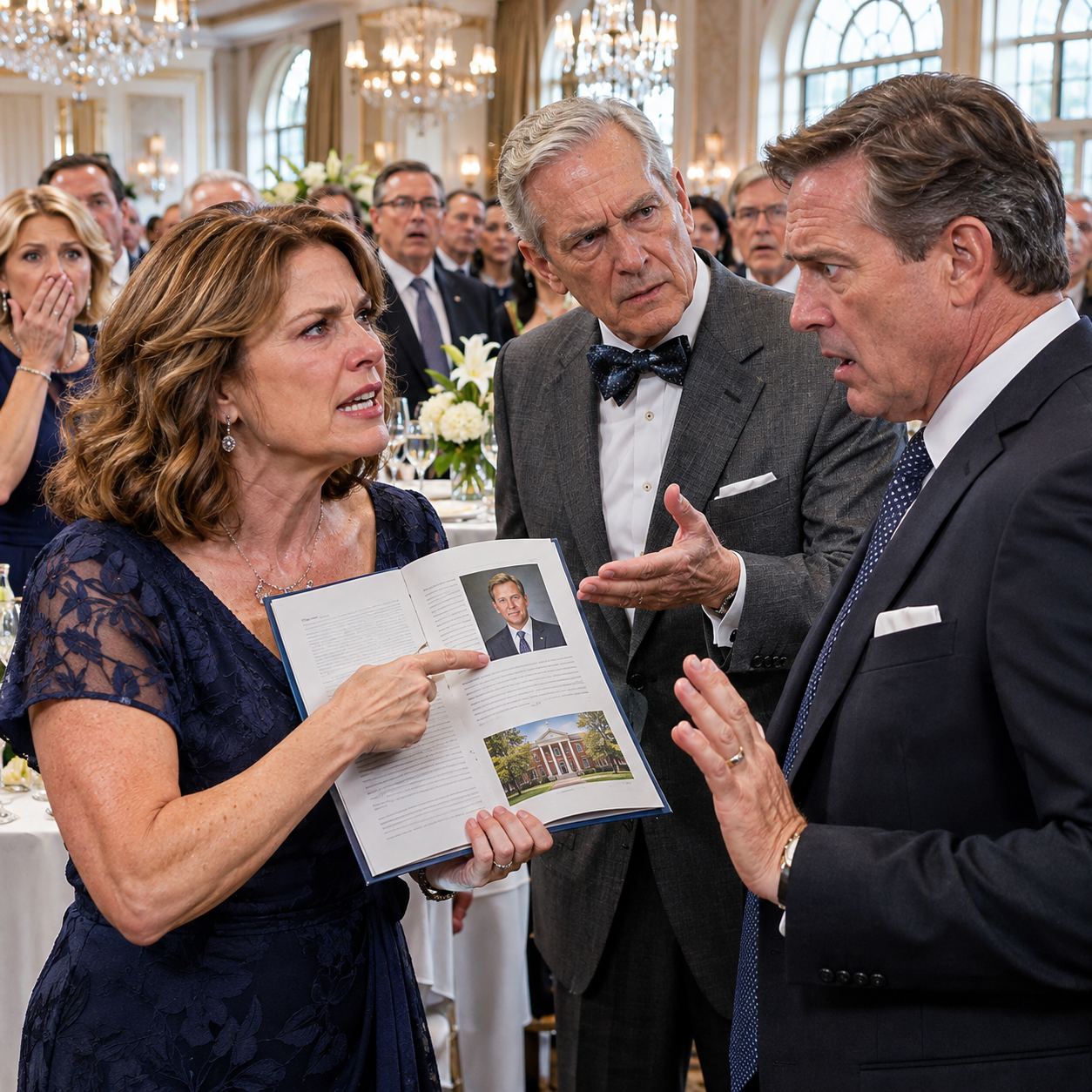
I stared at him, recognizing the familiar smile he wore whenever he was inventing an answer. Sam reached into his jacket and withdrew a folded reunion booklet. He opened it to Richard’s alumni profile, then handed it to me.
Beneath my husband’s name, the printed biography identified him as the founder and driving force behind Second Chapter. The next paragraph described our volunteers, student progress, and expansion plans in language I knew by heart.
It was my report.
The one I’d emailed him because I thought he was proud of me.
Richard hadn’t merely hidden his wife from the reunion. He had brought my life’s work into that ballroom and introduced it as his own.
## Part 2: A Stolen Report Turns Private Humiliation Into Public Truth
“Richard, did you write this?” I asked, holding the booklet between us. He glanced toward the nearby guests, his mouth tightening. “Claire, don’t make a scene. We’re married. Your accomplishments are our accomplishments.” I looked directly into his eyes. “Then why is your name the only one printed here?”
Sam explained that the original report reviewed by the Whitaker Fund clearly identified me as Second Chapter’s founding coordinator. He asked whether Richard’s version contained an error, but my husband insisted he’d merely simplified a complicated story. Sam suggested we continue in a private lounge, where he explained that Richard was being considered for an alumni advisory position partly because of his supposed community contributions. “The university needs accurate information,” Sam said. “This isn’t about embarrassing anybody.”
Richard crossed his arms and demanded that I acknowledge his support. “You donated two hundred dollars at our first fundraiser,” I replied. “I appreciated it, Richard, but you didn’t recruit our volunteers or organize six years of classes.” He looked at me with the familiar warning expression that had silenced me for decades. When Sam asked whether I would verify the program’s history for Diane Mercer before the next morning’s recognition breakfast, I felt that old instinct to protect my husband rise inside me, then answered, “Yes.”
Back in our hotel room, Richard slammed his jacket onto a chair. “Do you have any idea what you’ve done? Those alumni connections could change my career!” I set my purse on the dresser and asked when he’d last been proud of something I’d accomplished. He stared at me, visibly irritated, then said he was tired and turned on the television. Minutes later, Diane sent me a message requesting documentation, and Richard ordered me not to respond.
At seven the next morning, I called Ellen Parker, my oldest friend and one of Second Chapter’s first volunteers. I told her everything, including the stolen report and the humiliating corner beside the coatroom. “Richard couldn’t even find our first classroom,” she said indignantly, but her voice softened when I admitted how frightened I was of going home with him—or without him. “You don’t have to decide the rest of your life today, Claire,” she told me. “Just decide whether you’re willing to lie for him again.”
I emailed Diane the original report, our library’s public program history, and an accurate description of Richard’s donation. At breakfast, my husband accused me of ruining his weekend, though Diane had already offered him an opportunity to correct his statement. He refused, insisting that presenting our family’s accomplishments as his own was perfectly reasonable. When Diane approached me at 8:40, she confirmed that the committee had independently verified my account and removed Richard’s community service recognition from the presentation. His advisory application had been postponed.
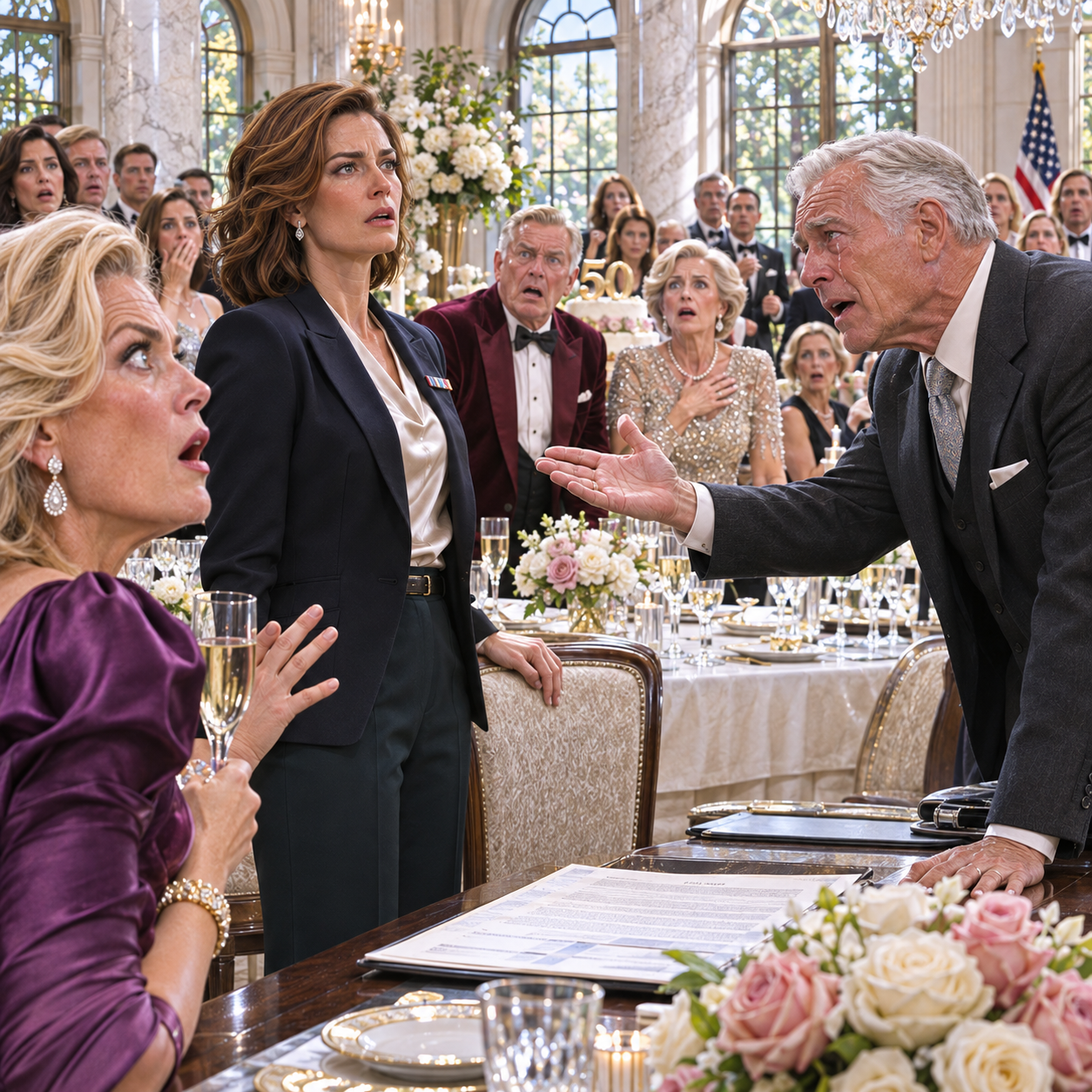
Eighty guests filled the breakfast ballroom when Dr. Samuel Whittaker stepped onto the stage. After speaking about his late wife’s struggle with reading, he introduced Second Chapter and invited me to join him. My knees trembled as I approached the microphone, and I nearly collided with a chair. “I help adults who are nervous about reading aloud,” I told the audience. “Apparently, I should have asked them for public-speaking advice.”
The laughter was gentle, encouraging. I described the four original learners, the borrowed tables, our unpredictable coffee machine, and Margaret’s determination to read to her granddaughter. I thanked Ellen, the retired teachers, and the library staff who had built the program beside me. When Sam asked what advice I’d give someone starting a similar initiative, I looked across the room and answered, “Start small. Listen carefully. And never confuse being important with being useful.”
The applause rose around me, sincere and sustained. Richard sat motionless near the front, staring at the printed program that still contained his false biography. For the first time in years, I stood before a room full of accomplished people without needing my husband’s permission to speak.
## Part 3: His Excuses Collapse When I Finally Refuse to Disappear
Greg Hollis approached me after the presentation, asking whether Second Chapter could help businesses connect employees with evening literacy classes. We discussed volunteer training, privacy, and how employers might support adult education without embarrassing their workers. Then Richard appeared, wearing the same polished smile he’d used the previous night. “Greg! I see Claire’s been telling you about our program. I can introduce you to the right people.”
Greg glanced at me. “I believe I’m already talking to the right person.” Richard laughed awkwardly and repeated that we’d both contributed considerably. Something inside me finally settled. “Richard donated to our first fundraiser,” I said calmly. “But he didn’t found Second Chapter.” His smile vanished, and he whispered that we shouldn’t discuss it there. I met his eyes. “You brought my work here, Richard. I didn’t.”
When I asked why he’d been ashamed to stand beside me the previous evening, he looked toward Greg and Diane, who had stopped nearby. “That was private,” he muttered. “So was my work,” I answered, “until you decided to take credit for it.” Nobody cheered or humiliated him; Greg simply thanked me and promised to contact the library. Diane later confirmed that Richard’s advisory application would not proceed that selection cycle, and the alumni committee would require a written correction.
Outside the hotel, Richard caught my arm lightly to get my attention, then released it when I turned. “You enjoyed watching everyone turn against me, didn’t you?” he demanded. I remembered twenty-seven years of smoothing over his mistakes, laughing at unkind jokes, and apologizing for conversations he’d interrupted. “Nobody turned against you,” I answered. “They learned the truth. I finally stopped helping you pretend.”
He ordered me to collect my coat because we were leaving. I looked through the glass doors toward the parking lot. “I’m not leaving with you.” Richard stared at me as though I’d forgotten the most basic rule of our marriage. “We’re married, Claire.” I swallowed against the tightness in my throat. “I’ve spent twenty-seven years remembering that. Maybe it’s time you did, too.”
I drove toward Columbus alone, stopping outside Dayton when the tears finally came. I remembered the grocery-store flowers Richard had brought me after my first library job, the cheap chocolate cake we’d eaten at our kitchen table, and the years when he’d listened to my stories with genuine interest. I wasn’t mourning only the marriage I’d lost. I was mourning the man I’d spent years hoping would return.
Richard arrived home Sunday evening and immediately asked whether I’d calmed down. When I explained that his behavior extended far beyond the reunion, he dismissed the interruptions, jokes, and public belittling as insignificant. “You’re throwing away twenty-seven years over a few comments?” he demanded. “No,” I answered. “I’m finally seeing what those twenty-seven years have become.”
That evening, I packed a suitcase and drove to Ellen’s house. She opened the door wearing an old Ohio State sweatshirt, glanced at my luggage, and announced that her guest room finally had a purpose beyond storing Christmas decorations. I laughed, then cried into her shoulder. During the following weeks, we sat at her kitchen table reviewing my pay statements, household expenses, and savings. I consulted an attorney about marital property, opened an individual bank account for future earnings, and began seeing a counselor.
Second Chapter kept me grounded while everything else shifted. Greg visited with two members of his employee development team, offering useful introductions rather than extravagant promises. The Whitaker Fund invited our library to apply for a competitive grant, and Ellen helped me review the proposal until we could practically recite it. I also accepted an invitation to speak at a regional library workshop, something I would once have declined for fear of embarrassing Richard.
Driving home after that presentation, I realized I hadn’t wondered what my husband would think even once. Four months after the reunion, Richard called and asked to meet for coffee. I agreed, not because I wanted our old life back, but because there was one question I still needed him to answer.
## Part 4: Losing My Marriage Gives Me Back My Own Voice
Richard was already seated when I entered the quiet Columbus café. He looked older, his shoulders less certain, his coffee untouched. He handed me a copy of the written correction he’d submitted to Whitmore’s alumni committee, acknowledging that Second Chapter had been established through the library and that I’d served as its founding coordinator. His actual involvement, the letter confirmed, had been limited to personal support and a donation.
The committee had accepted the correction, but his advisory application wouldn’t be reinstated. “I’m sorry, Claire,” he said, stirring his coffee without looking up. I asked what he was sorry for, and he mentioned the reunion, the inaccurate statement, and how badly he’d spoken to me. Then he admitted he hadn’t realized how unhappy I’d been. I believed him; he’d become so comfortable with my silence that he’d mistaken it for happiness.
There was still one thing I needed to know. “Richard, would you have apologized if Samuel Whittaker hadn’t recognized me?” He looked through the window for a long time, watching pedestrians move along the sidewalk. Finally, he lowered his eyes. “I don’t know.”
It was the most truthful answer he’d given me in months. I thanked him for it, then told him I wanted to end our marriage. His face tightened. “Claire, I thought we’d grow old together.” I felt my eyes fill, because once upon a time I’d wanted exactly that. “So did I, Richard,” I whispered. “But I never thought growing old together meant becoming smaller every year.”
We discussed the house, shared savings, attorney appointments, and the practical details of separating our lives. There were no dramatic declarations, only two exhausted people facing what remained of a marriage neither could restore. Six months after the reunion, our divorce was moving forward, and I’d rented a modest one-bedroom apartment near the library. I bought a bright yellow armchair, placed it beside the living-room window, and smiled because Richard would have hated it.
The following spring, our library received wonderful news: the Whitaker Fund had approved Second Chapter’s grant application. The funding allowed us to introduce another evening tutoring session and expand volunteer training, while the library offered me additional paid coordination hours. I still watched my expenses carefully, and some evenings the quiet apartment felt unbearably lonely. But whenever I returned home and saw that ridiculous yellow chair glowing in the afternoon sunshine, I remembered that every choice inside those walls belonged to me.
One Saturday, Margaret Ellis walked into the library carrying a children’s book against her chest. Her granddaughter had invited her to read at a school event, and she was terrified she’d stumble over a word in front of the third graders. “What if I make a mistake?” she asked. I smiled and straightened the book in her hands. “Then you correct yourself and keep reading.”
She laughed nervously, then joined one of our volunteers to practice. A moment later, I noticed another woman sitting alone near the back of the room, her coat still buttoned and an untouched registration form trembling in her hands. She looked about sixty, and I recognized the expression immediately. It was the same uncertainty I’d felt beneath the chandeliers at Whitmore, convinced that I was somehow less worthy of belonging than everyone around me.
I approached her and gently touched the back of the empty chair. “Excuse me, is this seat taken?” She shook her head, and I sat down beside her. “I’m Claire. I’m glad you’re here.” Her eyes glistened as she whispered, “I almost didn’t come. I was afraid people would think I was stupid.”
I placed a pencil beside her registration form. “You know what I’ve learned? Sometimes the hardest part of a new chapter is believing you deserve to begin one.” She gave me a small, uncertain smile, then slowly unbuttoned her coat. Together, we filled out the form, and when she wrote her name, her hand no longer trembled.
I thought about Richard standing in that ballroom, ashamed to be seen beside the woman he’d married. He’d wanted everyone to admire him, even if that meant stealing the accomplishments he couldn’t appreciate. In the end, the guest of honor hadn’t ruined my marriage or rescued me from it; he’d simply recognized the work I’d done, and the truth had revealed everything else.
Richard had finally acknowledged my name in writing, but I no longer needed his approval to know what it was worth. I had a home, work that mattered, people who respected me, and a future I was learning to build without asking permission.
For twenty-seven years, I’d mistaken keeping the peace for being loved. I’d apologized for speaking, for succeeding, and sometimes simply for taking up space. But sitting beside that frightened woman in the library, I understood something that had taken half my lifetime to learn.
The second chapter of my life hadn’t begun when an important man recognized me.
It began when I finally recognized myself.
THE END.
All characters and events in this story are fictional, created for storytelling and entertainment purposes. Thank you sincerely for reading. Your feedback and support are invaluable and motivate me to continue sharing more stories with you.