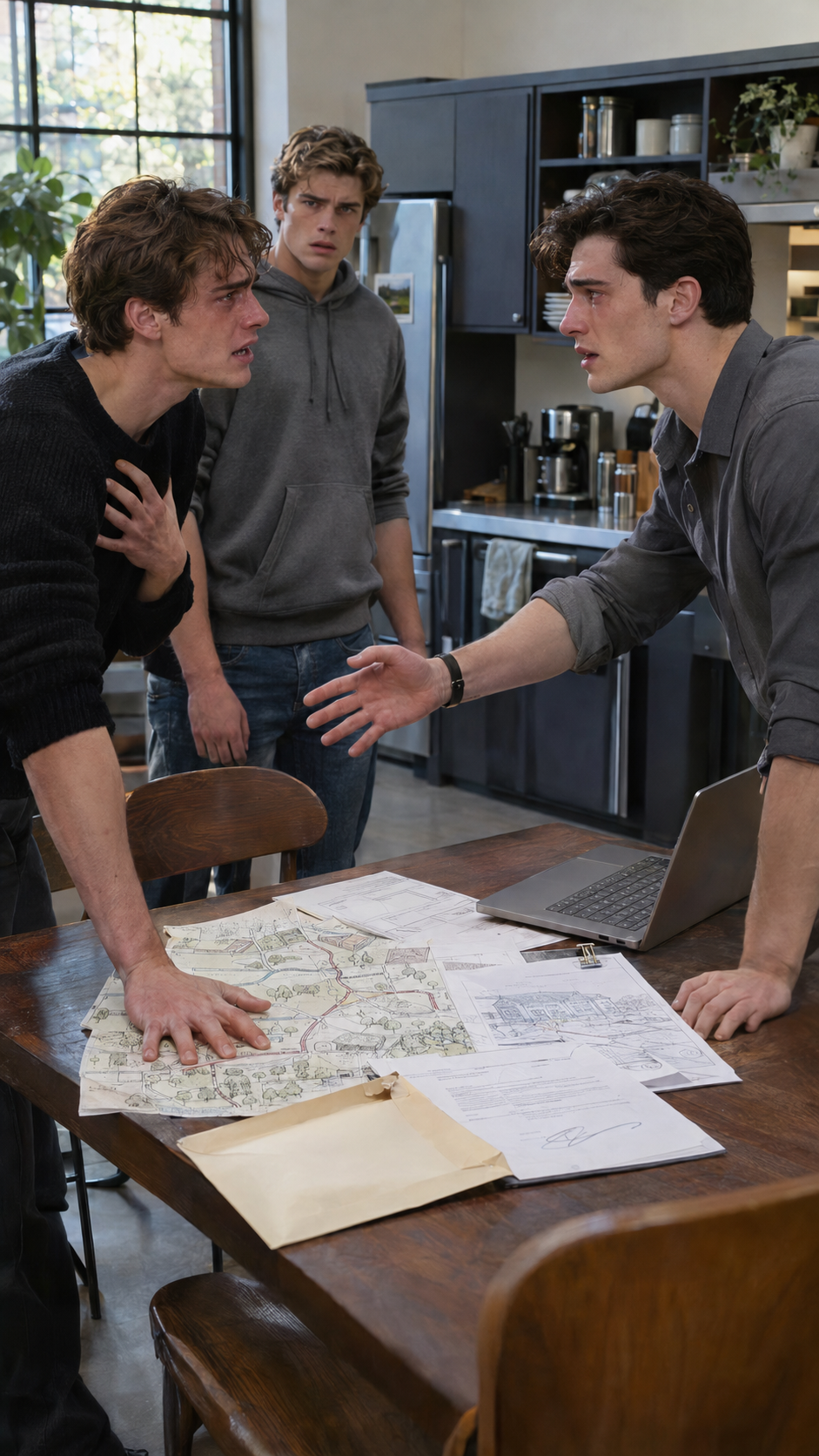
### Part 2: His Desperate Manipulation Uncovered A Secret Financial Betrayal
The next morning, Brandon walked into Sugar Maple carrying white roses. Nine customers watched him approach the counter with sorrowful eyes. “Emma, I’m sorry your mother is so sensitive,” he announced. “She misunderstood me.” When I mentioned the voicemail, he claimed he had spoken in anger and accused me of twisting his words. I accepted the flowers without arguing. “Come to my apartment at six,” I said. “We’ll talk privately.”
He spent forty minutes explaining how much pressure he was under. Then he asked me to call Dad about the rehearsal dinner deposit. “Brookhaven needs the fifteen thousand. It’s tradition for the bride’s family to pay.” I folded my arms. “My parents won’t be contributing another dollar.” He stared at me. “You can’t change tradition because you’re upset.” I held his gaze. “You’re marrying me, not my family. Why should they pay?” For once, Brandon had nothing to say.
Four days later, his truck broke down on Interstate 270. He called Dad, expecting another free repair. I told him my father wasn’t available. He paid $1,400 for towing and transmission work at Dale’s Auto. Then my aunt Linda, who had prepared Brandon’s taxes without charging him for two years, stopped helping him. She brought a folder to my bakery and placed it beneath my hand. “Keep this,” she said. “And when you’re ready, look at page four.”
I put it away without reading it.
Brandon complained about paying a new accountant $600. His mother, Carol, called to ask why I was being cruel. Six of his friends and relatives sent messages accusing me of being “harsh.” None had heard his voicemail. They only knew the version of events Brandon had invented.
On September 2, he forwarded an email demanding an $18,500 final deposit for Brookhaven by September 15. He insisted my name was on the contract, although I didn’t remember signing anything. When I demanded a copy, he kept promising to find it. His laptop was updating. The document was on another account. He would send it tomorrow. Tomorrow never came.
Then, on September 5, he called me from Grant Medical Center, struggling to breathe. I rushed to the emergency room and held his hand through four frightening hours of tests. The doctor eventually explained that Brandon had experienced a panic episode, not a heart attack. I nearly cried with relief. Brandon looked at me from the hospital bed. “You’re doing this to me, Emma. If something happens, it’s on you.”
For the first time, I wondered whether protecting my parents was somehow hurting him.
Two days later, Brandon appeared at my parents’ house carrying lilies. He took Mom’s hands, apologized through tears, and told her she had treated him better than his own mother. She hugged him. Even I wanted to believe him. Then he asked Dad to step onto the porch for a private conversation.
Through the screen door, I saw Brandon unfold a manila folder and offer my father a pen. Twenty minutes later, Dad signed something. When I asked what it was, he avoided my eyes. “Just helping him straighten things out,” he said. I should have asked again. Instead, I let the evening end peacefully.
On September 20, Brandon emailed me the final seating arrangement with the subject line “Final — No Changes.” His grandmother and mother occupied table one. His boss, Gerald Hutchins, sat near the front. My parents were assigned table fourteen, beside the restrooms and kitchen entrance. When I protested, Brandon answered coldly. “Somebody has to sit there. Don’t embarrass me over this.”
A week later, his best man, Jason Reyes, sent me an unfamiliar message asking whether we could talk. Before I answered properly, he withdrew it. On October 2, he finally called. His voice trembled. “Emma, I’ve known Brandon since college. He’s helped me get jobs. I’ve covered for him. But I can’t keep covering for this.”
The screenshots arrived while I sat on my kitchen floor.
In a group chat called Whitfield Wedding Crew, Brandon had joked about putting my plumber father and receptionist mother beside the bathroom. His friends mocked Dad’s tools and laughed about the cheap seats. Another message said Brandon planned to see my parents only on holidays after we married. Jason admitted he had laughed along, and I heard the shame in his voice.
Then I saw a message Brandon had sent from the emergency room: “Doctor’s about to say panic attack. Perfect. Emma will fold. She always folds when I get sick.”
My fingers went numb. I remembered holding his hand while he was secretly congratulating himself for manipulating me.
The next screenshots were worse. Brandon expected a promotion to vice president at Hutchins Commercial Roofing that November. He wanted a glamorous wedding because Gerald Hutchins valued polished, successful family men. In another message, he called marrying me the cheapest financial upgrade he could make. He claimed to be $74,000 in debt and described our marriage as his escape route.
I drove to my bakery and opened Aunt Linda’s folder.
On page four was an IRS notice showing $90,340 due on a prior tax return, along with a $14,200 canceled-debt tax entry. His filed annual incomes were $52,400 and $54,990, nowhere near the $140,000 he had claimed to earn. The declined credit card, the expensive engagement ring, the constant demands for money—all suddenly made sense.
“Emma?” Jason whispered through the phone. “What are you going to do?”
I stared at the screenshots. Quietly ending our engagement would give Brandon another opportunity to rewrite what had happened. He had already persuaded strangers that I was cruel and my mother was oversensitive.
“Jason,” I asked, “are you still running the slideshow at the rehearsal dinner?”
“Yes.”
“Then I need you to add something after the baby pictures.”
He was silent for several seconds. “Brandon will never forgive me.”
“I know.”
Finally, Jason whispered, “Tell me what you need.”
### Part 3: One Wedding Slideshow Destroyed His Carefully Constructed Perfect Reputation
On Friday, October 10, I arrived at Brookhaven Country Club before the guests. I had already consulted my attorney friend, Priya Nair, about the recording and my legal options. Now I stood beneath three crystal chandeliers while the event coordinator, Ms. Abernathy, checked her clipboard. I asked whose name appeared on the venue contract. “Brandon Whitfield’s,” she answered. “Only his.” Another lie fell away.
My parents arrived in Dad’s gray Buick at six-thirty. Mom wore the blue dress she’d worn to my college graduation. Dad wore his only good suit, with an anchor-patterned tie he kept nervously adjusting. I walked them to table fourteen, beside the swinging kitchen door. Mom glanced toward the beautiful tables near the front, then smiled. “It’s lovely, honey. We can help the servers if they need anything.”
I squeezed her hand. “Whatever happens tonight, please trust me.”
By seven, 120 guests filled the ballroom. Brandon wore a charcoal suit and burgundy tie. He reminded me that Gerald Hutchins was attending and warned me not to cause trouble. During dinner, Brandon thanked his boss, his mother, and his business associates. He never mentioned my parents. Gerald stood and toasted Brandon as a man who understood the importance of family.
At 8:15, Jason stepped beside the projector. His hands shook as he introduced a slideshow of Brandon’s childhood. The guests laughed at photographs of a little boy riding a tricycle, wearing a Cleveland Browns jersey, and sleeping on his grandmother Dorothea’s shoulder. Carol dabbed her eyes. Brandon raised his glass.
Then the screen went black.
A message appeared, bearing Brandon’s name: “Her parents are a plumber and a receptionist. I’ll stick them by the bathroom door.”
Another described how rarely he intended to visit them after the wedding. A third called marrying the bakery girl his cheapest upgrade. Finally, the speakers crackled, and Brandon’s recorded voice filled the room.
“Your parents are nobodies, Emma. Nobody will even notice them.”
Brandon sprang upright, knocking over his chair. “Turn it off! That’s edited!” Jason didn’t move. I crossed the dance floor and took the microphone. My heart pounded so violently I could feel it in my throat.
“You told my mother nobody would look at her,” I said. “Look at her now.”
One hundred twenty people turned toward table fourteen. Mom covered her mouth. Dad sat straight-backed beside her, holding her hand. Gerald set down his fork and asked Brandon whether the recording was genuine. Brandon stammered about private jokes and misunderstandings. Then, astonishingly, he shouted that he’d done my parents a favor by seating them near the exit because people like them didn’t belong at Brookhaven.
Dorothea struck her cane against the floor. “Brandon Alexander Whitfield. Sit down.”
I looked at the man I had planned to marry. “My father repaired your truck. My mother fed you every Sunday. They worked extra shifts to educate me and sacrificed their retirement savings for my business. You called them nobodies because you never understood what they gave you.”
My voice broke. “Everything good in me came from that table. And I’d rather be nobody with them than somebody with you.”
I slipped off my engagement ring and laid it on the white tablecloth. Carol walked past her son and embraced my mother, apologizing through tears.
I thought the nightmare had ended.
But Brandon slowly smiled, took the microphone, and looked directly at my father.
“Frank,” he said, “why don’t you tell your daughter what you signed last month?”
Dad went white.
Gerald ordered Brandon to surrender the microphone. I hurried my parents through the kitchen onto the loading dock, where Dad collapsed onto an overturned milk crate. He untied his necktie with trembling hands.
“It was a loan,” he whispered.
On September 7, Brandon had told Dad my bakery was secretly struggling. He claimed I was ashamed to ask for help and needed an emergency financial bridge to protect the wedding. Then he persuaded Dad to co-sign a $28,000 loan at Buckeye Community Credit Union.
“Sixty months,” Dad said. “Eleven-point-nine percent interest. Six hundred twenty-one dollars every month.”
The application listed Brandon’s income as $138,000. Dad believed he could repay it quickly. Brandon had promised everything would be settled by January.
“Why didn’t you tell us?” Mom whispered.
Dad pressed his tie against his eyes. “I thought I was saving our girl’s future.”
I knelt on the cold concrete and held his rough hands. “Dad, my bakery was never in trouble. He lied to you.”
Mom turned away, devastated that her husband had hidden something so serious. For the first time in thirty-four years of marriage, my parents stood together without knowing how to speak to each other.
And I understood that breaking off the wedding was only the beginning.
### Part 4: The Final Financial Truth Restored My Family’s Stolen Peace
Brandon started texting at 11:07 that night. First came threats. “Your father’s responsible for twenty-eight thousand dollars, and I’m not paying if there’s no wedding.” By dawn, he was begging me to reconsider. I forwarded everything to Priya.
Saturday morning, we sat in her downtown office. Dad stared at the loan papers while Mom sat one chair away from him. Priya explained that co-signing made Dad legally responsible for the debt, whether Brandon paid or not. She couldn’t promise to release him. But when she compared Brandon’s claimed $138,000 income against his tax returns, she stopped turning pages.
“This income discrepancy is substantial,” she said. “We need the credit union to investigate.”
On Monday, we met Denise Moreau, the loan officer. She studied the documents, then admitted something troubling. Brandon’s paystub had seemed suspiciously perfect. She had flagged it, but someone had marked it verified. Denise promised to refer everything to compliance.
Aunt Linda arrived carrying a banker’s box filled with financial records. She set it on the desk and sat beside Mom, taking her hand. Nobody needed to make a speech. For the first time in weeks, my father wasn’t fighting alone.
Gerald Hutchins called the next day. His company had confirmed Brandon’s previous annual earnings were approximately $55,800. Gerald also told me Brandon would not receive the vice-presidential promotion. Before hanging up, he asked me to tell Mom something.
“Your mother looked beautiful that evening, Emma. I noticed her.”
I cried after that call.
Brandon’s attorney later demanded $19,400 in wedding expenses. Priya challenged the claim, and we heard nothing further. Meanwhile, Brandon posted videos accusing my parents of taking advantage of him. Some relatives believed him. Others stopped calling. His mother, Carol, gave Priya a statement, and Dorothea sent me a handwritten letter apologizing for her grandson.
On October 20, Brandon appeared at my parents’ door carrying another document. He promised to keep making the loan payments if Dad signed a statement affirming that we were still on good terms and that the wedding could be repaired.
Dad stood behind the screen door.
“Frank, it’s only a signature,” Brandon pleaded.
My father looked at the paper, then at the man holding it. “I know what a signature costs.”
He closed the door.
The wedding date, October 11, had passed without a ceremony. That afternoon, I found fourteen mason jars hidden in a box beneath Dad’s garage workbench. Each was wrapped in white lace, with a handwritten tag reading, Emma and Brandon, October 11. Mom had made them despite Brandon’s insults, hoping he might change his mind.
I sat on the garage floor holding one and finally wept for the marriage I had imagined.
Mom moved into the guest room for sixteen days. Dad never complained. He left tea outside her door every night, just as he had done when she was sick years earlier. Eventually, they began speaking again. Their trust wasn’t repaired overnight, but they chose to work on it together.
In December, Brandon lost his job. I heard he had moved in with a cousin in Dayton. I didn’t ask for details.
On February 6, the credit union released my father from the loan following its compliance review. We were never told the full reasoning. I had paid $1,863 to protect his credit during the investigation. When Denise called with the decision, Dad sat at the kitchen table and cried without trying to hide it.
A year later, Sugar Maple had expanded into the neighboring storefront. I had four employees and a second oven. I had repaid $27,500 of my parents’ original investment, although Dad kept the checks in a coffee can instead of cashing them.
The fourteen mason jars now sat on my bakery tables. Mom and I had removed the old wedding tags and replaced them with ones reading Sugar Maple. Every morning, I filled them with fresh flowers. Customers sometimes asked where I bought them. I always answered, “My mother made them.”
Carol and I still met for coffee. When Dorothea passed away that April, my parents and I attended her funeral. Jason sent a Christmas card thanking me for giving him the courage to tell the truth.
And Sunday dinners returned.
One evening, after Mom passed the potatoes and Dad finished blessing the meal, she brought two dresses into the kitchen. My cousin Dennis was getting married in May, and she wanted my opinion. One dress was green. The other was blue.
“Which do you think I should wear, sweetheart?”
For a moment, I saw her standing beside table fourteen, smiling through humiliation because she loved me enough to endure it.
I took the blue dress from her hands and held it against her shoulders.
“This one, Mom. You look beautiful in blue.”
She laughed, and Dad smiled at her from the table.
I had once believed love meant holding on, even when someone hurt the people who mattered most. Now I understood something different. Love was my father working beneath a truck for six hours. It was my mother saving vacation money for my future. It was a handwritten label on a container of leftovers, asking for nothing in return.
Brandon had wanted the world to see him as somebody important. He had pushed my parents into the back because he thought their ordinary lives made him look small.
But when the truth finally came out, the people he considered nobodies were the ones who still had a family, a home, and a place at the table.
I watched Mom hang the green dress away.
And I promised myself that nobody would ever make her feel invisible again.
THE END.
All characters and events in this story are fictional, created for storytelling and entertainment purposes. Thank you sincerely for reading. Your feedback and support are invaluable and motivate me to continue sharing more stories with you.