### Part 2: A Secret Plan Leads Me Toward My Long-Forgotten Dream
Phil Rogers still kept butterscotch candies on his desk, although his gray mustache had grown considerably whiter since Bruce’s funeral. He listened as I described the bedroom, the missing furniture, the years of unpaid expenses, and the dinner conversation that had finally forced me to confront my situation. When I finished, he removed his glasses and asked one question. “Marilyn, are they treating you well?” I stared at the candy dish, swallowed against the tightness in my throat, and answered, “No, Phil, they are not.”
He didn’t interrupt my silence or tell me that families sometimes said hurtful things without meaning them. Instead, he asked what I wanted, and I told him I wanted a clean bedroom, a door I could close, and the freedom to decide what happened inside my own home. Phil examined the deed and explained that I held clear title, which meant Christina and Mark had no ownership claim simply because they lived there. We discussed written notice, the appropriate legal process, and a generous sixty-day period for them to arrange another home. “We can do this properly,” he said, “but I suggest you make your decisions before announcing them.”
Three days later, I met Barbara Shaw, a real estate agent who had been selling houses in my Dayton neighborhood for decades. She walked through the rooms with a notebook, admired the original staircase, measured the dining room windows, and finally gave me a number that made me grip the kitchen counter. The house and its valuable lot could bring just under eight hundred thousand dollars, especially with the neighborhood schools attracting buyers willing to move quickly. “If you give me access for photographs and showings, Marilyn, I can find someone serious,” she said. I thought of the spring-break vacation Christina had booked in Destin, Florida, and told Barbara she would have the house to herself for nine days.
My daughter had planned that vacation months earlier, cheerfully discussing the beach rental, the restaurants, and all the activities she had arranged for Mark and the children. Nobody had asked whether I wanted to go, although Christina assured me that Mrs. Kowalski next door would check on me while they were away. I had smiled and told them to enjoy themselves, pretending not to notice how relieved Christina looked when I didn’t protest. Now those nine days offered something I had not possessed in two years: uninterrupted time to make decisions without asking permission. But selling the house was only half my plan, because an old promise had begun stirring in the back of my mind.
Years before Bruce became ill, we had spent a September vacation in Traverse City, Michigan, in a little rented cottage overlooking the bay. Every morning we drank coffee on a screened porch while the fog drifted across the water, and one afternoon I told him I wanted to retire somewhere just like it. He squeezed my hand and promised we would make that dream happen, although work, family obligations, and eventually his illness kept pushing it farther into the future. Late one night, I opened my laptop at the kitchen table and searched for cottages near Traverse City. A gray Craftsman house from the 1920s appeared on the screen, with two bedrooms, a stone fireplace, an enclosed sunroom, peonies in the garden, a crabapple tree, and a screened porch overlooking the water.
The cottage stood four blocks from the library and six from a grocery store, and its asking price was four hundred ten thousand dollars. I drove five hours north to tour it, ignoring the imaginary sound of Christina warning me that I was too old for highway driving. When the realtor opened the back door, cool lake air swept through the porch screen, and sunlight fell across a wooden floor that creaked beneath my shoes. I stood in the sunroom, imagining Bruce sitting beside me with his morning newspaper, and felt an ache that was almost happiness. “I’ll take it,” I said, before I could begin talking myself out of the first thing I had wanted in years.
I signed the purchase papers, arranged to pay in cash without a mortgage or co-signer, and returned to Dayton carrying a certainty I had forgotten I could feel. Before the family left for Florida, I also visited a neurologist for updated examinations, determined to document my health and ability to make independent decisions. He confirmed that my recovery was excellent and that my cognitive testing showed no troubling impairment, and I placed his written assessment in a folder labeled In Case Anyone Asks. The morning Christina’s minivan disappeared around the corner, Lucy had hugged me tightly, Max had smiled, and my daughter had kissed the air beside my cheek. I waited until their taillights vanished, then walked into the kitchen and called the moving company.
### Part 3: Hidden Water Damage Exposes The Truth Behind My Humiliation
The movers arrived with blankets, dollies, and the quiet patience of people accustomed to handling possessions that mattered more than their price tags. I directed them upstairs for my personal belongings, into the basement for my piano, and into the garage for Bruce’s rolltop desk. We brought down my good china and carefully wrapped the dining table, including the dent Christina had made during a childhood science project involving a homemade volcano. I even had the pencil-marked pantry door removed and protected in a quilt, preserving the lines Bruce had drawn as our daughter grew from a tiny girl into a teenager. I left every piece of furniture belonging to Christina and Mark untouched, along with their clothing, dishes, and children’s belongings.
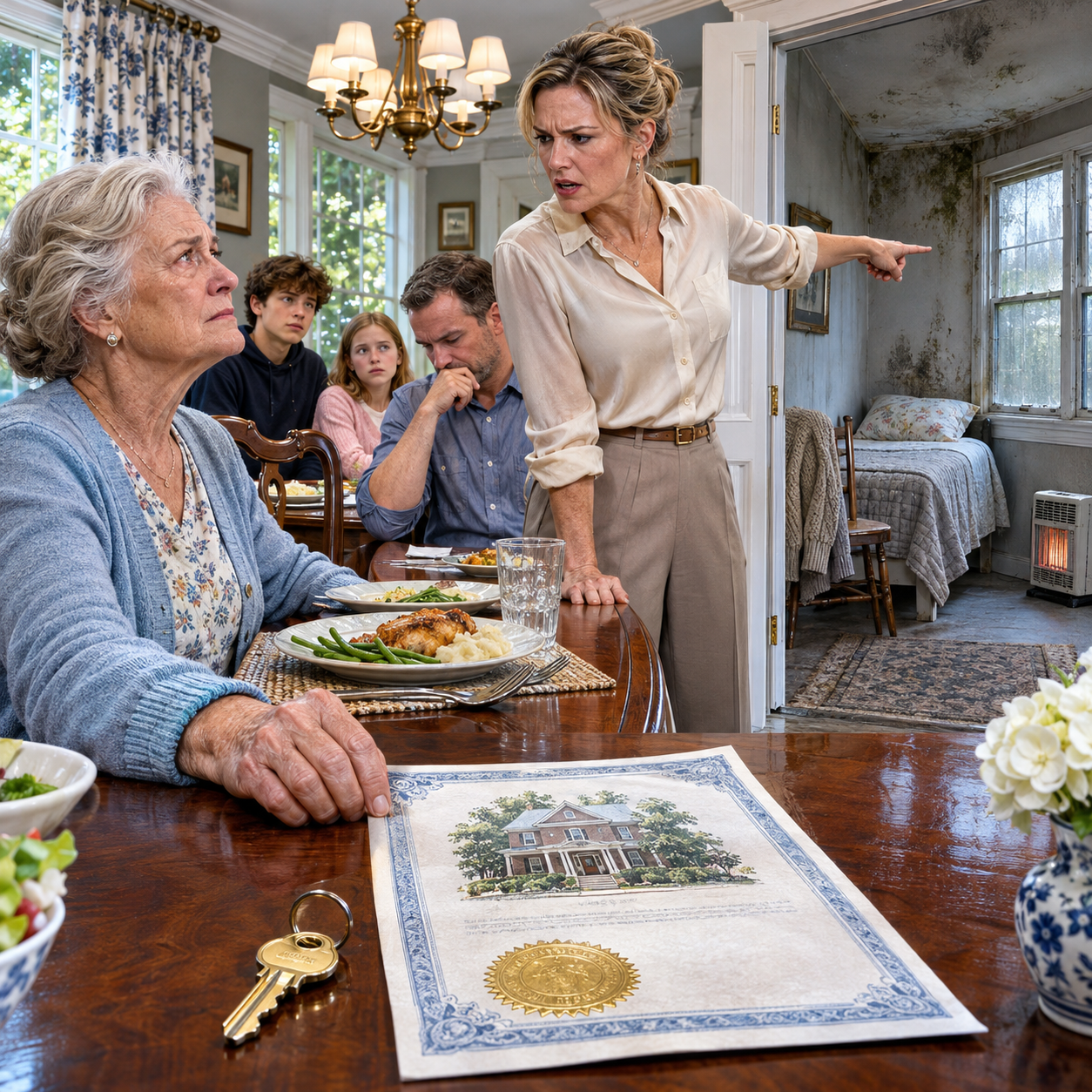
Before leaving, I called a plumber Barbara had recommended and asked him to investigate the odor in my former bedroom. His name was Dale, and after inspecting the sunroom, he cut a small opening in the drywall behind the twin bed. He aimed his flashlight inside, crouched closer, and went so still that I thought he had found something dangerous. “How long has someone been sleeping in this room?” he asked quietly. When I answered two years, he turned the light toward a cracked copper water line, blackened wood, and damp insulation that had been deteriorating behind the wall for a very long time.
The smell had not come from my body, my laundry, or the unfortunate habits of an aging woman. It came from water damage and mold inside a wall that my family had refused to examine, although I had begged them to do so repeatedly. I made Dale photograph everything and document the damaged plumbing before he left, then sat on the porch steps with the pictures spread across my knees. For a moment, I laughed so hard that tears rolled down my face, and then the laughter collapsed into something much closer to grief. I thought of every nightgown I had washed, every hug I had avoided giving Lucy, and every morning I had wondered whether old age was turning me into someone even my daughter couldn’t stand.
I left two items on the kitchen island: a handwritten letter and a folder containing Dale’s photographs. The letter explained that I had sold the house, that the transaction was scheduled to close in sixty days, and that Phil’s office had prepared and delivered the appropriate written notice. Christina and Mark could remain rent-free during that period, but they needed to arrange their departure and have the water damage properly addressed before anyone used that room again. I told them I loved them and would welcome a respectful relationship, but I could no longer accept being treated as an inconvenience inside my own home. Then I locked the front door, placed the spare key beneath the flowerpot where Max always looked for it, and drove north with my mother’s recipe cards on the back seat.
Somewhere outside Lansing, I caught myself singing an old tune Bruce used to hum while washing dishes. I couldn’t remember the words, but I kept singing anyway, with the windows down and a thermos of coffee rolling gently against the passenger seat. By the following morning, Christina had called eleven times, leaving messages that shifted from confusion to anger and finally to frightened demands. I replied only that I was safe, healthy, and that Phil had all the necessary information. Then I turned off the telephone, unpacked my skillet, and ate an omelet on the screened porch of a cottage that smelled of lake water and clean wood.
Phil called two days later with news of Christina’s visit to his office. She had marched inside wearing sunglasses, sand still caught in the cuffs of her jeans, and insisted I was confused because of my previous stroke. When Phil presented the neurologist’s letter, she read it twice and stopped accusing strangers of influencing me. Then she insisted that sixty days was not enough time because they had nowhere else to live, blurting out that she and Mark had already paid a thirty-thousand-dollar nonrefundable deposit on a summer lake house. They had also borrowed against Mark’s future income, apparently confident that my Dayton property would eventually become theirs.
Phil asked whether I had ever promised them the house, and Christina answered that I had never said they couldn’t have it. That sentence hurt more than the financial figures because it revealed how completely she had mistaken my generosity for surrender. The family had been spending money based on an inheritance they had never been offered, while I paid the household bills and slept beside a rotting wall. Barbara had already shared Dale’s findings with the buyer’s inspector, who requested that Christina’s family clear their belongings from the damaged sunroom before closing. For the first time, someone else was insisting that the problem I had described for two years deserved immediate attention.
That evening, I finally answered Christina’s call while sitting beneath a blanket on my porch. She asked how I could do this to her family, and I asked whether she remembered humiliating me over the smell at dinner. “I was stressed,” she whispered, but I told her I had washed my clothes every day, scrubbed myself raw, and stopped embracing my granddaughter because I believed something was wrong with me. When I described the wet wall and the photographs, she began crying, saying she had never realized the damage was so serious. “You didn’t know because you never looked,” I told her, watching the last silver light fade from the bay. “I asked you three times, Christina, and you never looked.”
### Part 4: A Grandson’s Apology And A Mother’s Return Change Everything
By May, tomato seedlings filled the garden behind my cottage, and the air carried the scent of new leaves and damp earth. I joined the library’s Tuesday book club, began walking the bay trail every morning, and learned euchre from my eighty-year-old neighbor Joanne, who played cards with the seriousness of a courtroom judge. I also met with a fee-only financial adviser who helped me invest the remaining proceeds conservatively after the Dayton sale. From that money, I allocated one hundred fifty thousand dollars between two 529 college accounts for Max and Lucy, keeping myself as owner and naming Phil as successor. Whatever mistakes their parents had made, I refused to let my grandchildren’s education become another bargaining chip.
Two weeks before the closing, my phone rang on a Thursday afternoon, and I heard Max whispering from his bedroom. He told me the inspector had shown them the damaged wall, that his father had been shouting about money, and that Christina had stood staring at the photographs without speaking. Then my grandson’s voice cracked, and he apologized for sitting silently while his mother embarrassed me at dinner. I reminded him that he had been fourteen, but he immediately corrected me, insisting he was fifteen now and old enough to know better. “Then start being kind today,” I told him, struggling to keep my voice steady. “You don’t have to carry yesterday forever, sweetheart.”
Max visited in July, buying his own Greyhound ticket with money he had saved. When I met him at the Traverse City station, he strode across the parking lot in worn sneakers and hugged me without caring who might see. We cooked pancakes that evening, ate them on the porch, and talked about school, baseball, and the strange things that happened when adults became afraid of losing control. Before bed, Max wandered into the living room, breathed deeply, and smiled. “Grandma, your whole house smells like the lake,” he said, and I laughed because nobody could have offered me a more beautiful compliment.
Christina came in August, arriving unexpectedly in a rented compact car with Lucy beside her. The Dayton house had closed, and the family was now living in an eleven-hundred-square-foot apartment above a dry cleaner in Columbus, with two bedrooms and a window air conditioner. They had lost their lake house deposit, while Mark was taking extra contract work at night to repay the money they had borrowed. Christina looked thinner and more tired as she climbed out of the car, and there was gray showing at her temples where she had stopped coloring her hair. When she reached the bottom of my porch steps, she clasped her hands together and asked, “Mom, may I come up?”
I watched her for a long moment, remembering a little girl who once fell asleep on my lap during Wheel of Fortune, long before she began treating my love as something she owned. Then I opened the screen door, told her she could sit on the porch, and went inside to prepare coffee. Lucy came up the steps behind her and curled against me on the wicker loveseat, although she was nearly too big to fit comfortably in my lap. Christina stared across the bay, turning her cup slowly between her hands, before admitting that she owed me an apology and didn’t know how to begin. “Begin badly,” I told her. “I’ll listen anyway.”
She gave a shaky laugh, wiped her eyes, and finally said the things I had once believed I would never hear. She apologized for humiliating me at dinner, ignoring my complaints about the dampness, and allowing me to live in a room that was making me miserable while she enjoyed the best rooms in my house. “I thought you’d always be there,” she admitted, her voice breaking. “Cooking, helping, paying for things, making everything easier for us. I forgot you were a person with your own life, Mom, and I am so ashamed.”
I thanked her, but when she asked whether we were finally all right, I told her healing would require more than a single afternoon. I would welcome visits and phone calls, but I would not surrender my independence or pretend the past two years had never happened. “This door is open,” I said, touching the wooden frame beside my chair, “but it belongs to me, and that means you knock before coming inside.” Christina nodded through her tears, then smiled when I added that I would also appreciate not hearing any further opinions about how I smelled.
They stayed two nights in the guest bedroom, which I had painted pale yellow and furnished with a comfortable new mattress beneath a window that opened wide. I cooked breakfast because I wanted to, not because anyone expected me to, and Christina washed the dishes without being asked. Lucy cried when it was time to leave, while Christina held me in the driveway longer than she had in years. Before getting into the rental car, she quietly asked whether they might return for Thanksgiving. “Ask me in October,” I answered, “and ask as though my time matters.” She nodded, kissed my cheek properly, and promised she would.
After their car disappeared down the road, I returned to the porch and noticed a small envelope Christina had left beside my coffee cup. Inside was a photograph I had almost forgotten, taken many years earlier during our family vacation in Traverse City. Bruce and I were standing on a screened porch, smiling into the wind, his arm wrapped around my shoulders, while little Christina stood between us. On the back, in the uneven handwriting of the girl she once had been, were six words: Mom and Dad’s dream house someday.
I held that photograph against my chest and finally understood something I had been too hurt to see. Christina had once known that I had dreams beyond taking care of her, even if she had forgotten them as she grew older. Her apology could not restore the years we had lost, but the photograph reminded me that our family had existed before her mistakes and might still have a future beyond them. I placed it on the mantel beside Bruce’s picture, where the afternoon sunlight reached them both.
Outside, my tomatoes hung red and heavy on their vines, the crabapple tree was beginning to fruit, and a neighbor’s dog barked once at the passing mail truck. I poured another cup of coffee, settled into my favorite chair, and watched the breeze ripple across the bay while the screen door creaked softly behind me. I didn’t know whether Christina and I would ever recover everything we had lost, and I had learned not to promise myself a happiness that depended on somebody else’s choices. But that night, I climbed into my own bed, opened my own window, and slept until morning without fear, embarrassment, or the need to apologize for occupying space.
For the first time in two years, my bedroom smelled of nothing except fresh sheets and cool northern air.
And I had never felt more at home.
THE END.
All characters and events in this story are fictional, created for storytelling and entertainment purposes. Thank you sincerely for reading. Your feedback and support are invaluable and motivate me to continue sharing more stories with you.