### Part 2: One Quiet Sentence Destroyed Diane’s Carefully Prepared Moving Plans
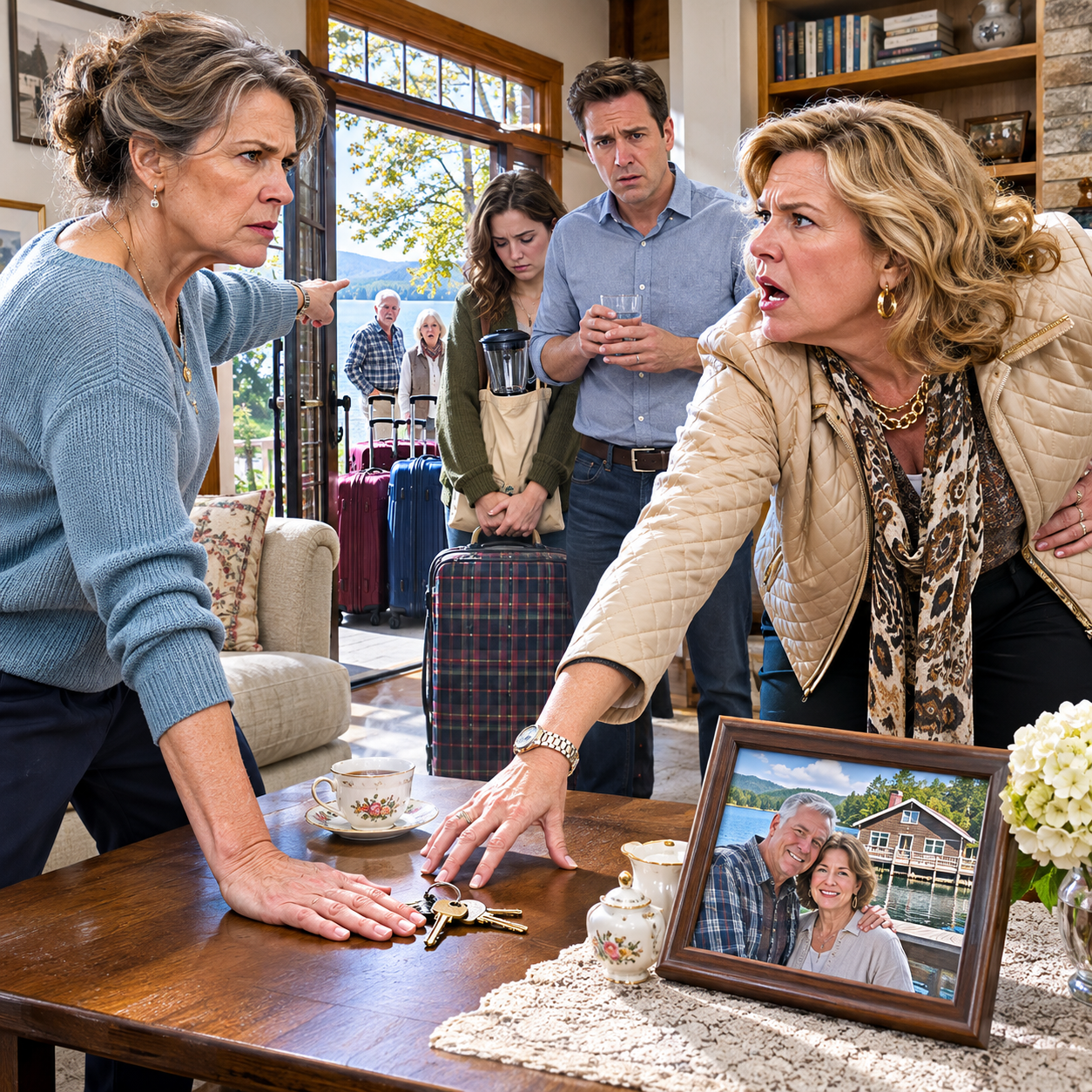
Diane reached for the keys, but I placed my hand over them first. “These look like the emergency keys Frank gave Victor and Leah years ago,” I said, watching her expression. Victor frowned and explained that Leah had kept their spare set in a kitchen drawer, although he had never authorized anyone else to use it. Diane lifted her chin. “My daughter gave them to me, and Victor promised we could stay. I don’t understand why you’re making such a spectacle over a perfectly reasonable arrangement.”
“Because neither of them owns the cottage,” I replied.
Victor looked at me with genuine confusion, and I realized he knew considerably less about our family finances than I had assumed. After Frank died, I had arranged for the lake property to be held in a sole-owner living trust under my control, with my solicitor preparing the documents to protect it. Victor remained a beneficiary of my estate, but that gave him no present authority to lend, lease, or surrender the property to anyone. His expression changed as I explained this, and when I finished, he whispered, “Mom, I didn’t know.”
“I should have discussed it with you sooner,” I admitted. “But not knowing you own something isn’t permission to give it away.”
Diane pushed herself upright, using her considerable height to loom over me. “So you’re going to hide behind some legal technicality while your own relatives have nowhere to live?” she demanded. “Leah is married to your son, Eleanor. That makes us family, whether you like it or not.” Her voice rose until Wren stared at her hands, and Victor sat rigidly between us, watching another family disagreement spiral toward the familiar conclusion in which he would apologize to everyone.
I was sixty-four years old, and I had spent much of my life making peace for people who never considered making any for me. Frank used to joke that I could make a thunderstorm feel welcome if I offered it enough tea. For thirty-eight years, we had built a marriage around kindness, compromise, and the certainty that our home was a place where people could rest. But during his final illness, I had learned the difference between generosity freely given and generosity demanded by someone who intended to keep taking.
“Diane,” I said, setting my teacup down, “if you enter my husband’s cottage without my written permission, I will contact the RCMP and report the unauthorized entry.”
The silence that followed seemed to drain every sound from the house.
Diane stared at me as though I had slapped her with a legal document. Wren made a small noise on the loveseat, and Victor slowly closed his eyes. “You wouldn’t dare involve the police over a misunderstanding,” Diane said, but the uncertainty in her voice betrayed her. I looked steadily at her and answered, “You arrived with four suitcases, keys you were never entitled to use, and a plan nobody discussed with the owner. That isn’t a misunderstanding.”
Her cheeks reddened. “Leah will hear about this.”
“I’m certain she will,” I replied. “You’re welcome to finish your tea, but your luggage is going back into your car.”
Diane snatched up her handbag and marched toward the porch, muttering about selfishness and disrespect. Wren struggled with the blender bag, then paused beside me and whispered, “I’m sorry, Mrs. Whitmore. I told her we shouldn’t come.” I squeezed her shoulder and told her she had nothing to apologize for, although I suspected she had spent years apologizing for things that belonged to her mother. After they drove away, I returned to the living room and found Victor staring at the untouched cups.
“Mom, I was trying to help,” he said.
“I know, sweetheart, but you were trying to help them with something that belongs to me.” I sat beside him and waited until he met my eyes. “You find it so difficult to disappoint Leah’s family that you decided I should carry the consequences instead. I love you, Victor, but that cannot happen again.”
He bent forward and covered his face. “You’re right,” he said, his voice breaking. “I should have asked you first.”
For the first time that afternoon, I believed he understood.
I heard nothing from Diane or Leah that evening, and I allowed myself to believe the confrontation had ended. But shortly after eight the next morning, my neighbor Marion called from two lots down the lake. “Eleanor,” she said carefully, “there was a woman walking around your cottage yesterday evening, taking pictures of the windows and the dock. I wrote down her license plate because something didn’t feel right.”
When Marion described the car, I recognized it immediately.
Diane hadn’t merely arrived hoping I would surrender the keys.
She had already gone to inspect what she intended to take.
### Part 3: The Lakefront Photographs Revealed Her Real Financial Intentions
I stood at my kitchen window holding the telephone long after Marion finished speaking. The previous afternoon, Diane had sat in my living room pretending she needed a temporary roof over her head, yet only hours later she had been photographing a cottage I had explicitly forbidden her to enter. Marion said the woman had walked around the back deck, stopped near the dock, and raised her phone toward the windows for nearly twenty minutes. She had behaved less like someone searching for shelter than someone preparing photographs for a real estate advertisement.
By nine o’clock, I was speaking with my solicitor.
I explained the suitcases, the emergency keys, the disputed permission, and Marion’s observations. My solicitor asked whether Diane had any ownership interest in the property, and I told her what the trust documents already established: she had none. Before eleven, formal notices were being prepared for email and registered delivery, explaining that Diane had no permission to enter the property or represent it as available for rental. Any further unauthorized entry or attempt to market the cottage would be addressed through the appropriate legal channels.
I felt no pleasure signing those instructions. I remembered standing beside Frank’s hospital bed nineteen months earlier, watching the man who could repair almost anything struggle with a body that would no longer cooperate. He had held my hand and told me not to let grief convince me that I was helpless. Until that morning, I hadn’t fully understood how often I had mistaken avoiding conflict for protecting peace.
That afternoon, Victor called with news that made the situation worse.
“Leah admitted she gave her mother the spare keys,” he said. “She thought Diane needed somewhere safe to stay, and she believed I had everything arranged.”
“Did Leah know about the debts?”
Victor hesitated. “She knew things were bad, but her mother told her the sale was voluntary. Leah says she didn’t know about the creditor action.”
I rubbed my forehead, remembering Patricia’s registry documents and the uncomfortable silence in my living room. Diane had allowed her own daughter and son-in-law to believe a convenient version of events, then used their sympathy to secure access to valuable property. What I still couldn’t understand was why a woman supposedly seeking a quiet temporary home needed photographs of every exterior feature.
I received the answer two days later.
Wren telephoned me from a borrowed phone, her voice shaking as she asked whether she could send me something. She had seen her mother drafting a short-term rental advertisement with a description of the cottage’s lake access, private dock, and spacious back deck. Attached were several photographs taken after our confrontation, along with proposed nightly rates that would have turned Frank’s little retreat into a holiday business. Wren had saved screenshots because she feared her mother would tell Victor that everyone had agreed.
“I didn’t know what to do,” she whispered. “Mom said we could make enough money to get back on our feet, and she kept saying Victor wouldn’t mind.”
I sat down at the kitchen table and opened the images. The cottage appeared on my screen beneath an enthusiastic description of its waterfront charm, with the same cedar porch where Frank used to leave muddy work boots after repairing the dock. Diane hadn’t simply expected me to provide free accommodation; she had intended to use the property to generate income against debts I hadn’t incurred. The photographs made clear what her complaints about wasted property had really meant.
“Thank you for telling me,” I said to Wren. “You did the right thing.”
I forwarded the screenshots to my solicitor, who added them to the file, and then I called Victor. He listened without interrupting as I explained what Wren had discovered. When I finished, he said, “Leah needs to see those.”
“She does,” I agreed. “But what happens next is something you two must work through together.”
Victor came alone the following Sunday, looking as though he hadn’t slept properly in days. I had made vegetable soup, and he sat at my kitchen table watching me fill his bowl while he searched for the right words. Finally, he told me about the argument with Leah, the crying, and the painful conversation in which he had insisted that his mother’s property could not become her family’s emergency fund. For the first time in their marriage, he had refused to apologize merely because someone was upset with him.
“Leah was furious at first,” he admitted. “Then I showed her the screenshots, and she started crying because she realized her mother hadn’t told her the truth either.”
“Did you tell her what you wanted?”
He nodded. “I told her I love her, and I want to help her family when we can. But I’m not going to promise something that belongs to you, and I’m not going to pretend your wishes don’t matter.”
I placed the bread basket beside his bowl. “How did that feel?”
“Awful,” he answered with a tired smile. “But also like the first completely honest conversation we’ve had in a long time.”
I reached across the table and covered his hand with mine.
For years, I had worried that saying no would push my family away. Watching my son sit across from me, exhausted but finally speaking honestly, I began to understand that a boundary could do something I had never expected.
It could show people where a relationship was worth repairing.
### Part 4: Frank’s Quiet Cottage Became the Place Our Family Healed
A month passed without another visit from Diane, and Marion reported that the unfamiliar car had not returned. My solicitor received no challenge to the formal notice, and I began sleeping through the night again. Leah eventually called to apologize for giving her mother the keys, admitting that she had been frightened by Diane’s financial troubles and had convinced herself that Frank’s cottage offered an easy solution. I listened until she finished, then told her I understood her fear, but fear did not give anyone the right to make decisions about property they did not own.
“I never realized she was planning to rent it out,” Leah said softly.
“I believe you,” I answered. “But next time, I need you and Victor to talk to me before promising anyone something that belongs to me.”
She agreed, and although neither of us pretended the damage had vanished, our conversation ended without anger.
Meanwhile, news reached me through an old colleague whose daughter worked at a community legal clinic in Kelowna. Wren had contacted a housing support coordinator and secured a subsidized apartment on the north side of town. She was applying for office jobs, assembling secondhand furniture, and apparently enjoying the unfamiliar experience of making decisions without her mother directing every move. My colleague mentioned that Wren seemed especially relieved to have somewhere she could close the door and call her own.
Diane had gone to stay with a cousin elsewhere in the Okanagan Valley.
I didn’t ask where she was living, whether she was still angry, or whether she blamed me for the collapse of her plans. Whatever difficulties she faced were hers to address, and I sincerely hoped she would find a lawful, stable way forward. But I had no intention of becoming responsible for solving problems through the sacrifice of something Frank and I had spent decades building. There is a difference between helping someone stand and allowing them to take the ground beneath your feet.
In early November, just before the first serious frost, I drove out to the cottage alone.
The gravel crunched beneath my tires as I approached the house, and the familiar cedar shutters appeared between the tall pines. I unlocked the front door, opened the windows briefly to let in the cold lake air, and stood beside Frank’s old workbench, where he had left a small tin filled with screws and brass fittings. His handwriting still marked the drawers, and the faint smell of sawdust lingered in the corners. For a moment, the ache of missing him was so strong that I had to grip the edge of the bench.
Then I walked outside toward the water.
The stone path curved through the trees just as it had for decades, uneven in places because Frank had insisted on laying the stones himself. I remembered him kneeling in the dirt with a measuring tape hanging from his belt, arguing cheerfully that a proper path ought to follow the land rather than fight it. At the end stood the dock he had rebuilt during the last healthy summer of his life. The boards were solid beneath my shoes, and beyond them Okanagan Lake stretched gray and enormous under the November sky.
Diane had called this place empty.
I lowered myself onto the wooden bench Frank had built to face the morning sunlight and poured tea from my thermos. Two Canada geese moved across the distant water, leaving narrow silver trails behind them, while the wind rustled through the pines. I thought about the evenings Frank and I had spent there without saying much, sitting shoulder to shoulder while the sun disappeared behind the hills. We had never needed the cottage to earn money or impress anyone; it had been enough that we were together.
I sat there for nearly an hour before realizing something that made me smile through my tears.
I had been afraid that defending what was mine would make me bitter, suspicious, and lonely. Instead, refusing Diane had brought honesty back into my relationship with Victor, forced a difficult but necessary conversation between him and Leah, and allowed Wren to begin choosing her own future. The people who genuinely loved me had not disappeared when I stopped surrendering my boundaries. They had begun learning how to respect them.
As the afternoon light faded, I returned to the cottage and checked the locks before leaving. I put Frank’s photograph back where it belonged on the mantel, made certain the windows were secure, and took one final look around the room. The chairs, handmade cabinets, and familiar worn floorboards seemed exactly as they had always been. Nothing needed to be rearranged, monetized, or transformed into something more valuable.
On my drive home, Victor called through the car’s speaker.
“How’s the cottage, Mom?”
“Just fine,” I told him. “The dock is holding up beautifully. Your father built things to last.”
He was quiet for a moment before asking whether he and Leah could come with me in December, just the three of us, for a few peaceful days by the lake. He added that Leah wanted to return the emergency keys herself and apologize properly, away from the arguments and confusion. I glanced at the sunset spreading orange and rose across the Okanagan hills and told him I would make sure the guest room was warm.
“Mom,” Victor said before we hung up, “Dad would have been proud of you.”
My throat tightened. “I hope so, sweetheart.”
“He would,” Victor replied. “And I think he would have been disappointed in me for putting you through this.”
“Your father knew people make mistakes,” I said. “What mattered to him was what they did after they understood them.”
We said goodnight, and I continued down the familiar road with the radio playing softly. I remembered Frank driving beside me on countless November evenings, one hand resting on the gearshift, never needing to fill every silence with conversation. For nineteen months, I had thought the deepest loss was knowing I would never hear his voice in the passenger seat again. But as the road curved toward Kelowna, I understood that the life we had built together hadn’t disappeared simply because he was gone.
I could still hear his lessons in the choices I made.
And then came the realization that finally settled everything.
Diane had looked at the cottage and seen an opportunity to recover the money she had lost. Victor had looked at it and seen a way to avoid disappointing his wife. Leah had looked at it and imagined she could rescue her mother without confronting the truth about her debts.
But Frank had built that cottage because he wanted us to have somewhere we could return to one another.
I had almost forgotten that in the rush to defend it.
When December came, I would open the door to Victor and Leah, put the kettle on, and welcome them into the place their father had made. There would be room for conversation, forgiveness, laughter, and whatever honest work our family still needed to do. The cottage would never be available to anyone who believed love entitled them to take what wasn’t theirs, but it would always welcome those willing to arrive with respect.
Diane had come to my house with four suitcases and a set of keys, expecting a widow to be too lonely, too polite, or too frightened to refuse her.
She left without a single night at the lake.
And I was left with something far more valuable than the property she had wanted.
I had my son’s respect, my family’s honesty, and the quiet certainty that Frank’s love was still protecting me—not from the world, but from the mistaken belief that I had to give everything away to deserve being loved.
That December, when I pictured the three of us sitting beside the cottage window with the winter lake beyond the glass, I no longer imagined an empty chair at the center of our family.
I imagined the place Frank had built doing precisely what he always intended.
Bringing us home.
THE END.
All characters and events in this story are fictional, created for storytelling and entertainment purposes. Thank you sincerely for reading. Your feedback and support are invaluable and motivate me to continue sharing more stories with you.