
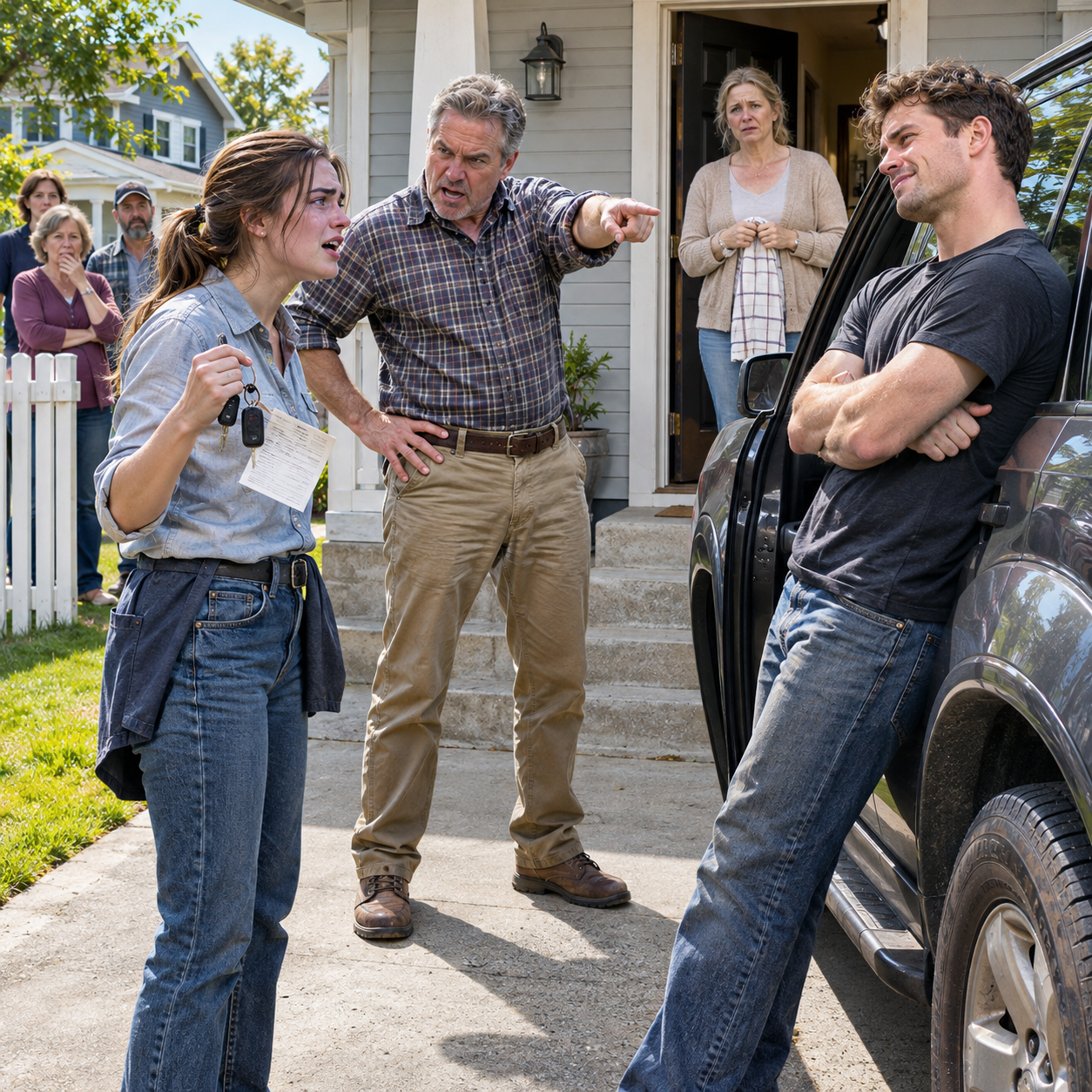
## Part 2: A stranger offered opportunity while my family offered silence.
Brady’s Auto stood in a gravel lot on the outskirts of Bozeman, its faded sign hanging above two busy service bays. Walt Brady, the owner, was a broad-shouldered man in his late fifties with silver hair and grease beneath his fingernails. When he noticed the suitcases piled inside my Explorer, his eyebrows rose.
“Everything you own?” he asked.
“Pretty much.”
He studied me for another moment, then led me into an office with a cracked window and overflowing parts catalogs.
The position involved answering phones, scheduling repairs, ordering parts, and explaining repair estimates to impatient customers. The pay wasn’t impressive, but it was steady, and Walt offered me the job before I’d finished describing my experience. When he asked whether I could begin Monday, I surprised him by saying I could start immediately.
For three nights, my Explorer was my bedroom. I parked beneath the lights behind a grocery store, wrapped myself in a blanket, and woke whenever a delivery truck rattled across the pavement. Every morning, I washed up, changed clothes, and arrived at the shop looking more confident than I felt.
On the fourth day, I rented a room from Marlene, a retired schoolteacher who lived near downtown. For $475 a month, I got a twin bed, a dresser, and a window overlooking a maple tree. After paying the deposit and first month’s rent, I sat on the mattress and counted my remaining dollars twice.
I survived on oatmeal, homemade sandwiches, and coffee brewed in Marlene’s kitchen. Every Sunday, I visited the library and recorded my expenses in a battered notebook, including the quarters I spent doing laundry. I wasn’t building wealth; I was making certain nobody could ever threaten me with homelessness again.
Walt noticed how carefully I handled his business. One afternoon, an angry customer stormed into the office because his truck hadn’t been returned by noon. The mechanic had discovered a damaged brake line, and the customer demanded that we release the vehicle anyway.
“I’m not telling you it’s ready when it isn’t safe,” I said, holding his gaze. “Give me ten minutes, and I’ll find out exactly what we can do.”
The man eventually sat down, grumbling beneath his breath. Later, Walt placed a paper cup of coffee beside my keyboard and said, “You handled that well.” I carried those four words home like they were worth more than my paycheck.
Two months after I left Spokane, Mom finally called.
“Your father’s still upset,” she told me. “Derek’s car hasn’t been fixed, and things are difficult here. Dad thinks you’ve made your point.”
I stood beside my rented bedroom window, looking at the Explorer parked outside.
“I’m not trying to prove anything, Mom,” I replied. “I’m building a life.”
She sighed and called me independent, as though independence explained why I deserved so little support. After we hung up, I opened my notebook and wrote a new goal beneath my expenses: Save enough to never live paycheck to paycheck again.
The years moved forward through small, stubborn victories. I enrolled in bookkeeping classes at the community college, learned to negotiate with suppliers, and gradually took responsibility for Walt’s accounts. Once, I ordered the wrong alternator and spent an entire morning untangling the mistake, but Walt corrected me without humiliation.
By twenty-two, I had my own apartment. By twenty-six, I no longer checked my phone each morning hoping Dad would apologize. I still spoke to Mom occasionally, but our conversations rarely traveled beyond birthdays, weather, and Derek’s latest failed venture.
Then, when I was thirty, Walt announced he wanted to retire.
He offered to sell me Brady’s Auto.
I stared at the financial statements he’d placed on my desk. “Walt, I can’t afford this.”
“You know what the business is worth,” he replied. “Find out whether you can make the numbers work.”
For weeks, I reviewed accounts with an accountant, met with the bank, and calculated how much debt the shop could safely carry. I used most of my savings for the down payment and bought the business through a carefully structured loan. Walt stayed on as a consultant, teasing me whenever I reminded him that I was now his boss.
I kept the name Brady’s Auto because the reputation mattered more than putting my own name above the door.
By then, I’d sold the old Explorer and purchased a newer SUV. Still, I kept the original registration and purchase receipt in a folder at home. Those yellowing papers reminded me of a twenty-year-old woman who had crossed state lines with everything she owned.
My father never asked how I’d managed to become a business owner. When he called around Christmas, he usually asked whether I was still working at the repair shop. I stopped correcting him because I no longer needed his approval to make my success real.
Then, in the spring of 2024, my mother’s name appeared on my phone while I was closing the office.
“Tessa,” she said, her voice unusually strained. “Your father’s warehouse hours have been cut. He’s behind on bills.”
I leaned against the counter, listening.
“And Derek’s marriage is falling apart,” she continued. “He’s staying with us again. He needs a vehicle.”
Eleven years had passed, but my stomach tightened as though I were standing in that driveway again.
Mom hesitated before telling me Dad wanted to visit Montana and Derek might come along.
I stared through the office window at the SUV parked outside.
They weren’t coming simply because they missed me.
They were coming because my brother needed another car.
## Part 3: Eleven years later, my brother returned demanding another SUV.
I called Mom the following morning and agreed to the visit, but I made my conditions clear. I wouldn’t finance Derek’s problems, lend him my vehicle, or allow another family argument to take place in my home. She promised she understood, though her relief sounded stronger than her agreement.
A week later, I stood inside Bozeman Yellowstone International Airport, watching three familiar figures emerge through the arriving passengers. Mom hurried forward and hugged me, while Dad approached more slowly, his hair almost entirely gray and one leg noticeably stiff. Derek followed with a duffel bag and the same confident smile he’d worn eleven years earlier.
“Look at you, little sister,” he said, pulling away from a brief hug. “Business owner and everything.”
His eyes traveled beyond me to the SUV waiting at the curb.
“That’s a nice ride.”
“It does its job,” I answered.
He chuckled. “Still possessive about your cars, huh?”
I opened the driver’s door without answering.
During the drive to their hotel, Dad asked about my employees and how business was going. I told him about the mechanics, our customers, and the responsibilities of running a shop. He listened, then offered a stiff compliment.
“You’ve done pretty well for yourself.”
Eleven years earlier, I’d have done almost anything to hear those words. Now, watching Derek’s reflection in my rearview mirror, I wondered what price would be attached to them.
The next morning, my brother appeared at Brady’s Auto wearing a pressed shirt and carrying a hopeful expression. He wandered around the office, studying the schedules on the walls and the invoices stacked on my desk. Finally, he dragged a chair across the floor and sat opposite me.
“Things have been rough,” he began. “The separation, legal bills, trying to find work. Dad’s car is barely hanging on.”
I put down my pen.
“What are you asking, Derek?”
He spread his hands. “Maybe you could let me use your SUV until I get back on my feet. Or help me buy something similar.”
“No.”
His smile disappeared.
“Come on, Tessa. You own a business. You could buy another one.”
“I have one vehicle, Derek, and I’m keeping it.”
He shook his head, rising from the chair. “Unbelievable. You’re still upset about something that happened when we were kids.”
“I was twenty, Derek. And this isn’t about punishing you. It’s about you respecting my answer.”
He shoved the chair backward and left without saying goodbye.
That evening, we met at a restaurant near downtown. Mom tried discussing the weather, and Dad asked whether I planned to expand the shop. I mentioned Caleb, the electrician I’d been dating, and how he sometimes arrived at my house with groceries when I’d worked late.
For a little while, dinner almost felt normal.
Then Dad lowered his fork.
“Your brother says you refused to help him.”
The scrape of silverware suddenly sounded enormous.
“He asked for my SUV,” I said. “I told him no.”
Dad frowned. “You’re successful now. Surely you can afford to make things easier for him.”
I placed my water glass on the table.
“Having money doesn’t mean Derek gets to decide how I spend it.”
Dad’s cheeks reddened. “Family takes care of family.”
“Then why did nobody take care of me when you told me to leave?”
Mom’s hand trembled around her glass. Derek looked away, and Dad stared at me as though I’d violated some unspoken agreement by mentioning the past.
“We’re not doing this here,” he muttered.
“That’s fine,” I said. “But we’re not doing it anywhere else, either.”
The following morning, Dad arrived at my shop alone. He stood in the office doorway while I finished signing an invoice, his hands buried in his jacket pockets. When I offered him a chair, he remained standing.
“I want to talk about your brother,” he said.
“I’ve already answered him.”
Dad shifted his weight. “You know, leaving home the way you did hurt your mother terribly.”
I slowly placed my pen on the desk.
“You told me to leave because I wouldn’t give Derek my car.”
“I was angry.”
“You were clear.”
He rubbed his forehead, looking suddenly exhausted.
Then he said something that stopped me cold.
“I never thought you’d actually go.”
For several seconds, I couldn’t speak.
I’d spent eleven years wondering whether Dad had wanted me gone. Now I understood he’d expected his threat to frighten me into surrendering. He’d believed I would stay, swallow the humiliation, and eventually hand Derek my keys.
“Dad,” I whispered, “I was twenty. I had nowhere to live.”
His eyes dropped to the floor.
“I know.”
“You made me choose between my home and something I’d worked two years to buy.”
He swallowed. “I know that now.”
I waited, allowing the silence to stretch between us.
Then he added, “But I still think you could help Derek get started.”
The small hope gathering in my chest collapsed.
“Then you haven’t understood enough,” I said.
Dad left without another argument. That afternoon, Derek texted that I was impossible, and I called Caleb because I needed to hear a voice that didn’t treat my decisions like an invitation to negotiate. He listened, then reminded me that I could care about my parents without taking responsibility for my brother.
On the family’s last morning in Montana, I met them at their hotel and explained that I would drive them to the airport, but discussions about money and cars were finished. Derek rolled his eyes, Dad looked disappointed, and Mom quietly said she’d hoped the visit would bring us closer.
“So did I,” I answered.
At the airport, Mom held me longer than she had on arrival.
“I’m proud of you,” she whispered.
I hugged her back, fighting unexpected tears. Dad stood nearby, watching us, but whatever words he wanted to say remained trapped behind his closed mouth.
Derek walked toward security without looking back.
I returned to my SUV and rested both hands on the steering wheel. The first time my family had demanded my car, I’d needed to escape in the darkness. Eleven years later, I had a home, a business, and the power to refuse without going anywhere.
But as I drove away, I realized the apology I’d waited more than a decade to hear still hadn’t come.
## Part 4: My father’s confession finally exposed the truth behind his favoritism.
Three weeks after my family returned to Spokane, Mom called while I was sorting invoices at the shop. Her voice was softer than usual, and she spent several seconds asking about my day before admitting why she’d called. Dad had been unusually quiet since their trip.
“He told me he was wrong about your SUV,” she said. “And wrong to threaten you with leaving.”
I leaned back in my chair, staring through the window at one of our mechanics rolling a tire across the lot.
“He actually said that?”
“Yes. He also told Derek he needs to start solving his own problems.”
I could picture my brother’s reaction without asking.
Mom took a shaky breath.
“Tessa, there’s something I’ve needed to say for a long time. I should have defended you that night.”
My eyes settled on the photograph of Walt and his old crew hanging beside my desk.
“Yes, Mom,” I answered. “You should have.”
She didn’t make excuses. She didn’t blame Dad’s temper or Derek’s difficulties. Instead, she apologized, and for the first time, I believed she was asking for forgiveness rather than trying to restore peace without changing anything.
We spoke for another ten minutes about ordinary things: her garden, the weather, and Caleb’s plans to replace the cabinets in his kitchen. When I hung up, I realized how different a conversation felt when nobody ended it by asking me for something.
A month later, a plain envelope arrived at my house.
Dad had written my name in the same blocky handwriting I remembered from childhood. I opened it at the kitchen table while Caleb made coffee, and the familiar sight of my father’s letters brought back the image of him sitting in his recliner as I carried my belongings outside.
The letter was three pages long.
Dad admitted he’d treated my property as though Derek had a greater claim to it simply because Derek was struggling. He wrote about his fear that my brother would never become independent and how he’d spent years mistaking protection for love.
Then I reached a paragraph that made me stop breathing.
Dad confessed he’d known I was the dependable child. He’d counted on me to work, contribute to the household, and surrender things without complaint because I always had before. When he’d threatened to throw me out, he hadn’t believed I would leave.
He had wanted me frightened enough to obey.
That was the final truth I’d never been able to see clearly. Dad hadn’t chosen Derek because I mattered less to him; he’d convinced himself that my strength meant he could demand more from me and offer less in return. Instead of teaching my brother responsibility, he’d been making me responsible for both of us.
Near the end, Dad wrote that he’d confused my silence with agreement and my independence with proof that I didn’t need him.
His final sentence was simple.
I should have told you I was proud of you years ago.
I read it twice, then folded the pages carefully. Caleb placed a cup of coffee beside me and waited without asking what I intended to do. I slipped the letter into the drawer containing the original registration and purchase receipt from my Explorer.
I wasn’t ready to pretend the past had disappeared.
But I was ready to stop carrying all of it alone.
Derek never apologized. He sent one more text asking whether I could lend him money for an apartment deposit, and when I declined, he replied with a thumbs-up. I didn’t chase him, argue, or write a long explanation.
Dad and I began speaking occasionally. Our first conversations were awkward, filled with questions about the shop and observations about the weather. Eventually, he started asking about Caleb and listening when I talked about work, and neither of us pretended that a few pleasant phone calls erased eleven years.
The following summer, Mom and Dad returned to Montana without Derek.
This time, Dad called before their arrival and asked whether he could visit Brady’s Auto. On Friday afternoon, Mom appeared carrying a bakery pie while Dad slowly walked through the garage, studying the equipment and watching my mechanics work.
He shook their hands, asked questions about the repairs, and listened as one of them explained how I’d improved the ordering system. Walt happened to be visiting that afternoon, and I watched him clap my father lightly on the shoulder.
“Your daughter earned every inch of this place,” Walt said.
Dad looked across the garage toward me. For a moment, I saw the same man who’d stood on our porch in Spokane, convinced he could decide what I deserved.
But this time, he walked toward me without demanding anything.
“You’ve built something good here, Tessa,” he said.
“Thank you, Dad.”
He glanced around the busy shop, then looked directly into my eyes.
“And you earned it.”
There was no dramatic speech, no public confession, and no attempt to make me forget the past. Just those words, spoken in a garage filled with the tools, people, and responsibilities that had become my life’s work.
For the first time, I believed he understood.
That evening, Caleb and I drove home beneath the Montana mountains, stopping at a grocery store for milk and eggs. As we waited at a red light, he glanced over and noticed the tears shining in my eyes.
“You okay?” he asked.
I looked through the windshield at the ordinary road ahead.
“Yeah,” I whispered. “I think I finally am.”
I remembered the frightened twenty-year-old who’d crossed into Montana with $1,143, two suitcases, and a battered Explorer. She hadn’t known whether she’d find work, whether she’d have somewhere warm to sleep, or whether her father would ever admit he’d been wrong.
She’d only known that the car she bought belonged to her.
Eleven years later, I understood something far more important: my future had belonged to me, too.
My father had once ordered me to leave because I wouldn’t hand over my keys. Now, after everything we’d lost and slowly begun to rebuild, I could welcome him into my life without surrendering the right to lock my own doors.
And that was the difference between the daughter who left and the woman who came home to herself.
THE END.
All characters and events in this story are fictional, created for storytelling and entertainment purposes. Thank you sincerely for reading. Your feedback and support are invaluable and motivate me to continue sharing more stories with you.

