
## Part 2: The police uncovered a secret my husband desperately wanted buried.
Monday afternoon, I drove to Rosewood Estate Jewelry during my lunch break. A brass bell jingled as I entered the narrow shop, where an older woman stood behind glass cases filled with antique necklaces and rings. I showed her my mother’s photographs, the appraisal, and the image from the store’s website. She studied everything carefully before explaining that she couldn’t disclose another customer’s transaction or release disputed property without proper legal authority.
Outside, I sat in my car with Richard’s number glowing on my screen. Part of me wanted to call him and demand an explanation, but another part feared he would talk me into doubting what I had seen. Instead, I drove directly to the police station. I handed an officer the photographs, financial statements, saved messages, and jewelry listing, explaining that I had loaned the ring to Melissa but never authorized anyone to sell it.
Richard erupted when he learned about the report. “You could destroy Melissa’s business over this!” he shouted, gripping the kitchen counter. I asked why an honest person would fear an investigation into a supposedly misplaced ring. His expression hardened, and he warned that I had no idea what I was setting in motion.
I spent that night at Denise’s house, where she quietly prepared the guest bedroom and made me breakfast the following morning. Later that week, I consulted a family law attorney about our finances and how to preserve the documents I could legally access. Then Detective James Porter called with information that made my knees weaken. Investigators had identified Mom’s ring by its engraving, and Melissa had sold it with Richard standing beside her.
That evening, I confronted my husband in our kitchen. He initially claimed he had accompanied Melissa merely to have jewelry appraised, then insisted she’d believed I approved of selling the ring. I asked why he had supported her story about losing it if he genuinely thought I had agreed to the sale. Richard stared at the refrigerator, avoiding my eyes, and muttered that I didn’t understand the entire situation.
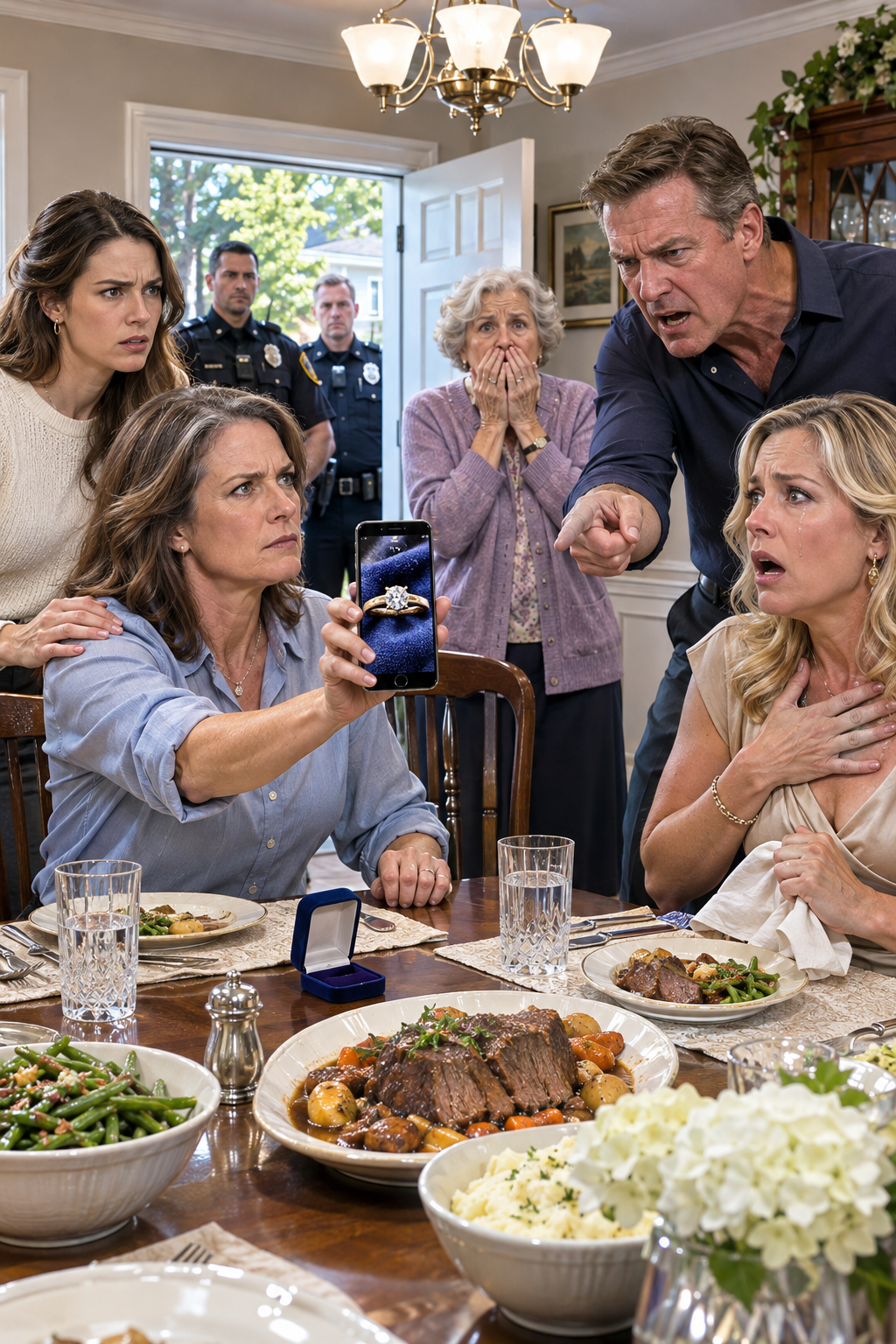
Several days later, Dorothy summoned everyone to another Sunday dinner, declaring that the dispute had lasted long enough. Hannah accompanied me, and I brought copies of the evidence after discussing the gathering with my attorney. Dorothy served pot roast, mashed potatoes, and green beans while Melissa sat looking wounded and Richard pretended we were having an ordinary evening. Then Dorothy laid down her fork and announced that I needed to forgive Melissa for an unfortunate accident.
I turned toward my sister-in-law and asked directly whether she had sold my mother’s ring. Melissa glanced at Richard, and the color drained from her face. Before she could answer, Richard stood and ordered me to apologize for making his sister miserable. When I refused, he dismissed the heirloom as an ordinary piece of jewelry and announced that he would buy me a fake replacement.
I unlocked my phone and placed the Rosewood photograph in front of Melissa. Her crying stopped immediately as I pointed to the six-prong setting and the familiar scratch, then explained that investigators had confirmed the engraving. Dorothy demanded to know whether the accusation was true, but Melissa only lowered her eyes. Richard leaned toward me, furious that I had involved the authorities, and I answered, “Oops, I called the police.”
At that moment, the doorbell rang.
Dorothy opened the door to find Detective Porter and another officer waiting outside. They explained that they were trying to arrange interviews with Richard and Melissa concerning the jewelry transaction. Richard demanded to know whether he was under arrest, and Porter calmly explained that he wasn’t, but the investigation was continuing. My husband declined to answer questions without an attorney, while Melissa stood in the hallway trembling.
After the officers left, Dorothy accused me of humiliating the family. Hannah stood beside my chair and reminded her grandmother that I hadn’t sold anybody’s property. Richard ordered our daughter to stay out of the argument, but Melissa suddenly pulled away from him. “You promised you’d take care of everything,” she cried, before adding that she wouldn’t accept responsibility for an idea that hadn’t been hers.
The room went silent as Richard ordered his sister to stop talking. I looked at my husband and realized his involvement might extend far beyond helping Melissa complete a dishonest transaction. Later, when I confronted him at home, he admitted that Melissa had needed something valuable to sell because her studio was drowning in expenses. He insisted he’d only been protecting his family, but when I asked whether he’d suggested borrowing my ring, he couldn’t look me in the eye.
For the first time, I wondered whether the man I’d trusted for twenty-eight years had planned the entire deception.
## Part 3: Hidden messages revealed why my husband believed I would forgive everything.
Richard hired an attorney, and within days, relatives began repeating his newest explanation: Melissa had intended to repurchase the ring, and I had ruined that possibility by involving the police. Yet nobody could tell me where the money for repurchasing it would have come from. Our own attorney meetings established that recovering the ring would require resolving the ownership dispute and evidence issues properly. Meanwhile, Richard continued living in our house as though my refusal to forget the betrayal was the only problem.
One Thursday evening, I found a small white jewelry box waiting on the kitchen counter. Richard watched hopefully as I opened it and discovered an imitation diamond with an oversized stone and a thin, shiny band. “Pretty close, isn’t it?” he asked, smiling as though he had repaired our marriage. I closed the box and asked where my mother’s actual ring was, and his smile disappeared.
Over the following weeks, Melissa began cooperating with investigators through her attorney, especially after Richard tried to place the entire responsibility on her. As the legal proceedings advanced, their messages became available through the appropriate disclosures, and the contents exposed a betrayal more deliberate than I had imagined. Richard had secretly transferred $3,200 from our joint savings to rescue Melissa’s business, but her expenses continued mounting. When she suggested selling some jewelry for additional cash, he rejected the idea of touching anything belonging to Dorothy.
Instead, Richard suggested my mother’s diamond.
He knew I wore it only on special occasions and understood its sentimental importance, but he also knew Melissa could borrow it by inventing an excuse about the wedding reception. One message revealed that Melissa had worried about what would happen when I discovered the ring missing. Richard’s response was chilling: “She’ll forgive me. She always does.”
When Melissa asked what story they should tell, he instructed her to claim the ring had been lost and promised to handle my reaction. I remembered him speaking those exact words into the telephone while I stood beside him clutching a dish towel. He had never been comforting his sister after an accident. He had been assuring her that twenty-eight years of conditioning would keep me quiet.
The financial evidence completed the picture. Rosewood Estate Jewelry had paid Melissa $4,600, of which $3,200 went back into our savings account to conceal Richard’s unauthorized transfers. The remaining $1,400 covered additional overdue expenses at her studio. They had reserved nothing to repurchase my mother’s ring, because the entire scheme depended on my accepting the supposed loss.
During a meeting with our attorneys, Richard insisted he’d been trying to save his sister’s livelihood. I asked why he hadn’t considered selling jewelry belonging to Dorothy instead. He looked genuinely offended and explained that his mother would have been devastated, then admitted she would never have forgiven him. I held his gaze and said, “But you were certain I would.”
He didn’t answer, and the silence was more revealing than anything he’d said that afternoon. For years, I had mistaken his confidence in my forgiveness for proof that he trusted our marriage. Now I understood he had been calculating how much pain I would tolerate before drawing a boundary. Even his kindness had sometimes been a way to end difficult conversations without changing anything.
I began packing that weekend, with Hannah helping me fold clothes into suitcases. She admitted she still loved her father and feared I would expect her to choose between us. I held her hands and promised that whatever happened to my marriage would never change her right to love both parents. When she asked whether I still loved Richard, I told her I loved parts of the man he had been, but I couldn’t continue living with the man he had become.
My new apartment was small, with a bedroom facing a parking lot and a kitchen floor that tilted toward the refrigerator. On my first evening, I opened the silverware drawer and discovered that I’d brought exactly one fork. I laughed until tears streamed down my cheeks, then cried for real when the unfamiliar silence reminded me that twenty-eight years of shared routines were gone. Before bedtime, Richard texted that he’d ordered another ring for me, and I replied that he still didn’t understand what I wanted.
By January, I owned six forks, including five with cheerful blue handles I’d chosen myself. I ate sandwiches for dinner, watched old movies without explaining my plans, and sometimes stood alone in my kitchen wishing change didn’t hurt so much. I missed the familiar sound of Richard searching for keys he’d left in his coat pocket. What I didn’t miss was being told that every injury he caused was somehow my responsibility to heal.
And for the first time in my adult life, loneliness felt less frightening than returning to a marriage without trust.
## Part 4: My mother’s ring finally returned, revealing the truth about forgiveness.
Through the winter, the investigation continued, and Melissa eventually acknowledged through the legal process that she had sold jewelry she had no authority to sell. Her case concluded with an agreed court disposition requiring her to accept responsibility and make restitution under conditions established by the court. I attended the proceeding where she formally acknowledged her actions. Seeing her answer the judge’s questions without tears, excuses, or Richard speaking for her gave me a quiet sense of closure.
Melissa eventually downsized her beauty studio, but financial reality proved harder to escape than her brother’s promises had suggested. One afternoon, she called and told me she’d never expected the situation to become so serious. I reminded her that she’d promised to bring my ring home the next morning. After a long silence, she apologized, and although I accepted that she regretted what happened, I wasn’t ready to restore our relationship.
Richard and I continued negotiating our separation through attorneys, including how his transfers to Melissa would be addressed in dividing our marital finances. We reached a written financial arrangement, and I filed for divorce. He called when the papers arrived, sounding genuinely stunned that twenty-eight years of marriage hadn’t guaranteed another opportunity to forgive him. I looked around my little apartment, at my mother’s photograph beside the lamp, and told him that our long history was precisely why his deception had hurt so deeply.
In March, Richard asked to meet at a quiet coffee shop near downtown Westerville. He looked tired and admitted he’d started counseling, where he was beginning to recognize how often he treated Melissa’s financial problems as emergencies and my concerns as inconveniences. When I asked whether he’d ever planned to confess the truth about the ring, he lowered his eyes and said no. It was the first completely honest answer he’d given me in months.
Richard asked whether we could rebuild our marriage, and I believed him when he said he still loved me. But love and trust were no longer the same thing in my mind, and I told him I couldn’t return. He confessed that he’d never imagined I would actually leave him. Before we parted, he asked permission to hug me, and I allowed it, recognizing the familiar comfort of his arms without mistaking it for a reason to surrender my freedom.
Then, in April, Dorothy sent me a four-page handwritten letter containing one final revelation. Melissa had confessed the sale to her before that disastrous Sunday dinner, meaning Dorothy had knowingly demanded that I apologize for a lie. She admitted she’d been terrified that her children would face consequences and had convinced herself that protecting them was more important than correcting them. Her letter ended with an acknowledgment that shielding her children from their mistakes had only encouraged them to keep making them.
I read those pages twice before writing back to thank her for apologizing and explain that I still needed distance. Hannah continued visiting her grandmother occasionally but refused to listen when Dorothy blamed me for the family’s broken Sunday traditions. I was proud that my daughter could love someone without agreeing to be manipulated by them. It was a lesson I had learned much later than I wished.
By early summer, the remaining legal and evidence issues surrounding Mom’s ring were finally resolved, and arrangements were made for its return. I visited the jewelry store to have it inspected, watching as the jeweler examined the setting and confirmed that the diamond remained secure. She noticed the small scratch beside the prongs and offered to polish it away. I shook my head, remembering Mom laughing after catching her ring on the garden gate and saying that every good marriage collected a few scratches.
When the jeweler handed it back, I slipped the band onto my finger, and its familiar weight brought tears to my eyes. I sat in my car afterward, studying the same diamond that had accompanied my mother through decades of ordinary days and difficult seasons. Richard and Melissa had seen its resale value, but Mom had seen a promise worth preserving. That difference explained almost everything I’d lost and everything I was learning to protect.
A few days later, another package arrived from Richard. Inside was a more expensive imitation ring and a card acknowledging that he couldn’t replace what I’d lost, while expressing hope that I might eventually forgive him. I appreciated the apology, but his choice of gift showed that he still believed the problem could be solved with a brighter stone. I returned the box with a short note explaining that replacing a fake ring was simple, while repairing a marriage built on broken trust was not.
I kept my wedding band, leaving its future entirely up to me.
By July, Hannah and I had established a new Sunday tradition. Every other weekend, she visited my apartment, where we cooked together and filled the small kitchen with conversation, laughter, and the smell of dinner. One afternoon, we prepared roast chicken, mashed potatoes, green beans, and carrots while Hannah teased me about owning enough forks to host a banquet. I told her a woman deserved at least one harmless extravagance after starting her life over at fifty-six.
Halfway through dinner, Hannah noticed Grandma’s ring resting against my hand. She smiled and said it looked beautiful, then quietly asked whether I missed her father. I admitted that sometimes I did, and when she asked whether I missed being married, I told her I missed the marriage I’d believed we had, not the one the truth had exposed. She reached across the table and squeezed my hand before changing the subject to a little boy at her school who believed the class hamster deserved a birthday party.
We finished our meal laughing about hamster-sized birthday cakes, then washed the dishes together while the evening sunlight stretched across the kitchen floor. Nobody demanded an apology, nobody needed rescuing, and nobody expected me to sacrifice something precious to preserve another person’s comfort. It was an ordinary Sunday dinner, the kind my mother had cherished throughout her life. And standing beside my daughter, I finally understood that ordinary peace was extraordinary when it didn’t require silence.
Richard had believed my mother’s ring was replaceable because he saw only a diamond and a gold band. I saw the woman who had worn it while raising a family, caring for my father, and teaching me that love should never require surrendering my dignity. Calling the police hadn’t destroyed a happy marriage; it had uncovered a betrayal that had been hiding beneath years of forced forgiveness. I recovered the ring, lost the marriage I thought I had, and discovered that the most valuable thing returned to me was the right to decide what I would never give away again.
THE END.
All characters and events in this story are fictional, created for storytelling and entertainment purposes. Thank you sincerely for reading. Your feedback and support are invaluable and motivate me to continue sharing more stories with you.

